Research data for the Arts and
Humanities – What? Why? How?
Rebecca Grant, Digital Archivist, Digital Repository of Ireland
Doctoral student, Archivistics Department, UCD
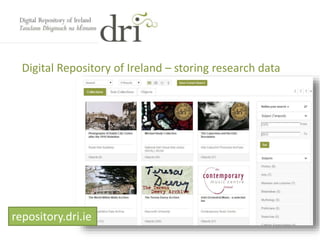
Digital Repository of Ireland – storing research data
repository.dri.ie
Research data publication and Open Access
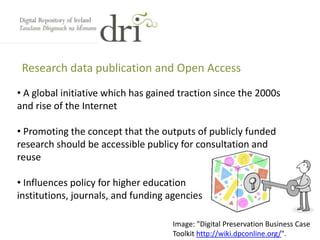
Image: "Digital Preservation Business Case
Toolkit http://wiki.dpconline.org/".
• A global initiative which has gained traction since the 2000s
and rise of the Internet
• Promoting the concept that the outputs of publicly funded
research should be accessible publicy for consultation and
reuse
• Influences policy for higher education
institutions, journals, and funding agencies
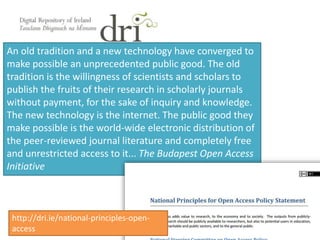
An old tradition and a new technology have converged to
make possible an unprecedented public good. The old
tradition is the willingness of scientists and scholars to
publish the fruits of their research in scholarly journals
without payment, for the sake of inquiry and knowledge.
The new technology is the internet. The public good they
make possible is the world-wide electronic distribution of
the peer-reviewed journal literature and completely free
and unrestricted access to it... The Budapest Open Access
Initiative
http://dri.ie/national-principles-open-
access
Drivers in research data publication
• Your home institution – UCD, TCD, DIT, NUI Galway all provide some
guidance for researchers
• Your funding agency – Irish Research Council, the Higher Education
Authority, Science Foundation Ireland, Teagasc, the Health Research
Board support the National Principles of Open Access; Horizon 2020 at
an EU level
• Your journal publisher - Journals published by Taylor and Francis, such
as World Archaeology and The Journal of Visual Art Practice suggest the
deposit of accompanying research data with submitted publications.
Research Data in the Sciences
“A record, if it is to be useful to science, must be continually
extended, it must be stored, and above all it must be
consulted”. Vannever Bush, Atlantic Monthly, 1945.
[f]aced with massive data, this approach to science —
hypothesize, model, test — is becoming obsolete. Chris
Anderson, Wired, 2008.
Volumes of reusable scientific data and analytical
methods allow data to speak “free of theory”. Rob
Kitchin, The Data Revolution, 2014.
Arts and Humanities research data
“Compared with some other disciplines researchers in the arts and
humanities do not publish a great deal of research data.” Data Dimensions
“The first step... is achieving consensus over what research data comprises,
and the forms it takes. In the sciences this first step is relatively
straightforward and reasonably well described; however this is not always
the case in the creative disciplines” Pinning it Down
“Research endeavour in the arts relies heavily on
sketchbooks, logbooks, journals, and workbooks […] Research in the arts is highly
complex and varied, often comprising a wide variety of outputs and formats…”
KAPTUR project
“Humanities research often aims to explore questions rather than
definitively solve them (process not product)” – Julianne Nyhan
What does Arts & Humanities research data include?
Arts and Humanities Data Service Collection Policy: “archaeological excavation
archives; historical, reference, and other databases; electronic texts and
musical scores; linguistic corpora; geospatial data; images; digital sound and
video; mixed media installations; VR and CAD”
“sketchbooks, logbooks, journals, and workbooks. Alongside this data, a wide
range of related project documentation and protocols are also created” KAPTUR
project
“Monographs, editions or articles; electronic data, including sound or images;
performances, films or broadcasts; or exhibitions” Arts and Humanities Research Council
Documents; spreadsheets; Online questionnaires, transcripts, surveys or codebooks; Digital audiotapes,
videotapes and other digital recording media; Scanned photographs or films; Transcribed test responses;
Database contents (video, audio, text, images); Digital models, algorithms, scripts; contents of an application
(input, output, log files for analysis software, simulation software, schemas); Documented methodologies and
workflows; Records of standard operating procedures and protocols” University College Dublin
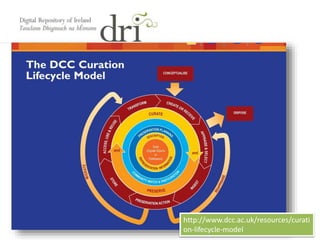
http://www.dcc.ac.uk/resources/curati
on-lifecycle-model
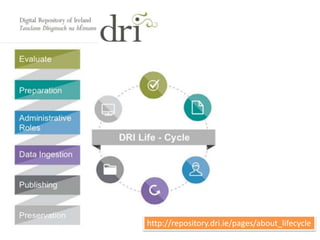
http://repository.dri.ie/pages/about_lifecycle
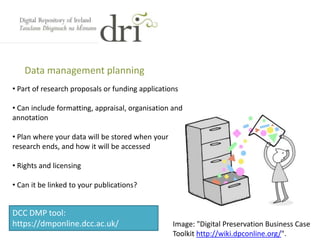
Image: "Digital Preservation Business Case
Toolkit http://wiki.dpconline.org/".
Data management planning
• Part of research proposals or funding applications
• Can include formatting, appraisal, organisation and
annotation
• Plan where your data will be stored when your
research ends, and how it will be accessed
• Rights and licensing
• Can it be linked to your publications?
DCC DMP tool:
https://dmponline.dcc.ac.uk/
Preparing your data
• Which parts of your research should be published?
• Do you own copyright to your research data? Eg. source images, annotated
texts, archival documents, academic publications?
• What context should you provide so that your research will be
understood?
• How will you describe your data – which metadata schema will you use?
Does your chosen repository support your metadata schema?
• Are your file formats appropriate for long term preservation? Are they
proprietary or open formats?
• How will you licence your data for others to reuse?
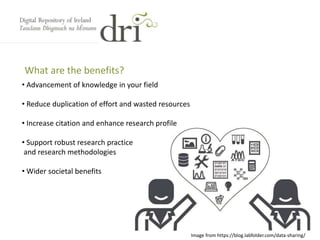
What are the benefits?
• Advancement of knowledge in your field
• Reduce duplication of effort and wasted resources
• Increase citation and enhance research profile
• Support robust research practice
and research methodologies
• Wider societal benefits
Image from https://blog.labfolder.com/data-sharing/
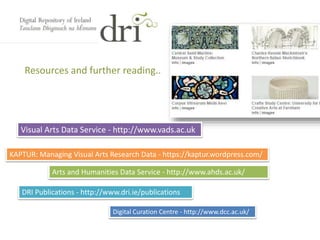
Resources and further reading..
Visual Arts Data Service - http://www.vads.ac.uk
KAPTUR: Managing Visual Arts Research Data - https://kaptur.wordpress.com/
Arts and Humanities Data Service - http://www.ahds.ac.uk/
DRI Publications - http://www.dri.ie/publications
Digital Curation Centre - http://www.dcc.ac.uk/
Bibliography
Budapest Open Access Initiative, http://www.budapestopenaccessinitiative.org/, accessed 31
December 2014.
Bush, Vannevar. ‘As We May Think’. The Atlantic Monthly, July 1945.
Garrett, Leight and Marie-Therese Gramstadt. ‘KAPTUR: exploring the nature of visual arts
research data and its effective management’. EVA LONDON 2012 Electronic Workshops in
Computing (2012), pp 88-96.
Guy, Marieke, Martin Donnelly and Laura Molloy. ‘Pinning it Down: Towards a Practical
Definition of ‘Research Data’ for Creative Arts Institutions’. International Journal of Digital
Curation 8, no. 2 (2013), pp 99-110.
Kitchin, Rob. The Data Revolution. London, 2014.
Key Perspectives. Data dimensions: disciplinary differences in research data sharing, reuse
and long term viability. SCARP Synthesis Study. Glasgow, 2010.
Wired Magazine: The End of Theory: The Data Deluge Makes the Scientific Method Obsolete,
http://archive.wired.com/science/discoveries/magazine/16-07/pb_theory, accessed 31
December 2014.
@beck_grant
r.grant@ria.ie
beck.grant@gmail.com
www.dri.ie
The content of this presentation is licensed as CC-BY unless otherwise stated. Please attribute
to Rebecca Grant, Digital Archivist, Digital Repository of Ireland, 2015.

Rebecca Grant DAH Research Presentation

  • 1.
    Research data forthe Arts and Humanities – What? Why? How? Rebecca Grant, Digital Archivist, Digital Repository of Ireland Doctoral student, Archivistics Department, UCD
  • 2.
    Digital Repository ofIreland – storing research data repository.dri.ie
  • 3.
    Research data publicationand Open Access Image: "Digital Preservation Business Case Toolkit http://wiki.dpconline.org/". • A global initiative which has gained traction since the 2000s and rise of the Internet • Promoting the concept that the outputs of publicly funded research should be accessible publicy for consultation and reuse • Influences policy for higher education institutions, journals, and funding agencies
  • 4.
    An old traditionand a new technology have converged to make possible an unprecedented public good. The old tradition is the willingness of scientists and scholars to publish the fruits of their research in scholarly journals without payment, for the sake of inquiry and knowledge. The new technology is the internet. The public good they make possible is the world-wide electronic distribution of the peer-reviewed journal literature and completely free and unrestricted access to it... The Budapest Open Access Initiative http://dri.ie/national-principles-open- access
  • 5.
    Drivers in researchdata publication • Your home institution – UCD, TCD, DIT, NUI Galway all provide some guidance for researchers • Your funding agency – Irish Research Council, the Higher Education Authority, Science Foundation Ireland, Teagasc, the Health Research Board support the National Principles of Open Access; Horizon 2020 at an EU level • Your journal publisher - Journals published by Taylor and Francis, such as World Archaeology and The Journal of Visual Art Practice suggest the deposit of accompanying research data with submitted publications.
  • 6.
    Research Data inthe Sciences “A record, if it is to be useful to science, must be continually extended, it must be stored, and above all it must be consulted”. Vannever Bush, Atlantic Monthly, 1945. [f]aced with massive data, this approach to science — hypothesize, model, test — is becoming obsolete. Chris Anderson, Wired, 2008. Volumes of reusable scientific data and analytical methods allow data to speak “free of theory”. Rob Kitchin, The Data Revolution, 2014.
  • 7.
    Arts and Humanitiesresearch data “Compared with some other disciplines researchers in the arts and humanities do not publish a great deal of research data.” Data Dimensions “The first step... is achieving consensus over what research data comprises, and the forms it takes. In the sciences this first step is relatively straightforward and reasonably well described; however this is not always the case in the creative disciplines” Pinning it Down “Research endeavour in the arts relies heavily on sketchbooks, logbooks, journals, and workbooks […] Research in the arts is highly complex and varied, often comprising a wide variety of outputs and formats…” KAPTUR project “Humanities research often aims to explore questions rather than definitively solve them (process not product)” – Julianne Nyhan
  • 8.
    What does Arts& Humanities research data include? Arts and Humanities Data Service Collection Policy: “archaeological excavation archives; historical, reference, and other databases; electronic texts and musical scores; linguistic corpora; geospatial data; images; digital sound and video; mixed media installations; VR and CAD” “sketchbooks, logbooks, journals, and workbooks. Alongside this data, a wide range of related project documentation and protocols are also created” KAPTUR project “Monographs, editions or articles; electronic data, including sound or images; performances, films or broadcasts; or exhibitions” Arts and Humanities Research Council Documents; spreadsheets; Online questionnaires, transcripts, surveys or codebooks; Digital audiotapes, videotapes and other digital recording media; Scanned photographs or films; Transcribed test responses; Database contents (video, audio, text, images); Digital models, algorithms, scripts; contents of an application (input, output, log files for analysis software, simulation software, schemas); Documented methodologies and workflows; Records of standard operating procedures and protocols” University College Dublin
  • 9.
  • 10.
  • 11.
    Image: "Digital PreservationBusiness Case Toolkit http://wiki.dpconline.org/". Data management planning • Part of research proposals or funding applications • Can include formatting, appraisal, organisation and annotation • Plan where your data will be stored when your research ends, and how it will be accessed • Rights and licensing • Can it be linked to your publications? DCC DMP tool: https://dmponline.dcc.ac.uk/
  • 12.
    Preparing your data •Which parts of your research should be published? • Do you own copyright to your research data? Eg. source images, annotated texts, archival documents, academic publications? • What context should you provide so that your research will be understood? • How will you describe your data – which metadata schema will you use? Does your chosen repository support your metadata schema? • Are your file formats appropriate for long term preservation? Are they proprietary or open formats? • How will you licence your data for others to reuse?
  • 13.
    What are thebenefits? • Advancement of knowledge in your field • Reduce duplication of effort and wasted resources • Increase citation and enhance research profile • Support robust research practice and research methodologies • Wider societal benefits Image from https://blog.labfolder.com/data-sharing/
  • 14.
    Resources and furtherreading.. Visual Arts Data Service - http://www.vads.ac.uk KAPTUR: Managing Visual Arts Research Data - https://kaptur.wordpress.com/ Arts and Humanities Data Service - http://www.ahds.ac.uk/ DRI Publications - http://www.dri.ie/publications Digital Curation Centre - http://www.dcc.ac.uk/
  • 15.
    Bibliography Budapest Open AccessInitiative, http://www.budapestopenaccessinitiative.org/, accessed 31 December 2014. Bush, Vannevar. ‘As We May Think’. The Atlantic Monthly, July 1945. Garrett, Leight and Marie-Therese Gramstadt. ‘KAPTUR: exploring the nature of visual arts research data and its effective management’. EVA LONDON 2012 Electronic Workshops in Computing (2012), pp 88-96. Guy, Marieke, Martin Donnelly and Laura Molloy. ‘Pinning it Down: Towards a Practical Definition of ‘Research Data’ for Creative Arts Institutions’. International Journal of Digital Curation 8, no. 2 (2013), pp 99-110. Kitchin, Rob. The Data Revolution. London, 2014. Key Perspectives. Data dimensions: disciplinary differences in research data sharing, reuse and long term viability. SCARP Synthesis Study. Glasgow, 2010. Wired Magazine: The End of Theory: The Data Deluge Makes the Scientific Method Obsolete, http://archive.wired.com/science/discoveries/magazine/16-07/pb_theory, accessed 31 December 2014.
  • 16.
    @beck_grant r.grant@ria.ie beck.grant@gmail.com www.dri.ie The content ofthis presentation is licensed as CC-BY unless otherwise stated. Please attribute to Rebecca Grant, Digital Archivist, Digital Repository of Ireland, 2015.