The Landscape Design
Process
Just as you would not build a
house without blueprints, you
should not put together a
landscape without a design,
no matter how small.
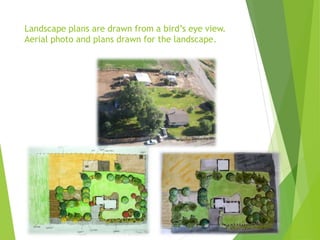
Landscape plans are drawn from a bird’s eye view.
Aerial photo and plans drawn for the landscape.
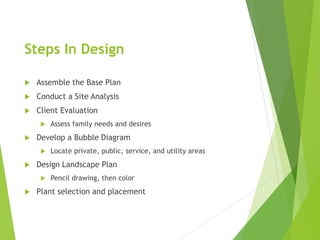
Steps In Design
 Assemble the Base Plan
 Conduct a Site Analysis
 Client Evaluation
 Assess family needs and desires
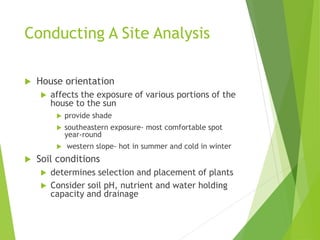
 Develop a Bubble Diagram
 Locate private, public, service, and utility areas
 Design Landscape Plan
 Pencil drawing, then color
 Plant selection and placement
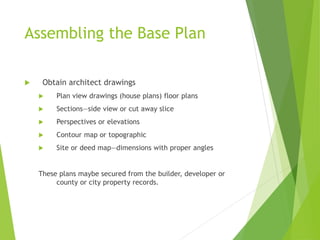
Assembling the Base Plan
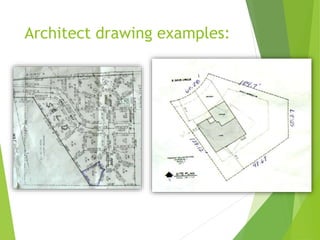
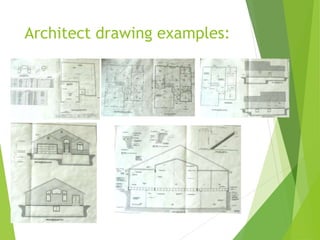
 Obtain architect drawings
 Plan view drawings (house plans) floor plans
 Sections—side view or cut away slice
 Perspectives or elevations
 Contour map or topographic
 Site or deed map—dimensions with proper angles
These plans maybe secured from the builder, developer or
county or city property records.
Architect drawing examples:
Assembling the Base Plan
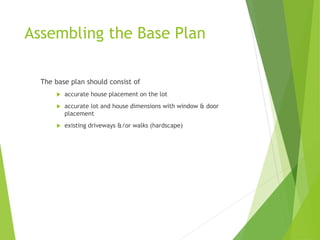
The base plan should consist of
 accurate house placement on the lot
 accurate lot and house dimensions with window & door
placement
 existing driveways &/or walks (hardscape)
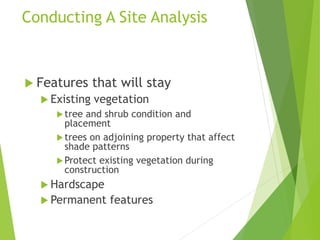
Conducting A Site Analysis
 Features that will stay
 Existing vegetation
tree and shrub condition and
placement
trees on adjoining property that affect
shade patterns
Protect existing vegetation during
construction
 Hardscape
 Permanent features
Conducting A Site Analysis
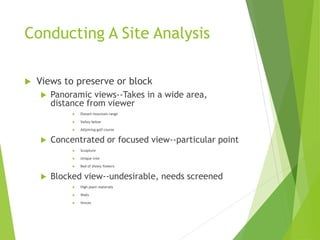
 Views to preserve or block
 Panoramic views--Takes in a wide area,
distance from viewer
 Distant mountain range
 Valley below
 Adjoining golf course
 Concentrated or focused view--particular point
 Sculpture
 Unique tree
 Bed of showy flowers
 Blocked view--undesirable, needs screened
 High plant materials
 Walls
 fences
Conducting A Site Analysis
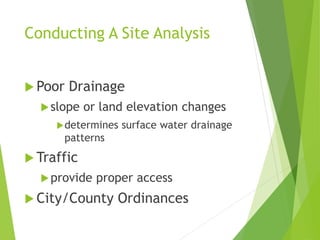
 Poor Drainage
slope or land elevation changes
determines surface water drainage
patterns
 Traffic
provide proper access
 City/County Ordinances
Conducting A Site Analysis
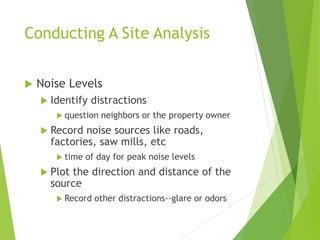
 Noise Levels
 Identify distractions
 question neighbors or the property owner
 Record noise sources like roads,
factories, saw mills, etc
 time of day for peak noise levels
 Plot the direction and distance of the
source
 Record other distractions--glare or odors
Conducting A Site Analysis
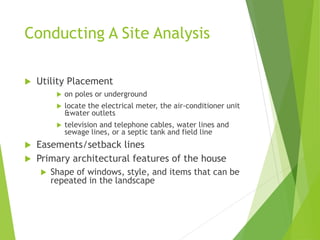
 Utility Placement
 on poles or underground
 locate the electrical meter, the air-conditioner unit
&water outlets
 television and telephone cables, water lines and
sewage lines, or a septic tank and field line
 Easements/setback lines
 Primary architectural features of the house
 Shape of windows, style, and items that can be
repeated in the landscape
Conducting A Site Analysis
 House orientation
 affects the exposure of various portions of the
house to the sun
 provide shade
 southeastern exposure- most comfortable spot
year-round
 western slope- hot in summer and cold in winter
 Soil conditions
 determines selection and placement of plants
 Consider soil pH, nutrient and water holding
capacity and drainage
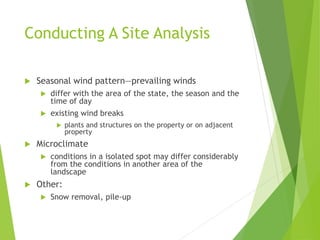
Conducting A Site Analysis
 Seasonal wind pattern—prevailing winds
 differ with the area of the state, the season and the
time of day
 existing wind breaks
 plants and structures on the property or on adjacent
property
 Microclimate
 conditions in a isolated spot may differ considerably
from the conditions in another area of the
landscape
 Other:
 Snow removal, pile-up
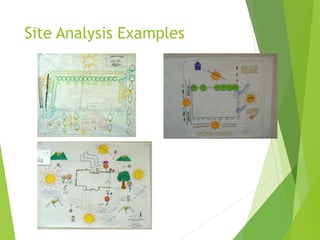
Site Analysis Examples
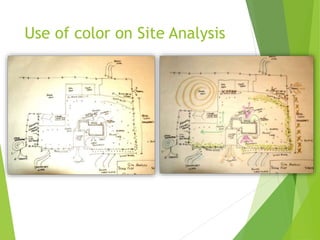
Use of color on Site Analysis
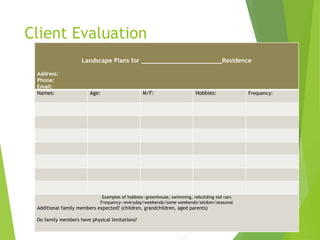
Landscape Plans for ______________________Residence
Address:
Phone:
Email:
Names: Age: M/F: Hobbies: Frequency:
Examples of hobbies—greenhouse, swimming, rebuilding old cars
Frequency--everyday/weekends/some weekends/seldom/seasonal
Additional family members expected? (children, grandchildren, aged parents)
Do family members have physical limitations?
Client Evaluation
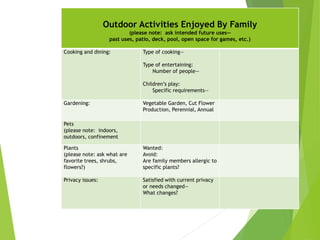
Outdoor Activities Enjoyed By Family
(please note: ask intended future uses—
past uses, patio, deck, pool, open space for games, etc.)
Cooking and dining: Type of cooking—
Type of entertaining:
Number of people—
Children’s play:
Specific requirements--
Gardening: Vegetable Garden, Cut Flower
Production, Perennial, Annual
Pets
(please note: indoors,
outdoors, confinement
Plants
(please note: ask what are
favorite trees, shrubs,
flowers?)
Wanted:
Avoid:
Are family members allergic to
specific plants?
Privacy issues: Satisfied with current privacy
or needs changed—
What changes?
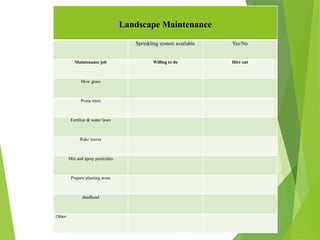
Landscape Maintenance
Sprinkling system available Yes/No
Maintenance job Willing to do Hire out
Mow grass
Prune trees
Fertilize & water lawn
Rake leaves
Mix and spray pesticides
Prepare planting areas
deadhead
Other:
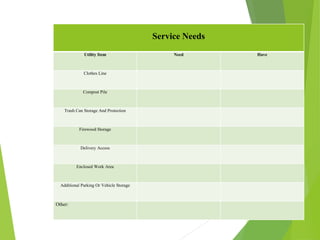
Service Needs
Utility Item Need Have
Clothes Line
Compost Pile
Trash Can Storage And Protection
Firewood Storage
Delivery Access
Enclosed Work Area
Additional Parking Or Vehicle Storage
Other:
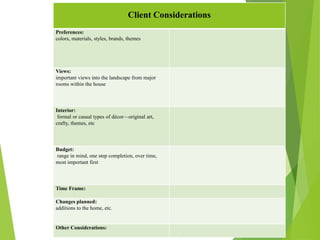
Client Considerations
Preferences:
colors, materials, styles, brands, themes
Views:
important views into the landscape from major
rooms within the house
Interior:
formal or casual types of décor—original art,
crafty, themes, etc
Budget:
range in mind, one step completion, over time,
most important first
Time Frame:
Changes planned:
additions to the home, etc.
Other Considerations:
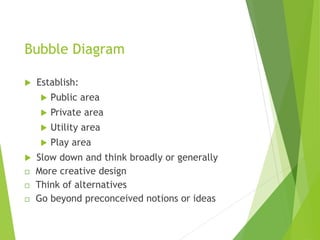
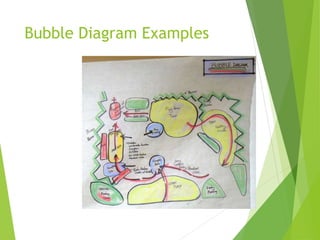
Bubble Diagram
 Establish:
 Public area
 Private area
 Utility area
 Play area
 Slow down and think broadly or generally
 More creative design
 Think of alternatives
 Go beyond preconceived notions or ideas
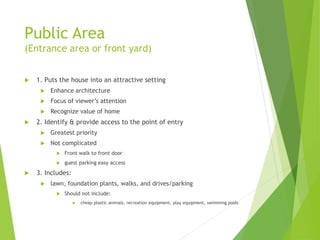
Public Area
(Entrance area or front yard)
 1. Puts the house into an attractive setting
 Enhance architecture
 Focus of viewer’s attention
 Recognize value of home
 2. Identify & provide access to the point of entry
 Greatest priority
 Not complicated
 Front walk to front door
 guest parking easy access
 3. Includes:
 lawn, foundation plants, walks, and drives/parking
 Should not include:
 cheap plastic animals, recreation equipment, play equipment, swimming pools
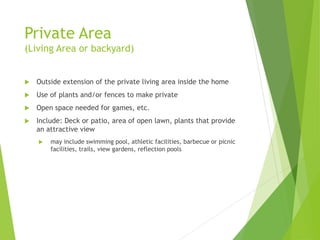
Private Area
(Living Area or backyard)
 Outside extension of the private living area inside the home
 Use of plants and/or fences to make private
 Open space needed for games, etc.
 Include: Deck or patio, area of open lawn, plants that provide
an attractive view
 may include swimming pool, athletic facilities, barbecue or picnic
facilities, trails, view gardens, reflection pools
Utility Area (service/work
area)
 Smallest space possible and still functional
 Screen from private area
 Locate on driveway side of yard for access
 May have two or more locations
 Includes:
 Clothesline
 compost bin
 fuel tanks
 garbage containers
 garden supplies storage
 Greenhouse
 pet facilities
 tool storage
 utility buildings
 vegetable gardens
Play Area
 May or may not be part of private area
 Visible from kitchen
 Easy access to rear entry door
• Grass warn under play equipment
 Use mulch, fine gravel, or sand
• Includes: swings, slides, sandbox, shade trees
Bubble Diagram Examples
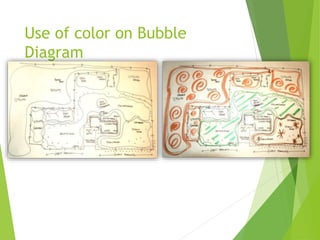
Use of color on Bubble
Diagram
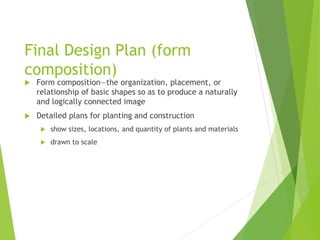
Final Design Plan (form
composition)
 Form composition—the organization, placement, or
relationship of basic shapes so as to produce a naturally
and logically connected image
 Detailed plans for planting and construction
 show sizes, locations, and quantity of plants and materials
 drawn to scale
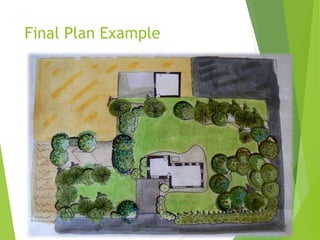
Final Plan Example
Outdoor Room
Concept
Outdoor Room Concept
 Outdoor wall
 Outdoor floor
 Outdoor ceiling
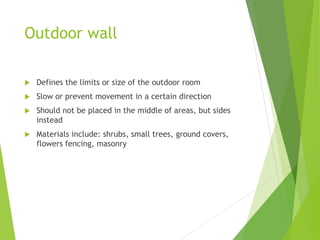
Outdoor wall
 Defines the limits or size of the outdoor room
 Slow or prevent movement in a certain direction
 Should not be placed in the middle of areas, but sides
instead
 Materials include: shrubs, small trees, ground covers,
flowers fencing, masonry
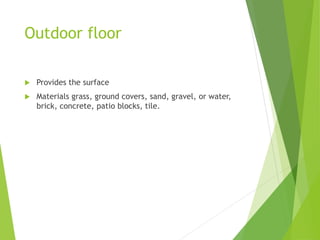
Outdoor floor
 Provides the surface
 Materials grass, ground covers, sand, gravel, or water,
brick, concrete, patio blocks, tile.
Outdoor ceiling
 Defines the upper limits of the outdoor room
 May offer physical protection—awning or aluminum
covering
 Shade in summer, drop leaves, warm house in winter
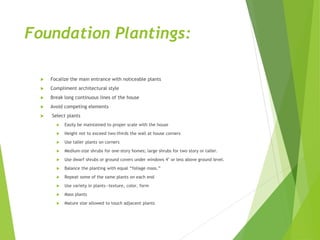
Foundation Plantings:
 Focalize the main entrance with noticeable plants
 Compliment architectural style
 Break long continuous lines of the house
 Avoid competing elements
 Select plants
 Easily be maintained to proper scale with the house
 Height not to exceed two-thirds the wall at house corners
 Use taller plants on corners
 Medium-size shrubs for one-story homes; large shrubs for two story or taller.
 Use dwarf shrubs or ground covers under windows 4’ or less above ground level.
 Balance the planting with equal “foliage mass.”
 Repeat some of the same plants on each end
 Use variety in plants—texture, color, form
 Mass plants
 Mature size allowed to touch adjacent plants
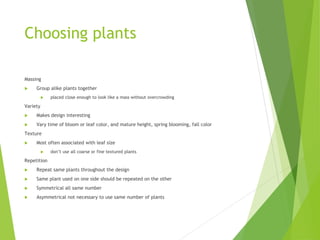
Choosing plants
Massing
 Group alike plants together
 placed close enough to look like a mass without overcrowding
Variety
 Makes design interesting
 Vary time of bloom or leaf color, and mature height, spring blooming, fall color
Texture
 Most often associated with leaf size
 don’t use all coarse or fine textured plants
Repetition
 Repeat same plants throughout the design
 Same plant used on one side should be repeated on the other
 Symmetrical all same number
 Asymmetrical not necessary to use same number of plants
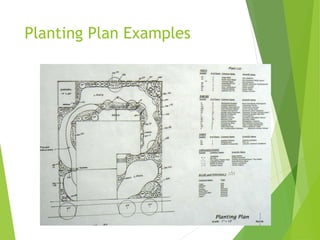
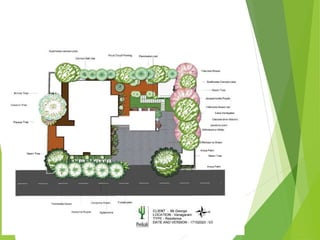
Planting Plan Examples
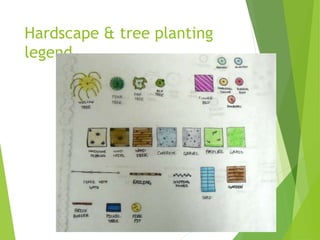
Hardscape & tree planting
legend
Low-Maintenance
Landscape Design Planning
 Even the perfectly designed and installed landscape will
fail if maintenance fails
 Many maintenance problems are designed into
landscapes
 Complex designs usually require more maintenance
Design
 Keep outlines of grass, decks, sidewalks simple
 Use curing lines in the borders--more natural
 Keep lawn out of small wedges and acute angles
 Avoid acute angles—obtuse is allowable
 If it can be mowed with a riding lawnmower without a
lot of trimming, it is a low maintenance design
 When lines and forms intersect a square, connect them
at right angles--90 degrees
 Landscape the borders of the property—especially the
rear garden
Trees and Shrubs
 Avoid improper plant selection, spacing and installation
 Own planting bed
 Less edging and trimming if not planted in grass
 Next to building Placement
 Genetically small w/ slow rate of growth
 Selection
 Little pruning
 Pest resistance
 Avoid messy fruit drop
Lawn
 Keep plant materials separate from grass
 Leave open areas of lawn
 Learn to use weed barrier fabrics, mulches,
groundcovers and chemicals to reduce weeds
 Only plant grass where it is actually needed
 Use edging materials that are impregnable
 Bender board, metal or concrete edging
 Distinct mowing edge, clean lawn boundary

LANDSCAPE DESIGN PROGRESS for residential .pptx

  • 1.
  • 2.
    Just as youwould not build a house without blueprints, you should not put together a landscape without a design, no matter how small.
  • 3.
    Landscape plans aredrawn from a bird’s eye view. Aerial photo and plans drawn for the landscape.
  • 4.
    Steps In Design Assemble the Base Plan  Conduct a Site Analysis  Client Evaluation  Assess family needs and desires  Develop a Bubble Diagram  Locate private, public, service, and utility areas  Design Landscape Plan  Pencil drawing, then color  Plant selection and placement
  • 5.
    Assembling the BasePlan  Obtain architect drawings  Plan view drawings (house plans) floor plans  Sections—side view or cut away slice  Perspectives or elevations  Contour map or topographic  Site or deed map—dimensions with proper angles These plans maybe secured from the builder, developer or county or city property records.
  • 6.
  • 7.
  • 8.
    Assembling the BasePlan The base plan should consist of  accurate house placement on the lot  accurate lot and house dimensions with window & door placement  existing driveways &/or walks (hardscape)
  • 9.
    Conducting A SiteAnalysis  Features that will stay  Existing vegetation tree and shrub condition and placement trees on adjoining property that affect shade patterns Protect existing vegetation during construction  Hardscape  Permanent features
  • 10.
    Conducting A SiteAnalysis  Views to preserve or block  Panoramic views--Takes in a wide area, distance from viewer  Distant mountain range  Valley below  Adjoining golf course  Concentrated or focused view--particular point  Sculpture  Unique tree  Bed of showy flowers  Blocked view--undesirable, needs screened  High plant materials  Walls  fences
  • 11.
    Conducting A SiteAnalysis  Poor Drainage slope or land elevation changes determines surface water drainage patterns  Traffic provide proper access  City/County Ordinances
  • 12.
    Conducting A SiteAnalysis  Noise Levels  Identify distractions  question neighbors or the property owner  Record noise sources like roads, factories, saw mills, etc  time of day for peak noise levels  Plot the direction and distance of the source  Record other distractions--glare or odors
  • 13.
    Conducting A SiteAnalysis  Utility Placement  on poles or underground  locate the electrical meter, the air-conditioner unit &water outlets  television and telephone cables, water lines and sewage lines, or a septic tank and field line  Easements/setback lines  Primary architectural features of the house  Shape of windows, style, and items that can be repeated in the landscape
  • 14.
    Conducting A SiteAnalysis  House orientation  affects the exposure of various portions of the house to the sun  provide shade  southeastern exposure- most comfortable spot year-round  western slope- hot in summer and cold in winter  Soil conditions  determines selection and placement of plants  Consider soil pH, nutrient and water holding capacity and drainage
  • 15.
    Conducting A SiteAnalysis  Seasonal wind pattern—prevailing winds  differ with the area of the state, the season and the time of day  existing wind breaks  plants and structures on the property or on adjacent property  Microclimate  conditions in a isolated spot may differ considerably from the conditions in another area of the landscape  Other:  Snow removal, pile-up
  • 16.
  • 17.
    Use of coloron Site Analysis
  • 18.
    Landscape Plans for______________________Residence Address: Phone: Email: Names: Age: M/F: Hobbies: Frequency: Examples of hobbies—greenhouse, swimming, rebuilding old cars Frequency--everyday/weekends/some weekends/seldom/seasonal Additional family members expected? (children, grandchildren, aged parents) Do family members have physical limitations? Client Evaluation
  • 19.
    Outdoor Activities EnjoyedBy Family (please note: ask intended future uses— past uses, patio, deck, pool, open space for games, etc.) Cooking and dining: Type of cooking— Type of entertaining: Number of people— Children’s play: Specific requirements-- Gardening: Vegetable Garden, Cut Flower Production, Perennial, Annual Pets (please note: indoors, outdoors, confinement Plants (please note: ask what are favorite trees, shrubs, flowers?) Wanted: Avoid: Are family members allergic to specific plants? Privacy issues: Satisfied with current privacy or needs changed— What changes?
  • 20.
    Landscape Maintenance Sprinkling systemavailable Yes/No Maintenance job Willing to do Hire out Mow grass Prune trees Fertilize & water lawn Rake leaves Mix and spray pesticides Prepare planting areas deadhead Other:
  • 21.
    Service Needs Utility ItemNeed Have Clothes Line Compost Pile Trash Can Storage And Protection Firewood Storage Delivery Access Enclosed Work Area Additional Parking Or Vehicle Storage Other:
  • 22.
    Client Considerations Preferences: colors, materials,styles, brands, themes Views: important views into the landscape from major rooms within the house Interior: formal or casual types of décor—original art, crafty, themes, etc Budget: range in mind, one step completion, over time, most important first Time Frame: Changes planned: additions to the home, etc. Other Considerations:
  • 23.
    Bubble Diagram  Establish: Public area  Private area  Utility area  Play area  Slow down and think broadly or generally  More creative design  Think of alternatives  Go beyond preconceived notions or ideas
  • 24.
    Public Area (Entrance areaor front yard)  1. Puts the house into an attractive setting  Enhance architecture  Focus of viewer’s attention  Recognize value of home  2. Identify & provide access to the point of entry  Greatest priority  Not complicated  Front walk to front door  guest parking easy access  3. Includes:  lawn, foundation plants, walks, and drives/parking  Should not include:  cheap plastic animals, recreation equipment, play equipment, swimming pools
  • 25.
    Private Area (Living Areaor backyard)  Outside extension of the private living area inside the home  Use of plants and/or fences to make private  Open space needed for games, etc.  Include: Deck or patio, area of open lawn, plants that provide an attractive view  may include swimming pool, athletic facilities, barbecue or picnic facilities, trails, view gardens, reflection pools
  • 26.
    Utility Area (service/work area) Smallest space possible and still functional  Screen from private area  Locate on driveway side of yard for access  May have two or more locations  Includes:  Clothesline  compost bin  fuel tanks  garbage containers  garden supplies storage  Greenhouse  pet facilities  tool storage  utility buildings  vegetable gardens
  • 27.
    Play Area  Mayor may not be part of private area  Visible from kitchen  Easy access to rear entry door • Grass warn under play equipment  Use mulch, fine gravel, or sand • Includes: swings, slides, sandbox, shade trees
  • 28.
  • 29.
    Use of coloron Bubble Diagram
  • 30.
    Final Design Plan(form composition)  Form composition—the organization, placement, or relationship of basic shapes so as to produce a naturally and logically connected image  Detailed plans for planting and construction  show sizes, locations, and quantity of plants and materials  drawn to scale
  • 31.
  • 32.
  • 33.
    Outdoor Room Concept Outdoor wall  Outdoor floor  Outdoor ceiling
  • 34.
    Outdoor wall  Definesthe limits or size of the outdoor room  Slow or prevent movement in a certain direction  Should not be placed in the middle of areas, but sides instead  Materials include: shrubs, small trees, ground covers, flowers fencing, masonry
  • 35.
    Outdoor floor  Providesthe surface  Materials grass, ground covers, sand, gravel, or water, brick, concrete, patio blocks, tile.
  • 36.
    Outdoor ceiling  Definesthe upper limits of the outdoor room  May offer physical protection—awning or aluminum covering  Shade in summer, drop leaves, warm house in winter
  • 37.
    Foundation Plantings:  Focalizethe main entrance with noticeable plants  Compliment architectural style  Break long continuous lines of the house  Avoid competing elements  Select plants  Easily be maintained to proper scale with the house  Height not to exceed two-thirds the wall at house corners  Use taller plants on corners  Medium-size shrubs for one-story homes; large shrubs for two story or taller.  Use dwarf shrubs or ground covers under windows 4’ or less above ground level.  Balance the planting with equal “foliage mass.”  Repeat some of the same plants on each end  Use variety in plants—texture, color, form  Mass plants  Mature size allowed to touch adjacent plants
  • 38.
    Choosing plants Massing  Groupalike plants together  placed close enough to look like a mass without overcrowding Variety  Makes design interesting  Vary time of bloom or leaf color, and mature height, spring blooming, fall color Texture  Most often associated with leaf size  don’t use all coarse or fine textured plants Repetition  Repeat same plants throughout the design  Same plant used on one side should be repeated on the other  Symmetrical all same number  Asymmetrical not necessary to use same number of plants
  • 39.
  • 40.
    Hardscape & treeplanting legend
  • 42.
    Low-Maintenance Landscape Design Planning Even the perfectly designed and installed landscape will fail if maintenance fails  Many maintenance problems are designed into landscapes  Complex designs usually require more maintenance
  • 43.
    Design  Keep outlinesof grass, decks, sidewalks simple  Use curing lines in the borders--more natural  Keep lawn out of small wedges and acute angles  Avoid acute angles—obtuse is allowable  If it can be mowed with a riding lawnmower without a lot of trimming, it is a low maintenance design  When lines and forms intersect a square, connect them at right angles--90 degrees  Landscape the borders of the property—especially the rear garden
  • 44.
    Trees and Shrubs Avoid improper plant selection, spacing and installation  Own planting bed  Less edging and trimming if not planted in grass  Next to building Placement  Genetically small w/ slow rate of growth  Selection  Little pruning  Pest resistance  Avoid messy fruit drop
  • 45.
    Lawn  Keep plantmaterials separate from grass  Leave open areas of lawn  Learn to use weed barrier fabrics, mulches, groundcovers and chemicals to reduce weeds  Only plant grass where it is actually needed  Use edging materials that are impregnable  Bender board, metal or concrete edging  Distinct mowing edge, clean lawn boundary

Editor's Notes

  • #3 http://www.google.com/imgres?imgurl=http://www.thelandscapedesigncenter.com/images/pictures/patios/BlueandLilacPAflagstone.jpg&imgrefurl=http://www.thelandscapedesigncenter.com/design.html&usg=__6KaeNC64Xy6VUSSAbrCZaqYnL_Q=&h=413&w=550&sz=288&hl=en&start=39&sig2=n23kmnEqaiGSCAa9Cty-nw&itbs=1&tbnid=myxRXpeuECBM_M:&tbnh=100&tbnw=133&prev=/images%3Fq%3Dlandscape%2Bdesign%26start%3D36%26hl%3Den%26sa%3DN%26gbv%3D2%26ndsp%3D18%26tbs%3Disch:1&ei=gPkFTKClKo6sMdn0rIUJ
  • #11 Booth, Norman K. & James E. Hiss. Residential Landscape Architecture: Design Process for the Private Residence, 3rd Edition. Prentice Hall 2002.
  • #38 1. This document is CIR536, one of a series of the Environmental Horticulture Department, Florida Cooperative Extension Service, Institute of Food and Agricultural Sciences, University of Florida. Original publication date June 1991. Reviewed October 2003. Visit the EDIS Web Site at http://edis.ifas.ufl.edu. 2. Dewayne L. Ingram, former professor and extension horticulturalist, Environmental Horticulture Department, Cooperative Extension Service, Institute of Food and Agricultural Sciences, University of Florida, Gainesville FL 32611. The Institute of Food and Agricultural Sciences (IFAS) is an Equal Opportunity Institution authorized to provide research, educational information and other services only to individuals and institutions that function with non-discrimination with respect to race, creed, color, religion, age, disability, sex, sexual orientation, marital status, national origin, political opinions or affiliations. For more information on obtaining other extension publications, contact your county Cooperative Extension service. U.S. Department of Agriculture, Cooperative Extension Service, University of Florida, IFAS, Florida A. & M. University Cooperative Extension Program, and Boards of County Commissioners Cooperating. Millie Ferrer-Chancy, Interim Dean.  
  • #39 1. This document is CIR536, one of a series of the Environmental Horticulture Department, Florida Cooperative Extension Service, Institute of Food and Agricultural Sciences, University of Florida. Original publication date June 1991. Reviewed October 2003. Visit the EDIS Web Site at http://edis.ifas.ufl.edu. 2. Dewayne L. Ingram, former professor and extension horticulturalist, Environmental Horticulture Department, Cooperative Extension Service, Institute of Food and Agricultural Sciences, University of Florida, Gainesville FL 32611. The Institute of Food and Agricultural Sciences (IFAS) is an Equal Opportunity Institution authorized to provide research, educational information and other services only to individuals and institutions that function with non-discrimination with respect to race, creed, color, religion, age, disability, sex, sexual orientation, marital status, national origin, political opinions or affiliations. For more information on obtaining other extension publications, contact your county Cooperative Extension service. U.S. Department of Agriculture, Cooperative Extension Service, University of Florida, IFAS, Florida A. & M. University Cooperative Extension Program, and Boards of County Commissioners Cooperating. Millie Ferrer-Chancy, Interim Dean.