AR3701 CONTEMPORARY
ARCHITECTURE: THEORIES AND
PRACTICE
UNIT – 1:THE POSTMODERN WORLD
CRITIQUE AND THEORIES
PREPARED BY Ar. SWETHA SEKHAR
UNIT I: THE POSTMODERN WORLD -
CRITIQUE AND THEORIES
3
TOPICS COVERED
Ideologies, conceptualization of various Theories
and works of Christopher Alexander
UNIT I.A
Aldo Rossi’s ideas on the city. Neorationalism. Semiology.
Writings of Venturi and Umberto Eco.
UNIT I.B
Poststructuralism and Deconstruction. Building examples around the world
UNIT I.C
The postmodern world and multiple world views-
to include the realms of literature, economics,
technology, culture, society, environment.
UNIT I.D
UNIT I.E
Critique of modernist cities by Jane Jacobs.
4
LITERATURE
•Characteristics of Postmodern
Literature:
•Metafiction: Self-referential texts that
comment on their own creation.
•Fragmentation: Non-linear narratives
and fragmented structure.
•Intertextuality: The relationship
between texts, referencing other
literary works.
•Paranoia: A sense of distrust and
suspicion in narratives.
•Pastiche: The blending of multiple
styles and genres.
5
NOTABLE AUTHORS AND
WORKS
•Thomas Pynchon: Gravity’s
Rainbow
•Don DeLillo: White Noise
•Salman Rushdie: Midnight's
Children
•Margaret Atwood: The
Handmaid’s Tale
6
THEMES
•Subjectivity and Relativism: The
idea that truth and reality are
subjective and multiple.
•Hyperreality: The blurring of reality
and fiction, often through media and
technology.
•Irony and Playfulness: Use of
irony, dark humor, and playfulness in
narrative style.
7
ECONOMICS
Postmodern Economic Thought:
Globalization: The interconnectedness
of global economies and its impact on
local markets.
Consumerism: The shift towards a
consumer-driven economy.
Flexible Accumulation: Changes in
production processes, such as just-in-time
production and outsourcing.
Information Economy: The rise of
knowledge-based industries and the
significance of information technology.
8
ECONOMICS
Critiques of Modernist Economic
Models:
Neoliberalism: Criticized for increasing
inequality and eroding public services.
Capitalist Realism: The pervasive belief
that capitalism is the only viable
economic system.
9
CULTURE
•Postmodern Culture:
•Cultural Pluralism: The coexistence of
diverse cultures and the recognition of
multiple cultural identities.
•Hybridization: The blending and merging of
different cultural elements.
•Hyperreality in Culture: The prevalence of
simulacra and the imitation of reality in media
and consumer culture.
•Art and Architecture:
•Deconstructivism: An architectural style
characterized by fragmentation and non-
linear processes.
•Pop Art: The incorporation of popular
culture and mass media in art.
•Street Art and Graffiti: The rise of
alternative and subversive art forms.
10
SOCIETY
•Social Changes:
•Identity Politics: The emphasis on the politics of
identity, including gender, race, and sexual
orientation.
•Decentralization: The move away from centralized
power structures towards more localized and
participatory forms of governance.
•Global Citizenship: The concept of individuals as
members of a global community.
•Postmodern Social Theories:
•Jean Baudrillard: The idea of simulacra and
simulation.
•Michel Foucault: The exploration of power,
knowledge, and discourse.
•Judith Butler: The performative nature of gender
and identity.
11
ENVIRONMENT
•Postmodern Environmental Thought:
•Ecological Awareness: The recognition of
the interconnectedness of human and natural
systems.
•Sustainability: The focus on sustainable
development and the limits of growth.
•Environmental Justice: Addressing the
disproportionate impact of environmental
degradation on marginalized communities.
•Critique of Modernist Environmental
Practices:
•Industrialization: Criticized for its
environmental impact and contribution to
climate change.
•Urban Sprawl: The spread of cities and its
negative effects on the environment.
12
TECHNOLOGY
•Advancements in Technology:
•Digital Revolution: The shift from analog to
digital technology.
•Internet and Connectivity: The impact of the
internet on communication, commerce, and
society.
•Artificial Intelligence and Automation: The
rise of AI and its implications for labor and
society.
•Impact on Society:
•Information Overload: The challenge of
managing vast amounts of information.
•Surveillance and Privacy: Concerns about data
privacy and surveillance by governments and
corporations.
•Virtual Reality and Augmented Reality: New
ways of experiencing and interacting with the
world.
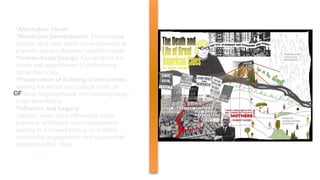
CRITIQUE OF MODERNIST CITIES BY JANE JACOBS
•Background:Jane Jacobs was an urbanist and
activist known for her critiques of modernist urban
planning and her advocacy for community-based
approaches to city planning.
•Key Works:
•The Death and Life of Great American Cities:
Jacobs' seminal work critiquing modernist urban
planning principles.
•Main Critiques:
•Overemphasis on Order and Predictability:
Modernist planners prioritized order and efficiency,
often leading to sterile, unlivable environments.
•Destruction of Community: Large-scale urban
renewal projects displaced communities and
destroyed the social fabric of neighborhoods.
•Monotonous and Monofunctional Spaces: The
separation of residential, commercial, and
industrial areas led to lifeless, single-use zones.
CRITIQUE OF MODERNIST CITIES BY JANE JACOBS
GF
•Alternative Vision:
•Mixed-Use Development: Encouraging
diverse land uses within close proximity to
promote vibrant, dynamic neighborhoods.
•Human-Scale Design: Focusing on the
needs and experiences of pedestrians
rather than cars.
•Preservation of Existing Communities:
Valuing the social and cultural fabric of
existing neighborhoods and resisting large-
scale demolitions.
•Influence and Legacy:
•Jacobs' ideas have influenced urban
planners, architects, and policymakers,
leading to a renewed focus on livability,
community engagement, and sustainable
development in cities.
ILLUSTRATION
Introduction
Published in 1961, The Death and Life of Great
American Cities is Jane Jacobs' seminal work
critiquing the urban planning policies of the mid-
20th century.
Jacobs argues against the modernist planning
principles advocated by figures like Le Corbusier
and Robert Moses, promoting instead a vision of
urban vitality grounded in mixed-use, pedestrian-
friendly, and community-oriented neighborhoods.
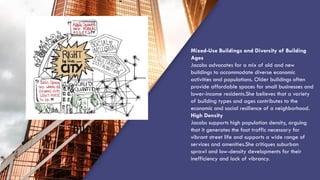
Key Themes and ConceptsDiversity of UsesJacobs
champions the idea that cities thrive on a diversity
of uses. A mix of residential, commercial, and
industrial functions in close proximity promotes
economic and social vitality.She criticizes the
modernist tendency to segregate functions, which
leads to sterile, monotonous environments that lack
the vibrancy of mixed-use areas.
“QUOTE”
Eyes on the Street
The concept of "eyes on the street" is central to
Jacobs' vision of urban safety. She argues that
natural surveillance by residents and passersby
creates safer, more vibrant public spaces.Jacobs
emphasizes the importance of active street life and
the presence of people at different times of day to
enhance security and community cohesion.The
Importance of Small Blocks
Small, walkable blocks facilitate pedestrian
movement and encourage interactions among
residents. Jacobs contrasts this with large
superblocks, which inhibit movement and social
interaction.She argues that a fine-grained street
network is essential for fostering vibrant, diverse
urban areas.
“QUOTE”
Mixed-Use Buildings and Diversity of Building
Ages
Jacobs advocates for a mix of old and new
buildings to accommodate diverse economic
activities and populations. Older buildings often
provide affordable spaces for small businesses and
lower-income residents.She believes that a variety
of building types and ages contributes to the
economic and social resilience of a neighborhood.
High Density
Jacobs supports high population density, arguing
that it generates the foot traffic necessary for
vibrant street life and supports a wide range of
services and amenities.She critiques suburban
sprawl and low-density developments for their
inefficiency and lack of vibrancy.
“QUOTE”
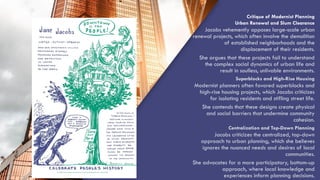
Critique of Modernist Planning
Urban Renewal and Slum Clearance
Jacobs vehemently opposes large-scale urban
renewal projects, which often involve the demolition
of established neighborhoods and the
displacement of their residents.
She argues that these projects fail to understand
the complex social dynamics of urban life and
result in soulless, unlivable environments.
Superblocks and High-Rise Housing
Modernist planners often favored superblocks and
high-rise housing projects, which Jacobs criticizes
for isolating residents and stifling street life.
She contends that these designs create physical
and social barriers that undermine community
cohesion.
Centralization and Top-Down Planning
Jacobs criticizes the centralized, top-down
approach to urban planning, which she believes
ignores the nuanced needs and desires of local
communities.
She advocates for a more participatory, bottom-up
approach, where local knowledge and
experiences inform planning decisions.
“QUOTE”
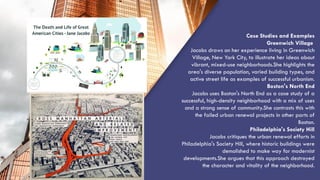
Case Studies and Examples
Greenwich Village
Jacobs draws on her experience living in Greenwich
Village, New York City, to illustrate her ideas about
vibrant, mixed-use neighborhoods.She highlights the
area's diverse population, varied building types, and
active street life as examples of successful urbanism.
Boston's North End
Jacobs uses Boston's North End as a case study of a
successful, high-density neighborhood with a mix of uses
and a strong sense of community.She contrasts this with
the failed urban renewal projects in other parts of
Boston.
Philadelphia's Society Hill
Jacobs critiques the urban renewal efforts in
Philadelphia's Society Hill, where historic buildings were
demolished to make way for modernist
developments.She argues that this approach destroyed
the character and vitality of the neighborhood.
“QUOTE”
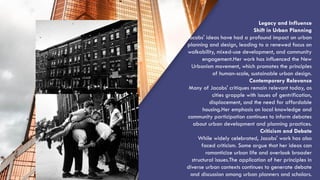
Legacy and Influence
Shift in Urban Planning
Jacobs' ideas have had a profound impact on urban
planning and design, leading to a renewed focus on
walkability, mixed-use development, and community
engagement.Her work has influenced the New
Urbanism movement, which promotes the principles
of human-scale, sustainable urban design.
Contemporary Relevance
Many of Jacobs' critiques remain relevant today, as
cities grapple with issues of gentrification,
displacement, and the need for affordable
housing.Her emphasis on local knowledge and
community participation continues to inform debates
about urban development and planning practices.
Criticism and Debate
While widely celebrated, Jacobs' work has also
faced criticism. Some argue that her ideas can
romanticize urban life and overlook broader
structural issues.The application of her principles in
diverse urban contexts continues to generate debate
and discussion among urban planners and scholars.
Focusing on the topic of human well-being and
interconnectedness, as well as on the safety and economic
vitality of cities, this article will summarize Jacobs’ main
points.
A big first chunk of Jacobs’ analysis on cities focuses on the
sidewalks, neighborhoods, and neighborhood playgrounds
and parks, with many of her observations being from her
lifetime spent in New York City.
Sidewalks as a means to ensure street safety.
The sidewalks, she argues, serve many purposes besides
carrying pedestrians. She views the primary task of
sidewalks to be ensuring street safety for the city as a
whole. A city district that fails to ensure street safety makes
people fear the streets. Jacobs actually discusses sidewalks
as causing eiether an upward or downward spiral. In the
latter, the more people fear the streets, the more they
avoid the streets, and the more dangerous those streets
then become. In this particular example, the city as a whole
then becomes more unsafe.
Jacobs argues that the public peace of cities, and
particularly of a city’s sidewalks, is not primarily kept by
the police, but by an intricate network of voluntary controls
and standards among people themselves. On busy city
streets passers-by, street-level merchants, and residents, all
work together effortlessly and naturally to keep an eye on
the street provide few opportunities for street crime. In
order this to happen, a city must abide by the following:
First, public and private space must be clearly
demarcated.
An important condition for safe city streets is a clear
demarcation between public and private space. These
spaces should not merge into one another as they typically
do in suburban settings.
Second, there must be eyes on the street
These eyes belong to what Jacobs calls the “natural
proprietors of the street”, including residents, and passers-
by. As such, buildings must be looking outward towards the
city’s streets.
Third, sidewalks must have users fairly continuously.
Jacobs argues that the mixture of workplaces and
residences within a single neighborhood generally assures
that there are always people around keeping the streets
safe with their presence.
Then, she also states that there should also be stores, bars,
cafés, and restaurants within those same neighborhoods.
These places attract people not only during the day, but at
night as well, and thus, ensure that a city’s streets will
almost never be empty.
Sidewalks as a means to foster contacts.
As opposed to the erroneous Orthodox planning judgement
that she mentions extensively in her book, Jacobs discusses
the benefits of busy street life on sidewalks, and their
vitality for the city.
Reformers have long observed city people loitering
on busy corners, hanging around in candy stores and
bars, and drikning soda pop on stoops, and have
passed a judgement, the gist of which is: “This is
deplorable. If these people had decent homes and a
more private or bosky outdoor place, they wouldn’t
be on the street!” (Jacobs, 55)
Instead, Jacobs argues that actually, busy city
streets are incredibly important in order to create
a feeling of public identity, a web of public respect
and trust, as well as a resource for the
neighborhood as a whole.
Sidewalks as a means to assimilate children.
Regarding sidewalks and their relation to children, Jacobs
mentions yet another erroneous belief of Orthodox
planning. This conclusion states that streets compel children
to discuss innapropriate matters and learn “new forms of
curription as efficiently as if they were in reform school”.
Consequently, Orthodox planning proposed environments
such as playgrounds and parks, which are ‘always cleaner
than city streets’, as better suited for children, and streets
to be strictly avoided by them.
Yet Jacobs tells us this is not the case. She mentions
several examples from housing projects during the 1950s
and 1960s, where the city streets were replaced by the
playgrounds and parks of these super-blocks, and where
crime amoung adolescent street gangs actually increased.
In general, these crimes place took place between gangs
of housing projects, and within the confines of their
isolated, unsupervised, and sterile playgrounds and parks.
“I was scared they would catch me when I had to pass the playground.
If they caught me there I’d be sunk!” (Jacobs, 77)
Instead, Jacobs argues that lively and supervised streets offer children
supervision, safety, an array of diverse activities to pursue, and also, an
unspecialized outdoor home base from which to play, to hang around in,
and to help form their notions of the world.
Parks as mirrors of their own neighborhoods.
At the center of Jacobs’ analysis of city neighborhoods, she discusses
parks, and argues that parks cannot transform neighborhoods and
automatically uplift them as planners have often thought they might.
Instead of transforming a neighborhood, parks actually mirror the
neighborhood.
Popular and livable neighborhoods with diverse uses, like streets, attract
people into them, and thus, attract people into its parks. Like the streets,
these parks become vibrant places where metropolitan life can thrive
effortlessly.
Unpopular parks in unpopular neighborhoods attract very little people,
and like unpopular streets, attract crime. Parks in these kinds of
neighborhoods are not only troubling because of their missed
opportunities, but also because of their negative effects on the
neighborhood in its entirety.
“The more successfully a city mingles everyday diversity of
uses and users in its everyday streets, the more successfully,
casually, and economically, its people thereby enliven and
support well-located parks that can in thus give back grace
and delight to their neighborhoods instead of vacuity.”
(Jacobs, 111)
Neighborhoods as a complex and continuous fabric of
intersecting streets and uses.
In her final discussion on city streets and neighborhoods,
Jacobs discusses self-government within cities, and what makes
city neighborhoods successful. She argues that the only kinds
of entities that ‘demonstrate useful functions in real life self
government’ are the city as a whole, streets, and districts.
Effective neighborhood physical planning for cities, she states,
should therefore aim to foster lively and intersecting streets
that have no distinct beginnings and ends separating them as
indivudal units, with parks, squares, and public buildings that
become part of the street’s fabric, kniting together ‘the
fabric’s complexity and multiple use’ (129). As opposed to
isolated street neighborhoods associated with long self-
isolating blocks, she defends lively interconnected streets as a
means to foster a continuous network throughout a city’s
district and emphasize the ‘functional identity’ of those areas
— allowing districts be more efficiently self-governed.
“QUOTE”
"Slumdog Millionaire" (2008) - Illustrates cultural and
societal aspects of India, focusing on the life of a boy
from the slums who participates in a game show.
"Fight Club" (1999) - Critiques modern consumer
culture and societal norms, exploring themes of
identity, masculinity, and rebellion.
"Parasite" (2019) - A sharp commentary on class
disparity and social stratification, highlighting the
tensions between different social classes.
“QUOTE”
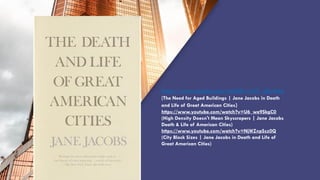
https://www.youtube.com/watch?v=wLiC_qGvAdg
(The Need for Aged Buildings | Jane Jacobs in Death
and Life of Great American Cities)
https://www.youtube.com/watch?v=U6_we9SkgC0
(High Density Doesn't Mean Skyscrapers | Jane Jacobs
Death & Life of American Cities)
https://www.youtube.com/watch?v=NjWZnpSsz0Q
(City Block Sizes | Jane Jacobs in Death and Life of
Great American Cities)
“QUOTE”
ASSIGNMENT – 1: Book review: Select two
postmodern theorists or critics from the unit, such as
Jane Jacobs and Robert Venturi, or Aldo Rossi and
Umberto Eco.
Write a comparative analysis essay (1500-2000
words) discussing their key ideas, theories, and
critiques. Address how their perspectives contrast
with modernist viewpoints and with each other.
Include examples of buildings, cities, or urban plans
that illustrate their theories. Discuss the impact of
their ideas on contemporary architecture and
urbanism.
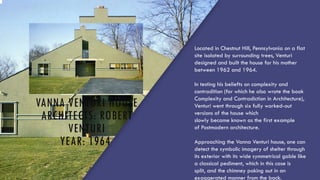
VANNA VENTURI HOUSE
ARCHITECTS: ROBERT
VENTURI
YEAR: 1964
• Located in Chestnut Hill, Pennsylvania on a flat
site isolated by surrounding trees, Venturi
designed and built the house for his mother
between 1962 and 1964.
• In testing his beliefts on complexity and
contradition (for which he also wrote the book
Complexity and Contradiction in Architecture),
Venturi went through six fully worked-out
versions of the house which
slowly became known as the first example
of Postmodern architecture.
• Approaching the Vanna Venturi house, one can
detect the symbolic imagery of shelter through
its exterior with its wide symmetrical gable like
a classical pediment, which in this case is
split, and the chimney poking out in an
exaggerated manner from the back.
VANNA VENTURI HOUSE
ARCHITECTS: ROBERT VENTURI
YEAR: 1964
VANNA VENTURI HOUSE
ARCHITECTS: ROBERT VENTURI
YEAR: 1964
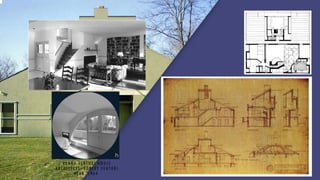
The main entrance is in the center, creating a sense of
symmetry that both is and is not there due to the
placement of the windows. These windows are located
based on function in the interior. For instance, there is a
Modernist ribbon window for the kitchen and square
windows serving the bedroom and bathroom on the other
side of the front facade.
Upon entering there is the main living space. Also located
on the first floor due to a request from Venturi's mother
are the kitchen and the bedroom. The second floor
contains another bedroom, storage space, and a terrace.
A "nowhere stair" on the second floor also integrates itself
into the core space. It rises up at an awkward angle, and
its function on one level is completely useless due to its
steep slope, while on the other level it serves as a ladder
to clean the high window on the second level.
VANNA VENTURI HOUSE
ARCHITECTS: ROBERT VENTURI
YEAR: 1964
THE ARCHITECTURE OF A CITY : ALDO
ROSSI
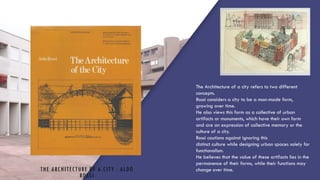
1. The Architecture of a city refers to two different
concepts.
2. Rossi considers a city to be a man-made form,
growing over time.
3. He also views this form as a collective of urban
artifacts or monuments, which have their own form
and are an expression of collective memory or the
culture of a city.
4. Rossi cautions against ignoring this
distinct culture while designing urban spaces solely for
functionalism.
5. He believes that the value of these artifacts lies in the
permanence of their forms, while their functions may
change over time.
THE ARCHITECTURE OF A CITY : ALDO
ROSSI
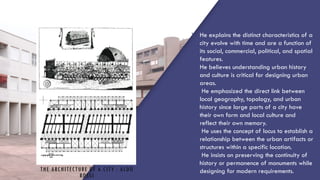
1. He explains the distinct characteristics of a
city evolve with time and are a function of
its social, commercial, political, and spatial
features.
2. He believes understanding urban history
and culture is critical for designing urban
areas.
3. He emphasized the direct link between
local geography, topology, and urban
history since large parts of a city have
their own form and local culture and
reflect their own memory.
4. He uses the concept of locus to establish a
relationship between the urban artifacts or
structures within a specific location.
5. He insists on preserving the continuity of
history or permanence of monuments while
designing for modern requirements.
THE ARCHITECTURE OF A CITY : ALDO
ROSSI
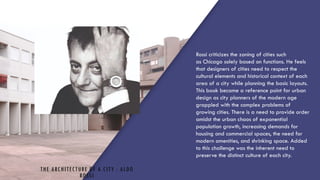
1. Rossi criticizes the zoning of cities such
as Chicago solely based on functions. He feels
that designers of cities need to respect the
cultural elements and historical context of each
area of a city while planning the basic layouts.
2. This book became a reference point for urban
design as city planners of the modern age
grappled with the complex problems of
growing cities. There is a need to provide order

amidst the urban chaos of exponential
population growth, increasing demands for
housing and commercial spaces, the need for
modern amenities, and shrinking space. Added
to this challenge was the inherent need to
preserve the distinct culture of each city.
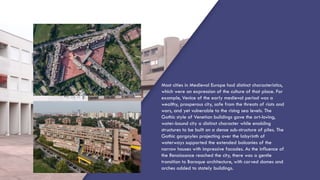
Most cities in Medieval Europe had distinct characteristics,
which were an expression of the culture of that place. For
example, Venice of the early medieval period was a
wealthy, prosperous city, safe from the threats of riots and
wars, and yet vulnerable to the rising sea levels. The
Gothic style of Venetian buildings gave the art-loving,
water-bound city a distinct character while enabling
structures to be built on a dense sub-structure of piles. The
Gothic gargoyles projecting over the labyrinth of
waterways supported the extended balconies of the
narrow houses with impressive facades. As the influence of
the Renaissance reached the city, there was a gentle
transition to Baroque architecture, with carved domes and
arches added to stately buildings.
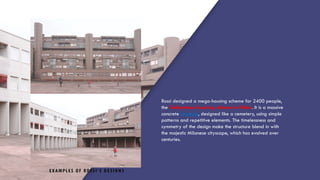
EXAMPLES OF ROSSI’S DESIGNS
Rossi designed a mega-housing scheme for 2400 people,
the Gallaratese housing scheme in Milan. It is a massive
concrete structure, designed like a cemetery, using simple
patterns and repetitive elements. The timelessness and
symmetry of the design make the structure blend in with
the majestic Milanese cityscape, which has evolved over
centuries.
EXAMPLES OF ROSSI’S DESIGNS
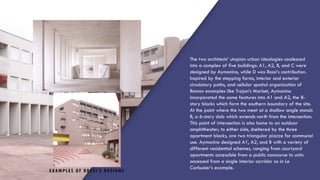
The two architects’ utopian urban ideologies coalesced
into a complex of five buildings: A1, A2, B, and C were
designed by Aymonino, while D was Rossi’s contribution.
Inspired by the stepping forms, interior and exterior
circulatory paths, and cellular spatial organization of
Roman examples like Trajan’s Market, Aymonino
incorporated the same features into A1 and A2, the 8-
story blocks which form the southern boundary of the site.
At the point where the two meet at a shallow angle stands
B, a 6-story slab which extends north from the intersection.
This point of intersection is also home to an outdoor
amphitheater; to either side, sheltered by the three
apartment blocks, are two triangular piazze for communal
use. Aymonino designed A1, A2, and B with a variety of
different residential schemes, ranging from courtyard
apartments accessible from a public concourse to units
accessed from a single interior corridor as in Le
Corbusier’s example.
EXAMPLES OF ROSSI’S DESIGNS
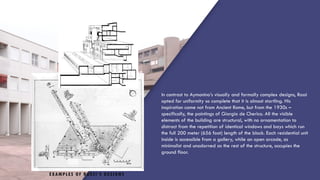
In contrast to Aymonino’s visually and formally complex designs, Rossi
opted for uniformity so complete that it is almost startling. His
inspiration came not from Ancient Rome, but from the 1930s –
specifically, the paintings of Giorgio de Cherico. All the visible
elements of the building are structural, with no ornamentation to
distract from the repetition of identical windows and bays which run
the full 200 meter (656 foot) length of the block. Each residential unit
inside is accessible from a gallery, while an open arcade, as
minimalist and unadorned as the rest of the structure, occupies the
ground floor.
UMBERTO ECO
Umberto Eco, a renowned Italian philosopher, semiotician, and author,
made significant contributions to the study of semiotics—the science
of signs and symbols and their use or interpretation. Eco's work
extends into various fields, including architecture, where he explored
how buildings and architectural forms communicate meanings.
UMBERTO ECO
Key Concepts in Eco's Semiology
Signs and Codes: Eco's semiotic theory revolves around the idea that
signs (anything that can be used to communicate) are part of broader
systems called codes. In architecture, these signs can include materials,
forms, colors, and spatial arrangements.
Denotation and Connotation: Eco differentiates between the
denotative (literal) and connotative (symbolic or cultural) meanings of
signs. In buildings, this can be seen in how a structure's function
(denotation) contrasts with its stylistic or cultural associations
(connotation).
Syntactics, Semantics, and Pragmatics: Eco applies these three
branches of semiotics to architecture:
Syntactics: The rules and structures that govern how elements of
architecture are arranged.
Semantics: The meaning of the architectural elements and how
they communicate specific messages or concepts.
Pragmatics: The use and interpretation of architectural elements
in different contexts by various users.

AR3701 CONTEMPORARY ARCHITECTURE UNIT 1 NOTES.pptx

  • 1.
    AR3701 CONTEMPORARY ARCHITECTURE: THEORIESAND PRACTICE UNIT – 1:THE POSTMODERN WORLD CRITIQUE AND THEORIES PREPARED BY Ar. SWETHA SEKHAR
  • 2.
    UNIT I: THEPOSTMODERN WORLD - CRITIQUE AND THEORIES
  • 3.
    3 TOPICS COVERED Ideologies, conceptualizationof various Theories and works of Christopher Alexander UNIT I.A Aldo Rossi’s ideas on the city. Neorationalism. Semiology. Writings of Venturi and Umberto Eco. UNIT I.B Poststructuralism and Deconstruction. Building examples around the world UNIT I.C The postmodern world and multiple world views- to include the realms of literature, economics, technology, culture, society, environment. UNIT I.D UNIT I.E Critique of modernist cities by Jane Jacobs.
  • 4.
    4 LITERATURE •Characteristics of Postmodern Literature: •Metafiction:Self-referential texts that comment on their own creation. •Fragmentation: Non-linear narratives and fragmented structure. •Intertextuality: The relationship between texts, referencing other literary works. •Paranoia: A sense of distrust and suspicion in narratives. •Pastiche: The blending of multiple styles and genres.
  • 5.
    5 NOTABLE AUTHORS AND WORKS •ThomasPynchon: Gravity’s Rainbow •Don DeLillo: White Noise •Salman Rushdie: Midnight's Children •Margaret Atwood: The Handmaid’s Tale
  • 6.
    6 THEMES •Subjectivity and Relativism:The idea that truth and reality are subjective and multiple. •Hyperreality: The blurring of reality and fiction, often through media and technology. •Irony and Playfulness: Use of irony, dark humor, and playfulness in narrative style.
  • 7.
    7 ECONOMICS Postmodern Economic Thought: Globalization:The interconnectedness of global economies and its impact on local markets. Consumerism: The shift towards a consumer-driven economy. Flexible Accumulation: Changes in production processes, such as just-in-time production and outsourcing. Information Economy: The rise of knowledge-based industries and the significance of information technology.
  • 8.
    8 ECONOMICS Critiques of ModernistEconomic Models: Neoliberalism: Criticized for increasing inequality and eroding public services. Capitalist Realism: The pervasive belief that capitalism is the only viable economic system.
  • 9.
    9 CULTURE •Postmodern Culture: •Cultural Pluralism:The coexistence of diverse cultures and the recognition of multiple cultural identities. •Hybridization: The blending and merging of different cultural elements. •Hyperreality in Culture: The prevalence of simulacra and the imitation of reality in media and consumer culture. •Art and Architecture: •Deconstructivism: An architectural style characterized by fragmentation and non- linear processes. •Pop Art: The incorporation of popular culture and mass media in art. •Street Art and Graffiti: The rise of alternative and subversive art forms.

  • 10.
    10 SOCIETY •Social Changes: •Identity Politics:The emphasis on the politics of identity, including gender, race, and sexual orientation. •Decentralization: The move away from centralized power structures towards more localized and participatory forms of governance. •Global Citizenship: The concept of individuals as members of a global community. •Postmodern Social Theories: •Jean Baudrillard: The idea of simulacra and simulation. •Michel Foucault: The exploration of power, knowledge, and discourse. •Judith Butler: The performative nature of gender and identity.
  • 11.
    11 ENVIRONMENT •Postmodern Environmental Thought: •EcologicalAwareness: The recognition of the interconnectedness of human and natural systems. •Sustainability: The focus on sustainable development and the limits of growth. •Environmental Justice: Addressing the disproportionate impact of environmental degradation on marginalized communities. •Critique of Modernist Environmental Practices: •Industrialization: Criticized for its environmental impact and contribution to climate change. •Urban Sprawl: The spread of cities and its negative effects on the environment.
  • 12.
    12 TECHNOLOGY •Advancements in Technology: •DigitalRevolution: The shift from analog to digital technology. •Internet and Connectivity: The impact of the internet on communication, commerce, and society. •Artificial Intelligence and Automation: The rise of AI and its implications for labor and society. •Impact on Society: •Information Overload: The challenge of managing vast amounts of information. •Surveillance and Privacy: Concerns about data privacy and surveillance by governments and corporations. •Virtual Reality and Augmented Reality: New ways of experiencing and interacting with the world.
  • 13.
    CRITIQUE OF MODERNISTCITIES BY JANE JACOBS •Background:Jane Jacobs was an urbanist and activist known for her critiques of modernist urban planning and her advocacy for community-based approaches to city planning. •Key Works: •The Death and Life of Great American Cities: Jacobs' seminal work critiquing modernist urban planning principles. •Main Critiques: •Overemphasis on Order and Predictability: Modernist planners prioritized order and efficiency, often leading to sterile, unlivable environments. •Destruction of Community: Large-scale urban renewal projects displaced communities and destroyed the social fabric of neighborhoods. •Monotonous and Monofunctional Spaces: The separation of residential, commercial, and industrial areas led to lifeless, single-use zones.
  • 14.
    CRITIQUE OF MODERNISTCITIES BY JANE JACOBS GF •Alternative Vision: •Mixed-Use Development: Encouraging diverse land uses within close proximity to promote vibrant, dynamic neighborhoods. •Human-Scale Design: Focusing on the needs and experiences of pedestrians rather than cars. •Preservation of Existing Communities: Valuing the social and cultural fabric of existing neighborhoods and resisting large- scale demolitions. •Influence and Legacy: •Jacobs' ideas have influenced urban planners, architects, and policymakers, leading to a renewed focus on livability, community engagement, and sustainable development in cities.
  • 15.
    ILLUSTRATION Introduction Published in 1961,The Death and Life of Great American Cities is Jane Jacobs' seminal work critiquing the urban planning policies of the mid- 20th century. Jacobs argues against the modernist planning principles advocated by figures like Le Corbusier and Robert Moses, promoting instead a vision of urban vitality grounded in mixed-use, pedestrian- friendly, and community-oriented neighborhoods. Key Themes and ConceptsDiversity of UsesJacobs champions the idea that cities thrive on a diversity of uses. A mix of residential, commercial, and industrial functions in close proximity promotes economic and social vitality.She criticizes the modernist tendency to segregate functions, which leads to sterile, monotonous environments that lack the vibrancy of mixed-use areas.
  • 16.
    “QUOTE” Eyes on theStreet The concept of "eyes on the street" is central to Jacobs' vision of urban safety. She argues that natural surveillance by residents and passersby creates safer, more vibrant public spaces.Jacobs emphasizes the importance of active street life and the presence of people at different times of day to enhance security and community cohesion.The Importance of Small Blocks Small, walkable blocks facilitate pedestrian movement and encourage interactions among residents. Jacobs contrasts this with large superblocks, which inhibit movement and social interaction.She argues that a fine-grained street network is essential for fostering vibrant, diverse urban areas.
  • 17.
    “QUOTE” Mixed-Use Buildings andDiversity of Building Ages Jacobs advocates for a mix of old and new buildings to accommodate diverse economic activities and populations. Older buildings often provide affordable spaces for small businesses and lower-income residents.She believes that a variety of building types and ages contributes to the economic and social resilience of a neighborhood. High Density Jacobs supports high population density, arguing that it generates the foot traffic necessary for vibrant street life and supports a wide range of services and amenities.She critiques suburban sprawl and low-density developments for their inefficiency and lack of vibrancy.
  • 18.
    “QUOTE” Critique of ModernistPlanning Urban Renewal and Slum Clearance Jacobs vehemently opposes large-scale urban renewal projects, which often involve the demolition of established neighborhoods and the displacement of their residents. She argues that these projects fail to understand the complex social dynamics of urban life and result in soulless, unlivable environments. Superblocks and High-Rise Housing Modernist planners often favored superblocks and high-rise housing projects, which Jacobs criticizes for isolating residents and stifling street life. She contends that these designs create physical and social barriers that undermine community cohesion. Centralization and Top-Down Planning Jacobs criticizes the centralized, top-down approach to urban planning, which she believes ignores the nuanced needs and desires of local communities. She advocates for a more participatory, bottom-up approach, where local knowledge and experiences inform planning decisions.
  • 19.
    “QUOTE” Case Studies andExamples Greenwich Village Jacobs draws on her experience living in Greenwich Village, New York City, to illustrate her ideas about vibrant, mixed-use neighborhoods.She highlights the area's diverse population, varied building types, and active street life as examples of successful urbanism. Boston's North End Jacobs uses Boston's North End as a case study of a successful, high-density neighborhood with a mix of uses and a strong sense of community.She contrasts this with the failed urban renewal projects in other parts of Boston. Philadelphia's Society Hill Jacobs critiques the urban renewal efforts in Philadelphia's Society Hill, where historic buildings were demolished to make way for modernist developments.She argues that this approach destroyed the character and vitality of the neighborhood.
  • 20.
    “QUOTE” Legacy and Influence Shiftin Urban Planning Jacobs' ideas have had a profound impact on urban planning and design, leading to a renewed focus on walkability, mixed-use development, and community engagement.Her work has influenced the New Urbanism movement, which promotes the principles of human-scale, sustainable urban design. Contemporary Relevance Many of Jacobs' critiques remain relevant today, as cities grapple with issues of gentrification, displacement, and the need for affordable housing.Her emphasis on local knowledge and community participation continues to inform debates about urban development and planning practices. Criticism and Debate While widely celebrated, Jacobs' work has also faced criticism. Some argue that her ideas can romanticize urban life and overlook broader structural issues.The application of her principles in diverse urban contexts continues to generate debate and discussion among urban planners and scholars.
  • 21.
    Focusing on thetopic of human well-being and interconnectedness, as well as on the safety and economic vitality of cities, this article will summarize Jacobs’ main points. A big first chunk of Jacobs’ analysis on cities focuses on the sidewalks, neighborhoods, and neighborhood playgrounds and parks, with many of her observations being from her lifetime spent in New York City. Sidewalks as a means to ensure street safety. The sidewalks, she argues, serve many purposes besides carrying pedestrians. She views the primary task of sidewalks to be ensuring street safety for the city as a whole. A city district that fails to ensure street safety makes people fear the streets. Jacobs actually discusses sidewalks as causing eiether an upward or downward spiral. In the latter, the more people fear the streets, the more they avoid the streets, and the more dangerous those streets then become. In this particular example, the city as a whole then becomes more unsafe. Jacobs argues that the public peace of cities, and particularly of a city’s sidewalks, is not primarily kept by the police, but by an intricate network of voluntary controls and standards among people themselves. On busy city streets passers-by, street-level merchants, and residents, all work together effortlessly and naturally to keep an eye on the street provide few opportunities for street crime. In order this to happen, a city must abide by the following:
  • 22.
    First, public andprivate space must be clearly demarcated. An important condition for safe city streets is a clear demarcation between public and private space. These spaces should not merge into one another as they typically do in suburban settings. Second, there must be eyes on the street These eyes belong to what Jacobs calls the “natural proprietors of the street”, including residents, and passers- by. As such, buildings must be looking outward towards the city’s streets. Third, sidewalks must have users fairly continuously. Jacobs argues that the mixture of workplaces and residences within a single neighborhood generally assures that there are always people around keeping the streets safe with their presence. Then, she also states that there should also be stores, bars, cafés, and restaurants within those same neighborhoods. These places attract people not only during the day, but at night as well, and thus, ensure that a city’s streets will almost never be empty. Sidewalks as a means to foster contacts. As opposed to the erroneous Orthodox planning judgement that she mentions extensively in her book, Jacobs discusses the benefits of busy street life on sidewalks, and their vitality for the city.
  • 23.
    Reformers have longobserved city people loitering on busy corners, hanging around in candy stores and bars, and drikning soda pop on stoops, and have passed a judgement, the gist of which is: “This is deplorable. If these people had decent homes and a more private or bosky outdoor place, they wouldn’t be on the street!” (Jacobs, 55) Instead, Jacobs argues that actually, busy city streets are incredibly important in order to create a feeling of public identity, a web of public respect and trust, as well as a resource for the neighborhood as a whole.
  • 24.
    Sidewalks as ameans to assimilate children. Regarding sidewalks and their relation to children, Jacobs mentions yet another erroneous belief of Orthodox planning. This conclusion states that streets compel children to discuss innapropriate matters and learn “new forms of curription as efficiently as if they were in reform school”. Consequently, Orthodox planning proposed environments such as playgrounds and parks, which are ‘always cleaner than city streets’, as better suited for children, and streets to be strictly avoided by them. Yet Jacobs tells us this is not the case. She mentions several examples from housing projects during the 1950s and 1960s, where the city streets were replaced by the playgrounds and parks of these super-blocks, and where crime amoung adolescent street gangs actually increased. In general, these crimes place took place between gangs of housing projects, and within the confines of their isolated, unsupervised, and sterile playgrounds and parks.
  • 25.
    “I was scaredthey would catch me when I had to pass the playground. If they caught me there I’d be sunk!” (Jacobs, 77) Instead, Jacobs argues that lively and supervised streets offer children supervision, safety, an array of diverse activities to pursue, and also, an unspecialized outdoor home base from which to play, to hang around in, and to help form their notions of the world. Parks as mirrors of their own neighborhoods. At the center of Jacobs’ analysis of city neighborhoods, she discusses parks, and argues that parks cannot transform neighborhoods and automatically uplift them as planners have often thought they might. Instead of transforming a neighborhood, parks actually mirror the neighborhood. Popular and livable neighborhoods with diverse uses, like streets, attract people into them, and thus, attract people into its parks. Like the streets, these parks become vibrant places where metropolitan life can thrive effortlessly. Unpopular parks in unpopular neighborhoods attract very little people, and like unpopular streets, attract crime. Parks in these kinds of neighborhoods are not only troubling because of their missed opportunities, but also because of their negative effects on the neighborhood in its entirety.
  • 26.
    “The more successfullya city mingles everyday diversity of uses and users in its everyday streets, the more successfully, casually, and economically, its people thereby enliven and support well-located parks that can in thus give back grace and delight to their neighborhoods instead of vacuity.” (Jacobs, 111) Neighborhoods as a complex and continuous fabric of intersecting streets and uses. In her final discussion on city streets and neighborhoods, Jacobs discusses self-government within cities, and what makes city neighborhoods successful. She argues that the only kinds of entities that ‘demonstrate useful functions in real life self government’ are the city as a whole, streets, and districts. Effective neighborhood physical planning for cities, she states, should therefore aim to foster lively and intersecting streets that have no distinct beginnings and ends separating them as indivudal units, with parks, squares, and public buildings that become part of the street’s fabric, kniting together ‘the fabric’s complexity and multiple use’ (129). As opposed to isolated street neighborhoods associated with long self- isolating blocks, she defends lively interconnected streets as a means to foster a continuous network throughout a city’s district and emphasize the ‘functional identity’ of those areas — allowing districts be more efficiently self-governed.
  • 27.
    “QUOTE” "Slumdog Millionaire" (2008)- Illustrates cultural and societal aspects of India, focusing on the life of a boy from the slums who participates in a game show. "Fight Club" (1999) - Critiques modern consumer culture and societal norms, exploring themes of identity, masculinity, and rebellion. "Parasite" (2019) - A sharp commentary on class disparity and social stratification, highlighting the tensions between different social classes.
  • 28.
    “QUOTE” https://www.youtube.com/watch?v=wLiC_qGvAdg (The Need forAged Buildings | Jane Jacobs in Death and Life of Great American Cities) https://www.youtube.com/watch?v=U6_we9SkgC0 (High Density Doesn't Mean Skyscrapers | Jane Jacobs Death & Life of American Cities) https://www.youtube.com/watch?v=NjWZnpSsz0Q (City Block Sizes | Jane Jacobs in Death and Life of Great American Cities)
  • 29.
    “QUOTE” ASSIGNMENT – 1:Book review: Select two postmodern theorists or critics from the unit, such as Jane Jacobs and Robert Venturi, or Aldo Rossi and Umberto Eco. Write a comparative analysis essay (1500-2000 words) discussing their key ideas, theories, and critiques. Address how their perspectives contrast with modernist viewpoints and with each other. Include examples of buildings, cities, or urban plans that illustrate their theories. Discuss the impact of their ideas on contemporary architecture and urbanism.
  • 30.
    VANNA VENTURI HOUSE ARCHITECTS:ROBERT VENTURI YEAR: 1964 • Located in Chestnut Hill, Pennsylvania on a flat site isolated by surrounding trees, Venturi designed and built the house for his mother between 1962 and 1964. • In testing his beliefts on complexity and contradition (for which he also wrote the book Complexity and Contradiction in Architecture), Venturi went through six fully worked-out versions of the house which slowly became known as the first example of Postmodern architecture. • Approaching the Vanna Venturi house, one can detect the symbolic imagery of shelter through its exterior with its wide symmetrical gable like a classical pediment, which in this case is split, and the chimney poking out in an exaggerated manner from the back.
  • 31.
    VANNA VENTURI HOUSE ARCHITECTS:ROBERT VENTURI YEAR: 1964
  • 32.
    VANNA VENTURI HOUSE ARCHITECTS:ROBERT VENTURI YEAR: 1964 The main entrance is in the center, creating a sense of symmetry that both is and is not there due to the placement of the windows. These windows are located based on function in the interior. For instance, there is a Modernist ribbon window for the kitchen and square windows serving the bedroom and bathroom on the other side of the front facade. Upon entering there is the main living space. Also located on the first floor due to a request from Venturi's mother are the kitchen and the bedroom. The second floor contains another bedroom, storage space, and a terrace. A "nowhere stair" on the second floor also integrates itself into the core space. It rises up at an awkward angle, and its function on one level is completely useless due to its steep slope, while on the other level it serves as a ladder to clean the high window on the second level.
  • 33.
    VANNA VENTURI HOUSE ARCHITECTS:ROBERT VENTURI YEAR: 1964
  • 34.
    THE ARCHITECTURE OFA CITY : ALDO ROSSI 1. The Architecture of a city refers to two different concepts. 2. Rossi considers a city to be a man-made form, growing over time. 3. He also views this form as a collective of urban artifacts or monuments, which have their own form and are an expression of collective memory or the culture of a city. 4. Rossi cautions against ignoring this distinct culture while designing urban spaces solely for functionalism. 5. He believes that the value of these artifacts lies in the permanence of their forms, while their functions may change over time.
  • 35.
    THE ARCHITECTURE OFA CITY : ALDO ROSSI 1. He explains the distinct characteristics of a city evolve with time and are a function of its social, commercial, political, and spatial features. 2. He believes understanding urban history and culture is critical for designing urban areas. 3. He emphasized the direct link between local geography, topology, and urban history since large parts of a city have their own form and local culture and reflect their own memory. 4. He uses the concept of locus to establish a relationship between the urban artifacts or structures within a specific location. 5. He insists on preserving the continuity of history or permanence of monuments while designing for modern requirements.
  • 36.
    THE ARCHITECTURE OFA CITY : ALDO ROSSI 1. Rossi criticizes the zoning of cities such as Chicago solely based on functions. He feels that designers of cities need to respect the cultural elements and historical context of each area of a city while planning the basic layouts. 2. This book became a reference point for urban design as city planners of the modern age grappled with the complex problems of growing cities. There is a need to provide order amidst the urban chaos of exponential population growth, increasing demands for housing and commercial spaces, the need for modern amenities, and shrinking space. Added to this challenge was the inherent need to preserve the distinct culture of each city.
  • 37.
    Most cities inMedieval Europe had distinct characteristics, which were an expression of the culture of that place. For example, Venice of the early medieval period was a wealthy, prosperous city, safe from the threats of riots and wars, and yet vulnerable to the rising sea levels. The Gothic style of Venetian buildings gave the art-loving, water-bound city a distinct character while enabling structures to be built on a dense sub-structure of piles. The Gothic gargoyles projecting over the labyrinth of waterways supported the extended balconies of the narrow houses with impressive facades. As the influence of the Renaissance reached the city, there was a gentle transition to Baroque architecture, with carved domes and arches added to stately buildings.
  • 38.
    EXAMPLES OF ROSSI’SDESIGNS Rossi designed a mega-housing scheme for 2400 people, the Gallaratese housing scheme in Milan. It is a massive concrete structure, designed like a cemetery, using simple patterns and repetitive elements. The timelessness and symmetry of the design make the structure blend in with the majestic Milanese cityscape, which has evolved over centuries.
  • 39.
    EXAMPLES OF ROSSI’SDESIGNS The two architects’ utopian urban ideologies coalesced into a complex of five buildings: A1, A2, B, and C were designed by Aymonino, while D was Rossi’s contribution. Inspired by the stepping forms, interior and exterior circulatory paths, and cellular spatial organization of Roman examples like Trajan’s Market, Aymonino incorporated the same features into A1 and A2, the 8- story blocks which form the southern boundary of the site. At the point where the two meet at a shallow angle stands B, a 6-story slab which extends north from the intersection. This point of intersection is also home to an outdoor amphitheater; to either side, sheltered by the three apartment blocks, are two triangular piazze for communal use. Aymonino designed A1, A2, and B with a variety of different residential schemes, ranging from courtyard apartments accessible from a public concourse to units accessed from a single interior corridor as in Le Corbusier’s example.
  • 40.
    EXAMPLES OF ROSSI’SDESIGNS In contrast to Aymonino’s visually and formally complex designs, Rossi opted for uniformity so complete that it is almost startling. His inspiration came not from Ancient Rome, but from the 1930s – specifically, the paintings of Giorgio de Cherico. All the visible elements of the building are structural, with no ornamentation to distract from the repetition of identical windows and bays which run the full 200 meter (656 foot) length of the block. Each residential unit inside is accessible from a gallery, while an open arcade, as minimalist and unadorned as the rest of the structure, occupies the ground floor.
  • 41.
    UMBERTO ECO Umberto Eco,a renowned Italian philosopher, semiotician, and author, made significant contributions to the study of semiotics—the science of signs and symbols and their use or interpretation. Eco's work extends into various fields, including architecture, where he explored how buildings and architectural forms communicate meanings.
  • 42.
    UMBERTO ECO Key Conceptsin Eco's Semiology Signs and Codes: Eco's semiotic theory revolves around the idea that signs (anything that can be used to communicate) are part of broader systems called codes. In architecture, these signs can include materials, forms, colors, and spatial arrangements. Denotation and Connotation: Eco differentiates between the denotative (literal) and connotative (symbolic or cultural) meanings of signs. In buildings, this can be seen in how a structure's function (denotation) contrasts with its stylistic or cultural associations (connotation). Syntactics, Semantics, and Pragmatics: Eco applies these three branches of semiotics to architecture: Syntactics: The rules and structures that govern how elements of architecture are arranged. Semantics: The meaning of the architectural elements and how they communicate specific messages or concepts. Pragmatics: The use and interpretation of architectural elements in different contexts by various users.