- By Aditya Bhattacharya
- Data and Cloud Platform Engineer, West
Pharmaceuticals
NIT Silchar ML Hackathon
Computer Vision
About Me
My Associations
My Interests
Goals of this discussion!
• Introduce you to new topics and concepts
• Discuss about practical use cases
• Develop new intuitions
• Improve existing intuitions
• Pro-tips!
Topics to be discussed
• Convolutional Neural Networks ( CNN or ConvNets )
• Popular ConvNet Architectures
• Data Augmentation
• Transfer Learning
• Object Detection
• Neural Style Transfer
• Generative Adversarial Networks (GANs)
• Variational Auto Encoders (VAEs)
Typical Computer Vision Problems
- Image Classification
- Object Detection
- Neural Style Transfer
- Image Generation
Image Generation
Neural Style Transfer
Convolutional Neural Networks (CNN or ConvNets)
Why CNN? Why not classical ML approach?
- Classical ML approach requires a lot of research on the dataset for
feature engineering
- Requires cleaner dataset for higher accuracy
- Accuracy of the algorithms were not good enough with classical ML
approach
- CNNs are far more accurate and reliable and easier to implement
Convolutional Neural Networks (CNN or ConvNets)
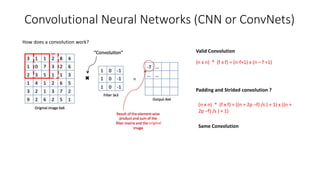
How does a convolution work?
original
(n x n) * (f x f) = (n-f+1) x (n – f +1)
Padding and Strided convolution ?
(n x n) * (f x f) = ((n + 2p –f) /s ) + 1) x ((n +
2p –f) /s ) + 1)
Valid Convolution
Same Convolution
Convolutional Neural Networks (CNN or ConvNets)
Edge Detection
Convolutional Neural Networks (CNN or ConvNets)
Pooling
Deep Convolution Neural Network
Popular ConvNet Architectures
ResNet
LeNet
VGG
AlexNet
Inception Net
Data Augmentation
Types of operation
• Mirroring
• Random Crop
• Rotation
• Shearing
• Warpig
• Colour Shifting
Why Data Augmentation?
• With a smaller dataset over-fitting is a huge
problem.
• Data augmentation helps you to expand your
dataset from available data in an unbiased way.
Transfer Learning
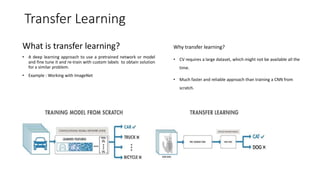
What is transfer learning?
• A deep learning approach to use a pretrained network or model
and fine tune it and re-train with custom labels to obtain solution
for a similar problem.
• Example : Working with ImageNet
Why transfer learning?
• CV requires a large dataset, which might not be available all the
time.
• Much faster and reliable approach than training a CNN from
scratch.
Transfer Learning
• Working on Pre-Trained networks
• Load a pretrained network
• Replace the final layer including the output layer
• Fine tune the weights depending on new task and new data
• Train the network on the data for new task
• Test the accuracy of the new network and tune the model if required.
Object Detection
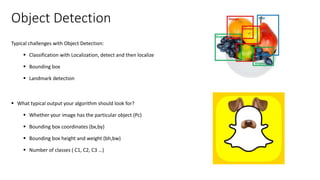
Typical challenges with Object Detection:
 Classification with Localization, detect and then localize
 Bounding box
 Landmark detection
 What typical output your algorithm should look for?
 Whether your image has the particular object (Pc)
 Bounding box coordinates (bx,by)
 Bounding box height and weight (bh,bw)
 Number of classes ( C1, C2, C3 …)
Object Detection with YOLO algorithm
• Yolo – You Only Look Once
• YOLO divides the input image into an S×S grid. Each grid cell predicts only one object
• For each grid cell, it predicts B boundary boxes and each box has one box confidence score,
• It detects one object only regardless of the number of boxes B,
• It predicts C conditional class probabilities (one per class for the likeliness of the object class).
Intersection over union (IoU)
Non-max suppression
YOLO
YOLO uses sum-squared error between the predictions
and the ground truth to calculate loss. The loss
function composes of:
•the classification loss.
•the localization loss (errors between the predicted
boundary box and the ground truth).
•the confidence loss
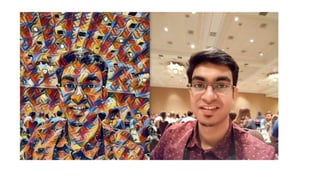
Neural Style Transfer
− Learn features from different layers of ConvNet
− The key notion behind implementing style
transfer :
 define a loss function to specify what we
want to achieve,
 minimize this loss.
− main loss functions primarily compute the
distance in terms of these different
representations.
Content image + Style Image = Generated image
What we want to achieve?
• Conserve the contents of the original image
• Adopt the style of the reference image.
Neural Style Transfer
How do we define a neural network
to perform style transfer?
 The original 2015 paper by Gatys et al. proposed a neural style
transfer algorithm that does not require a new architecture at all.
 We can take a pre-trained network (typically on ImageNet) and
define a loss function that will enable us to achieve our end goal of
style transfer and then optimize over that loss function.
What loss function do we use?
• Content loss
• Style loss
• Total-variation loss
Generative Adversarial Networks (GANs)
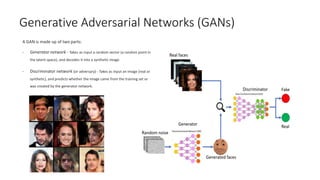
A GAN is made up of two parts:
- Generator network - Takes as input a random vector (a random point in
the latent space), and decodes it into a synthetic image
- Discriminator network (or adversary) - Takes as input an image (real or
synthetic), and predicts whether the image came from the training set or
was created by the generator network.
Variational Auto Encoders (VAEs)
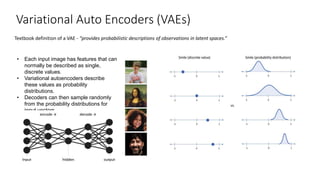
Textbook definition of a VAE - “provides probabilistic descriptions of observations in latent spaces.”
• Each input image has features that can
normally be described as single,
discrete values.
• Variational autoencoders describe
these values as probability
distributions.
• Decoders can then sample randomly
from the probability distributions for
input vectors
Variational Auto Encoders (VAEs)
Pro-tips!
- Community participation
- Kaggle competitions
- Stop procrastinating! Start working on projects
- Read research papers
- AI for all!
- By Aditya Bhattacharya
- Data and Cloud Platform Engineer West
Pharmaceuticals
Thanks
- Questions?
- Want to connect over LinkedIn ?
- Or email me at:
- aditya.bhattacharya2016@gmail.com

Computer vision-nit-silchar-hackathon

  • 1.
    - By AdityaBhattacharya - Data and Cloud Platform Engineer, West Pharmaceuticals NIT Silchar ML Hackathon Computer Vision
  • 2.
  • 3.
    Goals of thisdiscussion! • Introduce you to new topics and concepts • Discuss about practical use cases • Develop new intuitions • Improve existing intuitions • Pro-tips!
  • 4.
    Topics to bediscussed • Convolutional Neural Networks ( CNN or ConvNets ) • Popular ConvNet Architectures • Data Augmentation • Transfer Learning • Object Detection • Neural Style Transfer • Generative Adversarial Networks (GANs) • Variational Auto Encoders (VAEs)
  • 5.
    Typical Computer VisionProblems - Image Classification - Object Detection - Neural Style Transfer - Image Generation Image Generation Neural Style Transfer
  • 6.
    Convolutional Neural Networks(CNN or ConvNets) Why CNN? Why not classical ML approach? - Classical ML approach requires a lot of research on the dataset for feature engineering - Requires cleaner dataset for higher accuracy - Accuracy of the algorithms were not good enough with classical ML approach - CNNs are far more accurate and reliable and easier to implement
  • 7.
    Convolutional Neural Networks(CNN or ConvNets) How does a convolution work? original (n x n) * (f x f) = (n-f+1) x (n – f +1) Padding and Strided convolution ? (n x n) * (f x f) = ((n + 2p –f) /s ) + 1) x ((n + 2p –f) /s ) + 1) Valid Convolution Same Convolution
  • 8.
    Convolutional Neural Networks(CNN or ConvNets) Edge Detection
  • 9.
    Convolutional Neural Networks(CNN or ConvNets) Pooling Deep Convolution Neural Network
  • 10.
  • 11.
    Data Augmentation Types ofoperation • Mirroring • Random Crop • Rotation • Shearing • Warpig • Colour Shifting Why Data Augmentation? • With a smaller dataset over-fitting is a huge problem. • Data augmentation helps you to expand your dataset from available data in an unbiased way.
  • 12.
    Transfer Learning What istransfer learning? • A deep learning approach to use a pretrained network or model and fine tune it and re-train with custom labels to obtain solution for a similar problem. • Example : Working with ImageNet Why transfer learning? • CV requires a large dataset, which might not be available all the time. • Much faster and reliable approach than training a CNN from scratch.
  • 13.
    Transfer Learning • Workingon Pre-Trained networks • Load a pretrained network • Replace the final layer including the output layer • Fine tune the weights depending on new task and new data • Train the network on the data for new task • Test the accuracy of the new network and tune the model if required.
  • 14.
    Object Detection Typical challengeswith Object Detection:  Classification with Localization, detect and then localize  Bounding box  Landmark detection  What typical output your algorithm should look for?  Whether your image has the particular object (Pc)  Bounding box coordinates (bx,by)  Bounding box height and weight (bh,bw)  Number of classes ( C1, C2, C3 …)
  • 15.
    Object Detection withYOLO algorithm • Yolo – You Only Look Once • YOLO divides the input image into an S×S grid. Each grid cell predicts only one object • For each grid cell, it predicts B boundary boxes and each box has one box confidence score, • It detects one object only regardless of the number of boxes B, • It predicts C conditional class probabilities (one per class for the likeliness of the object class). Intersection over union (IoU) Non-max suppression
  • 16.
    YOLO YOLO uses sum-squarederror between the predictions and the ground truth to calculate loss. The loss function composes of: •the classification loss. •the localization loss (errors between the predicted boundary box and the ground truth). •the confidence loss
  • 17.
    Neural Style Transfer −Learn features from different layers of ConvNet − The key notion behind implementing style transfer :  define a loss function to specify what we want to achieve,  minimize this loss. − main loss functions primarily compute the distance in terms of these different representations. Content image + Style Image = Generated image What we want to achieve? • Conserve the contents of the original image • Adopt the style of the reference image.
  • 18.
    Neural Style Transfer Howdo we define a neural network to perform style transfer?  The original 2015 paper by Gatys et al. proposed a neural style transfer algorithm that does not require a new architecture at all.  We can take a pre-trained network (typically on ImageNet) and define a loss function that will enable us to achieve our end goal of style transfer and then optimize over that loss function. What loss function do we use? • Content loss • Style loss • Total-variation loss
  • 20.
    Generative Adversarial Networks(GANs) A GAN is made up of two parts: - Generator network - Takes as input a random vector (a random point in the latent space), and decodes it into a synthetic image - Discriminator network (or adversary) - Takes as input an image (real or synthetic), and predicts whether the image came from the training set or was created by the generator network.
  • 21.
    Variational Auto Encoders(VAEs) Textbook definition of a VAE - “provides probabilistic descriptions of observations in latent spaces.” • Each input image has features that can normally be described as single, discrete values. • Variational autoencoders describe these values as probability distributions. • Decoders can then sample randomly from the probability distributions for input vectors
  • 22.
  • 23.
    Pro-tips! - Community participation -Kaggle competitions - Stop procrastinating! Start working on projects - Read research papers - AI for all!
  • 24.
    - By AdityaBhattacharya - Data and Cloud Platform Engineer West Pharmaceuticals Thanks - Questions? - Want to connect over LinkedIn ? - Or email me at: - aditya.bhattacharya2016@gmail.com

Editor's Notes

  • #6 Notes: Images have been taken from: https://raw.githubusercontent.com/torch/torch.github.io/master/blog/_posts/images/out.gif https://i.stack.imgur.com/mFBCV.png https://cdn-images-1.medium.com/max/1600/0*JTxhYFzNFZ0xlWlB.png
  • #7 Reference image has been taken from: https://medium.freecodecamp.org/an-intuitive-guide-to-convolutional-neural-networks-260c2de0a050
  • #8 Reference image has been taken from: https://medium.freecodecamp.org/an-intuitive-guide-to-convolutional-neural-networks-260c2de0a050
  • #9 Reference image has been taken from: https://medium.freecodecamp.org/an-intuitive-guide-to-convolutional-neural-networks-260c2de0a050 https://www.owlnet.rice.edu/~elec539/Projects97/morphjrks/moredge.html
  • #10 Reference image has been taken from: https://medium.freecodecamp.org/an-intuitive-guide-to-convolutional-neural-networks-260c2de0a050 https://i.stack.imgur.com/QZsRB.png
  • #12  https://cdn-images-1.medium.com/max/1200/1*C8hNiOqur4OJyEZmC7OnzQ.png https://www.kdnuggets.com/2018/05/data-augmentation-deep-learning-limited-data.html
  • #13 https://www.mathworks.com/discovery/transfer-learning.html
  • #14 https://www.mathworks.com/discovery/transfer-learning.html
  • #16 https://medium.com/@jonathan_hui/real-time-object-detection-with-yolo-yolov2-28b1b93e2088 https://leonardoaraujosantos.gitbooks.io/artificial-inteligence/content/single-shot-detectors/yolo.html
  • #18 https://www.matthewwilson.co/tomtom https://www.pyimagesearch.com/2018/08/27/neural-style-transfer-with-opencv/
  • #19 https://www.pyimagesearch.com/2018/08/27/neural-style-transfer-with-opencv/
  • #21 https://www.spindox.it/en/blog/generative-adversarial-neural-networks/ Deep Learning with Python by Chollet
  • #22 https://towardsdatascience.com/what-the-heck-are-vae-gans-17b86023588a
  • #23 https://towardsdatascience.com/what-the-heck-are-vae-gans-17b86023588a