Your guide to finding the patterns in literature.Archetypes and Archetypal Theory
Definition of ArchetypeArchetype is a Greek word meaning “original pattern, or model.” In literature, film and art an archetype is a character, an event, a story or an image that recurs in different works, in different cultures and in different periods of time.  An example of an archetype occurs in the common story of “The Flood” (most commonly Noah & the Ark).  Many different cultures have similar stories about the reasons for and the results of a flood. Can you think of any stories or image patterns that have been repeated in movies, books, or even commercials?
Read the stories on the following slides about how different cultures interpreted the creation of the earth.  Look for the similarities and differences in these tales.
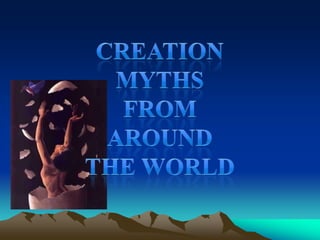
CREATION MYTHSFROM AROUND THE WORLD
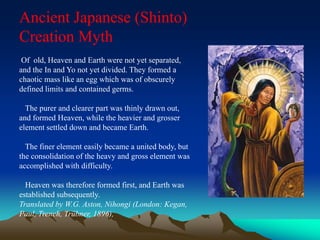
Ancient Japanese (Shinto) Creation Myth Of  old, Heaven and Earth were not yet separated, and the In and Yo not yet divided. They formed a chaotic mass like an egg which was of obscurely defined limits and contained germs.    The purer and clearer part was thinly drawn out, and formed Heaven, while the heavier and grosser element settled down and became Earth.    The finer element easily became a united body, but the consolidation of the heavy and gross element was accomplished with difficulty.    Heaven was therefore formed first, and Earth was established subsequently.Translated by W.G. Aston, Nihongi (London: Kegan, Paul, Trench, Trübner, 1896),
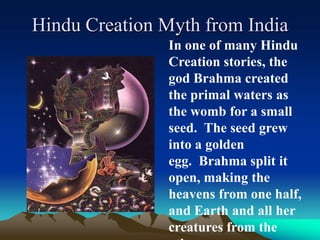
Hindu Creation Myth from IndiaIn one of many Hindu Creation stories, the god Brahma created the primal waters as the womb for a small seed.  The seed grew into a golden egg.  Brahma split it open, making the heavens from one half, and Earth and all her creatures from the other.
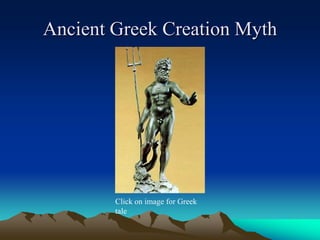
Ancient Greek Creation MythClick on image for Greek tale
Native American (Blackfoot Indian) Creation MythDuring the flood, Old Man was sitting on the highest mountain with all the beasts. The flood was caused by the above people, because the baby (a fungus) of the woman who married a star was heedlessly torn in pieces by an Indian child. Old Man sent the Otter down to get some earth. For a long time he waited, then the Otter came up dead. Old Man examined its feet, but found nothing on them. Next he sent Beaver down, but after a long time he also came up drowned. Again nothing was found on his feet. He sent Muskrat to dive next. Muskrat also was drowned. At length he sent the Duck . It was drowned, but in its paw held some earth. Old Man saw it, put it in his hand, feigned putting it on the water three times, and at last dropped it. Then the above-people sent rain, and everything grew on the earth.
Creation myth=An Archetype(universal pattern)
Choose a partner. Retell the story of one of the myths in your own words.  Together, using the web, find another culture’s story explaining how the earth was created.
The End of ChildhoodThis archetype focuses on stories of both loss of innocence as well as the acquisition of knowledge.  “What is the meaning of “lost childhood” or “falling down”?  In life, it is called “growing up.”  That time when innocence somehow fades away and is replaced by experience or knowledge of the world.  While a time of lost innocence is the end of an era, it is also the opening of a forbidden jar, the eating of a forbidden fruit, the death of a loved one, the destruction of something  beautiful…it is a story or an event that is a symbol of a universal human experience.  “When such imaginative stories or events are so common as to be used over and over by many cultures, they are called archetypes” (Jewkes 142).
End of Childhood cont.“The fall from innocence is an archetypal event.  It signifies the realization that we cannot hide from time.  It is the discovery that all the potential for happiness that we feel in childhood is often not realized in adulthood” (Jewkes 142).
End of Childhood Cont.In your English Onenote Notebook:Think of an instance when you had to leave a part of your childhood behind because you acquired knowledge.  When did this happen?  What was the situation?  How did you feel once you had discovered the truth?  Did it make you feel more grown up or did you wish that you could still remain “innocent” to the truth?What books or movies have you seen in which a loss of innocence is a theme?
The End of Childhood:Prometheus and Pandora’s BoxZeus Gets Back at PrometheusZeus reacted to these tricks by presenting man with a "gift," Pandora, the first woman. While Prometheus may have crafted man, woman was a different sort of creature. She came from the forge of Hephaestus, beautiful as a goddess and beguiling. Zeus presented her as a bride to Prometheus' brother Epimetheus. Prometheus had the gift of thinking ahead, but Epimetheus was only capable of afterthought, so Prometheus, expecting retribution for his audacity, had warned his brother against accepting gifts from Zeus.Zeus gave the gods-crafted Pandora as bride to Epimetheus, along with a box that they were instructed to keep closed. Epimetheus was dazzled by Pandora and forgot the advice of his prescient brother.Pandora Opens the BoxUnfortunately, one day while her husband Epimetheus was away, Pandora opened the box Zeus had given them along with the warning never to open it. When she opened it, Pandora unleashed all the evils now known to man. No longer could man loll about all day, but he would have to work and would succumb to illnesses.In your English Onenote Notebook:How is the story of Pandora like the biblical story of Adam and Eve?Why do you think people would make a myth like this one about Pandora?
The End of Childhood:The Circle Game http://www.jmdl.com/lyrics/TheCircleGame.cfmWhat do you think the different stages in this boy’s life represent?Which stanza do you think is most telling of the boy’s transition from childhood to adulthood?  Quote the stanza.Why do you think this song/poem is entitled “The Circle Game?”  What do circles represent?  Do you think of life as more circular or linear (linear means that it goes straight from one point to the next.)
The End of Childhood: Phaethonhttp://www.loggia.com/myth/phaethon.htmlhttp://www.hol.gr/greece/mythology/phaethon.htmlWhat is Phaethon’s goal in this story?How do you think Phaethon’s quest may be a search to find out who he is?What does he discover?Who is most at fault for Phaethon’s death?  Why?“Phaethon” by Morris Bishophttp://www.bundy223.net/~andyb/poems/apollo.htmlWhy is this poem titled “Phaethon”?  What similar connections do you see between this poem and the story of Phaethon?
The End of Childhood: Athena and Arachnehttp://www.goddess-athena.org/Encyclopedia/Athena/Arachne.htmDo you think that Arachne got what she deserved in this story?  Why?  Why not?What important lesson is taught here?   What other archetype do you think that this story could fit into?
The End of Childhood: It Is Better To Die Foreverhttp://www.pitt.edu/~dash/blkftcreation.html#dieDo you think this myth was comforting to the people who told it?  Why?
In literature the rhythm of the seasons provides a store of opposing images that relate to emotions that swing back and forth in the human mind and heart…Spring, the time of planting and growth is related in the imagination to youth, hope, courtship and love.  Summer, a time of ripening, is related to the maturing of relations, to comradeship and community, to fertility and passion.  Fall, the time of harvest, is related to reflection and declining vigor.  Winter, when the earth seems sterile, is related to death and emptiness.The Human Year
The Gettysburg Addresshttp://showcase.netins.net/web/creative/lincoln/speeches/gettysburg.htmAfter Apple Picking by Robert Frosthttp://www.bartleby.com/118/10.htmlThe Falling of Leaves by Yeatshttp://classiclit.about.com/library/bl-etexts/wbyeats/bl-wbye-falling.htmDemeter and Persephonehttp://www.arthistory.sbc.edu/imageswomen/papers/paolicchidemeter/demeter.htmlA Human Year
Orpheus and Eurydicehttp://classiclit.about.com/library/bl-etexts/wbyeats/bl-wbye-falling.htmhttp://www.bulfinch.org/fables/bull24.htmlA Human Year cont.
Water: birth-death-resurrection; creation; purification and redemption; fertility and growth.Sea/ocean: the mother of all life; spiritual mystery; death and/or rebirth; timelessness and eternity.Rivers: death and rebirth (baptism); the flowing of time into eternity; transitional phases of the life cycle. . . .Sun (fire and sky are closely related): creative energy; thinking, enlightenment, wisdom, spiritual vision.Rising sun: birth, creation, enlightenment.Setting sun: death.Archetypal Symbols
Colors:Red: blood, sacrifice, passion; disorder.Green: growth, hope, fertility.Blue: highly positive; secure; tranquil; spiritual purity.Black: darkness, chaos, mystery, the unknown, death, wisdom, evil, melancholy.White: light, purity, innocence, timelessness; [negative: death, terror, supernatural]Yellow: enlightenment, wisdom.Archetypal Colors
Serpent (snake, worm): symbol of energy and pure force (libido); evil, corruption, sensuality, destruction.Numbers:3 - light, spiritual awareness, unity (the Holy Trinity); male principle.4 - associated with the circle, life cycle, four seasons; female principle, earth, nature, elements.7 - the most potent of all symbolic numbers signifying the union of three and four, the completion of a cycle, perfect order, perfect number; religious symbol.Important Archetypalsymbols and numbers
Wise old Man: savior, redeemer, guru, representing knowledge, reflection, insight, wisdom, intuition, and morality.Garden: paradise, innocence, unspoiled beauty.Tree: denotes life of the cosmos; growth; proliferation; symbol of immortality; phallic symbol.Desert: spiritual aridity; death; hopelessness.Creation: All cultures believe the Cosmos was brought into existence by some Supernatural Being (or Beings).Seasons:Spring - rebirth; genre/comedy.Summer - life; genre/romance.Fall - death/dying; genre/tragedy.Winter - without life/death; genre/irony.The great fish: divine creation/life.Archetypal Symbols
The HEROThe SCAPEGOATThe LONER or OUTCASTThe TEMPTRESSThe EARTH MOTHER/GODDESSThe SPIRIT or INTELLECTArchetypal Characters
Larger than lifeSearch for self-identity results in self-destructionDeath of him/her leads toward some idealModern superheroes (Superman)The Hero
Innocent characterSituation is blamed on this characterCharacter assumes the blame for a situationIs punished in place of the truly guilty partyHe/she removes the guilt from the culprit and societyThe Scapegoat
Character separated from societyImpaired physically, emotionally, physiologicallyEx. – Jesus goes into the desert to discern his destinyBuddha leaves society to come to terms with his philosophyVictor Frankenstein travels to remote locales to avoid people when he realizes he has created a monsterHeroes can be loners or outcasts tooThe Loner or Outcast
The TemptressFemaleShe wants what the male desiresShe uses his desire (intentionally or unintentionally) to achieve his destructionEx.  Eve, Juliet, Lady Macbeth
Mother NatureMother EarthNurturing, life-giving aspect of femininityEarth Mother/Goddess
The QUESTRENEWAL OF LIFEINITIATIONThe FALLREDEMPTIVE SACRIFICEArchetypal Situations
Hero’s endeavor to establish his/her identity or 	fulfill his/her destinyThe Quest
Death and rebirthResurrection as seen in the cycle of the seasonsPhases of the day, sleeping and wakingEx.  “Sleeping Beauty,” “The Secret Garden”Renewal of Life
Coming of ageRites of passageEx.  First hunt, weddings, teenage angst filmsInitiation
Any event that marks a loss of innocenceA devolution from a paradisiacal life and viewpoint to a tainted oneThe Great GatsbyThe Fall
Any voluntary lossEspecially loss of life that results in another’s gaining or regaining a desired stateREDEMPTIVE SACRIFICE
COLORSNUMBERSWATERGARDENSGEOMETRIC SHAPESCELESTIAL BODIESYIN and YANGARCHETYPAL IMAGES
Red = blood, passion, violenceGold=greatness, value, wealthGreen-fertility, luxury, growthBlue (the color of the sky)=God-like holiness, peace, serenityWhite=purityCOLORS
Three=Christian trinityFour= four Seasons, ancient elements (earth, water, fire, air)Twelve=months of the solar year, etc.Archetypal Numbers
Source of life and sustenanceCleansing or purificationBaptismWater
Natural abundanceEasy, beautiful lifeNew birth, hopeEden, the original Paradise from which humankind was expelledGardens
Triangle= the trinityCircle = perfection and eternity, wholeness, unionShapes
Sun (masculine)=the giver and destroyer of lifeMoon (feminine)=the passage of time, controls the course of human eventsEx.  Seedtime, harvest, etc., are all determined more by the phases of the moon than the phases of the sunCelestial Bodies
Grudzina, Douglas.  Teaching F. Scott Fitzgerald’s The Great Gatsby from Multiple Critical Perspectives.  Clayton:  Prestwick House, Inc., 2006.Works Cited
Archetypal Theory Iii

Archetypal Theory Iii

  • 1.
    Your guide tofinding the patterns in literature.Archetypes and Archetypal Theory
  • 2.
    Definition of ArchetypeArchetypeis a Greek word meaning “original pattern, or model.” In literature, film and art an archetype is a character, an event, a story or an image that recurs in different works, in different cultures and in different periods of time. An example of an archetype occurs in the common story of “The Flood” (most commonly Noah & the Ark). Many different cultures have similar stories about the reasons for and the results of a flood. Can you think of any stories or image patterns that have been repeated in movies, books, or even commercials?
  • 3.
    Read the storieson the following slides about how different cultures interpreted the creation of the earth. Look for the similarities and differences in these tales.
  • 4.
  • 5.
    Ancient Japanese (Shinto)Creation Myth Of old, Heaven and Earth were not yet separated, and the In and Yo not yet divided. They formed a chaotic mass like an egg which was of obscurely defined limits and contained germs.    The purer and clearer part was thinly drawn out, and formed Heaven, while the heavier and grosser element settled down and became Earth.    The finer element easily became a united body, but the consolidation of the heavy and gross element was accomplished with difficulty.    Heaven was therefore formed first, and Earth was established subsequently.Translated by W.G. Aston, Nihongi (London: Kegan, Paul, Trench, Trübner, 1896),
  • 6.
    Hindu Creation Mythfrom IndiaIn one of many Hindu Creation stories, the god Brahma created the primal waters as the womb for a small seed.  The seed grew into a golden egg.  Brahma split it open, making the heavens from one half, and Earth and all her creatures from the other.
  • 7.
    Ancient Greek CreationMythClick on image for Greek tale
  • 8.
    Native American (BlackfootIndian) Creation MythDuring the flood, Old Man was sitting on the highest mountain with all the beasts. The flood was caused by the above people, because the baby (a fungus) of the woman who married a star was heedlessly torn in pieces by an Indian child. Old Man sent the Otter down to get some earth. For a long time he waited, then the Otter came up dead. Old Man examined its feet, but found nothing on them. Next he sent Beaver down, but after a long time he also came up drowned. Again nothing was found on his feet. He sent Muskrat to dive next. Muskrat also was drowned. At length he sent the Duck . It was drowned, but in its paw held some earth. Old Man saw it, put it in his hand, feigned putting it on the water three times, and at last dropped it. Then the above-people sent rain, and everything grew on the earth.
  • 9.
  • 10.
    Choose a partner.Retell the story of one of the myths in your own words. Together, using the web, find another culture’s story explaining how the earth was created.
  • 11.
    The End ofChildhoodThis archetype focuses on stories of both loss of innocence as well as the acquisition of knowledge. “What is the meaning of “lost childhood” or “falling down”? In life, it is called “growing up.” That time when innocence somehow fades away and is replaced by experience or knowledge of the world. While a time of lost innocence is the end of an era, it is also the opening of a forbidden jar, the eating of a forbidden fruit, the death of a loved one, the destruction of something beautiful…it is a story or an event that is a symbol of a universal human experience. “When such imaginative stories or events are so common as to be used over and over by many cultures, they are called archetypes” (Jewkes 142).
  • 12.
    End of Childhoodcont.“The fall from innocence is an archetypal event. It signifies the realization that we cannot hide from time. It is the discovery that all the potential for happiness that we feel in childhood is often not realized in adulthood” (Jewkes 142).
  • 13.
    End of ChildhoodCont.In your English Onenote Notebook:Think of an instance when you had to leave a part of your childhood behind because you acquired knowledge. When did this happen? What was the situation? How did you feel once you had discovered the truth? Did it make you feel more grown up or did you wish that you could still remain “innocent” to the truth?What books or movies have you seen in which a loss of innocence is a theme?
  • 14.
    The End ofChildhood:Prometheus and Pandora’s BoxZeus Gets Back at PrometheusZeus reacted to these tricks by presenting man with a "gift," Pandora, the first woman. While Prometheus may have crafted man, woman was a different sort of creature. She came from the forge of Hephaestus, beautiful as a goddess and beguiling. Zeus presented her as a bride to Prometheus' brother Epimetheus. Prometheus had the gift of thinking ahead, but Epimetheus was only capable of afterthought, so Prometheus, expecting retribution for his audacity, had warned his brother against accepting gifts from Zeus.Zeus gave the gods-crafted Pandora as bride to Epimetheus, along with a box that they were instructed to keep closed. Epimetheus was dazzled by Pandora and forgot the advice of his prescient brother.Pandora Opens the BoxUnfortunately, one day while her husband Epimetheus was away, Pandora opened the box Zeus had given them along with the warning never to open it. When she opened it, Pandora unleashed all the evils now known to man. No longer could man loll about all day, but he would have to work and would succumb to illnesses.In your English Onenote Notebook:How is the story of Pandora like the biblical story of Adam and Eve?Why do you think people would make a myth like this one about Pandora?
  • 15.
    The End ofChildhood:The Circle Game http://www.jmdl.com/lyrics/TheCircleGame.cfmWhat do you think the different stages in this boy’s life represent?Which stanza do you think is most telling of the boy’s transition from childhood to adulthood? Quote the stanza.Why do you think this song/poem is entitled “The Circle Game?” What do circles represent? Do you think of life as more circular or linear (linear means that it goes straight from one point to the next.)
  • 16.
    The End ofChildhood: Phaethonhttp://www.loggia.com/myth/phaethon.htmlhttp://www.hol.gr/greece/mythology/phaethon.htmlWhat is Phaethon’s goal in this story?How do you think Phaethon’s quest may be a search to find out who he is?What does he discover?Who is most at fault for Phaethon’s death? Why?“Phaethon” by Morris Bishophttp://www.bundy223.net/~andyb/poems/apollo.htmlWhy is this poem titled “Phaethon”? What similar connections do you see between this poem and the story of Phaethon?
  • 17.
    The End ofChildhood: Athena and Arachnehttp://www.goddess-athena.org/Encyclopedia/Athena/Arachne.htmDo you think that Arachne got what she deserved in this story? Why? Why not?What important lesson is taught here? What other archetype do you think that this story could fit into?
  • 18.
    The End ofChildhood: It Is Better To Die Foreverhttp://www.pitt.edu/~dash/blkftcreation.html#dieDo you think this myth was comforting to the people who told it? Why?
  • 19.
    In literature therhythm of the seasons provides a store of opposing images that relate to emotions that swing back and forth in the human mind and heart…Spring, the time of planting and growth is related in the imagination to youth, hope, courtship and love. Summer, a time of ripening, is related to the maturing of relations, to comradeship and community, to fertility and passion. Fall, the time of harvest, is related to reflection and declining vigor. Winter, when the earth seems sterile, is related to death and emptiness.The Human Year
  • 20.
    The Gettysburg Addresshttp://showcase.netins.net/web/creative/lincoln/speeches/gettysburg.htmAfterApple Picking by Robert Frosthttp://www.bartleby.com/118/10.htmlThe Falling of Leaves by Yeatshttp://classiclit.about.com/library/bl-etexts/wbyeats/bl-wbye-falling.htmDemeter and Persephonehttp://www.arthistory.sbc.edu/imageswomen/papers/paolicchidemeter/demeter.htmlA Human Year
  • 21.
  • 22.
    Water: birth-death-resurrection; creation;purification and redemption; fertility and growth.Sea/ocean: the mother of all life; spiritual mystery; death and/or rebirth; timelessness and eternity.Rivers: death and rebirth (baptism); the flowing of time into eternity; transitional phases of the life cycle. . . .Sun (fire and sky are closely related): creative energy; thinking, enlightenment, wisdom, spiritual vision.Rising sun: birth, creation, enlightenment.Setting sun: death.Archetypal Symbols
  • 23.
    Colors:Red: blood, sacrifice,passion; disorder.Green: growth, hope, fertility.Blue: highly positive; secure; tranquil; spiritual purity.Black: darkness, chaos, mystery, the unknown, death, wisdom, evil, melancholy.White: light, purity, innocence, timelessness; [negative: death, terror, supernatural]Yellow: enlightenment, wisdom.Archetypal Colors
  • 24.
    Serpent (snake, worm):symbol of energy and pure force (libido); evil, corruption, sensuality, destruction.Numbers:3 - light, spiritual awareness, unity (the Holy Trinity); male principle.4 - associated with the circle, life cycle, four seasons; female principle, earth, nature, elements.7 - the most potent of all symbolic numbers signifying the union of three and four, the completion of a cycle, perfect order, perfect number; religious symbol.Important Archetypalsymbols and numbers
  • 25.
    Wise old Man:savior, redeemer, guru, representing knowledge, reflection, insight, wisdom, intuition, and morality.Garden: paradise, innocence, unspoiled beauty.Tree: denotes life of the cosmos; growth; proliferation; symbol of immortality; phallic symbol.Desert: spiritual aridity; death; hopelessness.Creation: All cultures believe the Cosmos was brought into existence by some Supernatural Being (or Beings).Seasons:Spring - rebirth; genre/comedy.Summer - life; genre/romance.Fall - death/dying; genre/tragedy.Winter - without life/death; genre/irony.The great fish: divine creation/life.Archetypal Symbols
  • 26.
    The HEROThe SCAPEGOATTheLONER or OUTCASTThe TEMPTRESSThe EARTH MOTHER/GODDESSThe SPIRIT or INTELLECTArchetypal Characters
  • 27.
    Larger than lifeSearchfor self-identity results in self-destructionDeath of him/her leads toward some idealModern superheroes (Superman)The Hero
  • 28.
    Innocent characterSituation isblamed on this characterCharacter assumes the blame for a situationIs punished in place of the truly guilty partyHe/she removes the guilt from the culprit and societyThe Scapegoat
  • 29.
    Character separated fromsocietyImpaired physically, emotionally, physiologicallyEx. – Jesus goes into the desert to discern his destinyBuddha leaves society to come to terms with his philosophyVictor Frankenstein travels to remote locales to avoid people when he realizes he has created a monsterHeroes can be loners or outcasts tooThe Loner or Outcast
  • 30.
    The TemptressFemaleShe wantswhat the male desiresShe uses his desire (intentionally or unintentionally) to achieve his destructionEx. Eve, Juliet, Lady Macbeth
  • 31.
    Mother NatureMother EarthNurturing,life-giving aspect of femininityEarth Mother/Goddess
  • 32.
    The QUESTRENEWAL OFLIFEINITIATIONThe FALLREDEMPTIVE SACRIFICEArchetypal Situations
  • 33.
    Hero’s endeavor toestablish his/her identity or fulfill his/her destinyThe Quest
  • 34.
    Death and rebirthResurrectionas seen in the cycle of the seasonsPhases of the day, sleeping and wakingEx. “Sleeping Beauty,” “The Secret Garden”Renewal of Life
  • 35.
    Coming of ageRitesof passageEx. First hunt, weddings, teenage angst filmsInitiation
  • 36.
    Any event thatmarks a loss of innocenceA devolution from a paradisiacal life and viewpoint to a tainted oneThe Great GatsbyThe Fall
  • 37.
    Any voluntary lossEspeciallyloss of life that results in another’s gaining or regaining a desired stateREDEMPTIVE SACRIFICE
  • 38.
  • 39.
    Red = blood,passion, violenceGold=greatness, value, wealthGreen-fertility, luxury, growthBlue (the color of the sky)=God-like holiness, peace, serenityWhite=purityCOLORS
  • 40.
    Three=Christian trinityFour= fourSeasons, ancient elements (earth, water, fire, air)Twelve=months of the solar year, etc.Archetypal Numbers
  • 41.
    Source of lifeand sustenanceCleansing or purificationBaptismWater
  • 42.
    Natural abundanceEasy, beautifullifeNew birth, hopeEden, the original Paradise from which humankind was expelledGardens
  • 43.
    Triangle= the trinityCircle= perfection and eternity, wholeness, unionShapes
  • 44.
    Sun (masculine)=the giverand destroyer of lifeMoon (feminine)=the passage of time, controls the course of human eventsEx. Seedtime, harvest, etc., are all determined more by the phases of the moon than the phases of the sunCelestial Bodies
  • 45.
    Grudzina, Douglas. Teaching F. Scott Fitzgerald’s The Great Gatsby from Multiple Critical Perspectives. Clayton: Prestwick House, Inc., 2006.Works Cited