www.iita.orgA member of CGIAR consortium
Overview of
Aflasafe
Development in
Africa
Agriculture for Nutrition & Health
Ranajit Bandyopadhyay &
Peter Cotty
On behalf of the
Aflasafe Team
www.iita.orgA member of CGIAR consortium
Pre-Harvest Problem
Aflatoxin (ppb) Maize (n = 241) Peanut (n = 188)
> 4 70 54
> 10 52 41
> 20 24 29
Samples (%) with Aflatoxin
At harvest -- Nigeria
Kenya data: CDC & Ministry of Health, 2004
Aflatoxin (ppb) Maize (n = 342)
> 20 53
> 100 34
> 1000 7
In Farmers’ Store -- Kenya
Increases
after
Harvest
Agriculture for Nutrition & Health
www.iita.orgA member of CGIAR consortium
Almost one million
acres of several crops
treated annually in
the US with 2 EPA-
Approved products !
Production Room
Atoxigenic Strain Manufacturing Facility
Arizona Cotton Research & Protection Council
(Funded and Governed by the Farmers of Arizona),
Phoenix, Arizona
Biocontrol Works!
Agriculture for Nutrition & Health
www.iita.orgA member of CGIAR consortium
Biocontrol Works!
Agriculture for Nutrition & Health
It Works in
Africa Too
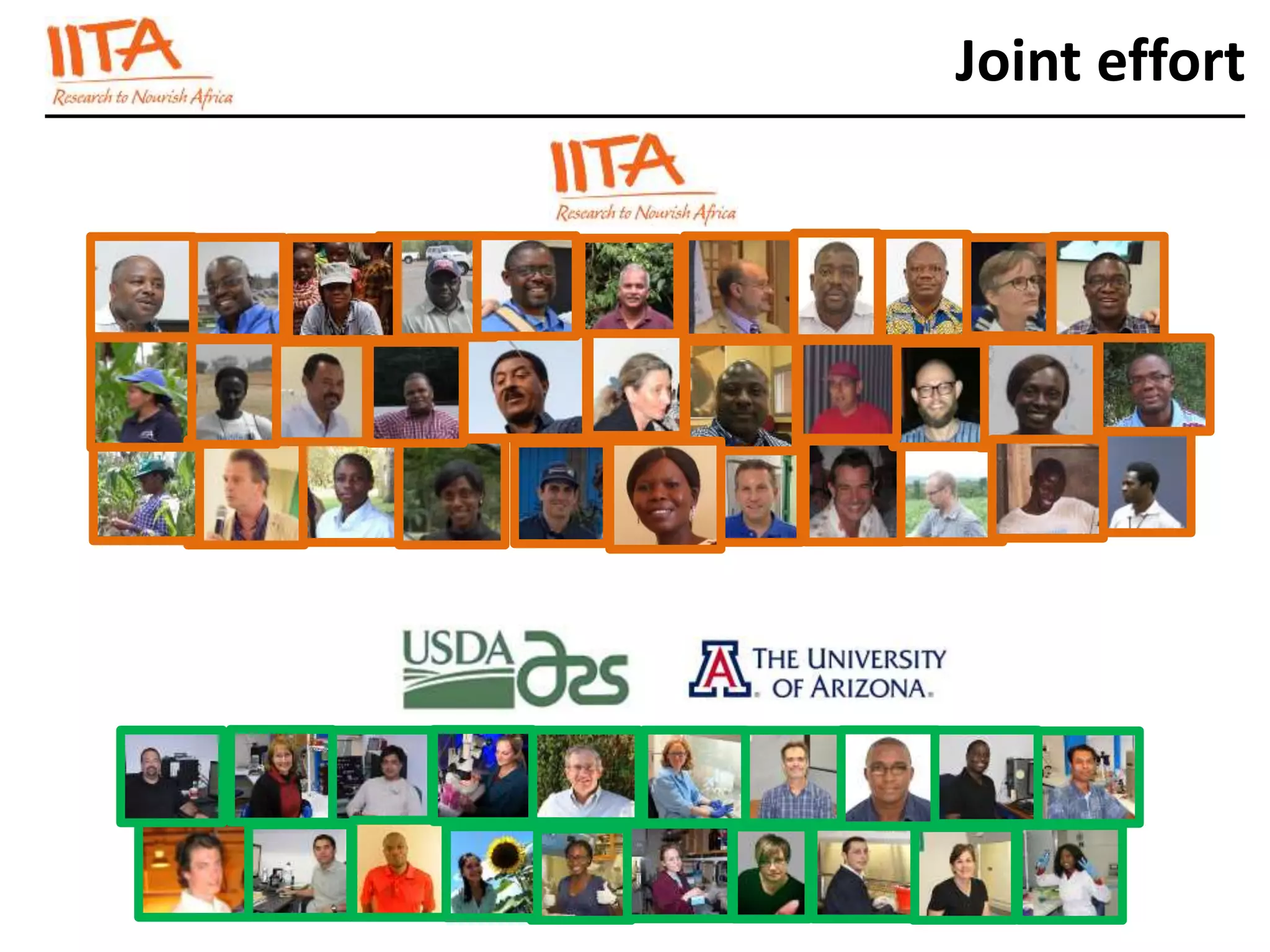
Joint effort
Partners
National Food Security Processing
and Marketing Corporation, The Gambia
www.iita.orgA member of CGIAR consortium
Biocontrol Principles
 In nature, some strains produce a lot
(toxigenic), and others no aflatoxin
(atoxigenic) (Donner, Soil Biol Biochem
2009)
 Atoxigenic strains are already present on
the crop (Atehnkeng et al., IJFM, 2008)
 Increase the frequency of atoxigenic
strains to competitively displace
toxigenic strains (Cotty & Bayman,
Phytopath 1993) to reduce aflatoxin
contamination
 Atoxigenic strains can be applied without
increasing infection and without
increasing the overall quantity of A. flavus
on the crop or in the environment (Cotty,
Phytopath 1994; Atehnkeng et al., Biological
Control 2014)
0
1
2
3
4
5
6
7
8
9
0 20 40 60 80 100
AflatoxinB1(ng/gX10,000)
Isolates (%) in Applied Atoxigenic Strain
 Strains move from
field to stores
 Multiple year & crop
carry-over effect
(Jaime & Cotty,
Phytopath 2006)
 We use only native
strains
Agriculture for Nutrition & Health
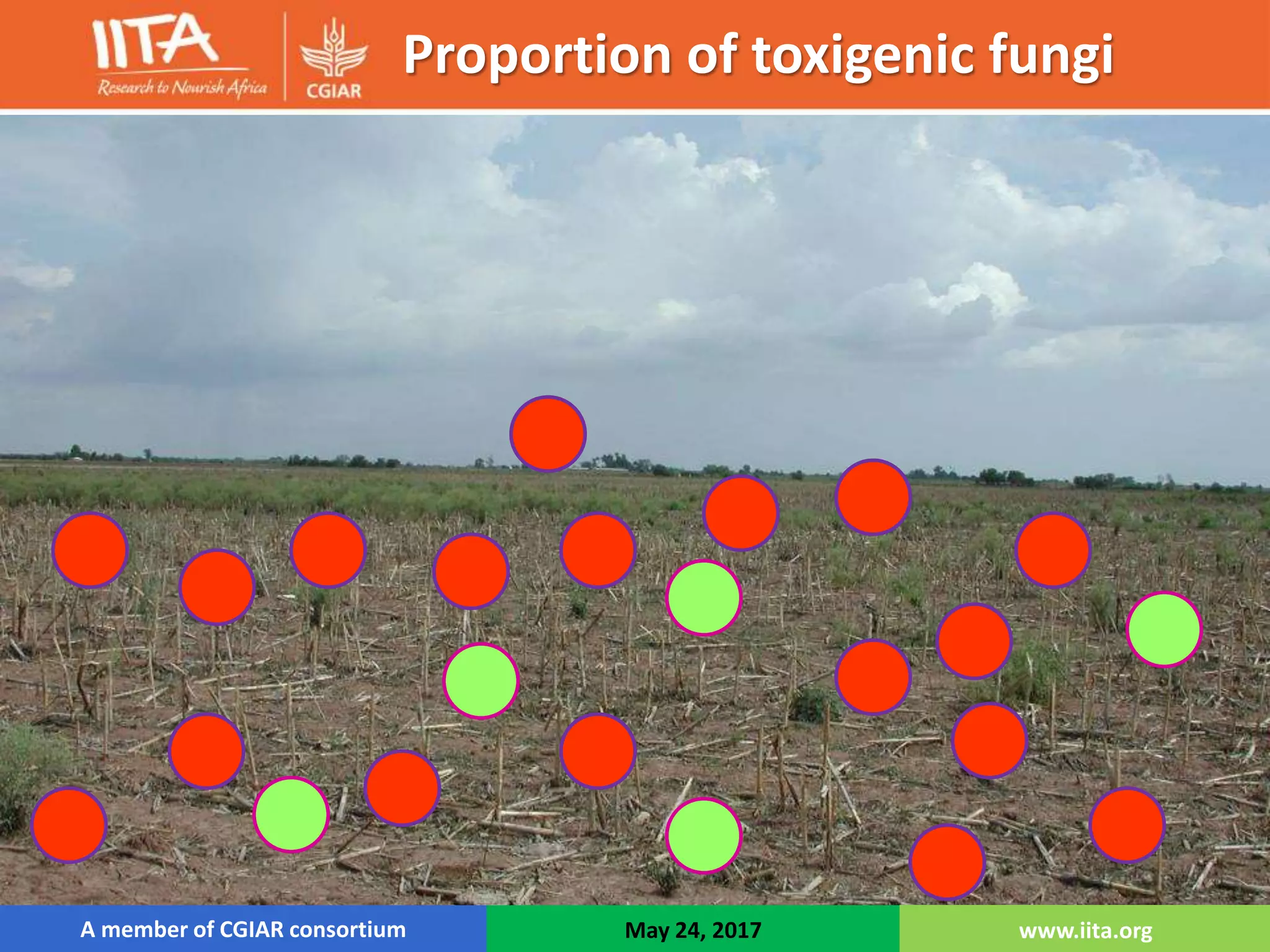
Proportion of toxigenic fungi
A member of CGIAR consortium May 24, 2017 www.iita.org
High aflatoxin contamination
Non-treated fields
A member of CGIAR consortium May 24, 2017 www.iita.org
Little to no aflatoxin contamination
A member of CGIAR consortium May 24, 2017 www.iita.org
Treated fields
www.iita.orgA member of CGIAR consortium
Strain Selection Criteria
In the laboratory (~5,000 strains):
• Does not produce aflatoxin
• VCG/SSR group with
Wide geographic distribution
No toxigenic member
• Defective in >2 aflatoxin & CPA
genes
• Outcompetes toxigenic strains
8-12 native strains
selected for field tests
Agriculture for Nutrition & Health
After field application:
• Superior capacity to colonize,
multiply and survive in soil
• Superior frequency of isolation
from grains
• Superior capacity to reduce
aflatoxin
4 native strains
formulated into
the final
product
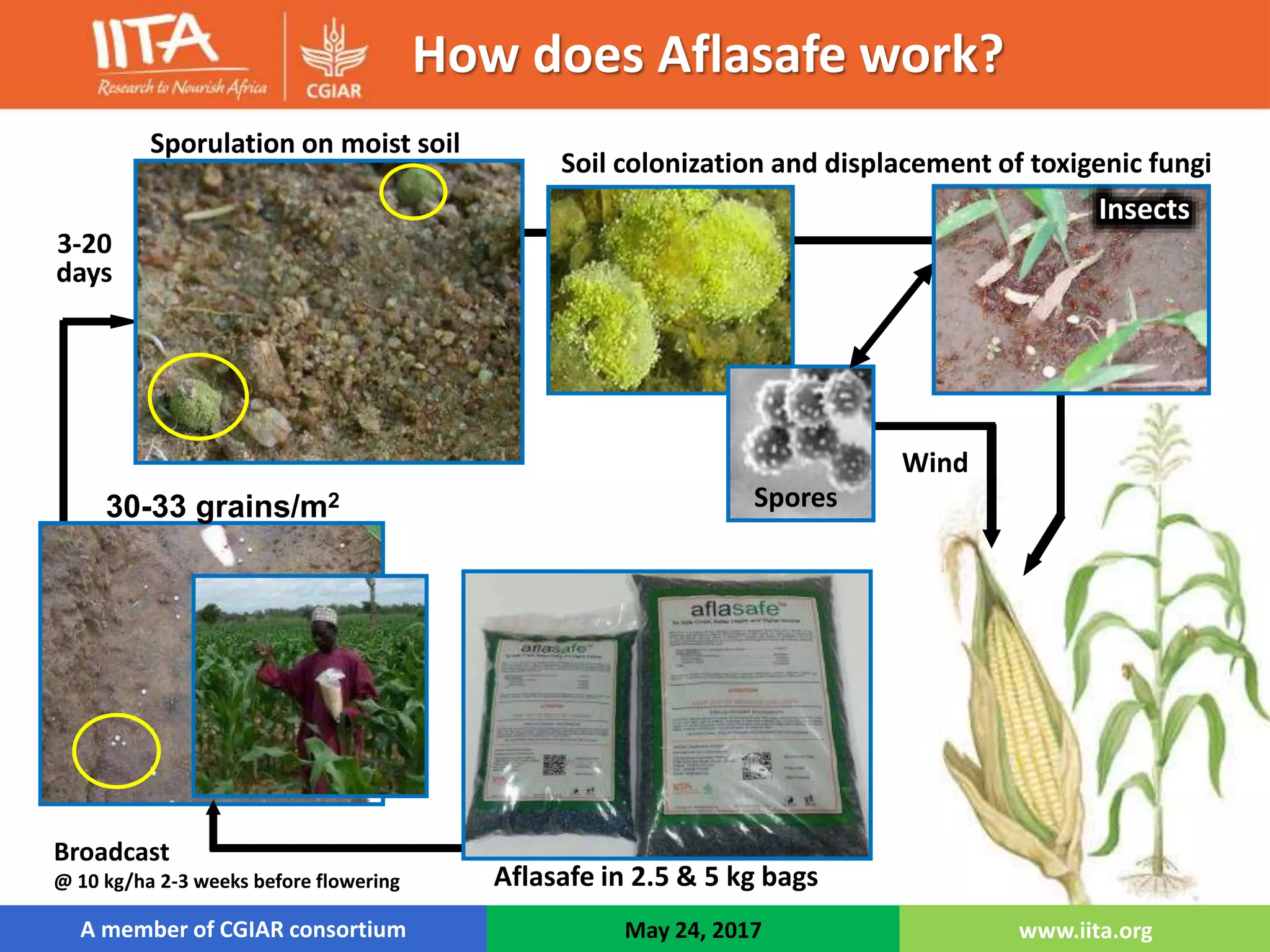
Spores
Aflasafe in 2.5 & 5 kg bags
Wind
Soil colonization and displacement of toxigenic fungi
Sporulation on moist soil
3-20
days
Insects
Broadcast
@ 10 kg/ha 2-3 weeks before flowering
30-33 grains/m2
How does Aflasafe work?
A member of CGIAR consortium May 24, 2017 www.iita.org
www.iita.orgA member of CGIAR consortium
Nigeria: Efficacy on Maize
372
0
20
40
60
80
100
120
2009 2010 2011 2012
Aflasafe™
Control
0
100
200
300
400
500
600
2009 2010 2011 2012
82 94 83 86 82 93 89 90
51 14 199 38 51 14 166 38Fields (#)
Less (%)
At Harvest After Storage
*All means of aflasafe and control pairs significantly different; Student’s t-test (P<0.05)
*
Aflatoxin(ppb)
www.iita.orgA member of CGIAR consortium
Senegal: Efficacy on Groundnut
-
10
20
30
40
50
60
70
80
90
2010 2011 2012 2013 2014
Aflasafe™
Control
-
10
20
30
40
50
60
70
80
90
2010 2011 2012 2013 2014
Aflatoxin(ppb)
At Harvest After Storage
Less 82% 80% 91% 89% 87% 85% 95% 86% 95%
*
*All means of aflasafe and control pairs significantly different; Student’s t-test (P<0.05)
Fields (#) 72 80 76 120 188 72 80 76 120
No
Data
www.iita.orgA member of CGIAR consortium
Kenya: Efficacy of aflasafe KE01™
Area (fields) Control Treated
Reduction
(%)
Hola (n = 20) 885 20 98
Bura (n = 16) 105 7 93
Makueni (n = 15) 85 1 99
Aflatoxin (ppb)
*All means of aflasafe treated and control pairs significantly different; Student’s t-test (P<0.05)
38
20
0
88
60
33
0
10
20
30
40
50
60
70
80
90
100
Treated
Control
Fields (%) above
10 ppb in 3 areas
Fields(%)
Deadly (3,700 ppb & 2,270 ppb)
533 ppb
Hola
Agriculture for Nutrition & Health
www.iita.orgA member of CGIAR consortium
* Treated and control significantly different (P < 0.05) based on Student’s t-test
Efficacy of Aflasafe SN01
0
20
40
60
80
100
120
140
At harvest After Storage Oil cake
Treated
Control
Reduction in
treated
The Gambia - 2014
Aflatoxin(ppb)
n = 44 n = 45 n = 45
97%
81%
85%
* * *
Photo: Lamine Senghor
Agriculture for Nutrition & Health
www.iita.orgA member of CGIAR consortium
Tox & Ecotox Studies -- Summary
Agriculture for Nutrition & Health
Study Type AF36 AflaGuard Aflasafe
Nigeria
Aflasafe
Kenya
Aflasafe
Senegal
Acute oral No adverse No adverse Waived No adverse Waived
Acute dermal Waived Waived Waived No adverse Waived
Acute eye Waived Waived Waived No adverse Waived
Acute Inhalation Waived Waived Waived No adverse Waived
Pulmonary No adverse No adverse Waived Waived Waived
Injection Waived No adverse Waived No adverse Waived
Hypersensitivity Waived Waived Waived No adverse Waived
Avian Injection No adverse No adverse Waived No adverse Waived
Honeybee No adverse No adverse Waived No adverse Waived
Avian oral Waived No adverse No adverse No adverse Waived
Fresh fish & invertebrates Waived Waived Waived No adverse Waived
Algae Waived Waived Waived No adverse Waived
Also waived: Immunotoxicity, wild mammal, beneficial insects, non-target plants and Tier 2 & 3
Senegal
Burkina
Faso
Ghana
Nigeria
Kenya
Tanzania
Mozambique
Zambia
Rwanda
Malawi
Burundi
Uganda
The
Gambia
Strain
development in
progress
Products under
testing in
farmers’ fields
Product ready
for registration
Product registered
&
commercialization
began
www.iita.orgA member of CGIAR consortium
Aflasafe Development in Africa
Agriculture for Nutrition & Health
Country-
specific strains
and products
www.iita.orgA member of CGIAR consortium
This Manufacturing Facility in IITA-Ibadan can
supply aflasafe to treat 2 million ha annually
Large-scale: capacity 5 tons/hour
Product cost: $12 to $18.75/ha
Agriculture for Nutrition & Health
Kenya
Modular Manufacturing Facility
Capacity: 10 tons/day
Cost: $ 700K - 1.2 million
Product cost: $12 – 15/ha
Labour intensive
Kenya
Factory floor
Poultry Feeding Study
$3,200 net
profit from
10,000 birds
in 8 weeks
www.iita.orgMycored Europe, 28 May, 2013A member of CGIAR consortium
Aflasafe maize feed
Toxic maize feed
Agriculture for Nutrition & Health
www.iita.orgwww.iita.orgA member of CGIAR consortium
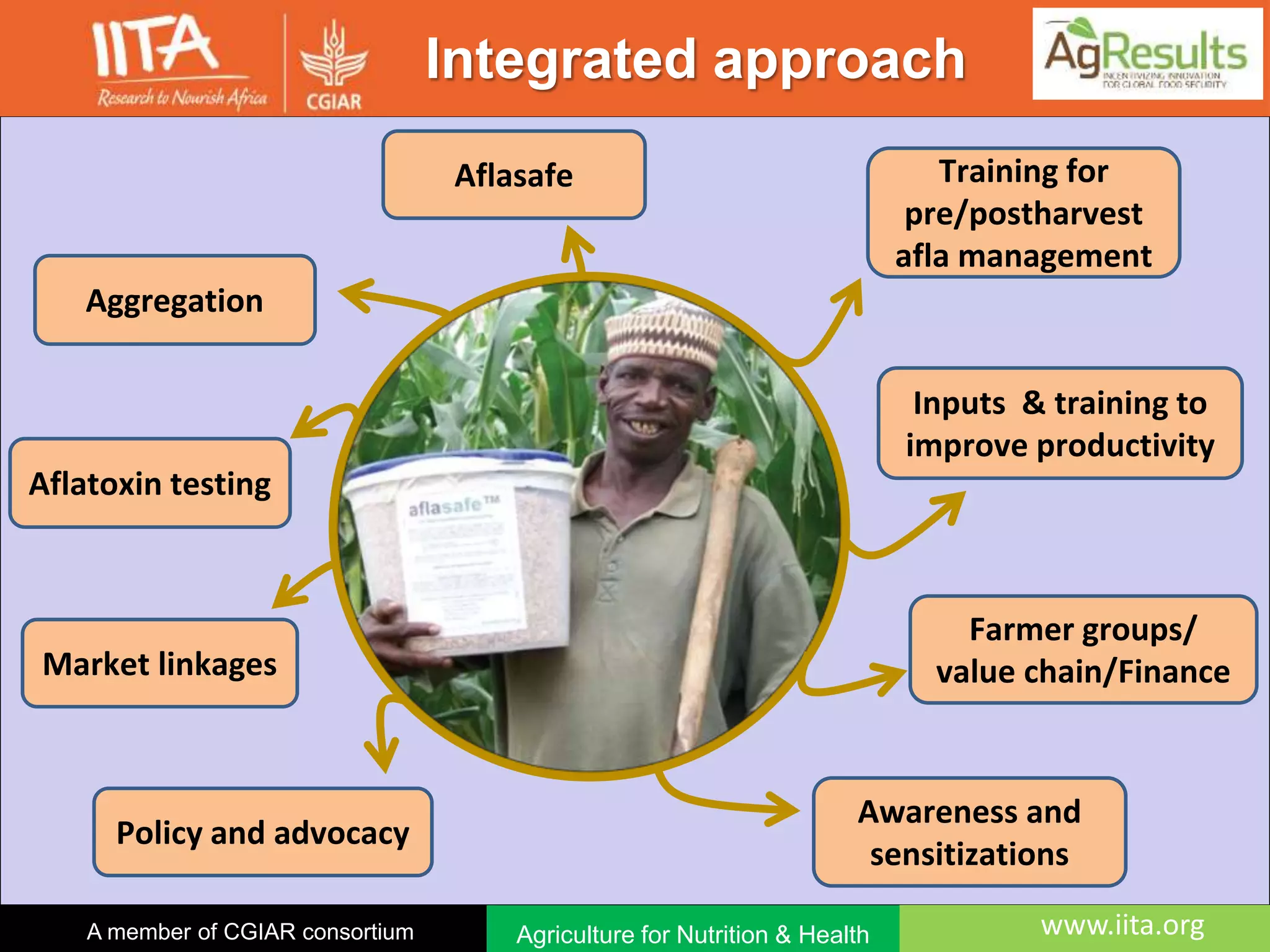
Integrated approach
Aggregation
Aflasafe
Inputs & training to
improve productivity
Farmer groups/
value chain/Finance
Training for
pre/postharvest
afla management
Awareness and
sensitizations
Policy and advocacy
Market linkages
Aflatoxin testing
Agriculture for Nutrition & Health
www.iita.orgwww.iita.orgA member of CGIAR consortium
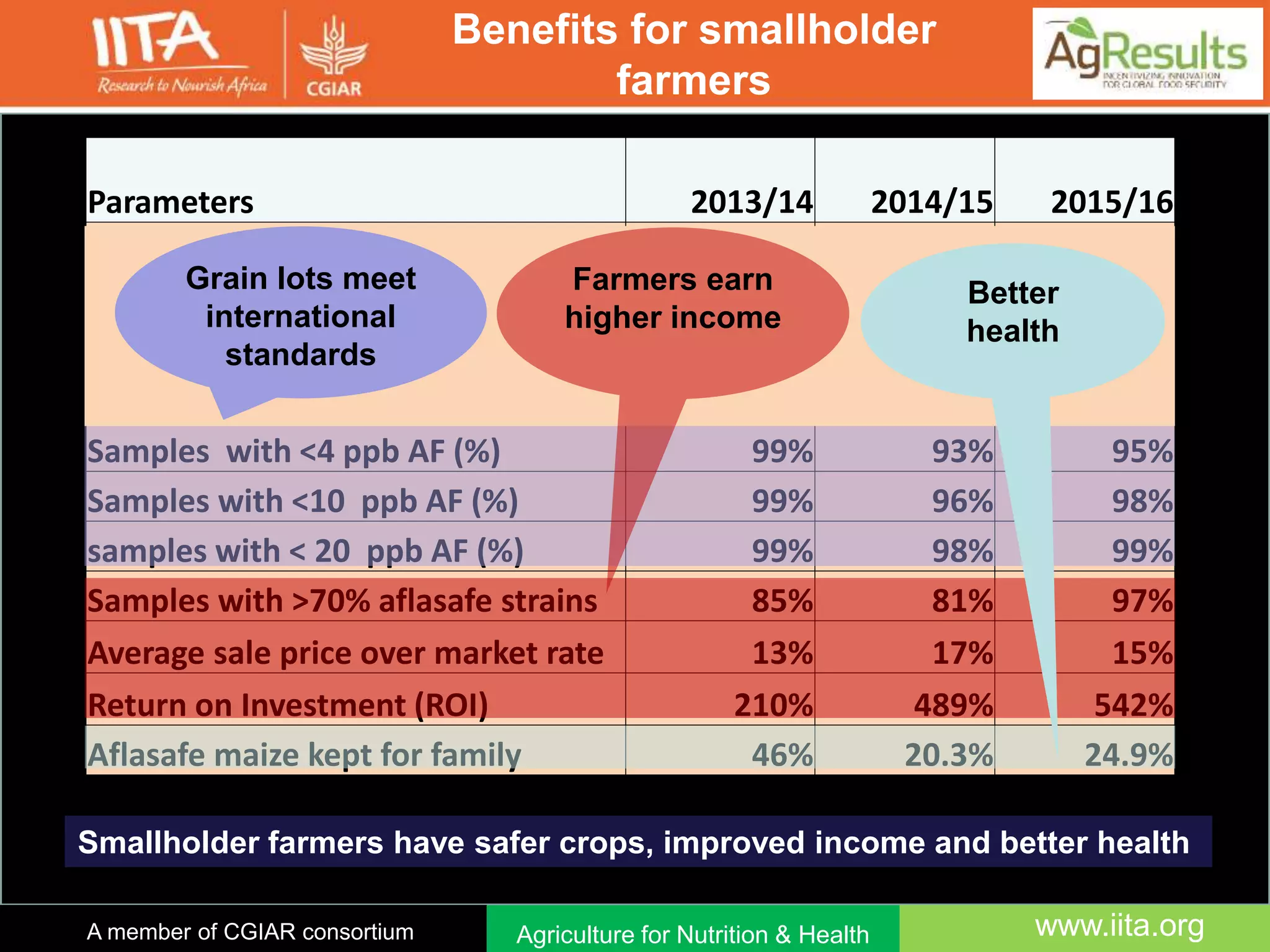
Parameters 2013/14 2014/15 2015/16
Number of implementers 4 9 16
Number of farmers 1,015 3,271 6,279
Treated area (ha) 1,457 4,998 6,601
Maize aggregated for sale (tons) 2,031 7,220 9,368*
Samples with <4 ppb AF (%) 99% 93% 95%
Samples with <10 ppb AF (%) 99% 96% 98%
samples with < 20 ppb AF (%) 99% 98% 99%
Samples with >70% aflasafe strains 85% 81% 97%
Average sale price over market rate 13% 17% 15%
Return on Investment (ROI) 210% 489% 542%
Aflasafe maize kept for family 46% 20.3% 24.9%
Smallholder farmers have safer crops, improved income and better health
Benefits for smallholder
farmers
Grain lots meet
international
standards
Farmers earn
higher income
Better
health
Agriculture for Nutrition & Health
www.iita.org
• Managed by the National
Irrigation Board (NIB)
• Highly productive area
but aflatoxin-prone
• Maize frequently
rejected as >50% strains
in soil are highly toxic
Maize grown under center pivot in Galana-
Kulaku, which is a part of 1 million acre Jubilee
Food Security project of the Kenyan Govt.
• 238 tons aflasafe ordered
(8.1 tons airlifted for
emergency treatment)
from IITA in Nigeria
• The entire crop of 3,000
acres treated with aflasafe
• 99% of harvested grains
had <4 ppb aflatoxins
(meets strict European
limit) in spite of delayed
harvest
Aflasafe KE01 in the Aflasafe
factory in IITA-Nigeria ready
for shipment to Kenya
Maize crop being treated
with Aflasafe KE01 in Galana
Kenya food security project
www.iita.orgA member of CGIAR consortium
Scaling-Up and Models
• Nigeria: AgResults farmers to
produce 260,000 tons of
Aflasafe maize; Public-private
partnership model
• Senegal: Area-wide treatment
in 2013 and 2014 with 16 tons;
20 tons use projected in 2015;
private sector led model
• Kenya: Government buy-in;
about 230 tons procured;
excellent support; public model
• Critical role of PACA and RECs
Agriculture for Nutrition & Health
Senegal
Kenya
www.iita.orgA member of CGIAR consortium
Aflasafe Development in Africa
Agriculture for Nutrition & Health
www.iita.orgA member of CGIAR consortium
Aflasafe Technology Transfer &
Commercialization Project
Put in place the resources required for
registering products, developing and
executing strategies needed for identifying
manufacturing and distribution partners,
transfer of Aflasafe technologies to these
entities, and technically backstop these
partners during the start-up and initial stages
of scale-up execution.
Agriculture for Nutrition & Health
www.iita.orgA member of CGIAR consortium
Summary
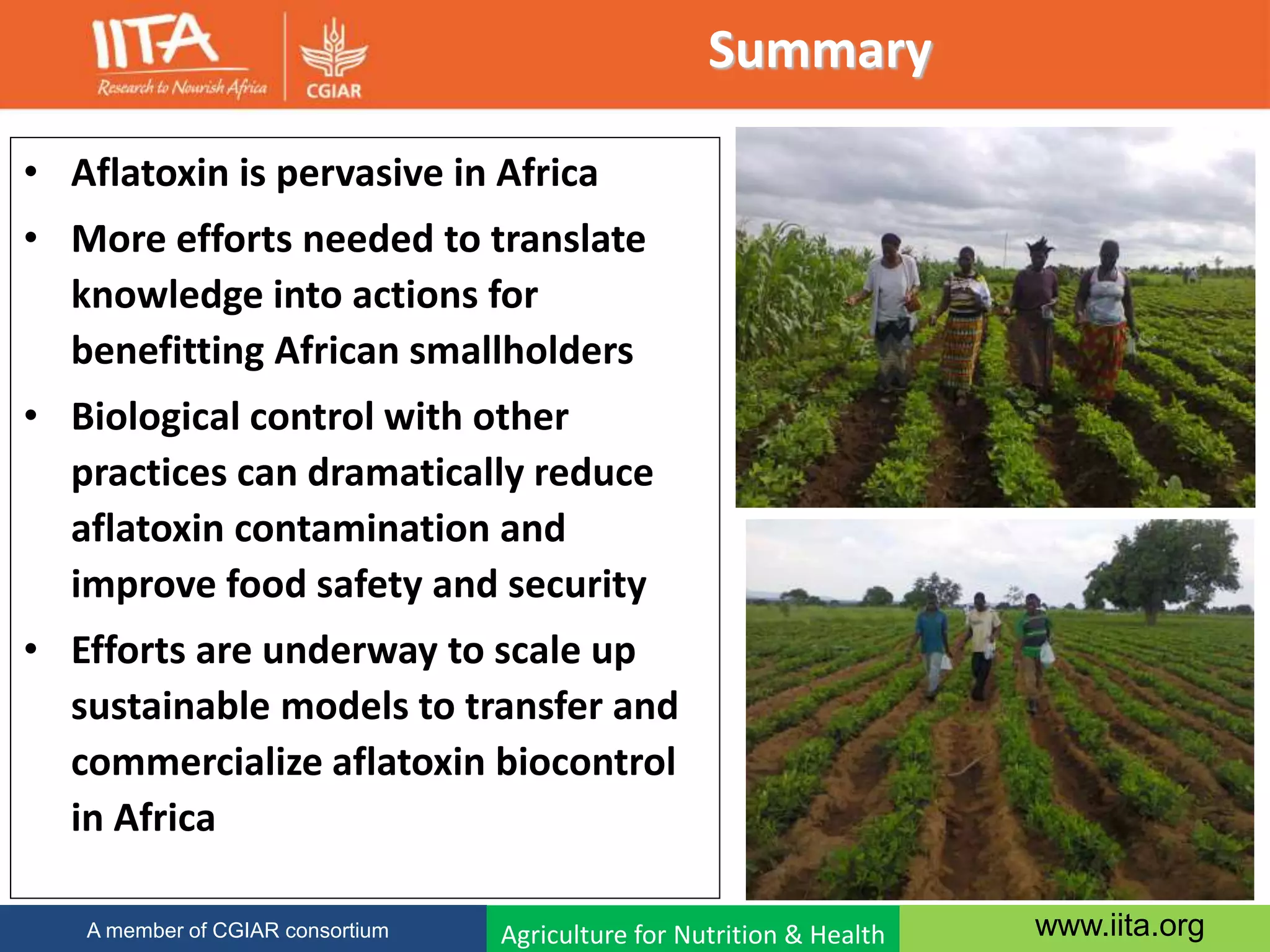
• Aflatoxin is pervasive in Africa
• More efforts needed to translate
knowledge into actions for
benefitting African smallholders
• Biological control with other
practices can dramatically reduce
aflatoxin contamination and
improve food safety and security
• Efforts are underway to scale up
sustainable models to transfer and
commercialize aflatoxin biocontrol
in Africa
Agriculture for Nutrition & Health
Made Possible by Many National Partners in Ministries, Industry, and on the Farm
Nigeria
For more information about aflatoxin biocontrol for Africa, check out: www.aflasafe.com
IITA
Tucson
USDA/ARS
IITA, USDA, & Doreo have Teamed up to Bring
Aflatoxin Prevention to Africa

Overview of Aflasafe Development in Africa

  • 1.
    www.iita.orgA member ofCGIAR consortium Overview of Aflasafe Development in Africa Agriculture for Nutrition & Health Ranajit Bandyopadhyay & Peter Cotty On behalf of the Aflasafe Team
  • 2.
    www.iita.orgA member ofCGIAR consortium Pre-Harvest Problem Aflatoxin (ppb) Maize (n = 241) Peanut (n = 188) > 4 70 54 > 10 52 41 > 20 24 29 Samples (%) with Aflatoxin At harvest -- Nigeria Kenya data: CDC & Ministry of Health, 2004 Aflatoxin (ppb) Maize (n = 342) > 20 53 > 100 34 > 1000 7 In Farmers’ Store -- Kenya Increases after Harvest Agriculture for Nutrition & Health
  • 3.
    www.iita.orgA member ofCGIAR consortium Almost one million acres of several crops treated annually in the US with 2 EPA- Approved products ! Production Room Atoxigenic Strain Manufacturing Facility Arizona Cotton Research & Protection Council (Funded and Governed by the Farmers of Arizona), Phoenix, Arizona Biocontrol Works! Agriculture for Nutrition & Health
  • 4.
    www.iita.orgA member ofCGIAR consortium Biocontrol Works! Agriculture for Nutrition & Health It Works in Africa Too
  • 5.
  • 6.
    Partners National Food SecurityProcessing and Marketing Corporation, The Gambia
  • 7.
    www.iita.orgA member ofCGIAR consortium Biocontrol Principles  In nature, some strains produce a lot (toxigenic), and others no aflatoxin (atoxigenic) (Donner, Soil Biol Biochem 2009)  Atoxigenic strains are already present on the crop (Atehnkeng et al., IJFM, 2008)  Increase the frequency of atoxigenic strains to competitively displace toxigenic strains (Cotty & Bayman, Phytopath 1993) to reduce aflatoxin contamination  Atoxigenic strains can be applied without increasing infection and without increasing the overall quantity of A. flavus on the crop or in the environment (Cotty, Phytopath 1994; Atehnkeng et al., Biological Control 2014) 0 1 2 3 4 5 6 7 8 9 0 20 40 60 80 100 AflatoxinB1(ng/gX10,000) Isolates (%) in Applied Atoxigenic Strain  Strains move from field to stores  Multiple year & crop carry-over effect (Jaime & Cotty, Phytopath 2006)  We use only native strains Agriculture for Nutrition & Health
  • 8.
    Proportion of toxigenicfungi A member of CGIAR consortium May 24, 2017 www.iita.org
  • 9.
    High aflatoxin contamination Non-treatedfields A member of CGIAR consortium May 24, 2017 www.iita.org
  • 10.
    Little to noaflatoxin contamination A member of CGIAR consortium May 24, 2017 www.iita.org Treated fields
  • 11.
    www.iita.orgA member ofCGIAR consortium Strain Selection Criteria In the laboratory (~5,000 strains): • Does not produce aflatoxin • VCG/SSR group with Wide geographic distribution No toxigenic member • Defective in >2 aflatoxin & CPA genes • Outcompetes toxigenic strains 8-12 native strains selected for field tests Agriculture for Nutrition & Health After field application: • Superior capacity to colonize, multiply and survive in soil • Superior frequency of isolation from grains • Superior capacity to reduce aflatoxin 4 native strains formulated into the final product
  • 12.
    Spores Aflasafe in 2.5& 5 kg bags Wind Soil colonization and displacement of toxigenic fungi Sporulation on moist soil 3-20 days Insects Broadcast @ 10 kg/ha 2-3 weeks before flowering 30-33 grains/m2 How does Aflasafe work? A member of CGIAR consortium May 24, 2017 www.iita.org
  • 13.
    www.iita.orgA member ofCGIAR consortium Nigeria: Efficacy on Maize 372 0 20 40 60 80 100 120 2009 2010 2011 2012 Aflasafe™ Control 0 100 200 300 400 500 600 2009 2010 2011 2012 82 94 83 86 82 93 89 90 51 14 199 38 51 14 166 38Fields (#) Less (%) At Harvest After Storage *All means of aflasafe and control pairs significantly different; Student’s t-test (P<0.05) * Aflatoxin(ppb)
  • 14.
    www.iita.orgA member ofCGIAR consortium Senegal: Efficacy on Groundnut - 10 20 30 40 50 60 70 80 90 2010 2011 2012 2013 2014 Aflasafe™ Control - 10 20 30 40 50 60 70 80 90 2010 2011 2012 2013 2014 Aflatoxin(ppb) At Harvest After Storage Less 82% 80% 91% 89% 87% 85% 95% 86% 95% * *All means of aflasafe and control pairs significantly different; Student’s t-test (P<0.05) Fields (#) 72 80 76 120 188 72 80 76 120 No Data
  • 15.
    www.iita.orgA member ofCGIAR consortium Kenya: Efficacy of aflasafe KE01™ Area (fields) Control Treated Reduction (%) Hola (n = 20) 885 20 98 Bura (n = 16) 105 7 93 Makueni (n = 15) 85 1 99 Aflatoxin (ppb) *All means of aflasafe treated and control pairs significantly different; Student’s t-test (P<0.05) 38 20 0 88 60 33 0 10 20 30 40 50 60 70 80 90 100 Treated Control Fields (%) above 10 ppb in 3 areas Fields(%) Deadly (3,700 ppb & 2,270 ppb) 533 ppb Hola Agriculture for Nutrition & Health
  • 16.
    www.iita.orgA member ofCGIAR consortium * Treated and control significantly different (P < 0.05) based on Student’s t-test Efficacy of Aflasafe SN01 0 20 40 60 80 100 120 140 At harvest After Storage Oil cake Treated Control Reduction in treated The Gambia - 2014 Aflatoxin(ppb) n = 44 n = 45 n = 45 97% 81% 85% * * * Photo: Lamine Senghor Agriculture for Nutrition & Health
  • 17.
    www.iita.orgA member ofCGIAR consortium Tox & Ecotox Studies -- Summary Agriculture for Nutrition & Health Study Type AF36 AflaGuard Aflasafe Nigeria Aflasafe Kenya Aflasafe Senegal Acute oral No adverse No adverse Waived No adverse Waived Acute dermal Waived Waived Waived No adverse Waived Acute eye Waived Waived Waived No adverse Waived Acute Inhalation Waived Waived Waived No adverse Waived Pulmonary No adverse No adverse Waived Waived Waived Injection Waived No adverse Waived No adverse Waived Hypersensitivity Waived Waived Waived No adverse Waived Avian Injection No adverse No adverse Waived No adverse Waived Honeybee No adverse No adverse Waived No adverse Waived Avian oral Waived No adverse No adverse No adverse Waived Fresh fish & invertebrates Waived Waived Waived No adverse Waived Algae Waived Waived Waived No adverse Waived Also waived: Immunotoxicity, wild mammal, beneficial insects, non-target plants and Tier 2 & 3
  • 18.
    Senegal Burkina Faso Ghana Nigeria Kenya Tanzania Mozambique Zambia Rwanda Malawi Burundi Uganda The Gambia Strain development in progress Products under testingin farmers’ fields Product ready for registration Product registered & commercialization began www.iita.orgA member of CGIAR consortium Aflasafe Development in Africa Agriculture for Nutrition & Health Country- specific strains and products
  • 19.
    www.iita.orgA member ofCGIAR consortium This Manufacturing Facility in IITA-Ibadan can supply aflasafe to treat 2 million ha annually Large-scale: capacity 5 tons/hour Product cost: $12 to $18.75/ha Agriculture for Nutrition & Health
  • 20.
    Kenya Modular Manufacturing Facility Capacity:10 tons/day Cost: $ 700K - 1.2 million Product cost: $12 – 15/ha Labour intensive Kenya Factory floor
  • 21.
    Poultry Feeding Study $3,200net profit from 10,000 birds in 8 weeks www.iita.orgMycored Europe, 28 May, 2013A member of CGIAR consortium Aflasafe maize feed Toxic maize feed Agriculture for Nutrition & Health
  • 22.
    www.iita.orgwww.iita.orgA member ofCGIAR consortium Integrated approach Aggregation Aflasafe Inputs & training to improve productivity Farmer groups/ value chain/Finance Training for pre/postharvest afla management Awareness and sensitizations Policy and advocacy Market linkages Aflatoxin testing Agriculture for Nutrition & Health
  • 23.
    www.iita.orgwww.iita.orgA member ofCGIAR consortium Parameters 2013/14 2014/15 2015/16 Number of implementers 4 9 16 Number of farmers 1,015 3,271 6,279 Treated area (ha) 1,457 4,998 6,601 Maize aggregated for sale (tons) 2,031 7,220 9,368* Samples with <4 ppb AF (%) 99% 93% 95% Samples with <10 ppb AF (%) 99% 96% 98% samples with < 20 ppb AF (%) 99% 98% 99% Samples with >70% aflasafe strains 85% 81% 97% Average sale price over market rate 13% 17% 15% Return on Investment (ROI) 210% 489% 542% Aflasafe maize kept for family 46% 20.3% 24.9% Smallholder farmers have safer crops, improved income and better health Benefits for smallholder farmers Grain lots meet international standards Farmers earn higher income Better health Agriculture for Nutrition & Health
  • 24.
    www.iita.org • Managed bythe National Irrigation Board (NIB) • Highly productive area but aflatoxin-prone • Maize frequently rejected as >50% strains in soil are highly toxic Maize grown under center pivot in Galana- Kulaku, which is a part of 1 million acre Jubilee Food Security project of the Kenyan Govt. • 238 tons aflasafe ordered (8.1 tons airlifted for emergency treatment) from IITA in Nigeria • The entire crop of 3,000 acres treated with aflasafe • 99% of harvested grains had <4 ppb aflatoxins (meets strict European limit) in spite of delayed harvest Aflasafe KE01 in the Aflasafe factory in IITA-Nigeria ready for shipment to Kenya Maize crop being treated with Aflasafe KE01 in Galana Kenya food security project
  • 25.
    www.iita.orgA member ofCGIAR consortium Scaling-Up and Models • Nigeria: AgResults farmers to produce 260,000 tons of Aflasafe maize; Public-private partnership model • Senegal: Area-wide treatment in 2013 and 2014 with 16 tons; 20 tons use projected in 2015; private sector led model • Kenya: Government buy-in; about 230 tons procured; excellent support; public model • Critical role of PACA and RECs Agriculture for Nutrition & Health Senegal Kenya
  • 26.
    www.iita.orgA member ofCGIAR consortium Aflasafe Development in Africa Agriculture for Nutrition & Health
  • 27.
    www.iita.orgA member ofCGIAR consortium Aflasafe Technology Transfer & Commercialization Project Put in place the resources required for registering products, developing and executing strategies needed for identifying manufacturing and distribution partners, transfer of Aflasafe technologies to these entities, and technically backstop these partners during the start-up and initial stages of scale-up execution. Agriculture for Nutrition & Health
  • 28.
    www.iita.orgA member ofCGIAR consortium Summary • Aflatoxin is pervasive in Africa • More efforts needed to translate knowledge into actions for benefitting African smallholders • Biological control with other practices can dramatically reduce aflatoxin contamination and improve food safety and security • Efforts are underway to scale up sustainable models to transfer and commercialize aflatoxin biocontrol in Africa Agriculture for Nutrition & Health
  • 29.
    Made Possible byMany National Partners in Ministries, Industry, and on the Farm Nigeria For more information about aflatoxin biocontrol for Africa, check out: www.aflasafe.com IITA Tucson USDA/ARS IITA, USDA, & Doreo have Teamed up to Bring Aflatoxin Prevention to Africa

Editor's Notes

  • #11 En este campo de maiz pueden ver que existen muchos individuos productores de toxinas en el aire, la planta, o en suelo. * Afortunadamente, tambien existen hongos dentro de esta misma seccion fungica que no las producen y que pueden ser utilizados como agentes de biocontrol para reducir la contaminacion. La mayoria de estos grupos de individuos que no producen toxinas son altamente competitivos, por lo que desplazan a los individuos toxicos y ocupan los lugares que estos ocuparian.
  • #12 En este campo de maiz pueden ver que existen muchos individuos productores de toxinas en el aire, la planta, o en suelo. * Afortunadamente, tambien existen hongos dentro de esta misma seccion fungica que no las producen y que pueden ser utilizados como agentes de biocontrol para reducir la contaminacion. La mayoria de estos grupos de individuos que no producen toxinas son altamente competitivos, por lo que desplazan a los individuos toxicos y ocupan los lugares que estos ocuparian.
  • #13 Una vez aplicdo el producto en el campo, la cantidad de individuos beneficos se incrementa y los niveles de aflatoxinas se reducen a niveles permitidos por las agencias alrededor del mundo.
  • #24 Aflasafe is a biopesticide developed by IITA and USDA-ARS and registered by NAFDAC for aflatoxin mitigation in maize and groundnut in Nigeria. The demonstration-scale manufacturing aflasafe facility, funded by the Bill & Melinda Gates Foundation under the aegis of Partnership for Aflatoxin Control in Africa, was built in 2014 to supply aflasafe to farmers. This is the largest aflatoxin biocontrol product manufacturing plant and has the highest production throughput in the world. Nigerian farmers are purchasing aflasafe to treat their maize fields. Aflasafe (www.aflasafe.com) is packaged in 2.5 kg and 5 kg bags and available for sale at IITA’s Business Incubation Platform.