CILIARY BODY
FORWARD CONTINUATIONOF CHOROID
ANTERIOR PART HAVING FINGER LIKE
CILIARY PROCESSES CALLED PARS PLICATA
POSTERIOR SMOOTH PART PARS PLANA
5.
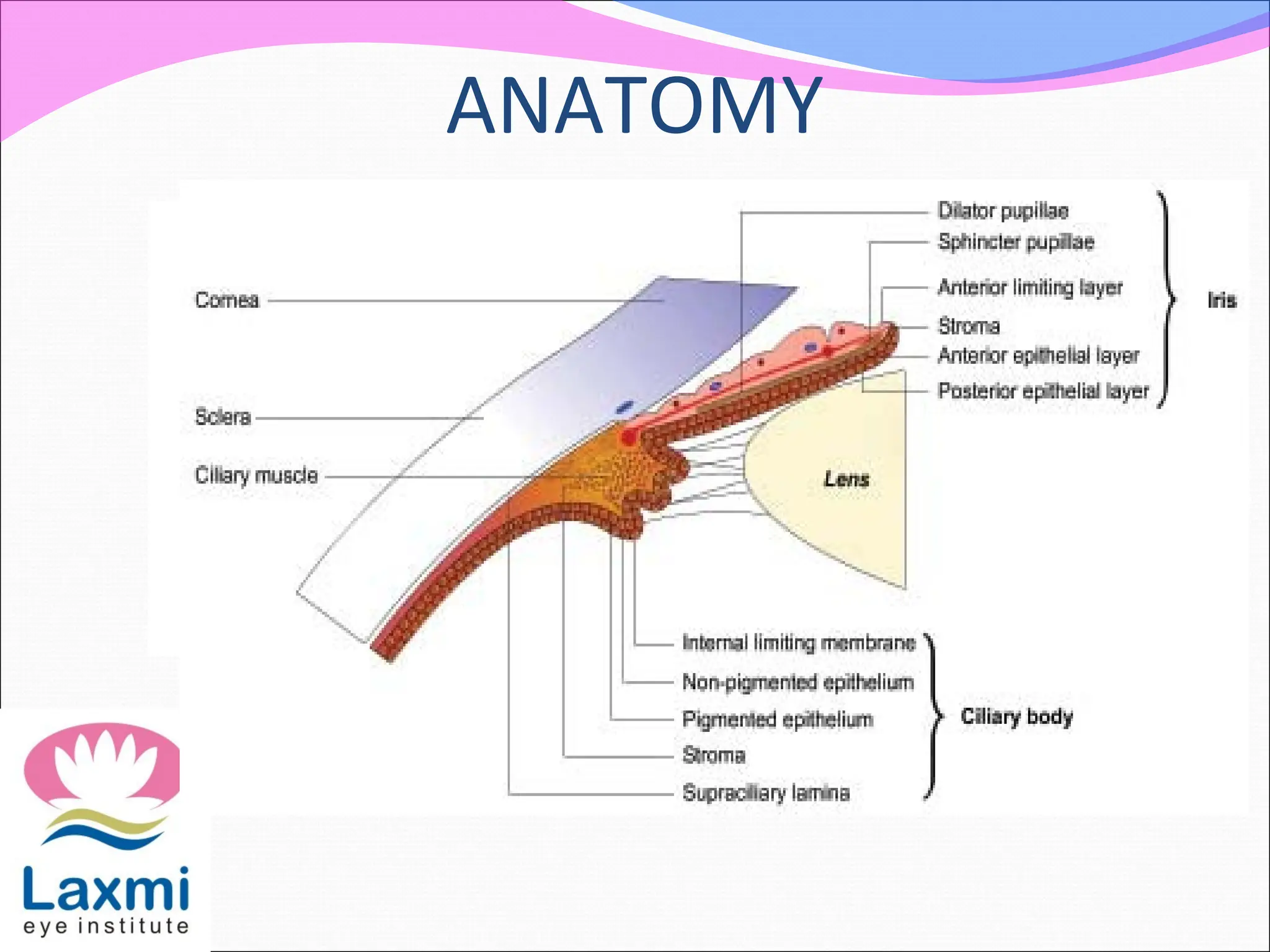
CILIARY PROCESSES
THESE AREFINGER LIKE PROJECTIONS
70-80 IN NUMBER
2 MM LONG AND 0.5 MM IN D
WHITE IN COLOUR
EACH PROCESS LINED BY 2 LAYERS OF EPITHELIAL CELLS
IT CONTAINS BLOOD VESSELS AND LOOSE CONNECTIVE
TISSUSE
SITE OF AQUEOUS PRODUCTION
Ciliary epithelium
Nonpigmented -inner layer, adjacent to aqueous in
the posterior chamber,
consisting of columnar cells (cuboidal in pars plana).
Intercellular tight junctions (zonulae occludens) form
major element of blood-aqueous barrier.
Tips or crests of nonpigmented ciliary epithelia are
site of active secretion,
hence numerous mitochondria, rough
endoplasmic reticulum, pinocytic
8.
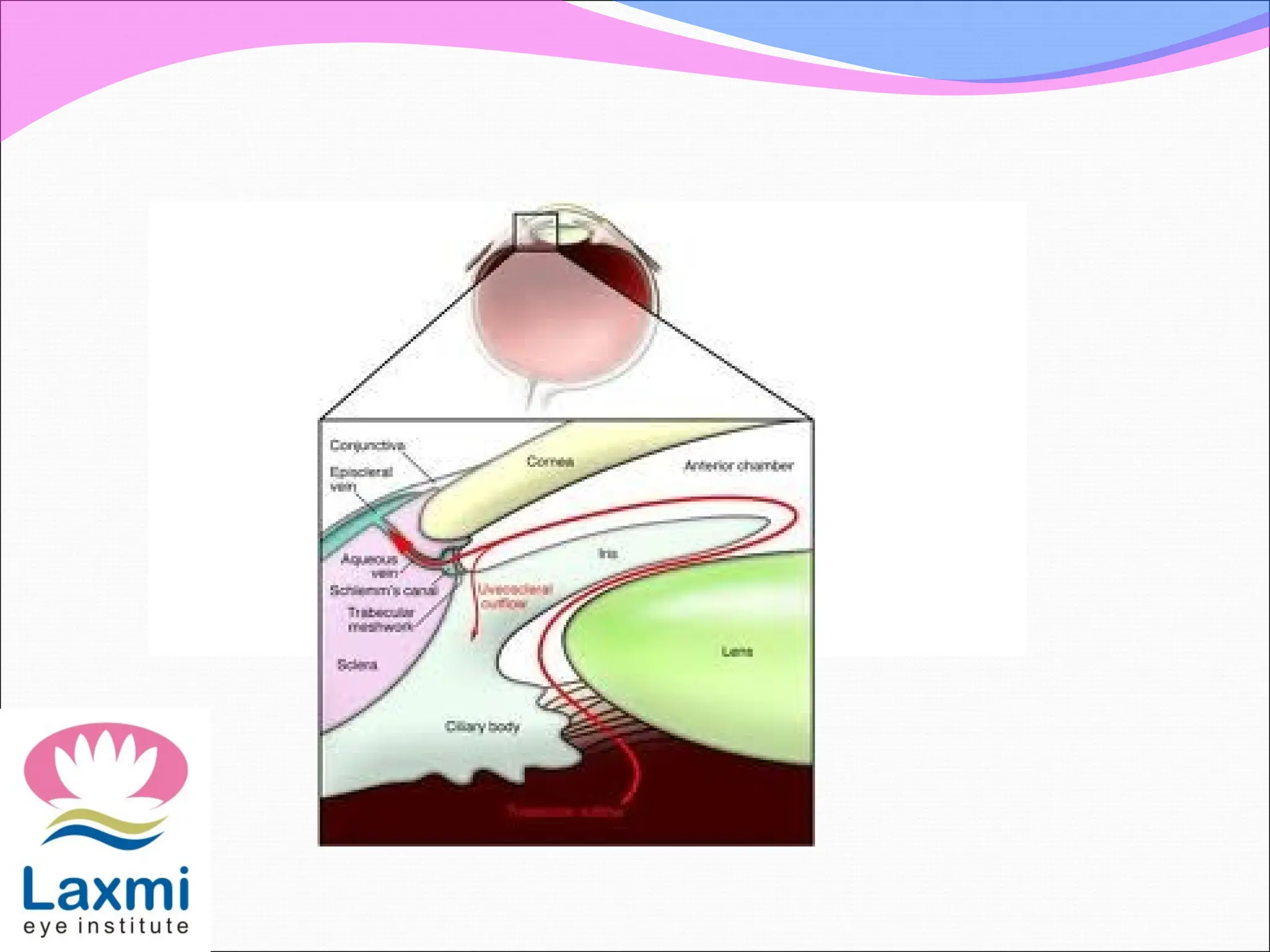
Angle of anteriorchamber
Clinically angle structures can be visualized by
goniosciopic examination
Starting from posterior to anterior
1)Ciliary band
2)Scleral spur
3)Trabecular meshwork
4)Schwalbes line
9.
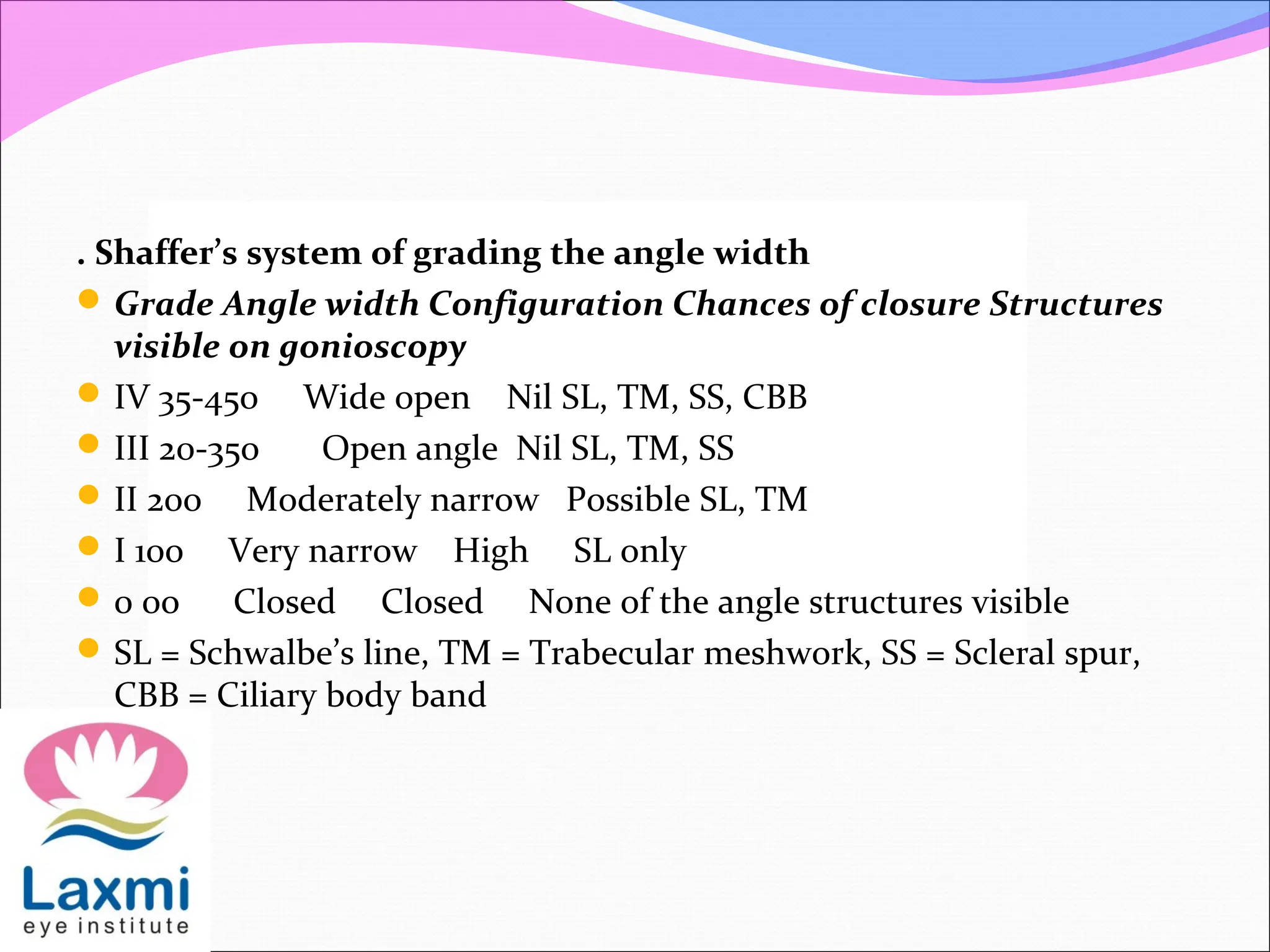
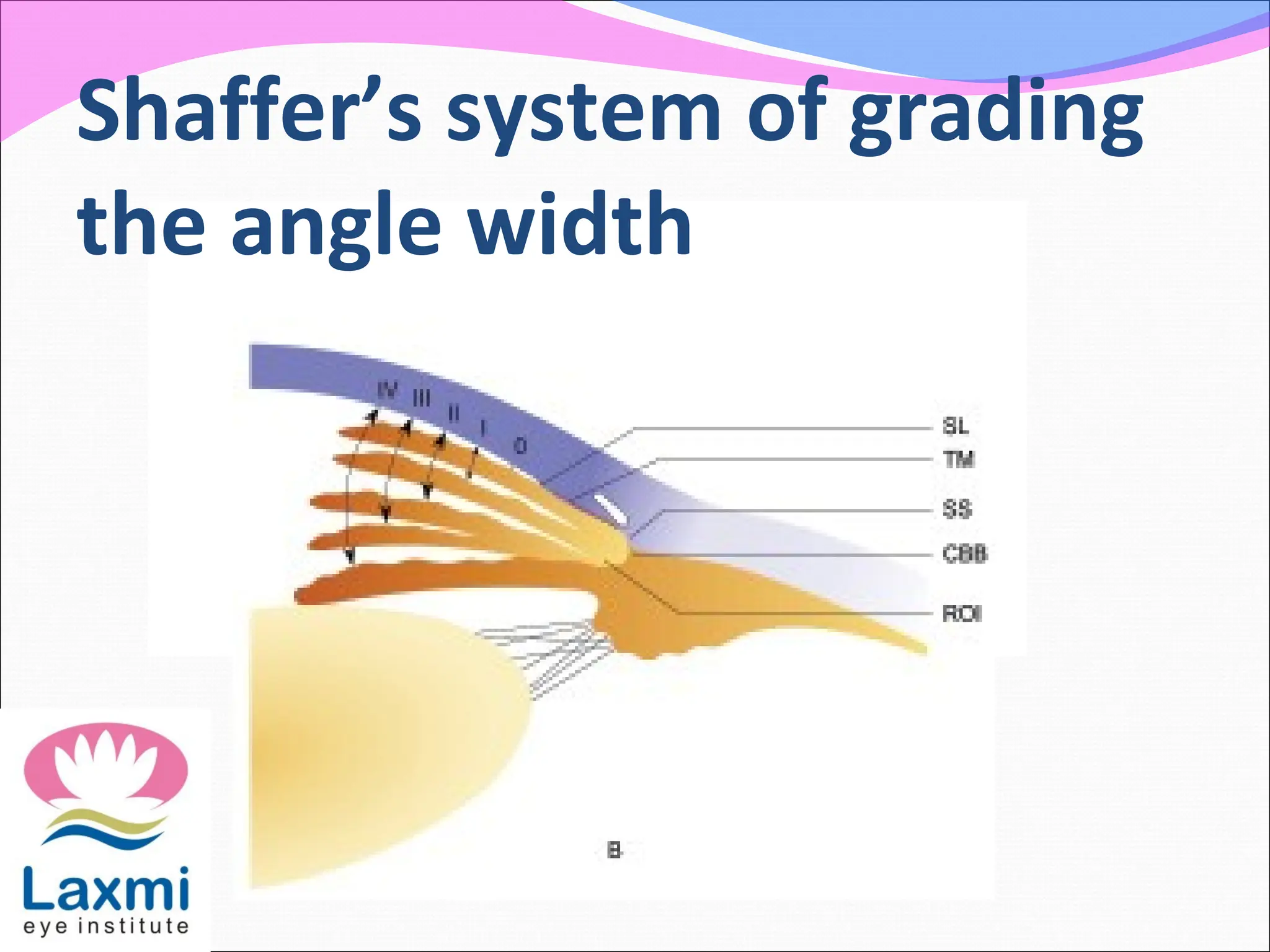
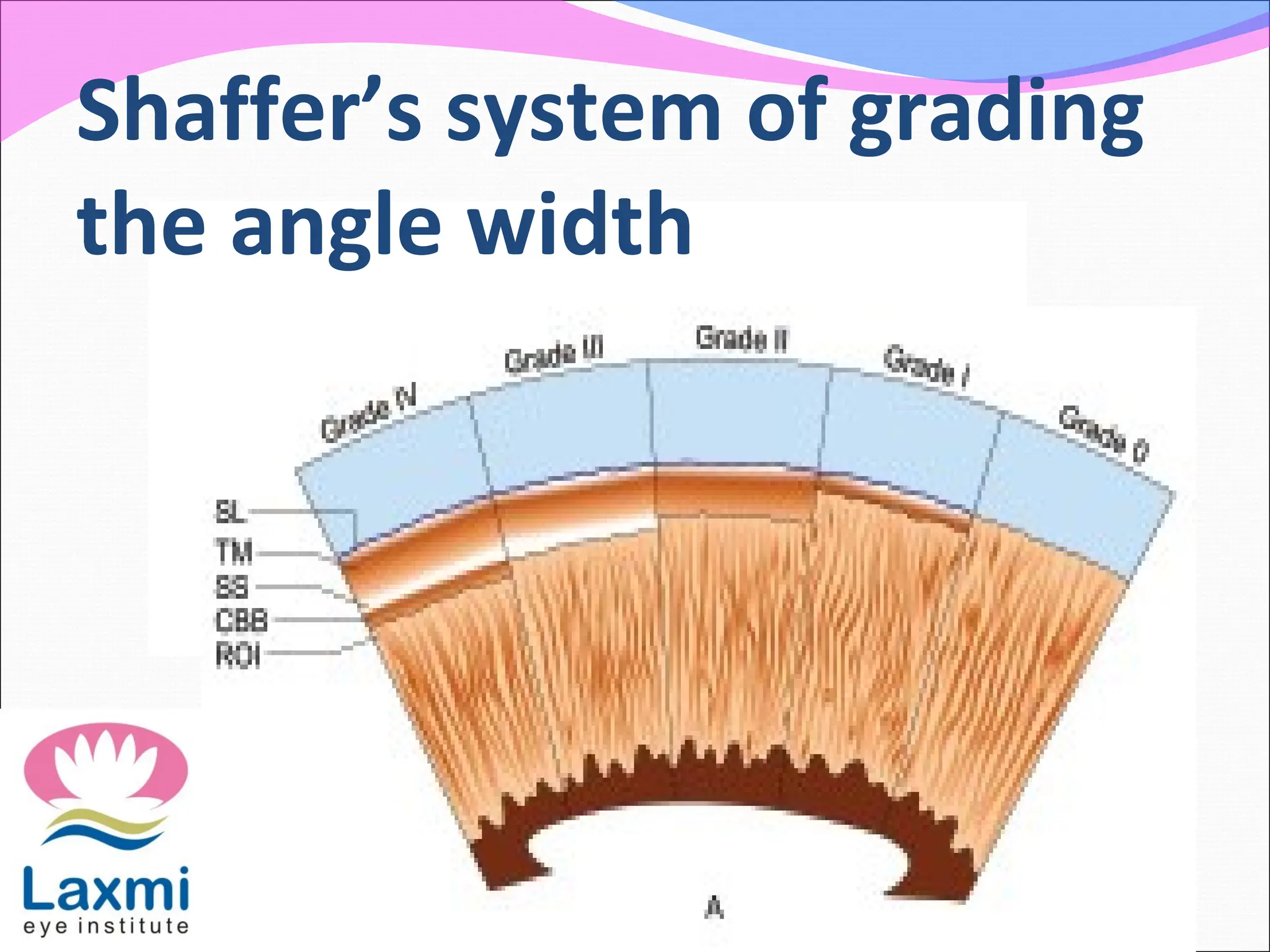
. Shaffer’s systemof grading the angle width
Grade Angle width Configuration Chances of closure Structures
visible on gonioscopy
IV 35-45o Wide open Nil SL, TM, SS, CBB
III 20-35o Open angle Nil SL, TM, SS
II 20o Moderately narrow Possible SL, TM
I 10o Very narrow High SL only
0 0o Closed Closed None of the angle structures visible
SL = Schwalbe’s line, TM = Trabecular meshwork, SS = Scleral spur,
CBB = Ciliary body band
TRABECULAR MESHWORK
IT ISSIEVE LIKE STRUCTURE THROUGH WHICH AQUEOUS
HUMOUR LEAVES EYE
CONSIST OF 3 PORTIONS
1)UVEAL MESHWORK
-Innermost part of TM, extends from iris root and ciliary body to
schwalbes line
-the arrangement of uveal trabecular bands create opening of 25 mu to
75 mu
-least resistance to flow
20.
2)CORNEOSCLERAL MESHWORK
-larger middleportion ,extends from scleral spur to
lateral wall of scleral sulcus
-opening 5 mu to 50 mu
Moderate resistance to flow
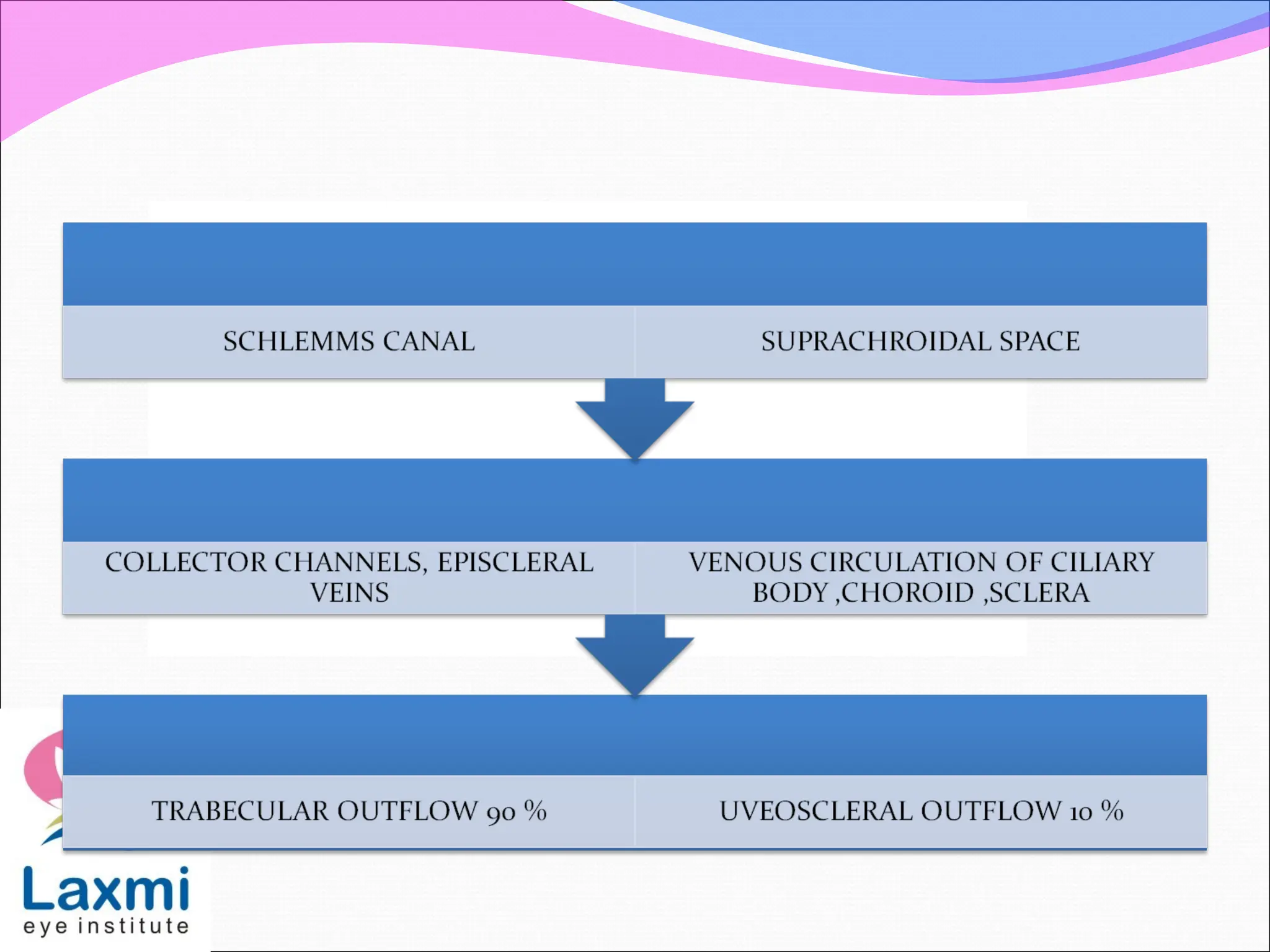
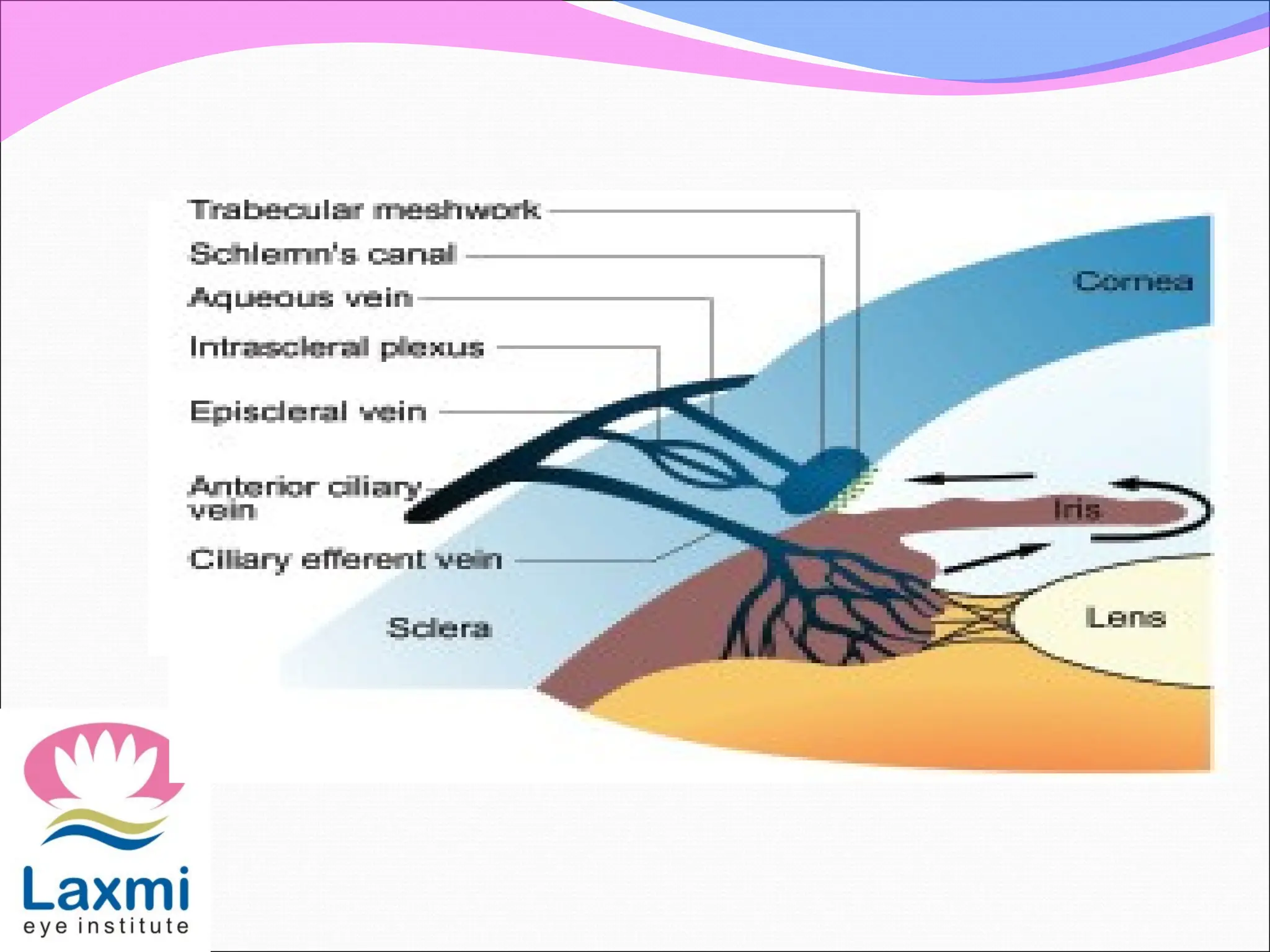
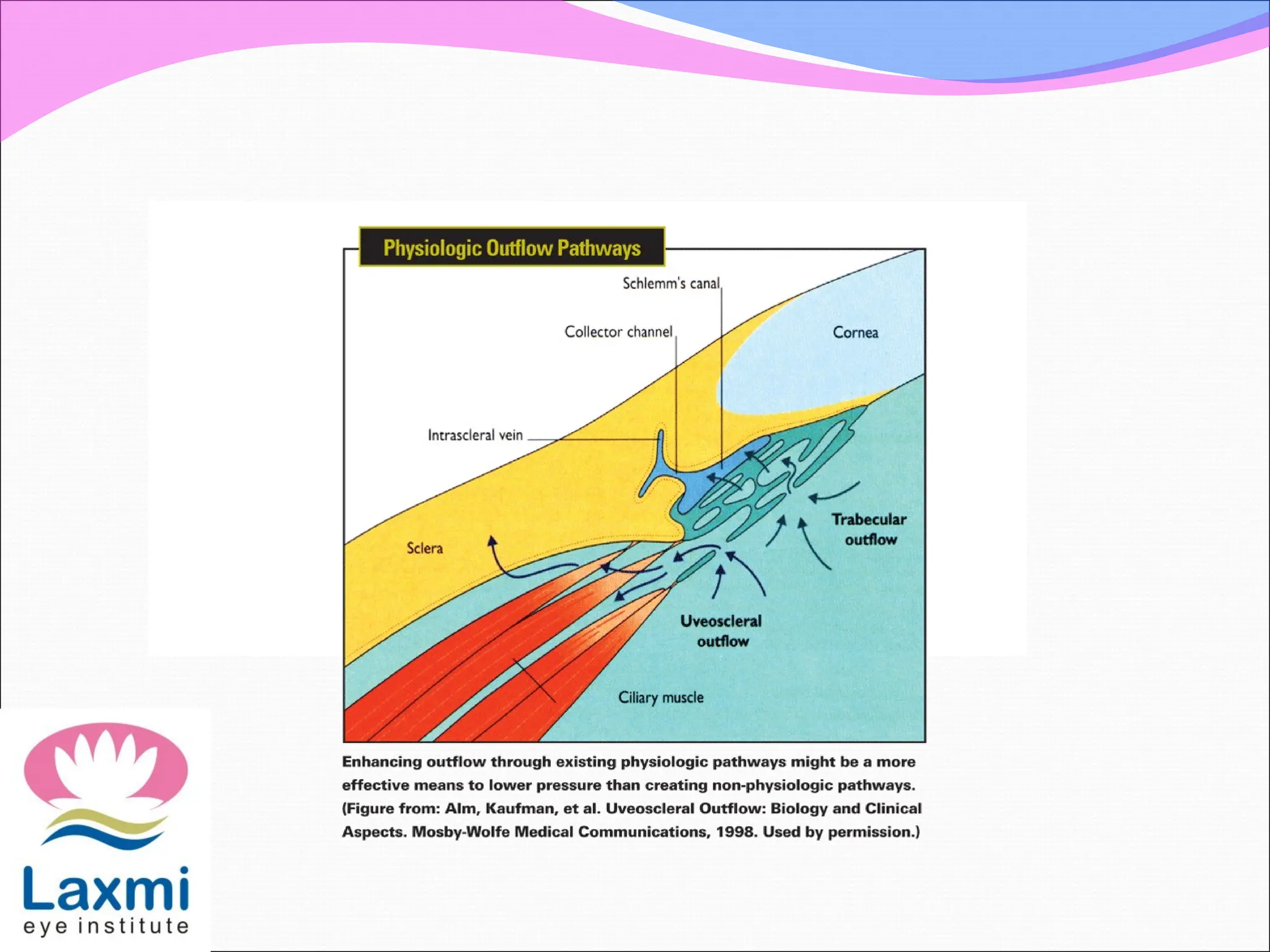
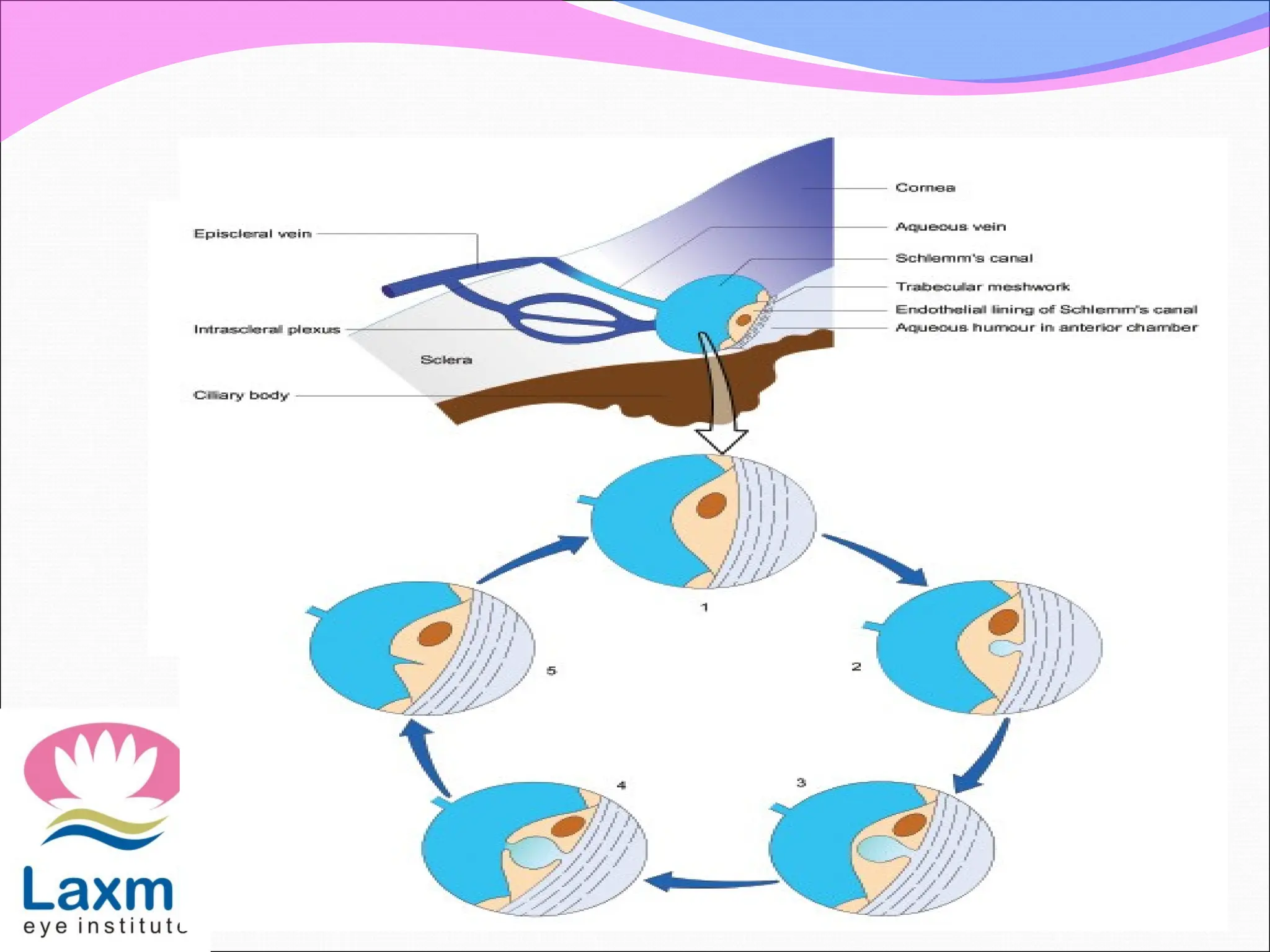
SCHLEMMS CANAL
IT ISENDOTHELIAL LINED OVAL CHANNEL PRESENT
CIRCUMFERENTIALLY IN SCLERAL SULCUS
THE ENDOTHELIAL CELLS OF ITS INNER WALL ARE
IRREGULAR, SPINDLE SHAPED AND CONTAIN GAINT
VACUOLES
THE OUTER WALL OF THE CANAL IS LINED BY
SMOOTH FLAT CELLS
CONTAINS OPENING OF COLLECTOR CHANNELS
25.
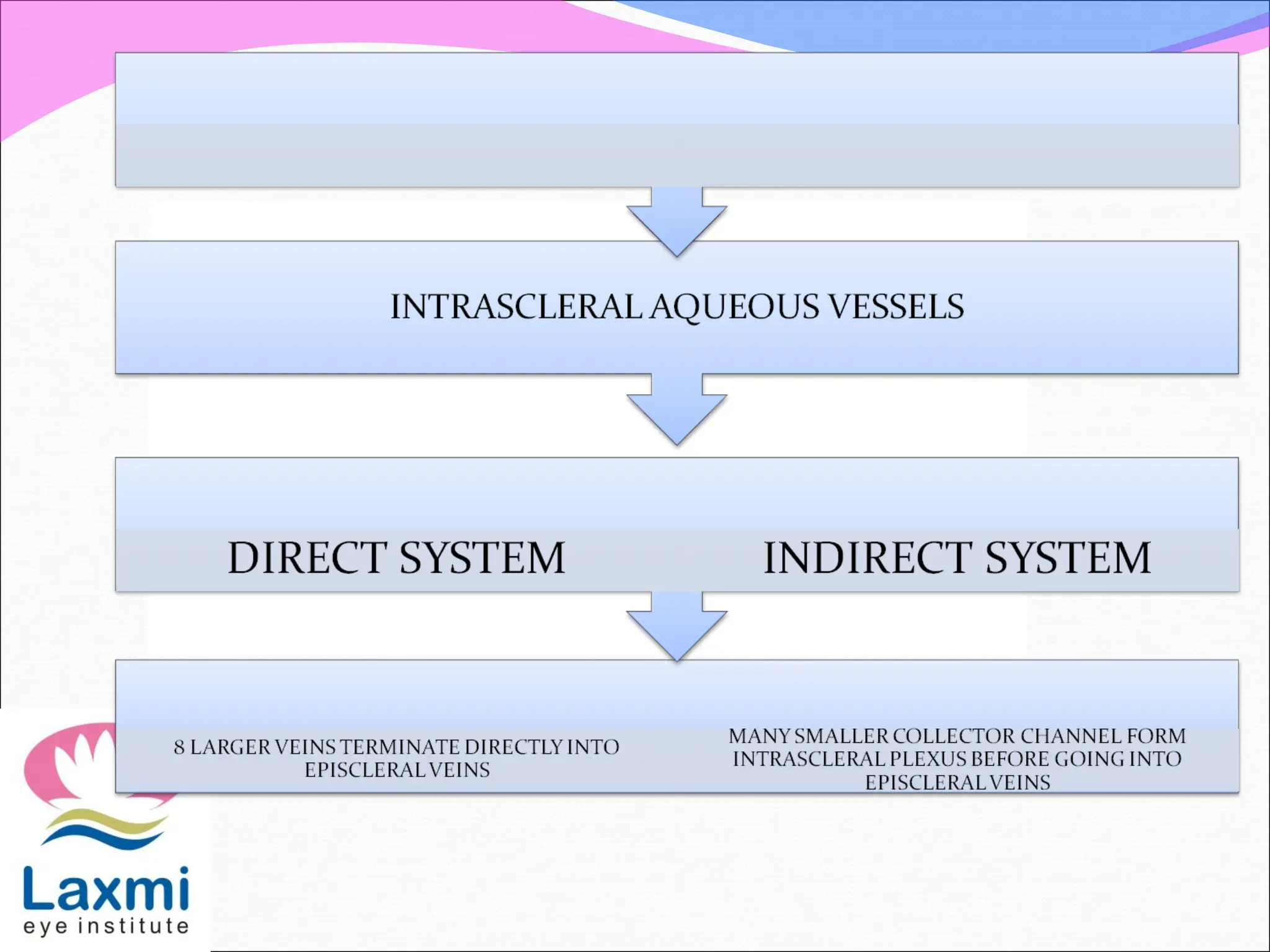
COLLECTOR CHANNELS
ALSO CALLEDINTRASCLERAL AQUEOUS VESSELS
ABOUT 25-35 IN NUMBER
LEAVES SCHLEMMS CANAL AT OBLIQUE ANGLES TO
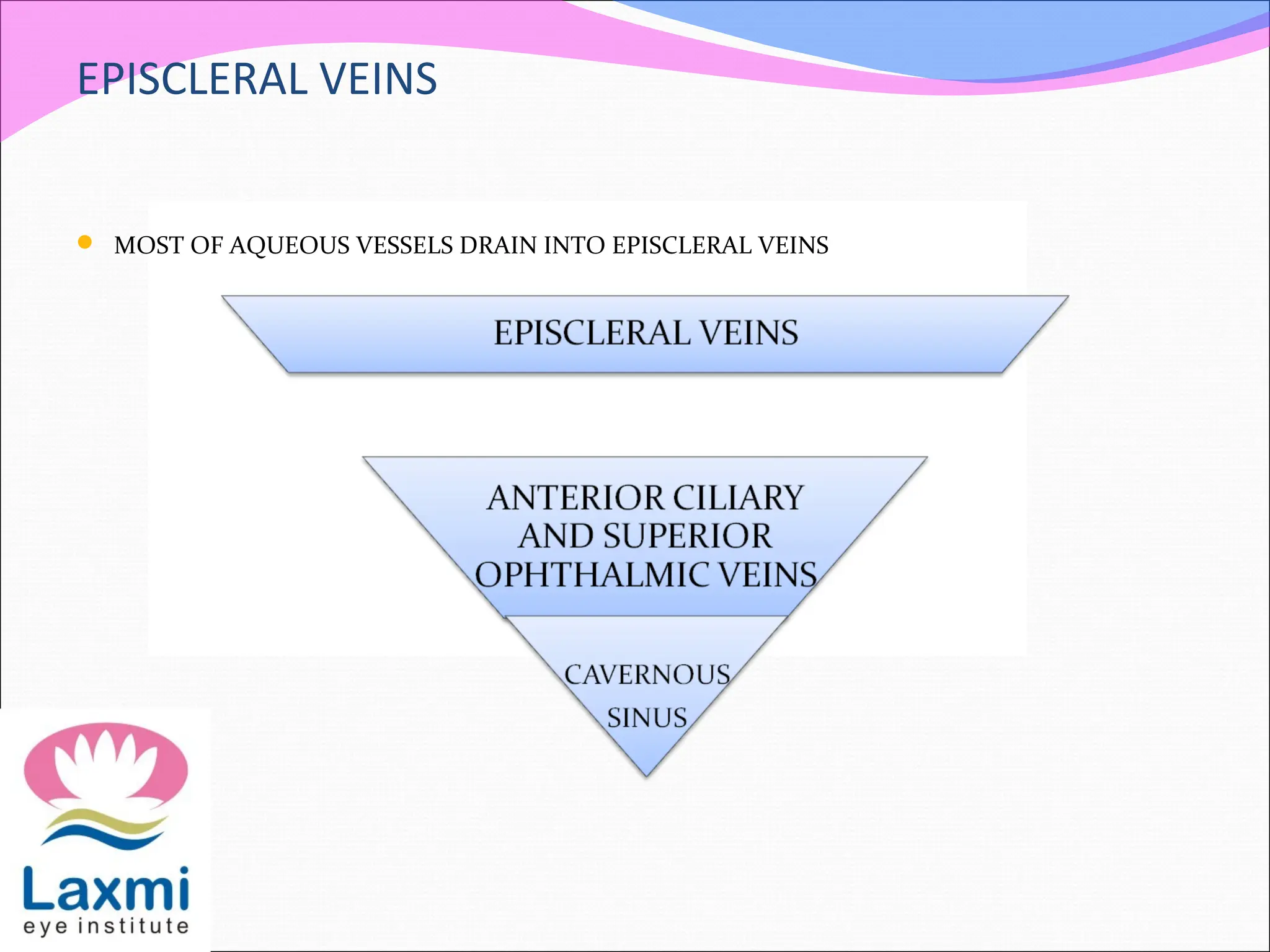
TERMINATE INTO EPISCLERAL VEINS
NO VALVES ARE PRESENT IN COLLECTOR CHANNELS
THESE INTRASCLERAL AQUEOUS VESSELS CAN BE
DIVIDED INTO TWO SYSTEM
27.
DIRECT SYSTEM
ON SLITLAMP , THESE APPEAR AS CLEAR VESSELS WITH
AQUEOUS CALLED AS AQUEOUS VEINS BY ASCHER
AS THESE VESSELS TERMINATE INTO EPISCLERAL AND
CONJUNCTIVAL VEINS IN LAMINATED JUNCTIONS ,CALLED AS
LAMINATED VEIN OF GOLDMANN
Aqueous humor
isa relatively cell free,protein free
fluid formed by non pigmented ciliary epithelium
Slightly hypertonic
Acidic , PH IS 7.2
Marked excess of ascorbate
Marked deficit of proteins
Slight excess of chloride and lactic acid
30.
PHYSICOCHEMICAL PROPERTIES
VOLUME
0.31 ML(0.25 ml in AC 0.06 ml in PC)
REFRACTIVE INDEX
1.336 SLIGHTLY LOWER THAN CORNEA
SLIGHT DIVERGENCE OF LIGHT AS IT PASS CORNEA -AQUEOUS
INTERFACE
DENSITY
SLIGHTLY GREATER THAN WATER
31.
OSMOTICS PRESSURE
AQUEOUS ISSLIGHTLY HYPEROSMOTIC TO PLASMA BY 3 TO 5
MOSM/L
PH
ACDIC IN AC 7.2
RATE OF FORMATION
2.3 Ul/min
32.
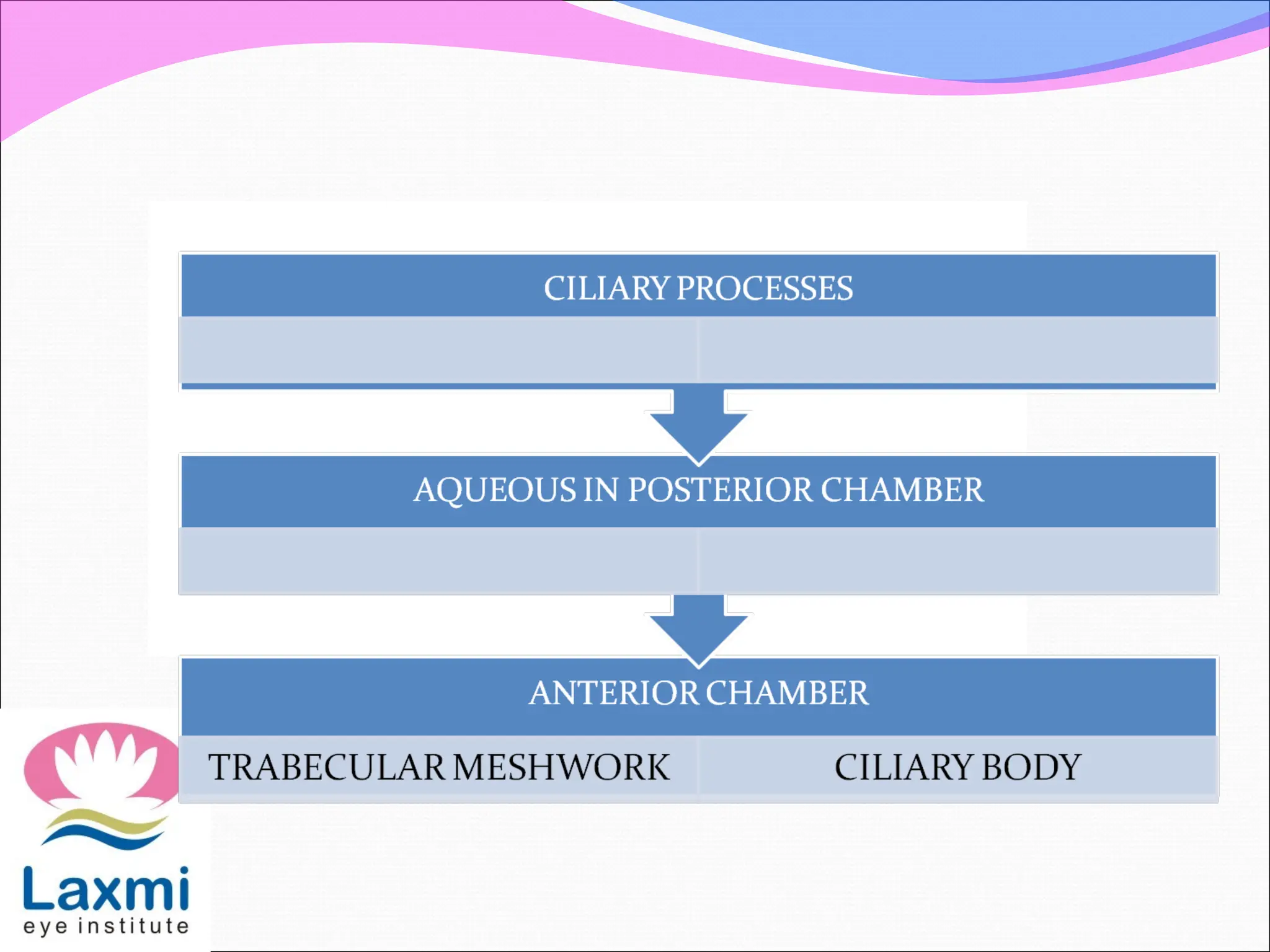
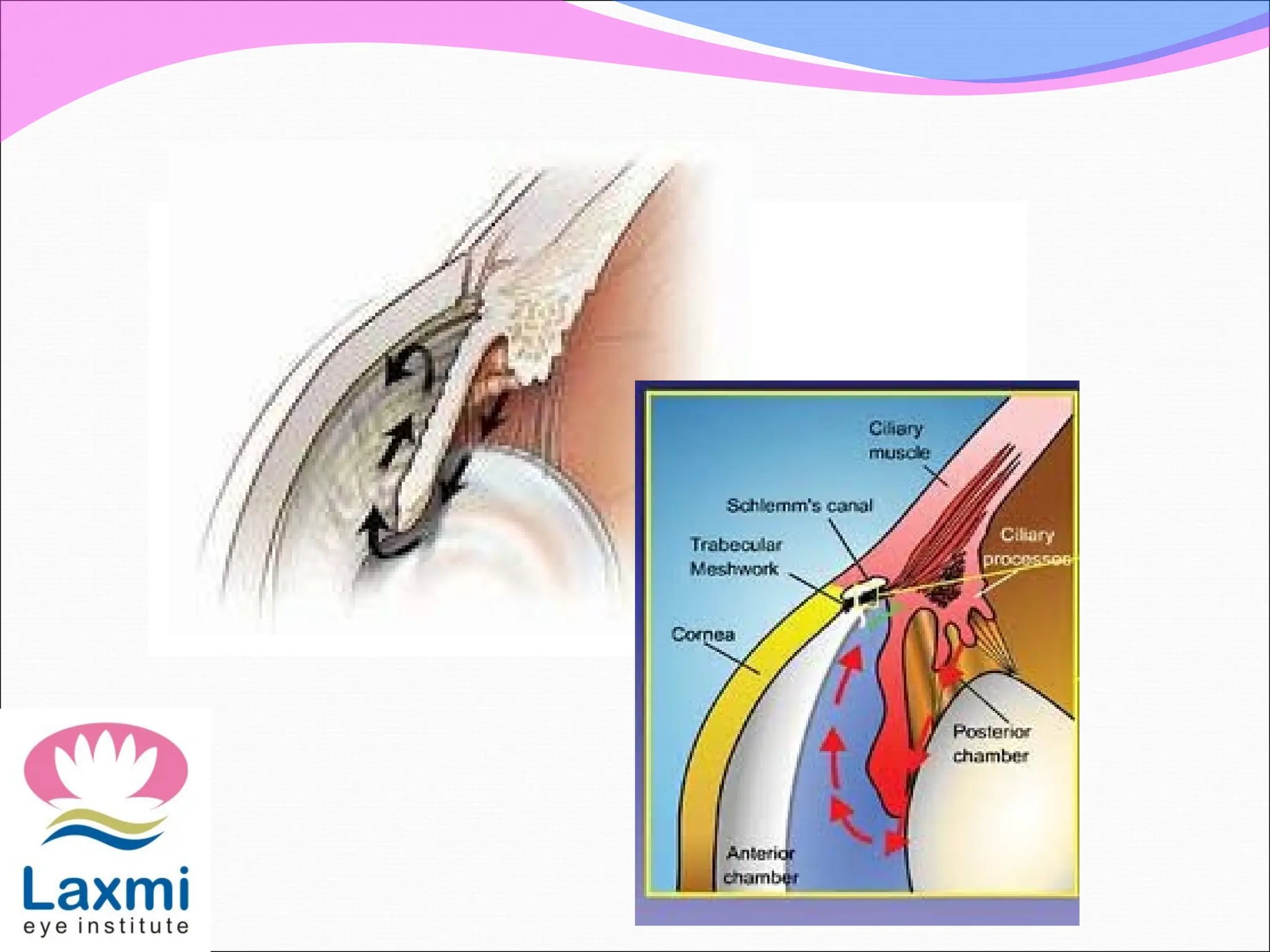
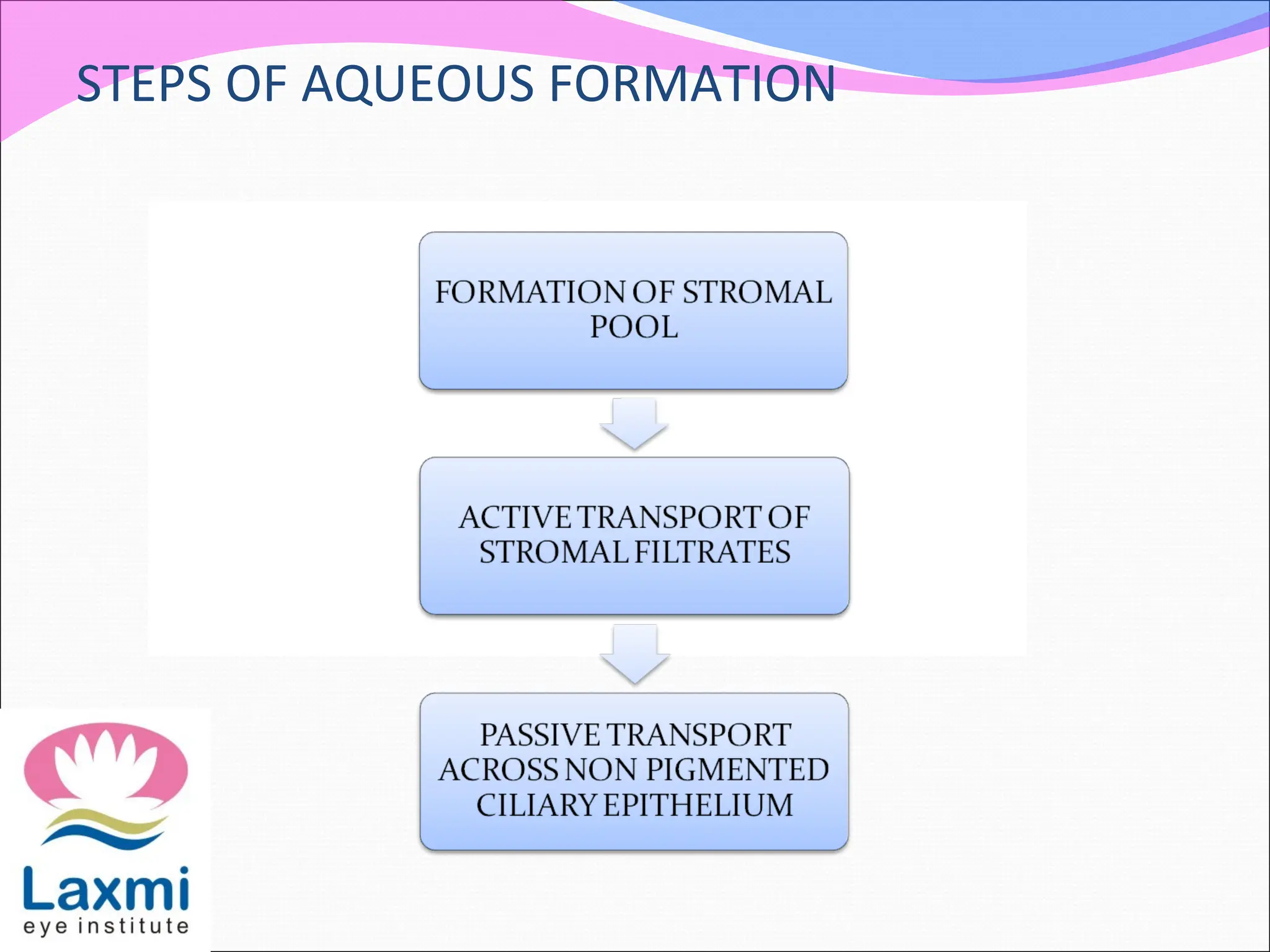
Formation of aqueoushumour
Ciliary processes are site of aqueous production
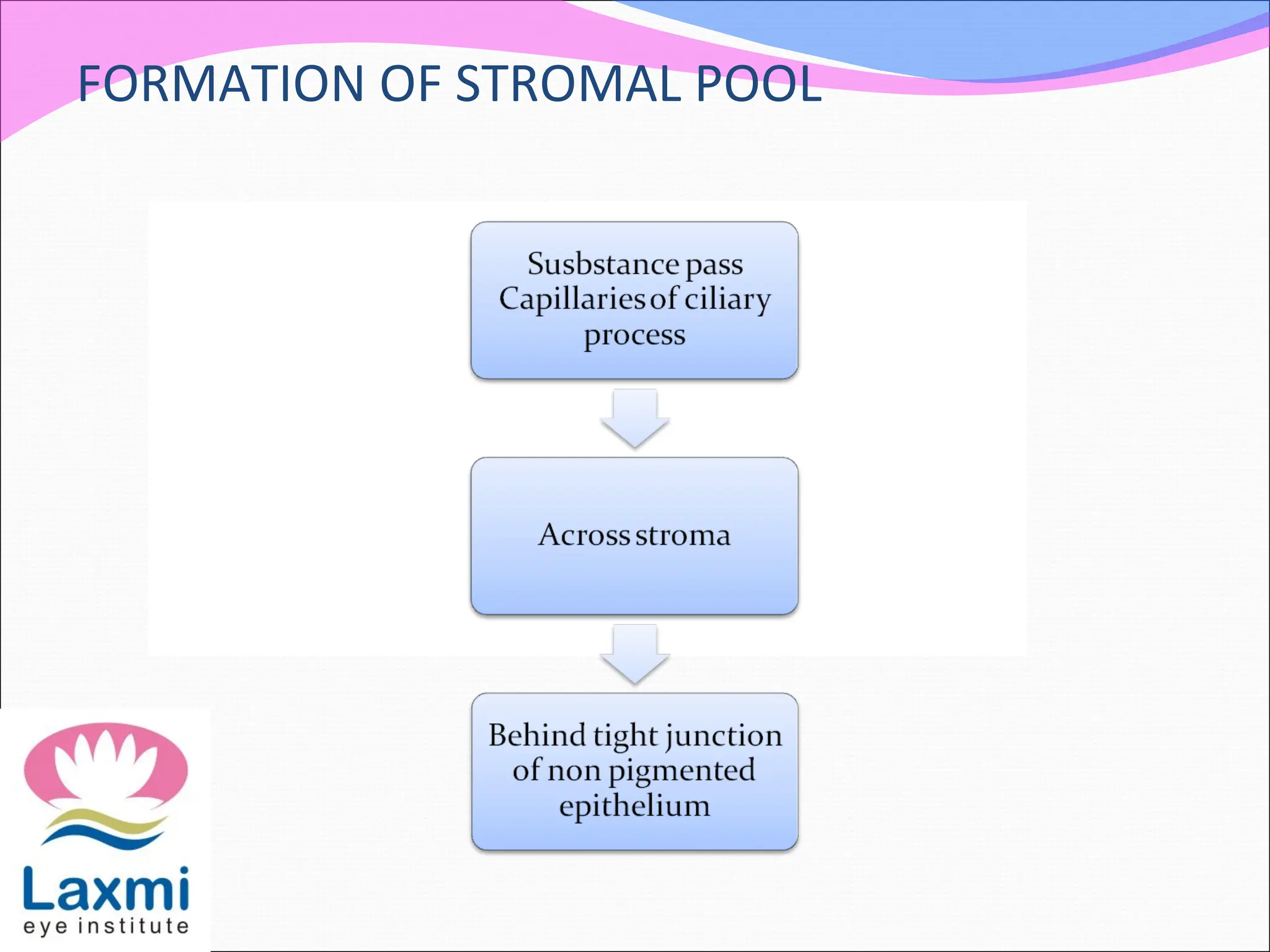
The various constituents of aqueous humour have to
pass 3 tissue layers of cililary processes
1)capillary wall
2)stroma
3)two layers of epithelium
DIFFUSION
Diffusion - lipid-solublesubstances are transported
through the lipid portions of the cell membrane
proportional to a concentration gradient across the membrane
35.
ULTRAFILTRATION
Ultrafiltration - waterand water-soluble substances,
limited by size and charge, flow through theoretical
micropores in the cell membrane in response to an
osmotic gradient or hydrostatic pressure; influenced
by
intraocular pressure,
blood pressure in the ciliary capillaries,
and plasma oncotic pressure
36.
Diffusion and ultrafiltrationare both passive
mechanisms, with lipid- and water-soluble substances
from the capillary core traversing the stroma and
passing between pigmented epithelial cells and
limited by the tight junctions of the non-pigmented
epithelial cells
c. Active transport (secretion) - water-soluble
substances
37.
SECRETION
Active transport (secretion)- water-soluble substances
of larger size or greater charge are actively
transported across the cell membrane, requiring the
expenditure of energy; Na-K ATPase and glycolytic
enzymes are present in nonpigmented epithelial cells.
Active transport is decreased by hypoxia, hypothermia,
and any inhibitor of active metabolism.
Active transport accounts for the majority of aqueous
production.
MEDIATED BY GLOBULAR PROTEINS IN MEMBRANE
PASSIVE TRANSPORT ACROSSNON PIGMENTED
CILIARY EPITHELIUM
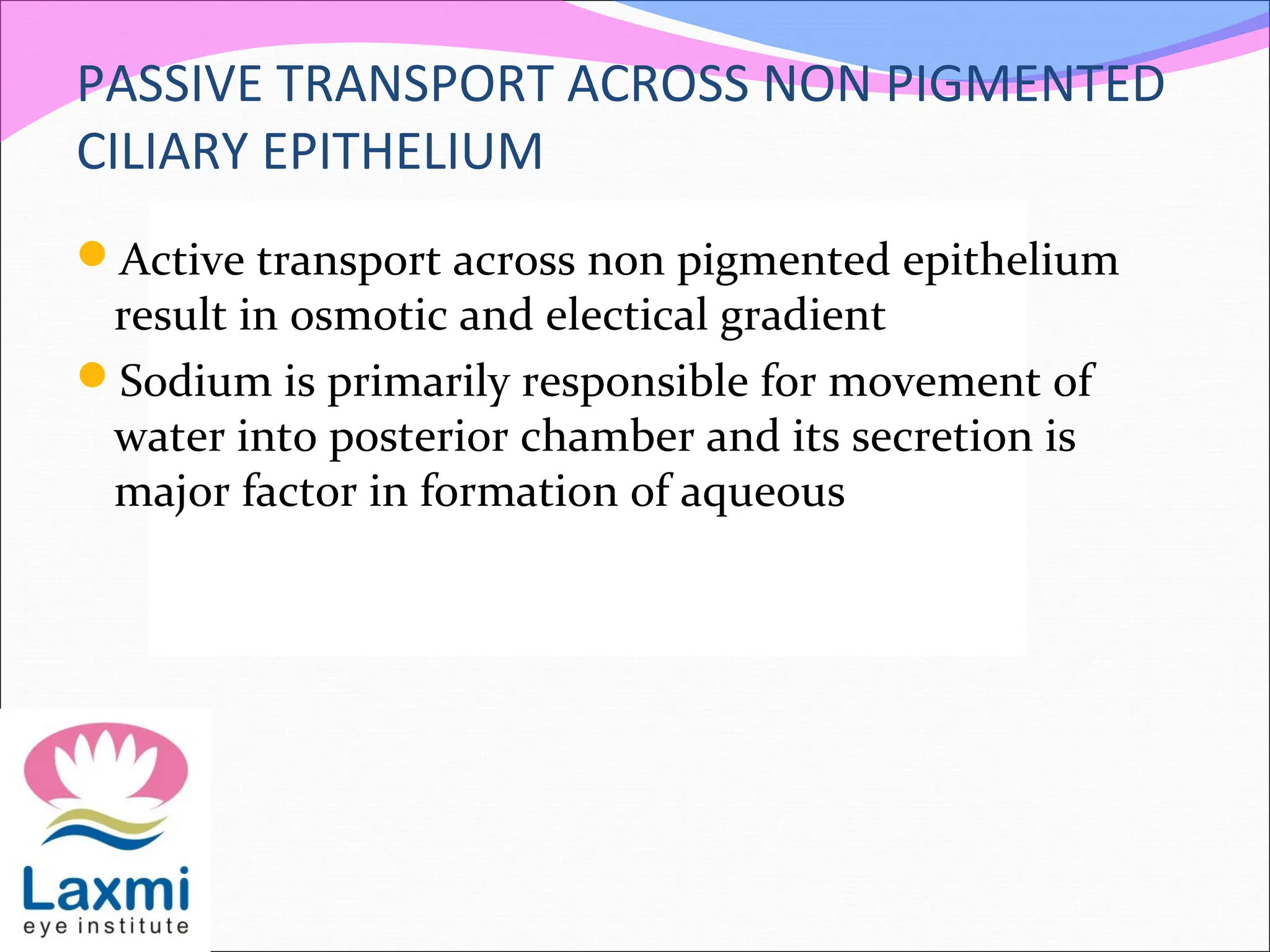
Active transport across non pigmented epithelium
result in osmotic and electical gradient
Sodium is primarily responsible for movement of
water into posterior chamber and its secretion is
major factor in formation of aqueous
41.
ACTIVE TRANSPORT OFSTROMAL FILTRATES
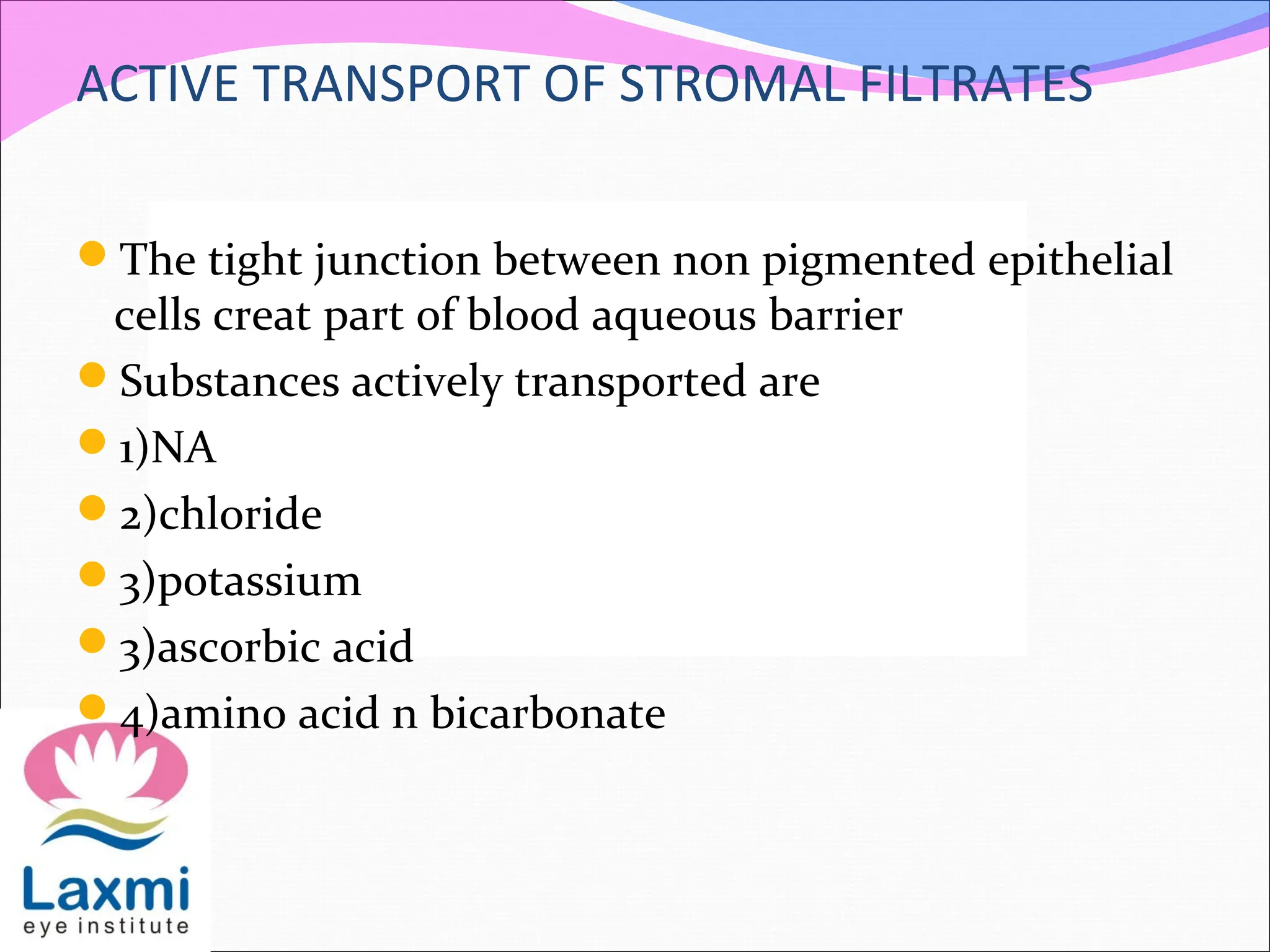
The tight junction between non pigmented epithelial
cells creat part of blood aqueous barrier
Substances actively transported are
1)NA
2)chloride
3)potassium
3)ascorbic acid
4)amino acid n bicarbonate
42.
Control of aqueousformation
ADRENERGIC INNERVATION
CILIARY EPITHELIUM DOES NOT SHOW NERVE SUPPLY , BUT
VESSELS HAVE NERVE SUPPLY
MAJORITY OF RECEPTORS IN CILIARY BODY ARE α2 & β2
RECEPTORS
STIMULATION OF α 2 RECEPTOR LOWER AQUEOUS HUMOUR
PRODUCTION THROUGH INHIBITION OF ADENYLATE CYCLASE
STIMULATION OF β 2 RECEPTOR LEADS TO INCREASE IN
PRODUCTION BY STIMULATION OF ADENYLATE CYCLASE
43.
α 2 AGONISTLIKE CLONIDINE AND β2
ANTAGONIST LIKE TIMOLOL DECREASES
AQUEOUS PRODUCTION
44.
Functions
It serves thecirculatory function for the avascular
tissues of the eye.
Brings essential nutrients such as oxygen glucose and
amino acids .
Removes harmful substances such as lactic acid and
CO2
45.
Maintains the IOPand structural integrity of the eye.
Contains high concentrate of ascorbate which act to
scavenge free radicles and protects against effects of
radiation.
Facilitates cellular and humoral immunity in case
inflamation and infections
2)PILOCARPINE
PILOCARPINE CONTRACTS LONGITUDINALMUSCLE OF CILIARY
BODY AND OPENS SPACE IN T.M , SO MECHANICALLY
INCREASEING AQUEOUS OUTFLOW
3)CARBONIC ANHYDRASE INHIBITOR
BY DECREASING AQUEOUS SECRETION
DORZOLAMIDE
4) PROSTAGLANDINS
ACT BY INCREASING UVEO SCLERAL OUTFLOW OF AQUEOUS




![Apporach to lung biopsy [Auto-saved].pptx latest](https://cdn.slidesharecdn.com/ss_thumbnails/apporachtolungbiopsyauto-saved-251211225655-93258539-thumbnail.jpg?width=640&height=640&fit=bounds)


