B7 Non-communicable diseases
Student Book answers
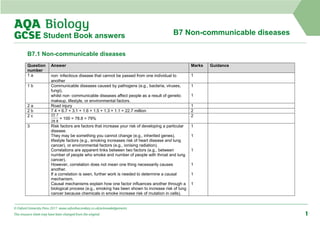
B7.1 Non-communicable diseases
Question
number
Answer Marks Guidance
1 a non‑infectious disease that cannot be passed from one individual to
another
1
1 b Communicable diseases caused by pathogens (e.g., bacteria, viruses,
fungi),
whilst non‑communicable diseases affect people as a result of genetic
makeup, lifestyle, or environmental factors.
1
1
2 a Road injury 1
2 b 7.4 + 6.7 + 3.1 + 1.6 + 1.5 + 1.3 + 1.1 = 22.7 million 2
2 c
× 100 = 78.8 = 79%
2
3 Risk factors are factors that increase your risk of developing a particular
disease.
They may be something you cannot change (e.g., inherited genes),
lifestyle factors (e.g., smoking increases risk of heart disease and lung
cancer), or environmental factors (e.g., ionising radiation).
Correlations are apparent links between two factors (e.g., between
number of people who smoke and number of people with throat and lung
cancer).
However, correlation does not mean one thing necessarily causes
another.
If a correlation is seen, further work is needed to determine a causal
mechanism.
Causal mechanisms explain how one factor influences another through a
biological process (e.g., smoking has been shown to increase risk of lung
cancer because chemicals in smoke increase risk of mutation in cells).
1
1
1
1
1
1
© Oxford University Press 2017 www.oxfordsecondary.co.uk/acknowledgements
This resource sheet may have been changed from the original. 1
B7 Non-communicable diseases
Student Book answers
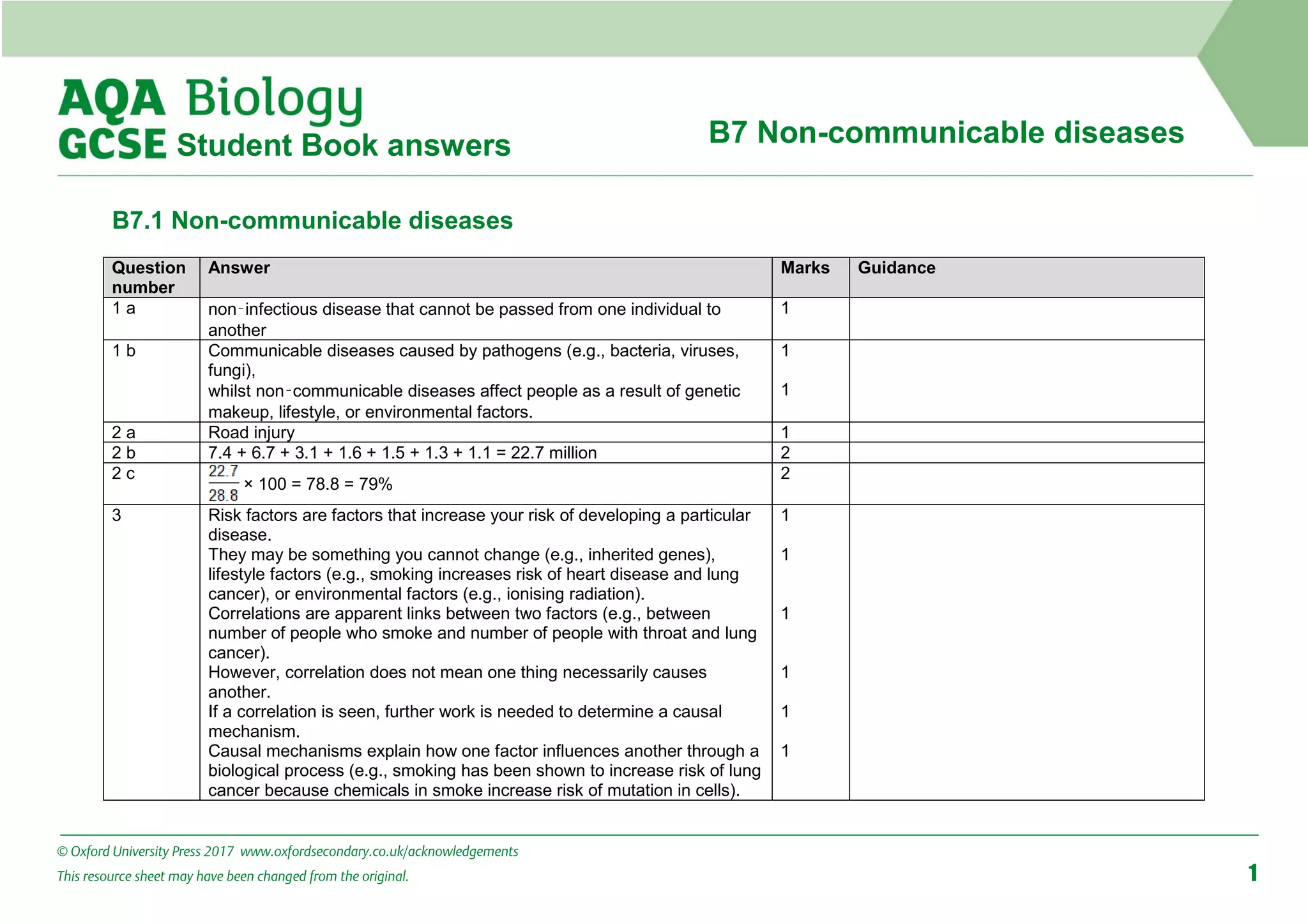
B7.2 Cancer
Question
number
Answer Marks Guidance
1 a mass of abnormally growing cells
formed when normal control of cell cycle is lost
and cells divide rapidly without growing and maturing.
1
1
1
1 b Benign tumour grows in one place, is usually contained in a membrane,
and does not invade other tissues.
Malignant tumour invades neighbouring healthy tissues and can also
split,
releasing small clumps of cells that spread around the body in the blood
and invade different healthy tissues.
1
1
1
1 c Benign tumour can grow very large and compress/damage organs,
which can be life‑threatening (e.g., brain tumour).
Malignant tumour may split into pieces that are carried around the body
in the blood or lymph
where uncontrolled cell division continues to form secondary tumours.
These tumours disrupt normal tissue and often cause death if
untreated.
1
1
1
1
2 a either stop cancer cells dividing,
or make them self‑destruct
1
1
2 b Cancer drugs are designed to target rapidly dividing cancer cells.
They also tend to affect other rapidly dividing cells.
Cells of hair follicles, skin, stomach lining, and blood‑forming bone
marrow are always dividing rapidly
so are more likely than other body cells to be affected by
chemotherapy.
1
1
1
1
© Oxford University Press 2017 www.oxfordsecondary.co.uk/acknowledgements
This resource sheet may have been changed from the original. 2
B7 Non-communicable diseases
Student Book answers
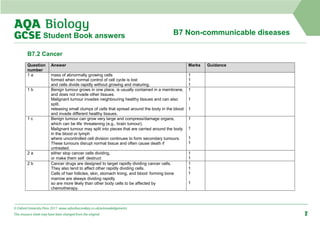
B7.3 Smoking and the risk of disease
Question
number
Answer Marks Guidance
1 a nicotine
carbon monoxide
tar
1
1
1
1 b nicotine: addictive/produces sense of calm/increases heat rate
carbon monoxide: poisonous/taken up by blood instead of oxygen
tar: carcinogenic/damages lung tissue causing COPD
1
1
1
2 a Award marks for well‑drawn chart correctly labelled. 4
2 b the more cigarettes smoked, the greater the risk of dying from
cardiovascular disease (CVD)
1
2 c Smoking narrows blood vessels, which can increase blood pressure.
Nicotine in cigarette smoke increases heart rate.
Other chemicals in cigarette smoke damage lining of arteries, making
atherosclerosis more likely, or increase blood pressure.
1
1
1
3 Scientists have several causal mechanisms that work together to
explain link between smoking and lung cancer.
Cigarette smoke contains tar and other carcinogens. The higher the
concentration of these chemicals in the lungs, the more likely they are
to affect cells and turn them malignant.
Cilia that would naturally filter out tar are anaesthetised by chemicals in
cigarette smoke so they do not work,
allowing tar and other carcinogenic chemicals to build up in delicate
lung tissue.
1
1
1
1
© Oxford University Press 2017 www.oxfordsecondary.co.uk/acknowledgements
This resource sheet may have been changed from the original. 3
B7 Non-communicable diseases
Student Book answers
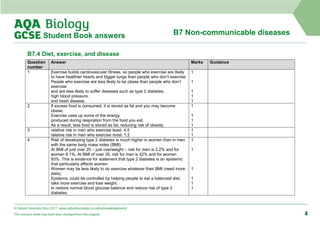
B7.4 Diet, exercise, and disease
Question
number
Answer Marks Guidance
1 Exercise builds cardiovascular fitness, so people who exercise are likely
to have healthier hearts and bigger lungs than people who don’t exercise.
People who exercise are less likely to be obese than people who don’t
exercise
and are less likely to suffer diseases such as type 2 diabetes,
high blood pressure,
and heart disease.
1
1
1
1
1
2 If excess food is consumed, it is stored as fat and you may become
obese.
Exercise uses up some of the energy
produced during respiration from the food you eat.
As a result, less food is stored as fat, reducing risk of obesity.
1
1
1
1
3 relative risk in men who exercise least: 4.5
relative risk in men who exercise most: 1.2
1
1
4 Risk of developing type 2 diabetes is much higher in women than in men
with the same body mass index (BMI).
At BMI of just over 25 – just overweight – risk for men is 2.2% and for
women 8.1%. At BMI of over 35, risk for men is 42% and for women
93%. This is evidence for statement that type 2 diabetes is an epidemic
that particularly affects women.
Women may be less likely to do exercise whatever their BMI (need more
data).
Epidemic could be controlled by helping people to eat a balanced diet,
take more exercise and lose weight,
to restore normal blood glucose balance and reduce risk of type 2
diabetes.
1
1
1
1
1
1
© Oxford University Press 2017 www.oxfordsecondary.co.uk/acknowledgements
This resource sheet may have been changed from the original. 4
B7 Non-communicable diseases
Student Book answers
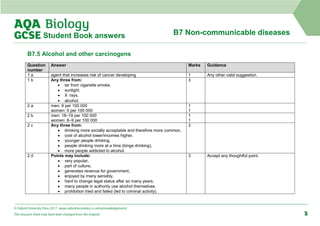
B7.5 Alcohol and other carcinogens
Question
number
Answer Marks Guidance
1 a agent that increases risk of cancer developing 1 Any other valid suggestion.
1 b Any three from:
• tar from cigarette smoke,
• sunlight,
• X‑rays,
• alcohol.
3
2 a men: 9 per 100 000
women: 5 per 100 000
1
1
2 b men: 18–19 per 100 000
women: 8–9 per 100 000
1
1
2 c Any three from:
• drinking more socially acceptable and therefore more common,
• cost of alcohol lower/incomes higher,
• younger people drinking,
• people drinking more at a time (binge drinking),
• more people addicted to alcohol.
3
2 d Points may include:
• very popular,
• part of culture,
• generates revenue for government,
• enjoyed by many sensibly,
• hard to change legal status after so many years,
• many people in authority use alcohol themselves,
• prohibition tried and failed (led to criminal activity).
3 Accept any thoughtful point.
© Oxford University Press 2017 www.oxfordsecondary.co.uk/acknowledgements
This resource sheet may have been changed from the original. 5

AQA Biology B7 [ Answers ]

  • 1.
    B7 Non-communicable diseases StudentBook answers B7.1 Non-communicable diseases Question number Answer Marks Guidance 1 a non‑infectious disease that cannot be passed from one individual to another 1 1 b Communicable diseases caused by pathogens (e.g., bacteria, viruses, fungi), whilst non‑communicable diseases affect people as a result of genetic makeup, lifestyle, or environmental factors. 1 1 2 a Road injury 1 2 b 7.4 + 6.7 + 3.1 + 1.6 + 1.5 + 1.3 + 1.1 = 22.7 million 2 2 c × 100 = 78.8 = 79% 2 3 Risk factors are factors that increase your risk of developing a particular disease. They may be something you cannot change (e.g., inherited genes), lifestyle factors (e.g., smoking increases risk of heart disease and lung cancer), or environmental factors (e.g., ionising radiation). Correlations are apparent links between two factors (e.g., between number of people who smoke and number of people with throat and lung cancer). However, correlation does not mean one thing necessarily causes another. If a correlation is seen, further work is needed to determine a causal mechanism. Causal mechanisms explain how one factor influences another through a biological process (e.g., smoking has been shown to increase risk of lung cancer because chemicals in smoke increase risk of mutation in cells). 1 1 1 1 1 1 © Oxford University Press 2017 www.oxfordsecondary.co.uk/acknowledgements This resource sheet may have been changed from the original. 1
  • 2.
    B7 Non-communicable diseases StudentBook answers B7.2 Cancer Question number Answer Marks Guidance 1 a mass of abnormally growing cells formed when normal control of cell cycle is lost and cells divide rapidly without growing and maturing. 1 1 1 1 b Benign tumour grows in one place, is usually contained in a membrane, and does not invade other tissues. Malignant tumour invades neighbouring healthy tissues and can also split, releasing small clumps of cells that spread around the body in the blood and invade different healthy tissues. 1 1 1 1 c Benign tumour can grow very large and compress/damage organs, which can be life‑threatening (e.g., brain tumour). Malignant tumour may split into pieces that are carried around the body in the blood or lymph where uncontrolled cell division continues to form secondary tumours. These tumours disrupt normal tissue and often cause death if untreated. 1 1 1 1 2 a either stop cancer cells dividing, or make them self‑destruct 1 1 2 b Cancer drugs are designed to target rapidly dividing cancer cells. They also tend to affect other rapidly dividing cells. Cells of hair follicles, skin, stomach lining, and blood‑forming bone marrow are always dividing rapidly so are more likely than other body cells to be affected by chemotherapy. 1 1 1 1 © Oxford University Press 2017 www.oxfordsecondary.co.uk/acknowledgements This resource sheet may have been changed from the original. 2
  • 3.
    B7 Non-communicable diseases StudentBook answers B7.3 Smoking and the risk of disease Question number Answer Marks Guidance 1 a nicotine carbon monoxide tar 1 1 1 1 b nicotine: addictive/produces sense of calm/increases heat rate carbon monoxide: poisonous/taken up by blood instead of oxygen tar: carcinogenic/damages lung tissue causing COPD 1 1 1 2 a Award marks for well‑drawn chart correctly labelled. 4 2 b the more cigarettes smoked, the greater the risk of dying from cardiovascular disease (CVD) 1 2 c Smoking narrows blood vessels, which can increase blood pressure. Nicotine in cigarette smoke increases heart rate. Other chemicals in cigarette smoke damage lining of arteries, making atherosclerosis more likely, or increase blood pressure. 1 1 1 3 Scientists have several causal mechanisms that work together to explain link between smoking and lung cancer. Cigarette smoke contains tar and other carcinogens. The higher the concentration of these chemicals in the lungs, the more likely they are to affect cells and turn them malignant. Cilia that would naturally filter out tar are anaesthetised by chemicals in cigarette smoke so they do not work, allowing tar and other carcinogenic chemicals to build up in delicate lung tissue. 1 1 1 1 © Oxford University Press 2017 www.oxfordsecondary.co.uk/acknowledgements This resource sheet may have been changed from the original. 3
  • 4.
    B7 Non-communicable diseases StudentBook answers B7.4 Diet, exercise, and disease Question number Answer Marks Guidance 1 Exercise builds cardiovascular fitness, so people who exercise are likely to have healthier hearts and bigger lungs than people who don’t exercise. People who exercise are less likely to be obese than people who don’t exercise and are less likely to suffer diseases such as type 2 diabetes, high blood pressure, and heart disease. 1 1 1 1 1 2 If excess food is consumed, it is stored as fat and you may become obese. Exercise uses up some of the energy produced during respiration from the food you eat. As a result, less food is stored as fat, reducing risk of obesity. 1 1 1 1 3 relative risk in men who exercise least: 4.5 relative risk in men who exercise most: 1.2 1 1 4 Risk of developing type 2 diabetes is much higher in women than in men with the same body mass index (BMI). At BMI of just over 25 – just overweight – risk for men is 2.2% and for women 8.1%. At BMI of over 35, risk for men is 42% and for women 93%. This is evidence for statement that type 2 diabetes is an epidemic that particularly affects women. Women may be less likely to do exercise whatever their BMI (need more data). Epidemic could be controlled by helping people to eat a balanced diet, take more exercise and lose weight, to restore normal blood glucose balance and reduce risk of type 2 diabetes. 1 1 1 1 1 1 © Oxford University Press 2017 www.oxfordsecondary.co.uk/acknowledgements This resource sheet may have been changed from the original. 4
  • 5.
    B7 Non-communicable diseases StudentBook answers B7.5 Alcohol and other carcinogens Question number Answer Marks Guidance 1 a agent that increases risk of cancer developing 1 Any other valid suggestion. 1 b Any three from: • tar from cigarette smoke, • sunlight, • X‑rays, • alcohol. 3 2 a men: 9 per 100 000 women: 5 per 100 000 1 1 2 b men: 18–19 per 100 000 women: 8–9 per 100 000 1 1 2 c Any three from: • drinking more socially acceptable and therefore more common, • cost of alcohol lower/incomes higher, • younger people drinking, • people drinking more at a time (binge drinking), • more people addicted to alcohol. 3 2 d Points may include: • very popular, • part of culture, • generates revenue for government, • enjoyed by many sensibly, • hard to change legal status after so many years, • many people in authority use alcohol themselves, • prohibition tried and failed (led to criminal activity). 3 Accept any thoughtful point. © Oxford University Press 2017 www.oxfordsecondary.co.uk/acknowledgements This resource sheet may have been changed from the original. 5