© Oxford University Press 2016 www.oxfordsecondary.co.uk/acknowledgements
This resource sheet may have been changed from the original. 1
C5 Summary questions
Student Book answers
Question
number
Answer Marks Guidance
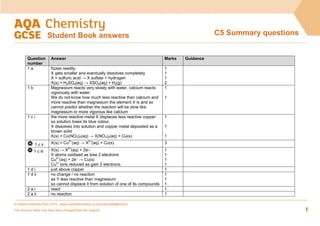
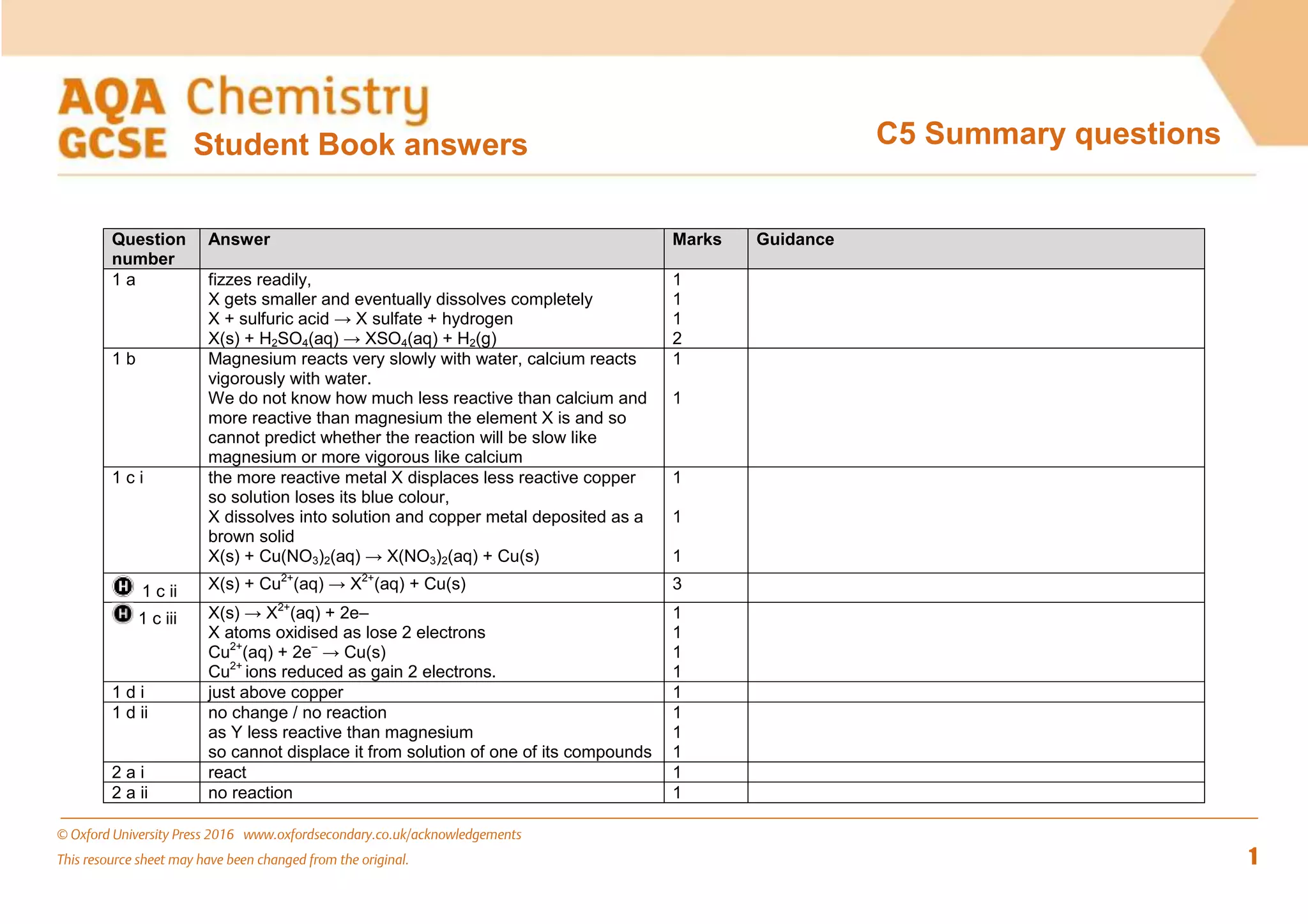
1 a fizzes readily,
X gets smaller and eventually dissolves completely
X + sulfuric acid → X sulfate + hydrogen
X(s) + H2SO4(aq) → XSO4(aq) + H2(g)
1
1
1
2
1 b Magnesium reacts very slowly with water, calcium reacts
vigorously with water.
We do not know how much less reactive than calcium and
more reactive than magnesium the element X is and so
cannot predict whether the reaction will be slow like
magnesium or more vigorous like calcium
1
1
1 c i the more reactive metal X displaces less reactive copper
so solution loses its blue colour,
X dissolves into solution and copper metal deposited as a
brown solid
X(s) + Cu(NO3)2(aq) → X(NO3)2(aq) + Cu(s)
1
1
1
1 c ii X(s) + Cu2+
(aq) → X2+
(aq) + Cu(s) 3
1 c iii X(s) → X2+
(aq) + 2e–
X atoms oxidised as lose 2 electrons
Cu2+
(aq) + 2e–
→ Cu(s)
Cu2+
ions reduced as gain 2 electrons.
1
1
1
1
1 d i just above copper 1
1 d ii no change / no reaction
as Y less reactive than magnesium
so cannot displace it from solution of one of its compounds
1
1
1
2 a i react 1
2 a ii no reaction 1
© Oxford University Press 2016 www.oxfordsecondary.co.uk/acknowledgements
This resource sheet may have been changed from the original. 2
C5 Summary questions
Student Book answers
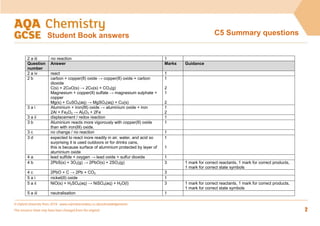
2 a iii no reaction 1
Question
number
Answer Marks Guidance
2 a iv react 1
2 b carbon + copper(II) oxide → copper(II) oxide + carbon
dioxide
C(s) + 2CuO(s) → 2Cu(s) + CO2(g)
Magnesium + copper(II) sulfate → magnesium sulphate +
copper
Mg(s) + CuSO4(aq) → MgSO4(aq) + Cu(s)
1
2
1
2
3 a i Aluminium + iron(III) oxide → aluminium oxide + iron
2Al + Fe2O3 → Al2O3 + 2Fe
1
2
3 a ii displacement / redox reaction 1
3 b Aluminium reacts more vigorously with copper(II) oxide
than with iron(III) oxide.
1
3 c no change / no reaction 1
3 d expected to react more readily in air, water, and acid so
surprising it is used outdoors or for drinks cans,
this is because surface of aluminium protected by layer of
aluminium oxide
1
1
4 a lead sulfide + oxygen → lead oxide + sulfur dioxide 1
4 b 2PbS(s) + 3O2(g) → 2PbO(s) + 2SO2(g) 3 1 mark for correct reactants, 1 mark for correct products,
1 mark for correct state symbols
4 c 2PbO + C → 2Pb + CO2 3
5 a i nickel(II) oxide 1
5 a ii NiO(s) + H2SO4(aq) → NiSO4(aq) + H2O(l) 3 1 mark for correct reactants, 1 mark for correct products,
1 mark for correct state symbols
5 a iii neutralisation 1
© Oxford University Press 2016 www.oxfordsecondary.co.uk/acknowledgements
This resource sheet may have been changed from the original. 3
C5 Summary questions
Student Book answers
Question
number
Answer Marks Guidance
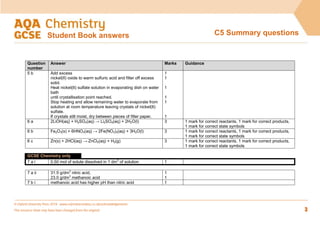
5 b Add excess
nickel(II) oxide to warm sulfuric acid and filter off excess
solid.
Heat nickel(II) sulfate solution in evaporating dish on water
bath
until crystallisation point reached.
Stop heating and allow remaining water to evaporate from
solution at room temperature leaving crystals of nickel(II)
sulfate.
If crystals still moist, dry between pieces of filter paper.
1
1
1
1
1
1
6 a 2LiOH(aq) + H2SO4(aq) → Li2SO4(aq) + 2H2O(l) 3 1 mark for correct reactants, 1 mark for correct products,
1 mark for correct state symbols
6 b Fe2O3(s) + 6HNO3(aq) → 2Fe(NO3)3(aq) + 3H2O(l) 3 1 mark for correct reactants, 1 mark for correct products,
1 mark for correct state symbols
6 c Zn(s) + 2HCl(aq) → ZnCl2(aq) + H2(g) 3 1 mark for correct reactants, 1 mark for correct products,
1 mark for correct state symbols
GCSE Chemistry only
7 a i 0.50 mol of solute dissolved in 1 dm3
of solution 1
7 a ii 31.5 g/dm3
nitric acid,
23.0 g/dm3
methanoic acid
1
1
7 b i methanoic acid has higher pH than nitric acid 1
© Oxford University Press 2016 www.oxfordsecondary.co.uk/acknowledgements
This resource sheet may have been changed from the original. 4
C5 Summary questions
Student Book answers
Question
number
Answer Marks Guidance
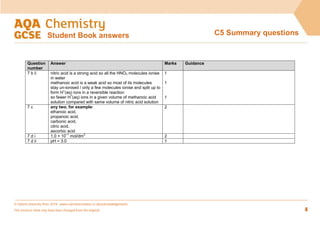
7 b ii nitric acid is a strong acid so all the HNO3 molecules ionise
in water
methanoic acid is a weak acid so most of its molecules
stay un-ionised / only a few molecules ionise and split up to
form H+
(aq) ions in a reversible reaction
so fewer H+
(aq) ions in a given volume of methanoic acid
solution compared with same volume of nitric acid solution
1
1
1
7 c any two, for example:
ethanoic acid,
propanoic acid,
carbonic acid,
citric acid,
ascorbic acid
2
7 d i 1.0 × 10⁻¹
mol/dm3
2
7 d ii pH = 3.0 1

AQA Chemistry C5 [ Summary Answers ]

  • 1.
    © Oxford UniversityPress 2016 www.oxfordsecondary.co.uk/acknowledgements This resource sheet may have been changed from the original. 1 C5 Summary questions Student Book answers Question number Answer Marks Guidance 1 a fizzes readily, X gets smaller and eventually dissolves completely X + sulfuric acid → X sulfate + hydrogen X(s) + H2SO4(aq) → XSO4(aq) + H2(g) 1 1 1 2 1 b Magnesium reacts very slowly with water, calcium reacts vigorously with water. We do not know how much less reactive than calcium and more reactive than magnesium the element X is and so cannot predict whether the reaction will be slow like magnesium or more vigorous like calcium 1 1 1 c i the more reactive metal X displaces less reactive copper so solution loses its blue colour, X dissolves into solution and copper metal deposited as a brown solid X(s) + Cu(NO3)2(aq) → X(NO3)2(aq) + Cu(s) 1 1 1 1 c ii X(s) + Cu2+ (aq) → X2+ (aq) + Cu(s) 3 1 c iii X(s) → X2+ (aq) + 2e– X atoms oxidised as lose 2 electrons Cu2+ (aq) + 2e– → Cu(s) Cu2+ ions reduced as gain 2 electrons. 1 1 1 1 1 d i just above copper 1 1 d ii no change / no reaction as Y less reactive than magnesium so cannot displace it from solution of one of its compounds 1 1 1 2 a i react 1 2 a ii no reaction 1
  • 2.
    © Oxford UniversityPress 2016 www.oxfordsecondary.co.uk/acknowledgements This resource sheet may have been changed from the original. 2 C5 Summary questions Student Book answers 2 a iii no reaction 1 Question number Answer Marks Guidance 2 a iv react 1 2 b carbon + copper(II) oxide → copper(II) oxide + carbon dioxide C(s) + 2CuO(s) → 2Cu(s) + CO2(g) Magnesium + copper(II) sulfate → magnesium sulphate + copper Mg(s) + CuSO4(aq) → MgSO4(aq) + Cu(s) 1 2 1 2 3 a i Aluminium + iron(III) oxide → aluminium oxide + iron 2Al + Fe2O3 → Al2O3 + 2Fe 1 2 3 a ii displacement / redox reaction 1 3 b Aluminium reacts more vigorously with copper(II) oxide than with iron(III) oxide. 1 3 c no change / no reaction 1 3 d expected to react more readily in air, water, and acid so surprising it is used outdoors or for drinks cans, this is because surface of aluminium protected by layer of aluminium oxide 1 1 4 a lead sulfide + oxygen → lead oxide + sulfur dioxide 1 4 b 2PbS(s) + 3O2(g) → 2PbO(s) + 2SO2(g) 3 1 mark for correct reactants, 1 mark for correct products, 1 mark for correct state symbols 4 c 2PbO + C → 2Pb + CO2 3 5 a i nickel(II) oxide 1 5 a ii NiO(s) + H2SO4(aq) → NiSO4(aq) + H2O(l) 3 1 mark for correct reactants, 1 mark for correct products, 1 mark for correct state symbols 5 a iii neutralisation 1
  • 3.
    © Oxford UniversityPress 2016 www.oxfordsecondary.co.uk/acknowledgements This resource sheet may have been changed from the original. 3 C5 Summary questions Student Book answers Question number Answer Marks Guidance 5 b Add excess nickel(II) oxide to warm sulfuric acid and filter off excess solid. Heat nickel(II) sulfate solution in evaporating dish on water bath until crystallisation point reached. Stop heating and allow remaining water to evaporate from solution at room temperature leaving crystals of nickel(II) sulfate. If crystals still moist, dry between pieces of filter paper. 1 1 1 1 1 1 6 a 2LiOH(aq) + H2SO4(aq) → Li2SO4(aq) + 2H2O(l) 3 1 mark for correct reactants, 1 mark for correct products, 1 mark for correct state symbols 6 b Fe2O3(s) + 6HNO3(aq) → 2Fe(NO3)3(aq) + 3H2O(l) 3 1 mark for correct reactants, 1 mark for correct products, 1 mark for correct state symbols 6 c Zn(s) + 2HCl(aq) → ZnCl2(aq) + H2(g) 3 1 mark for correct reactants, 1 mark for correct products, 1 mark for correct state symbols GCSE Chemistry only 7 a i 0.50 mol of solute dissolved in 1 dm3 of solution 1 7 a ii 31.5 g/dm3 nitric acid, 23.0 g/dm3 methanoic acid 1 1 7 b i methanoic acid has higher pH than nitric acid 1
  • 4.
    © Oxford UniversityPress 2016 www.oxfordsecondary.co.uk/acknowledgements This resource sheet may have been changed from the original. 4 C5 Summary questions Student Book answers Question number Answer Marks Guidance 7 b ii nitric acid is a strong acid so all the HNO3 molecules ionise in water methanoic acid is a weak acid so most of its molecules stay un-ionised / only a few molecules ionise and split up to form H+ (aq) ions in a reversible reaction so fewer H+ (aq) ions in a given volume of methanoic acid solution compared with same volume of nitric acid solution 1 1 1 7 c any two, for example: ethanoic acid, propanoic acid, carbonic acid, citric acid, ascorbic acid 2 7 d i 1.0 × 10⁻¹ mol/dm3 2 7 d ii pH = 3.0 1