© Oxford University Press 2016 www.oxfordsecondary.co.uk/acknowledgements
This resource sheet may have been changed from the original. 1
P1 Summary questionsStudent Book answers
Question
number
Answer Marks Guidance
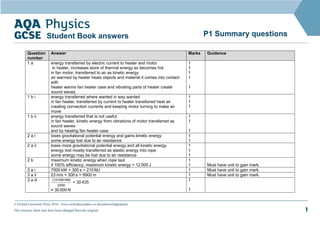
1 a energy transferred by electric current to heater and motor
in heater, increases store of thermal energy so becomes hot
in fan motor, transferred to air as kinetic energy
air warmed by heater heats objects and material it comes into contact
with
heater warms fan heater case and vibrating parts of heater create
sound waves
1
1
1
1
1
1 b i energy transferred where wanted in way wanted
in fan heater, transferred by current to heater transferred heat air
creating convection currents and keeping motor turning to make air
move
1
1
1
1 b ii energy transferred that is not useful
in fan heater, kinetic energy from vibrations of motor transferred as
sound waves
and by heating fan heater case
1
1
1
2 a i loses gravitational potential energy and gains kinetic energy
some energy lost due to air resistance
1
1
2 a ii loses more gravitational potential energy and all kinetic energy
energy lost mostly transferred as elastic energy into rope
some energy may be lost due to air resistance
1
1
1
2 b maximum kinetic energy when rope taut
if 100% efficiency, maximum kinetic energy = 12 000 J
1
1 Must have unit to gain mark.
3 a i 7000 kW × 300 s = 210 MJ 1 Must have unit to gain mark.
3 a ii 23 m/s × 300 s = 6900 m 1 Must have unit to gain mark.
3 a iii
6900
000000210
= 30 435
≈ 30 000 N
1
1
© Oxford University Press 2016 www.oxfordsecondary.co.uk/acknowledgements
This resource sheet may have been changed from the original. 2
P1 Summary questionsStudent Book answers
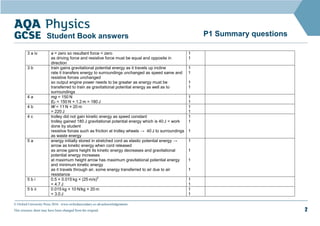
3 a iv a = zero so resultant force = zero
as driving force and resistive force must be equal and opposite in
direction
1
1
3 b train gains gravitational potential energy as it travels up incline
rate it transfers energy to surroundings unchanged as speed same and
resistive forces unchanged
so output engine power needs to be greater as energy must be
transferred to train as gravitational potential energy as well as to
surroundings
1
1
1
1
4 a mg = 150 N
EP = 150 N × 1.2 m = 180 J
1
1
4 b W = 11 N × 20 m
= 220 J
1
1
4 c trolley did not gain kinetic energy as speed constant
trolley gained 180 J gravitational potential energy which is 40 J < work
done by student
resistive forces such as friction at trolley wheels → 40 J to surroundings
as waste energy
1
1
1
5 a energy initially stored in stretched cord as elastic potential energy →
arrow as kinetic energy when cord released
as arrow gains height its kinetic energy decreases and gravitational
potential energy increases
at maximum height arrow has maximum gravitational potential energy
and minimum kinetic energy
as it travels through air, some energy transferred to air due to air
resistance
1
1
1
1
5 b i 0.5 × 0.015 kg × (25 m/s)2
= 4.7 J
1
1
5 b ii 0.015 kg × 10 N/kg × 20 m
= 3.0 J
1
1
© Oxford University Press 2016 www.oxfordsecondary.co.uk/acknowledgements
This resource sheet may have been changed from the original. 3
P1 Summary questionsStudent Book answers
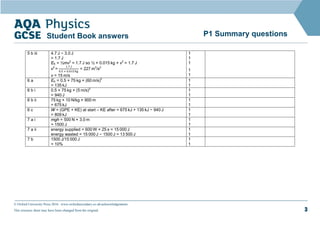
5 b iii 4.7 J − 3.0 J
= 1.7 J
EK = ½mv2
= 1.7 J so ½ × 0.015 kg × v2
= 1.7 J
v2
=
1.7 𝐽𝐽
0.5 × 0.015 kg
= 227 m2
/s2
v = 15 m/s
1
1
1
1
1
6 a EK = 0.5 × 75 kg × (60 m/s)2
= 135 kJ
1
1
6 b i 0.5 × 75 kg × (5 m/s)2
= 940 J
1
1
6 b ii 75 kg × 10 N/kg × 900 m
= 675 kJ
1
1
6 c W = (GPE + KE) at start – KE after = 675 kJ + 135 kJ − 940 J
= 809 kJ
1
1
7 a i mgh = 500 N × 3.0 m
= 1500 J
1
1
7 a ii energy supplied = 600 W × 25 s = 15 000 J
energy wasted = 15 000 J − 1500 J = 13 500 J
1
1
7 b 1500 J/15 000 J
= 10%
1
1

AQA GCSE Physics P1 [ Summary answers ]

  • 1.
    © Oxford UniversityPress 2016 www.oxfordsecondary.co.uk/acknowledgements This resource sheet may have been changed from the original. 1 P1 Summary questionsStudent Book answers Question number Answer Marks Guidance 1 a energy transferred by electric current to heater and motor in heater, increases store of thermal energy so becomes hot in fan motor, transferred to air as kinetic energy air warmed by heater heats objects and material it comes into contact with heater warms fan heater case and vibrating parts of heater create sound waves 1 1 1 1 1 1 b i energy transferred where wanted in way wanted in fan heater, transferred by current to heater transferred heat air creating convection currents and keeping motor turning to make air move 1 1 1 1 b ii energy transferred that is not useful in fan heater, kinetic energy from vibrations of motor transferred as sound waves and by heating fan heater case 1 1 1 2 a i loses gravitational potential energy and gains kinetic energy some energy lost due to air resistance 1 1 2 a ii loses more gravitational potential energy and all kinetic energy energy lost mostly transferred as elastic energy into rope some energy may be lost due to air resistance 1 1 1 2 b maximum kinetic energy when rope taut if 100% efficiency, maximum kinetic energy = 12 000 J 1 1 Must have unit to gain mark. 3 a i 7000 kW × 300 s = 210 MJ 1 Must have unit to gain mark. 3 a ii 23 m/s × 300 s = 6900 m 1 Must have unit to gain mark. 3 a iii 6900 000000210 = 30 435 ≈ 30 000 N 1 1
  • 2.
    © Oxford UniversityPress 2016 www.oxfordsecondary.co.uk/acknowledgements This resource sheet may have been changed from the original. 2 P1 Summary questionsStudent Book answers 3 a iv a = zero so resultant force = zero as driving force and resistive force must be equal and opposite in direction 1 1 3 b train gains gravitational potential energy as it travels up incline rate it transfers energy to surroundings unchanged as speed same and resistive forces unchanged so output engine power needs to be greater as energy must be transferred to train as gravitational potential energy as well as to surroundings 1 1 1 1 4 a mg = 150 N EP = 150 N × 1.2 m = 180 J 1 1 4 b W = 11 N × 20 m = 220 J 1 1 4 c trolley did not gain kinetic energy as speed constant trolley gained 180 J gravitational potential energy which is 40 J < work done by student resistive forces such as friction at trolley wheels → 40 J to surroundings as waste energy 1 1 1 5 a energy initially stored in stretched cord as elastic potential energy → arrow as kinetic energy when cord released as arrow gains height its kinetic energy decreases and gravitational potential energy increases at maximum height arrow has maximum gravitational potential energy and minimum kinetic energy as it travels through air, some energy transferred to air due to air resistance 1 1 1 1 5 b i 0.5 × 0.015 kg × (25 m/s)2 = 4.7 J 1 1 5 b ii 0.015 kg × 10 N/kg × 20 m = 3.0 J 1 1
  • 3.
    © Oxford UniversityPress 2016 www.oxfordsecondary.co.uk/acknowledgements This resource sheet may have been changed from the original. 3 P1 Summary questionsStudent Book answers 5 b iii 4.7 J − 3.0 J = 1.7 J EK = ½mv2 = 1.7 J so ½ × 0.015 kg × v2 = 1.7 J v2 = 1.7 𝐽𝐽 0.5 × 0.015 kg = 227 m2 /s2 v = 15 m/s 1 1 1 1 1 6 a EK = 0.5 × 75 kg × (60 m/s)2 = 135 kJ 1 1 6 b i 0.5 × 75 kg × (5 m/s)2 = 940 J 1 1 6 b ii 75 kg × 10 N/kg × 900 m = 675 kJ 1 1 6 c W = (GPE + KE) at start – KE after = 675 kJ + 135 kJ − 940 J = 809 kJ 1 1 7 a i mgh = 500 N × 3.0 m = 1500 J 1 1 7 a ii energy supplied = 600 W × 25 s = 15 000 J energy wasted = 15 000 J − 1500 J = 13 500 J 1 1 7 b 1500 J/15 000 J = 10% 1 1