PHYSICAL EDUCATION
CHAPTER 4: MODIFIABLE RISK FACTORS OF
LIFESTYLE DIEASES
SMOKING
WHY IS SMOKING HARMFUL?
• Almost every organ in the body is damaged when a person smokes. Weakens
the body and leads to many diseases.
• Others who are exposed to cigarette smoke are also at risk from its chemical
effects. The smoke contains hydrogen cyanide (a deadly substance used in
gas chambers).
• Tar, Nicotine, and carbon monoxide are substances from to bacco that are
substances from to bacco that are among the most harmful to health.
• Tar is a toxic substance that has carcinogenic and accumulates inside the
respiratory system.
• Nicotine is a toxic chemical compound that
mostly consists nitrogen, which also makes
cigarettes addictive.
• Carbon Monoxide is a poisonous chemical from
burnt cigarette that makes the heart do more
work to supply sufficient oxygen in the body.
WHAT ARE THE KINDS OF TOBACCO
SMOKE?
• Mainstream smoke, commonly known as “first-hand smoke” is the
smoke from lit cigarette that is both inhaled and exhaled.
• Second-hand smoke is a very dangerous smoke when taken in. It is
the smoke puffed out by smokers called environmental tobacco or
“sidestream” smoke.
• Third-hand smoke refers to cigarette offshoots which is attached to
the smokers’ hair and clothing as well as various surfaces like
walls, floors, furniture, chairs, and toys.
WHY DO PEOPLE START SMOKING?
a. Parental Role Model
b. Adolescent Experimentation and
Rebellion
c. Depression
d. Limited Education
e. Weight Control
f. Aggressive Marketing
g. Stress
h. Addiction
WHY DO PEOPLE KEEP SMOKING?
a. Pleasure
b. Fear of weight gain
c. Nicotine Dependence
d.Use of other substances (many smokers
also use alcohol and drugs)
POOR DIETARY HABITS
HOW ARE HEALTHY EATING HABITS
DEVELOPED?
•Dietary habits are the usual choices of food
that people make. Diet affects an individual
health condition.
•Poor dietary habits occur when the person
does not follow the principles of good
nutrition adequacy, balance, and variety.
RISK OF DEVELOPING DISEASES AND HEALTH PROBLEMS
SUCH AS:
• Obesity
• Tooth decay
• High Blood Pressure
• High Cholesterol
• Heart Disease and stroke
• Type-2 Diabetes
• Osteoporosis
• Certain Types of Cancer
• Depression
• Eating Disorder
SEDENTARY LIFESTYLE
• Sedentary Lifestyle occurs when an individual
lacks the recommended level of regular physical
activity or if he/she is physically inactive.
• What does physical inactivity causes you?
Increase risks of certain cancers
Contribute to anxiety and depression
Risk factor of certain cardiovascular disease and obesity
Decrease in skeletal muscle mass due to excessive sitting
High blood pressure and increased cholesterol levels
WHAT ARE THE TYPES OF DISEASES ASSOCIATED
WITH UNHEALTHY LIFESTYLE?
1. Cardiovascular Disease- a disease of the heart and blood vessels and
is the leading cause of death in the Philippines.
What are the types of cardiovascular diseases?
Arteriosclerosis- a condition causing the arteries to harden and
thicken.
Atherosclerosis- type of arteriosclerosis where deposited fat hardens
and becomes plaque on arterial wall.
Coronary Heart disease- coronary arteries (pathway of blood to the
heart muscles) are narrowed or blocked; a disease of the coronary
vessels and not the heart.
MAJOR RISK FACTORS FOR CORONARY HEART
DISEASE
• Smoking
• Diabetes
• Hypertension
• Cholesterol
• Age
• Obesity
• Physical Inactivity
Heart Attack- cardiac muscle failure due to lack of blood flow to
the heart.
Angina Pectoris- chest pain from narrowed coronary arteries due
to inadequate oxygen for the heart.
Rheumatic Fever- the immune system attacks the heart and can
cause fever, weakness and damage to its valves.
Heart Rhythm Abnormalities/Arrythmia-irregular heart rhythm
brought about by faulty electrical conduction system that is
worsened by uncontrolled stress levels and high caffeine intake.
Congestive Heart Failure- the heart is not able or below its
normal capacity to pump blood, causing liquid to accumulate in
the lungs and other areas of the body.
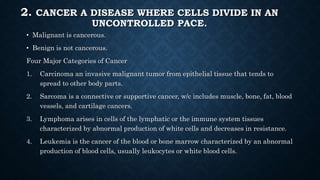
2. CANCER A DISEASE WHERE CELLS DIVIDE IN AN
UNCONTROLLED PACE.
• Malignant is cancerous.
• Benign is not cancerous.
Four Major Categories of Cancer
1. Carcinoma an invasive malignant tumor from epithelial tissue that tends to
spread to other body parts.
2. Sarcoma is a connective or supportive cancer, w/c includes muscle, bone, fat, blood
vessels, and cartilage cancers.
3. Lymphoma arises in cells of the lymphatic or the immune system tissues
characterized by abnormal production of white cells and decreases in resistance.
4. Leukemia is the cancer of the blood or bone marrow characterized by an abnormal
production of blood cells, usually leukocytes or white blood cells.
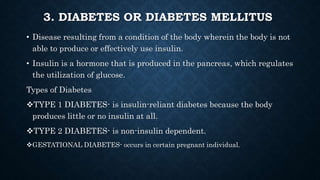
3. DIABETES OR DIABETES MELLITUS
• Disease resulting from a condition of the body wherein the body is not
able to produce or effectively use insulin.
• Insulin is a hormone that is produced in the pancreas, which regulates
the utilization of glucose.
Types of Diabetes
TYPE 1 DIABETES- is insulin-reliant diabetes because the body
produces little or no insulin at all.
TYPE 2 DIABETES- is non-insulin dependent.
GESTATIONAL DIABETES- occurs in certain pregnant individual.
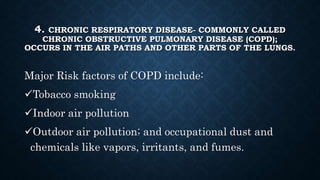
4. CHRONIC RESPIRATORY DISEASE- COMMONLY CALLED
CHRONIC OBSTRUCTIVE PULMONARY DISEASE (COPD);
OCCURS IN THE AIR PATHS AND OTHER PARTS OF THE LUNGS.
Major Risk factors of COPD include:
Tobacco smoking
Indoor air pollution
Outdoor air pollution; and occupational dust and
chemicals like vapors, irritants, and fumes.

CHAPTER 4- P.E..pptx

  • 1.
    PHYSICAL EDUCATION CHAPTER 4:MODIFIABLE RISK FACTORS OF LIFESTYLE DIEASES
  • 2.
  • 3.
    WHY IS SMOKINGHARMFUL? • Almost every organ in the body is damaged when a person smokes. Weakens the body and leads to many diseases. • Others who are exposed to cigarette smoke are also at risk from its chemical effects. The smoke contains hydrogen cyanide (a deadly substance used in gas chambers). • Tar, Nicotine, and carbon monoxide are substances from to bacco that are substances from to bacco that are among the most harmful to health. • Tar is a toxic substance that has carcinogenic and accumulates inside the respiratory system.
  • 4.
    • Nicotine isa toxic chemical compound that mostly consists nitrogen, which also makes cigarettes addictive. • Carbon Monoxide is a poisonous chemical from burnt cigarette that makes the heart do more work to supply sufficient oxygen in the body.
  • 5.
    WHAT ARE THEKINDS OF TOBACCO SMOKE? • Mainstream smoke, commonly known as “first-hand smoke” is the smoke from lit cigarette that is both inhaled and exhaled. • Second-hand smoke is a very dangerous smoke when taken in. It is the smoke puffed out by smokers called environmental tobacco or “sidestream” smoke. • Third-hand smoke refers to cigarette offshoots which is attached to the smokers’ hair and clothing as well as various surfaces like walls, floors, furniture, chairs, and toys.
  • 6.
    WHY DO PEOPLESTART SMOKING? a. Parental Role Model b. Adolescent Experimentation and Rebellion c. Depression d. Limited Education e. Weight Control f. Aggressive Marketing g. Stress h. Addiction
  • 7.
    WHY DO PEOPLEKEEP SMOKING? a. Pleasure b. Fear of weight gain c. Nicotine Dependence d.Use of other substances (many smokers also use alcohol and drugs)
  • 8.
  • 9.
    HOW ARE HEALTHYEATING HABITS DEVELOPED? •Dietary habits are the usual choices of food that people make. Diet affects an individual health condition. •Poor dietary habits occur when the person does not follow the principles of good nutrition adequacy, balance, and variety.
  • 10.
    RISK OF DEVELOPINGDISEASES AND HEALTH PROBLEMS SUCH AS: • Obesity • Tooth decay • High Blood Pressure • High Cholesterol • Heart Disease and stroke • Type-2 Diabetes • Osteoporosis • Certain Types of Cancer • Depression • Eating Disorder
  • 11.
    SEDENTARY LIFESTYLE • SedentaryLifestyle occurs when an individual lacks the recommended level of regular physical activity or if he/she is physically inactive. • What does physical inactivity causes you? Increase risks of certain cancers Contribute to anxiety and depression Risk factor of certain cardiovascular disease and obesity Decrease in skeletal muscle mass due to excessive sitting High blood pressure and increased cholesterol levels
  • 12.
    WHAT ARE THETYPES OF DISEASES ASSOCIATED WITH UNHEALTHY LIFESTYLE? 1. Cardiovascular Disease- a disease of the heart and blood vessels and is the leading cause of death in the Philippines. What are the types of cardiovascular diseases? Arteriosclerosis- a condition causing the arteries to harden and thicken. Atherosclerosis- type of arteriosclerosis where deposited fat hardens and becomes plaque on arterial wall. Coronary Heart disease- coronary arteries (pathway of blood to the heart muscles) are narrowed or blocked; a disease of the coronary vessels and not the heart.
  • 13.
    MAJOR RISK FACTORSFOR CORONARY HEART DISEASE • Smoking • Diabetes • Hypertension • Cholesterol • Age • Obesity • Physical Inactivity
  • 14.
    Heart Attack- cardiacmuscle failure due to lack of blood flow to the heart. Angina Pectoris- chest pain from narrowed coronary arteries due to inadequate oxygen for the heart. Rheumatic Fever- the immune system attacks the heart and can cause fever, weakness and damage to its valves. Heart Rhythm Abnormalities/Arrythmia-irregular heart rhythm brought about by faulty electrical conduction system that is worsened by uncontrolled stress levels and high caffeine intake. Congestive Heart Failure- the heart is not able or below its normal capacity to pump blood, causing liquid to accumulate in the lungs and other areas of the body.
  • 15.
    2. CANCER ADISEASE WHERE CELLS DIVIDE IN AN UNCONTROLLED PACE. • Malignant is cancerous. • Benign is not cancerous. Four Major Categories of Cancer 1. Carcinoma an invasive malignant tumor from epithelial tissue that tends to spread to other body parts. 2. Sarcoma is a connective or supportive cancer, w/c includes muscle, bone, fat, blood vessels, and cartilage cancers. 3. Lymphoma arises in cells of the lymphatic or the immune system tissues characterized by abnormal production of white cells and decreases in resistance. 4. Leukemia is the cancer of the blood or bone marrow characterized by an abnormal production of blood cells, usually leukocytes or white blood cells.
  • 16.
    3. DIABETES ORDIABETES MELLITUS • Disease resulting from a condition of the body wherein the body is not able to produce or effectively use insulin. • Insulin is a hormone that is produced in the pancreas, which regulates the utilization of glucose. Types of Diabetes TYPE 1 DIABETES- is insulin-reliant diabetes because the body produces little or no insulin at all. TYPE 2 DIABETES- is non-insulin dependent. GESTATIONAL DIABETES- occurs in certain pregnant individual.
  • 17.
    4. CHRONIC RESPIRATORYDISEASE- COMMONLY CALLED CHRONIC OBSTRUCTIVE PULMONARY DISEASE (COPD); OCCURS IN THE AIR PATHS AND OTHER PARTS OF THE LUNGS. Major Risk factors of COPD include: Tobacco smoking Indoor air pollution Outdoor air pollution; and occupational dust and chemicals like vapors, irritants, and fumes.