B8 Photosynthesis
Student Book answers
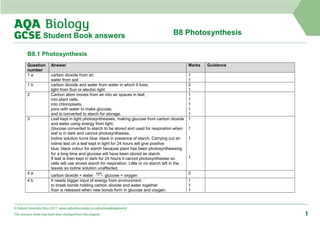
B8.1 Photosynthesis
Question
number
Answer Marks Guidance
1 a carbon dioxide from air,
water from soil
1
1
1 b carbon dioxide and water from water in which it lives,
light from Sun or electric light
2
1
2 Carbon atom moves from air into air spaces in leaf,
into plant cells,
into chloroplasts,
joins with water to make glucose,
and is converted to starch for storage.
1
1
1
1
1
3 Leaf kept in light photosynthesises, making glucose from carbon dioxide
and water using energy from light.
Glucose converted to starch to be stored and used for respiration when
leaf is in dark and cannot photosynthesise.
Iodine solution turns blue‑black in presence of starch. Carrying out an
iodine test on a leaf kept in light for 24 hours will give positive
blue‑black colour for starch because plant has been photosynthesising
for a long time and glucose will have been stored as starch.
If leaf is then kept in dark for 24 hours it cannot photosynthesise so
cells will use stored starch for respiration. Little or no starch left in the
leaves so iodine solution unaffected.
1
1
1
1
4 a
carbon dioxide + water glucose + oxygen
2
4 b It needs bigger input of energy from environment
to break bonds holding carbon dioxide and water together
than is released when new bonds form in glucose and oxygen.
1
1
1
© Oxford University Press 2017 www.oxfordsecondary.co.uk/acknowledgements
This resource sheet may have been changed from the original. 1
B8 Photosynthesis
Student Book answers
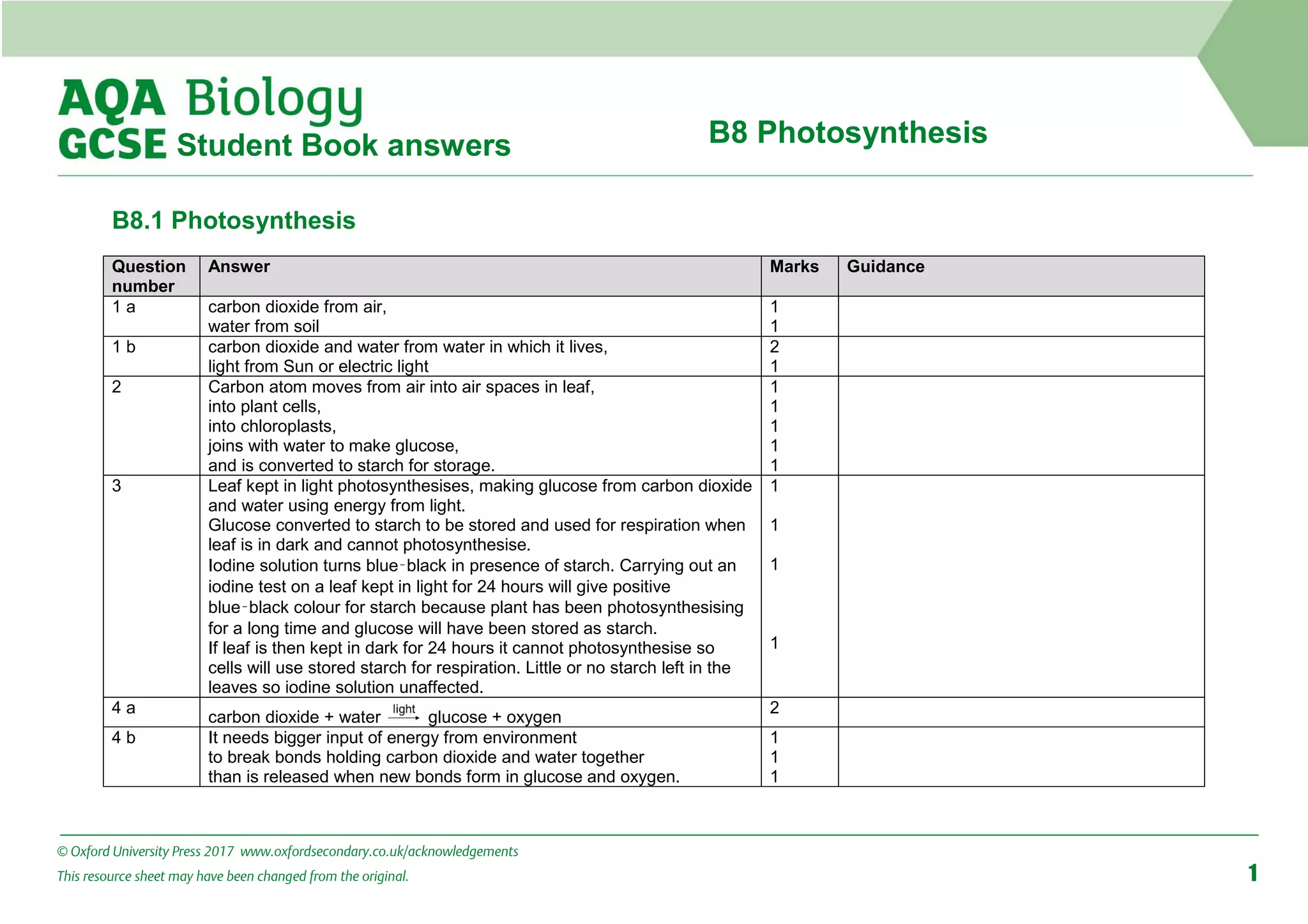
B8.2 The rate of photosynthesis
Question
number
Answer Marks Guidance
1 carbon dioxide,
light,
temperature
1
1
1
2 a As light intensity increases, so does rate of photosynthesis.
This indicates that light intensity is limiting factor.
1
1
2 b Increase in light intensity has no effect on rate of photosynthesis,
so light intensity is no longer limiting factor (something else probably is).
1
1
2 c Temperature acts as a normal limiting factor to begin with, in that
increase in temperature increases rate of photosynthesis.
This is consistent with light and carbon dioxide concentrations (Figures
1 and 4).
Increasing light intensity and carbon dioxide concentration cause rate of
photosynthesis to rise and then plateau when another factor becomes
limiting.
Above a certain temperature, enzymes in cells are denatured so no
photosynthesis can take place at all.
1
1
1
1
3 Tropical rainforest: high light intensity, warm temperature, plenty of
moisture, carbon dioxide from decaying material (relatively few limiting
factors and rapid growth conditions available all year round, allowing
plants and even individual leaves get very large);
UK woodland: low light intensity, short days in winter, cold temperature
(most growth takes place in spring and summer with plenty of light and
warmth but temperatures still lower temperatures than tropical rain
forest, less time for growth so plants smaller);
Arctic tundra: no light all winter but lots of light in summer, lack of water
due to frozen ground (low temperatures limiting factor on
2
2
2
© Oxford University Press 2017 www.oxfordsecondary.co.uk/acknowledgements
This resource sheet may have been changed from the original. 2
B8 Photosynthesis
Student Book answers
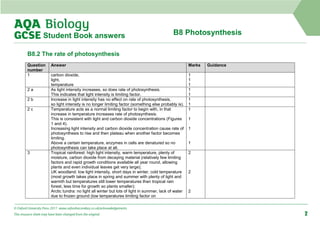
photosynthesis for most of year, so plants much smaller and slower-
growing than tropical rainforest or UK woodland)
© Oxford University Press 2017 www.oxfordsecondary.co.uk/acknowledgements
This resource sheet may have been changed from the original. 3
B8 Photosynthesis
Student Book answers
B8.3 How plants use glucose
Question
number
Answer Marks Guidance
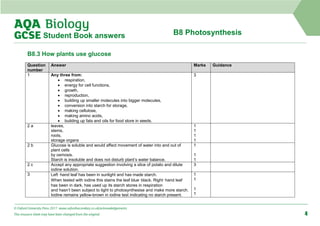
1 Any three from:
• respiration,
• energy for cell functions,
• growth,
• reproduction,
• building up smaller molecules into bigger molecules,
• conversion into starch for storage,
• making cellulose,
• making amino acids,
• building up fats and oils for food store in seeds.
3
2 a leaves,
stems,
roots,
storage organs
1
1
1
1
2 b Glucose is soluble and would affect movement of water into and out of
plant cells
by osmosis.
Starch is insoluble and does not disturb plant’s water balance.
1
1
1
2 c Accept any appropriate suggestion involving a slice of potato and dilute
iodine solution.
3
3 Left‑hand leaf has been in sunlight and has made starch.
When tested with iodine this stains the leaf blue‑black. Right‑hand leaf
has been in dark, has used up its starch stores in respiration
and hasn’t been subject to light to photosynthesise and make more starch.
Iodine remains yellow-brown in iodine test indicating no starch present.
1
1
1
1
© Oxford University Press 2017 www.oxfordsecondary.co.uk/acknowledgements
This resource sheet may have been changed from the original. 4
B8 Photosynthesis
Student Book answers
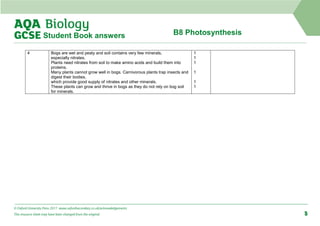
4 Bogs are wet and peaty and soil contains very few minerals,
especially nitrates.
Plants need nitrates from soil to make amino acids and build them into
proteins.
Many plants cannot grow well in bogs. Carnivorous plants trap insects and
digest their bodies,
which provide good supply of nitrates and other minerals.
These plants can grow and thrive in bogs as they do not rely on bog soil
for minerals.
1
1
1
1
1
1
© Oxford University Press 2017 www.oxfordsecondary.co.uk/acknowledgements
This resource sheet may have been changed from the original. 5
B8 Photosynthesis
Student Book answers
B8.4 Making the most of photosynthesis
Question
number
Answer Marks Guidance
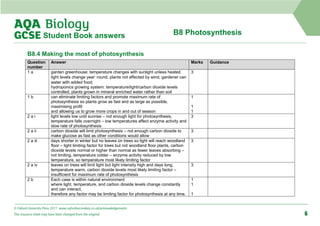
1 a garden greenhouse: temperature changes with sunlight unless heated,
light levels change year‑round, plants not affected by wind, gardener can
water with added food;
hydroponics growing system: temperature/light/carbon dioxide levels
controlled, plants grown in mineral enriched water rather than soil
3
1 b can eliminate limiting factors and promote maximum rate of
photosynthesis so plants grow as fast and as large as possible,
maximising profit
and allowing us to grow more crops in and out of season
1
1
1
2 a i light levels low until sunrise – not enough light for photosynthesis,
temperature falls overnight – low temperatures affect enzyme activity and
slow rate of photosynthesis
3
2 a ii carbon dioxide will limit photosynthesis – not enough carbon dioxide to
make glucose as fast as other conditions would allow
3
2 a iii days shorter in winter but no leaves on trees so light will reach woodland
floor – light limiting factor for trees but not woodland floor plants, carbon
dioxide levels normal or higher than normal as fewer leaves absorbing –
not limiting, temperature colder – enzyme activity reduced by low
temperature, so temperature most likely limiting factor
3
2 a iv leaves on trees will limit light but light intensity high and days long,
temperature warm, carbon dioxide levels most likely limiting factor –
insufficient for maximum rate of photosynthesis
3
2 b Each case is within natural environment
where light, temperature, and carbon dioxide levels change constantly
and can interact,
therefore any factor may be limiting factor for photosynthesis at any time.
1
1
1
© Oxford University Press 2017 www.oxfordsecondary.co.uk/acknowledgements
This resource sheet may have been changed from the original. 6
B8 Photosynthesis
Student Book answers
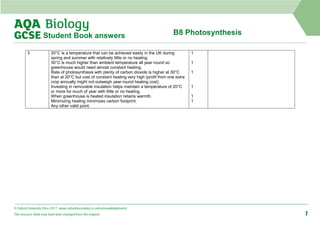
3 20°C is a temperature that can be achieved easily in the UK during
spring and summer with relatively little or no heating.
30°C is much higher than ambient temperature all year round so
greenhouse would need almost constant heating.
Rate of photosynthesis with plenty of carbon dioxide is higher at 30°C
than at 20°C but cost of constant heating very high (profit from one extra
crop annually might not outweigh year-round heating cost).
Investing in removable insulation helps maintain a temperature of 20°C
or more for much of year with little or no heating.
When greenhouse is heated insulation retains warmth.
Minimizing heating minimizes carbon footprint.
Any other valid point.
1
1
1
1
1
1
© Oxford University Press 2017 www.oxfordsecondary.co.uk/acknowledgements
This resource sheet may have been changed from the original. 7

AQA Biology B8 [ Answers ]

  • 1.
    B8 Photosynthesis Student Bookanswers B8.1 Photosynthesis Question number Answer Marks Guidance 1 a carbon dioxide from air, water from soil 1 1 1 b carbon dioxide and water from water in which it lives, light from Sun or electric light 2 1 2 Carbon atom moves from air into air spaces in leaf, into plant cells, into chloroplasts, joins with water to make glucose, and is converted to starch for storage. 1 1 1 1 1 3 Leaf kept in light photosynthesises, making glucose from carbon dioxide and water using energy from light. Glucose converted to starch to be stored and used for respiration when leaf is in dark and cannot photosynthesise. Iodine solution turns blue‑black in presence of starch. Carrying out an iodine test on a leaf kept in light for 24 hours will give positive blue‑black colour for starch because plant has been photosynthesising for a long time and glucose will have been stored as starch. If leaf is then kept in dark for 24 hours it cannot photosynthesise so cells will use stored starch for respiration. Little or no starch left in the leaves so iodine solution unaffected. 1 1 1 1 4 a carbon dioxide + water glucose + oxygen 2 4 b It needs bigger input of energy from environment to break bonds holding carbon dioxide and water together than is released when new bonds form in glucose and oxygen. 1 1 1 © Oxford University Press 2017 www.oxfordsecondary.co.uk/acknowledgements This resource sheet may have been changed from the original. 1
  • 2.
    B8 Photosynthesis Student Bookanswers B8.2 The rate of photosynthesis Question number Answer Marks Guidance 1 carbon dioxide, light, temperature 1 1 1 2 a As light intensity increases, so does rate of photosynthesis. This indicates that light intensity is limiting factor. 1 1 2 b Increase in light intensity has no effect on rate of photosynthesis, so light intensity is no longer limiting factor (something else probably is). 1 1 2 c Temperature acts as a normal limiting factor to begin with, in that increase in temperature increases rate of photosynthesis. This is consistent with light and carbon dioxide concentrations (Figures 1 and 4). Increasing light intensity and carbon dioxide concentration cause rate of photosynthesis to rise and then plateau when another factor becomes limiting. Above a certain temperature, enzymes in cells are denatured so no photosynthesis can take place at all. 1 1 1 1 3 Tropical rainforest: high light intensity, warm temperature, plenty of moisture, carbon dioxide from decaying material (relatively few limiting factors and rapid growth conditions available all year round, allowing plants and even individual leaves get very large); UK woodland: low light intensity, short days in winter, cold temperature (most growth takes place in spring and summer with plenty of light and warmth but temperatures still lower temperatures than tropical rain forest, less time for growth so plants smaller); Arctic tundra: no light all winter but lots of light in summer, lack of water due to frozen ground (low temperatures limiting factor on 2 2 2 © Oxford University Press 2017 www.oxfordsecondary.co.uk/acknowledgements This resource sheet may have been changed from the original. 2
  • 3.
    B8 Photosynthesis Student Bookanswers photosynthesis for most of year, so plants much smaller and slower- growing than tropical rainforest or UK woodland) © Oxford University Press 2017 www.oxfordsecondary.co.uk/acknowledgements This resource sheet may have been changed from the original. 3
  • 4.
    B8 Photosynthesis Student Bookanswers B8.3 How plants use glucose Question number Answer Marks Guidance 1 Any three from: • respiration, • energy for cell functions, • growth, • reproduction, • building up smaller molecules into bigger molecules, • conversion into starch for storage, • making cellulose, • making amino acids, • building up fats and oils for food store in seeds. 3 2 a leaves, stems, roots, storage organs 1 1 1 1 2 b Glucose is soluble and would affect movement of water into and out of plant cells by osmosis. Starch is insoluble and does not disturb plant’s water balance. 1 1 1 2 c Accept any appropriate suggestion involving a slice of potato and dilute iodine solution. 3 3 Left‑hand leaf has been in sunlight and has made starch. When tested with iodine this stains the leaf blue‑black. Right‑hand leaf has been in dark, has used up its starch stores in respiration and hasn’t been subject to light to photosynthesise and make more starch. Iodine remains yellow-brown in iodine test indicating no starch present. 1 1 1 1 © Oxford University Press 2017 www.oxfordsecondary.co.uk/acknowledgements This resource sheet may have been changed from the original. 4
  • 5.
    B8 Photosynthesis Student Bookanswers 4 Bogs are wet and peaty and soil contains very few minerals, especially nitrates. Plants need nitrates from soil to make amino acids and build them into proteins. Many plants cannot grow well in bogs. Carnivorous plants trap insects and digest their bodies, which provide good supply of nitrates and other minerals. These plants can grow and thrive in bogs as they do not rely on bog soil for minerals. 1 1 1 1 1 1 © Oxford University Press 2017 www.oxfordsecondary.co.uk/acknowledgements This resource sheet may have been changed from the original. 5
  • 6.
    B8 Photosynthesis Student Bookanswers B8.4 Making the most of photosynthesis Question number Answer Marks Guidance 1 a garden greenhouse: temperature changes with sunlight unless heated, light levels change year‑round, plants not affected by wind, gardener can water with added food; hydroponics growing system: temperature/light/carbon dioxide levels controlled, plants grown in mineral enriched water rather than soil 3 1 b can eliminate limiting factors and promote maximum rate of photosynthesis so plants grow as fast and as large as possible, maximising profit and allowing us to grow more crops in and out of season 1 1 1 2 a i light levels low until sunrise – not enough light for photosynthesis, temperature falls overnight – low temperatures affect enzyme activity and slow rate of photosynthesis 3 2 a ii carbon dioxide will limit photosynthesis – not enough carbon dioxide to make glucose as fast as other conditions would allow 3 2 a iii days shorter in winter but no leaves on trees so light will reach woodland floor – light limiting factor for trees but not woodland floor plants, carbon dioxide levels normal or higher than normal as fewer leaves absorbing – not limiting, temperature colder – enzyme activity reduced by low temperature, so temperature most likely limiting factor 3 2 a iv leaves on trees will limit light but light intensity high and days long, temperature warm, carbon dioxide levels most likely limiting factor – insufficient for maximum rate of photosynthesis 3 2 b Each case is within natural environment where light, temperature, and carbon dioxide levels change constantly and can interact, therefore any factor may be limiting factor for photosynthesis at any time. 1 1 1 © Oxford University Press 2017 www.oxfordsecondary.co.uk/acknowledgements This resource sheet may have been changed from the original. 6
  • 7.
    B8 Photosynthesis Student Bookanswers 3 20°C is a temperature that can be achieved easily in the UK during spring and summer with relatively little or no heating. 30°C is much higher than ambient temperature all year round so greenhouse would need almost constant heating. Rate of photosynthesis with plenty of carbon dioxide is higher at 30°C than at 20°C but cost of constant heating very high (profit from one extra crop annually might not outweigh year-round heating cost). Investing in removable insulation helps maintain a temperature of 20°C or more for much of year with little or no heating. When greenhouse is heated insulation retains warmth. Minimizing heating minimizes carbon footprint. Any other valid point. 1 1 1 1 1 1 © Oxford University Press 2017 www.oxfordsecondary.co.uk/acknowledgements This resource sheet may have been changed from the original. 7