CONGENITAL HIP DISEASE
DR VIVESH KR SINGH
MS ORTHOPAEDIC
DDH
•Dysplasia of the hip that develop during fetal life or in infancy.
•It ranges from dysplasia of the acetabulum (shallow acetabulum) to
subluxation of the joint to complete dislocation.
•Complete hip dislocation.
•Partial hip subluxation.
•Acetabular dysplasia (incomplete development).
•Dislocatable hip
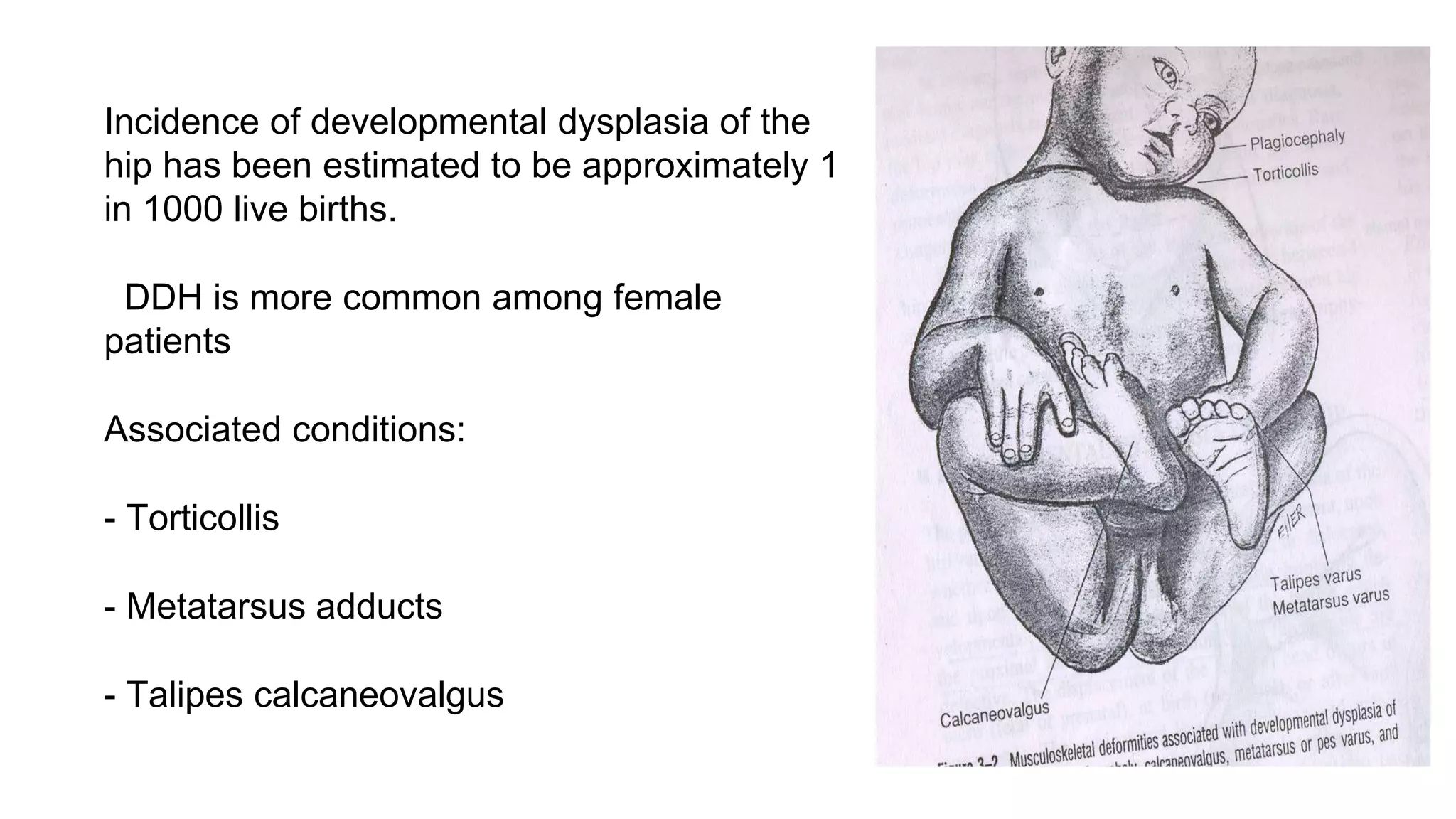
Incidence of developmental dysplasia of the
hip has been estimated to be approximately 1
in 1000 live births.
DDH is more common among female
patients
Associated conditions:
- Torticollis
- Metatarsus adducts
- Talipes calcaneovalgus
•Types:
•DDH is classified into two major groups :
•Typical and teratologic .
•Typical DDH occurs in otherwise normal patients or
those without defined syndromes or genetic conditions.
•Teratologic hip dislocations usually have identifiable
causes such as arthrogyposis or a genetic syndrome and
occur before birth.
Teratological DDH
•Irreducible.
•False acetabulum.
•Defective anterior acetabulum “anteverted”.
•Increased femoral neck anteversion.
Clinical Presentation
Neonatal Presentation
Exam one hip at a time
Baby must be quiet
Barlow’s sign: provocative maneuver
Ortolani’s sign: reduces hip
Other signs not helpful in newborn
CLINICAL FINDINGS
•IN NEWBORNS
•Usually asymptomatic and must be screened by special
maneuvers
•1) Barlow test.
It is a provocative test that attempts to dislocate an
unstable hip.
-Flexion, adduction, posteriorly.
-“Clunk”
Barlow test for DDH in a neonate
2) Ortolani test
It is a maneuver to reduce a recently dislocated hip.
Flexion, abduction, anteriorly.
We can`t use X-rays because the acetabulum and
proximal femur are cartilaginous and wont be shown
on X-ray.
USG is the best method to Dx.
ORTOLANI TEST
Clinical Manifestations
•In infants:
•As the baby enters the 2nd and 3rd months of life, the soft
tissues begin to tighten and the Ortolani and Barlow tests
are no longer reliable.
•Shortening of the thigh, the Galeazzi sign , is best
appreciated by placing both hips in 90 degrees of flexion and
comparing the height of the knees, looking for asymmetry
•The most diagnostic sign is Ortolani’s limitation of
abduction.
•Abduction less than 60 degrees is almost diagnostic.
•X-rays after the age of 3 months can be helpful
especially after the appearance of the ossific nucleus of
the femoral head
•USG is 100% diagnostic.
Infant Presentation
•Skin fold asymmetry
•Limited hip abduction
•Unequal femoral lengths (Galeazzi’s sign)
• GALEAZZI’S SIGN.
Skin fold Asymmetry
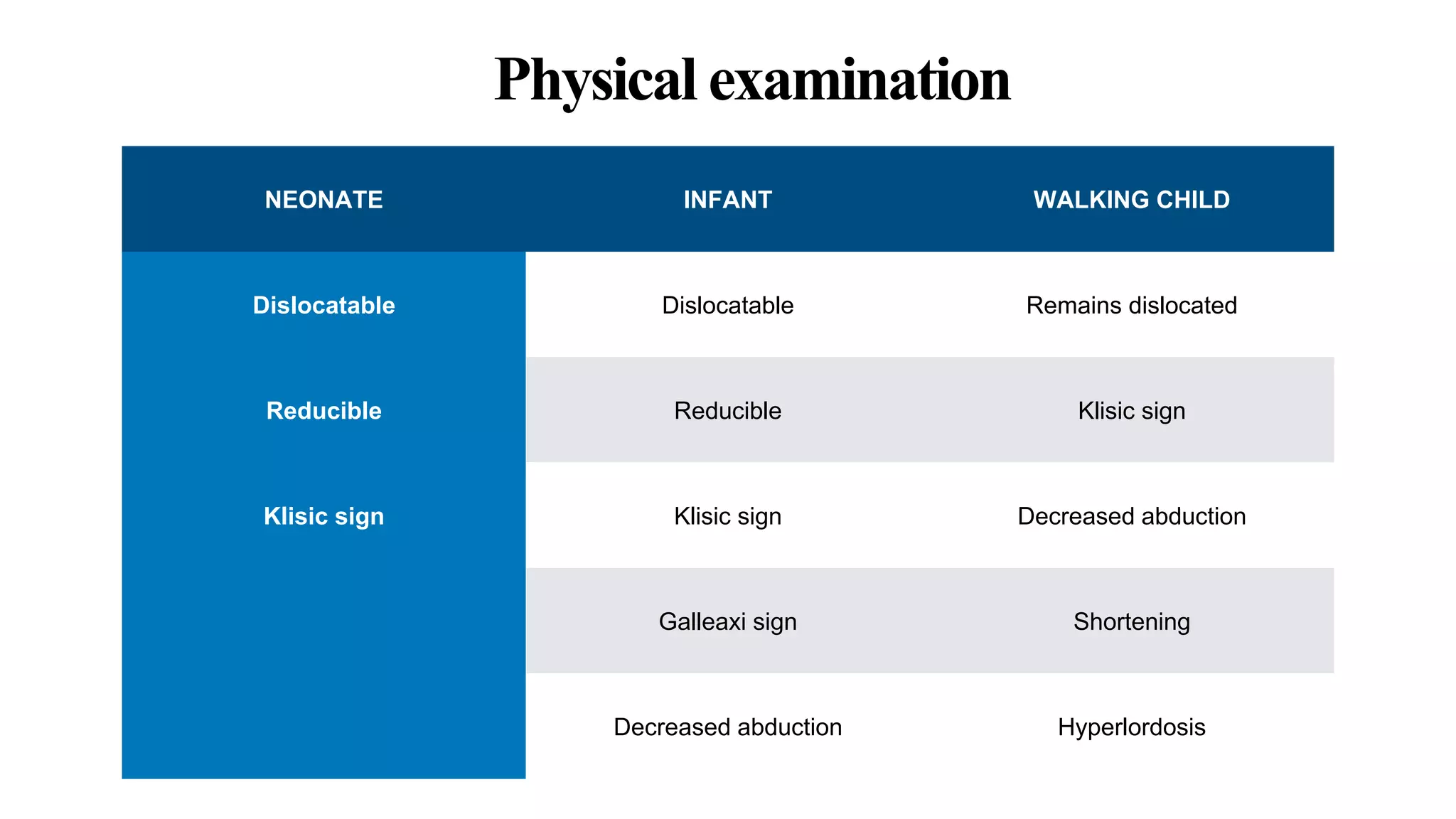
Physical examination
NEONATE INFANT WALKING CHILD
Dislocatable Dislocatable Remains dislocated
Reducible Reducible Klisic sign
Klisic sign Klisic sign Decreased abduction
Galleaxi sign Shortening
Decreased abduction Hyperlordosis
PERTHES DISEASE
Epidemiology
• Disorder of the hip in young children • Usually ages 4-8yrs
• As early as 2yrs, as late as teens
• Boys:Girls= 4-5:1
• Bilateral 10-12%
Etiology
• Disorder of the hip in young children • Usually ages 4-8yrs
• As early as 2yrs, as late as teens
• Boys:Girls= 4-5:1
• Bilateral 10-12%
Presentation
• Often insidious onset of painless limp, increases by activity.
• May complain of pain in groin, thigh, knee
• Few relate trauma history
• Can have an acute onset
Physical Exam
• Decreased ROM, especially
abduction and internal rotation
• • Trendelenburg test often positive
• • Muscular atrophy of
thigh/buttock/calf
• • Limb length discrepency
Imaging
• AP pelvis
• Frog leg view and lateral view
• Bone scan - shows decreased uptake
Radio graphic stages
• Four Waldenstrom stages:
• 1) Ischaemia and bone death(stage of avascular necrosis)
• 2) Fragmentation stage
• 3) Reossification stage
• 4)Remodelling
Stage of Avascular necrosis
Crescent sign
Stage of revasculaization
Stage of ossification
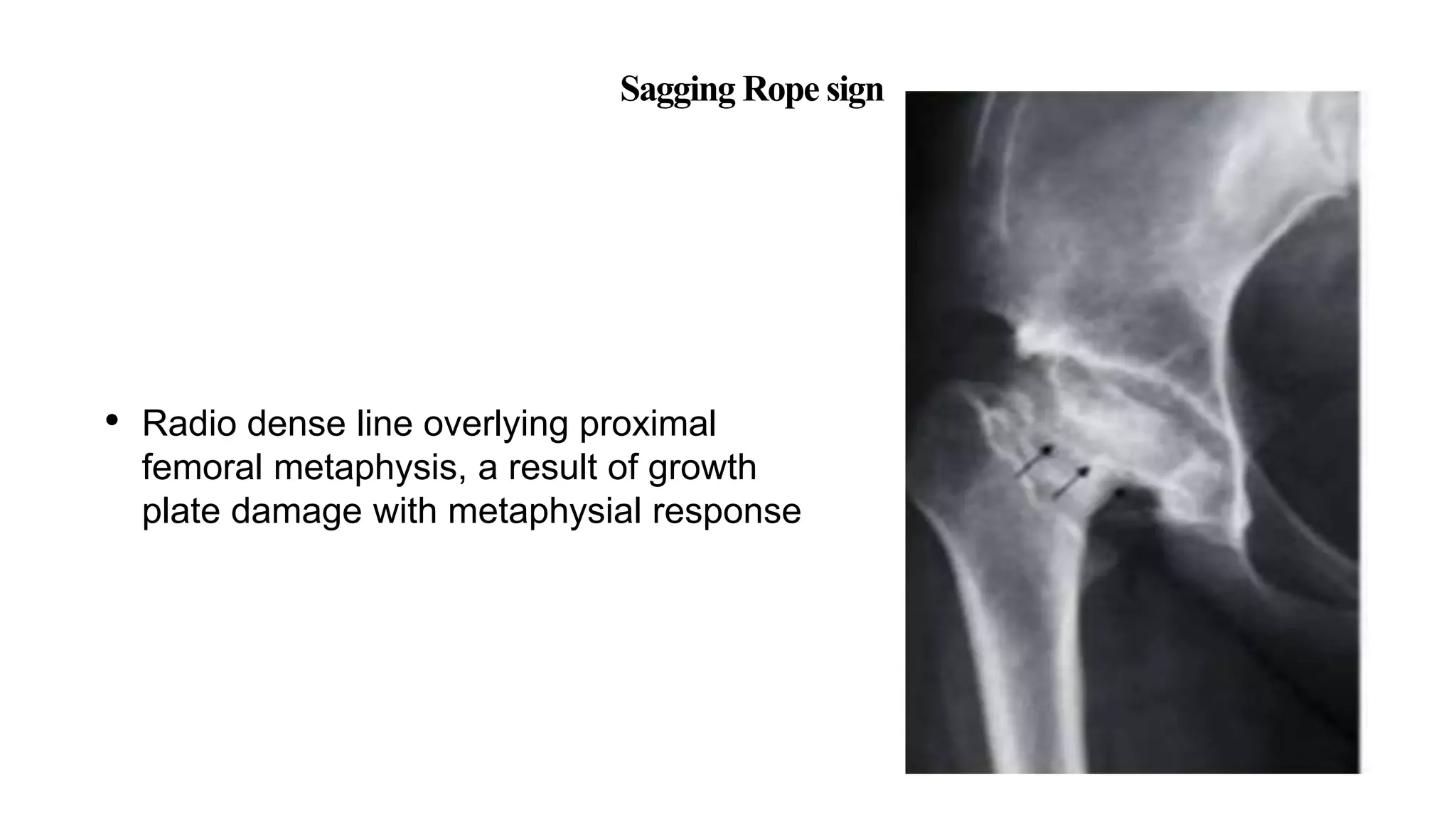
Sagging Rope sign
• Radio dense line overlying proximal
femoral metaphysis, a result of growth
plate damage with metaphysial response
Salter Thompson classification
• BASED ON EXTENT OF SUBCHONDRAL
FRACTURE-
• A> LESS THAN HALF OF FEMORAL HEAD
INVOLVED
• B> MORE THAN HALF OF THE FEMORAL HEAD
INVOLVED
Catterall classification
• Based on extent of
epiphyseal involvement
and percentage of
collapse as seen in x-
ray (both AP and
Lateral view)
SLIPPED CAPITAL FEMORAL EPIPHYSIS
• Femoral neck and shaft displace relative to the femoral epiphysis and the
acetabulum
• Usually, upward & anterior
• Head remains posterior and downward in the acetabulum.
Displacements
• Femoral epiphysis displacing relative femoral neck :
• i) Posterior-a varus relation M.C
• ii) Forward (anteriorly)
• iii) Laterally (into a valgus position)
Displacement
Patho-anatomy
Growth plate
• Reserve Zone
• Composed of chondrocytes
• Type II collagen is present in its highest amount
• Oxygen tension is low
• Proliferative Zone
• Chondrocytes form matrix
• Oxygen tension is high
• Rich vascular supply.
• The majority of the longitudinal growth of the growth plate occurs in this zone.
• Hypertrophic Zone
• The zone is avascular,
• low oxygen tension (similar to the reserve zone).
• Chondrocytes prepare matrix for mineralization and calcification.
• Slip occurs through the weakest structural area of the plate, the hypertrophic
zone.
ETIOLOGY
• Often unknown
• Majority are normal by current endocrine work-up
• Etiologic –
• Altering the strength of the zone of hypertrophy
• Affecting the shear stress to the plate
• 1)Endocrine
• 2)Mechanical
Mechanical Factors
• Predisposing features:
• Thinning of perichondral ring complex
• Retroversion of femoral neck
• Change in inclination of prox femoral physis relative to
femoral neck/shaft
CLINICAL FEATURES
• Preslip phase-
• i)Weakness in the leg
• ii) limping on exertion;
• iii)On physical examination,
• Lack of medial rotation of hip , hip in extension.
• Affected leg is fixed, the thigh goes into abduction and external rotation.
Unstable Acute or Acute-on-Chronic Slipped Capital Femoral Epiphysis
• The clinical criterion- acute onset of symptoms < 2 weeks
• Prodromal symptoms - weakness, limp, and intermittent groin, medial thigh, or knee
pain , Uable to weight bear.
• Antalgic gait
• An external rotation deformity
• Shortening
• limitation of motion.
• The greater the amount of slip, the greater is the restriction of motion.
CHRONIC SLIP/ STABLE SLIP
• i) Groin or medial thigh/knee pain for months to years.
• ii) Exacerbations and remissions of the pain or limp
• iii) Limitation of motion(particularly medial rotation) the leg fixed external
rotation
• iv) Increased- hip extension, external rotation, Adduction
• Decreased: Flexion , internal rotation ,abduction.
• v) Antalgic limp
• vi) Local tenderness over the hip joint
• vii) Shortening
• viii) Thigh or calf atrophy.
• ix) Hip flexion contracture -Chondrolysis.
Causes of Limp & Hip, Thigh or Knee Pain in Children
THANK YOU

Congenital hip disease

  • 1.
    CONGENITAL HIP DISEASE DRVIVESH KR SINGH MS ORTHOPAEDIC
  • 2.
    DDH •Dysplasia of thehip that develop during fetal life or in infancy. •It ranges from dysplasia of the acetabulum (shallow acetabulum) to subluxation of the joint to complete dislocation. •Complete hip dislocation. •Partial hip subluxation. •Acetabular dysplasia (incomplete development). •Dislocatable hip
  • 4.
    Incidence of developmentaldysplasia of the hip has been estimated to be approximately 1 in 1000 live births. DDH is more common among female patients Associated conditions: - Torticollis - Metatarsus adducts - Talipes calcaneovalgus
  • 5.
    •Types: •DDH is classifiedinto two major groups : •Typical and teratologic . •Typical DDH occurs in otherwise normal patients or those without defined syndromes or genetic conditions. •Teratologic hip dislocations usually have identifiable causes such as arthrogyposis or a genetic syndrome and occur before birth.
  • 6.
    Teratological DDH •Irreducible. •False acetabulum. •Defectiveanterior acetabulum “anteverted”. •Increased femoral neck anteversion.
  • 8.
    Clinical Presentation Neonatal Presentation Examone hip at a time Baby must be quiet Barlow’s sign: provocative maneuver Ortolani’s sign: reduces hip Other signs not helpful in newborn
  • 9.
    CLINICAL FINDINGS •IN NEWBORNS •Usuallyasymptomatic and must be screened by special maneuvers •1) Barlow test. It is a provocative test that attempts to dislocate an unstable hip. -Flexion, adduction, posteriorly. -“Clunk”
  • 10.
    Barlow test forDDH in a neonate
  • 11.
    2) Ortolani test Itis a maneuver to reduce a recently dislocated hip. Flexion, abduction, anteriorly. We can`t use X-rays because the acetabulum and proximal femur are cartilaginous and wont be shown on X-ray. USG is the best method to Dx.
  • 12.
  • 13.
    Clinical Manifestations •In infants: •Asthe baby enters the 2nd and 3rd months of life, the soft tissues begin to tighten and the Ortolani and Barlow tests are no longer reliable. •Shortening of the thigh, the Galeazzi sign , is best appreciated by placing both hips in 90 degrees of flexion and comparing the height of the knees, looking for asymmetry
  • 14.
    •The most diagnosticsign is Ortolani’s limitation of abduction. •Abduction less than 60 degrees is almost diagnostic. •X-rays after the age of 3 months can be helpful especially after the appearance of the ossific nucleus of the femoral head •USG is 100% diagnostic.
  • 15.
    Infant Presentation •Skin foldasymmetry •Limited hip abduction •Unequal femoral lengths (Galeazzi’s sign)
  • 16.
  • 17.
  • 19.
    Physical examination NEONATE INFANTWALKING CHILD Dislocatable Dislocatable Remains dislocated Reducible Reducible Klisic sign Klisic sign Klisic sign Decreased abduction Galleaxi sign Shortening Decreased abduction Hyperlordosis
  • 20.
  • 21.
    Epidemiology • Disorder ofthe hip in young children • Usually ages 4-8yrs • As early as 2yrs, as late as teens • Boys:Girls= 4-5:1 • Bilateral 10-12%
  • 22.
    Etiology • Disorder ofthe hip in young children • Usually ages 4-8yrs • As early as 2yrs, as late as teens • Boys:Girls= 4-5:1 • Bilateral 10-12%
  • 23.
    Presentation • Often insidiousonset of painless limp, increases by activity. • May complain of pain in groin, thigh, knee • Few relate trauma history • Can have an acute onset
  • 24.
    Physical Exam • DecreasedROM, especially abduction and internal rotation • • Trendelenburg test often positive • • Muscular atrophy of thigh/buttock/calf • • Limb length discrepency
  • 25.
    Imaging • AP pelvis •Frog leg view and lateral view • Bone scan - shows decreased uptake
  • 26.
    Radio graphic stages •Four Waldenstrom stages: • 1) Ischaemia and bone death(stage of avascular necrosis) • 2) Fragmentation stage • 3) Reossification stage • 4)Remodelling
  • 27.
  • 28.
    Crescent sign Stage ofrevasculaization
  • 29.
  • 30.
    Sagging Rope sign •Radio dense line overlying proximal femoral metaphysis, a result of growth plate damage with metaphysial response
  • 31.
    Salter Thompson classification •BASED ON EXTENT OF SUBCHONDRAL FRACTURE- • A> LESS THAN HALF OF FEMORAL HEAD INVOLVED • B> MORE THAN HALF OF THE FEMORAL HEAD INVOLVED
  • 33.
    Catterall classification • Basedon extent of epiphyseal involvement and percentage of collapse as seen in x- ray (both AP and Lateral view)
  • 34.
  • 35.
    SLIPPED CAPITAL FEMORALEPIPHYSIS • Femoral neck and shaft displace relative to the femoral epiphysis and the acetabulum • Usually, upward & anterior • Head remains posterior and downward in the acetabulum.
  • 36.
    Displacements • Femoral epiphysisdisplacing relative femoral neck : • i) Posterior-a varus relation M.C • ii) Forward (anteriorly) • iii) Laterally (into a valgus position)
  • 37.
  • 38.
  • 39.
    Growth plate • ReserveZone • Composed of chondrocytes • Type II collagen is present in its highest amount • Oxygen tension is low • Proliferative Zone • Chondrocytes form matrix • Oxygen tension is high • Rich vascular supply. • The majority of the longitudinal growth of the growth plate occurs in this zone.
  • 40.
    • Hypertrophic Zone •The zone is avascular, • low oxygen tension (similar to the reserve zone). • Chondrocytes prepare matrix for mineralization and calcification. • Slip occurs through the weakest structural area of the plate, the hypertrophic zone.
  • 41.
    ETIOLOGY • Often unknown •Majority are normal by current endocrine work-up • Etiologic – • Altering the strength of the zone of hypertrophy • Affecting the shear stress to the plate • 1)Endocrine • 2)Mechanical
  • 42.
    Mechanical Factors • Predisposingfeatures: • Thinning of perichondral ring complex • Retroversion of femoral neck • Change in inclination of prox femoral physis relative to femoral neck/shaft
  • 43.
    CLINICAL FEATURES • Preslipphase- • i)Weakness in the leg • ii) limping on exertion; • iii)On physical examination, • Lack of medial rotation of hip , hip in extension. • Affected leg is fixed, the thigh goes into abduction and external rotation.
  • 44.
    Unstable Acute orAcute-on-Chronic Slipped Capital Femoral Epiphysis • The clinical criterion- acute onset of symptoms < 2 weeks • Prodromal symptoms - weakness, limp, and intermittent groin, medial thigh, or knee pain , Uable to weight bear. • Antalgic gait • An external rotation deformity • Shortening • limitation of motion. • The greater the amount of slip, the greater is the restriction of motion.
  • 45.
    CHRONIC SLIP/ STABLESLIP • i) Groin or medial thigh/knee pain for months to years. • ii) Exacerbations and remissions of the pain or limp • iii) Limitation of motion(particularly medial rotation) the leg fixed external rotation • iv) Increased- hip extension, external rotation, Adduction • Decreased: Flexion , internal rotation ,abduction.
  • 46.
    • v) Antalgiclimp • vi) Local tenderness over the hip joint • vii) Shortening • viii) Thigh or calf atrophy. • ix) Hip flexion contracture -Chondrolysis.
  • 47.
    Causes of Limp& Hip, Thigh or Knee Pain in Children
  • 48.