Marketing
   Manufacturing
    ◦ Apple, Nike
   Advertising
    ◦ HUL, P&G
   Marketing
    ◦ Film producers
   IT Infrastructure
    ◦ Cloud based services


What can be Outsourced
   Aspirations
    ◦ Successful Businesses are aspirations realized
   Ideas
    ◦ Successful Businesses are about
      implementation of innovative ideas.
   Relationships
    ◦ Relationships creates trust, commitment,
      positive energy
    ◦ Provide information, investments, reputation
What cannot be outsourced?
   Customer Value can be Tangible and Intangible
    ◦ Tangible benefits can be imitated by competition
    ◦ Tangible benefits and resultant advantages are
      difficult to maintain
    ◦ Customer Satisfaction of tangibles is a moving target.
      Customers expect more when they get more.
    ◦ Expensive to create and maintain .
   Consumer Intangibles
    ◦ Symbolic Consumption (Imagery, aspirations)
    ◦ Hedonic Consumption (A superior Experience)
    ◦ Value we can capture can be more than the cost of
    Marketing is Customer Value
      creating it
   Brand Premium
   On tangibles?
    ◦ Certainly yes
    ◦ Lower the cost of production, sourcing,
      operations, have the least operating margins
    ◦ Provide the convenience , assortment, quality
      assurance , longer working hours, quick billing
    ◦ Have Economies of Scale, have large scale
   Be Big


Where do we want to compete?
   On Intangibles?
    ◦ Certainly yes
   Build a Brand
    ◦ Create aspiration in consumers to associate : What
      I get is more than the price product will fetch in the
      market.
    ◦ Create symbolic Value
   Provide a unique consumption experience
    difficult to duplicate
 ◦ Create hedonic value
 ◦ Personal relations, warmth, recognition, emotional
   bond
Where do we want Customer Experience
 ◦ Service differentiation and to compete?
   Management
      Customization
   What is the unique value you want to
    provide the consumer?
    ◦ Functional /Utilitarian (Tangibles)
    ◦ Symbolic Aspirational brand(Intangible)
    ◦ Hedonic Experience (Intangible)
   A Marketing strategy involves your choice
    of
    ◦ What type of consumers to serve?
    ◦ What value to provide?
    ◦ Communicating and Influencing the consumer


Strategic Marketing
   Types of mental responses
    ◦ Affect : Feel
      A state of Mind
      Feeling responses
    ◦ Cognition : Thought
      Mental process
      Thinking responses
    ◦ Behavior : Act
      Overt or Covert
   ABC Model of Influence
Influencing Consumers
   Emotion to Mood
    ◦ Joy, Love, Fear, Guilt, Anger, Warmth, Disgust,
      Sadness, Calm, Blue, Boredom, Dislike,
      Melancholy
    ◦ Positive and negative
    ◦ Strong or Weak
    ◦ Innate or learned
   Mental Biases


Affect
   Thought
    ◦ Information processing
   Thoughts about
    ◦   Benefits
    ◦   Comparisons
    ◦   Advantages
    ◦   Apply previous learning


Cognition
   Consumption behavior
    ◦   Purchase
    ◦   Selection
    ◦   Choice of a store
    ◦   Join a scheme
    ◦   Recommendation and referral
    ◦   Repeat Purchase


Behaviour
Love Marriages


ABC
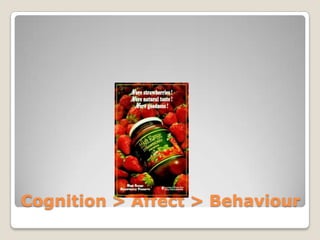
Cognition > Affect > Behaviour
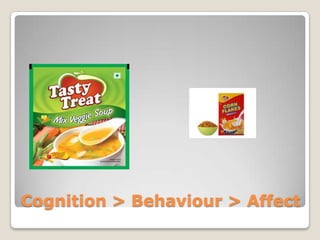
Cognition > Behaviour > Affect
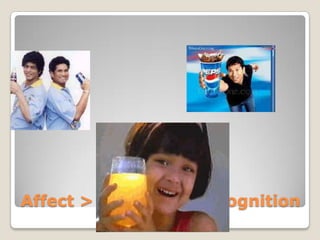
Affect > Behaviour > Cognition
Affect > Cognition > Behaviour
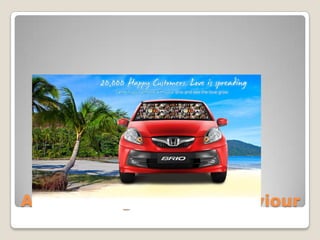
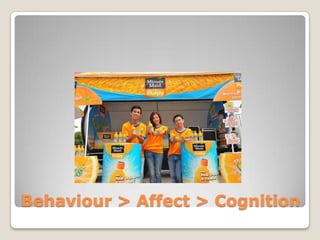
Behaviour > Affect > Cognition
   Please recall the experience as a customer
    you were most dissatisfied?
    ◦ Please Describe on a sheet


Customer Service
Customer Experience
Management
   Service Quality
    ◦ How do customers perceive and evaluate service
      quality?
    ◦ What are managers’ perceptions about service
      quality?
    ◦ Do discrepancies exist between the perceptions of
      customers and those of managers?
    ◦ How can Retailers improve customer service and
      achieve excellence?
   A Customers can be Satisfied and
    Dissatisfied at the same time
    ◦ Different factors cause satisfaction and
      dissatisfaction
    ◦ Identify factors (hygiene factors) that cause
      dissatisfaction and remove them
    ◦ Identify factors (Satisfiers) that cause
      Satisfaction and Implement.


Service Quality and
Satisfaction
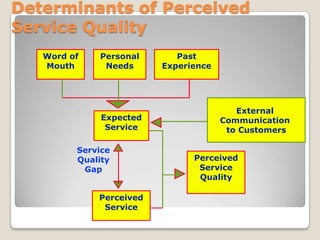
Determinants of Perceived
Service Quality
   Word of   Personal       Past
   Mouth      Needs      Experience


                                         External
              Expected                Communication
               Service                 to Customers

         Service
         Quality               Perceived
          Gap                   Service
                                Quality

             Perceived
              Service
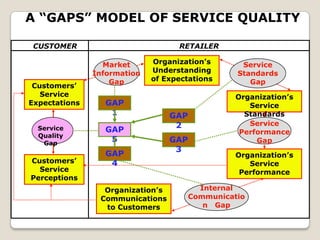
A “GAPS” MODEL OF SERVICE QUALITY

 CUSTOMER                          RETAILER

                 Market      Organization’s        Service
               Information   Understanding        Standards
                   Gap       of Expectations         Gap
 Customers’
   Service                                        Organization’s
Expectations     GAP                                 Service
                  1               GAP               Standards
                                   2                 Service
  Service        GAP
  Quality
                                                   Performance
   Gap
                  5               GAP                  Gap
                                   3
                 GAP                              Organization’s
Customers’        4                                  Service
  Service                                          Performance
Perceptions
                 Organization’s           Internal
                Communications          Communicatio
                 to Customers              n Gap
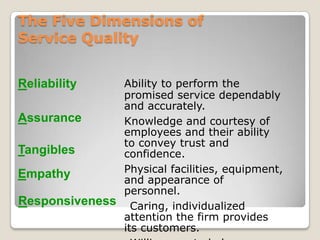
The Five Dimensions of
Service Quality


Reliability    Ability to perform the
               promised service dependably
               and accurately.
Assurance      Knowledge and courtesy of
               employees and their ability
               to convey trust and
Tangibles      confidence.
Empathy        Physical facilities, equipment,
               and appearance of
               personnel.
Responsiveness Caring, individualized
               attention the firm provides
               its customers.
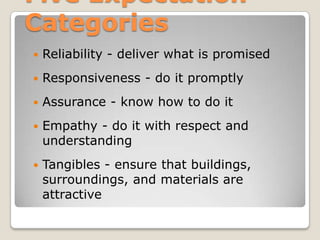
Five Expectation
Categories
   Reliability - deliver what is promised
   Responsiveness - do it promptly
   Assurance - know how to do it
   Empathy - do it with respect and
    understanding
   Tangibles - ensure that buildings,
    surroundings, and materials are
    attractive
Service Quality
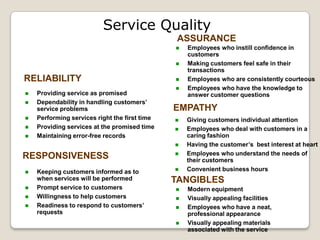
                                                ASSURANCE
                                                  Employees who instill confidence in
                                                   customers
                                                  Making customers feel safe in their
                                                   transactions
RELIABILITY                                       Employees who are consistently courteous
                                                  Employees who have the knowledge to
   Providing service as promised                  answer customer questions
   Dependability in handling customers’
    service problems                           EMPATHY
   Performing services right the first time      Giving customers individual attention
   Providing services at the promised time       Employees who deal with customers in a
   Maintaining error-free records                 caring fashion
                                                  Having the customer’s best interest at heart
                                                  Employees who understand the needs of
RESPONSIVENESS                                     their customers
   Keeping customers informed as to              Convenient business hours
    when services will be performed            TANGIBLES
   Prompt service to customers                   Modern equipment
   Willingness to help customers                 Visually appealing facilities
   Readiness to respond to customers’            Employees who have a neat,
    requests                                       professional appearance
                                                  Visually appealing materials
                                                   associated with the service
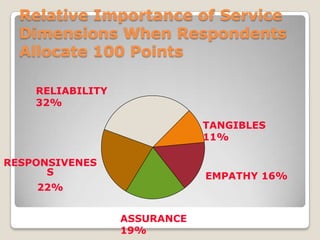
Relative Importance of Service
  Dimensions When Respondents
  Allocate 100 Points

    RELIABILITY
    32%

                              TANGIBLES
                              11%

RESPONSIVENES
      S                       EMPATHY 16%
    22%


                  ASSURANCE
                  19%
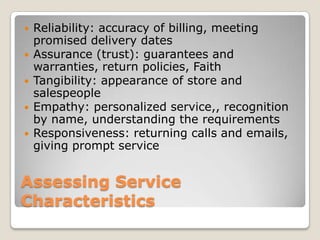
   Reliability: accuracy of billing, meeting
    promised delivery dates
   Assurance (trust): guarantees and
    warranties, return policies, Faith
   Tangibility: appearance of store and
    salespeople
   Empathy: personalized service,, recognition
    by name, understanding the requirements
   Responsiveness: returning calls and emails,
    giving prompt service


Assessing Service
Characteristics

Customer service

  • 1.
  • 2.
    Manufacturing ◦ Apple, Nike  Advertising ◦ HUL, P&G  Marketing ◦ Film producers  IT Infrastructure ◦ Cloud based services What can be Outsourced
  • 3.
    Aspirations ◦ Successful Businesses are aspirations realized  Ideas ◦ Successful Businesses are about implementation of innovative ideas.  Relationships ◦ Relationships creates trust, commitment, positive energy ◦ Provide information, investments, reputation What cannot be outsourced?
  • 4.
    Customer Value can be Tangible and Intangible ◦ Tangible benefits can be imitated by competition ◦ Tangible benefits and resultant advantages are difficult to maintain ◦ Customer Satisfaction of tangibles is a moving target. Customers expect more when they get more. ◦ Expensive to create and maintain .  Consumer Intangibles ◦ Symbolic Consumption (Imagery, aspirations) ◦ Hedonic Consumption (A superior Experience) ◦ Value we can capture can be more than the cost of Marketing is Customer Value creating it  Brand Premium
  • 5.
    On tangibles? ◦ Certainly yes ◦ Lower the cost of production, sourcing, operations, have the least operating margins ◦ Provide the convenience , assortment, quality assurance , longer working hours, quick billing ◦ Have Economies of Scale, have large scale  Be Big Where do we want to compete?
  • 6.
    On Intangibles? ◦ Certainly yes  Build a Brand ◦ Create aspiration in consumers to associate : What I get is more than the price product will fetch in the market. ◦ Create symbolic Value  Provide a unique consumption experience difficult to duplicate ◦ Create hedonic value ◦ Personal relations, warmth, recognition, emotional bond Where do we want Customer Experience ◦ Service differentiation and to compete? Management  Customization
  • 7.
    What is the unique value you want to provide the consumer? ◦ Functional /Utilitarian (Tangibles) ◦ Symbolic Aspirational brand(Intangible) ◦ Hedonic Experience (Intangible)  A Marketing strategy involves your choice of ◦ What type of consumers to serve? ◦ What value to provide? ◦ Communicating and Influencing the consumer Strategic Marketing
  • 8.
    Types of mental responses ◦ Affect : Feel  A state of Mind  Feeling responses ◦ Cognition : Thought  Mental process  Thinking responses ◦ Behavior : Act  Overt or Covert  ABC Model of Influence Influencing Consumers
  • 9.
    Emotion to Mood ◦ Joy, Love, Fear, Guilt, Anger, Warmth, Disgust, Sadness, Calm, Blue, Boredom, Dislike, Melancholy ◦ Positive and negative ◦ Strong or Weak ◦ Innate or learned  Mental Biases Affect
  • 10.
    Thought ◦ Information processing  Thoughts about ◦ Benefits ◦ Comparisons ◦ Advantages ◦ Apply previous learning Cognition
  • 11.
    Consumption behavior ◦ Purchase ◦ Selection ◦ Choice of a store ◦ Join a scheme ◦ Recommendation and referral ◦ Repeat Purchase Behaviour
  • 12.
  • 13.
    Cognition > Affect> Behaviour
  • 14.
  • 15.
    Affect > Behaviour> Cognition
  • 16.
    Affect > Cognition> Behaviour
  • 17.
    Behaviour > Affect> Cognition
  • 18.
    Please recall the experience as a customer you were most dissatisfied? ◦ Please Describe on a sheet Customer Service
  • 19.
    Customer Experience Management  Service Quality ◦ How do customers perceive and evaluate service quality? ◦ What are managers’ perceptions about service quality? ◦ Do discrepancies exist between the perceptions of customers and those of managers? ◦ How can Retailers improve customer service and achieve excellence?
  • 20.
    A Customers can be Satisfied and Dissatisfied at the same time ◦ Different factors cause satisfaction and dissatisfaction ◦ Identify factors (hygiene factors) that cause dissatisfaction and remove them ◦ Identify factors (Satisfiers) that cause Satisfaction and Implement. Service Quality and Satisfaction
  • 21.
    Determinants of Perceived ServiceQuality Word of Personal Past Mouth Needs Experience External Expected Communication Service to Customers Service Quality Perceived Gap Service Quality Perceived Service
  • 22.
    A “GAPS” MODELOF SERVICE QUALITY CUSTOMER RETAILER Market Organization’s Service Information Understanding Standards Gap of Expectations Gap Customers’ Service Organization’s Expectations GAP Service 1 GAP Standards 2 Service Service GAP Quality Performance Gap 5 GAP Gap 3 GAP Organization’s Customers’ 4 Service Service Performance Perceptions Organization’s Internal Communications Communicatio to Customers n Gap
  • 23.
    The Five Dimensionsof Service Quality Reliability Ability to perform the promised service dependably and accurately. Assurance Knowledge and courtesy of employees and their ability to convey trust and Tangibles confidence. Empathy Physical facilities, equipment, and appearance of personnel. Responsiveness Caring, individualized attention the firm provides its customers.
  • 24.
    Five Expectation Categories  Reliability - deliver what is promised  Responsiveness - do it promptly  Assurance - know how to do it  Empathy - do it with respect and understanding  Tangibles - ensure that buildings, surroundings, and materials are attractive
  • 25.
    Service Quality ASSURANCE  Employees who instill confidence in customers  Making customers feel safe in their transactions RELIABILITY  Employees who are consistently courteous  Employees who have the knowledge to  Providing service as promised answer customer questions  Dependability in handling customers’ service problems EMPATHY  Performing services right the first time  Giving customers individual attention  Providing services at the promised time  Employees who deal with customers in a  Maintaining error-free records caring fashion  Having the customer’s best interest at heart  Employees who understand the needs of RESPONSIVENESS their customers  Keeping customers informed as to  Convenient business hours when services will be performed TANGIBLES  Prompt service to customers  Modern equipment  Willingness to help customers  Visually appealing facilities  Readiness to respond to customers’  Employees who have a neat, requests professional appearance  Visually appealing materials associated with the service
  • 26.
    Relative Importance ofService Dimensions When Respondents Allocate 100 Points RELIABILITY 32% TANGIBLES 11% RESPONSIVENES S EMPATHY 16% 22% ASSURANCE 19%
  • 27.
    Reliability: accuracy of billing, meeting promised delivery dates  Assurance (trust): guarantees and warranties, return policies, Faith  Tangibility: appearance of store and salespeople  Empathy: personalized service,, recognition by name, understanding the requirements  Responsiveness: returning calls and emails, giving prompt service Assessing Service Characteristics