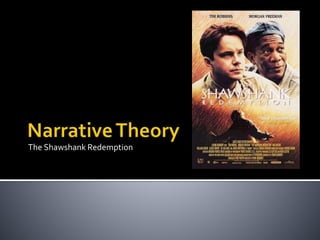
The Shawshank Redemption
 Simply put, narrative is basically the order something is put in and
there is always a reason for this.
 For example, directors often use flashbacks, voiceovers or
montages to show previous stories or show a passing of time.
 Genre ,Character, Form andTime help us make sense of a
narrative and also about what to expect.
 You must consider whether their is one narrative going on. For
example, Pulp Fiction has various stories with different characters
going on.We call this a multi-strand narrative
 There are a number of different narrative theories which
propose ways in which stories (including films) are commonly
put together
 Linear narratives are the ‘classic’ and simple
beginning, middle and end stories.
 This will follow the rule of situation-
disruption-resolution, in that order.
 In other words, the story will flow
chronologically (in time order) through one
story, from beginning to end.
 Non-Linear Narrative is where the narrative
does nor follow a regular beginning-middle-
end pattern.
 The storytellers will play with the order of
events.
 For example, some films will choose to show
the ending at the beginning (Fight Club,
Double Indemnity, Forrest Gump, American
Beauty etc.)
In pairs, pick a film of your choice and analyse its
narrative chronology. Consider:
•Do the events go in time order?
• If they don’t, how are the events ordered non-
chronologically (flashbacks, circular narrative)?
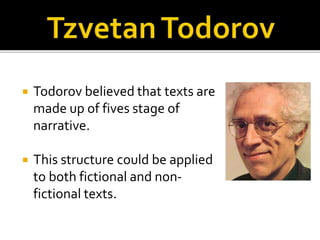
 Todorov believed that texts are
made up of fives stage of
narrative.
 This structure could be applied
to both fictional and non-
fictional texts.
 In pairs, take a film of your choice and break it down in
terms ofTodorov’s narrative structure
 Equilibrium –The situation in which the film begins
(the ‘norm’)
 Disruption – Something happens to upset the
equilibrium
 Realisation –The Hero is notified that a disruption has
occurred and must act to restore the equilibrium
 Action –The Hero attempts to restore equilibrium
 New Equilibrium – Equilibrium is restored, although
something will have changed as a result of action.
 Propp was a Russian critic who published his
Morphology of the FolkTale in 1928
 Propp analysed over 100 FolkTales
 He established that all of these tales followed
a strict Narrative structure, which usually
contained 8 characters
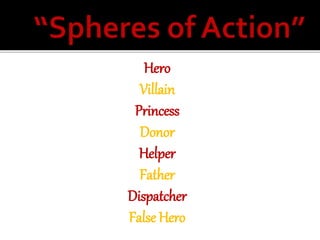
Hero
Villain
Princess
Donor
Helper
Father
Dispatcher
False Hero
In pairs, pick a film of your choice and analyse it against
some of the 8 character types. Consider:
•What character types do the main characters fit into?
• Do the characters live up to their character roles or do
they subvert/ go against, such connotations?
•Are there any character types which are not included?
Remember – to fulfil a character type, you do not necessarily
need a person! An object or concept could fulfil this role.
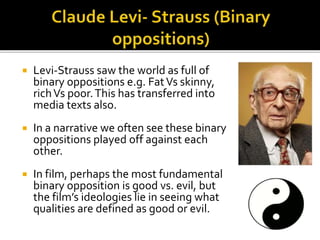
 Levi-Strauss saw the world as full of
binary oppositions e.g. FatVs skinny,
richVs poor.This has transferred into
media texts also.
 In a narrative we often see these binary
oppositions played off against each
other.
 In film, perhaps the most fundamental
binary opposition is good vs. evil, but
the film’s ideologies lie in seeing what
qualities are defined as good or evil.
 Can you identify the binary oppositions in
your film?
 Think about how two concepts or characters
are juxtaposed against each other.
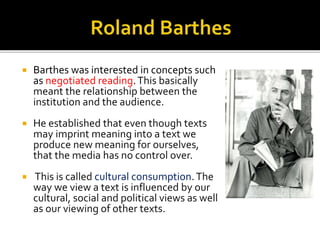
 Barthes was interested in concepts such
as negotiated reading.This basically
meant the relationship between the
institution and the audience.
 He established that even though texts
may imprint meaning into a text we
produce new meaning for ourselves,
that the media has no control over.
 This is called cultural consumption.The
way we view a text is influenced by our
cultural, social and political views as well
as our viewing of other texts.
 The most well known of Barthes theories was the idea
of the ‘Enigma code’
 In its simplest form it is the hook or mystery to be
resolved for an audience.
 This keeps the viewers engaged and makes them
more likely to watch the film after seeing a trailer or
tune in for the next episode. It is classically used in
trailers in order to hook an audience:
http://www.youtube.com/watch?v=LPKhWXhiMSw
 Can you identify the enigma codes in your
film?
 What are the mysteries you as an audience
member have to solve throughout the film?
 The way in which audiences are manipulated to
see a story from a particular point of view,
affecting who we sympathise with.
 In your chosen superhero film:
 Who do we sympathise with / against?
 How is this achieved?
 Dominating screen time?
 First-person narrator?
 Seeing the action through their eyes?
 Eponymous title?
 The way in which a story is told, which helps
to manipulate the audience’s point of view.
 In your chosen superhero film:
 Is the film dramatized or undramatized?
 If dramatized, is it first- or third-person
narrative?
 Is the narrative restricted (we only see events as
the main character sees them) or unrestricted
(we see events before the main character)?

Applying Narrative Theories

  • 1.
  • 2.
     Simply put,narrative is basically the order something is put in and there is always a reason for this.  For example, directors often use flashbacks, voiceovers or montages to show previous stories or show a passing of time.  Genre ,Character, Form andTime help us make sense of a narrative and also about what to expect.  You must consider whether their is one narrative going on. For example, Pulp Fiction has various stories with different characters going on.We call this a multi-strand narrative  There are a number of different narrative theories which propose ways in which stories (including films) are commonly put together
  • 3.
     Linear narrativesare the ‘classic’ and simple beginning, middle and end stories.  This will follow the rule of situation- disruption-resolution, in that order.  In other words, the story will flow chronologically (in time order) through one story, from beginning to end.
  • 4.
     Non-Linear Narrativeis where the narrative does nor follow a regular beginning-middle- end pattern.  The storytellers will play with the order of events.  For example, some films will choose to show the ending at the beginning (Fight Club, Double Indemnity, Forrest Gump, American Beauty etc.)
  • 5.
    In pairs, picka film of your choice and analyse its narrative chronology. Consider: •Do the events go in time order? • If they don’t, how are the events ordered non- chronologically (flashbacks, circular narrative)?
  • 6.
     Todorov believedthat texts are made up of fives stage of narrative.  This structure could be applied to both fictional and non- fictional texts.
  • 7.
     In pairs,take a film of your choice and break it down in terms ofTodorov’s narrative structure  Equilibrium –The situation in which the film begins (the ‘norm’)  Disruption – Something happens to upset the equilibrium  Realisation –The Hero is notified that a disruption has occurred and must act to restore the equilibrium  Action –The Hero attempts to restore equilibrium  New Equilibrium – Equilibrium is restored, although something will have changed as a result of action.
  • 8.
     Propp wasa Russian critic who published his Morphology of the FolkTale in 1928  Propp analysed over 100 FolkTales  He established that all of these tales followed a strict Narrative structure, which usually contained 8 characters
  • 9.
  • 10.
    In pairs, picka film of your choice and analyse it against some of the 8 character types. Consider: •What character types do the main characters fit into? • Do the characters live up to their character roles or do they subvert/ go against, such connotations? •Are there any character types which are not included? Remember – to fulfil a character type, you do not necessarily need a person! An object or concept could fulfil this role.
  • 11.
     Levi-Strauss sawthe world as full of binary oppositions e.g. FatVs skinny, richVs poor.This has transferred into media texts also.  In a narrative we often see these binary oppositions played off against each other.  In film, perhaps the most fundamental binary opposition is good vs. evil, but the film’s ideologies lie in seeing what qualities are defined as good or evil.
  • 12.
     Can youidentify the binary oppositions in your film?  Think about how two concepts or characters are juxtaposed against each other.
  • 13.
     Barthes wasinterested in concepts such as negotiated reading.This basically meant the relationship between the institution and the audience.  He established that even though texts may imprint meaning into a text we produce new meaning for ourselves, that the media has no control over.  This is called cultural consumption.The way we view a text is influenced by our cultural, social and political views as well as our viewing of other texts.
  • 14.
     The mostwell known of Barthes theories was the idea of the ‘Enigma code’  In its simplest form it is the hook or mystery to be resolved for an audience.  This keeps the viewers engaged and makes them more likely to watch the film after seeing a trailer or tune in for the next episode. It is classically used in trailers in order to hook an audience: http://www.youtube.com/watch?v=LPKhWXhiMSw
  • 15.
     Can youidentify the enigma codes in your film?  What are the mysteries you as an audience member have to solve throughout the film?
  • 16.
     The wayin which audiences are manipulated to see a story from a particular point of view, affecting who we sympathise with.  In your chosen superhero film:  Who do we sympathise with / against?  How is this achieved?  Dominating screen time?  First-person narrator?  Seeing the action through their eyes?  Eponymous title?
  • 17.
     The wayin which a story is told, which helps to manipulate the audience’s point of view.  In your chosen superhero film:  Is the film dramatized or undramatized?  If dramatized, is it first- or third-person narrative?  Is the narrative restricted (we only see events as the main character sees them) or unrestricted (we see events before the main character)?