Audience Theories

 Audience Positioning
Objectives
• To understand the relationship between
  the audience and the media text
• To understand the position that the
  audience will take dependent on certain
  factors
• To understand how audience are
  constructed by media producers
Past Paper Summer 2011
Audience Positioning
• All media text have a series of encoded
  signs and messages
• The audience decode these messages
• Different audiences will decode them
  differently
• Media texts and the industries are acutely
  aware of their audiences
Key Points
• The relationship between media and
  audience is fluent and changing
• Audiences are not a mass and their
  responses are complex and sophisticated
• Audiences are made up of individuals
• Either PASSIVE OR ACTIVE
Active Audience
• This audience responds to and interprets
  the media text in different ways and
  actively engages with the messages.
Passive Audience
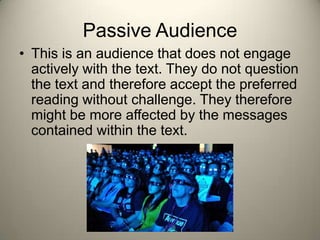
• This is an audience that does not engage
  actively with the text. They do not question
  the text and therefore accept the preferred
  reading without challenge. They therefore
  might be more affected by the messages
  contained within the text.
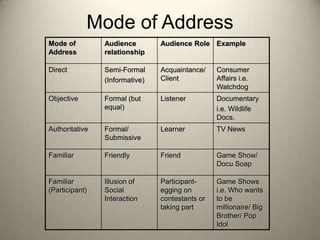
Mode of Address
Mode of         Audience        Audience Role Example
Address         relationship

Direct          Semi-Formal     Acquaintance/    Consumer
                (Informative)   Client           Affairs i.e.
                                                 Watchdog
Objective       Formal (but     Listener         Documentary
                equal)                           i.e. Wildlife
                                                 Docs.
Authoritative   Formal/         Learner          TV News
                Submissive

Familiar        Friendly        Friend           Game Show/
                                                 Docu Soap

Familiar        Illusion of     Participant-     Game Shows
(Participant)   Social          egging on        i.e. Who wants
                Interaction     contestants or   to be
                                taking part      millionaire/ Big
                                                 Brother/ Pop
                                                 Idol
Task
• What is the Mode of Address for the
  following texts?
• Why?
READINGS….
• ENCODERS (Producers) create texts with a
  PREFERRED READING (the meaning they WANT
  the audience to take from it) which the audience then
  DECODE.

• However audiences may not take the preferred
  reading, they may however take an
  OPPOSITIONAL or NEGOTIATED
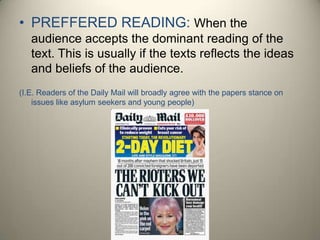
• PREFERRED READING: When the
   audience accepts the dominant reading of the
   text. This is usually if the texts reflects the ideas
   and beliefs of the audience.
(I.E. Readers of the Daily Mail will broadly agree with the papers stance on
    issues like asylum seekers and young people)
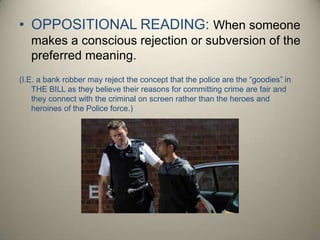
• OPPOSITIONAL READING: When someone
   makes a conscious rejection or subversion of the
   preferred meaning.
(I.E. a bank robber may reject the concept that the police are the “goodies” in
    THE BILL as they believe their reasons for committing crime are fair and
    they connect with the criminal on screen rather than the heroes and
    heroines of the Police force.)
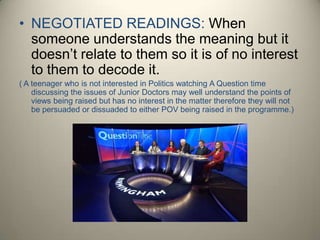
• NEGOTIATED READINGS: When
  someone understands the meaning but it
  doesn’t relate to them so it is of no interest
  to them to decode it.
( A teenager who is not interested in Politics watching A Question time
    discussing the issues of Junior Doctors may well understand the points of
    views being raised but has no interest in the matter therefore they will not
    be persuaded or dissuaded to either POV being raised in the programme.)
Task
Look at the following media texts and who
would take the
preferred/oppositional/negotiated reading?

Why?
You are going to produce a new television programme.

Decide on your TARGET audience?

How are you going to attract your TARGET audience?

What Channel would your programme be broadcast on and why?

Who might take an oppositional reading to your programme?


Put together a short presentation with pictures answering the questions
above.

Audience positioning

  • 1.
  • 2.
    Objectives • To understandthe relationship between the audience and the media text • To understand the position that the audience will take dependent on certain factors • To understand how audience are constructed by media producers
  • 3.
  • 4.
    Audience Positioning • Allmedia text have a series of encoded signs and messages • The audience decode these messages • Different audiences will decode them differently • Media texts and the industries are acutely aware of their audiences
  • 5.
    Key Points • Therelationship between media and audience is fluent and changing • Audiences are not a mass and their responses are complex and sophisticated • Audiences are made up of individuals • Either PASSIVE OR ACTIVE
  • 7.
    Active Audience • Thisaudience responds to and interprets the media text in different ways and actively engages with the messages.
  • 8.
    Passive Audience • Thisis an audience that does not engage actively with the text. They do not question the text and therefore accept the preferred reading without challenge. They therefore might be more affected by the messages contained within the text.
  • 10.
    Mode of Address Modeof Audience Audience Role Example Address relationship Direct Semi-Formal Acquaintance/ Consumer (Informative) Client Affairs i.e. Watchdog Objective Formal (but Listener Documentary equal) i.e. Wildlife Docs. Authoritative Formal/ Learner TV News Submissive Familiar Friendly Friend Game Show/ Docu Soap Familiar Illusion of Participant- Game Shows (Participant) Social egging on i.e. Who wants Interaction contestants or to be taking part millionaire/ Big Brother/ Pop Idol
  • 11.
    Task • What isthe Mode of Address for the following texts? • Why?
  • 15.
    READINGS…. • ENCODERS (Producers)create texts with a PREFERRED READING (the meaning they WANT the audience to take from it) which the audience then DECODE. • However audiences may not take the preferred reading, they may however take an OPPOSITIONAL or NEGOTIATED
  • 16.
    • PREFERRED READING:When the audience accepts the dominant reading of the text. This is usually if the texts reflects the ideas and beliefs of the audience. (I.E. Readers of the Daily Mail will broadly agree with the papers stance on issues like asylum seekers and young people)
  • 17.
    • OPPOSITIONAL READING:When someone makes a conscious rejection or subversion of the preferred meaning. (I.E. a bank robber may reject the concept that the police are the “goodies” in THE BILL as they believe their reasons for committing crime are fair and they connect with the criminal on screen rather than the heroes and heroines of the Police force.)
  • 18.
    • NEGOTIATED READINGS:When someone understands the meaning but it doesn’t relate to them so it is of no interest to them to decode it. ( A teenager who is not interested in Politics watching A Question time discussing the issues of Junior Doctors may well understand the points of views being raised but has no interest in the matter therefore they will not be persuaded or dissuaded to either POV being raised in the programme.)
  • 19.
    Task Look at thefollowing media texts and who would take the preferred/oppositional/negotiated reading? Why?
  • 27.
    You are goingto produce a new television programme. Decide on your TARGET audience? How are you going to attract your TARGET audience? What Channel would your programme be broadcast on and why? Who might take an oppositional reading to your programme? Put together a short presentation with pictures answering the questions above.