Copyright 2010 John Wiley & Sons, Inc. 1
Copyright 2010 John Wiley & Sons, Inc.
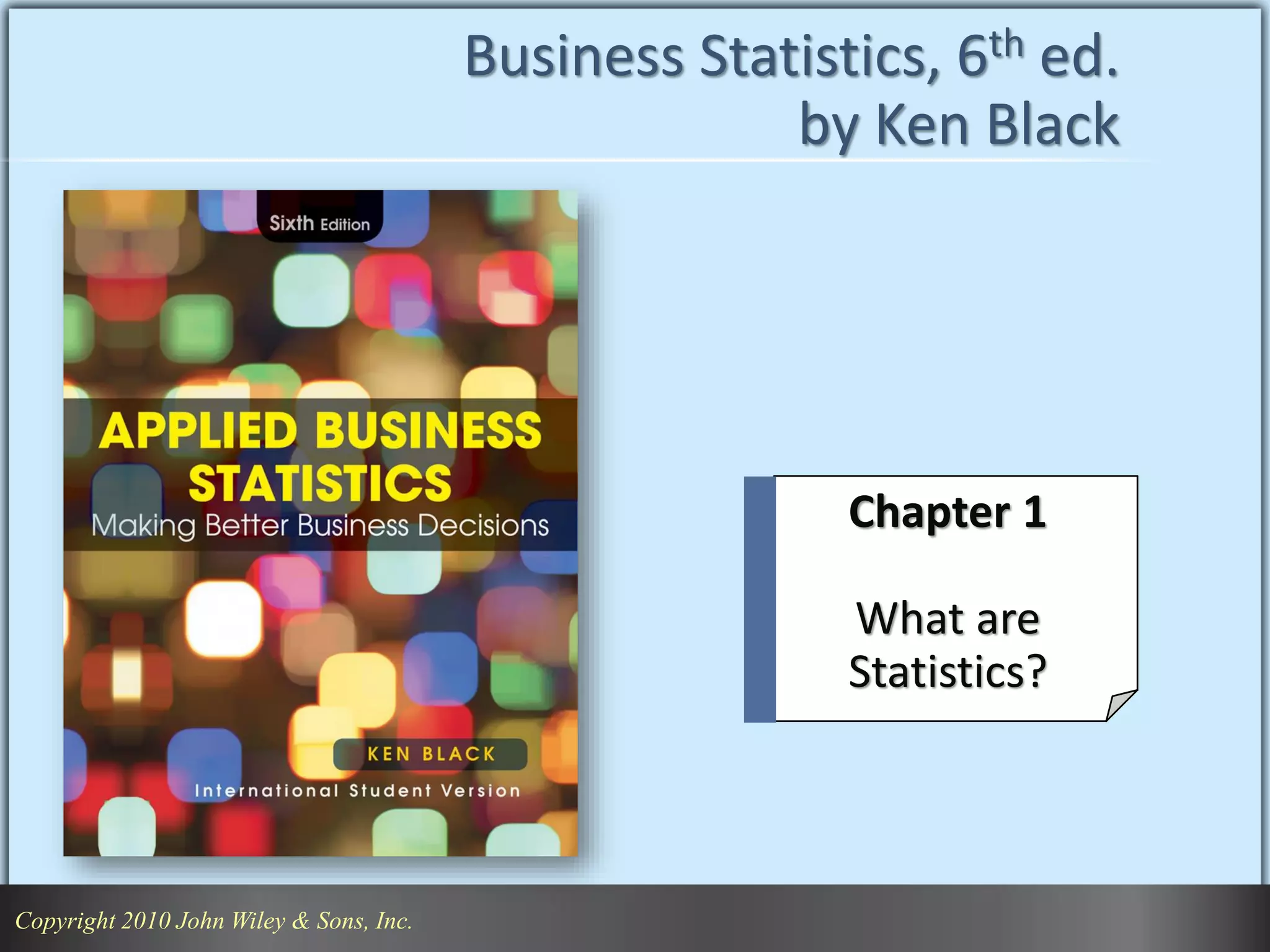
Business Statistics, 6th ed.
by Ken Black
Chapter 1
What are
Statistics?
Copyright 2010 John Wiley & Sons, Inc. 2
Define statistics.
Become aware of a wide range of applications of
statistics in business.
Differentiate between descriptive and inferential
statistics.
Classify numbers by level of data and understand
why doing so is important.
Learning Objectives
Copyright 2010 John Wiley & Sons, Inc. 3
Statistics in Business
Accounting — auditing and cost estimation
Economics — regional, national, and international economic
performance
Finance — investments and portfolio management
Management — human resources, compensation, and quality
management
Management Information Systems — performance of systems
which gather, summarize, and disseminate information to
various managerial levels
Marketing — market analysis and consumer research
International Business — market and demographic analysis
Copyright 2010 John Wiley & Sons, Inc. 4
Science of gathering, analyzing, interpreting, and
presenting data on various topics
Branch of mathematics
Course of study
Facts and figures
Measurement taken on a sample
Type of distribution being used to analyze data
What is Statistics?
Copyright 2010 John Wiley & Sons, Inc. 5
Statistics – science dealing with the collection,
analysis, interpretation, and presentation of
numerical data
Statistics has two types
Descriptive measure – computed from a sample and
used to make a determination
Distribution - used in the analysis of the data
Statistics in Business
Copyright 2010 John Wiley & Sons, Inc. 6
Branches of statistics
Descriptive – using data gathered on a group to describe
or reach conclusions about the group
Inferential – data gathered from a sample and used to
reach conclusions about the population from which the
data was gathered
Used to draw conclusions about the group or similar groups
Statistics in Business
Copyright 2010 John Wiley & Sons, Inc. 7
Population — the whole
a collection of persons, objects, or items under study
Census — gathering data from the entire population
Sample — a portion of the whole/population
a subset of the population; must be large enough to
represent the whole
Population Versus Sample
Copyright 2010 John Wiley & Sons, Inc. 8
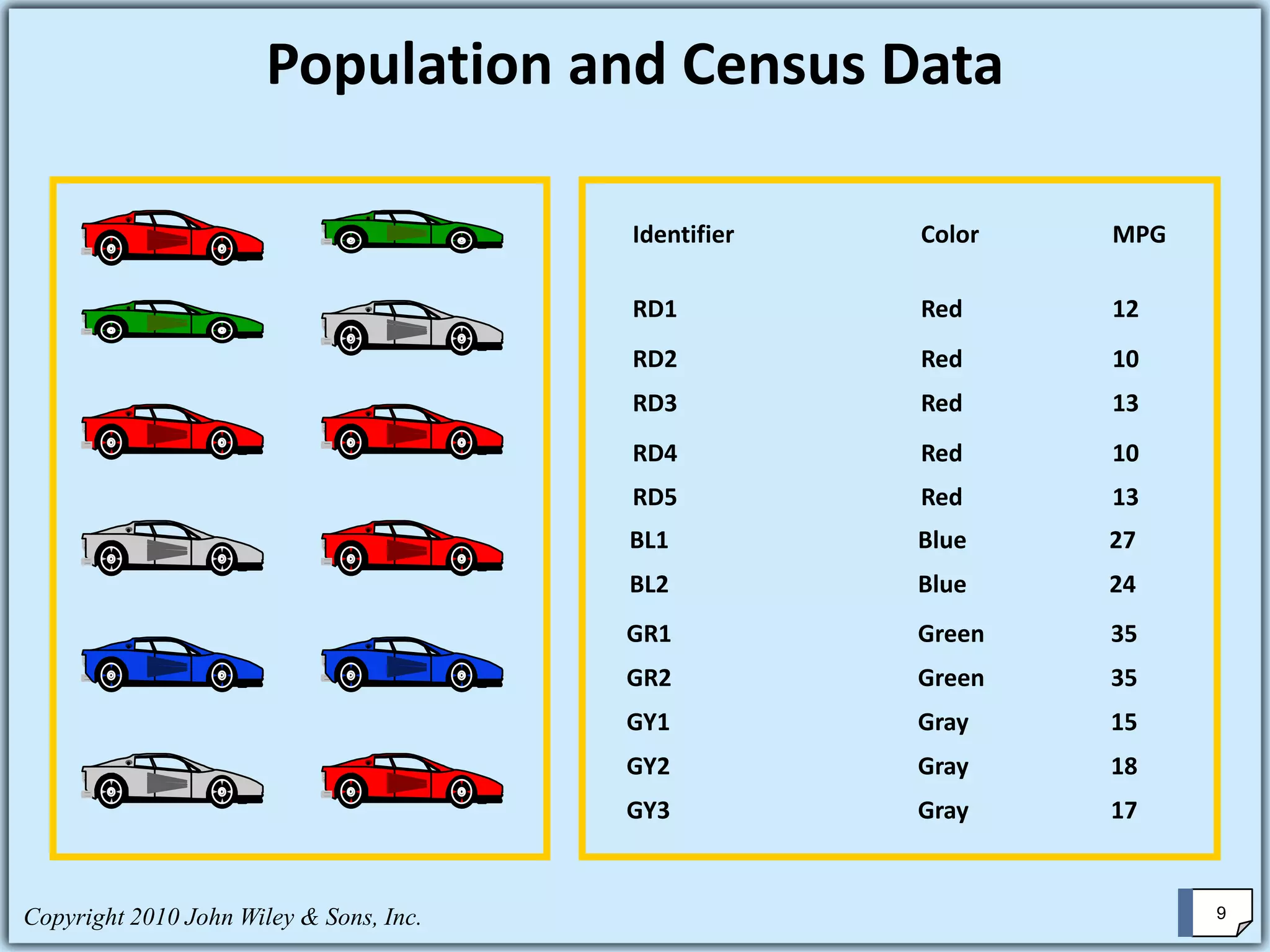
Population
Copyright 2010 John Wiley & Sons, Inc. 9
Identifier Color MPG
RD1 Red 12
RD2 Red 10
RD3 Red 13
RD4 Red 10
RD5 Red 13
BL1 Blue 27
BL2 Blue 24
GR1 Green 35
GR2 Green 35
GY1 Gray 15
GY2 Gray 18
GY3 Gray 17
Population and Census Data
Copyright 2010 John Wiley & Sons, Inc. 10
Sample and Sample Data
Identifier Color MPG
RD2 Red 10
RD5 Red 13
GR1 Green 35
GY2 Gray 18
Copyright 2010 John Wiley & Sons, Inc. 11Copyright 2010 John Wiley & Sons, Inc. 11
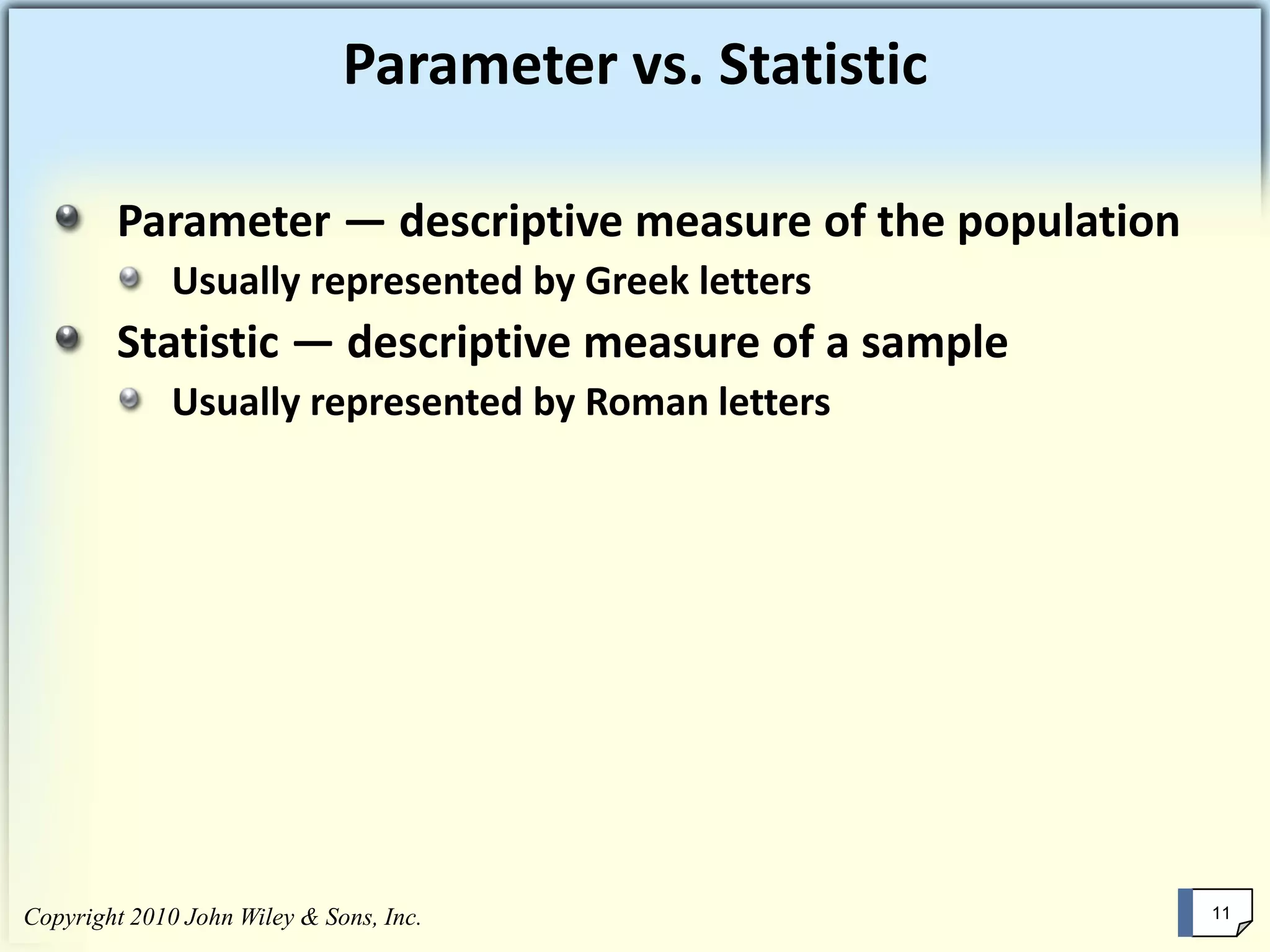
Parameter vs. Statistic
Parameter — descriptive measure of the population
Usually represented by Greek letters
Statistic — descriptive measure of a sample
Usually represented by Roman letters
Copyright 2010 John Wiley & Sons, Inc. 12Copyright 2010 John Wiley & Sons, Inc. 12
parameterpopulationdenotes
2
 denotes population variance
 denotes population standard deviation
Symbols for Population Parameters
Copyright 2010 John Wiley & Sons, Inc. 13Copyright 2010 John Wiley & Sons, Inc. 13
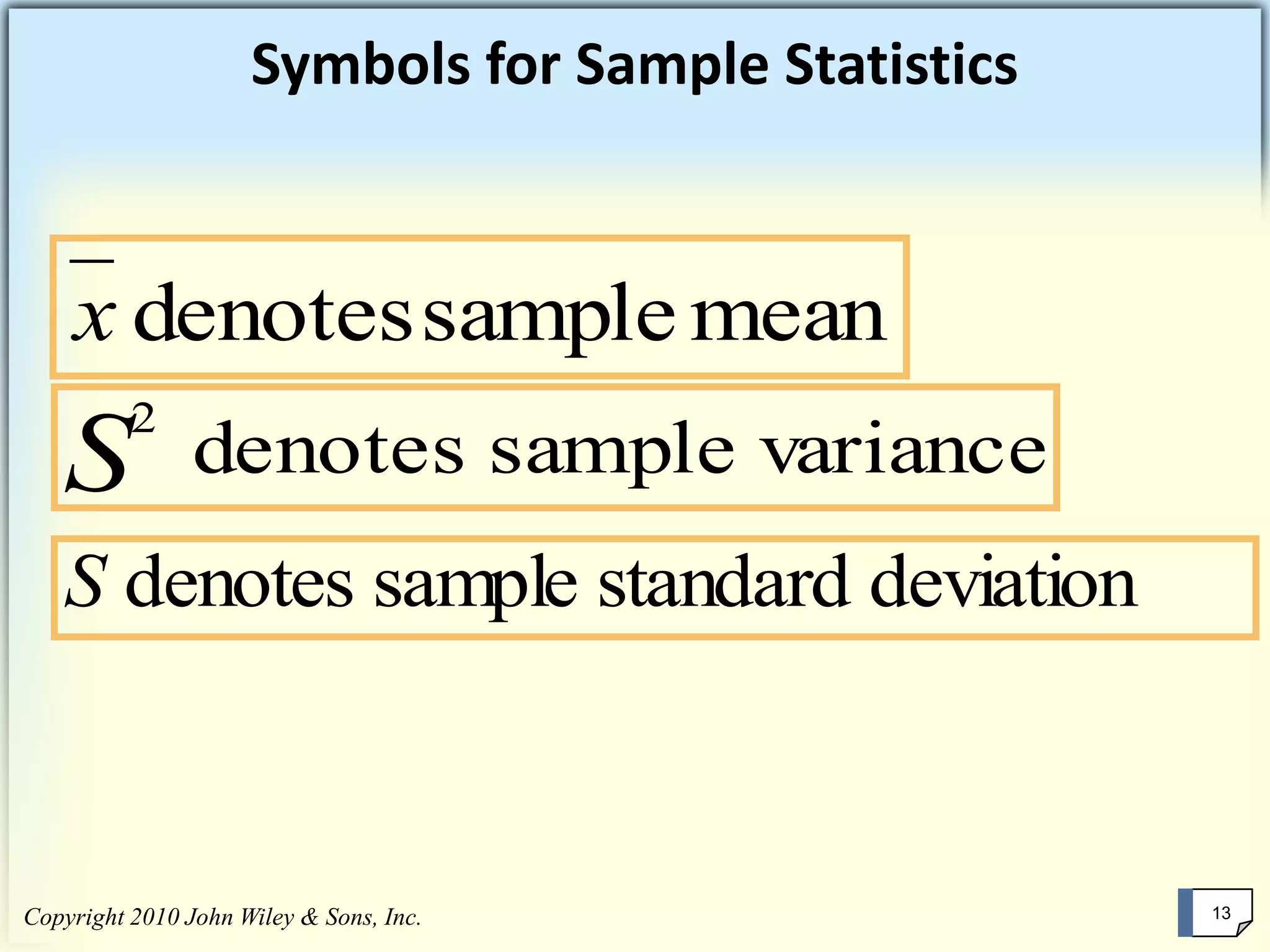
meansampledenotesx
2
S denotes sample variance
S denotes sample standard deviation
Symbols for Sample Statistics
Copyright 2010 John Wiley & Sons, Inc. 14Copyright 2010 John Wiley & Sons, Inc. 14
Process of Inferential Statistics
)(parameter
Population1.

)(statistic
x
Sample3.
estimateto
xCalculate4.
samplerandom
aSelect2.
Copyright 2010 John Wiley & Sons, Inc. 15Copyright 2010 John Wiley & Sons, Inc. 15
Statistics in Business
Difference between a parameter and statistic is only
important in the use of inferential statistics
Calculations of parameter can be cost prohibitive
When cost prohibitive, a sample calculates appropriate statistics.
Researchers use the calculation as an estimate of the parameter.
Copyright 2010 John Wiley & Sons, Inc. 16Copyright 2010 John Wiley & Sons, Inc. 16
Statistics in Business
Inferences about parameters made under conditions
of uncertainty
Uncertainty can be caused by
small sample
lack of knowledge about the source of the inferences
change in conditions not accounted for
Copyright 2010 John Wiley & Sons, Inc. 17Copyright 2010 John Wiley & Sons, Inc. 17
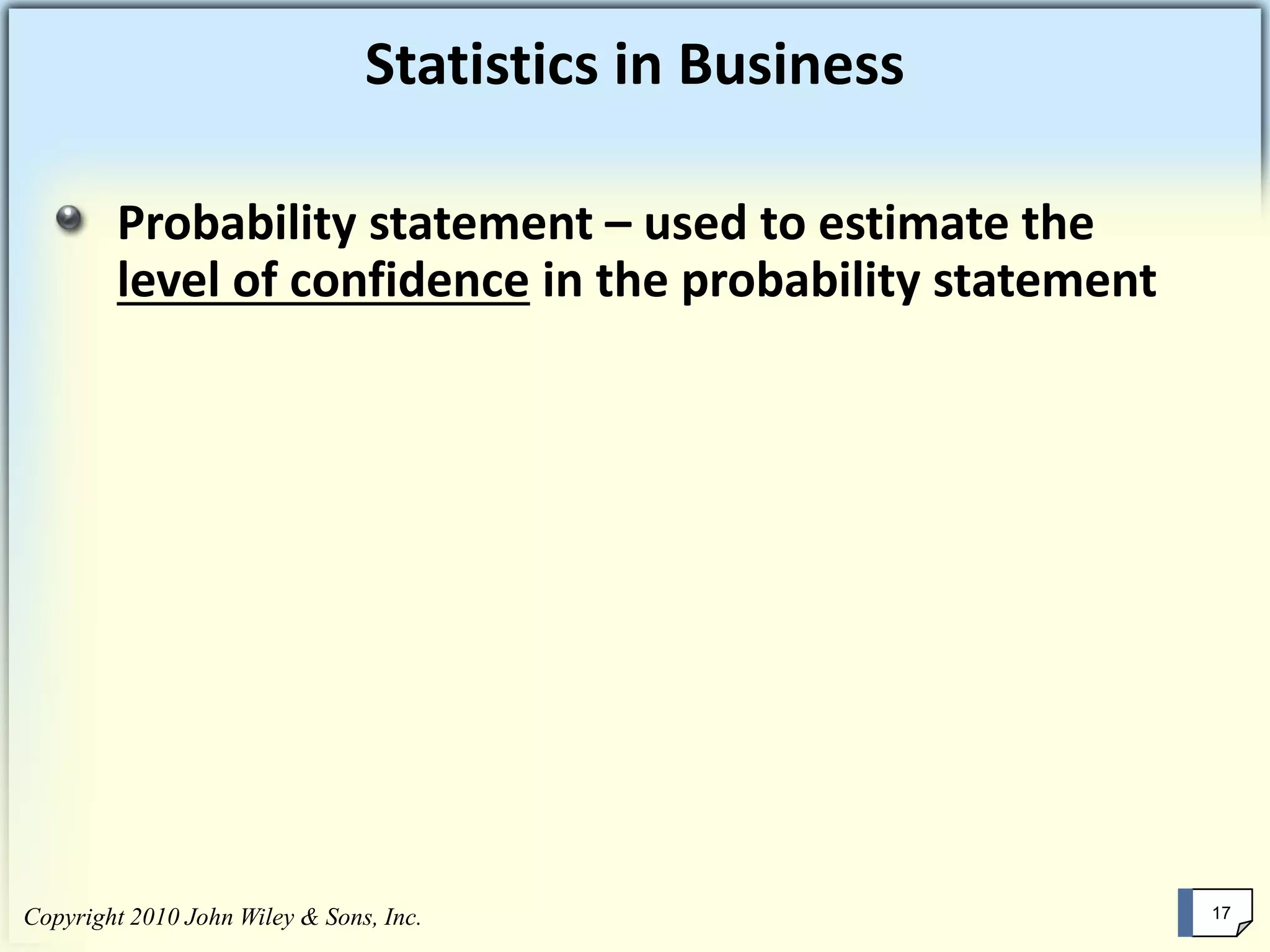
Statistics in Business
Probability statement – used to estimate the
level of confidence in the probability statement
Copyright 2010 John Wiley & Sons, Inc. 18
Nominal — In nominal measurement the numerical
values just "name" the attribute uniquely.
No ordering of the cases is implied. For example, jersey
numbers in basketball are measures at the nominal level.
A player with number 30 is not more of anything than a
player with number 15, and is certainly not twice
whatever number 15 is.
Levels of Data Measurement
Copyright 2010 John Wiley & Sons, Inc. 19
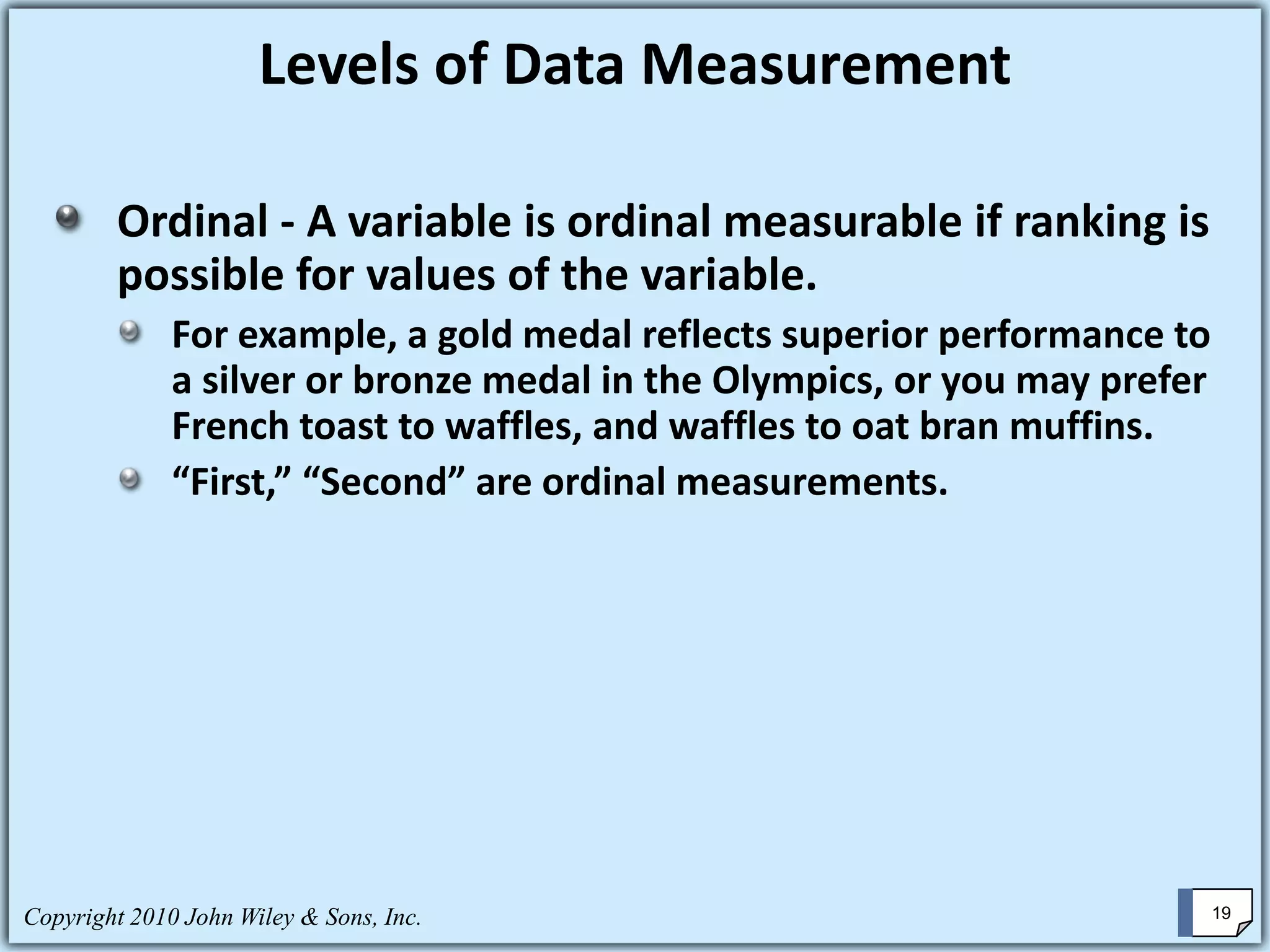
Ordinal - A variable is ordinal measurable if ranking is
possible for values of the variable.
For example, a gold medal reflects superior performance to
a silver or bronze medal in the Olympics, or you may prefer
French toast to waffles, and waffles to oat bran muffins.
“First,” “Second” are ordinal measurements.
Levels of Data Measurement
Copyright 2010 John Wiley & Sons, Inc. 20
Interval - In interval measurement the distance
between attributes does have meaning.
For example, when measuring temperature (in Fahrenheit),
the distance from 30-40 is same as the distance from 70-80.
The interval between values is interpretable.
Levels of Data Measurement
Copyright 2010 John Wiley & Sons, Inc. 21
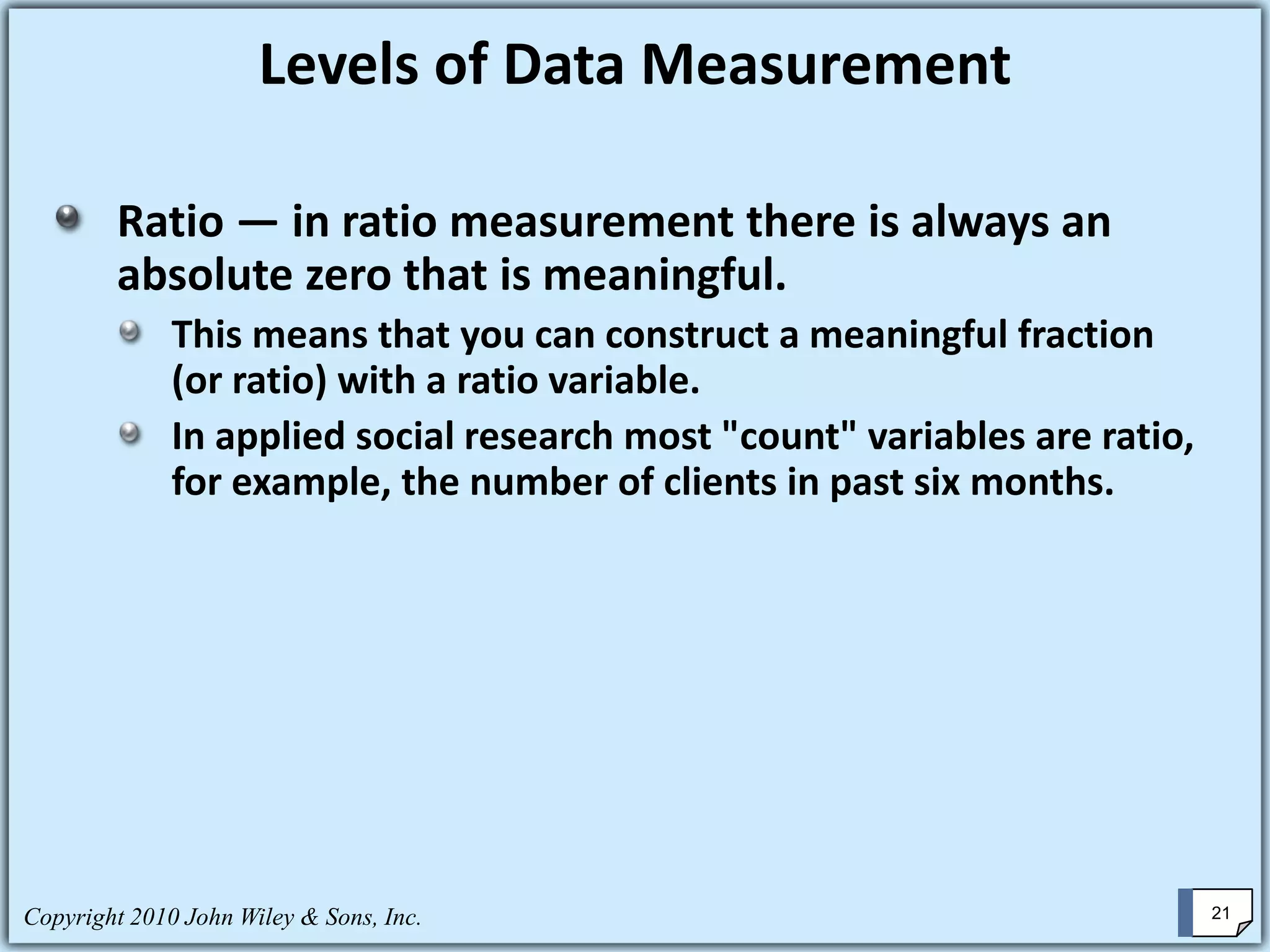
Ratio — in ratio measurement there is always an
absolute zero that is meaningful.
This means that you can construct a meaningful fraction
(or ratio) with a ratio variable.
In applied social research most "count" variables are ratio,
for example, the number of clients in past six months.
Levels of Data Measurement
Copyright 2010 John Wiley & Sons, Inc. 22
Cardinal - A variable is cardinally measurable if a given
interval between measures has a consistent meaning,
i.e., if the measure corresponds to points along a
straight line.
For example, height, output, and income are cardinally
measurable
Levels of Data Measurement
Copyright 2010 John Wiley & Sons, Inc. 23
Nominal Level Data
Numbers are used to classify or categorize
Example: Employment Classification
1 for Educator
2 for Construction Worker
3 for Manufacturing Worker
Copyright 2010 John Wiley & Sons, Inc. 24
Ordinal Level Data
Numbers are used to indicate rank or order
Relative magnitude of numbers is meaningful
Differences between numbers are not comparable
Example: Ranking productivity of employees
Example: Position within an organization
1 for President
2 for Vice President
3 for Plant Manager
4 for Department Supervisor
5 for Employee
Copyright 2010 John Wiley & Sons, Inc. 25
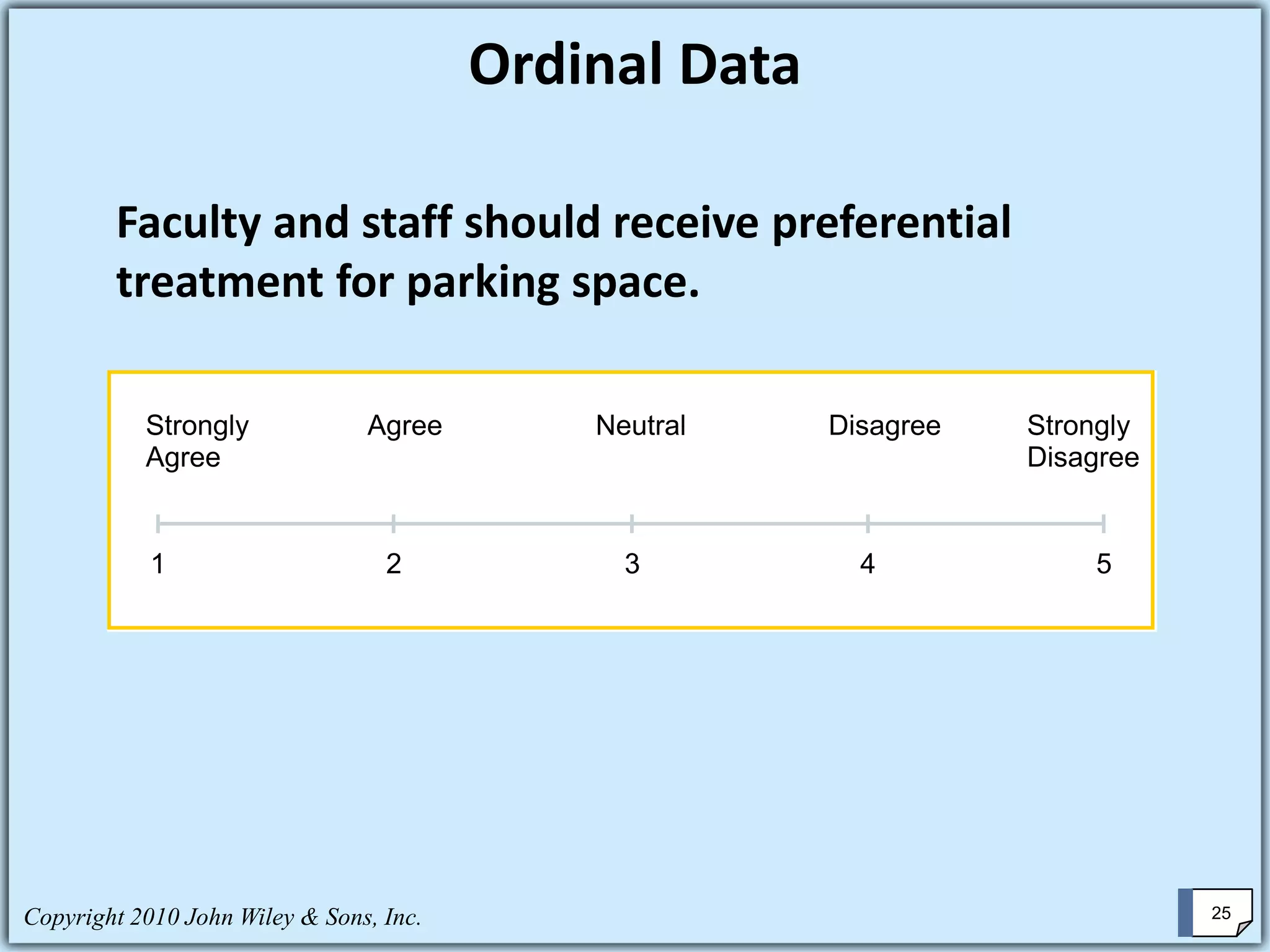
Faculty and staff should receive preferential
treatment for parking space.
Ordinal Data
1 2 3 4 5
Strongly
Agree
Agree Strongly
Disagree
DisagreeNeutral
Copyright 2010 John Wiley & Sons, Inc. 26
Interval Level Data
Interval Level data - Distances between consecutive
integers are equal
Relative magnitude of numbers is meaningful
Differences between numbers are comparable
Location of origin, zero, is arbitrary
Vertical intercept of unit of measure transform function is
not zero
Example: Fahrenheit Temperature
Example: Monetary Utility
Copyright 2010 John Wiley & Sons, Inc. 27
Highest level of measurement
Relative magnitude of numbers is meaningful
Differences between numbers are comparable
Location of origin, zero, is absolute (natural)
Vertical intercept of unit of measure transform function
is zero
Examples: Height, Weight, and Volume
Example: Monetary Variables, such as Profit and Loss,
Revenues, Expenses, Financial ratios - such as P/E
Ratio, Inventory Turnover, and Quick Ratio.
Ratio Level Data
Copyright 2010 John Wiley & Sons, Inc. 28
Ratio Level Data
Parametric statistics – requires that the data be
interval or ration
Non Parametric – used if data are nominal or ordinal
Non parametric statistics can be used to analyze interval
or ratio data
Copyright 2010 John Wiley & Sons, Inc. 29Copyright 2010 John Wiley & Sons, Inc. 29
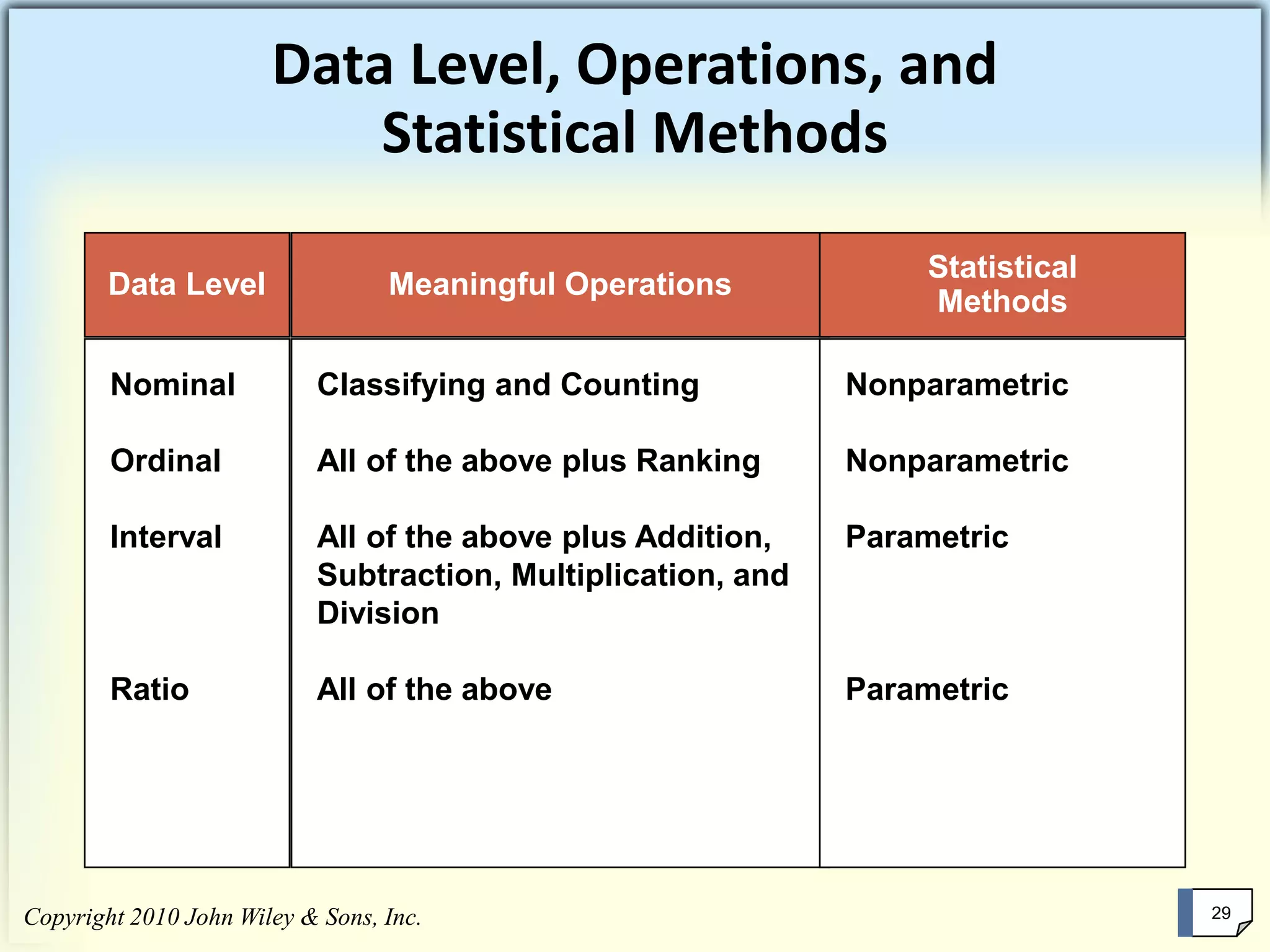
Data Level
Nominal
Ordinal
Interval
Ratio
Meaningful Operations
Classifying and Counting
All of the above plus Ranking
All of the above plus Addition,
Subtraction, Multiplication, and
Division
All of the above
Statistical
Methods
Nonparametric
Nonparametric
Parametric
Parametric
Data Level, Operations, and
Statistical Methods

Applied Business Statistics ch1

  • 1.
    Copyright 2010 JohnWiley & Sons, Inc. 1 Copyright 2010 John Wiley & Sons, Inc. Business Statistics, 6th ed. by Ken Black Chapter 1 What are Statistics?
  • 2.
    Copyright 2010 JohnWiley & Sons, Inc. 2 Define statistics. Become aware of a wide range of applications of statistics in business. Differentiate between descriptive and inferential statistics. Classify numbers by level of data and understand why doing so is important. Learning Objectives
  • 3.
    Copyright 2010 JohnWiley & Sons, Inc. 3 Statistics in Business Accounting — auditing and cost estimation Economics — regional, national, and international economic performance Finance — investments and portfolio management Management — human resources, compensation, and quality management Management Information Systems — performance of systems which gather, summarize, and disseminate information to various managerial levels Marketing — market analysis and consumer research International Business — market and demographic analysis
  • 4.
    Copyright 2010 JohnWiley & Sons, Inc. 4 Science of gathering, analyzing, interpreting, and presenting data on various topics Branch of mathematics Course of study Facts and figures Measurement taken on a sample Type of distribution being used to analyze data What is Statistics?
  • 5.
    Copyright 2010 JohnWiley & Sons, Inc. 5 Statistics – science dealing with the collection, analysis, interpretation, and presentation of numerical data Statistics has two types Descriptive measure – computed from a sample and used to make a determination Distribution - used in the analysis of the data Statistics in Business
  • 6.
    Copyright 2010 JohnWiley & Sons, Inc. 6 Branches of statistics Descriptive – using data gathered on a group to describe or reach conclusions about the group Inferential – data gathered from a sample and used to reach conclusions about the population from which the data was gathered Used to draw conclusions about the group or similar groups Statistics in Business
  • 7.
    Copyright 2010 JohnWiley & Sons, Inc. 7 Population — the whole a collection of persons, objects, or items under study Census — gathering data from the entire population Sample — a portion of the whole/population a subset of the population; must be large enough to represent the whole Population Versus Sample
  • 8.
    Copyright 2010 JohnWiley & Sons, Inc. 8 Population
  • 9.
    Copyright 2010 JohnWiley & Sons, Inc. 9 Identifier Color MPG RD1 Red 12 RD2 Red 10 RD3 Red 13 RD4 Red 10 RD5 Red 13 BL1 Blue 27 BL2 Blue 24 GR1 Green 35 GR2 Green 35 GY1 Gray 15 GY2 Gray 18 GY3 Gray 17 Population and Census Data
  • 10.
    Copyright 2010 JohnWiley & Sons, Inc. 10 Sample and Sample Data Identifier Color MPG RD2 Red 10 RD5 Red 13 GR1 Green 35 GY2 Gray 18
  • 11.
    Copyright 2010 JohnWiley & Sons, Inc. 11Copyright 2010 John Wiley & Sons, Inc. 11 Parameter vs. Statistic Parameter — descriptive measure of the population Usually represented by Greek letters Statistic — descriptive measure of a sample Usually represented by Roman letters
  • 12.
    Copyright 2010 JohnWiley & Sons, Inc. 12Copyright 2010 John Wiley & Sons, Inc. 12 parameterpopulationdenotes 2  denotes population variance  denotes population standard deviation Symbols for Population Parameters
  • 13.
    Copyright 2010 JohnWiley & Sons, Inc. 13Copyright 2010 John Wiley & Sons, Inc. 13 meansampledenotesx 2 S denotes sample variance S denotes sample standard deviation Symbols for Sample Statistics
  • 14.
    Copyright 2010 JohnWiley & Sons, Inc. 14Copyright 2010 John Wiley & Sons, Inc. 14 Process of Inferential Statistics )(parameter Population1.  )(statistic x Sample3. estimateto xCalculate4. samplerandom aSelect2.
  • 15.
    Copyright 2010 JohnWiley & Sons, Inc. 15Copyright 2010 John Wiley & Sons, Inc. 15 Statistics in Business Difference between a parameter and statistic is only important in the use of inferential statistics Calculations of parameter can be cost prohibitive When cost prohibitive, a sample calculates appropriate statistics. Researchers use the calculation as an estimate of the parameter.
  • 16.
    Copyright 2010 JohnWiley & Sons, Inc. 16Copyright 2010 John Wiley & Sons, Inc. 16 Statistics in Business Inferences about parameters made under conditions of uncertainty Uncertainty can be caused by small sample lack of knowledge about the source of the inferences change in conditions not accounted for
  • 17.
    Copyright 2010 JohnWiley & Sons, Inc. 17Copyright 2010 John Wiley & Sons, Inc. 17 Statistics in Business Probability statement – used to estimate the level of confidence in the probability statement
  • 18.
    Copyright 2010 JohnWiley & Sons, Inc. 18 Nominal — In nominal measurement the numerical values just "name" the attribute uniquely. No ordering of the cases is implied. For example, jersey numbers in basketball are measures at the nominal level. A player with number 30 is not more of anything than a player with number 15, and is certainly not twice whatever number 15 is. Levels of Data Measurement
  • 19.
    Copyright 2010 JohnWiley & Sons, Inc. 19 Ordinal - A variable is ordinal measurable if ranking is possible for values of the variable. For example, a gold medal reflects superior performance to a silver or bronze medal in the Olympics, or you may prefer French toast to waffles, and waffles to oat bran muffins. “First,” “Second” are ordinal measurements. Levels of Data Measurement
  • 20.
    Copyright 2010 JohnWiley & Sons, Inc. 20 Interval - In interval measurement the distance between attributes does have meaning. For example, when measuring temperature (in Fahrenheit), the distance from 30-40 is same as the distance from 70-80. The interval between values is interpretable. Levels of Data Measurement
  • 21.
    Copyright 2010 JohnWiley & Sons, Inc. 21 Ratio — in ratio measurement there is always an absolute zero that is meaningful. This means that you can construct a meaningful fraction (or ratio) with a ratio variable. In applied social research most "count" variables are ratio, for example, the number of clients in past six months. Levels of Data Measurement
  • 22.
    Copyright 2010 JohnWiley & Sons, Inc. 22 Cardinal - A variable is cardinally measurable if a given interval between measures has a consistent meaning, i.e., if the measure corresponds to points along a straight line. For example, height, output, and income are cardinally measurable Levels of Data Measurement
  • 23.
    Copyright 2010 JohnWiley & Sons, Inc. 23 Nominal Level Data Numbers are used to classify or categorize Example: Employment Classification 1 for Educator 2 for Construction Worker 3 for Manufacturing Worker
  • 24.
    Copyright 2010 JohnWiley & Sons, Inc. 24 Ordinal Level Data Numbers are used to indicate rank or order Relative magnitude of numbers is meaningful Differences between numbers are not comparable Example: Ranking productivity of employees Example: Position within an organization 1 for President 2 for Vice President 3 for Plant Manager 4 for Department Supervisor 5 for Employee
  • 25.
    Copyright 2010 JohnWiley & Sons, Inc. 25 Faculty and staff should receive preferential treatment for parking space. Ordinal Data 1 2 3 4 5 Strongly Agree Agree Strongly Disagree DisagreeNeutral
  • 26.
    Copyright 2010 JohnWiley & Sons, Inc. 26 Interval Level Data Interval Level data - Distances between consecutive integers are equal Relative magnitude of numbers is meaningful Differences between numbers are comparable Location of origin, zero, is arbitrary Vertical intercept of unit of measure transform function is not zero Example: Fahrenheit Temperature Example: Monetary Utility
  • 27.
    Copyright 2010 JohnWiley & Sons, Inc. 27 Highest level of measurement Relative magnitude of numbers is meaningful Differences between numbers are comparable Location of origin, zero, is absolute (natural) Vertical intercept of unit of measure transform function is zero Examples: Height, Weight, and Volume Example: Monetary Variables, such as Profit and Loss, Revenues, Expenses, Financial ratios - such as P/E Ratio, Inventory Turnover, and Quick Ratio. Ratio Level Data
  • 28.
    Copyright 2010 JohnWiley & Sons, Inc. 28 Ratio Level Data Parametric statistics – requires that the data be interval or ration Non Parametric – used if data are nominal or ordinal Non parametric statistics can be used to analyze interval or ratio data
  • 29.
    Copyright 2010 JohnWiley & Sons, Inc. 29Copyright 2010 John Wiley & Sons, Inc. 29 Data Level Nominal Ordinal Interval Ratio Meaningful Operations Classifying and Counting All of the above plus Ranking All of the above plus Addition, Subtraction, Multiplication, and Division All of the above Statistical Methods Nonparametric Nonparametric Parametric Parametric Data Level, Operations, and Statistical Methods