Applications of linear algebra in chemical engineerig
Linear algebra plays an important role in chemical engineering for solving problems related to balancing chemical reactions and determining the exact concentrations of reactants required. Chemical engineers use linear algebra to create systems of linear equations that represent chemical reactions, and techniques from linear algebra can be used to solve these systems and determine the proper exponents for components in reactions. Linear algebra is also used to solve systems of equations involving the volumes of different reactants needed to produce a certain product or mass.
Linear algebra inChemical
engineering.
● Chemical engineering deals with the production design of
chemical equipment, refinery of raw and mixed
materials, and compounding and processing chemicals
for many different products.
● Linear algebra plays an important role in the process of
problem solving for such processes. One of the main uses
of linear algebra in chemical engineering is in the
problem of preservation of mass .
3.
Where linear algebraused in
chemical engineering
Many raw materials are combined and transformed through
chemical processes in order to create desired compounds that
are used create a very wide diversity of items.
During this process, chemical engineers face many problems,
such as cost of production, materials abundance, balancing of
chemical reactions, among many other problems.
4.
Balancing of ChemicalReactions
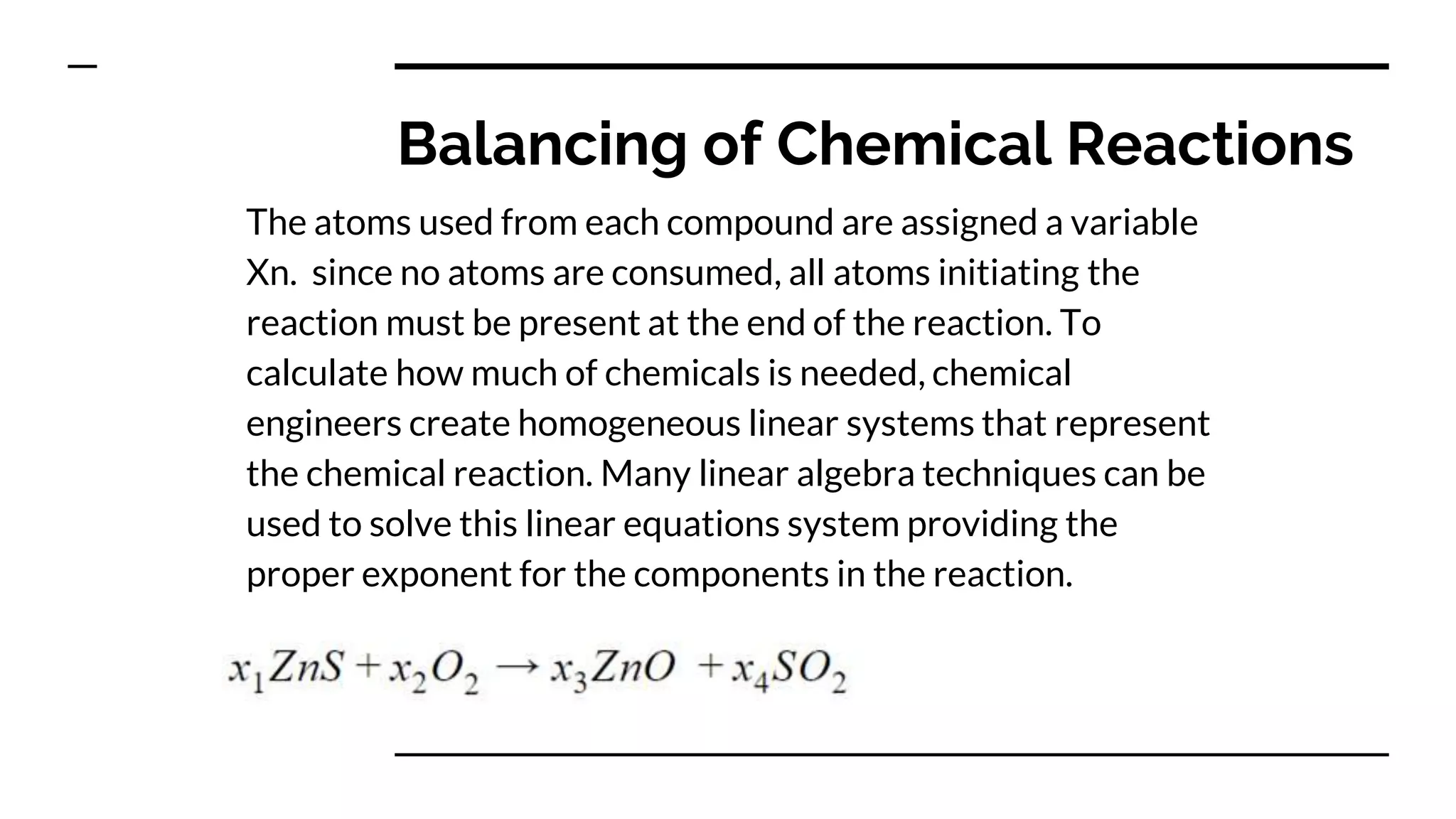
The atoms used from each compound are assigned a variable
Xn. since no atoms are consumed, all atoms initiating the
reaction must be present at the end of the reaction. To
calculate how much of chemicals is needed, chemical
engineers create homogeneous linear systems that represent
the chemical reaction. Many linear algebra techniques can be
used to solve this linear equations system providing the
proper exponent for the components in the reaction.
5.
Calculate exact concentrationof
reactants required
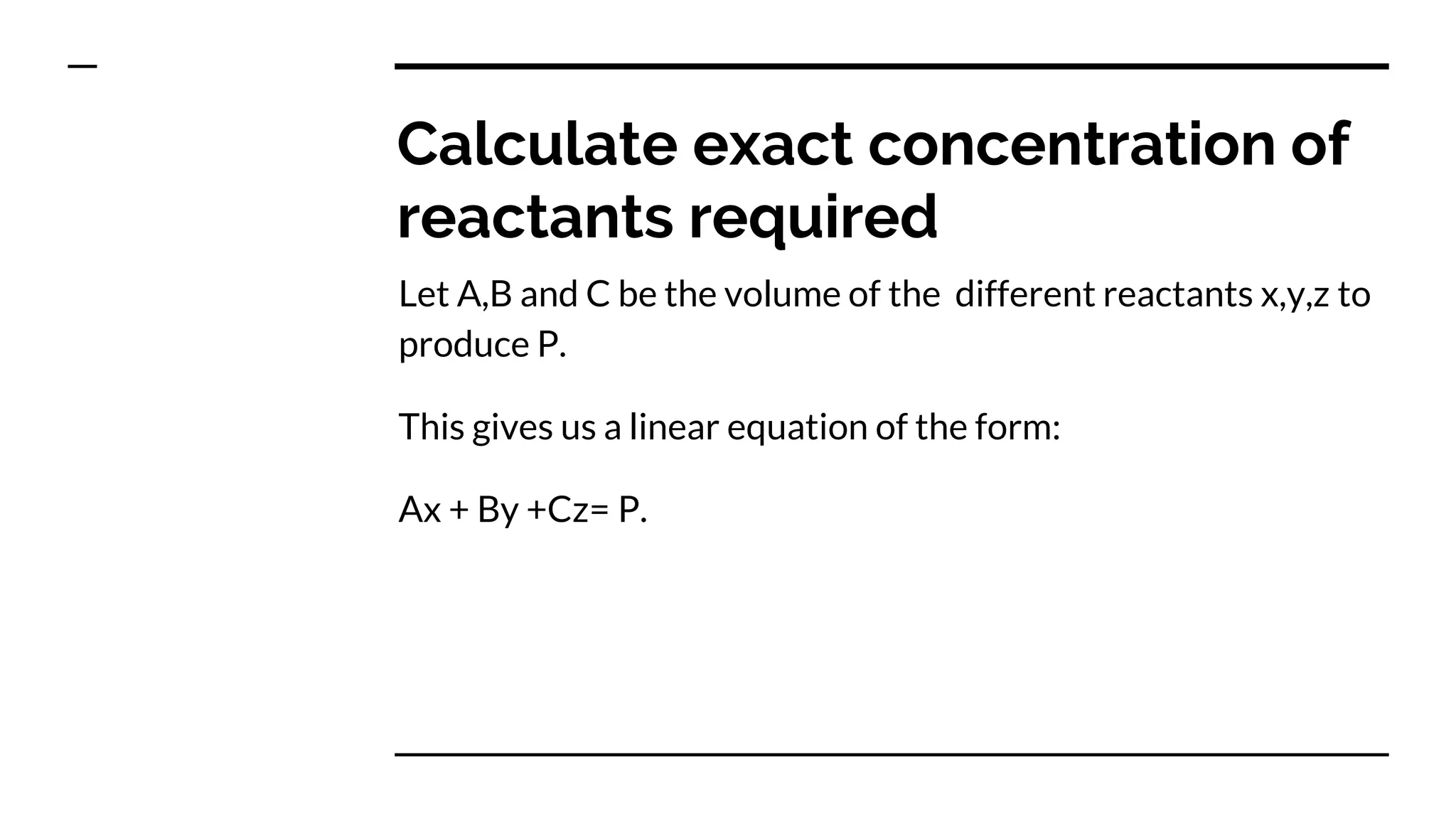
Let A,B and C be the volume of the different reactants x,y,z to
produce P.
This gives us a linear equation of the form:
Ax + By +Cz= P.
6.
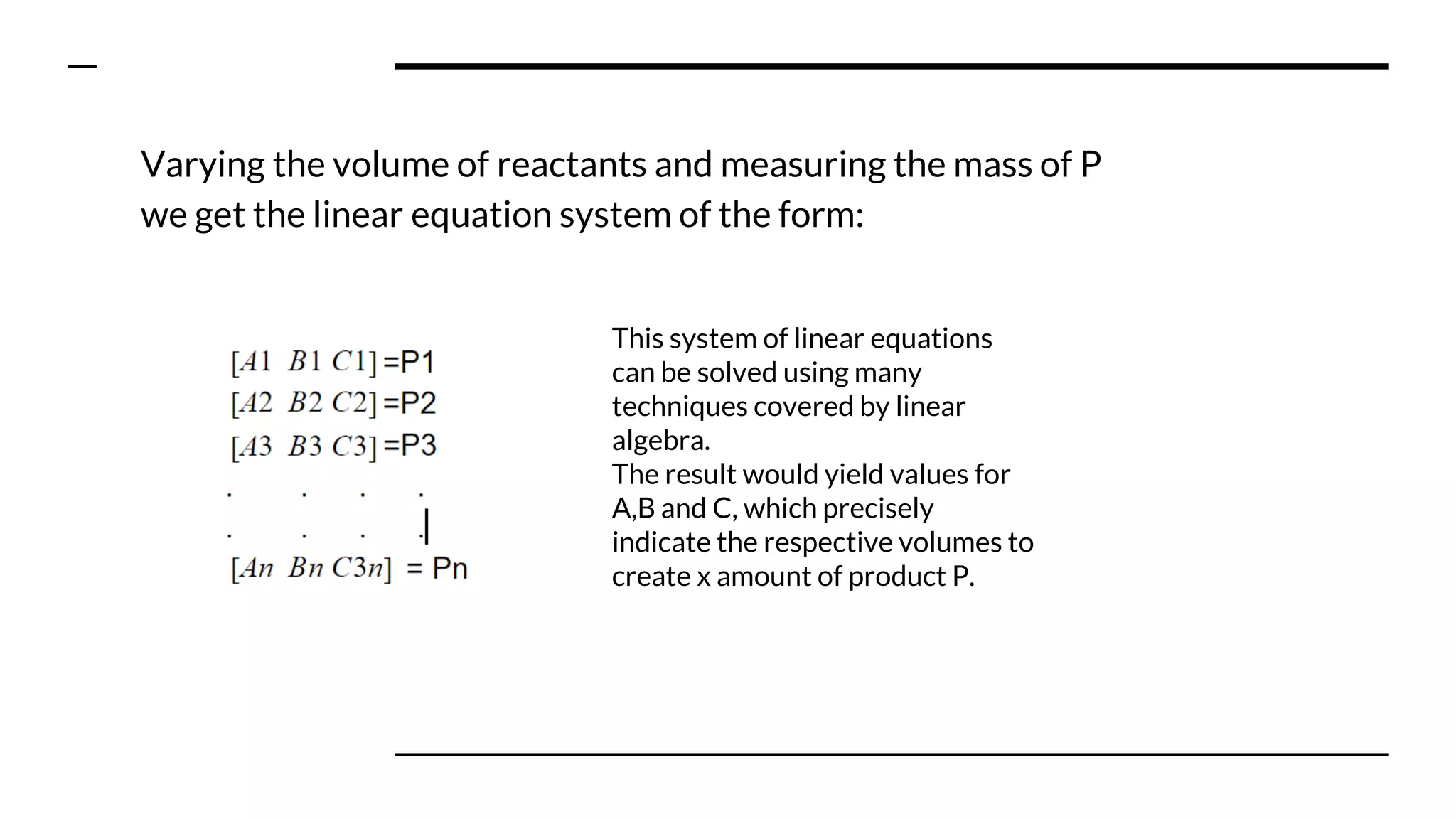
Varying the volumeof reactants and measuring the mass of P
we get the linear equation system of the form:
This system of linear equations
can be solved using many
techniques covered by linear
algebra.
The result would yield values for
A,B and C, which precisely
indicate the respective volumes to
create x amount of product P.