APPLICATION SECURITY
FROM THE INSIDE OUT
TALES FROM THE TRENCHES
DISCLAIMER
$ WHOAMI
Ulisses Albuquerque
Application Security Engineer
@urma
ulissesalbuquerque
• Open-source advocate
• Software engineer turned security professional
• Builder of breaking tools
CONTEXT
Cloud-First
• All new applications
and services
designed with focus
on maximising cloud
usage and technical
excellence.
Risk Appetite
• Low resistance to
adoption of new
technologies,
SaaS/PaaS solutions
and developer
autonomy.
Build It, Run It
• Teams own
development and
operations of their
solutions, enabling
technical excellence
and encouraging
risk ownership.
Greenfields
• Early days with full
autonomy to run
application security
program as seen fit
for organisation.
IDENTIFYING GAPS
AND LAYING A
PLAN
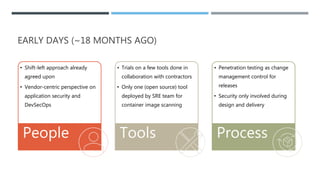
EARLY DAYS (~18 MONTHS AGO)
• Shift-left approach already
agreed upon
• Vendor-centric perspective on
application security and
DevSecOps
People
• Trials on a few tools done in
collaboration with contractors
• Only one (open source) tool
deployed by SRE team for
container image scanning
Tools
• Penetration testing as change
management control for
releases
• Security only involved during
design and delivery
Process
AWS SHARED
RESPONSIBILITY
MODEL
Security information mixed
with regular CI output in build
logs
EARLY DAYS
 Challenges in identifying gaps and mapping tools
 Significant number of repositories (600+) and AWS accounts (100+)
 Multitude of programming languages, including Java, JavaScript, Go,
Kotlin, Swift, Scala, Python and more
 Sophisticated development environment and stacks
 Providing security scan results as early as possible in CI environments
 Leveraging SaaS solutions while ensuring security and confidentiality of
data
STACK DIVERSITY
DETERMINES
TOOLSET
TOOLS MUST SUPPORT ALL LANGUAGES
AND TECH STACK COMPONENTS USED
STARTING
LEFT OF THE
SDLC
LESSONS LEARNED
Not every repository is relevant, but no single individual or team knows
which ones are
Licensing per unique contributor (SCA) can get expensive if you have
turnover and/or outsource
Licensing per repository (SAST) can get expensive with highly
compartmentalized architectures (e.g., microservices)
STEALTH MODE
LESSONS LEARNED
Automation of security scans is not enough…
SAST reports are useless in text/log output formats
SAST scans can take a long time to complete, resulting in slow builds if
done inline
SCA scans are much better when done inline, but hooking to
dependency management tools can get tricky
STARTING LEFT OF THE SDLC
• Individual developers
interested in testing security
tools
• Informal security champions
identified
People
• Checkmarx (SAST) and Snyk
(SCA) chosen as first tools
• Manually triggered scans
across all repositories
Tools
• On demand triage of findings
• No mandatory scans for
change requests
• JIRA tickets created for
confirmed findings
Process
PROVIDING FRIENDLY
SECURITY TOOLING
OUTPUT
SECURITY SCAN RESULTS
CAN BE MUCH EASIER TO
INTERPRET WHEN NOT
BURIED IN BUILD LOGS
HOW TO PROVIDE
SECURITY
FEEDBACK AS
EARLY AS
POSSIBLE?
Code
Change
Pull
Request
CI Build
Artefacts
Cloud
Resources
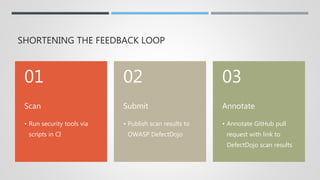
SHORTENING THE FEEDBACK LOOP
OWASP TO THE
RESCUE
SHORTENING THE FEEDBACK LOOP
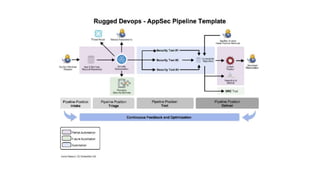
Scan
• Run security tools via
scripts in CI
01
Submit
• Publish scan results to
OWASP DefectDojo
02
Annotate
• Annotate GitHub pull
request with link to
DefectDojo scan results
03
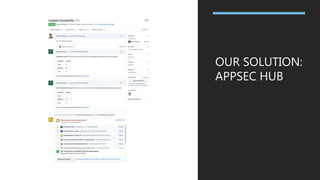
OUR SOLUTION:
APPSEC HUB
APPSEC HUB FLOW
1. GitHub PR webhooks trigger
build in CI and notify hub
2. Hub requests SAST and SCA
scans
3. SCA and SAST pull code from
GitHub
4. CI scans container using Clair
5. Clair scan log published as
artefact to CI
6. SCA and SAST scan results
fetched and published to PR
7. Clair scan results published to PR
APPSEC HUB
APPSEC HUB: FUNCTIONAL, NOT PRACTICAL
“BUILD IT, RUN IT” PROVEN EASIER SAID THAN DONE
APPSEC HUB:
LIMITATIONS
 Debugging failed scans is a nightmare
 Inconsistent APIs across tools
 Asynchronous APIs with no notification (e.g.,
webhooks) require polling
 Extensive sanity checks to prevent triggering
actions on unmanaged repositories and CI
pipelines
 Side effect: explosive license usage due to
scans on irrelevant code
 Implementation architecture misaligned with
other services/applications in organisation
EAT YOUR OWN DOG
FOOD
BUILD AND OPERATE
SYSTEMS THE SAME
WAY THE TEAMS
YOU ARE
SUPPORTING DO
EAT YOUR OWN DOG
FOOD
 Converging on stack used by development
teams enabled…
 Better understanding of user experience
 Early identification of common false positives
 Support from development teams
 Credibility and respect
LESSONS LEARNED
Scanning code and artefacts with security tools is the bare minimum
Security orchestration > security automation
Security checks and gates must be aligned with existing development
practices and flows
⚠ Security checks should only block if 100% accurate
⚠ Do not create long-lived issues automatically, developers might
address issues as soon as they are reported via pull request annotations
Automation might expose broken or questionable patterns and
processes
Engineering decisions might impact ability to perform security checks (e.g., Snyk automated pull
requests)
APPSECD HUB
IMPROVING ON THE
ORIGINAL DESIGN
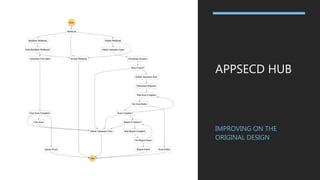
APPSECD HUB
 Lambda orchestration (using
AWS Step Functions)
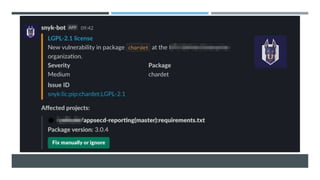
 Full traceability via state
machine
 Monitoring and alarms with
real time notifications in Slack
 Aligned with best practices
from development teams
BUILDING
RELATIONSHIPS
ACROSS TEAMS
BEYOND TECHNOLOGY
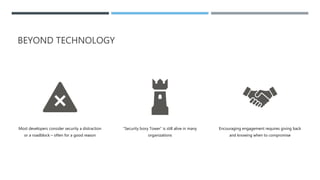
Most developers consider security a distraction
or a roadblock – often for a good reason
“Security Ivory Tower” is still alive in many
organizations
Encouraging engagement requires giving back
and knowing when to compromise
BEYOND
TECHNOLOGY
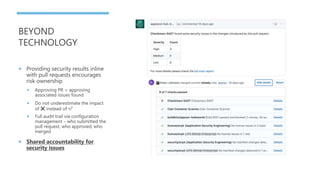
 Providing security results inline
with pull requests encourages
risk ownership
 Approving PR = approving
associated issues found
 Do not underestimate the impact
of ❌ instead of ✅
 Full audit trail via configuration
management – who submitted the
pull request, who approved, who
merged
 Shared accountability for
security issues
https://speakerdeck.com/chriseng/time-to-grow-up-counterproductive-security-behaviors-that-must-end
Security Approval
Security Endorsement
Security Advice
https://www.slideshare.net/wickett/how-to-effect-change-in-the-epistemological-wasteland-of-application-security
CONCLUSIONS
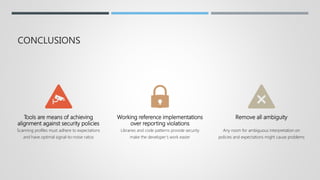
Tools are means of achieving
alignment against security policies
Scanning profiles must adhere to expectations
and have optimal signal-to-noise ratios
Working reference implementations
over reporting violations
Libraries and code patterns provide security
make the developer’s work easier
Remove all ambiguity
Any room for ambiguous interpretation on
policies and expectations might cause problems
CONCLUSIONS
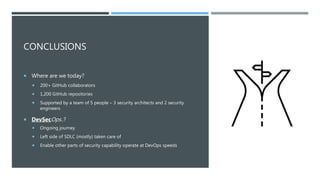
 Where are we today?
 200+ GitHub collaborators
 1,200 GitHub repositories
 Supported by a team of 5 people – 3 security architects and 2 security
engineers
 DevSecOps..?
 Ongoing journey
 Left side of SDLC (mostly) taken care of
 Enable other parts of security capability operate at DevOps speeds

Application Security from the Inside Out

  • 1.
    APPLICATION SECURITY FROM THEINSIDE OUT TALES FROM THE TRENCHES
  • 2.
  • 3.
    $ WHOAMI Ulisses Albuquerque ApplicationSecurity Engineer @urma ulissesalbuquerque • Open-source advocate • Software engineer turned security professional • Builder of breaking tools
  • 4.
    CONTEXT Cloud-First • All newapplications and services designed with focus on maximising cloud usage and technical excellence. Risk Appetite • Low resistance to adoption of new technologies, SaaS/PaaS solutions and developer autonomy. Build It, Run It • Teams own development and operations of their solutions, enabling technical excellence and encouraging risk ownership. Greenfields • Early days with full autonomy to run application security program as seen fit for organisation.
  • 6.
  • 7.
    EARLY DAYS (~18MONTHS AGO) • Shift-left approach already agreed upon • Vendor-centric perspective on application security and DevSecOps People • Trials on a few tools done in collaboration with contractors • Only one (open source) tool deployed by SRE team for container image scanning Tools • Penetration testing as change management control for releases • Security only involved during design and delivery Process
  • 8.
  • 9.
    Security information mixed withregular CI output in build logs
  • 10.
    EARLY DAYS  Challengesin identifying gaps and mapping tools  Significant number of repositories (600+) and AWS accounts (100+)  Multitude of programming languages, including Java, JavaScript, Go, Kotlin, Swift, Scala, Python and more  Sophisticated development environment and stacks  Providing security scan results as early as possible in CI environments  Leveraging SaaS solutions while ensuring security and confidentiality of data
  • 11.
    STACK DIVERSITY DETERMINES TOOLSET TOOLS MUSTSUPPORT ALL LANGUAGES AND TECH STACK COMPONENTS USED
  • 12.
  • 13.
    LESSONS LEARNED Not everyrepository is relevant, but no single individual or team knows which ones are Licensing per unique contributor (SCA) can get expensive if you have turnover and/or outsource Licensing per repository (SAST) can get expensive with highly compartmentalized architectures (e.g., microservices)
  • 14.
  • 15.
    LESSONS LEARNED Automation ofsecurity scans is not enough… SAST reports are useless in text/log output formats SAST scans can take a long time to complete, resulting in slow builds if done inline SCA scans are much better when done inline, but hooking to dependency management tools can get tricky
  • 16.
    STARTING LEFT OFTHE SDLC • Individual developers interested in testing security tools • Informal security champions identified People • Checkmarx (SAST) and Snyk (SCA) chosen as first tools • Manually triggered scans across all repositories Tools • On demand triage of findings • No mandatory scans for change requests • JIRA tickets created for confirmed findings Process
  • 17.
    PROVIDING FRIENDLY SECURITY TOOLING OUTPUT SECURITYSCAN RESULTS CAN BE MUCH EASIER TO INTERPRET WHEN NOT BURIED IN BUILD LOGS
  • 19.
    HOW TO PROVIDE SECURITY FEEDBACKAS EARLY AS POSSIBLE?
  • 20.
  • 21.
  • 23.
    SHORTENING THE FEEDBACKLOOP Scan • Run security tools via scripts in CI 01 Submit • Publish scan results to OWASP DefectDojo 02 Annotate • Annotate GitHub pull request with link to DefectDojo scan results 03
  • 25.
  • 26.
    APPSEC HUB FLOW 1.GitHub PR webhooks trigger build in CI and notify hub 2. Hub requests SAST and SCA scans 3. SCA and SAST pull code from GitHub 4. CI scans container using Clair 5. Clair scan log published as artefact to CI 6. SCA and SAST scan results fetched and published to PR 7. Clair scan results published to PR
  • 27.
  • 28.
    APPSEC HUB: FUNCTIONAL,NOT PRACTICAL “BUILD IT, RUN IT” PROVEN EASIER SAID THAN DONE
  • 29.
    APPSEC HUB: LIMITATIONS  Debuggingfailed scans is a nightmare  Inconsistent APIs across tools  Asynchronous APIs with no notification (e.g., webhooks) require polling  Extensive sanity checks to prevent triggering actions on unmanaged repositories and CI pipelines  Side effect: explosive license usage due to scans on irrelevant code  Implementation architecture misaligned with other services/applications in organisation
  • 31.
    EAT YOUR OWNDOG FOOD BUILD AND OPERATE SYSTEMS THE SAME WAY THE TEAMS YOU ARE SUPPORTING DO
  • 34.
    EAT YOUR OWNDOG FOOD  Converging on stack used by development teams enabled…  Better understanding of user experience  Early identification of common false positives  Support from development teams  Credibility and respect
  • 35.
    LESSONS LEARNED Scanning codeand artefacts with security tools is the bare minimum Security orchestration > security automation Security checks and gates must be aligned with existing development practices and flows ⚠ Security checks should only block if 100% accurate ⚠ Do not create long-lived issues automatically, developers might address issues as soon as they are reported via pull request annotations Automation might expose broken or questionable patterns and processes Engineering decisions might impact ability to perform security checks (e.g., Snyk automated pull requests)
  • 36.
    APPSECD HUB IMPROVING ONTHE ORIGINAL DESIGN
  • 37.
    APPSECD HUB  Lambdaorchestration (using AWS Step Functions)  Full traceability via state machine  Monitoring and alarms with real time notifications in Slack  Aligned with best practices from development teams
  • 38.
  • 40.
    BEYOND TECHNOLOGY Most developersconsider security a distraction or a roadblock – often for a good reason “Security Ivory Tower” is still alive in many organizations Encouraging engagement requires giving back and knowing when to compromise
  • 41.
    BEYOND TECHNOLOGY  Providing securityresults inline with pull requests encourages risk ownership  Approving PR = approving associated issues found  Do not underestimate the impact of ❌ instead of ✅  Full audit trail via configuration management – who submitted the pull request, who approved, who merged  Shared accountability for security issues
  • 42.
  • 43.
  • 44.
  • 45.
    CONCLUSIONS Tools are meansof achieving alignment against security policies Scanning profiles must adhere to expectations and have optimal signal-to-noise ratios Working reference implementations over reporting violations Libraries and code patterns provide security make the developer’s work easier Remove all ambiguity Any room for ambiguous interpretation on policies and expectations might cause problems
  • 46.
    CONCLUSIONS  Where arewe today?  200+ GitHub collaborators  1,200 GitHub repositories  Supported by a team of 5 people – 3 security architects and 2 security engineers  DevSecOps..?  Ongoing journey  Left side of SDLC (mostly) taken care of  Enable other parts of security capability operate at DevOps speeds

Editor's Notes

  • #3 While most of our story focuses on a specific organization, this is collation of experiences in multiple organizations of different sizes and cultures in implementing an application security program. It is intentionally told in a linear fashion to facilitate story telling but happened in a much more tortuous way in real life.
  • #5 Our not-so-fictional organization and the point in time in their journey to a devsecops/shared responsibility model
  • #6 Tech stack – top row: python, golang, java, swift, kotlin, javascript, scala Middle row: cloud formation, lambda, ecs, dynamodb, sagemaker, cognito, s3 Bottom row: buildkite, datadog, sumologic, github enterprise, slack, salesforce, apigee
  • #15 Support for languages/tech stacks limits products, which limits ability to shop around and exposes us to licensing issues
  • #18 We believed our experience as developers could be leveraged to deliver an implementation that is technically excellent in a short timeframe, and we could iterate from that. We enabled security scans in commits via an API we built, which allowed our pipeline tool to trigger scans by having security tools pull code from GitHub
  • #24 Why not move even further left and provide feedback via IDE (i.e., ”code change”?) – we do not have a standard IDE in the organization, and some artefacts on which we report (like containers) are only built as part of the CI pipeline
  • #25 Use OWASP as a reference – OWASP AppSec pipeline project Why remove defect tracker? Because we believe tickets created by systems are perceived as less valuable by development teams, and because those create a permanent record of what could potentially be an ephemeral/temporary vulnerable state during the development of a feature