Offensive Security Transformation:
Starting from Scratch
Spencer Koch
Offensive Security Leader, Securimancy
Altaz Valani
Cyber Security Researcher, Security Compass
Who We Are
Spencer Koch
Offensive Security Leader
@sp3nx0r
securimancy.com
Altaz Valani
Cyber Security Researcher, Security
Compass
securitycompass.com
This talk is:
• Aimed at security leaders early on
in the maturity curve
• A cohesive storyboard for
disparate capabilities that may
already exist within SecOps teams
• Pointers on what worked well and
resources to start down this path
• Both a practitioner and research
perspective
This talk is not:
• Going to go deep in implementation
or tooling details
• Going to be news to anyone doing
red teaming or having mature
appsec capabilities
About This Talk
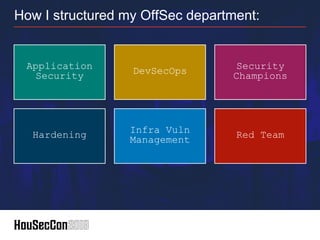
How I structured my OffSec department:
Application
Security DevSecOps Security
Champions
Hardening Infra Vuln
Management Red Team
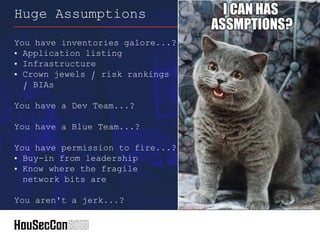
You have inventories galore...?
• Application listing
• Infrastructure
• Crown jewels / risk rankings
/ BIAs
You have a Dev Team...?
You have a Blue Team...?
You have permission to fire...?
• Buy-in from leadership
• Know where the fragile
network bits are
You aren't a jerk...?
Huge Assumptions
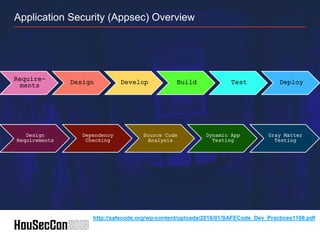
Application Security (Appsec) Overview
Design
Requirements
Dependency
Checking
Source Code
Analysis
Dynamic App
Testing
Gray Matter
Testing
http://safecode.org/wp-content/uploads/2018/01/SAFECode_Dev_Practices1108.pdf
Require-
ments Design Develop Build Test Deploy
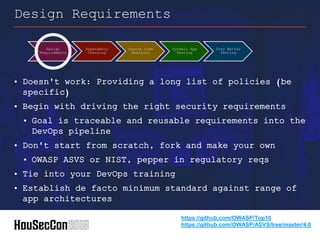
• Doesn't work: Providing a long list of policies (be
specific)
• Begin with driving the right security requirements
• Goal is traceable and reusable requirements into the
DevOps pipeline
• Don't start from scratch, fork and make your own
• OWASP ASVS or NIST, pepper in regulatory reqs
• Tie into your DevOps training
• Establish de facto minimum standard against range of
app architectures
Design Requirements
Design
Requirements
Dependency
Checking
Source Code
Analysis
Dynamic App
Testing
Gray Matter
Testing
https://github.com/OWASP/Top10
https://github.com/OWASP/ASVS/tree/master/4.0
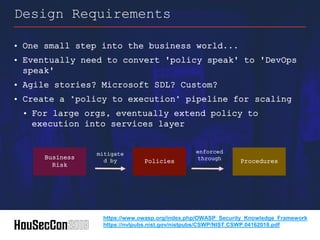
• One small step into the business world...
• Eventually need to convert 'policy speak' to 'DevOps
speak'
• Agile stories? Microsoft SDL? Custom?
• Create a "policy to execution" pipeline for scaling
• For large orgs, eventually extend policy to
execution into services layer
Design Requirements
Business
Risk
Policies
mitigate
d by Procedures
enforced
through
https://www.owasp.org/index.php/OWASP_Security_Knowledge_Framework
https://nvlpubs.nist.gov/nistpubs/CSWP/NIST.CSWP.04162018.pdf
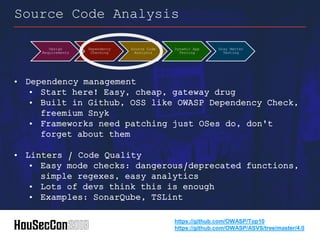
• Dependency management
• Start here! Easy, cheap, gateway drug
• Built in Github, OSS like OWASP Dependency Check,
freemium Snyk
• Frameworks need patching just OSes do, don't
forget about them
• Linters / Code Quality
• Easy mode checks: dangerous/deprecated functions,
simple regexes, easy analytics
• Lots of devs think this is enough
• Examples: SonarQube, TSLint
Source Code Analysis
https://github.com/OWASP/Top10
https://github.com/OWASP/ASVS/tree/master/4.0
Design
Requirements
Dependency
Checking
Source Code
Analysis
Dynamic App
Testing
Gray Matter
Testing
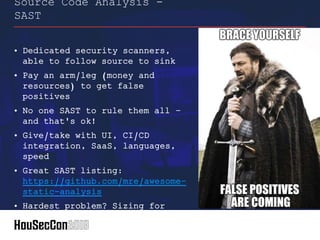
• Dedicated security scanners,
able to follow source to sink
• Pay an arm/leg (money and
resources) to get false
positives
• No one SAST to rule them all –
and that's ok!
• Give/take with UI, CI/CD
integration, SaaS, languages,
speed
• Great SAST listing:
https://github.com/mre/awesome-
static-analysis
• Hardest problem? Sizing for
licenses (how's that inventory)
Source Code Analysis -
SAST
• How are you pushing security
defects to backlog? ALM
Integrations
• DO NOT PRINT TO PDF & CHUCK
• Customize your own ruleset /
criticality ranking
• You will spend a lot of time here
trying to get this right...
Source Code Analysis Gotchas
• Use those IDE integrations – devs don't
want another tool
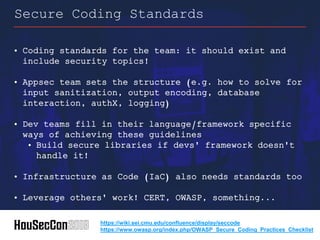
• Coding standards for the team: it should exist and
include security topics!
• Appsec team sets the structure (e.g. how to solve for
input sanitization, output encoding, database
interaction, authX, logging)
• Dev teams fill in their language/framework specific
ways of achieving these guidelines
• Build secure libraries if devs' framework doesn't
handle it!
• Infrastructure as Code (IaC) also needs standards too
• Leverage others' work! CERT, OWASP, something...
Secure Coding Standards
https://wiki.sei.cmu.edu/confluence/display/seccode
https://www.owasp.org/index.php/OWASP_Secure_Coding_Practices_Checklist
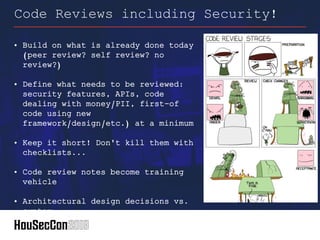
• Build on what is already done today
(peer review? self review? no
review?)
• Define what needs to be reviewed:
security features, APIs, code
dealing with money/PII, first-of
code using new
framework/design/etc.) at a minimum
• Keep it short! Don't kill them with
checklists...
• Code review notes become training
vehicle
• Architectural design decisions vs.
syntax
Code Reviews including Security!
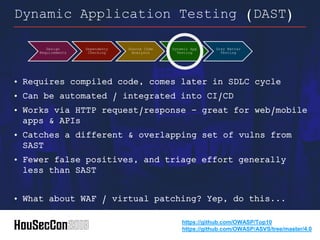
• Requires compiled code, comes later in SDLC cycle
• Can be automated / integrated into CI/CD
• Works via HTTP request/response - great for web/mobile
apps & APIs
• Catches a different & overlapping set of vulns from
SAST
• Fewer false positives, and triage effort generally
less than SAST
• What about WAF / virtual patching? Yep, do this...
• What about IAST/RASP? Don't worry about it yet...
Dynamic Application Testing (DAST)
https://github.com/OWASP/Top10
https://github.com/OWASP/ASVS/tree/master/4.0
Design
Requirements
Dependency
Checking
Source Code
Analysis
Dynamic App
Testing
Gray Matter
Testing
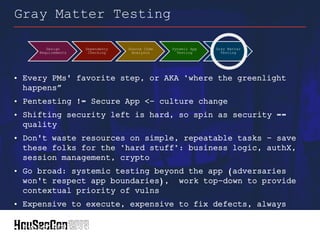
• Every PMs' favorite step, or AKA "where the greenlight
happens”
• Pentesting != Secure App <- culture change
• Shifting security left is hard, so spin as security ==
quality
• Don't waste resources on simple, repeatable tasks - save
these folks for the "hard stuff": business logic, authX,
session management, crypto
• Go broad: systemic testing beyond the app (adversaries
won't respect app boundaries), work top-down to provide
contextual priority of vulns
• Expensive to execute, expensive to fix defects, always
timeboxed
• Avoid RCP: pick a partner(s), pick a framework, get
involved
Gray Matter Testing
Design
Requirements
Dependency
Checking
Source Code
Analysis
Dynamic App
Testing
Gray Matter
Testing
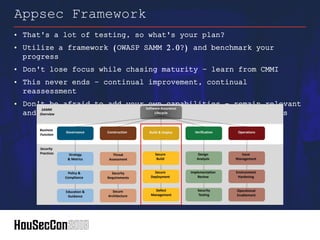
• That's a lot of testing, so what's your plan?
• Utilize a framework (OWASP SAMM 2.0?) and benchmark your
progress
• Don't lose focus while chasing maturity – learn from CMMI
• This never ends – continual improvement, continual
reassessment
• Don't be afraid to add your own capabilities – remain relevant
and look for what's critical for assurance to your business
Appsec Framework
• Start small:
• # of apps onboarded /
total apps
• Vulnerability type by
time (SQLi, XSS, etc.)
• Average time to
remediation
• Even those 3 can be hard
• Focus on telling a story
and grow
• Stay away from # of vulns
metrics, stick to behavior
around those vulns
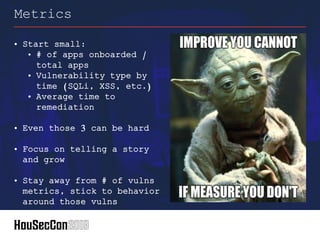
Metrics
• if (!infra_vuln && !appsec): devsecops = doomed
• DevSecOps Manifesto by Larry Macherone: Build
security in more than bolt it on
• All about about automating manual security testing
processes
• Make friends with DevOps, understand pipelines
• Build at lab/home, follow along with Securing DevOps
by Julien Vehent
• With this understanding, where to start putting Sec
in DevOps?
DevSecOps – Getting Started
https://medium.com/continuous-agile/the-devsecops-manifesto-94579e0eb716
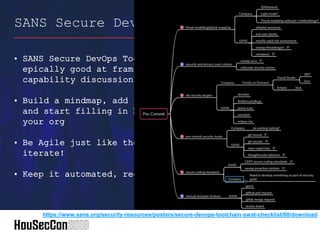
• SANS Secure DevOps Toolchain -
epically good at framing your
capability discussion!
• Build a mindmap, add your priorities
and start filling in blanks within
your org
• Be Agile just like the dev teams –
iterate!
• Keep it automated, reduce friction
SANS Secure DevOps Toolchain
https://www.sans.org/security-resources/posters/secure-devops-toolchain-swat-checklist/60/download
• Be choosey about what "breaks the build",
start without any breaks
• Plan out how security defects make it into
the backlog: manual is painful
• Get involved in backlog prioritization,
don't be unreasonable
• Come up with a plan and prioritize: ease to
implement, bang for buck
• Examples: dependency checking, to secrets
scanning, to CIS benchmarks, to OWASP Top
10 DAST scanning, to …
• Infra is always easier than app
• Expect to have to code some stuff, get
your hands dirty
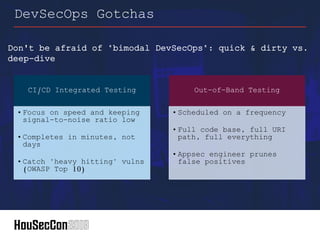
DevSecOps Gotchas
Don't be afraid of "bimodal DevSecOps": quick & dirty vs.
deep-dive
DevSecOps Gotchas
CI/CD Integrated Testing
•Focus on speed and keeping
signal-to-noise ratio low
•Completes in minutes, not
days
•Catch "heavy hitting" vulns
(OWASP Top 10)
Out-of-Band Testing
•Scheduled on a frequency
•Full code base, full URI
path, full everything
•Appsec engineer prunes
false positives
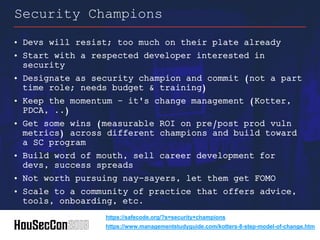
• Devs will resist; too much on their plate already
• Start with a respected developer interested in
security
• Designate as security champion and commit (not a part
time role; needs budget & training)
• Keep the momentum – it's change management (Kotter,
PDCA, ..)
• Get some wins (measurable ROI on pre/post prod vuln
metrics) across different champions and build toward
a SC program
• Build word of mouth, sell career development for
devs, success spreads
• Not worth pursuing nay-sayers, let them get FOMO
• Scale to a community of practice that offers advice,
tools, onboarding, etc.
Security Champions
https://safecode.org/?s=security+champions
https://www.managementstudyguide.com/kotters-8-step-model-of-change.htm
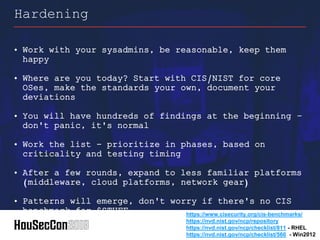
• Work with your sysadmins, be reasonable, keep them
happy
• Where are you today? Start with CIS/NIST for core
OSes, make the standards your own, document your
deviations
• You will have hundreds of findings at the beginning –
don't panic, it's normal
• Work the list - prioritize in phases, based on
criticality and testing timing
• After a few rounds, expand to less familiar platforms
(middleware, cloud platforms, network gear)
• Patterns will emerge, don't worry if there's no CIS
benchmark for $STUFF
Hardening
https://www.cisecurity.org/cis-benchmarks/
https://nvd.nist.gov/ncp/repository
https://nvd.nist.gov/ncp/checklist/811 - RHEL
https://nvd.nist.gov/ncp/checklist/560 - Win2012
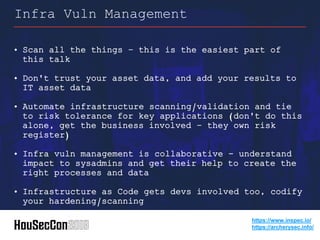
• Scan all the things – this is the easiest part of
this talk
• Don't trust your asset data, and add your results to
IT asset data
• Automate infrastructure scanning/validation and tie
to risk tolerance for key applications (don't do this
alone, get the business involved – they own risk
register)
• Infra vuln management is collaborative - understand
impact to sysadmins and get their help to create the
right processes and data
• Infrastructure as Code gets devs involved too, codify
your hardening/scanning
Infra Vuln Management
https://www.inspec.io/
https://archerysec.info/
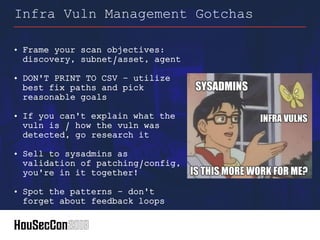
• Frame your scan objectives:
discovery, subnet/asset, agent
• DON'T PRINT TO CSV – utilize
best fix paths and pick
reasonable goals
• If you can't explain what the
vuln is / how the vuln was
detected, go research it
• Sell to sysadmins as
validation of patching/config,
you're in it together!
• Spot the patterns – don't
forget about feedback loops
Infra Vuln Management Gotchas
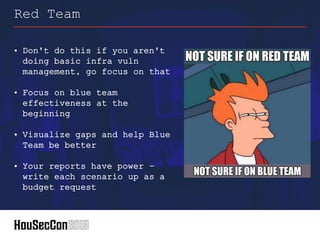
• Don't do this if you aren't
doing basic infra vuln
management, go focus on that
• Focus on blue team
effectiveness at the
beginning
• Visualize gaps and help Blue
Team be better
• Your reports have power –
write each scenario up as a
budget request
Red Team
• Phishing activities
• OSS tools galore like Gophish, just add AWS
infrastructure
• Social engineering
• Call center password reset
• Signature Emulation – is your $TOOL detecting what
you think it does?
• (Network) BT3 – Blue Team Training Toolkit
/ (Host) Red Canary
• Active Directory health (Bloodhound / PingCastle)
• Awesome Redteaming lists – pick your poison
Red Team Introductory Activities
https://www.redcanary.com/blog/atomic-red-team-testing/
https://github.com/BloodHoundAD/BloodHound
https://www.pingcastle.com/
https://github.com/yeyintminthuhtut/Awesome-Red-Teaming
https://github.com/gophish/gophish
https://www.bt3.no/
• Continue to build, automate where possible
• See a technique on Twitter, try it out and see if
Blue Team sees it
Red Team Final Notes
• Feedback loop forevah
• Always focus on ROI and value
proposition, or face budget cuts
• Don't expect or try to be the next
APT
Problem: Everything's going to the cloud! Oh nooooes…
Approaches that work:
• Fight for testing as it moves – you may never see
that app again!
• Shift security testing focus from depth to breadth
• Change methodologies – don't be the blocker
• Change the duration – 3 apps per week
• Stress importance of risk registers and good
documentation
• Pick the hill(s) to die on – care about the most
critical vulns
Bonus: Cloud Migrations
Ditch FUD, embrace the new
• Use Infrastructure as Code to your benefit
• Use Cloud Service Provider tools to your benefit
• Push for network segmentation
• Encourage use of cloud devops tools – they're likely
more secure than self-managed
Hardest part of migration: getting funding to fix
those uncovered vulns
Bonus: Cloud Migrations
https://github.com/dev-sec - IaC hardening
https://github.com/aws-quickstart/quickstart-compliance-cis-benchmark - CSP tooling
for hardening/alerting
• Still a fledgling discipline, room to
explore
• Get involved with DevSecOps
communities, local chapters
• Partner with researchers
• Industry collaboration - reach out to
us!
Next Steps / Where To Go From Here

HouSecCon 2019: Offensive Security - Starting from Scratch

  • 1.
    Offensive Security Transformation: Startingfrom Scratch Spencer Koch Offensive Security Leader, Securimancy Altaz Valani Cyber Security Researcher, Security Compass
  • 2.
    Who We Are SpencerKoch Offensive Security Leader @sp3nx0r securimancy.com Altaz Valani Cyber Security Researcher, Security Compass securitycompass.com
  • 3.
    This talk is: •Aimed at security leaders early on in the maturity curve • A cohesive storyboard for disparate capabilities that may already exist within SecOps teams • Pointers on what worked well and resources to start down this path • Both a practitioner and research perspective This talk is not: • Going to go deep in implementation or tooling details • Going to be news to anyone doing red teaming or having mature appsec capabilities About This Talk
  • 4.
    How I structuredmy OffSec department: Application Security DevSecOps Security Champions Hardening Infra Vuln Management Red Team
  • 5.
    You have inventoriesgalore...? • Application listing • Infrastructure • Crown jewels / risk rankings / BIAs You have a Dev Team...? You have a Blue Team...? You have permission to fire...? • Buy-in from leadership • Know where the fragile network bits are You aren't a jerk...? Huge Assumptions
  • 6.
    Application Security (Appsec)Overview Design Requirements Dependency Checking Source Code Analysis Dynamic App Testing Gray Matter Testing http://safecode.org/wp-content/uploads/2018/01/SAFECode_Dev_Practices1108.pdf Require- ments Design Develop Build Test Deploy
  • 7.
    • Doesn't work:Providing a long list of policies (be specific) • Begin with driving the right security requirements • Goal is traceable and reusable requirements into the DevOps pipeline • Don't start from scratch, fork and make your own • OWASP ASVS or NIST, pepper in regulatory reqs • Tie into your DevOps training • Establish de facto minimum standard against range of app architectures Design Requirements Design Requirements Dependency Checking Source Code Analysis Dynamic App Testing Gray Matter Testing https://github.com/OWASP/Top10 https://github.com/OWASP/ASVS/tree/master/4.0
  • 8.
    • One smallstep into the business world... • Eventually need to convert 'policy speak' to 'DevOps speak' • Agile stories? Microsoft SDL? Custom? • Create a "policy to execution" pipeline for scaling • For large orgs, eventually extend policy to execution into services layer Design Requirements Business Risk Policies mitigate d by Procedures enforced through https://www.owasp.org/index.php/OWASP_Security_Knowledge_Framework https://nvlpubs.nist.gov/nistpubs/CSWP/NIST.CSWP.04162018.pdf
  • 9.
    • Dependency management •Start here! Easy, cheap, gateway drug • Built in Github, OSS like OWASP Dependency Check, freemium Snyk • Frameworks need patching just OSes do, don't forget about them • Linters / Code Quality • Easy mode checks: dangerous/deprecated functions, simple regexes, easy analytics • Lots of devs think this is enough • Examples: SonarQube, TSLint Source Code Analysis https://github.com/OWASP/Top10 https://github.com/OWASP/ASVS/tree/master/4.0 Design Requirements Dependency Checking Source Code Analysis Dynamic App Testing Gray Matter Testing
  • 10.
    • Dedicated securityscanners, able to follow source to sink • Pay an arm/leg (money and resources) to get false positives • No one SAST to rule them all – and that's ok! • Give/take with UI, CI/CD integration, SaaS, languages, speed • Great SAST listing: https://github.com/mre/awesome- static-analysis • Hardest problem? Sizing for licenses (how's that inventory) Source Code Analysis - SAST
  • 11.
    • How areyou pushing security defects to backlog? ALM Integrations • DO NOT PRINT TO PDF & CHUCK • Customize your own ruleset / criticality ranking • You will spend a lot of time here trying to get this right... Source Code Analysis Gotchas • Use those IDE integrations – devs don't want another tool
  • 12.
    • Coding standardsfor the team: it should exist and include security topics! • Appsec team sets the structure (e.g. how to solve for input sanitization, output encoding, database interaction, authX, logging) • Dev teams fill in their language/framework specific ways of achieving these guidelines • Build secure libraries if devs' framework doesn't handle it! • Infrastructure as Code (IaC) also needs standards too • Leverage others' work! CERT, OWASP, something... Secure Coding Standards https://wiki.sei.cmu.edu/confluence/display/seccode https://www.owasp.org/index.php/OWASP_Secure_Coding_Practices_Checklist
  • 13.
    • Build onwhat is already done today (peer review? self review? no review?) • Define what needs to be reviewed: security features, APIs, code dealing with money/PII, first-of code using new framework/design/etc.) at a minimum • Keep it short! Don't kill them with checklists... • Code review notes become training vehicle • Architectural design decisions vs. syntax Code Reviews including Security!
  • 14.
    • Requires compiledcode, comes later in SDLC cycle • Can be automated / integrated into CI/CD • Works via HTTP request/response - great for web/mobile apps & APIs • Catches a different & overlapping set of vulns from SAST • Fewer false positives, and triage effort generally less than SAST • What about WAF / virtual patching? Yep, do this... • What about IAST/RASP? Don't worry about it yet... Dynamic Application Testing (DAST) https://github.com/OWASP/Top10 https://github.com/OWASP/ASVS/tree/master/4.0 Design Requirements Dependency Checking Source Code Analysis Dynamic App Testing Gray Matter Testing
  • 15.
    • Every PMs'favorite step, or AKA "where the greenlight happens” • Pentesting != Secure App <- culture change • Shifting security left is hard, so spin as security == quality • Don't waste resources on simple, repeatable tasks - save these folks for the "hard stuff": business logic, authX, session management, crypto • Go broad: systemic testing beyond the app (adversaries won't respect app boundaries), work top-down to provide contextual priority of vulns • Expensive to execute, expensive to fix defects, always timeboxed • Avoid RCP: pick a partner(s), pick a framework, get involved Gray Matter Testing Design Requirements Dependency Checking Source Code Analysis Dynamic App Testing Gray Matter Testing
  • 16.
    • That's alot of testing, so what's your plan? • Utilize a framework (OWASP SAMM 2.0?) and benchmark your progress • Don't lose focus while chasing maturity – learn from CMMI • This never ends – continual improvement, continual reassessment • Don't be afraid to add your own capabilities – remain relevant and look for what's critical for assurance to your business Appsec Framework
  • 17.
    • Start small: •# of apps onboarded / total apps • Vulnerability type by time (SQLi, XSS, etc.) • Average time to remediation • Even those 3 can be hard • Focus on telling a story and grow • Stay away from # of vulns metrics, stick to behavior around those vulns Metrics
  • 18.
    • if (!infra_vuln&& !appsec): devsecops = doomed • DevSecOps Manifesto by Larry Macherone: Build security in more than bolt it on • All about about automating manual security testing processes • Make friends with DevOps, understand pipelines • Build at lab/home, follow along with Securing DevOps by Julien Vehent • With this understanding, where to start putting Sec in DevOps? DevSecOps – Getting Started https://medium.com/continuous-agile/the-devsecops-manifesto-94579e0eb716
  • 19.
    • SANS SecureDevOps Toolchain - epically good at framing your capability discussion! • Build a mindmap, add your priorities and start filling in blanks within your org • Be Agile just like the dev teams – iterate! • Keep it automated, reduce friction SANS Secure DevOps Toolchain https://www.sans.org/security-resources/posters/secure-devops-toolchain-swat-checklist/60/download
  • 20.
    • Be chooseyabout what "breaks the build", start without any breaks • Plan out how security defects make it into the backlog: manual is painful • Get involved in backlog prioritization, don't be unreasonable • Come up with a plan and prioritize: ease to implement, bang for buck • Examples: dependency checking, to secrets scanning, to CIS benchmarks, to OWASP Top 10 DAST scanning, to … • Infra is always easier than app • Expect to have to code some stuff, get your hands dirty DevSecOps Gotchas
  • 21.
    Don't be afraidof "bimodal DevSecOps": quick & dirty vs. deep-dive DevSecOps Gotchas CI/CD Integrated Testing •Focus on speed and keeping signal-to-noise ratio low •Completes in minutes, not days •Catch "heavy hitting" vulns (OWASP Top 10) Out-of-Band Testing •Scheduled on a frequency •Full code base, full URI path, full everything •Appsec engineer prunes false positives
  • 22.
    • Devs willresist; too much on their plate already • Start with a respected developer interested in security • Designate as security champion and commit (not a part time role; needs budget & training) • Keep the momentum – it's change management (Kotter, PDCA, ..) • Get some wins (measurable ROI on pre/post prod vuln metrics) across different champions and build toward a SC program • Build word of mouth, sell career development for devs, success spreads • Not worth pursuing nay-sayers, let them get FOMO • Scale to a community of practice that offers advice, tools, onboarding, etc. Security Champions https://safecode.org/?s=security+champions https://www.managementstudyguide.com/kotters-8-step-model-of-change.htm
  • 23.
    • Work withyour sysadmins, be reasonable, keep them happy • Where are you today? Start with CIS/NIST for core OSes, make the standards your own, document your deviations • You will have hundreds of findings at the beginning – don't panic, it's normal • Work the list - prioritize in phases, based on criticality and testing timing • After a few rounds, expand to less familiar platforms (middleware, cloud platforms, network gear) • Patterns will emerge, don't worry if there's no CIS benchmark for $STUFF Hardening https://www.cisecurity.org/cis-benchmarks/ https://nvd.nist.gov/ncp/repository https://nvd.nist.gov/ncp/checklist/811 - RHEL https://nvd.nist.gov/ncp/checklist/560 - Win2012
  • 24.
    • Scan allthe things – this is the easiest part of this talk • Don't trust your asset data, and add your results to IT asset data • Automate infrastructure scanning/validation and tie to risk tolerance for key applications (don't do this alone, get the business involved – they own risk register) • Infra vuln management is collaborative - understand impact to sysadmins and get their help to create the right processes and data • Infrastructure as Code gets devs involved too, codify your hardening/scanning Infra Vuln Management https://www.inspec.io/ https://archerysec.info/
  • 25.
    • Frame yourscan objectives: discovery, subnet/asset, agent • DON'T PRINT TO CSV – utilize best fix paths and pick reasonable goals • If you can't explain what the vuln is / how the vuln was detected, go research it • Sell to sysadmins as validation of patching/config, you're in it together! • Spot the patterns – don't forget about feedback loops Infra Vuln Management Gotchas
  • 26.
    • Don't dothis if you aren't doing basic infra vuln management, go focus on that • Focus on blue team effectiveness at the beginning • Visualize gaps and help Blue Team be better • Your reports have power – write each scenario up as a budget request Red Team
  • 27.
    • Phishing activities •OSS tools galore like Gophish, just add AWS infrastructure • Social engineering • Call center password reset • Signature Emulation – is your $TOOL detecting what you think it does? • (Network) BT3 – Blue Team Training Toolkit / (Host) Red Canary • Active Directory health (Bloodhound / PingCastle) • Awesome Redteaming lists – pick your poison Red Team Introductory Activities https://www.redcanary.com/blog/atomic-red-team-testing/ https://github.com/BloodHoundAD/BloodHound https://www.pingcastle.com/ https://github.com/yeyintminthuhtut/Awesome-Red-Teaming https://github.com/gophish/gophish https://www.bt3.no/
  • 28.
    • Continue tobuild, automate where possible • See a technique on Twitter, try it out and see if Blue Team sees it Red Team Final Notes • Feedback loop forevah • Always focus on ROI and value proposition, or face budget cuts • Don't expect or try to be the next APT
  • 29.
    Problem: Everything's goingto the cloud! Oh nooooes… Approaches that work: • Fight for testing as it moves – you may never see that app again! • Shift security testing focus from depth to breadth • Change methodologies – don't be the blocker • Change the duration – 3 apps per week • Stress importance of risk registers and good documentation • Pick the hill(s) to die on – care about the most critical vulns Bonus: Cloud Migrations
  • 30.
    Ditch FUD, embracethe new • Use Infrastructure as Code to your benefit • Use Cloud Service Provider tools to your benefit • Push for network segmentation • Encourage use of cloud devops tools – they're likely more secure than self-managed Hardest part of migration: getting funding to fix those uncovered vulns Bonus: Cloud Migrations https://github.com/dev-sec - IaC hardening https://github.com/aws-quickstart/quickstart-compliance-cis-benchmark - CSP tooling for hardening/alerting
  • 31.
    • Still afledgling discipline, room to explore • Get involved with DevSecOps communities, local chapters • Partner with researchers • Industry collaboration - reach out to us! Next Steps / Where To Go From Here