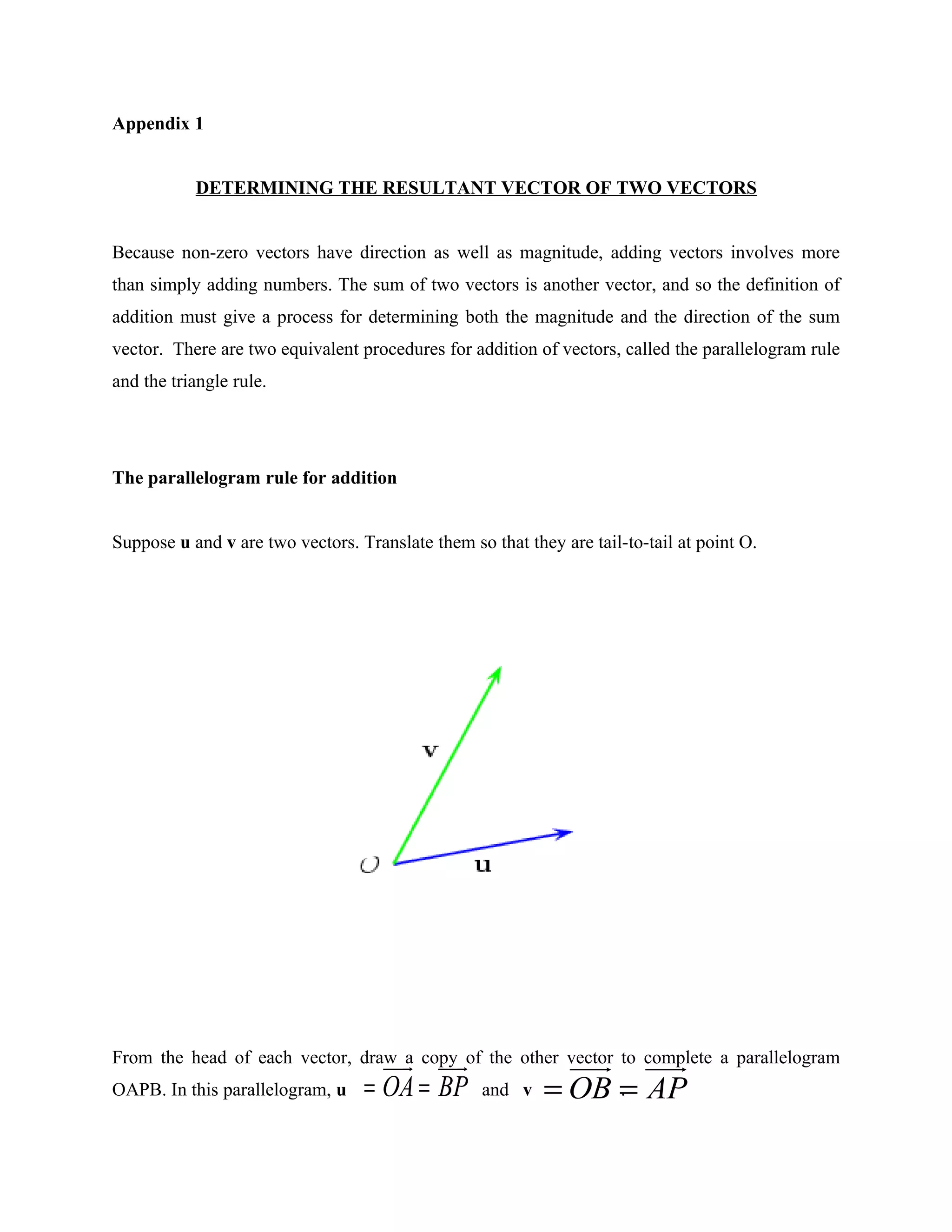
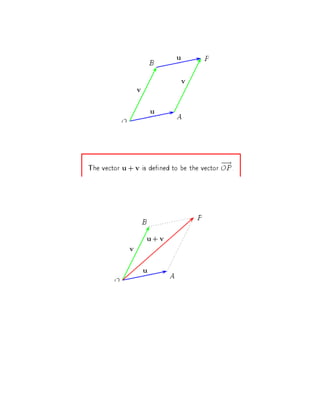
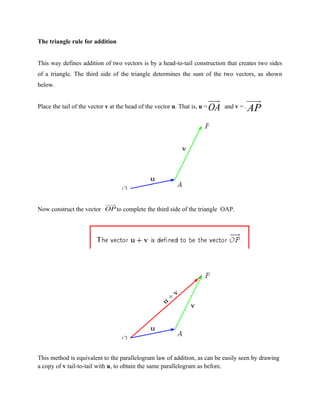
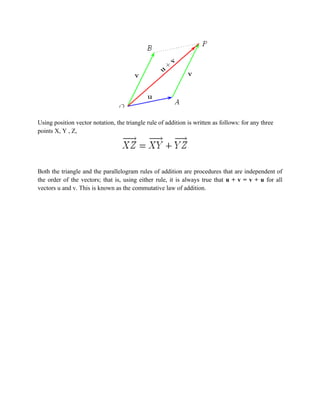
There are two methods for adding vectors: the parallelogram rule and the triangle rule. The parallelogram rule involves translating the vectors tail-to-tail to form the sides of a parallelogram, where the diagonal lines represent the sum vector. The triangle rule places the tail of one vector at the head of the other to form a triangle, where the third side of the triangle is the sum vector. Both methods are equivalent and result in the sum vector having the same magnitude and direction regardless of the order of the original vectors.



![Vector[1]](https://cdn.slidesharecdn.com/ss_thumbnails/vector1-120618011208-phpapp02-thumbnail.jpg?width=640&height=640&fit=bounds)


