Three coplanar parallel forces
Conditions of equilibrium of three coplanar parallel
forces
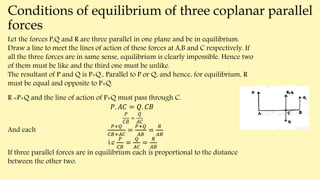
Let the forces P,Q and R are three parallel in one plane and be in equilibrium.
Draw a line to meet the lines of action of these forces at A,B and C respectively. If
all the three forces are in same sense, equilibrium is clearly impossible. Hence two
of them must be like and the third one must be unlike.
The resultant of P and Q is P+Q., Parallel to P or Q, and hence, for equilibrium, R
must be equal and opposite to P+Q.
R =P+Q and the line of action of P+Q must pass through C.
𝑃. 𝐴𝐶 = 𝑄. 𝐶𝐵
𝑃
𝐶𝐵
=
𝑄
𝐴𝐶
And each
𝑃+𝑄
𝐶𝐵+𝐴𝐶
=
𝑃+𝑄
𝐴𝐵
=
𝑅
𝐴𝐵
i.e
𝑃
𝐶𝐵
=
𝑄
𝐴𝐶
=
𝑅
𝐴𝐵
If three parallel forces are in equilibrium each is proportional to the distance
between the other two.
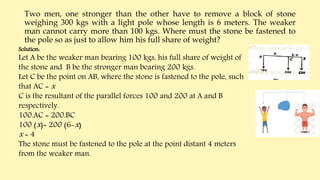
Two men, one stronger than the other have to remove a block of stone
weighing 300 kgs with a light pole whose length is 6 meters. The weaker
man cannot carry more than 100 kgs. Where must the stone be fastened to
the pole so as just to allow him his full share of weight?
Solution:
Let A be the weaker man bearing 100 kgs, his full share of weight of
the stone and B be the stronger man bearing 200 kgs.
Let C be the point on AB, where the stone is fastened to the pole, such
that AC = x
C is the resultant of the parallel forces 100 and 200 at A and B
respectively.
100.AC = 200.BC
100 (x)= 200 (6-x)
x = 4
The stone must be fastened to the pole at the point distant 4 meters
from the weaker man.
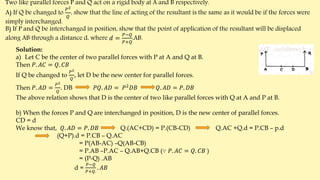
Two like parallel forces P and Q act on a rigid body at A and B respectively.
A) If Q be changed to
𝑃2
𝑄
, show that the line of acting of the resultant is the same as it would be if the forces were
simply interchanged.
B) If P and Q be interchanged in position, show that the point of application of the resultant will be displaced
along AB through a distance d, where 𝑑 =
𝑃−𝑄
𝑃+𝑄
.AB.
Solution:
a) Let C be the center of two parallel forces with P at A and Q at B.
Then 𝑃. 𝐴𝐶 = 𝑄. 𝐶𝐵
If Q be changed to
𝑃2
𝑄
, let D be the new center for parallel forces.
Then 𝑃. 𝐴𝐷 =
𝑃2
𝑄
. DB 𝑃𝑄. 𝐴𝐷 = 𝑃2
𝐷𝐵 𝑄. 𝐴𝐷 = 𝑃. 𝐷𝐵
The above relation shows that D is the center of two like parallel forces with Q at A and P at B.
b) When the forces P and Q are interchanged in position, D is the new center of parallel forces.
CD = d
We know that, 𝑄. 𝐴𝐷 = 𝑃. 𝐷𝐵 Q.(AC+CD) = P.(CB-CD) Q.AC +Q.d = P.CB – p.d
(Q+P).d = P.CB – Q.AC
= P(AB-AC) –Q(AB-CB)
= P.AB –P.AC – Q.AB+Q.CB (∵ 𝑃. 𝐴𝐶 = 𝑄. 𝐶𝐵 )
= (P-Q) .AB
d =
𝑃−𝑄
𝑃+𝑄.
. 𝐴𝐵
Three like parallel forces, acting at the vertices of a triangle, have
magnitudes proportional to the opposite sides. Show that their
resultant passes through the incentre of the triangle.
Solution:
Let like parallel forces P,Q R act at A,B, C. It is given that
𝑃
𝑎
=
𝑄
𝑏
=
𝑅
𝑐
Let the resultant of Q and R meet BC at D.
We know that the magnitude of the resultant is Q+R.
Also
𝐵𝐷
𝐷𝐶
=
𝐹𝑜𝑟𝑐𝑒 𝑎𝑡 𝐶
𝐹𝑜𝑟𝑐𝑒 𝑎𝑡 𝐵
=
𝑅
𝑄
=
𝑐
𝑏
=
𝐴𝐵
𝐴𝐶
AD is the internal bisector of triangle A.
We have now to find the resultant of the two like parallel forces, Q+R at D and P
at A. Let this resultant meet AD at I.
Then
𝐴𝐼
𝐼𝐷
=
𝐹𝑜𝑟𝑐𝑒 𝑎𝑡 𝐷
𝐹𝑜𝑟𝑐𝑒 𝑎𝑡 𝐴
=
𝑄+𝑅
𝑃
=
𝑏+𝑐
𝑎
It is clear that I is the incentre of the triangle
[ if I is the incentre of triangle ABC and AD bisects angle A internally, we have
𝐴𝐼
𝐼𝐷
=
𝑏+𝑐
𝑎
]
THANKYOU

Three coplanar parallel forces

  • 1.
  • 2.
    Conditions of equilibriumof three coplanar parallel forces Let the forces P,Q and R are three parallel in one plane and be in equilibrium. Draw a line to meet the lines of action of these forces at A,B and C respectively. If all the three forces are in same sense, equilibrium is clearly impossible. Hence two of them must be like and the third one must be unlike. The resultant of P and Q is P+Q., Parallel to P or Q, and hence, for equilibrium, R must be equal and opposite to P+Q. R =P+Q and the line of action of P+Q must pass through C. 𝑃. 𝐴𝐶 = 𝑄. 𝐶𝐵 𝑃 𝐶𝐵 = 𝑄 𝐴𝐶 And each 𝑃+𝑄 𝐶𝐵+𝐴𝐶 = 𝑃+𝑄 𝐴𝐵 = 𝑅 𝐴𝐵 i.e 𝑃 𝐶𝐵 = 𝑄 𝐴𝐶 = 𝑅 𝐴𝐵 If three parallel forces are in equilibrium each is proportional to the distance between the other two.
  • 3.
    Two men, onestronger than the other have to remove a block of stone weighing 300 kgs with a light pole whose length is 6 meters. The weaker man cannot carry more than 100 kgs. Where must the stone be fastened to the pole so as just to allow him his full share of weight? Solution: Let A be the weaker man bearing 100 kgs, his full share of weight of the stone and B be the stronger man bearing 200 kgs. Let C be the point on AB, where the stone is fastened to the pole, such that AC = x C is the resultant of the parallel forces 100 and 200 at A and B respectively. 100.AC = 200.BC 100 (x)= 200 (6-x) x = 4 The stone must be fastened to the pole at the point distant 4 meters from the weaker man.
  • 4.
    Two like parallelforces P and Q act on a rigid body at A and B respectively. A) If Q be changed to 𝑃2 𝑄 , show that the line of acting of the resultant is the same as it would be if the forces were simply interchanged. B) If P and Q be interchanged in position, show that the point of application of the resultant will be displaced along AB through a distance d, where 𝑑 = 𝑃−𝑄 𝑃+𝑄 .AB. Solution: a) Let C be the center of two parallel forces with P at A and Q at B. Then 𝑃. 𝐴𝐶 = 𝑄. 𝐶𝐵 If Q be changed to 𝑃2 𝑄 , let D be the new center for parallel forces. Then 𝑃. 𝐴𝐷 = 𝑃2 𝑄 . DB 𝑃𝑄. 𝐴𝐷 = 𝑃2 𝐷𝐵 𝑄. 𝐴𝐷 = 𝑃. 𝐷𝐵 The above relation shows that D is the center of two like parallel forces with Q at A and P at B. b) When the forces P and Q are interchanged in position, D is the new center of parallel forces. CD = d We know that, 𝑄. 𝐴𝐷 = 𝑃. 𝐷𝐵 Q.(AC+CD) = P.(CB-CD) Q.AC +Q.d = P.CB – p.d (Q+P).d = P.CB – Q.AC = P(AB-AC) –Q(AB-CB) = P.AB –P.AC – Q.AB+Q.CB (∵ 𝑃. 𝐴𝐶 = 𝑄. 𝐶𝐵 ) = (P-Q) .AB d = 𝑃−𝑄 𝑃+𝑄. . 𝐴𝐵
  • 5.
    Three like parallelforces, acting at the vertices of a triangle, have magnitudes proportional to the opposite sides. Show that their resultant passes through the incentre of the triangle. Solution: Let like parallel forces P,Q R act at A,B, C. It is given that 𝑃 𝑎 = 𝑄 𝑏 = 𝑅 𝑐 Let the resultant of Q and R meet BC at D. We know that the magnitude of the resultant is Q+R. Also 𝐵𝐷 𝐷𝐶 = 𝐹𝑜𝑟𝑐𝑒 𝑎𝑡 𝐶 𝐹𝑜𝑟𝑐𝑒 𝑎𝑡 𝐵 = 𝑅 𝑄 = 𝑐 𝑏 = 𝐴𝐵 𝐴𝐶 AD is the internal bisector of triangle A. We have now to find the resultant of the two like parallel forces, Q+R at D and P at A. Let this resultant meet AD at I. Then 𝐴𝐼 𝐼𝐷 = 𝐹𝑜𝑟𝑐𝑒 𝑎𝑡 𝐷 𝐹𝑜𝑟𝑐𝑒 𝑎𝑡 𝐴 = 𝑄+𝑅 𝑃 = 𝑏+𝑐 𝑎 It is clear that I is the incentre of the triangle [ if I is the incentre of triangle ABC and AD bisects angle A internally, we have 𝐴𝐼 𝐼𝐷 = 𝑏+𝑐 𝑎 ]
  • 6.