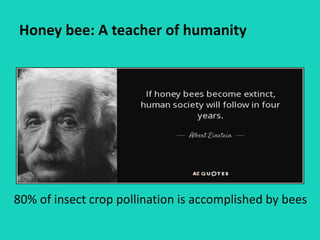
Honey bee: A teacher of humanity
80% of insect crop pollination is accomplished by bees
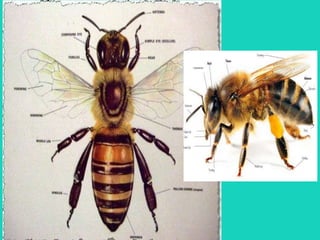
• Chewing and lapping type of mouth part:
• Antenna: Geniculate type(Elbow like)
• Type of wings: Membranous
• (Hymenoptera, Hymen+ membrane, ptera=
wings)
• Types of legs: Pollen collecting (Pollen basket
and pollen comb)
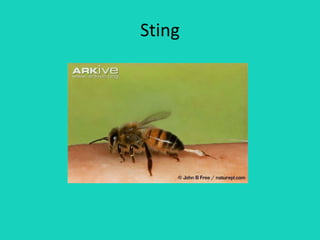
• Sting= modified ovipositor (Ovi= ova= eggs,
positor= depositor)
• Metamorphosis= Complete metamorphosis
• Egg- Young ones(Larva- grub)- Pupa- Adult
• Bee is a social insect
Different species of bees:
1. The rock bee
2. The little bee
3. The Indian bee
4. The European bee/ Italian bee- Prof. Atwal
5. The Dammer bee/ Stingless bee
6. The Himalayan bee
Species of honey bee
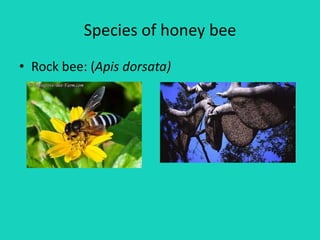
• Rock bee: (Apis dorsata)
• 1. Size: Largest species of the honey bees
• 2. No. of comb- It builds single comb (Size of
the comb- 6 ft long and 3 ft deep)
• 3. Honey collection capacity: 37 kg/ year/
colony
• 4. It is undomesticated (wild) species
• 5. Behaviour- ferocious and irritable, typical
type of hive (comb), habit of deserting the
hives often.
• 6. Place- Generally construct hive on the
branches of trees, along sides of steep rocks
and wall/ other parts of building.
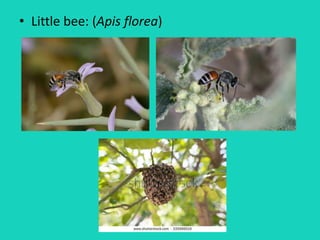
• Little bee: (Apis florea)
• 1. Size-
• 2. No of comb/s:
• 3. Honey collection capacity: 0.5 kg/ year/
colony
• 4. Undomesticated species
• 5. Behaviour: calm, frequently change their
places
• 6. Place: branches of bushes, hedges, caves,
empty cases etc.
• Indian bee: (Apis indica/ A. cerana indica)
• 1. Size:
• 2. No. of comb/s- constructs many parallel
combs
• 3. 5 kg/year/ colony
• Domesticated
• They are more prone to swarming and
absconding
• Builds combs on trees and cavities in darkness.
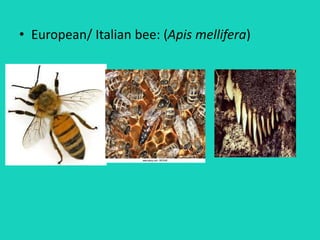
• European/ Italian bee: (Apis mellifera)
• Size-
• No. of comb/s
• Honey collection capacity: 45- 180 Kg/ year/
col.
• Domesticated
• Behaviour- Swarm less,
• Good honey gathering capacity, suitable for
Indian climatic conditions
• Places- cavities
• Stingless bee/ Dammer bee (Trigona iridipennis):
• Size- it is different from the four species of
bees in appearance and habits.
• It is tiny with vestigial sting
• The comb is made up of a dark material
known as cerumen (it is a mixture of wax and
earth / resin)
• Very honey gathering capacity (100 grams/
year/ col.)
• Domesticated
• Honey is useful in ayurvedic medicines.
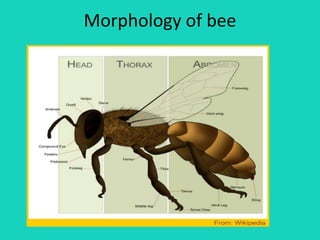
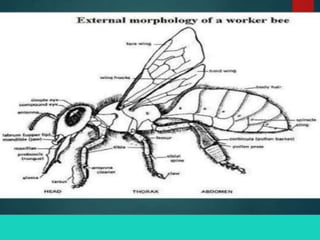
Morphology of bee
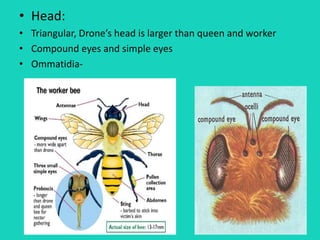
• Head:
• Triangular, Drone’s head is larger than queen and worker
• Compound eyes and simple eyes
• Ommatidia-
• No. of ommatidia-
• Queen- 4000
• Worker- 5000
• Drone - 8000
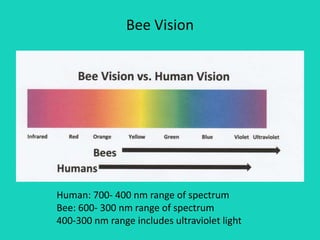
Bee Vision
Human: 700- 400 nm range of spectrum
Bee: 600- 300 nm range of spectrum
400-300 nm range includes ultraviolet light
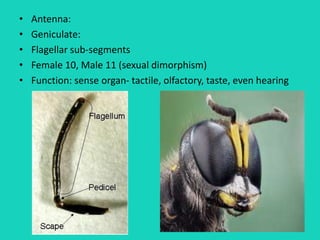
• Antenna:
• Geniculate:
• Flagellar sub-segments
• Female 10, Male 11 (sexual dimorphism)
• Function: sense organ- tactile, olfactory, taste, even hearing
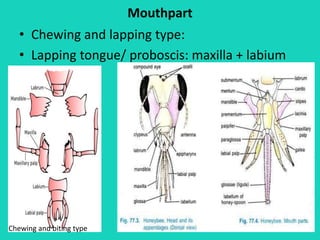
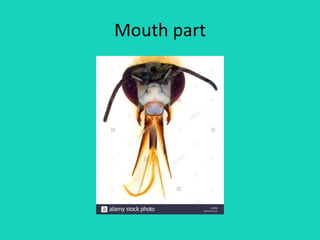
Mouthpart
• Chewing and lapping type:
• Lapping tongue/ proboscis: maxilla + labium
Chewing and biting type
• Labrum- flap like-
• Mandibles- broad at the base and apex and
narrowed in the middle, covered with hairs
• Maxillae (Paired structure)
• Labium
Maxillo – labial complex/
lapping tongue
Temporary feed canal: glossa, labial palpi and
galea
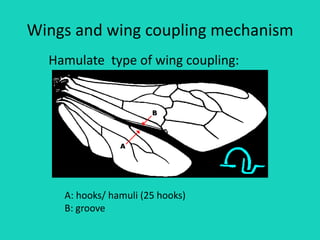
Wings and wing coupling mechanism
A: hooks/ hamuli (25 hooks)
B: groove
Hamulate type of wing coupling:
• Fore wings- mesothorax
• Hind wings- metathorax
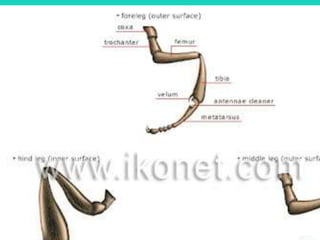
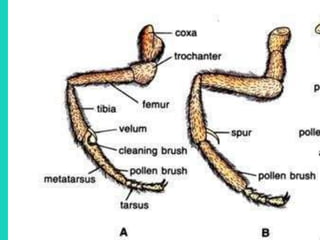
Leg
• Wax Glands: 4 pairs of wax gland- ventral side
of abdomen.
• 4-7th abdominal segments
• Oval polished area separated by a median
space called as wax plates/ was mirror
• Wax is removed by hind basitarsus then it is
taken off by mandibles.
• Sting: modified ovipositor supplied with
poison.
• INSTRUMENT OF DEFENCE.
• Stings are associated with accessory glands
found in female and these accessory glands
are modified for the secretion of venom.
Internal Anatomy
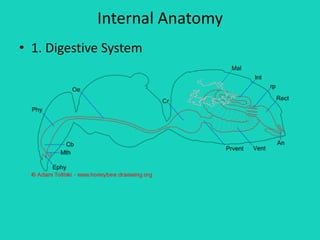
• 1. Digestive System
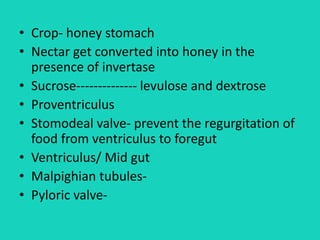
• Crop- honey stomach
• Nectar get converted into honey in the
presence of invertase
• Sucrose-------------- levulose and dextrose
• Proventriculus
• Stomodeal valve- prevent the regurgitation of
food from ventriculus to foregut
• Ventriculus/ Mid gut
• Malpighian tubules-
• Pyloric valve-
• Salivary glands-
• Two pairs
• Cephalic salivary gland- head region
• Thoracic salivary gland
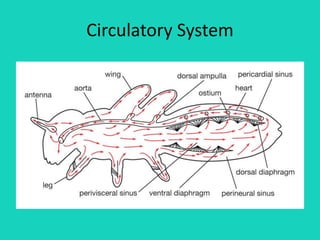
Circulatory System
Respiratory system
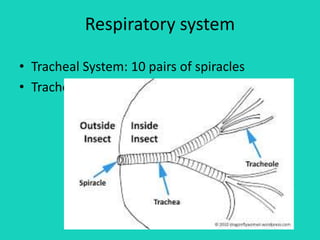
• Tracheal System: 10 pairs of spiracles
• Trachea- Spiracle
• Nervous system:
• Central nervous system- Brain
• Ganglia-
• Nerve-
• Neuron-
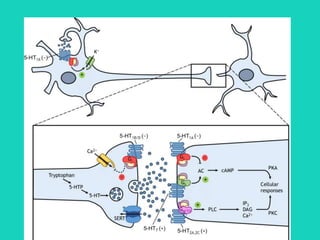
• Synapse-
• Reproductive System:
• Female reproductive system- 8-9 seg. Of
abdomen
• Male reproductive system- 9th ab. Segment
• Spermatheca-
• Excretory system:
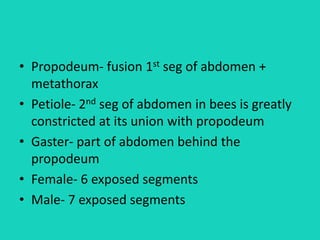
• Propodeum- fusion 1st seg of abdomen +
metathorax
• Petiole- 2nd seg of abdomen in bees is greatly
constricted at its union with propodeum
• Gaster- part of abdomen behind the
propodeum
• Female- 6 exposed segments
• Male- 7 exposed segments
• Mandibular glands- paired structure
• Position- at the base of mandibles
• Outlets communicate with a groove and
channel in mandibles
• Function- secretion is supposed to be used for
softening of wax.
• Lateral Pharyngeal gland-
• Position- head region
• Function- production of royal jelly/ bee milk
• Feeder bees-
• Well developed in worker, vestigial in queen
and absent in drone
Foraging
• Act of collection of pollen, nectar, propolis and
water by outdoor bees.
• Forager bees/ Foraging bees-
• 6.30- 8.00 am
• Scout bees/ searcher bee- the bees that go
out first to find out the new source of nectar,
pollen etc.
• Reticent bees- 50- 90%
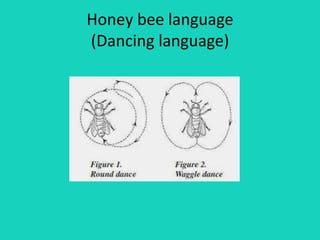
• Dancing language of bees-
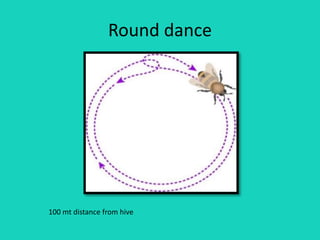
Round dance
100 mt distance from hive
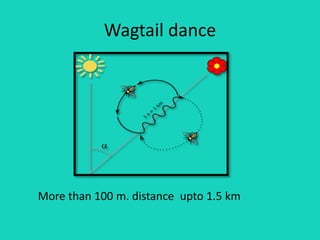
Wagtail dance
More than 100 m. distance upto 1.5 km
• Scent gland- 5-6 abdominal segment
• Temperature range for foraging- 25-27 0C
• 35% of its body weight
• 6000 trips for collection of 500- 1000 mg of
pollen
• Karl von Frisch- Nobel prize - 1973
Evolution of social life
1. Single queen
2. Work for the mutual benefit of other
3. Hive mind/ Hive odour
4. Storage of food
5. Coordination of activities
6. Trophallaxis
Honey flow season-
Honey bee colony
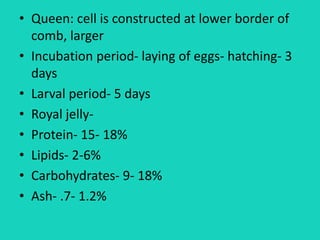
• Queen: cell is constructed at lower border of
comb, larger
• Incubation period- laying of eggs- hatching- 3
days
• Larval period- 5 days
• Royal jelly-
• Protein- 15- 18%
• Lipids- 2-6%
• Carbohydrates- 9- 18%
• Ash- .7- 1.2%
Life history/ Biology of bees:
• Fertilized eggs- female – queen and worker
• Unfertilized eggs- male- drone
• Spermatheca- function is to store sperm in
viable condition
• Pupal stage- 7 days
• Adult stage- 2-3 years
Functions of queen-
Pheromone:
Ectodermal control:
• Workers:
• Sterile female
• Cells- situated at lower border of comb
• Hexagonal cells are covered with flat cap
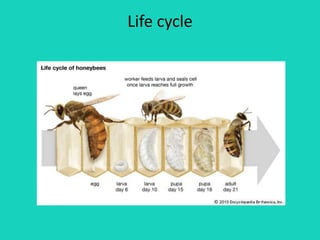
• Life cycle
• Incubation period- 3 days
• Larval period- 4 days
• (1ST DAY- ROYAL JELLY)
• (Remaining three days- bee bread)
• Bee bread- mixture honey and partially
digested pollen
• Pupation- 11- 12 days
• Adult- 6- 9 weeks
• Functions-
• Maintaining the hive temp- 33- 36 0c- By
nurse bee and older bees
• Drones: functional males
• Unfertilized eggs
• Drone cells (larva) are covered with convex
cap with central hole.
• INCUBATION FPERIOD: 3 DAYS
• Larval period- 7 days
• (First 3 days- royal jelly, remaining 4 days- bee
bread)
• Pupation- 13 days
• Adult- 60 days
• Functions-
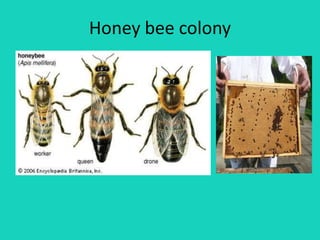
• Colony of bee is consist of three different castes-
• Queen (Functional female)
• Worker (Sterile female/ imperfectly developed
female)
• Drone (Functional male)
• Average size- it consist of 20,000- 30,000
members
• Queen-1
• Drones- few hundred
• Worker- 90% of population
QUEEN BEE
• Queen cells are formed
during Jan-Feb.
• Larva excessively fed on
royal jelly becomes the
queen.
• Queen survives for 2-3
years.
QUEEN BEE
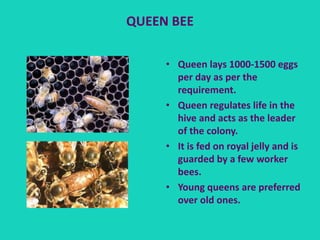
• Queen lays 1000-1500 eggs
per day as per the
requirement.
• Queen regulates life in the
hive and acts as the leader
of the colony.
• It is fed on royal jelly and is
guarded by a few worker
bees.
• Young queens are preferred
over old ones.
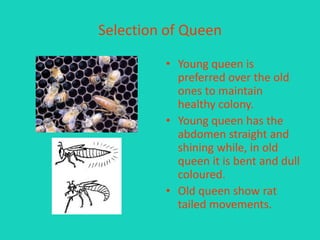
Selection of Queen
• Young queen is
preferred over the old
ones to maintain
healthy colony.
• Young queen has the
abdomen straight and
shining while, in old
queen it is bent and dull
coloured.
• Old queen show rat
tailed movements.
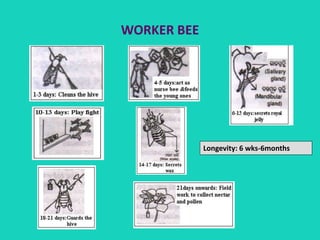
WORKER BEE
Longevity: 6 wks-6months
• Life span- 6 weeks
• First 3 weeks- indoor duties- workers are
called as indoor workers
• Second 3 weeks- Outdoor duties- workers are
called as outdoor workers- Foraging
• Foraging- act of collection nectar, pollen,
water and propolis by outdoor bees/ foraging
bees.
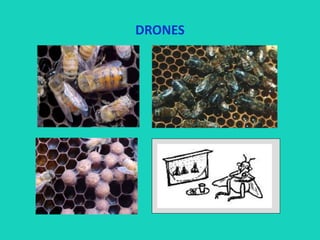
DRONES
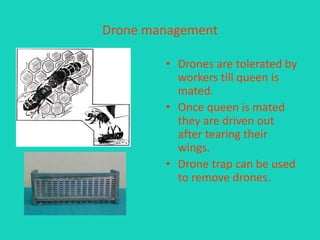
Drone management
• Drones are tolerated by
workers till queen is
mated.
• Once queen is mated
they are driven out
after tearing their
wings.
• Drone trap can be used
to remove drones.
Life cycle
Mouth part
Sting
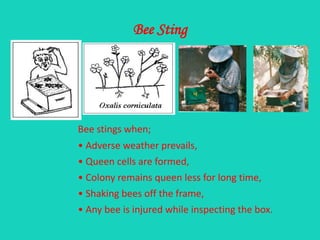
Bee Sting
Bee stings when;
• Adverse weather prevails,
• Queen cells are formed,
• Colony remains queen less for long time,
• Shaking bees off the frame,
• Any bee is injured while inspecting the box.
Honey bee language
(Dancing language)
Apiculture
• Apiary:
• History:
• Sushrutha Samhita- about medicinal importance
of honey
• “ MY SON, EAT THOU HONEY BECAUSE IT IS
GOOD AND THE HONEY COMB BECAUSE IT IS
SWEET A TO THE TASTE”
• Bee – tea:
• Honey – tea:
• Migratory beekeeping: Egypt
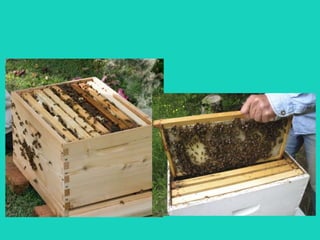
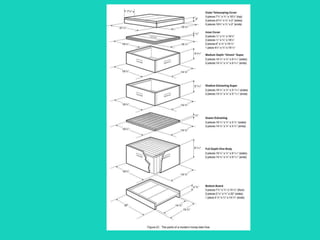
• Boxes :
• Bee space: it is the space between two frames
for bees to move about conveniently between
the frames and it is too small to encourage
bees for building the comb.
• Langstroth: 1851-
• 0.63 cm- A. indica
• 0.79 cm A. mellifera
• Movable frames:
• Pot hive:
• Fr. Newton: 1919:
• 1875- First World War- Golden ag of bee
keeping
Bee hive
• Brood:
Thank you

Honey Bee Ppt.pptx

  • 1.
    Honey bee: Ateacher of humanity 80% of insect crop pollination is accomplished by bees
  • 3.
    • Chewing andlapping type of mouth part: • Antenna: Geniculate type(Elbow like) • Type of wings: Membranous • (Hymenoptera, Hymen+ membrane, ptera= wings) • Types of legs: Pollen collecting (Pollen basket and pollen comb) • Sting= modified ovipositor (Ovi= ova= eggs, positor= depositor) • Metamorphosis= Complete metamorphosis • Egg- Young ones(Larva- grub)- Pupa- Adult • Bee is a social insect
  • 5.
    Different species ofbees: 1. The rock bee 2. The little bee 3. The Indian bee 4. The European bee/ Italian bee- Prof. Atwal 5. The Dammer bee/ Stingless bee 6. The Himalayan bee
  • 6.
    Species of honeybee • Rock bee: (Apis dorsata)
  • 7.
    • 1. Size:Largest species of the honey bees • 2. No. of comb- It builds single comb (Size of the comb- 6 ft long and 3 ft deep) • 3. Honey collection capacity: 37 kg/ year/ colony • 4. It is undomesticated (wild) species • 5. Behaviour- ferocious and irritable, typical type of hive (comb), habit of deserting the hives often. • 6. Place- Generally construct hive on the branches of trees, along sides of steep rocks and wall/ other parts of building.
  • 8.
    • Little bee:(Apis florea)
  • 9.
    • 1. Size- •2. No of comb/s: • 3. Honey collection capacity: 0.5 kg/ year/ colony • 4. Undomesticated species • 5. Behaviour: calm, frequently change their places • 6. Place: branches of bushes, hedges, caves, empty cases etc.
  • 10.
    • Indian bee:(Apis indica/ A. cerana indica)
  • 11.
    • 1. Size: •2. No. of comb/s- constructs many parallel combs • 3. 5 kg/year/ colony • Domesticated • They are more prone to swarming and absconding • Builds combs on trees and cavities in darkness.
  • 12.
    • European/ Italianbee: (Apis mellifera)
  • 13.
    • Size- • No.of comb/s • Honey collection capacity: 45- 180 Kg/ year/ col. • Domesticated • Behaviour- Swarm less, • Good honey gathering capacity, suitable for Indian climatic conditions • Places- cavities
  • 14.
    • Stingless bee/Dammer bee (Trigona iridipennis):
  • 15.
    • Size- itis different from the four species of bees in appearance and habits. • It is tiny with vestigial sting • The comb is made up of a dark material known as cerumen (it is a mixture of wax and earth / resin) • Very honey gathering capacity (100 grams/ year/ col.) • Domesticated • Honey is useful in ayurvedic medicines.
  • 16.
  • 17.
    • Head: • Triangular,Drone’s head is larger than queen and worker • Compound eyes and simple eyes • Ommatidia-
  • 18.
    • No. ofommatidia- • Queen- 4000 • Worker- 5000 • Drone - 8000
  • 19.
    Bee Vision Human: 700-400 nm range of spectrum Bee: 600- 300 nm range of spectrum 400-300 nm range includes ultraviolet light
  • 20.
    • Antenna: • Geniculate: •Flagellar sub-segments • Female 10, Male 11 (sexual dimorphism) • Function: sense organ- tactile, olfactory, taste, even hearing
  • 21.
    Mouthpart • Chewing andlapping type: • Lapping tongue/ proboscis: maxilla + labium Chewing and biting type
  • 22.
    • Labrum- flaplike- • Mandibles- broad at the base and apex and narrowed in the middle, covered with hairs • Maxillae (Paired structure) • Labium Maxillo – labial complex/ lapping tongue Temporary feed canal: glossa, labial palpi and galea
  • 23.
    Wings and wingcoupling mechanism A: hooks/ hamuli (25 hooks) B: groove Hamulate type of wing coupling:
  • 24.
    • Fore wings-mesothorax • Hind wings- metathorax
  • 25.
  • 28.
    • Wax Glands:4 pairs of wax gland- ventral side of abdomen. • 4-7th abdominal segments • Oval polished area separated by a median space called as wax plates/ was mirror • Wax is removed by hind basitarsus then it is taken off by mandibles.
  • 29.
    • Sting: modifiedovipositor supplied with poison. • INSTRUMENT OF DEFENCE. • Stings are associated with accessory glands found in female and these accessory glands are modified for the secretion of venom.
  • 30.
    Internal Anatomy • 1.Digestive System
  • 32.
    • Crop- honeystomach • Nectar get converted into honey in the presence of invertase • Sucrose-------------- levulose and dextrose • Proventriculus • Stomodeal valve- prevent the regurgitation of food from ventriculus to foregut • Ventriculus/ Mid gut • Malpighian tubules- • Pyloric valve-
  • 33.
    • Salivary glands- •Two pairs • Cephalic salivary gland- head region • Thoracic salivary gland
  • 34.
  • 35.
    Respiratory system • TrachealSystem: 10 pairs of spiracles • Trachea- Spiracle
  • 36.
    • Nervous system: •Central nervous system- Brain • Ganglia- • Nerve- • Neuron- • Synapse-
  • 38.
    • Reproductive System: •Female reproductive system- 8-9 seg. Of abdomen • Male reproductive system- 9th ab. Segment • Spermatheca- • Excretory system:
  • 40.
    • Propodeum- fusion1st seg of abdomen + metathorax • Petiole- 2nd seg of abdomen in bees is greatly constricted at its union with propodeum • Gaster- part of abdomen behind the propodeum • Female- 6 exposed segments • Male- 7 exposed segments
  • 41.
    • Mandibular glands-paired structure • Position- at the base of mandibles • Outlets communicate with a groove and channel in mandibles • Function- secretion is supposed to be used for softening of wax.
  • 42.
    • Lateral Pharyngealgland- • Position- head region • Function- production of royal jelly/ bee milk • Feeder bees- • Well developed in worker, vestigial in queen and absent in drone
  • 43.
    Foraging • Act ofcollection of pollen, nectar, propolis and water by outdoor bees. • Forager bees/ Foraging bees- • 6.30- 8.00 am • Scout bees/ searcher bee- the bees that go out first to find out the new source of nectar, pollen etc. • Reticent bees- 50- 90% • Dancing language of bees-
  • 44.
    Round dance 100 mtdistance from hive
  • 45.
    Wagtail dance More than100 m. distance upto 1.5 km
  • 46.
    • Scent gland-5-6 abdominal segment • Temperature range for foraging- 25-27 0C • 35% of its body weight • 6000 trips for collection of 500- 1000 mg of pollen • Karl von Frisch- Nobel prize - 1973
  • 47.
    Evolution of sociallife 1. Single queen 2. Work for the mutual benefit of other 3. Hive mind/ Hive odour 4. Storage of food 5. Coordination of activities 6. Trophallaxis Honey flow season-
  • 48.
  • 49.
    • Queen: cellis constructed at lower border of comb, larger • Incubation period- laying of eggs- hatching- 3 days • Larval period- 5 days • Royal jelly- • Protein- 15- 18% • Lipids- 2-6% • Carbohydrates- 9- 18% • Ash- .7- 1.2%
  • 50.
    Life history/ Biologyof bees: • Fertilized eggs- female – queen and worker • Unfertilized eggs- male- drone • Spermatheca- function is to store sperm in viable condition
  • 51.
    • Pupal stage-7 days • Adult stage- 2-3 years Functions of queen- Pheromone: Ectodermal control:
  • 52.
    • Workers: • Sterilefemale • Cells- situated at lower border of comb • Hexagonal cells are covered with flat cap • Life cycle • Incubation period- 3 days • Larval period- 4 days • (1ST DAY- ROYAL JELLY) • (Remaining three days- bee bread) • Bee bread- mixture honey and partially digested pollen
  • 53.
    • Pupation- 11-12 days • Adult- 6- 9 weeks • Functions- • Maintaining the hive temp- 33- 36 0c- By nurse bee and older bees
  • 54.
    • Drones: functionalmales • Unfertilized eggs • Drone cells (larva) are covered with convex cap with central hole. • INCUBATION FPERIOD: 3 DAYS • Larval period- 7 days • (First 3 days- royal jelly, remaining 4 days- bee bread) • Pupation- 13 days • Adult- 60 days • Functions-
  • 55.
    • Colony ofbee is consist of three different castes- • Queen (Functional female) • Worker (Sterile female/ imperfectly developed female) • Drone (Functional male) • Average size- it consist of 20,000- 30,000 members • Queen-1 • Drones- few hundred • Worker- 90% of population
  • 56.
    QUEEN BEE • Queencells are formed during Jan-Feb. • Larva excessively fed on royal jelly becomes the queen. • Queen survives for 2-3 years.
  • 57.
    QUEEN BEE • Queenlays 1000-1500 eggs per day as per the requirement. • Queen regulates life in the hive and acts as the leader of the colony. • It is fed on royal jelly and is guarded by a few worker bees. • Young queens are preferred over old ones.
  • 58.
    Selection of Queen •Young queen is preferred over the old ones to maintain healthy colony. • Young queen has the abdomen straight and shining while, in old queen it is bent and dull coloured. • Old queen show rat tailed movements.
  • 59.
  • 60.
    • Life span-6 weeks • First 3 weeks- indoor duties- workers are called as indoor workers • Second 3 weeks- Outdoor duties- workers are called as outdoor workers- Foraging • Foraging- act of collection nectar, pollen, water and propolis by outdoor bees/ foraging bees.
  • 61.
  • 62.
    Drone management • Dronesare tolerated by workers till queen is mated. • Once queen is mated they are driven out after tearing their wings. • Drone trap can be used to remove drones.
  • 63.
  • 64.
  • 65.
  • 66.
    Bee Sting Bee stingswhen; • Adverse weather prevails, • Queen cells are formed, • Colony remains queen less for long time, • Shaking bees off the frame, • Any bee is injured while inspecting the box.
  • 67.
  • 68.
    Apiculture • Apiary: • History: •Sushrutha Samhita- about medicinal importance of honey • “ MY SON, EAT THOU HONEY BECAUSE IT IS GOOD AND THE HONEY COMB BECAUSE IT IS SWEET A TO THE TASTE” • Bee – tea: • Honey – tea:
  • 69.
    • Migratory beekeeping:Egypt • Boxes : • Bee space: it is the space between two frames for bees to move about conveniently between the frames and it is too small to encourage bees for building the comb. • Langstroth: 1851- • 0.63 cm- A. indica • 0.79 cm A. mellifera • Movable frames:


  • 70.
    • Pot hive: •Fr. Newton: 1919: • 1875- First World War- Golden ag of bee keeping
  • 71.
  • 72.
  • 75.