Dr. Peteti Sairam,
MPT (Neuro)
Asst. professor
 In the year 1952 ‘Dr. VIRGINIA APGAR’ created the system
and used her name as a mnemonic for each of the five
categories that a person will score.
 The Apgar score is a scoring system medical professionals use
to assess newborns one minute and five minutes after they’re
born.
 Medical professionals use this score to quickly relay the status
of a newborn’s overall condition. Low Apgar scores may
indicate the baby needs special care, such as extra help with
their breathing.
 The Apgar scoring system is divided into 5 categories.
 Each category receives a score of 0 to 2 points.
 A child will receive an overall score of 10. However, a baby rarely
scores a 10 in the first few moments of life.
 This is because most babies have blue hands or feet immediately
after birth.
 0 points: If muscles are loose and floppy.
 1 point: If there is some muscle tone (limbs flexed).
 2 points: If there is active motion.
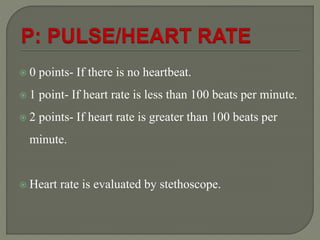
 0 points- If there is no heartbeat.
 1 point- If heart rate is less than 100 beats per minute.
 2 points- If heart rate is greater than 100 beats per
minute.
 Heart rate is evaluated by stethoscope.
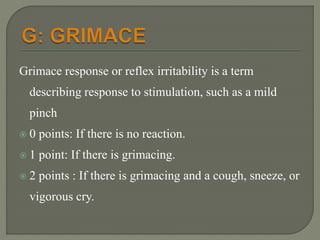
Grimace response or reflex irritability is a term
describing response to stimulation, such as a mild
pinch
 0 points: If there is no reaction.
 1 point: If there is grimacing.
 2 points : If there is grimacing and a cough, sneeze, or
vigorous cry.
 0 points- If the skin color is blue, bluish-gray, or pale
all over.
 1 point- If the body is pink and the extremities are
blue.
 2 points- If the entire body is pink.
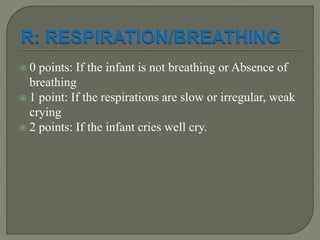
 0 points: If the infant is not breathing or Absence of
breathing
 1 point: If the respirations are slow or irregular, weak
crying
 2 points: If the infant cries well cry.
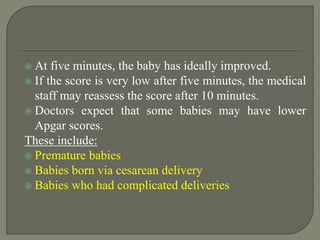
 At five minutes, the baby has ideally improved.
 If the score is very low after five minutes, the medical
staff may reassess the score after 10 minutes.
 Doctors expect that some babies may have lower
Apgar scores.
These include:
 Premature babies
 Babies born via cesarean delivery
 Babies who had complicated deliveries
APGAR SCORE

APGAR SCORE

  • 1.
    Dr. Peteti Sairam, MPT(Neuro) Asst. professor
  • 2.
     In theyear 1952 ‘Dr. VIRGINIA APGAR’ created the system and used her name as a mnemonic for each of the five categories that a person will score.  The Apgar score is a scoring system medical professionals use to assess newborns one minute and five minutes after they’re born.  Medical professionals use this score to quickly relay the status of a newborn’s overall condition. Low Apgar scores may indicate the baby needs special care, such as extra help with their breathing.
  • 3.
     The Apgarscoring system is divided into 5 categories.  Each category receives a score of 0 to 2 points.  A child will receive an overall score of 10. However, a baby rarely scores a 10 in the first few moments of life.  This is because most babies have blue hands or feet immediately after birth.
  • 4.
     0 points:If muscles are loose and floppy.  1 point: If there is some muscle tone (limbs flexed).  2 points: If there is active motion.
  • 5.
     0 points-If there is no heartbeat.  1 point- If heart rate is less than 100 beats per minute.  2 points- If heart rate is greater than 100 beats per minute.  Heart rate is evaluated by stethoscope.
  • 6.
    Grimace response orreflex irritability is a term describing response to stimulation, such as a mild pinch  0 points: If there is no reaction.  1 point: If there is grimacing.  2 points : If there is grimacing and a cough, sneeze, or vigorous cry.
  • 7.
     0 points-If the skin color is blue, bluish-gray, or pale all over.  1 point- If the body is pink and the extremities are blue.  2 points- If the entire body is pink.
  • 8.
     0 points:If the infant is not breathing or Absence of breathing  1 point: If the respirations are slow or irregular, weak crying  2 points: If the infant cries well cry.
  • 9.
     At fiveminutes, the baby has ideally improved.  If the score is very low after five minutes, the medical staff may reassess the score after 10 minutes.  Doctors expect that some babies may have lower Apgar scores. These include:  Premature babies  Babies born via cesarean delivery  Babies who had complicated deliveries