Screening,
Identification, and
Assessment
Screening,
Identification, and
Assessment
Assessment and Evaluation in early
childhood education are conducted for at
least four different purposes, with specific
tools for each.
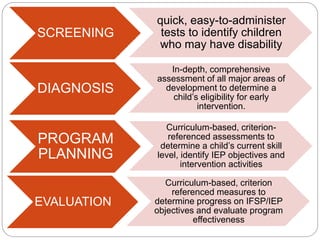
SCREENING
quick, easy-to-administer
tests to identify children
who may have disability
DIAGNOSIS
In-depth, comprehensive
assessment of all major areas of
development to determine a
child’s eligibility for early
intervention.
PROGRAM
PLANNING
Curriculum-based, criterion-
referenced assessments to
determine a child’s current skill
level, identify IEP objectives and
intervention activities
EVALUATION
Curriculum-based, criterion
referenced measures to
determine progress on IFSP/IEP
objectives and evaluate program
effectiveness
• The purpose of screening is to detect
potentially fatal or disabling conditions in
newborns as early as possible, often before the
infant displays any signs or symptoms of a
disease or condition.
Why is it important?
• Some children’s disability are so significant that
no test is needed. The more severe a disability,
the earlier it is detected.
Can we detect disability at an early
age?
Where do screening takes place?
• Most children who experience developmental
delays are not identifiable by obvious physical
characteristics or behavioral patterns,
especially at a very young stages.
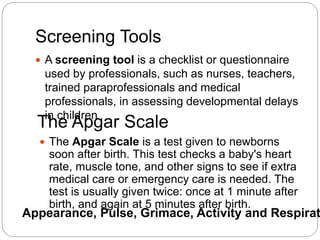
Screening Tools
 A screening tool is a checklist or questionnaire
used by professionals, such as nurses, teachers,
trained paraprofessionals and medical
professionals, in assessing developmental delays
in children
The Apgar Scale
 The Apgar Scale is a test given to newborns
soon after birth. This test checks a baby's heart
rate, muscle tone, and other signs to see if extra
medical care or emergency care is needed. The
test is usually given twice: once at 1 minute after
birth, and again at 5 minutes after birth.
Appearance, Pulse, Grimace, Activity and Respirat
The Apgar Scale
 Virginia Apgar (June 7, 1909 – August 7,
1974) was an American obstetrical
anesthesiologist, best known as the
inventor of the Apgar Score, a way to
quickly assess the health of a newborn
child immediately after birth.
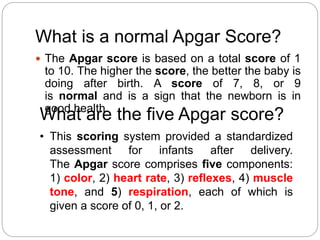
What is a normal Apgar Score?
 The Apgar score is based on a total score of 1
to 10. The higher the score, the better the baby is
doing after birth. A score of 7, 8, or 9
is normal and is a sign that the newborn is in
good health
What are the five Apgar score?
• This scoring system provided a standardized
assessment for infants after delivery.
The Apgar score comprises five components:
1) color, 2) heart rate, 3) reflexes, 4) muscle
tone, and 5) respiration, each of which is
given a score of 0, 1, or 2.
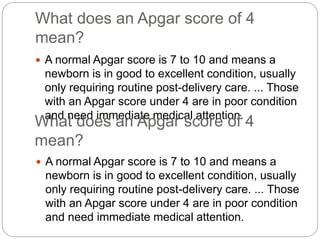
What does an Apgar score of 4
mean?
 A normal Apgar score is 7 to 10 and means a
newborn is in good to excellent condition, usually
only requiring routine post-delivery care. ... Those
with an Apgar score under 4 are in poor condition
and need immediate medical attention.
What does an Apgar score of 4
mean?
 A normal Apgar score is 7 to 10 and means a
newborn is in good to excellent condition, usually
only requiring routine post-delivery care. ... Those
with an Apgar score under 4 are in poor condition
and need immediate medical attention.
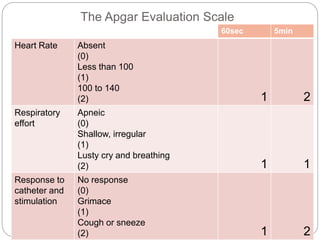
The Apgar Evaluation Scale
60sec 5min
Heart Rate Absent
(0)
Less than 100
(1)
100 to 140
(2) 1 2
Respiratory
effort
Apneic
(0)
Shallow, irregular
(1)
Lusty cry and breathing
(2) 1 1
Response to
catheter and
stimulation
No response
(0)
Grimace
(1)
Cough or sneeze
(2) 1 2

Screening, Identification, and Assessment.pptx

  • 1.
  • 2.
    Screening, Identification, and Assessment Assessment andEvaluation in early childhood education are conducted for at least four different purposes, with specific tools for each.
  • 3.
    SCREENING quick, easy-to-administer tests toidentify children who may have disability DIAGNOSIS In-depth, comprehensive assessment of all major areas of development to determine a child’s eligibility for early intervention. PROGRAM PLANNING Curriculum-based, criterion- referenced assessments to determine a child’s current skill level, identify IEP objectives and intervention activities EVALUATION Curriculum-based, criterion referenced measures to determine progress on IFSP/IEP objectives and evaluate program effectiveness
  • 4.
    • The purposeof screening is to detect potentially fatal or disabling conditions in newborns as early as possible, often before the infant displays any signs or symptoms of a disease or condition. Why is it important? • Some children’s disability are so significant that no test is needed. The more severe a disability, the earlier it is detected. Can we detect disability at an early age? Where do screening takes place? • Most children who experience developmental delays are not identifiable by obvious physical characteristics or behavioral patterns, especially at a very young stages.
  • 5.
    Screening Tools  Ascreening tool is a checklist or questionnaire used by professionals, such as nurses, teachers, trained paraprofessionals and medical professionals, in assessing developmental delays in children The Apgar Scale  The Apgar Scale is a test given to newborns soon after birth. This test checks a baby's heart rate, muscle tone, and other signs to see if extra medical care or emergency care is needed. The test is usually given twice: once at 1 minute after birth, and again at 5 minutes after birth. Appearance, Pulse, Grimace, Activity and Respirat
  • 6.
    The Apgar Scale Virginia Apgar (June 7, 1909 – August 7, 1974) was an American obstetrical anesthesiologist, best known as the inventor of the Apgar Score, a way to quickly assess the health of a newborn child immediately after birth.
  • 7.
    What is anormal Apgar Score?  The Apgar score is based on a total score of 1 to 10. The higher the score, the better the baby is doing after birth. A score of 7, 8, or 9 is normal and is a sign that the newborn is in good health What are the five Apgar score? • This scoring system provided a standardized assessment for infants after delivery. The Apgar score comprises five components: 1) color, 2) heart rate, 3) reflexes, 4) muscle tone, and 5) respiration, each of which is given a score of 0, 1, or 2.
  • 8.
    What does anApgar score of 4 mean?  A normal Apgar score is 7 to 10 and means a newborn is in good to excellent condition, usually only requiring routine post-delivery care. ... Those with an Apgar score under 4 are in poor condition and need immediate medical attention. What does an Apgar score of 4 mean?  A normal Apgar score is 7 to 10 and means a newborn is in good to excellent condition, usually only requiring routine post-delivery care. ... Those with an Apgar score under 4 are in poor condition and need immediate medical attention.
  • 9.
    The Apgar EvaluationScale 60sec 5min Heart Rate Absent (0) Less than 100 (1) 100 to 140 (2) 1 2 Respiratory effort Apneic (0) Shallow, irregular (1) Lusty cry and breathing (2) 1 1 Response to catheter and stimulation No response (0) Grimace (1) Cough or sneeze (2) 1 2

Editor's Notes

  • #2 What is screening and identification?
  • #3 What is screening and identification?