NETA PowerPoint® Slides 
to accompany 
Copyright © 2015 by Nelson Education Ltd. 
prepared by 
Rhonda Dynes 
Mohawk 
College 
19-1
Documenting 
Your Sources 
Copyright © 2015 by Nelson Education Ltd. 
Chapter 19 
19-2
When you document a source, you provide information that 
1. tells your readers that the ideas they are reading have 
been borrowed from another writer; 
2. enables your readers to find the source and read the 
material for themselves. 
Documentation is the process of acknowledging 
source material, something you have read or 
seen that was created by other people or that 
you have recreated for another purpose. 
Copyright © 2015 by Nelson Education Ltd. 
19-3 
Documentation
Documentation cont’d 
There are many different systems, but two of the most widely 
used are that of the Modern Language Association (MLA)— 
often used in English/Humanities, and that of the American 
Psychological Association (APA)—often used in social sciences. 
The source documents are: 
MLA Handbook for Writers of Research Papers. 7th ed. 
New York: MLA, 2009. www.mla.org/style. 
Publication Manual of the American Psychological Association. 
6th ed. Washington: APA, 2009. www.apastyle.org. 
Copyright © 2015 by Nelson Education Ltd. 
19-4
The Two-Part Principle of 
Documentation 
Documentation styles vary in their 
details, but most styles require 
authors to 
● identify in a parenthetical 
reference in the text any 
information taken from a source 
● list all sources for the paper 
on 
a separate page at the end 
Copyright © 2015 by Nelson Education Ltd. 
19-5
Tips for Writing a Research Paper 
Copyright © 2015 by Nelson Education Ltd. 
19-6 
A parenthetical citation tells the reader that the 
information preceding the parentheses is borrowed 
from a source and provides a key to the full 
identification of that source. Footnotes are now 
rarely used to document source material; instead, 
they are used to give additional information that 
cannot be conveniently worked into the body of 
your paragraph. A Works Cited (MLA) or References 
list (APA) is a list of all the sources from which you 
have borrowed words, ideas, data, or other 
material in your paper.
MLA Style 
Parenthetical References 
Standard practice in MLA is to provide 
the surname of the author of the source 
material and the page number where the 
material was taken from. If you’ve already 
mentioned the author’s name in your 
paragraph, you need to give only the 
page number in parentheses following 
subsequent references to the author’s 
work. Don’t repeat unnecessarily. 
Copyright © 2015 by Nelson Education Ltd. 
19-7
MLA Style 
Parenthetical References: 
Traditional Sources 
1. If you name the source author in your 
paragraph, give just the page number 
in parentheses. 
2. If you do not name the source author 
in your paragraph, give the author’s 
surname and the page number. 
3. If no author is named in the source, 
give the first few words of the title as it 
appears in the Works Cited entry. 
Copyright © 2015 by Nelson Education Ltd. 
19-8
MLA Style 
Parenthetical References: 
Traditional Sources cont’d 
4. If your source was published in more 
than one volume, give the volume number 
before the page reference. 
5. If you are quoting from a literary classic 
or the Bible, use Arabic numerals separated 
by periods to identify act, scene, and lines 
from a play or a biblical chapter and verse. 
Copyright © 2015 by Nelson Education Ltd. 
19-9
MLA Style 
Parenthetical References: Some Examples 
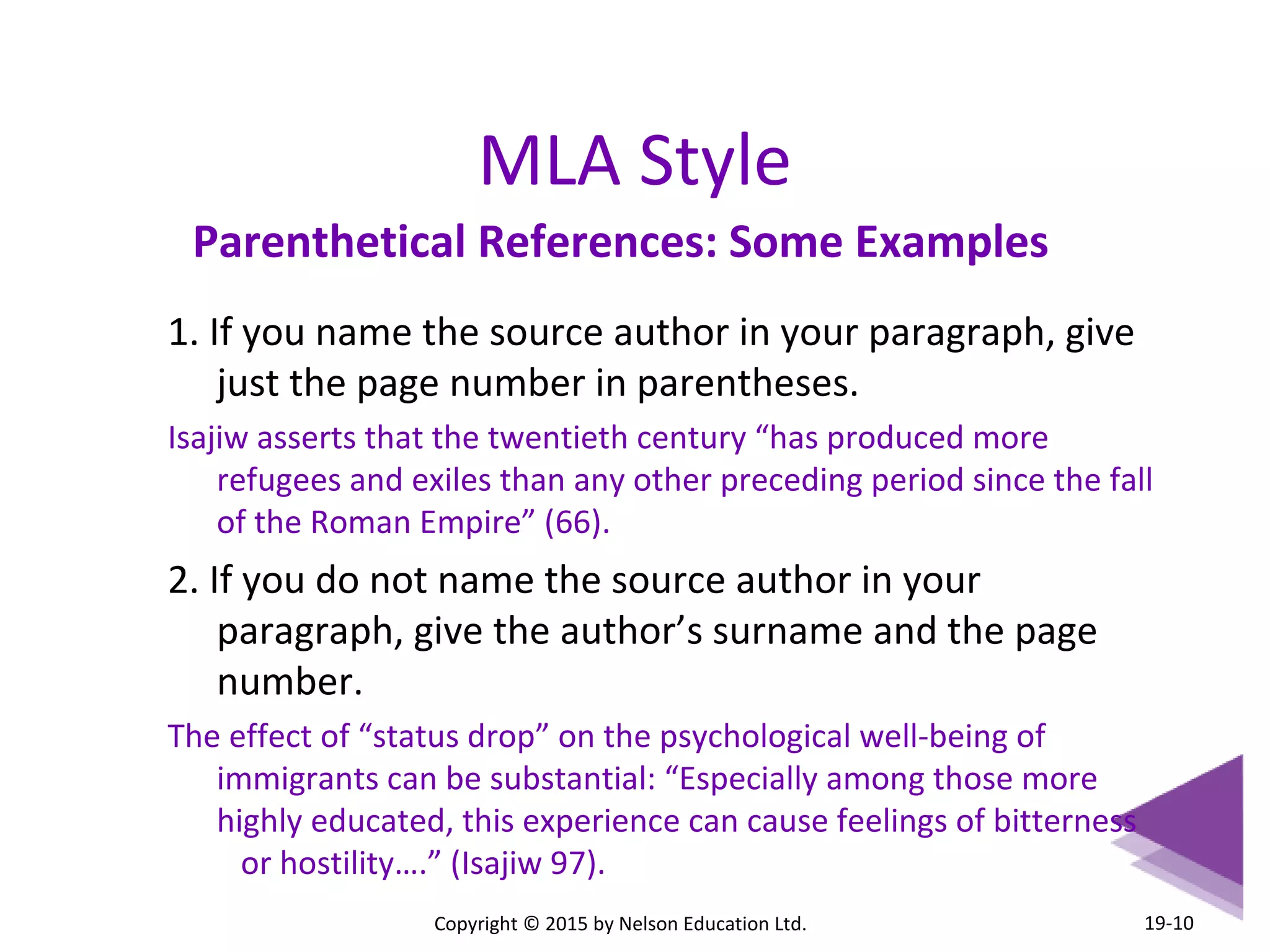
1. If you name the source author in your paragraph, give 
just the page number in parentheses. 
Isajiw asserts that the twentieth century “has produced more 
refugees and exiles than any other preceding period since the fall 
of the Roman Empire” (66). 
2. If you do not name the source author in your 
paragraph, give the author’s surname and the page 
number. 
The effect of “status drop” on the psychological well-being of 
immigrants can be substantial: “Especially among those more 
highly educated, this experience can cause feelings of bitterness 
or hostility….” (Isajiw 97). 
Copyright © 2015 by Nelson Education Ltd. 
19-10
MLA Style 
Parenthetical References: 
Electronic Sources 
1. If the electronic source lists an author, 
give the surname in your parenthetical 
reference. 
2. If the electronic source does not list an 
author, give the document title (or a 
shortened version of the title) in italics 
or quotation marks as appropriate, 
instead of the author’s name. 
Copyright © 2015 by Nelson Education Ltd. 
19-11
MLA Style 
Parenthetical References: 
Electronic Sources cont’d 
3. You do not usually find page numbers or 
other navigation devices in an electronic 
source. If there are page, paragraph, or 
section numbers that could guide your reader 
to the specific material being quoted, include 
them. If the author’s name is included in the 
parenthetical reference, put a comma after it 
and include the section or paragraph 
numbers. Use the abbreviations sec. and par. 
Copyright © 2015 by Nelson Education Ltd. 
19-12
MLA Style 
Parenthetical References: Some Electronic Examples 
3. You do not usually find page numbers in an electronic source. 
Even Margaret Atwood must endure the editing process before her books are 
published: 
Being edited is like falling face down into a threshing machine. Every page gets 
fought over, back and forth, like WWI. Unless the editor and the writer both 
have in mind the greater glory of the work, … blood will flow and the work will 
suffer. Every comma, every page break, may be a ground for slaughter. (sec. 6) 
Taken from Margaret Atwood. “The Rocky Road to Paper Heaven.” http://www.myscribeweb.com/TheRockyRoadToPaperHeaven.html 
Copyright © 2015 by Nelson Education Ltd. 
19-13
MLA Style 
Works Cited 
1. Italicize titles and subtitles of any work 
that is published as a whole. 
2. Put quotation marks around the titles of 
works published within larger works, as well 
as around the titles of unpublished works. 
3. Use capital letters for the first, the last, 
and all main words in a title and subtitle, 
even if your source capitalizes only the first 
word in the title. 
Copyright © 2015 by Nelson Education Ltd. 
19-14
MLA Style 
Works Cited cont’d 
● Begin the list on a new page, and number 
each page, continuing the page numbers of 
your paper. Your last name and the page 
number appear in the upper right-hand 
corner, 1.25 cm from the top and lined up 
with the right margin. 
● Centre the heading, “Works Cited,” 
2.50 cm from the top of the page. 
● Double-space the entire list, including 
the title and the first entry. 
Copyright © 2015 by Nelson Education Ltd. 
19-15
MLA Style 
Works Cited cont’d 
● Begin each entry at the left margin. If an 
entry runs more than one line (and most 
do), indent the subsequent line or lines one 
tab space, or 1.25 cm. This format 
is called a “hanging indent.” 
● Arrange the entries alphabetically, 
beginning with the first word of the entry, 
which is often the author’s surname. Do not 
number your entries. 
Copyright © 2015 by Nelson Education Ltd. 
19-16
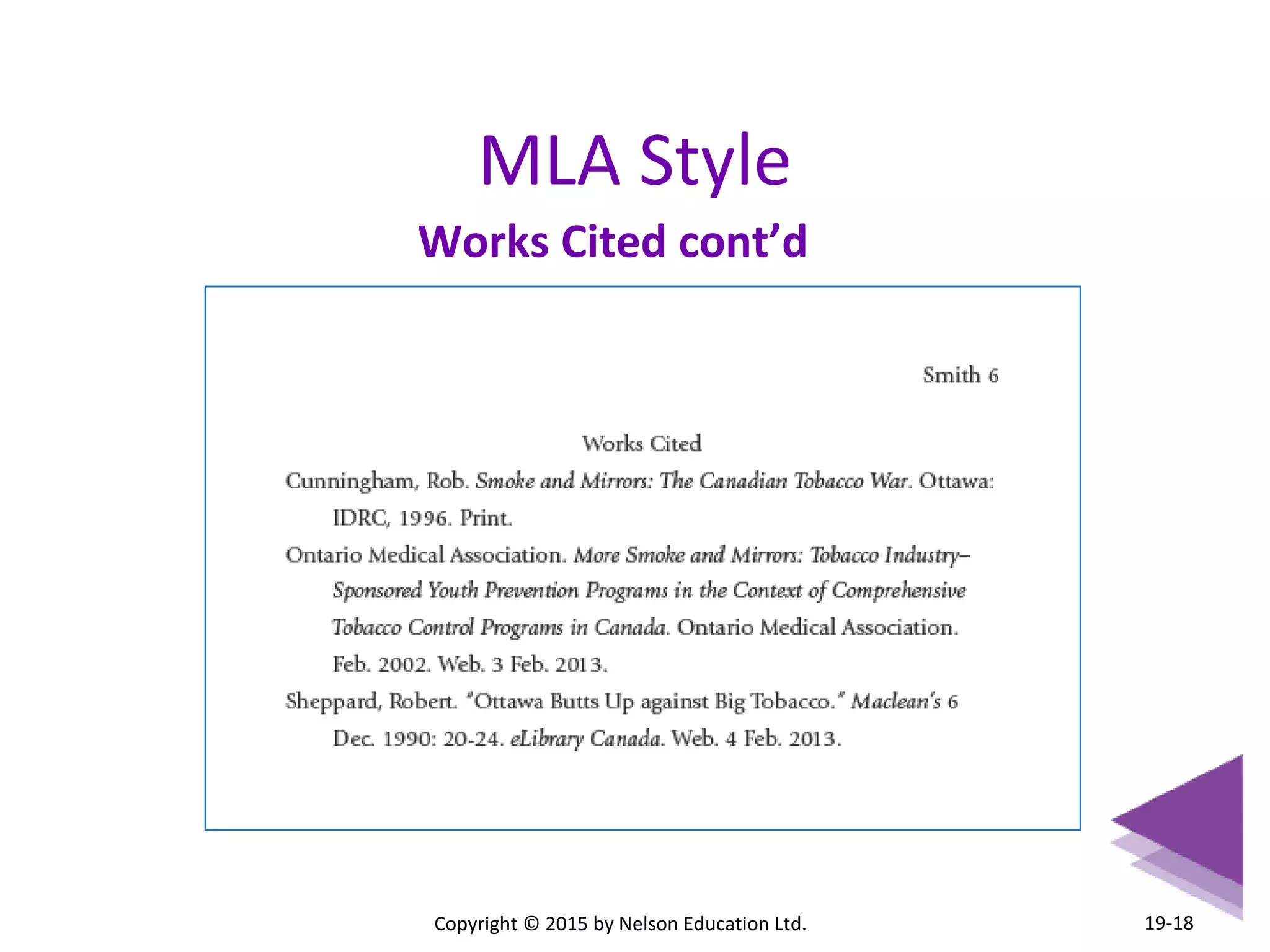
MLA Style 
Works Cited cont’d 
● If there are several works by the same 
author, put the author’s name in the 
first entry only. In the subsequent 
entries, type three hyphens and a 
period to represent the author’s name. 
● If no author is identified in your source, 
alphabetize by the first word in the title, 
ignoring “A,” “An,” and “The.” For example, 
The Canadian Encyclopedia would be listed 
under “C,” for “Canadian.” 
Copyright © 2015 by Nelson Education Ltd. 
19-17
MLA Style 
Works Cited cont’d 
Copyright © 2015 by Nelson Education Ltd. 
19-18
MLA Works Cited: Basic Format Rules 
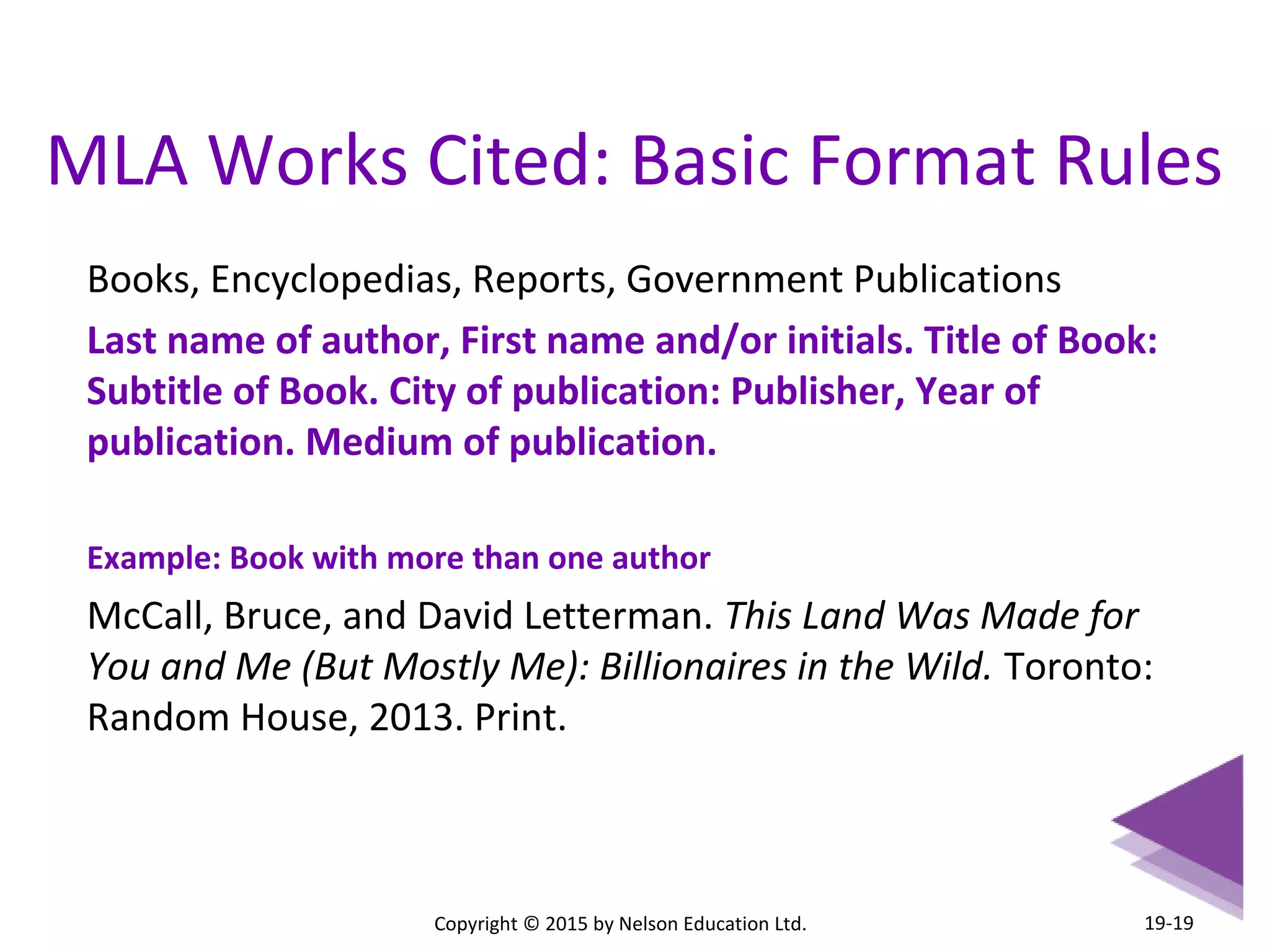
Books, Encyclopedias, Reports, Government Publications 
Last name of author, First name and/or initials. Title of Book: 
Subtitle of Book. City of publication: Publisher, Year of 
publication. Medium of publication. 
Example: Book with more than one author 
McCall, Bruce, and David Letterman. This Land Was Made for 
You and Me (But Mostly Me): Billionaires in the Wild. Toronto: 
Random House, 2013. Print. 
Copyright © 2015 by Nelson Education Ltd. 
19-19
MLA Works Cited: Basic Format Rules 
Articles in Magazines, Newspapers, and Journals 
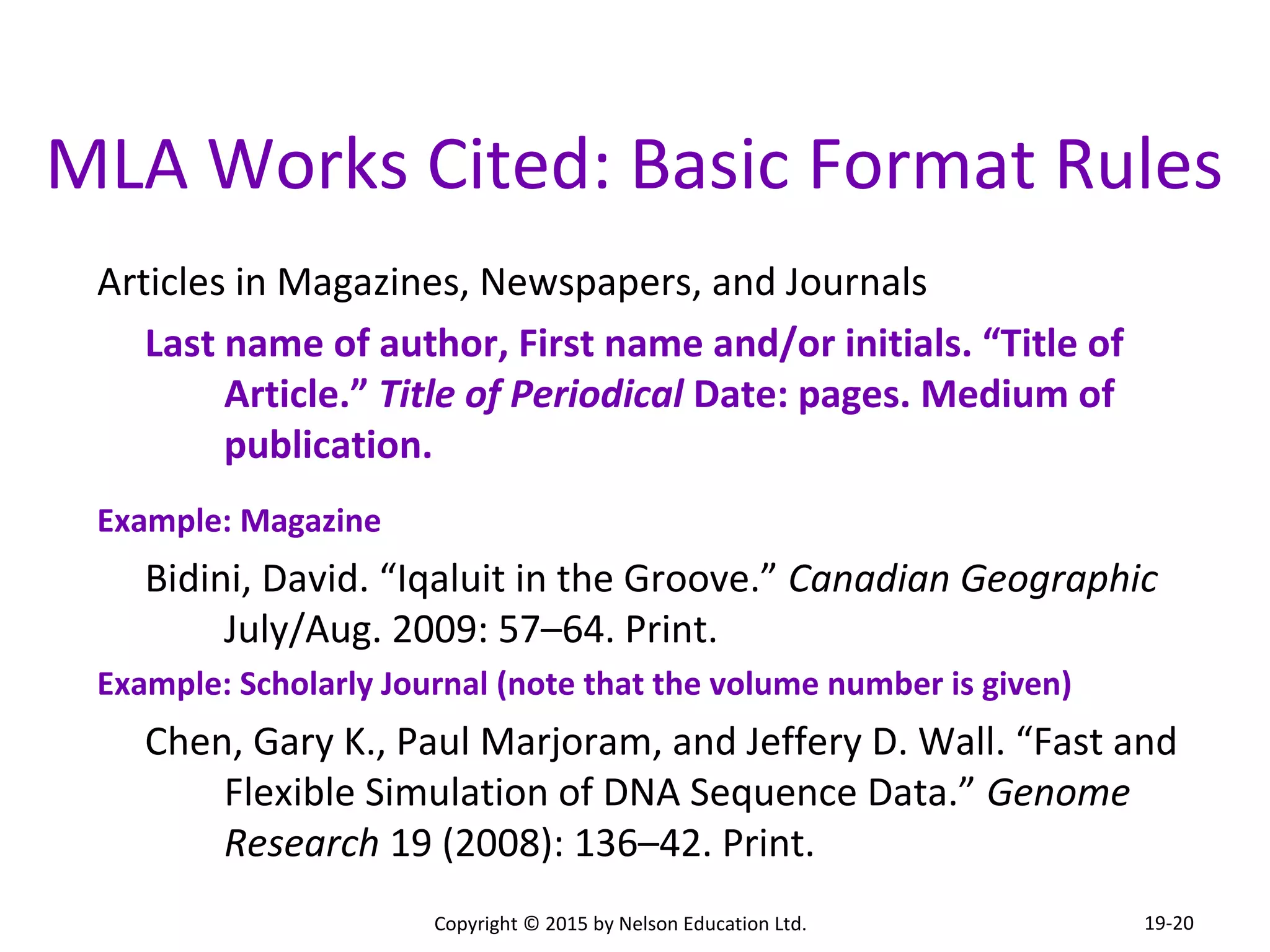
Last name of author, First name and/or initials. “Title of 
Article.” Title of Periodical Date: pages. Medium of 
publication. 
Example: Magazine 
Bidini, David. “Iqaluit in the Groove.” Canadian Geographic 
July/Aug. 2009: 57–64. Print. 
Example: Scholarly Journal (note that the volume number is given) 
Chen, Gary K., Paul Marjoram, and Jeffery D. Wall. “Fast and 
Flexible Simulation of DNA Sequence Data.” Genome 
Research 19 (2008): 136–42. Print. 
Copyright © 2015 by Nelson Education Ltd. 
19-20
MLA Works Cited: Electronic Sources 
Here are the elements to look for: 
● full name of author 
● title of the document (in italics if independent; in 
quotation marks if it is part of a larger website) 
● title of the overall website in italics 
● version or edition statement, if available 
● publisher or sponsor of the site (if unavailable use “n.p.”) 
● library database, if applicable 
● date of the publication (if unavailable use “n.d.”) 
● medium of publication (“Web”) 
● day, month, year on which you found and read the source 
● the URL, if required, or if helpful to the reader 
Copyright © 2015 by Nelson Education Ltd. 
19-21
MLA Works Cited: Electronic Sources 
Example: Online Encyclopedia, Dictionary 
“Canadian Literature.” Encyclopaedia Britannica Online. 
Encyclopaedia Britannica, 2009. Web. 5 May 2009. 
Example: Web Document 
“Michael Ondaatje.” The Canadian Literature Archive. 20 
Mar. 2006. Web. 2 Nov. 2013. <http://umanitoba.ca/ 
outreach/ canlit/michael_ondaatje.shtml>. 
Example: Newspaper Article from a Public Internet Site 
Brooymans, Hanneke. “Duck Death Toll Triples at Alberta 
Oilsands Pond.” edmontonjournal.com. Edmonton 
Journal, 31 Mar. 2009. Web. 1 Feb. 2014. 
Copyright © 2015 by Nelson Education Ltd. 
19-22
APA Style 
Parenthetical References 
Remember that a parenthetical 
reference in the text of your paper 
serves two functions: (1) it tells your 
reader that the information comes 
from somewhere else, and (2) it points 
the reader to full details about the 
source in the References list at the 
end of your paper. 
Copyright © 2015 by Nelson Education Ltd. 
19-23
APA Style 
Parenthetical References cont’d 
One way to acknowledge the author’s work is 
to name the author in your sentence and 
include the date of publication in parentheses 
immediately after the author’s name: e.g., 
“Smith (2009) reported….” If you do not name 
the author in your sentence, put the author’s 
surname followed by a comma and then the 
date in parentheses—(Smith, 2009)—right after 
your quotation, summary, or paraphrase. 
Copyright © 2015 by Nelson Education Ltd. 
19-24
APA Style 
Parenthetical References cont’d 
If you are quoting from a source, you must 
include in your parenthetical reference the 
page number(s) on which the quotation 
appears, using the abbreviation p. (page) or 
pp. (pages)—(e.g., Smith & Dolittle, 2010, 
p. 32). APA style encourages but does not 
require page references in citations for 
paraphrases or summaries. Electronic sources 
will work a bit differently. 
Copyright © 2015 by Nelson Education Ltd. 
19-25
APA Style 
Parenthetical References: 
Traditional Sources 
1. Author’s Name Given in Your Text 
Kevin Patterson (2000) wrote about his sailing 
journey from British Columbia to the South Pacific 
and back: “Suffused with optimism and rum, I told 
Peter I wanted to sail to Tahiti” (p. 6). 
Copyright © 2015 by Nelson Education Ltd. 
19-26
APA Style 
Parenthetical References: 
Traditional Sources cont’d 
2. Author’s Name Not Given in Your Text 
Long voyages by sea, especially in small boats, 
present obvious dangers depending on the ocean 
and the season of crossing: “The North Pacific is 
cold and volatile in the autumn and anyone who 
knew enough about the sea to consider sailing to 
Canada knew that much” (Patterson, 2000, p. 249). 
Copyright © 2015 by Nelson Education Ltd. 
19-27
APA Style 
Parenthetical References: 
Traditional Sources cont’d 
3. No Author Named in Source 
Give the first two or three words of the title of the 
publication or article in which the quotation appeared. 
Legislation to reduce the amount of pollution 
generated by large-scale vehicles has been on the 
federal agenda for some time: “Canada has said 
it will toughen pollution-emission rules for all new 
vehicles, ending a loophole that allowed less 
stringent standards for popular sport-utility 
vehicles and minivans” (“Canada to Toughen,” 
2002, p. A6). 
Copyright © 2015 by Nelson Education Ltd. 
19-28
APA Style 
Parenthetical References: 
Traditional Sources cont’d 
4. Source with Two Authors 
Name both authors in the order in which their names 
appear on the work. 
Norton and Green (2005) observe that 
inexperienced writers achieved superior results 
when they spent half the allotted time on 
planning “and” drafting, and the other half on 
revising. 
If you do not name the authors in your own sentence, use 
an ampersand (&) in the parenthetical reference. 
Copyright © 2015 by Nelson Education Ltd. 
19-29
APA Style 
Parenthetical References: 
Electronic Sources 
If the electronic source includes the author’s 
name, give the surname and the publication 
date (if provided) in your parenthetical 
reference. If no date is provided and your 
References list includes another author with the 
same surname, include the author’s initial(s) in 
your in-text reference. This is all the information 
your reader needs in order to find the full 
bibliographical data in your References list. 
Copyright © 2015 by Nelson Education Ltd. 
19-30
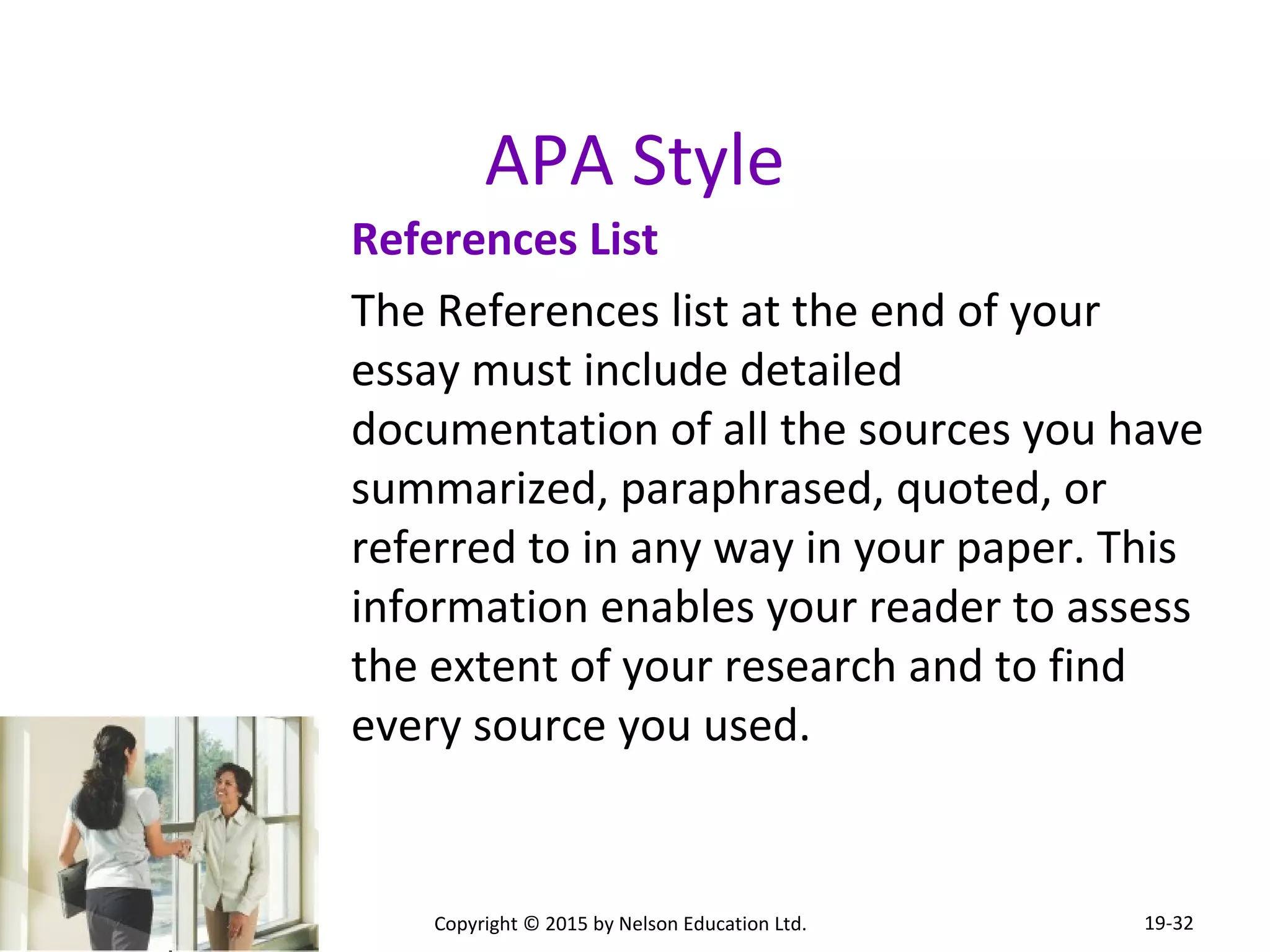
APA Style 
Parenthetical References: 
Electronic Sources cont’d 
If the electronic source does not list an author, 
use the document title (or a shortened version of 
the title) instead of the author’s name. Electronic 
sources don’t usually include page numbers or 
other navigation devices, but if there are page, 
paragraph, or section numbers that could guide 
your reader to the specific material being quoted, 
include them. Use the abbreviation par. or pars. 
for paragraph numbers. 
Copyright © 2015 by Nelson Education Ltd. 
19-31
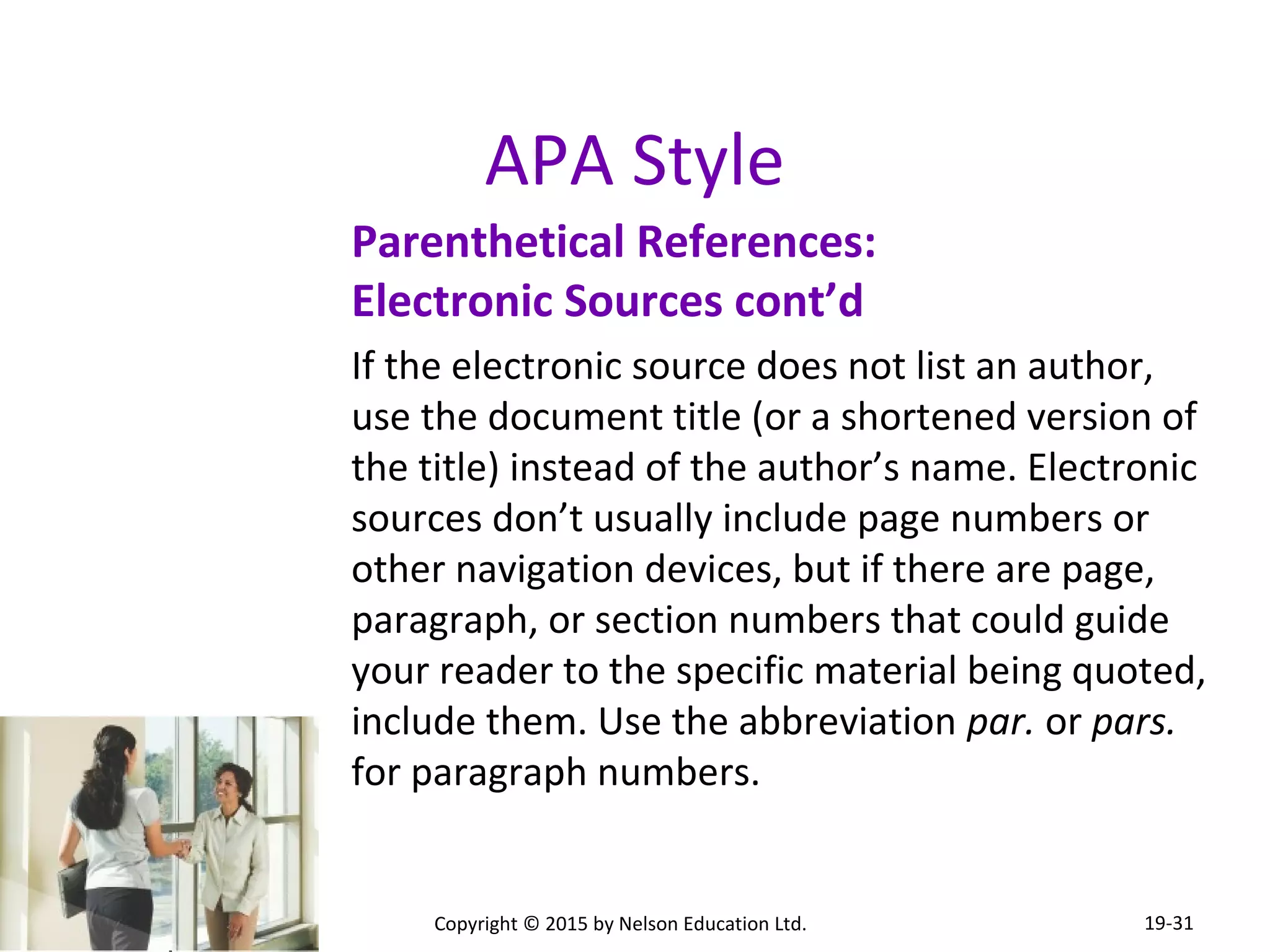
APA Style 
References List 
The References list at the end of your 
essay must include detailed 
documentation of all the sources you have 
summarized, paraphrased, quoted, or 
referred to in any way in your paper. This 
information enables your reader to assess 
the extent of your research and to find 
every source you used. 
Copyright © 2015 by Nelson Education Ltd. 
19-32
APA Style 
References List cont’d 
● Begin the References list on a new page. 
● Centre the word “References” on the 
page, two spaces below your running head 
(the title of your paper in all upper-case 
letters, abbreviated if necessary). 
● Leave a double space between the title 
“References” and the first entry, and 
double-space all of the entries. 
Copyright © 2015 by Nelson Education Ltd. 
19-33
APA Style 
References List cont’d 
● Begin each entry at the left margin. If the 
entry runs more than a single line—and 
most do—indent the second and 
subsequent lines 1.25 cm (this is called 
a “hanging indent”). 
● Arrange the entries alphabetically, 
beginning with the first word of the entry, 
which is often the author’s surname. Do 
not number your entries. 
Copyright © 2015 by Nelson Education Ltd. 
19-34
APA Style 
References List cont’d 
● If there are several works by the same 
author, arrange by year of publication, 
earliest first. 
● If no author is identified in your source, 
alphabetize by the first word in the title, 
ignoring “A,” “An,” and “The.” For example, 
The Canadian Encyclopedia would be listed 
under “C,” for “Canadian” (but would still 
retain 
“The” in the title). 
Copyright © 2015 by Nelson Education Ltd. 
19-35
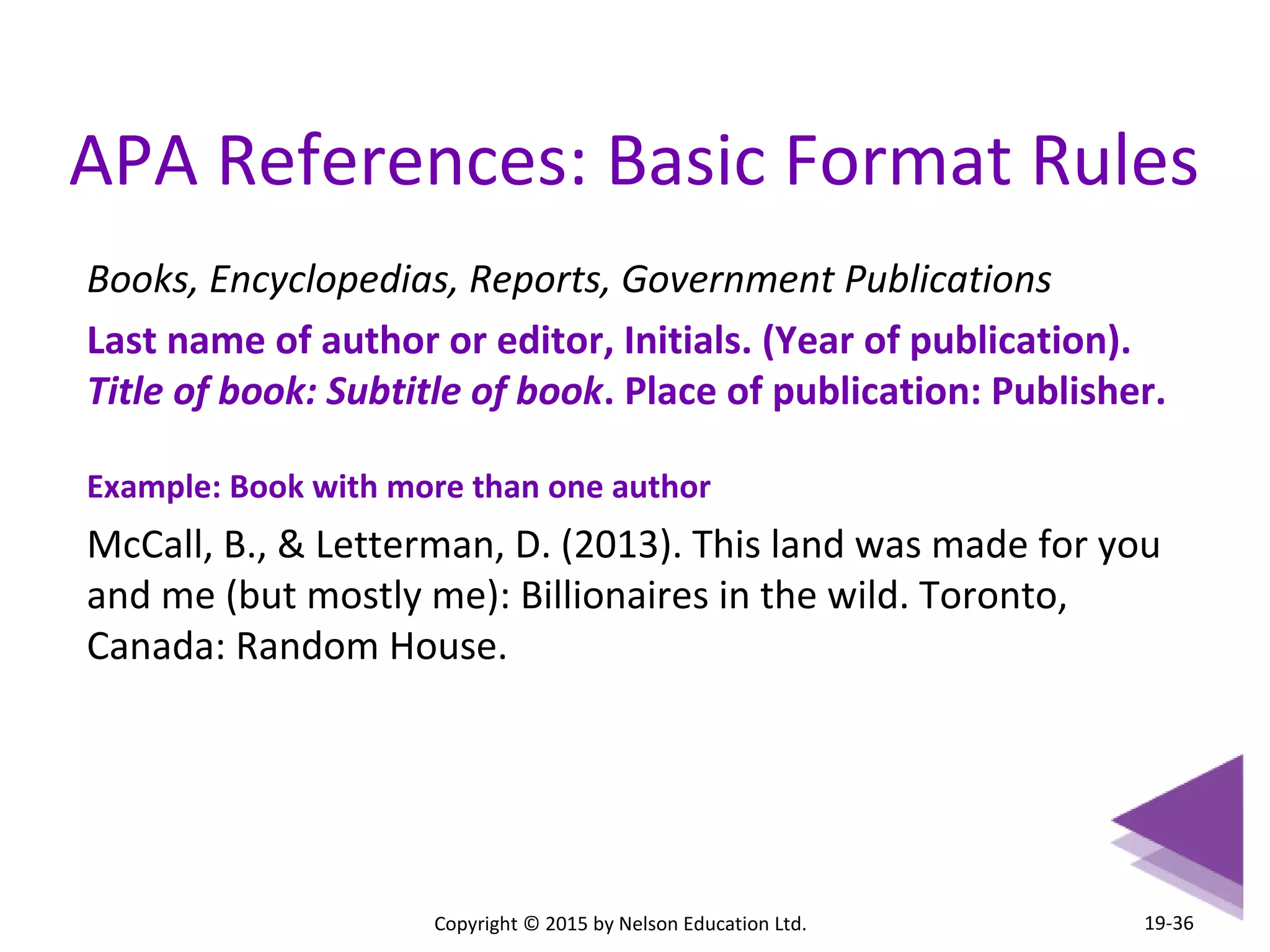
APA References: Basic Format Rules 
Books, Encyclopedias, Reports, Government Publications 
Last name of author or editor, Initials. (Year of publication). 
Title of book: Subtitle of book. Place of publication: Publisher. 
Example: Book with more than one author 
McCall, B., & Letterman, D. (2013). This land was made for you 
and me (but mostly me): Billionaires in the wild. Toronto, 
Canada: Random House. 
Copyright © 2015 by Nelson Education Ltd. 
19-36
APA References: Basic Format Rules 
Articles in Magazines, Newspapers, and Journals 
● each author’s last name and initials 
● date of publication in parentheses and in year–month–day: 
(2009, September 30) or (2010, January–February) 
● title with no quotes and an initial capital letter only; a capital 
letter is also required after the colon introducing a subtitle 
● name as it appears on the front page, in italics, with capital 
letters for all major words: The Globe and Mail 
● volume number and issue number (if any); these often appear 
in journal entries and are expressed as, for example: 
13(6), which means Volume 13, Issue 6 
● inclusive page numbers of the article 
Copyright © 2015 by Nelson Education Ltd. 
19-37
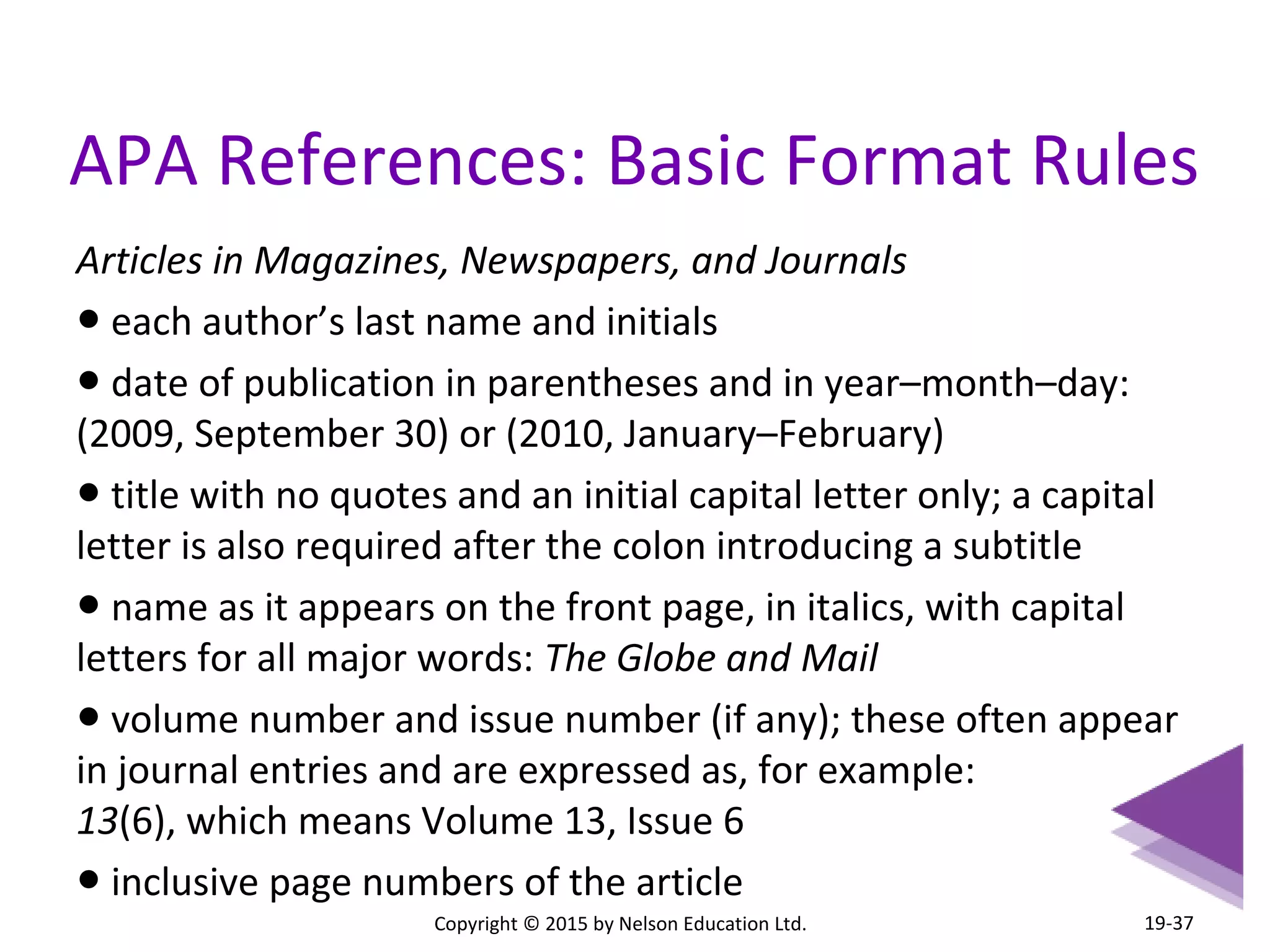
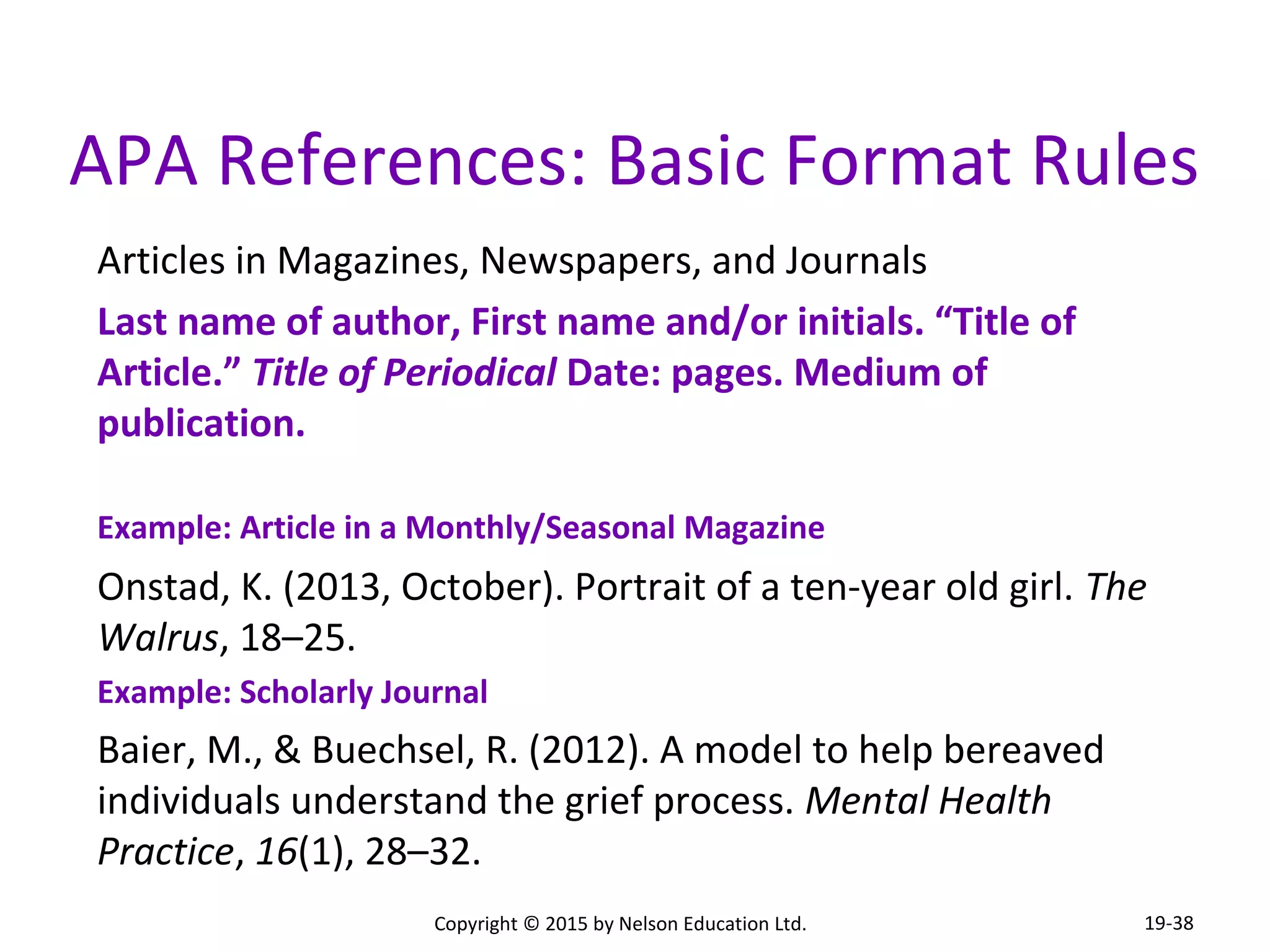
APA References: Basic Format Rules 
Articles in Magazines, Newspapers, and Journals 
Last name of author, First name and/or initials. “Title of 
Article.” Title of Periodical Date: pages. Medium of 
publication. 
Example: Article in a Monthly/Seasonal Magazine 
Onstad, K. (2013, October). Portrait of a ten-year old girl. The 
Walrus, 18–25. 
Example: Scholarly Journal 
Baier, M., & Buechsel, R. (2012). A model to help bereaved 
individuals understand the grief process. Mental Health 
Practice, 16(1), 28–32. 
Copyright © 2015 by Nelson Education Ltd. 
19-38
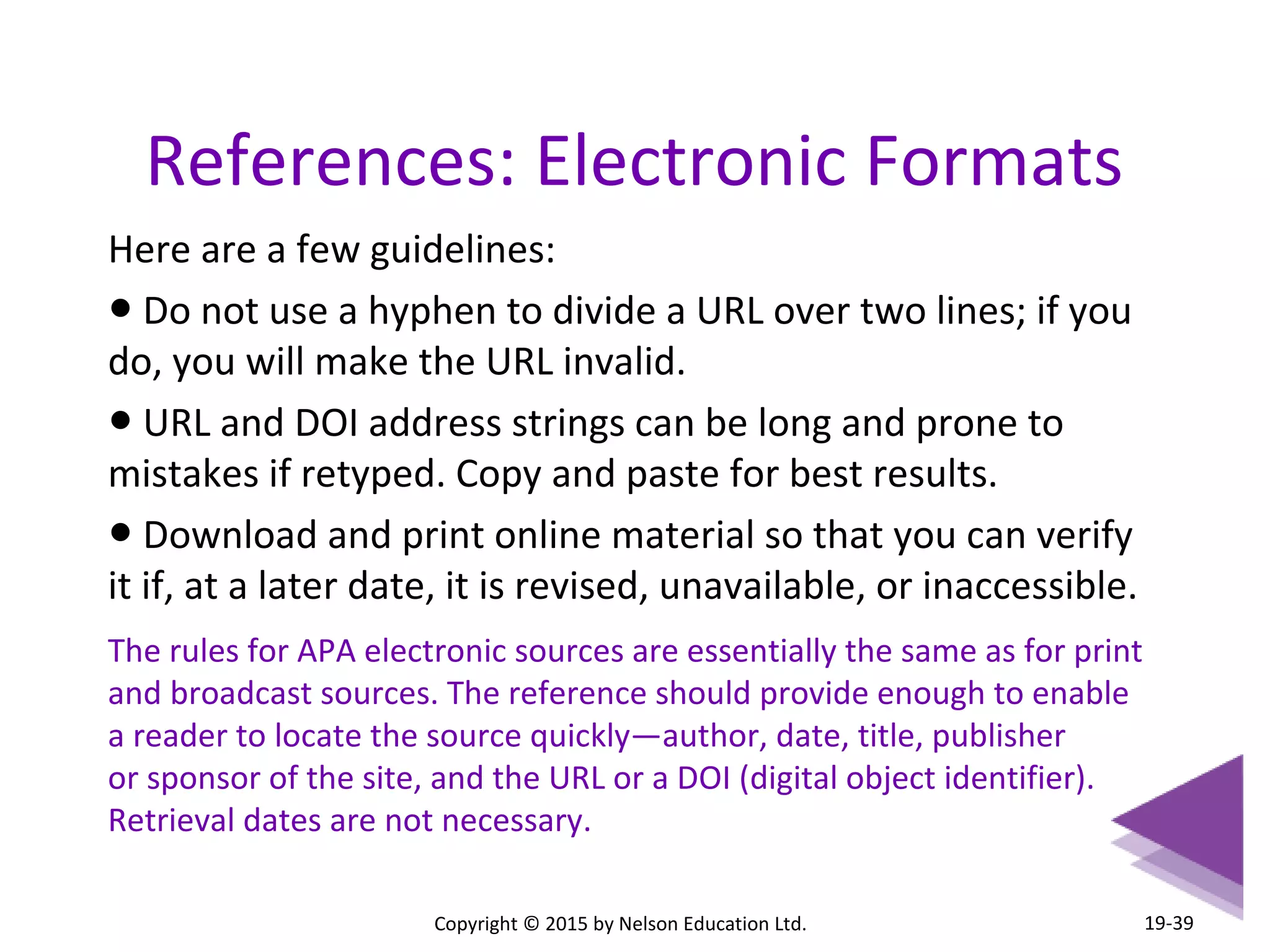
References: Electronic Formats 
Here are a few guidelines: 
● Do not use a hyphen to divide a URL over two lines; if you 
do, you will make the URL invalid. 
● URL and DOI address strings can be long and prone to 
mistakes if retyped. Copy and paste for best results. 
● Download and print online material so that you can verify 
it if, at a later date, it is revised, unavailable, or inaccessible. 
The rules for APA electronic sources are essentially the same as for print 
and broadcast sources. The reference should provide enough to enable 
a reader to locate the source quickly—author, date, title, publisher 
or sponsor of the site, and the URL or a DOI (digital object identifier). 
Retrieval dates are not necessary. 
Copyright © 2015 by Nelson Education Ltd. 
19-39
References: Electronic Format 
Example: Online Encyclopedia, Dictionary 
Capricious. (2009). In Merriam-Webster’s online dictionary. 
Retrieved from http://www.merriam-webster.com/ dictionary 
Example: Newspaper Article from a Public Internet Site 
Brooymans, H. (2009, March 31). Duck death toll triples at 
Alberta oilsands pond. Edmonton Journal. Retrieved from 
http://www.edmontonjournal.com 
Example: Audio Podcast 
Rule, B. (2009, April 5). Barbara Ferguson on Vampires, Art 
Waves #25 [Audio podcast]. Retrieved from 
https://archive.org/details/BarbaraFergusonOnVampiresArtWaves25 
Copyright © 2015 by Nelson Education Ltd. 
19-40

Chapter 19, Essay Essentials

  • 1.
    NETA PowerPoint® Slides to accompany Copyright © 2015 by Nelson Education Ltd. prepared by Rhonda Dynes Mohawk College 19-1
  • 2.
    Documenting Your Sources Copyright © 2015 by Nelson Education Ltd. Chapter 19 19-2
  • 3.
    When you documenta source, you provide information that 1. tells your readers that the ideas they are reading have been borrowed from another writer; 2. enables your readers to find the source and read the material for themselves. Documentation is the process of acknowledging source material, something you have read or seen that was created by other people or that you have recreated for another purpose. Copyright © 2015 by Nelson Education Ltd. 19-3 Documentation
  • 4.
    Documentation cont’d Thereare many different systems, but two of the most widely used are that of the Modern Language Association (MLA)— often used in English/Humanities, and that of the American Psychological Association (APA)—often used in social sciences. The source documents are: MLA Handbook for Writers of Research Papers. 7th ed. New York: MLA, 2009. www.mla.org/style. Publication Manual of the American Psychological Association. 6th ed. Washington: APA, 2009. www.apastyle.org. Copyright © 2015 by Nelson Education Ltd. 19-4
  • 5.
    The Two-Part Principleof Documentation Documentation styles vary in their details, but most styles require authors to ● identify in a parenthetical reference in the text any information taken from a source ● list all sources for the paper on a separate page at the end Copyright © 2015 by Nelson Education Ltd. 19-5
  • 6.
    Tips for Writinga Research Paper Copyright © 2015 by Nelson Education Ltd. 19-6 A parenthetical citation tells the reader that the information preceding the parentheses is borrowed from a source and provides a key to the full identification of that source. Footnotes are now rarely used to document source material; instead, they are used to give additional information that cannot be conveniently worked into the body of your paragraph. A Works Cited (MLA) or References list (APA) is a list of all the sources from which you have borrowed words, ideas, data, or other material in your paper.
  • 7.
    MLA Style ParentheticalReferences Standard practice in MLA is to provide the surname of the author of the source material and the page number where the material was taken from. If you’ve already mentioned the author’s name in your paragraph, you need to give only the page number in parentheses following subsequent references to the author’s work. Don’t repeat unnecessarily. Copyright © 2015 by Nelson Education Ltd. 19-7
  • 8.
    MLA Style ParentheticalReferences: Traditional Sources 1. If you name the source author in your paragraph, give just the page number in parentheses. 2. If you do not name the source author in your paragraph, give the author’s surname and the page number. 3. If no author is named in the source, give the first few words of the title as it appears in the Works Cited entry. Copyright © 2015 by Nelson Education Ltd. 19-8
  • 9.
    MLA Style ParentheticalReferences: Traditional Sources cont’d 4. If your source was published in more than one volume, give the volume number before the page reference. 5. If you are quoting from a literary classic or the Bible, use Arabic numerals separated by periods to identify act, scene, and lines from a play or a biblical chapter and verse. Copyright © 2015 by Nelson Education Ltd. 19-9
  • 10.
    MLA Style ParentheticalReferences: Some Examples 1. If you name the source author in your paragraph, give just the page number in parentheses. Isajiw asserts that the twentieth century “has produced more refugees and exiles than any other preceding period since the fall of the Roman Empire” (66). 2. If you do not name the source author in your paragraph, give the author’s surname and the page number. The effect of “status drop” on the psychological well-being of immigrants can be substantial: “Especially among those more highly educated, this experience can cause feelings of bitterness or hostility….” (Isajiw 97). Copyright © 2015 by Nelson Education Ltd. 19-10
  • 11.
    MLA Style ParentheticalReferences: Electronic Sources 1. If the electronic source lists an author, give the surname in your parenthetical reference. 2. If the electronic source does not list an author, give the document title (or a shortened version of the title) in italics or quotation marks as appropriate, instead of the author’s name. Copyright © 2015 by Nelson Education Ltd. 19-11
  • 12.
    MLA Style ParentheticalReferences: Electronic Sources cont’d 3. You do not usually find page numbers or other navigation devices in an electronic source. If there are page, paragraph, or section numbers that could guide your reader to the specific material being quoted, include them. If the author’s name is included in the parenthetical reference, put a comma after it and include the section or paragraph numbers. Use the abbreviations sec. and par. Copyright © 2015 by Nelson Education Ltd. 19-12
  • 13.
    MLA Style ParentheticalReferences: Some Electronic Examples 3. You do not usually find page numbers in an electronic source. Even Margaret Atwood must endure the editing process before her books are published: Being edited is like falling face down into a threshing machine. Every page gets fought over, back and forth, like WWI. Unless the editor and the writer both have in mind the greater glory of the work, … blood will flow and the work will suffer. Every comma, every page break, may be a ground for slaughter. (sec. 6) Taken from Margaret Atwood. “The Rocky Road to Paper Heaven.” http://www.myscribeweb.com/TheRockyRoadToPaperHeaven.html Copyright © 2015 by Nelson Education Ltd. 19-13
  • 14.
    MLA Style WorksCited 1. Italicize titles and subtitles of any work that is published as a whole. 2. Put quotation marks around the titles of works published within larger works, as well as around the titles of unpublished works. 3. Use capital letters for the first, the last, and all main words in a title and subtitle, even if your source capitalizes only the first word in the title. Copyright © 2015 by Nelson Education Ltd. 19-14
  • 15.
    MLA Style WorksCited cont’d ● Begin the list on a new page, and number each page, continuing the page numbers of your paper. Your last name and the page number appear in the upper right-hand corner, 1.25 cm from the top and lined up with the right margin. ● Centre the heading, “Works Cited,” 2.50 cm from the top of the page. ● Double-space the entire list, including the title and the first entry. Copyright © 2015 by Nelson Education Ltd. 19-15
  • 16.
    MLA Style WorksCited cont’d ● Begin each entry at the left margin. If an entry runs more than one line (and most do), indent the subsequent line or lines one tab space, or 1.25 cm. This format is called a “hanging indent.” ● Arrange the entries alphabetically, beginning with the first word of the entry, which is often the author’s surname. Do not number your entries. Copyright © 2015 by Nelson Education Ltd. 19-16
  • 17.
    MLA Style WorksCited cont’d ● If there are several works by the same author, put the author’s name in the first entry only. In the subsequent entries, type three hyphens and a period to represent the author’s name. ● If no author is identified in your source, alphabetize by the first word in the title, ignoring “A,” “An,” and “The.” For example, The Canadian Encyclopedia would be listed under “C,” for “Canadian.” Copyright © 2015 by Nelson Education Ltd. 19-17
  • 18.
    MLA Style WorksCited cont’d Copyright © 2015 by Nelson Education Ltd. 19-18
  • 19.
    MLA Works Cited:Basic Format Rules Books, Encyclopedias, Reports, Government Publications Last name of author, First name and/or initials. Title of Book: Subtitle of Book. City of publication: Publisher, Year of publication. Medium of publication. Example: Book with more than one author McCall, Bruce, and David Letterman. This Land Was Made for You and Me (But Mostly Me): Billionaires in the Wild. Toronto: Random House, 2013. Print. Copyright © 2015 by Nelson Education Ltd. 19-19
  • 20.
    MLA Works Cited:Basic Format Rules Articles in Magazines, Newspapers, and Journals Last name of author, First name and/or initials. “Title of Article.” Title of Periodical Date: pages. Medium of publication. Example: Magazine Bidini, David. “Iqaluit in the Groove.” Canadian Geographic July/Aug. 2009: 57–64. Print. Example: Scholarly Journal (note that the volume number is given) Chen, Gary K., Paul Marjoram, and Jeffery D. Wall. “Fast and Flexible Simulation of DNA Sequence Data.” Genome Research 19 (2008): 136–42. Print. Copyright © 2015 by Nelson Education Ltd. 19-20
  • 21.
    MLA Works Cited:Electronic Sources Here are the elements to look for: ● full name of author ● title of the document (in italics if independent; in quotation marks if it is part of a larger website) ● title of the overall website in italics ● version or edition statement, if available ● publisher or sponsor of the site (if unavailable use “n.p.”) ● library database, if applicable ● date of the publication (if unavailable use “n.d.”) ● medium of publication (“Web”) ● day, month, year on which you found and read the source ● the URL, if required, or if helpful to the reader Copyright © 2015 by Nelson Education Ltd. 19-21
  • 22.
    MLA Works Cited:Electronic Sources Example: Online Encyclopedia, Dictionary “Canadian Literature.” Encyclopaedia Britannica Online. Encyclopaedia Britannica, 2009. Web. 5 May 2009. Example: Web Document “Michael Ondaatje.” The Canadian Literature Archive. 20 Mar. 2006. Web. 2 Nov. 2013. <http://umanitoba.ca/ outreach/ canlit/michael_ondaatje.shtml>. Example: Newspaper Article from a Public Internet Site Brooymans, Hanneke. “Duck Death Toll Triples at Alberta Oilsands Pond.” edmontonjournal.com. Edmonton Journal, 31 Mar. 2009. Web. 1 Feb. 2014. Copyright © 2015 by Nelson Education Ltd. 19-22
  • 23.
    APA Style ParentheticalReferences Remember that a parenthetical reference in the text of your paper serves two functions: (1) it tells your reader that the information comes from somewhere else, and (2) it points the reader to full details about the source in the References list at the end of your paper. Copyright © 2015 by Nelson Education Ltd. 19-23
  • 24.
    APA Style ParentheticalReferences cont’d One way to acknowledge the author’s work is to name the author in your sentence and include the date of publication in parentheses immediately after the author’s name: e.g., “Smith (2009) reported….” If you do not name the author in your sentence, put the author’s surname followed by a comma and then the date in parentheses—(Smith, 2009)—right after your quotation, summary, or paraphrase. Copyright © 2015 by Nelson Education Ltd. 19-24
  • 25.
    APA Style ParentheticalReferences cont’d If you are quoting from a source, you must include in your parenthetical reference the page number(s) on which the quotation appears, using the abbreviation p. (page) or pp. (pages)—(e.g., Smith & Dolittle, 2010, p. 32). APA style encourages but does not require page references in citations for paraphrases or summaries. Electronic sources will work a bit differently. Copyright © 2015 by Nelson Education Ltd. 19-25
  • 26.
    APA Style ParentheticalReferences: Traditional Sources 1. Author’s Name Given in Your Text Kevin Patterson (2000) wrote about his sailing journey from British Columbia to the South Pacific and back: “Suffused with optimism and rum, I told Peter I wanted to sail to Tahiti” (p. 6). Copyright © 2015 by Nelson Education Ltd. 19-26
  • 27.
    APA Style ParentheticalReferences: Traditional Sources cont’d 2. Author’s Name Not Given in Your Text Long voyages by sea, especially in small boats, present obvious dangers depending on the ocean and the season of crossing: “The North Pacific is cold and volatile in the autumn and anyone who knew enough about the sea to consider sailing to Canada knew that much” (Patterson, 2000, p. 249). Copyright © 2015 by Nelson Education Ltd. 19-27
  • 28.
    APA Style ParentheticalReferences: Traditional Sources cont’d 3. No Author Named in Source Give the first two or three words of the title of the publication or article in which the quotation appeared. Legislation to reduce the amount of pollution generated by large-scale vehicles has been on the federal agenda for some time: “Canada has said it will toughen pollution-emission rules for all new vehicles, ending a loophole that allowed less stringent standards for popular sport-utility vehicles and minivans” (“Canada to Toughen,” 2002, p. A6). Copyright © 2015 by Nelson Education Ltd. 19-28
  • 29.
    APA Style ParentheticalReferences: Traditional Sources cont’d 4. Source with Two Authors Name both authors in the order in which their names appear on the work. Norton and Green (2005) observe that inexperienced writers achieved superior results when they spent half the allotted time on planning “and” drafting, and the other half on revising. If you do not name the authors in your own sentence, use an ampersand (&) in the parenthetical reference. Copyright © 2015 by Nelson Education Ltd. 19-29
  • 30.
    APA Style ParentheticalReferences: Electronic Sources If the electronic source includes the author’s name, give the surname and the publication date (if provided) in your parenthetical reference. If no date is provided and your References list includes another author with the same surname, include the author’s initial(s) in your in-text reference. This is all the information your reader needs in order to find the full bibliographical data in your References list. Copyright © 2015 by Nelson Education Ltd. 19-30
  • 31.
    APA Style ParentheticalReferences: Electronic Sources cont’d If the electronic source does not list an author, use the document title (or a shortened version of the title) instead of the author’s name. Electronic sources don’t usually include page numbers or other navigation devices, but if there are page, paragraph, or section numbers that could guide your reader to the specific material being quoted, include them. Use the abbreviation par. or pars. for paragraph numbers. Copyright © 2015 by Nelson Education Ltd. 19-31
  • 32.
    APA Style ReferencesList The References list at the end of your essay must include detailed documentation of all the sources you have summarized, paraphrased, quoted, or referred to in any way in your paper. This information enables your reader to assess the extent of your research and to find every source you used. Copyright © 2015 by Nelson Education Ltd. 19-32
  • 33.
    APA Style ReferencesList cont’d ● Begin the References list on a new page. ● Centre the word “References” on the page, two spaces below your running head (the title of your paper in all upper-case letters, abbreviated if necessary). ● Leave a double space between the title “References” and the first entry, and double-space all of the entries. Copyright © 2015 by Nelson Education Ltd. 19-33
  • 34.
    APA Style ReferencesList cont’d ● Begin each entry at the left margin. If the entry runs more than a single line—and most do—indent the second and subsequent lines 1.25 cm (this is called a “hanging indent”). ● Arrange the entries alphabetically, beginning with the first word of the entry, which is often the author’s surname. Do not number your entries. Copyright © 2015 by Nelson Education Ltd. 19-34
  • 35.
    APA Style ReferencesList cont’d ● If there are several works by the same author, arrange by year of publication, earliest first. ● If no author is identified in your source, alphabetize by the first word in the title, ignoring “A,” “An,” and “The.” For example, The Canadian Encyclopedia would be listed under “C,” for “Canadian” (but would still retain “The” in the title). Copyright © 2015 by Nelson Education Ltd. 19-35
  • 36.
    APA References: BasicFormat Rules Books, Encyclopedias, Reports, Government Publications Last name of author or editor, Initials. (Year of publication). Title of book: Subtitle of book. Place of publication: Publisher. Example: Book with more than one author McCall, B., & Letterman, D. (2013). This land was made for you and me (but mostly me): Billionaires in the wild. Toronto, Canada: Random House. Copyright © 2015 by Nelson Education Ltd. 19-36
  • 37.
    APA References: BasicFormat Rules Articles in Magazines, Newspapers, and Journals ● each author’s last name and initials ● date of publication in parentheses and in year–month–day: (2009, September 30) or (2010, January–February) ● title with no quotes and an initial capital letter only; a capital letter is also required after the colon introducing a subtitle ● name as it appears on the front page, in italics, with capital letters for all major words: The Globe and Mail ● volume number and issue number (if any); these often appear in journal entries and are expressed as, for example: 13(6), which means Volume 13, Issue 6 ● inclusive page numbers of the article Copyright © 2015 by Nelson Education Ltd. 19-37
  • 38.
    APA References: BasicFormat Rules Articles in Magazines, Newspapers, and Journals Last name of author, First name and/or initials. “Title of Article.” Title of Periodical Date: pages. Medium of publication. Example: Article in a Monthly/Seasonal Magazine Onstad, K. (2013, October). Portrait of a ten-year old girl. The Walrus, 18–25. Example: Scholarly Journal Baier, M., & Buechsel, R. (2012). A model to help bereaved individuals understand the grief process. Mental Health Practice, 16(1), 28–32. Copyright © 2015 by Nelson Education Ltd. 19-38
  • 39.
    References: Electronic Formats Here are a few guidelines: ● Do not use a hyphen to divide a URL over two lines; if you do, you will make the URL invalid. ● URL and DOI address strings can be long and prone to mistakes if retyped. Copy and paste for best results. ● Download and print online material so that you can verify it if, at a later date, it is revised, unavailable, or inaccessible. The rules for APA electronic sources are essentially the same as for print and broadcast sources. The reference should provide enough to enable a reader to locate the source quickly—author, date, title, publisher or sponsor of the site, and the URL or a DOI (digital object identifier). Retrieval dates are not necessary. Copyright © 2015 by Nelson Education Ltd. 19-39
  • 40.
    References: Electronic Format Example: Online Encyclopedia, Dictionary Capricious. (2009). In Merriam-Webster’s online dictionary. Retrieved from http://www.merriam-webster.com/ dictionary Example: Newspaper Article from a Public Internet Site Brooymans, H. (2009, March 31). Duck death toll triples at Alberta oilsands pond. Edmonton Journal. Retrieved from http://www.edmontonjournal.com Example: Audio Podcast Rule, B. (2009, April 5). Barbara Ferguson on Vampires, Art Waves #25 [Audio podcast]. Retrieved from https://archive.org/details/BarbaraFergusonOnVampiresArtWaves25 Copyright © 2015 by Nelson Education Ltd. 19-40

Editor's Notes

  • #11 Please see Chapter 19 of Essay Essentials 6e for a full list of rules and examples. Only some of the most common rules are included here.
  • #14 Please see Chapter 19 of Essay Essentials 6e for a full list of rules and examples. Only some of the most common rules are included here.
  • #20 Please see Chapter 19 of Essay Essentials 6e for a full list of examples. Only some of the most common examples are included here.
  • #21 Please see Chapter 19 of Essay Essentials 6e for a full list of examples. Only some of the most common examples are included here.
  • #22 Please see Chapter 19 of Essay Essentials 6e for a full list of examples. Only some of the most common examples are included here.
  • #23 Please see Chapter 19 of Essay Essentials 6e for a full list of examples. Only some of the most common examples are included here.
  • #27 More information can be found directly in Chapter 19 of Essay Essentials 6e.
  • #28 More information can be found directly in Chapter 19 of Essay Essentials 6e.
  • #29 More information can be found directly in Chapter 19 of Essay Essentials 6e.
  • #30 More information can be found directly in Chapter 19 of Essay Essentials 6e.
  • #37 Please see Chapter 19 of Essay Essentials 6e for a full list of examples. Only some of the most common examples are included here.
  • #38 Please see Chapter 19 of Essay Essentials 6e for a full list of examples. Only some of the most common examples are included here.
  • #39 Please see Chapter 19 of Essay Essentials 6e for a full list of examples. Only some of the most common examples are included here.
  • #40 Please see Chapter 19 of Essay Essentials 6e for a full list of examples. Only some of the most common examples are included here.
  • #41 Please see Chapter 19 of Essay Essentials 6e for a full list of examples. Only some of the most common examples are included here.