Who is
my
Teacher
?
IPC/Science
Resource
Coach McFarland,
MCAA
Room # 106
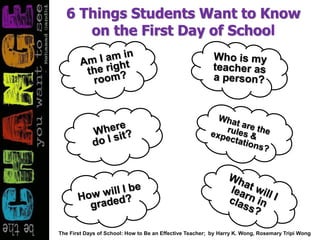
6 Things Students Want to Know
on the First Day of School
The First Days of School: How to Be an Effective Teacher; by Harry K. Wong, Rosemary Tripi Wong
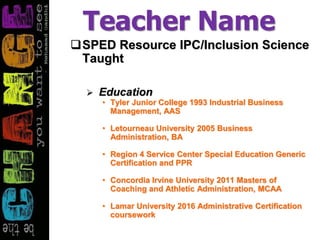
Teacher Name
SPED Resource IPC/Inclusion Science
Taught
 Education
• Tyler Junior College 1993 Industrial Business
Management, AAS
• Letourneau University 2005 Business
Administration, BA
• Region 4 Service Center Special Education Generic
Certification and PPR
• Concordia Irvine University 2011 Masters of
Coaching and Athletic Administration, MCAA
• Lamar University 2016 Administrative Certification
coursework
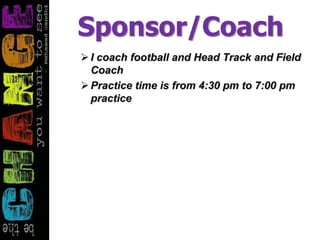
Sponsor/Coach
I coach football and Head Track and Field
Coach
Practice time is from 4:30 pm to 7:00 pm
practice
Honors & Achievements
Who’s Who’s among America
High School Students 1990
American Legion Boys State
1989
Cum Laude Graduate LETU
I have coach football,
basketball, track and field,
baseball, tennis, and soccer.
Family
Wife name Mrs. Shaneka
McFarland
I have 3 daughters Keira,
Kyra, and Kendall.
I have one granddaughter,
Kacee
When away from school…
 I like to workout, reading,
coaching, teaching at the nursing
home, church, traveling, and have
family and friends gathering.
 Include pictures
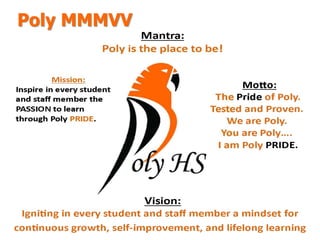
Poly MMMVV
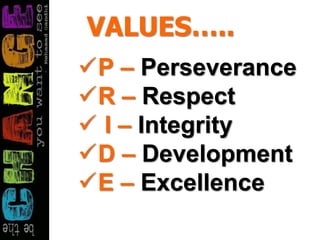
VALUES…..
P – Perseverance
R – Respect
 I – Integrity
D – Development
E – Excellence
Classroom
Expectations
and Rules
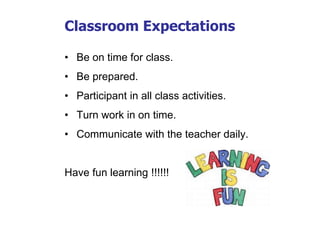
Classroom Expectations
• Be on time for class.
• Be prepared.
• Participant in all class activities.
• Turn work in on time.
• Communicate with the teacher daily.
Have fun learning !!!!!!
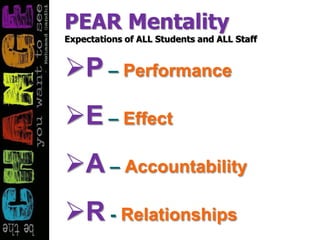
PEAR Mentality
Expectations of ALL Students and ALL Staff
P – Performance
E – Effect
A – Accountability
R - Relationships
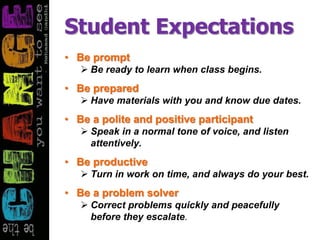
Student Expectations
• Be prompt
 Be ready to learn when class begins.
• Be prepared
 Have materials with you and know due dates.
• Be a polite and positive participant
 Speak in a normal tone of voice, and listen
attentively.
• Be productive
 Turn in work on time, and always do your best.
• Be a problem solver
 Correct problems quickly and peacefully
before they escalate.
Coursework Responsibility
(Daily Classroom Procedure)
Pick Up Folder as you enter the
room.
 Bring Writing Utensil, everyday
Be prepared to submit all
coursework on time.
Know DUE DATES
Major assignments and projects can
be resubmitted. They will be scored
at 70%
Attendance
Is imperative for SUCCESS in
the Class
If you miss class, it is your
responsibility to ask the
teacher what you missed
(before or after class)
Each absence has a two-day
grace period to make up
missed work.
Attendance Policy
 Attendance Recovery by
“APPROVAL of the
COMMITTEE – only”
 The Cost will be $5 per
semester; Seniors will be $25
for spring recovery.
 Pattern of Skipping will not
be approved
 Repeat Offenders will not be
approved
PROCEDURES
Come to class on time.
Be Organized and Prepare for
Class
Bring required supplies to class
each day.
Be in your seat ready to work
when the tardy bell rings – start
your warm up.
PROCEDURES
Raise your hand to be
recognized to ask or answer
question
Follow instructions the first time
they are given.
 Participate responsibly in
classroom activities and
discussions.
RULES
Only talk when permitted – use
appropriate speech and body
language.
Food and drink are not allowed
in classroom without
permission.
Stay in your seat unless you
have permission to move or
leave the room
RULES
One person at a time leaves the
room with the hall pass – NO
PASSES first 10 minutes of
class starts or last 10 minutes in
class
Be Respectful of Classmates,
Teacher, and Class Materials,
Tools, & Equipment
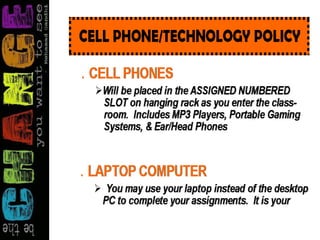
POLICIES
• NO Cell Phones
 They will be placed in the box slot of your
assigned number as you enter the
classroom
 Includes MP3 Players, Portable Gaming
Systems, & Ear/Head Phones
• Dress Code will be ENFORCED
 No Caps
 No “short, shorts or skirts
 No low cut, spaghetti strap, tank tops, or
strapless tops (even with a cover shirt)
 No Sagging Pants
 No leggings worn as “pants’, must have
dress or skirt over them.
Show Respect
• Value yourself. Be honest and
ethical, and practice strong moral
values.
• Treat all members of the school
community and all visitors with
politeness and respect.
• Honor the ideas and opinions of
others.
• Offer to help.
Promote Lifelong Learning
You can develop lifelong learning traits:
By showing curiosity about
human nature and how the
world works.
By seeking and valuing
diversity.
By persisting in seeking out
new solutions.
Promote Lifelong Learning
You can develop lifelong learning traits:
By using your unique talents
and intelligence to promote
positive change.
By learning and applying
technology tools to solve
problems.
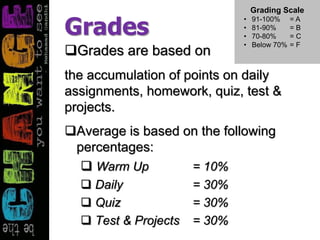
Grades
Grades are based on
the accumulation of points on daily
assignments, homework, quiz, test &
projects.
Average is based on the following
percentages:
 Warm Up = 10%
 Daily = 30%
 Quiz = 30%
 Test & Projects = 30%
Grading Scale
• 91-100% = A
• 81-90% = B
• 70-80% = C
• Below 70% = F
Where Do I Sit?
• Seating Chart
 Have a seating chart
 It helps with classroom
management, learning student
names, shows you are in control of
your classroom
• Real World
You don’t pick your co-workers –
so you don’t pick your seat
 You need to meet new people
 You learn to communicate with
others
Inegrated Physics and Chemistry - TEKS
§112.38. Integrated Physics and Chemistry, Beginning with School Year 2010-2011 (One Credit).
• (a) General requirements. Students shall be awarded one credit for successful completion of this course.
Prerequisites: none. This course is recommended for students in Grade 9 or 10.
• (b) Introduction.
• (1) Integrated Physics and Chemistry. In Integrated Physics and Chemistry, students conduct laboratory and field
investigations, use scientific methods during investigation, and make informed decisions using critical thinking and
scientific problem solving. This course integrates the disciplines of physics and chemistry in the following topics:
force, motion, energy, and matter.
• (2) Nature of science. Science, as defined by the National Academy of Sciences, is the "use of evidence to
construct testable explanations and predictions of natural phenomena, as well as the knowledge generated through
this process." This vast body of changing and increasing knowledge is described by physical, mathematical, and
conceptual models. Students should know that some questions are outside the realm of science because they deal
with phenomena that are not scientifically testable.
• (3) Scientific inquiry. Scientific inquiry is the planned and deliberate investigation of the natural world. Scientific
methods of investigation are experimental, descriptive, or comparative. The method chosen should be appropriate
to the question being asked.
• (4) Science and social ethics. Scientific decision making is a way of answering questions about the natural world.
Students should be able to distinguish between scientific decision-making methods (scientific methods) and ethical
and social decisions that involve science (the application of scientific information).
• (5) Science, systems, and models. A system is a collection of cycles, structures, and processes that interact. All
systems have basic properties that can be described in space, time, energy, and matter. Change and constancy
occur in systems as patterns and can be observed, measured, and modeled. These patterns help to make
predictions that can be scientifically tested. Students should analyze a system in terms of its components and how
these components relate to each other, to the whole, and to the external environment.
My Pledge to Students
I will model Poly’s MMMVV every
day I am your teacher
I will trust YOU to be successful
in my class.
I will respect YOU and work with
YOU to learn, critically think, and
become a problem solver.
My Pledge to Students
I will promptly grade and offer
feedback on YOUR work.
I will work with you to meet
YOUR learning goals.
I will offer extra help and
alternative assessments should
YOU require them.
CLIMATE CHANGE
2016 – 17
 Embrace the Student
 Build Relationship with
students
 Leave Judgment at the Door
 Encourage the “POSITIVE”
change for Academic
“SUCCESS”
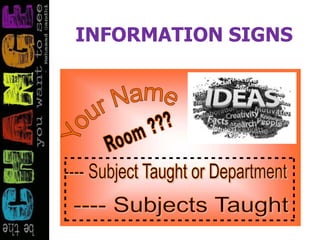
INFORMATION SIGNS
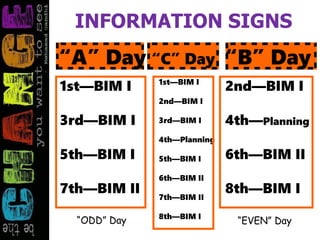
INFORMATION SIGNS
1st—BIM I
3rd—BIM I
5th—BIM I
7th—BIM II
“A” Day “B” Day
2nd—BIM I
4th—Planning
6th—BIM II
8th—BIM I
“C” Day
1st—BIM I
2nd—BIM I
3rd—BIM I
4th—Planning
5th—BIM I
6th—BIM II
7th—BIM II
8th—BIM I
“ODD” Day “EVEN” Day
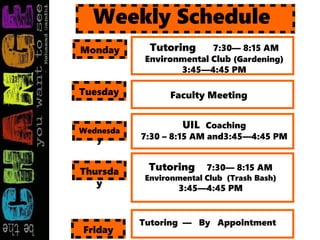
Tutoring 7:30— 8:15 AM
Environmental Club (Gardening)
3:45—4:45 PM
Weekly Schedule
Monday
Faculty MeetingTuesday
UIL Coaching
7:30 – 8:15 AM and3:45—4:45 PM
Wednesda
y
Tutoring 7:30— 8:15 AM
Environmental Club (Trash Bash)
3:45—4:45 PM
Thursda
y
Tutoring — By Appointment
Friday
1st daypp
1st daypp

1st daypp

  • 1.
  • 2.
    6 Things StudentsWant to Know on the First Day of School The First Days of School: How to Be an Effective Teacher; by Harry K. Wong, Rosemary Tripi Wong
  • 3.
    Teacher Name SPED ResourceIPC/Inclusion Science Taught  Education • Tyler Junior College 1993 Industrial Business Management, AAS • Letourneau University 2005 Business Administration, BA • Region 4 Service Center Special Education Generic Certification and PPR • Concordia Irvine University 2011 Masters of Coaching and Athletic Administration, MCAA • Lamar University 2016 Administrative Certification coursework
  • 4.
    Sponsor/Coach I coach footballand Head Track and Field Coach Practice time is from 4:30 pm to 7:00 pm practice
  • 5.
    Honors & Achievements Who’sWho’s among America High School Students 1990 American Legion Boys State 1989 Cum Laude Graduate LETU I have coach football, basketball, track and field, baseball, tennis, and soccer.
  • 6.
    Family Wife name Mrs.Shaneka McFarland I have 3 daughters Keira, Kyra, and Kendall. I have one granddaughter, Kacee
  • 7.
    When away fromschool…  I like to workout, reading, coaching, teaching at the nursing home, church, traveling, and have family and friends gathering.  Include pictures
  • 8.
  • 9.
    VALUES….. P – Perseverance R– Respect  I – Integrity D – Development E – Excellence
  • 10.
  • 11.
    Classroom Expectations • Beon time for class. • Be prepared. • Participant in all class activities. • Turn work in on time. • Communicate with the teacher daily. Have fun learning !!!!!!
  • 12.
    PEAR Mentality Expectations ofALL Students and ALL Staff P – Performance E – Effect A – Accountability R - Relationships
  • 13.
    Student Expectations • Beprompt  Be ready to learn when class begins. • Be prepared  Have materials with you and know due dates. • Be a polite and positive participant  Speak in a normal tone of voice, and listen attentively. • Be productive  Turn in work on time, and always do your best. • Be a problem solver  Correct problems quickly and peacefully before they escalate.
  • 14.
    Coursework Responsibility (Daily ClassroomProcedure) Pick Up Folder as you enter the room.  Bring Writing Utensil, everyday Be prepared to submit all coursework on time. Know DUE DATES Major assignments and projects can be resubmitted. They will be scored at 70%
  • 15.
    Attendance Is imperative forSUCCESS in the Class If you miss class, it is your responsibility to ask the teacher what you missed (before or after class) Each absence has a two-day grace period to make up missed work.
  • 16.
    Attendance Policy  AttendanceRecovery by “APPROVAL of the COMMITTEE – only”  The Cost will be $5 per semester; Seniors will be $25 for spring recovery.  Pattern of Skipping will not be approved  Repeat Offenders will not be approved
  • 17.
    PROCEDURES Come to classon time. Be Organized and Prepare for Class Bring required supplies to class each day. Be in your seat ready to work when the tardy bell rings – start your warm up.
  • 18.
    PROCEDURES Raise your handto be recognized to ask or answer question Follow instructions the first time they are given.  Participate responsibly in classroom activities and discussions.
  • 19.
    RULES Only talk whenpermitted – use appropriate speech and body language. Food and drink are not allowed in classroom without permission. Stay in your seat unless you have permission to move or leave the room
  • 20.
    RULES One person ata time leaves the room with the hall pass – NO PASSES first 10 minutes of class starts or last 10 minutes in class Be Respectful of Classmates, Teacher, and Class Materials, Tools, & Equipment
  • 21.
    POLICIES • NO CellPhones  They will be placed in the box slot of your assigned number as you enter the classroom  Includes MP3 Players, Portable Gaming Systems, & Ear/Head Phones • Dress Code will be ENFORCED  No Caps  No “short, shorts or skirts  No low cut, spaghetti strap, tank tops, or strapless tops (even with a cover shirt)  No Sagging Pants  No leggings worn as “pants’, must have dress or skirt over them.
  • 22.
    Show Respect • Valueyourself. Be honest and ethical, and practice strong moral values. • Treat all members of the school community and all visitors with politeness and respect. • Honor the ideas and opinions of others. • Offer to help.
  • 23.
    Promote Lifelong Learning Youcan develop lifelong learning traits: By showing curiosity about human nature and how the world works. By seeking and valuing diversity. By persisting in seeking out new solutions.
  • 24.
    Promote Lifelong Learning Youcan develop lifelong learning traits: By using your unique talents and intelligence to promote positive change. By learning and applying technology tools to solve problems.
  • 25.
    Grades Grades are basedon the accumulation of points on daily assignments, homework, quiz, test & projects. Average is based on the following percentages:  Warm Up = 10%  Daily = 30%  Quiz = 30%  Test & Projects = 30% Grading Scale • 91-100% = A • 81-90% = B • 70-80% = C • Below 70% = F
  • 26.
    Where Do ISit? • Seating Chart  Have a seating chart  It helps with classroom management, learning student names, shows you are in control of your classroom • Real World You don’t pick your co-workers – so you don’t pick your seat  You need to meet new people  You learn to communicate with others
  • 27.
    Inegrated Physics andChemistry - TEKS §112.38. Integrated Physics and Chemistry, Beginning with School Year 2010-2011 (One Credit). • (a) General requirements. Students shall be awarded one credit for successful completion of this course. Prerequisites: none. This course is recommended for students in Grade 9 or 10. • (b) Introduction. • (1) Integrated Physics and Chemistry. In Integrated Physics and Chemistry, students conduct laboratory and field investigations, use scientific methods during investigation, and make informed decisions using critical thinking and scientific problem solving. This course integrates the disciplines of physics and chemistry in the following topics: force, motion, energy, and matter. • (2) Nature of science. Science, as defined by the National Academy of Sciences, is the "use of evidence to construct testable explanations and predictions of natural phenomena, as well as the knowledge generated through this process." This vast body of changing and increasing knowledge is described by physical, mathematical, and conceptual models. Students should know that some questions are outside the realm of science because they deal with phenomena that are not scientifically testable. • (3) Scientific inquiry. Scientific inquiry is the planned and deliberate investigation of the natural world. Scientific methods of investigation are experimental, descriptive, or comparative. The method chosen should be appropriate to the question being asked. • (4) Science and social ethics. Scientific decision making is a way of answering questions about the natural world. Students should be able to distinguish between scientific decision-making methods (scientific methods) and ethical and social decisions that involve science (the application of scientific information). • (5) Science, systems, and models. A system is a collection of cycles, structures, and processes that interact. All systems have basic properties that can be described in space, time, energy, and matter. Change and constancy occur in systems as patterns and can be observed, measured, and modeled. These patterns help to make predictions that can be scientifically tested. Students should analyze a system in terms of its components and how these components relate to each other, to the whole, and to the external environment.
  • 28.
    My Pledge toStudents I will model Poly’s MMMVV every day I am your teacher I will trust YOU to be successful in my class. I will respect YOU and work with YOU to learn, critically think, and become a problem solver.
  • 29.
    My Pledge toStudents I will promptly grade and offer feedback on YOUR work. I will work with you to meet YOUR learning goals. I will offer extra help and alternative assessments should YOU require them.
  • 30.
    CLIMATE CHANGE 2016 –17  Embrace the Student  Build Relationship with students  Leave Judgment at the Door  Encourage the “POSITIVE” change for Academic “SUCCESS”
  • 31.
  • 32.
    INFORMATION SIGNS 1st—BIM I 3rd—BIMI 5th—BIM I 7th—BIM II “A” Day “B” Day 2nd—BIM I 4th—Planning 6th—BIM II 8th—BIM I “C” Day 1st—BIM I 2nd—BIM I 3rd—BIM I 4th—Planning 5th—BIM I 6th—BIM II 7th—BIM II 8th—BIM I “ODD” Day “EVEN” Day
  • 33.
    Tutoring 7:30— 8:15AM Environmental Club (Gardening) 3:45—4:45 PM Weekly Schedule Monday Faculty MeetingTuesday UIL Coaching 7:30 – 8:15 AM and3:45—4:45 PM Wednesda y Tutoring 7:30— 8:15 AM Environmental Club (Trash Bash) 3:45—4:45 PM Thursda y Tutoring — By Appointment Friday