No.511, 3A Main, 5th Cross, OMBR Layout,
Bangalore – 560 043
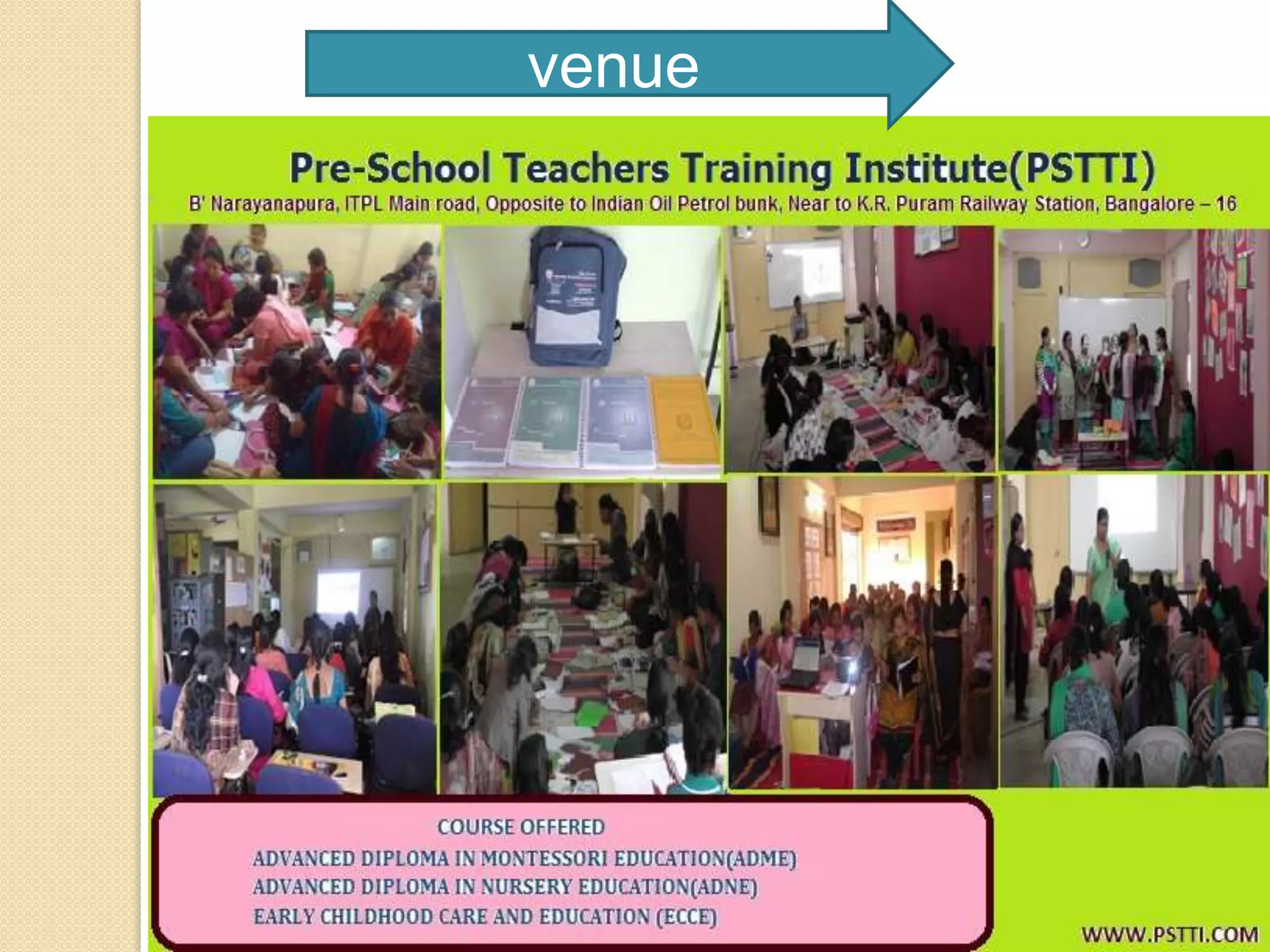
venue
Dealing with
Behavioural Challenges
in Early Learning
Alphonsa Joseph-Psychologist
Bhuvaneshwari- Speech –Language Pathologist
Characteristics of Effective
pre school Teachers
DAY 1 : 27TH December,2013
Teaching
Don't try to fix the students, fix ourselves
first. The good teacher makes the poor
student good and the good student
superior. When our students fail, we, as
teachers, too, have failed.

~Marva Collins
Core characteristics of teachers








What does it take to be an effective pre school teacher?
Effectiveness as a teacher comes from a combination of
1)knowledge, 2) skills, and 3) personal characteristics
Teachers can increase their knowledge and develop their
skills,
But, personal characteristics—which involve
social, emotional
and spiritual beliefs , in addition to the cognitive skills — are
often more set and fixed.
Teachers, educators and administrators would benefit from
knowing the characteristics of an effective teacher.
What made you join as a preschool teacher?
Money
 Occupational glamour
 Passion
 Feeling to create and make a difference in a child's life

12 Characteristics-by James H. Stronge

I- THE TEACHER AS A
PERSON
1)







Caring :
Exhibits active listening
Shows concern for students'
emotional and physical well-being
Displays interest in , and , concern
about the students' lives outside
school
Creates a supportive and warm
classroom environment.
FAIRNESS & RESPECT

Responds to misbehavior on an
individual level
 Prevents situations in which a student
loses peer respect
 Treats students equally
 Creates situations for all students to
succeed
 Shows respect to all students

INTERACTION with STUDENTS

Maintains professional role while
being friendly
 Gives students responsibility
 Knows students' interests both in and
out of school
 Values what students say
 Interacts in fun, playful manner; jokes
when appropriate

ENTHUSIASM
Shows joy for the content material
 Takes pleasure in teaching
 Demonstrates involvement in learning
activities outside school

MOTIVATION
Maintains high-quality work
 Returns student work in a timely
manner
 Provides students with meaningful
feedback

DEDICATION to TEACHING

Possesses a positive attitude about
life and teaching
 Spends time outside school preparing
 Accepts responsibility for student
outcomes
 Seeks professional development
 Finds, implements, and shares new
instructional strategies

REFLECTIVE PRACTICE
Knows areas of personal strengths
and weaknesses
 Uses reflection to improve teaching
 Sets high expectations for personal
classroom performance
 Demonstrates high efficacy

II) CLASSROOM MANAGEMENT- TEACHER AS

ORGANIZER










Uses consistent and proactive discipline
Establishes routines for all daily tasks and
needs
Orchestrates smooth transitions and
continuity of classroom momentum
Balances variety and challenge in student
activities
Multitasks
Is aware of all activities in the classroom
Anticipates potential problems
Uses space, proximity, or movement around
the classroom for nearness to trouble spots
and to encourage attention
ORGANIZATION
Handles routine tasks
promptly, efficiently, and consistently
 Prepares materials in advance; ready
to use
 Organizes classroom space efficiently

DISCIPLINING STUDENTS
Interprets and responds to
inappropriate behavior promptly
 Implements rules of behavior fairly
and consistently
 Reinforces and reiterates expectations
for positive behavior
 Uses appropriate disciplinary
measures

PERSONALITY QUALITIES
Check your skills and personality
traits
 Make a promise to change

THE TEACHER AS A PERSON -Positive Qualities



















Assumes ownership for the classroom and the students’ success
Uses personal experiences as examples in teaching
Understands feelings of students
Communicates clearly
Admits to mistakes and corrects them immediately ,e.g. sorry ,please etc.
Thinks about and reflects on practice
Displays a sense of humor
Dresses appropriately for the position
Maintains confidential trust and respect
Is structured, yet flexible and spontaneous
Is responsive to situations and students’ needs
Enjoys teaching and expects students to enjoy learning
Looks for the win-win solution in conflict situations
Listens attentively to student questions and comments.
Responds to students with respect, even in difficult situations
Positive qualities…..











Communicates high expectations consistently
Conducts one-on-one conversations with students
Treats students equally and fairly
Has positive dialogue and interactions with
students outside the classroom
Invests time with single students or small groups
of students outside the classroom
Maintains a professional manner at all times
Addresses students by name
Speaks in an appropriate tone and volume
Works actively with students
Red Flags – Teacher as a person















Believes that teaching is just a job
Arrives late to school and class on a regular basis
Has classroom discipline problems
Is not sensitive to a student’s culture or heritage
Expresses bias (positive or negative) with regard to students
Works on paperwork during class rather than working with
students
Has parents complaining about what is going on in the
classroom
Uses inappropriate language
Demeans or ridicules students
Exhibits defensive behavior for no apparent reason
Is confrontational with students
Lacks conflict resolution skills
Does not accept responsibility for what occurs in the
classroom
Positive Qualities – for classroom management












Positions chairs in groups or around tables to promote interaction
Manages classroom procedures to facilitate smooth transitions, for
procurement of materials and supplies, and supervision of volunteers
and paraprofessionals in the classroom
Manages student behavior through clear expectations and firm and
consistent responses to student actions
Maintains a physical environment where instructional materials and
equipment are in good repair
Covers walls with student work, student made signs, memos, and
calendars of student events
Has students welcome visitors and observers and explain activities
Emphasizes students addressing one another in a positive and
respectful manner
Encourages interactions and allows conversations about activities
or tasks in a low tone
Maximizes the physical aspect of the environment
Classroom management positive qualities
 Manages emergency situations as they occur











Maintains acceptable personal work space
Establishes routines for the running of the classroom and the
handling of routine student needs (e.g., bathroom visits,
pencil sharpening, and throwing away waste/trash)
Provides positive reinforcement and feedback
Disciplines students with dignity and respect
Shows evidence of established student routines for
responsibilities and student leadership
Exhibits consistency in management style
Is clear with classroom and school rules
Appropriate safety procedures are maintained
Red flags- classroom
management











Arranges desks and chairs in rows facing forward (without
regrouping)
Displays inconsistencies in enforcing class, school, and district
rules
Is not prepared with responses to common issues (bathroom
visits, pencil sharpening, and disruptions)
Uses strictly commercial posters to decorate walls
Lists rules and consequences for negative behaviors usually
(teacher formulated)
Ranks student progress on charts for all to view
Emphasizes facts and correct answers
Assigns one task to be completed by all students
Is not clear about expectations of students
Does not display school or classroom rules
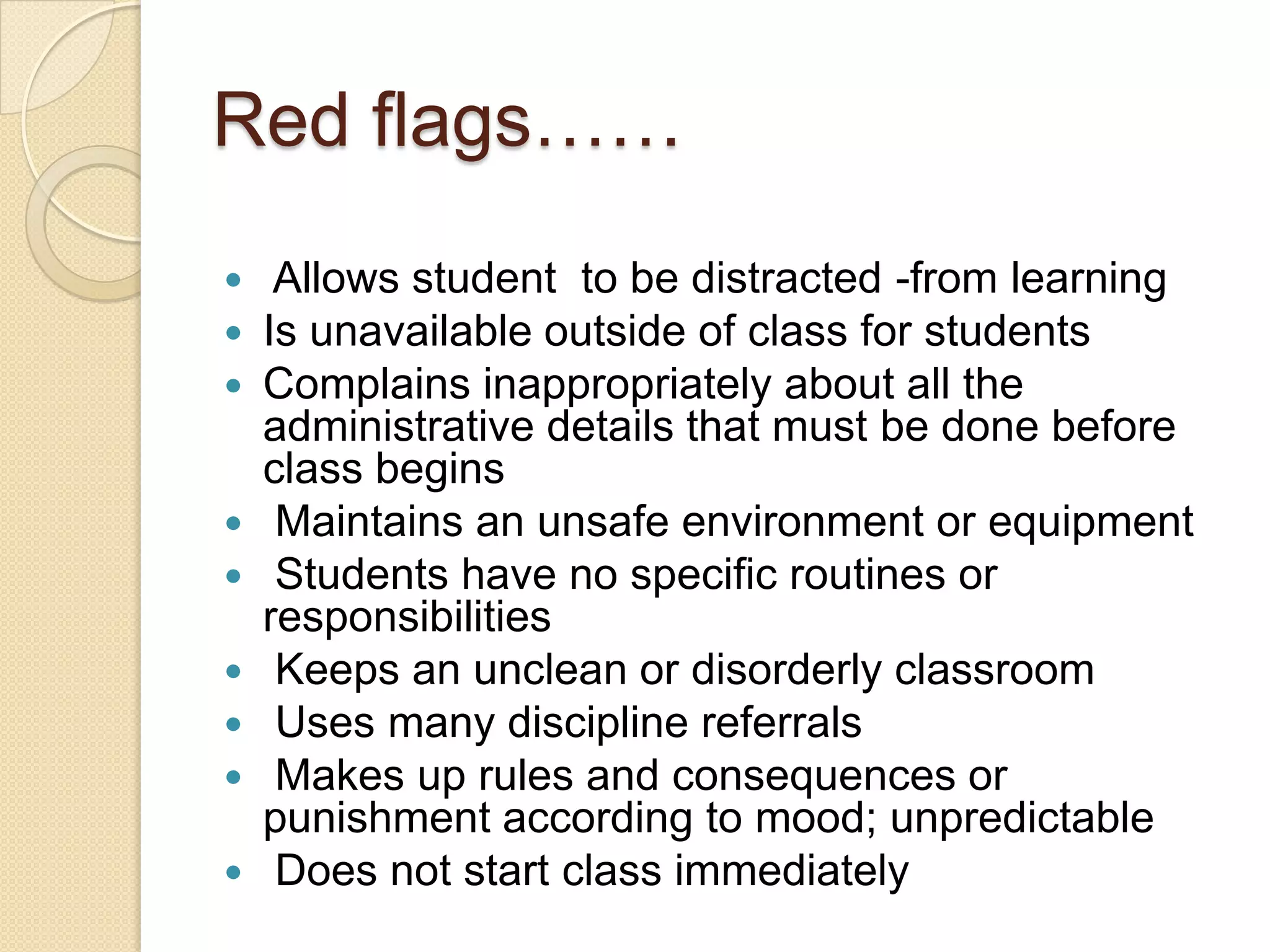
Red flags……











Allows student to be distracted -from learning
Is unavailable outside of class for students
Complains inappropriately about all the
administrative details that must be done before
class begins
Maintains an unsafe environment or equipment
Students have no specific routines or
responsibilities
Keeps an unclean or disorderly classroom
Uses many discipline referrals
Makes up rules and consequences or
punishment according to mood; unpredictable
Does not start class immediately
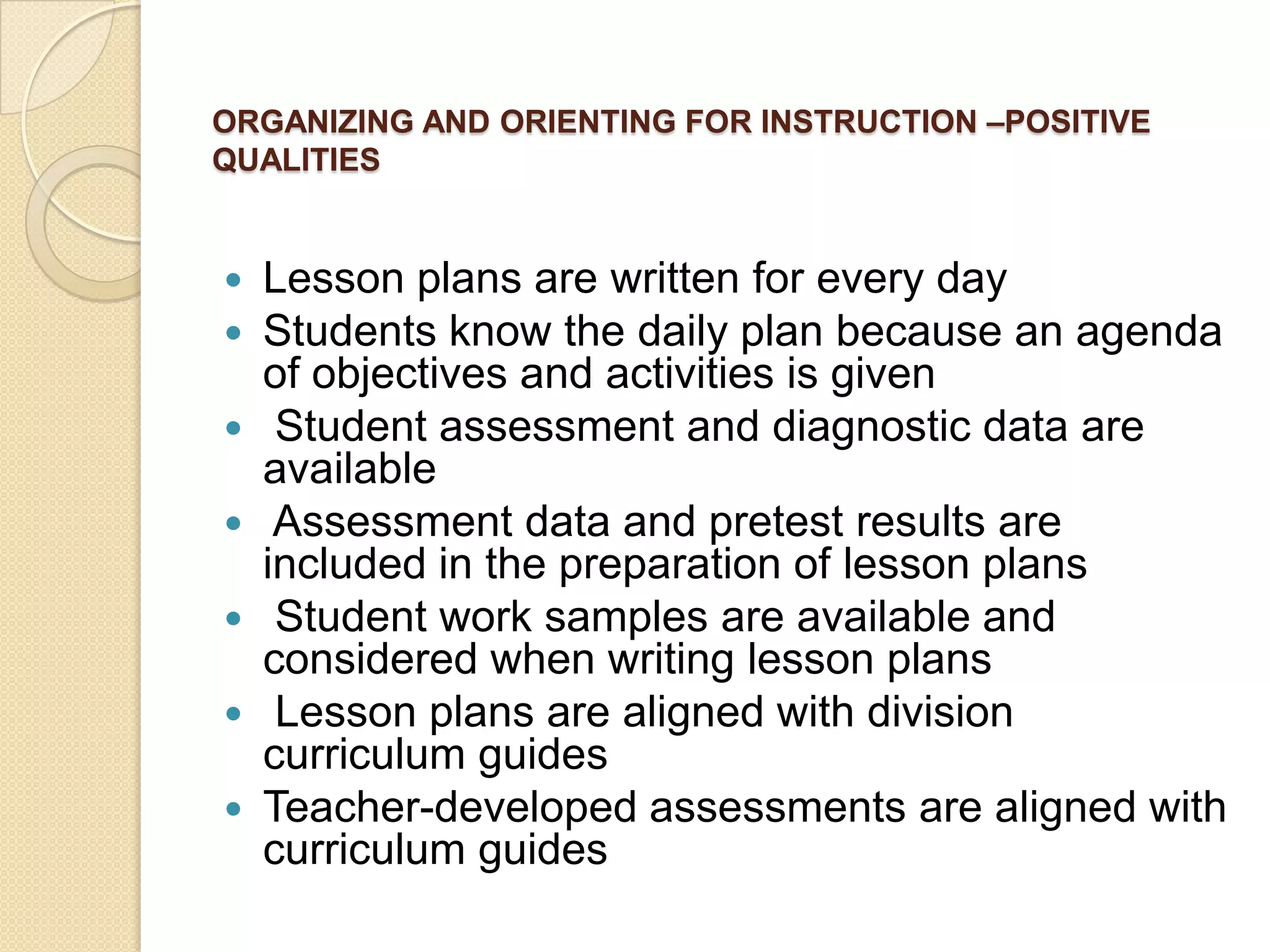
ORGANIZING AND ORIENTING FOR INSTRUCTION –POSITIVE
QUALITIES









Lesson plans are written for every day
Students know the daily plan because an agenda
of objectives and activities is given
Student assessment and diagnostic data are
available
Assessment data and pretest results are
included in the preparation of lesson plans
Student work samples are available and
considered when writing lesson plans
Lesson plans are aligned with division
curriculum guides
Teacher-developed assessments are aligned with
curriculum guides
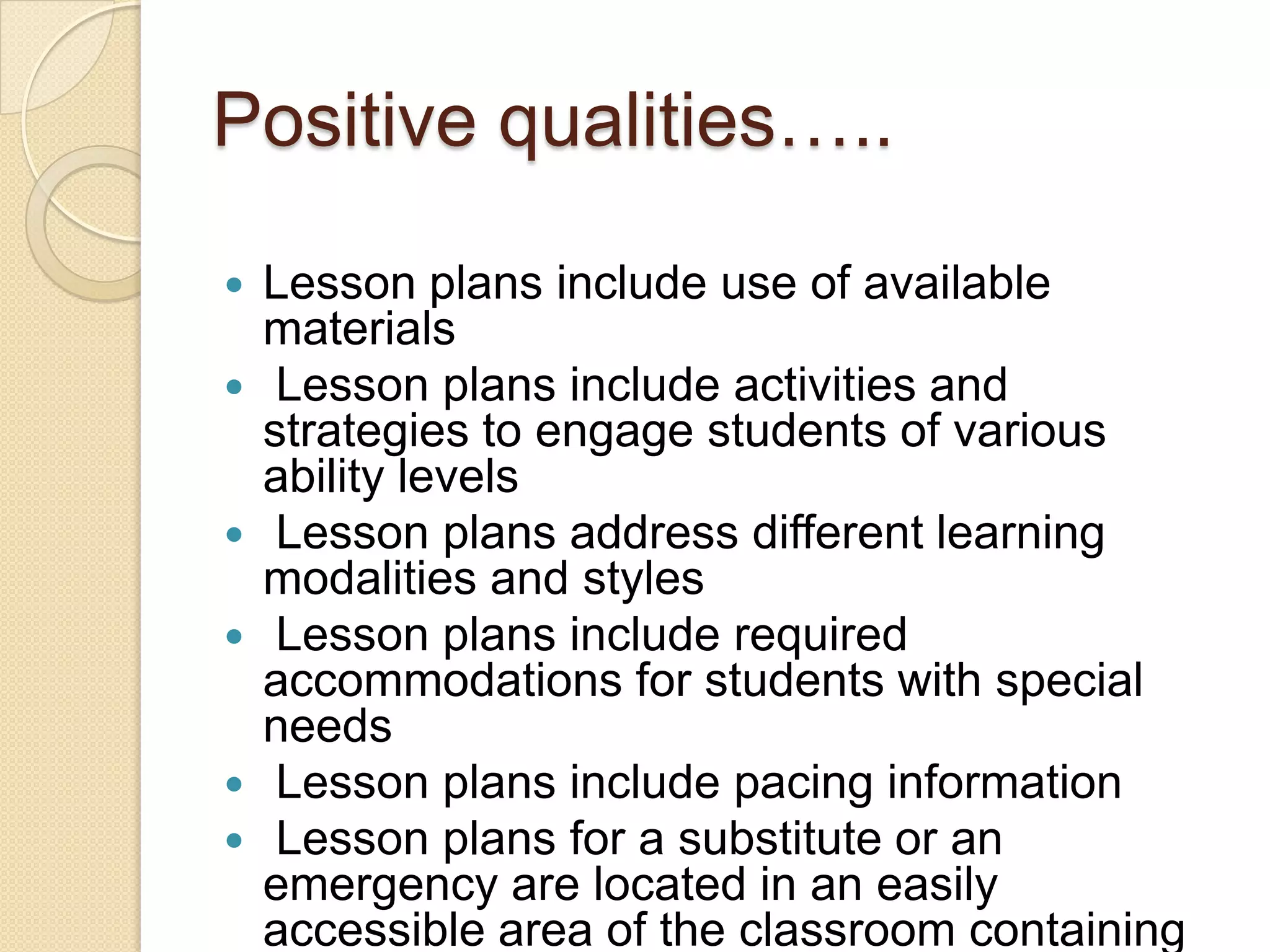
Positive qualities…..









Lesson plans include use of available
materials
Lesson plans include activities and
strategies to engage students of various
ability levels
Lesson plans address different learning
modalities and styles
Lesson plans include required
accommodations for students with special
needs
Lesson plans include pacing information
Lesson plans for a substitute or an
emergency are located in an easily
accessible area of the classroom containing
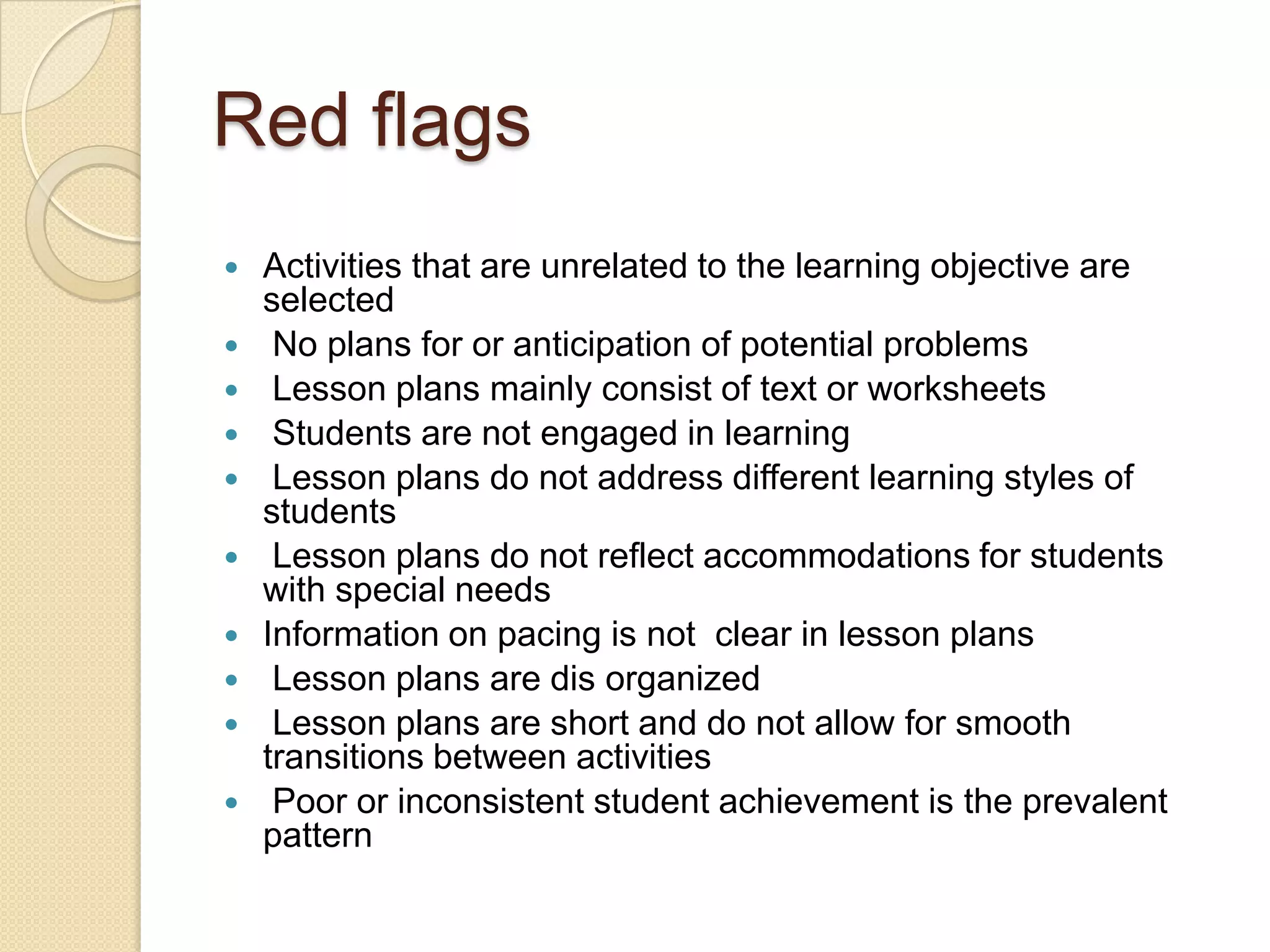
Red flags












Activities that are unrelated to the learning objective are
selected
No plans for or anticipation of potential problems
Lesson plans mainly consist of text or worksheets
Students are not engaged in learning
Lesson plans do not address different learning styles of
students
Lesson plans do not reflect accommodations for students
with special needs
Information on pacing is not clear in lesson plans
Lesson plans are dis organized
Lesson plans are short and do not allow for smooth
transitions between activities
Poor or inconsistent student achievement is the prevalent
pattern
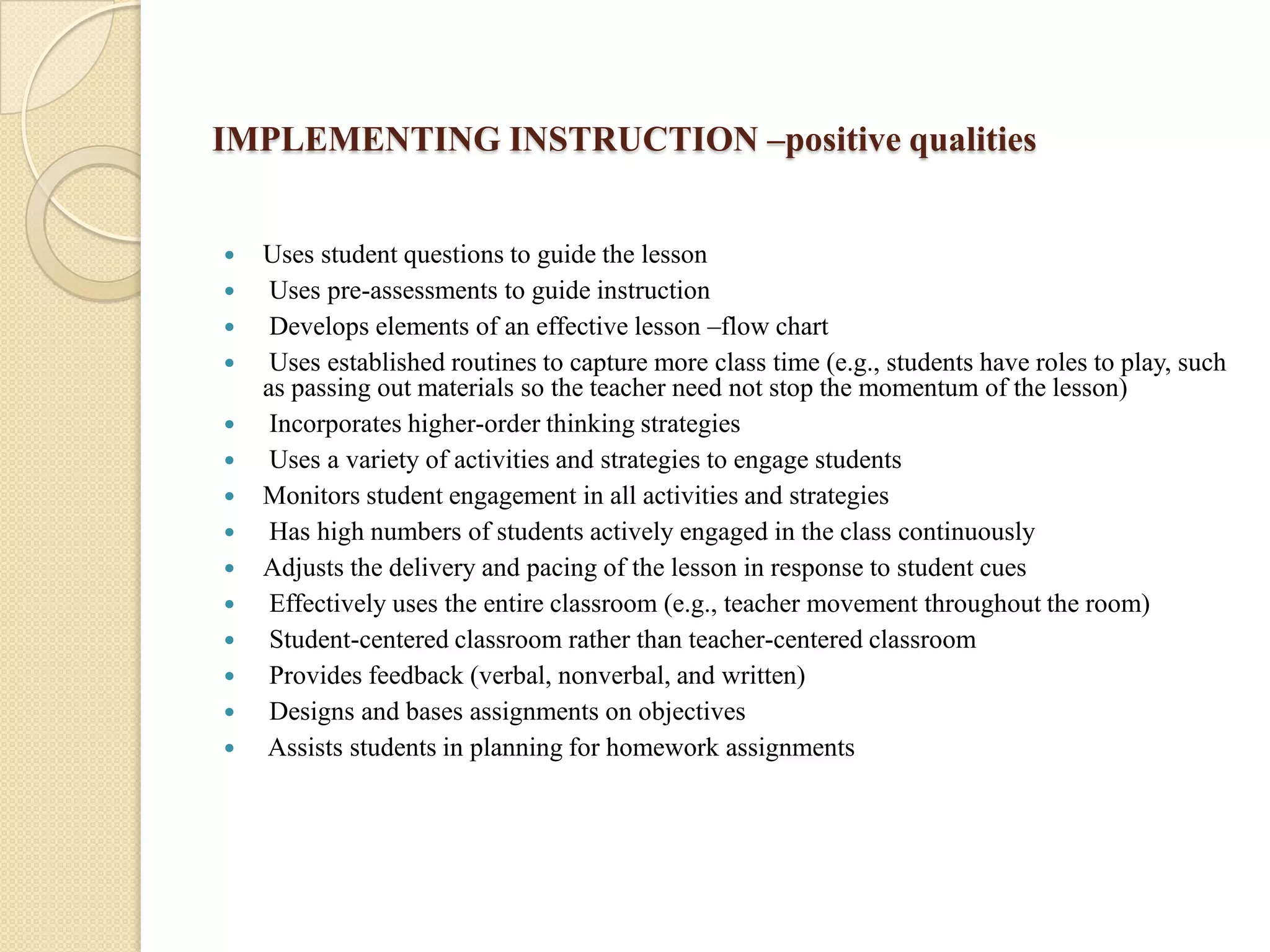
IMPLEMENTING INSTRUCTION –positive qualities
















Uses student questions to guide the lesson
Uses pre-assessments to guide instruction
Develops elements of an effective lesson –flow chart
Uses established routines to capture more class time (e.g., students have roles to play, such
as passing out materials so the teacher need not stop the momentum of the lesson)
Incorporates higher-order thinking strategies
Uses a variety of activities and strategies to engage students
Monitors student engagement in all activities and strategies
Has high numbers of students actively engaged in the class continuously
Adjusts the delivery and pacing of the lesson in response to student cues
Effectively uses the entire classroom (e.g., teacher movement throughout the room)
Student-centered classroom rather than teacher-centered classroom
Provides feedback (verbal, nonverbal, and written)
Designs and bases assignments on objectives
Assists students in planning for homework assignments
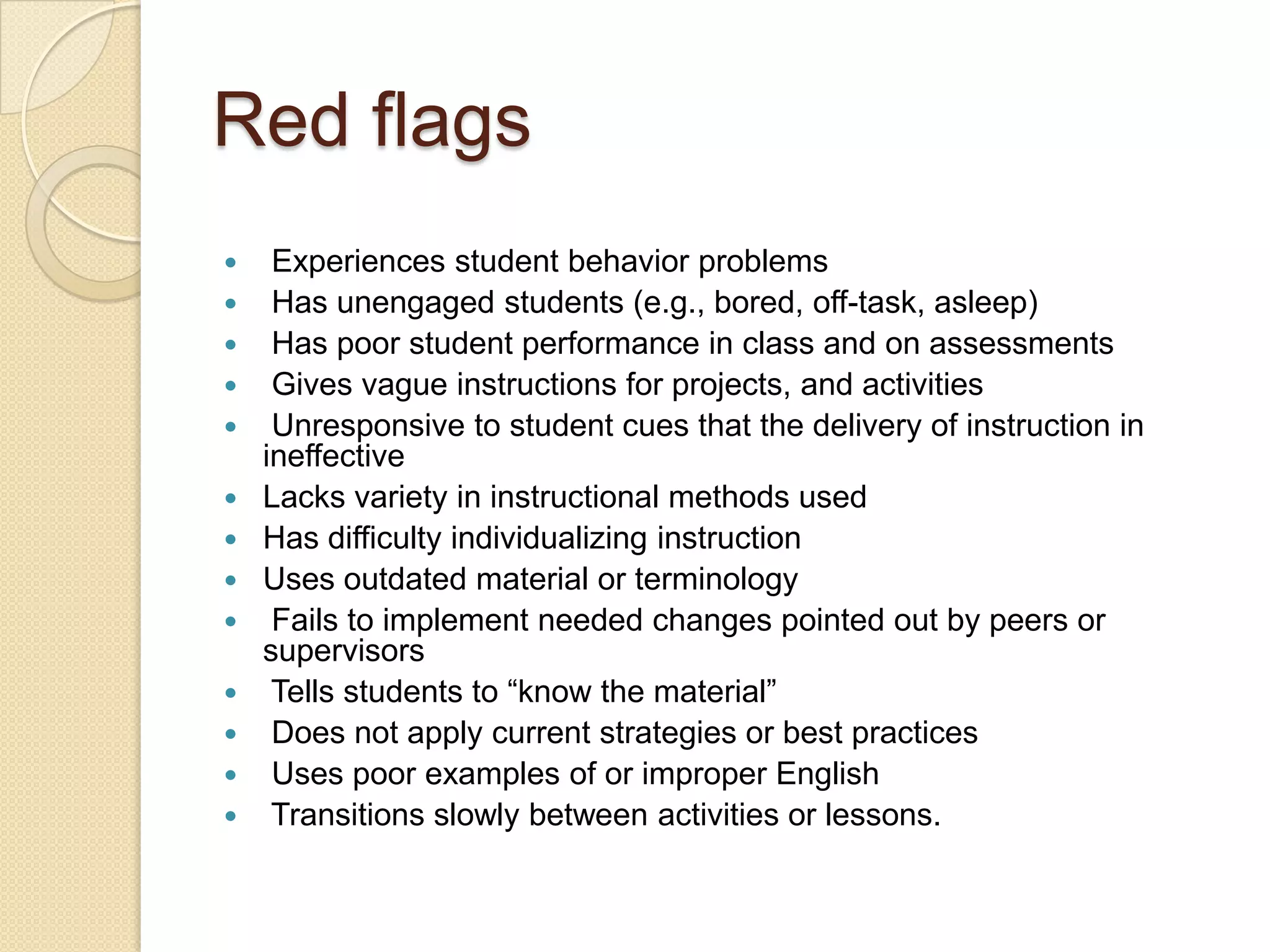
Red flags














Experiences student behavior problems
Has unengaged students (e.g., bored, off-task, asleep)
Has poor student performance in class and on assessments
Gives vague instructions for projects, and activities
Unresponsive to student cues that the delivery of instruction in
ineffective
Lacks variety in instructional methods used
Has difficulty individualizing instruction
Uses outdated material or terminology
Fails to implement needed changes pointed out by peers or
supervisors
Tells students to ―know the material‖
Does not apply current strategies or best practices
Uses poor examples of or improper English
Transitions slowly between activities or lessons.
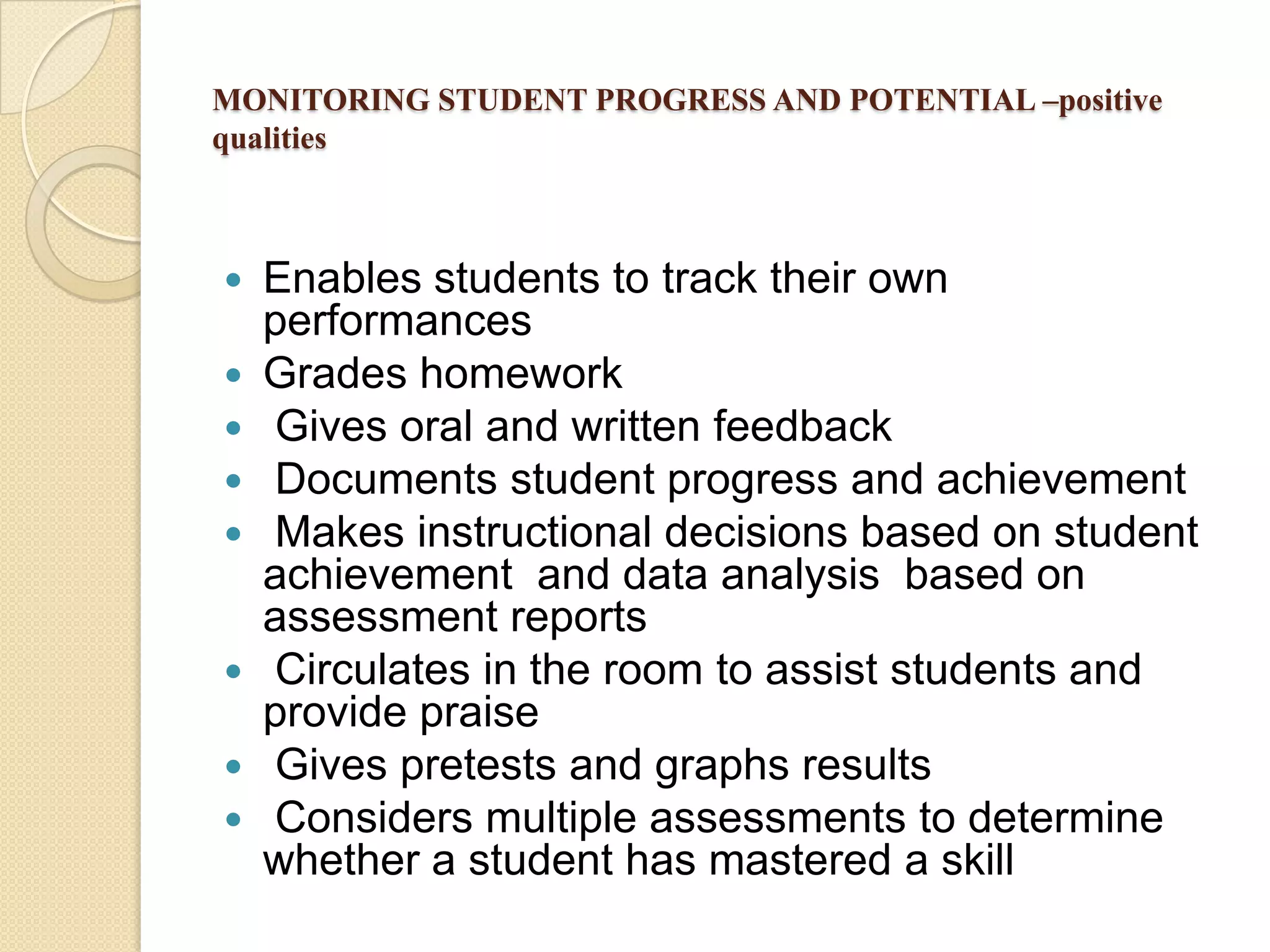
MONITORING STUDENT PROGRESS AND POTENTIAL –positive
qualities












Enables students to track their own
performances
Grades homework
Gives oral and written feedback
Documents student progress and achievement
Makes instructional decisions based on student
achievement and data analysis based on
assessment reports
Circulates in the room to assist students and
provide praise
Gives pretests and graphs results
Considers multiple assessments to determine
whether a student has mastered a skill
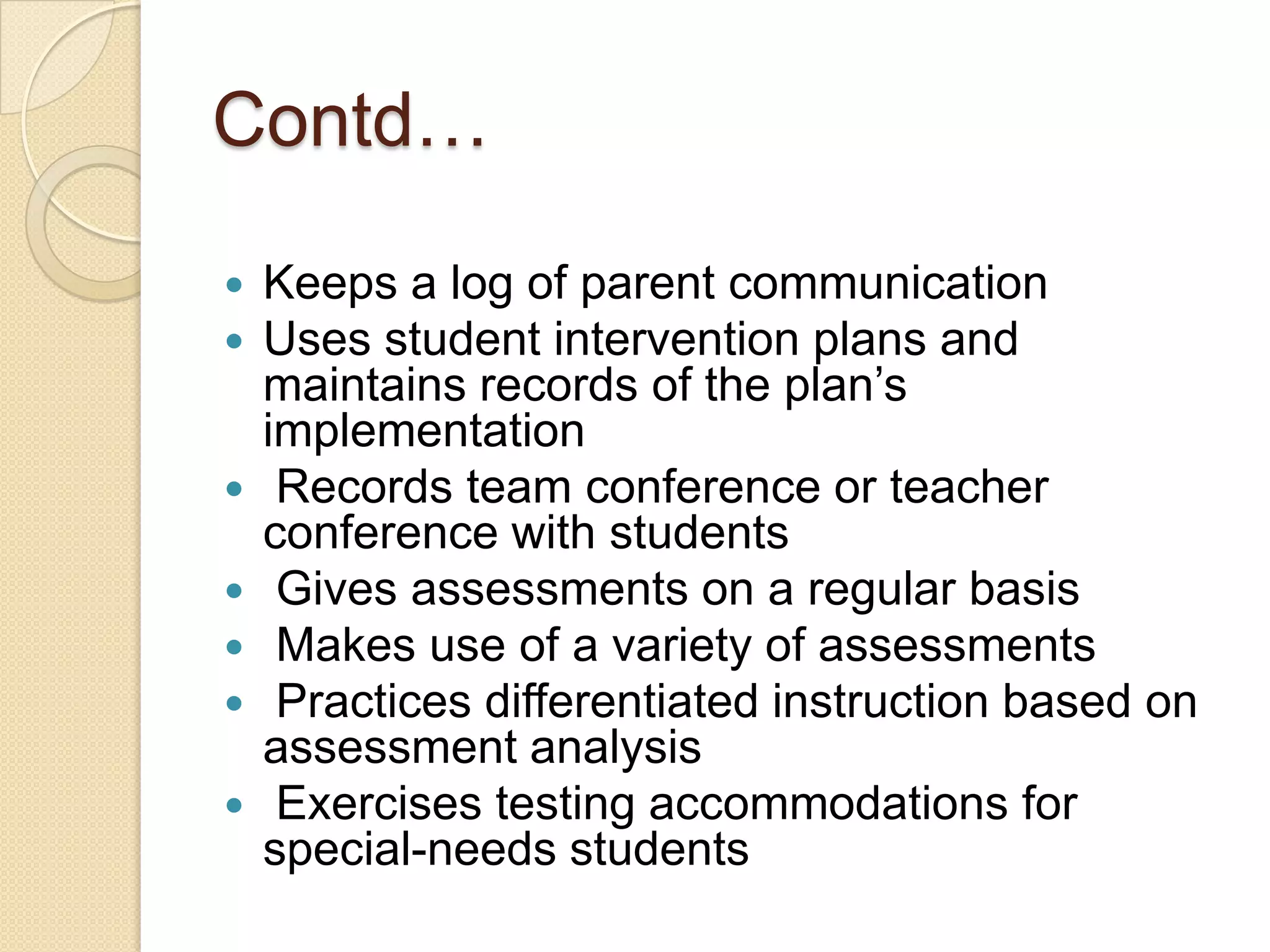
Contd…









Keeps a log of parent communication
Uses student intervention plans and
maintains records of the plan’s
implementation
Records team conference or teacher
conference with students
Gives assessments on a regular basis
Makes use of a variety of assessments
Practices differentiated instruction based on
assessment analysis
Exercises testing accommodations for
special-needs students
Contd…..







Maintains copies of all correspondence
(written, e-mail,) concerning student progress
Holds teacher-parent-student conferences
and meetings
Invites parents and guests to special class
events
Communicates with informal progress
reports
Uses appropriate and clear language in
communications
Participates in Individualized Education
Program (IEP) meetings for special-needs
Red flags












Does not monitor student progress or allow for questions
fails to monitor student progress
Does not keep a communication log
Does not record conferences with students or parents and
guardians
Uses extremes in grading – high failure rates or
unrealistically high percentage of excellent grades
Fails to re-teach after assessments to correct gaps in student
learning
Offers little or not variety of assessments
ignores testing accommodations for special-needs students
Does not document or holds few parent communications
technical, or inappropriate language in communication
Does not participate in or attend IEP meetings for students
with special needs
THANK YOU

OPEN FOR DISCUSSION

Dealing with Behavioral Challenges in Pre School Children - Workshop day 1

  • 1.
    No.511, 3A Main,5th Cross, OMBR Layout, Bangalore – 560 043
  • 2.
  • 3.
    Dealing with Behavioural Challenges inEarly Learning Alphonsa Joseph-Psychologist Bhuvaneshwari- Speech –Language Pathologist
  • 4.
    Characteristics of Effective preschool Teachers DAY 1 : 27TH December,2013
  • 5.
    Teaching Don't try tofix the students, fix ourselves first. The good teacher makes the poor student good and the good student superior. When our students fail, we, as teachers, too, have failed. ~Marva Collins
  • 6.
    Core characteristics ofteachers      What does it take to be an effective pre school teacher? Effectiveness as a teacher comes from a combination of 1)knowledge, 2) skills, and 3) personal characteristics Teachers can increase their knowledge and develop their skills, But, personal characteristics—which involve social, emotional and spiritual beliefs , in addition to the cognitive skills — are often more set and fixed. Teachers, educators and administrators would benefit from knowing the characteristics of an effective teacher.
  • 7.
    What made youjoin as a preschool teacher? Money  Occupational glamour  Passion  Feeling to create and make a difference in a child's life 
  • 8.
    12 Characteristics-by JamesH. Stronge I- THE TEACHER AS A PERSON 1)     Caring : Exhibits active listening Shows concern for students' emotional and physical well-being Displays interest in , and , concern about the students' lives outside school Creates a supportive and warm classroom environment.
  • 9.
    FAIRNESS & RESPECT Respondsto misbehavior on an individual level  Prevents situations in which a student loses peer respect  Treats students equally  Creates situations for all students to succeed  Shows respect to all students 
  • 10.
    INTERACTION with STUDENTS Maintainsprofessional role while being friendly  Gives students responsibility  Knows students' interests both in and out of school  Values what students say  Interacts in fun, playful manner; jokes when appropriate 
  • 11.
    ENTHUSIASM Shows joy forthe content material  Takes pleasure in teaching  Demonstrates involvement in learning activities outside school 
  • 12.
    MOTIVATION Maintains high-quality work Returns student work in a timely manner  Provides students with meaningful feedback 
  • 13.
    DEDICATION to TEACHING Possessesa positive attitude about life and teaching  Spends time outside school preparing  Accepts responsibility for student outcomes  Seeks professional development  Finds, implements, and shares new instructional strategies 
  • 14.
    REFLECTIVE PRACTICE Knows areasof personal strengths and weaknesses  Uses reflection to improve teaching  Sets high expectations for personal classroom performance  Demonstrates high efficacy 
  • 15.
    II) CLASSROOM MANAGEMENT-TEACHER AS ORGANIZER         Uses consistent and proactive discipline Establishes routines for all daily tasks and needs Orchestrates smooth transitions and continuity of classroom momentum Balances variety and challenge in student activities Multitasks Is aware of all activities in the classroom Anticipates potential problems Uses space, proximity, or movement around the classroom for nearness to trouble spots and to encourage attention
  • 16.
    ORGANIZATION Handles routine tasks promptly,efficiently, and consistently  Prepares materials in advance; ready to use  Organizes classroom space efficiently 
  • 17.
    DISCIPLINING STUDENTS Interprets andresponds to inappropriate behavior promptly  Implements rules of behavior fairly and consistently  Reinforces and reiterates expectations for positive behavior  Uses appropriate disciplinary measures 
  • 18.
    PERSONALITY QUALITIES Check yourskills and personality traits  Make a promise to change 
  • 19.
    THE TEACHER ASA PERSON -Positive Qualities                Assumes ownership for the classroom and the students’ success Uses personal experiences as examples in teaching Understands feelings of students Communicates clearly Admits to mistakes and corrects them immediately ,e.g. sorry ,please etc. Thinks about and reflects on practice Displays a sense of humor Dresses appropriately for the position Maintains confidential trust and respect Is structured, yet flexible and spontaneous Is responsive to situations and students’ needs Enjoys teaching and expects students to enjoy learning Looks for the win-win solution in conflict situations Listens attentively to student questions and comments. Responds to students with respect, even in difficult situations
  • 20.
    Positive qualities…..          Communicates highexpectations consistently Conducts one-on-one conversations with students Treats students equally and fairly Has positive dialogue and interactions with students outside the classroom Invests time with single students or small groups of students outside the classroom Maintains a professional manner at all times Addresses students by name Speaks in an appropriate tone and volume Works actively with students
  • 21.
    Red Flags –Teacher as a person              Believes that teaching is just a job Arrives late to school and class on a regular basis Has classroom discipline problems Is not sensitive to a student’s culture or heritage Expresses bias (positive or negative) with regard to students Works on paperwork during class rather than working with students Has parents complaining about what is going on in the classroom Uses inappropriate language Demeans or ridicules students Exhibits defensive behavior for no apparent reason Is confrontational with students Lacks conflict resolution skills Does not accept responsibility for what occurs in the classroom
  • 22.
    Positive Qualities –for classroom management          Positions chairs in groups or around tables to promote interaction Manages classroom procedures to facilitate smooth transitions, for procurement of materials and supplies, and supervision of volunteers and paraprofessionals in the classroom Manages student behavior through clear expectations and firm and consistent responses to student actions Maintains a physical environment where instructional materials and equipment are in good repair Covers walls with student work, student made signs, memos, and calendars of student events Has students welcome visitors and observers and explain activities Emphasizes students addressing one another in a positive and respectful manner Encourages interactions and allows conversations about activities or tasks in a low tone Maximizes the physical aspect of the environment
  • 23.
    Classroom management positivequalities  Manages emergency situations as they occur         Maintains acceptable personal work space Establishes routines for the running of the classroom and the handling of routine student needs (e.g., bathroom visits, pencil sharpening, and throwing away waste/trash) Provides positive reinforcement and feedback Disciplines students with dignity and respect Shows evidence of established student routines for responsibilities and student leadership Exhibits consistency in management style Is clear with classroom and school rules Appropriate safety procedures are maintained
  • 24.
    Red flags- classroom management           Arrangesdesks and chairs in rows facing forward (without regrouping) Displays inconsistencies in enforcing class, school, and district rules Is not prepared with responses to common issues (bathroom visits, pencil sharpening, and disruptions) Uses strictly commercial posters to decorate walls Lists rules and consequences for negative behaviors usually (teacher formulated) Ranks student progress on charts for all to view Emphasizes facts and correct answers Assigns one task to be completed by all students Is not clear about expectations of students Does not display school or classroom rules
  • 25.
    Red flags……          Allows studentto be distracted -from learning Is unavailable outside of class for students Complains inappropriately about all the administrative details that must be done before class begins Maintains an unsafe environment or equipment Students have no specific routines or responsibilities Keeps an unclean or disorderly classroom Uses many discipline referrals Makes up rules and consequences or punishment according to mood; unpredictable Does not start class immediately
  • 26.
    ORGANIZING AND ORIENTINGFOR INSTRUCTION –POSITIVE QUALITIES        Lesson plans are written for every day Students know the daily plan because an agenda of objectives and activities is given Student assessment and diagnostic data are available Assessment data and pretest results are included in the preparation of lesson plans Student work samples are available and considered when writing lesson plans Lesson plans are aligned with division curriculum guides Teacher-developed assessments are aligned with curriculum guides
  • 27.
    Positive qualities…..       Lesson plansinclude use of available materials Lesson plans include activities and strategies to engage students of various ability levels Lesson plans address different learning modalities and styles Lesson plans include required accommodations for students with special needs Lesson plans include pacing information Lesson plans for a substitute or an emergency are located in an easily accessible area of the classroom containing
  • 28.
    Red flags           Activities thatare unrelated to the learning objective are selected No plans for or anticipation of potential problems Lesson plans mainly consist of text or worksheets Students are not engaged in learning Lesson plans do not address different learning styles of students Lesson plans do not reflect accommodations for students with special needs Information on pacing is not clear in lesson plans Lesson plans are dis organized Lesson plans are short and do not allow for smooth transitions between activities Poor or inconsistent student achievement is the prevalent pattern
  • 29.
    IMPLEMENTING INSTRUCTION –positivequalities               Uses student questions to guide the lesson Uses pre-assessments to guide instruction Develops elements of an effective lesson –flow chart Uses established routines to capture more class time (e.g., students have roles to play, such as passing out materials so the teacher need not stop the momentum of the lesson) Incorporates higher-order thinking strategies Uses a variety of activities and strategies to engage students Monitors student engagement in all activities and strategies Has high numbers of students actively engaged in the class continuously Adjusts the delivery and pacing of the lesson in response to student cues Effectively uses the entire classroom (e.g., teacher movement throughout the room) Student-centered classroom rather than teacher-centered classroom Provides feedback (verbal, nonverbal, and written) Designs and bases assignments on objectives Assists students in planning for homework assignments
  • 30.
    Red flags              Experiences studentbehavior problems Has unengaged students (e.g., bored, off-task, asleep) Has poor student performance in class and on assessments Gives vague instructions for projects, and activities Unresponsive to student cues that the delivery of instruction in ineffective Lacks variety in instructional methods used Has difficulty individualizing instruction Uses outdated material or terminology Fails to implement needed changes pointed out by peers or supervisors Tells students to ―know the material‖ Does not apply current strategies or best practices Uses poor examples of or improper English Transitions slowly between activities or lessons.
  • 31.
    MONITORING STUDENT PROGRESSAND POTENTIAL –positive qualities         Enables students to track their own performances Grades homework Gives oral and written feedback Documents student progress and achievement Makes instructional decisions based on student achievement and data analysis based on assessment reports Circulates in the room to assist students and provide praise Gives pretests and graphs results Considers multiple assessments to determine whether a student has mastered a skill
  • 32.
    Contd…        Keeps a logof parent communication Uses student intervention plans and maintains records of the plan’s implementation Records team conference or teacher conference with students Gives assessments on a regular basis Makes use of a variety of assessments Practices differentiated instruction based on assessment analysis Exercises testing accommodations for special-needs students
  • 33.
    Contd…..       Maintains copies ofall correspondence (written, e-mail,) concerning student progress Holds teacher-parent-student conferences and meetings Invites parents and guests to special class events Communicates with informal progress reports Uses appropriate and clear language in communications Participates in Individualized Education Program (IEP) meetings for special-needs
  • 34.
    Red flags           Does notmonitor student progress or allow for questions fails to monitor student progress Does not keep a communication log Does not record conferences with students or parents and guardians Uses extremes in grading – high failure rates or unrealistically high percentage of excellent grades Fails to re-teach after assessments to correct gaps in student learning Offers little or not variety of assessments ignores testing accommodations for special-needs students Does not document or holds few parent communications technical, or inappropriate language in communication Does not participate in or attend IEP meetings for students with special needs
  • 35.