U.S. foreign policy, "The Bush Revolution”, the Obama
Administration & the U.S. Military Industrial Complex
"As we defend the peace, we will also take
advantage of an historic opportunity to preserve the
peace."
--Former President George W. Bush (2003), National
security strategy of the United States of America
"Obviously the permanent peace of the world can be secured only
through the gradual concentration of the preponderant military
strength into the hands of the most pacific communities."
- John Fiske (1880), American political ideas viewed from
standpoint of universal history
While there are instances and individuals who
can be met only by force, the United States
will be prepared to listen to and talk with our
adversaries in order to advance our interests.
-- President Barack Obama (2009)
Daalder & Lindsay: A brief history of
U.S. foreign policy - Nascent America
Late 1700s, early 1800s
- political distance from Europe (“isolationism”)
- neutrality
"Europe has a set of primary interests which to us have
none or a very remote relation. Hence she must be
engaged in frequent controversies, the causes of
which are essentially foreign to our concerns.”
- George Washington
"(America) goes not abroad, in search of monsters to
destroy. She is the well-wisher to the freedom and
independence of all. She is the champion and
vindicator only of her own.”
- John Quincy Adams (1821)
Monroe Doctrine (1823)
Daalder & Lindsay: A brief
history of U.S. foreign policy -
Manifest Destiny
Middle 1800s
- intra-national, westward expansion
- global economic & religious expansion
- social Darwinism
"No man, no party, can fight with any chance of success against a
cosmic tendency; no cleverness, no popularity avails against the
spirit of the age.”
- John Hay, Secretary of State for William McKinley
"All nations that are worth anything, always have had, and always
will have, some ideal of national destiny, and without it, would soon
disappear, and would deserve their fate."
- Ephraim Douglass Adams, The power of ideals in American
history (1913)
Daalder & Lindsay: A brief history
of U.S. foreign policy - Growing
ambition
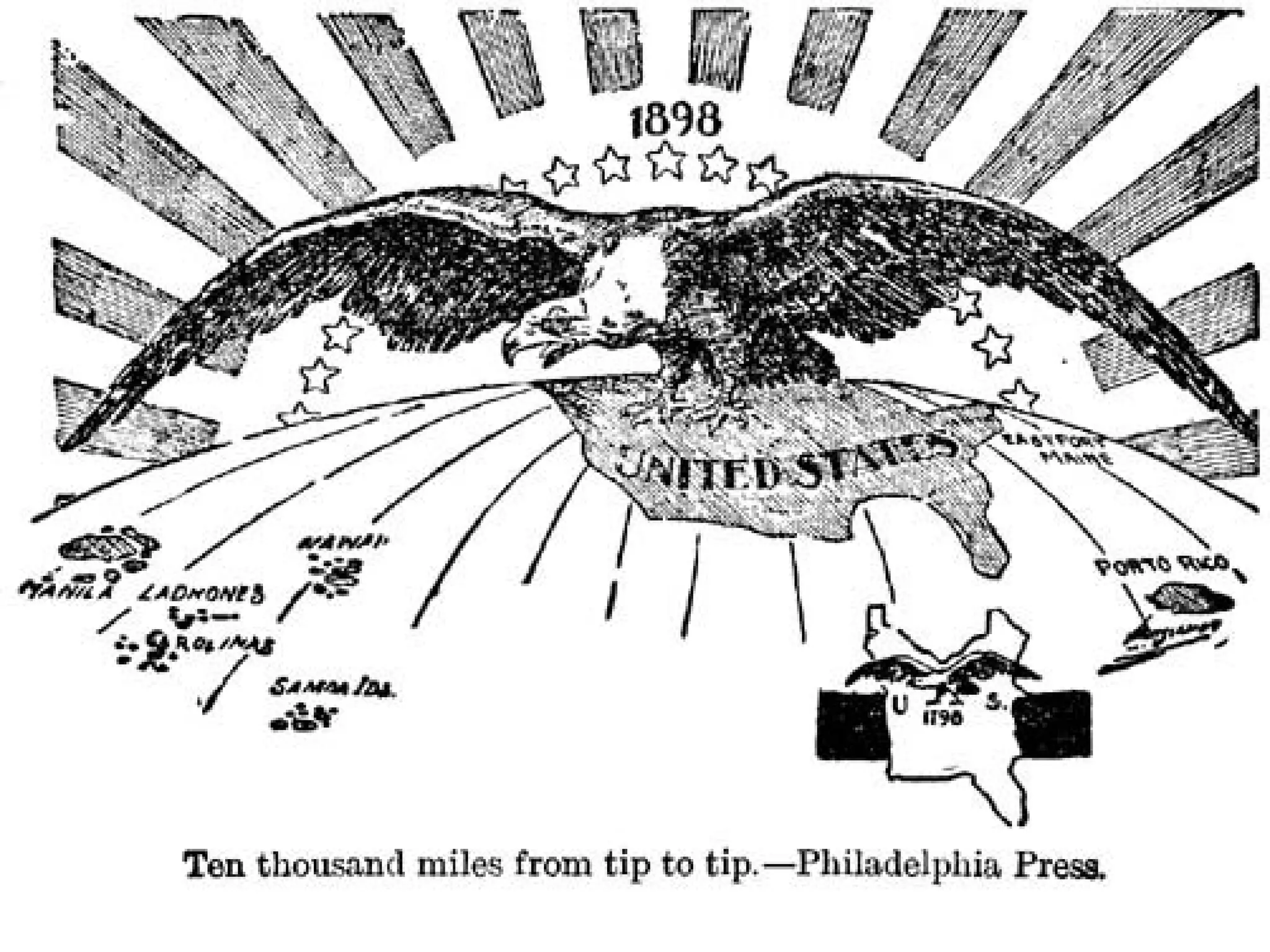
Late 1800s, Early 1900s
- internationalists vs. isolationists
- Spanish American War & American colonialism
- Theodore Roosevelt
- costs of America imperialism
"I believe that the time will come when such a state of
(global federalism) will exist upon the earth, when it will be
possible . . . to speak of the UNITED STATES as stretching
from pole to pole, -- or, with Tennyson, to celebrate the
'parliament of man and federation of the world.' "
- John Fiske (1880), American political ideas viewed from
standpoint of universal history
Daalder & Lindsay: A brief history of
U.S. foreign policy - Wilsonianism
1913 - ?
- New World Order
- American exceptionalism + divine providence =
interventionism
- international law & institutions
- Treaty of Versailles (1919): League of Nations
"We do not confine our enthusiasm for individual
liberty and free national development to the
incidents and movements of affairs which affect
only ourselves. We feel it wherever there is a
people that tries to walk in these difficult paths of
independence and right."
-- Woodrow Wilson, 1916
- internationalism vs. unilateralism
- 1930s: Depression & return to isolationism
Daalder & Lindsay: A brief history of U.S.
foreign policy - Post WWII: "The Truman
Doctrine”
1945
- U.S. emerges as “preeminent” world power
- largest economic & military power; nuclear capacity
- key question: not what can U.S. do abroad, but what should it
do?
- Truman Doctrine (1947)
"It must be the policy of the United States to support free peoples
who are resisting attempted subjugation by armed minorities or by
outside pressures."
- Marshall Plan (1947)
- NATO (1949)
-->multilateral alliances & agreements
(GATT, IMF, World Bank, etc.)
Daalder & Lindsay: A brief history of
U.S. foreign policy - The Cold War
1950s
- Eisenhower --> unilateralist/anti-containment rhetoric;
multilateral/containment actions
- specter of nuclear annihilation (mutually assured
destruction)
- hegemonic American multilateralism
- rise of U.S. military industrial complex (Eisenhower
voices reservations)
1960s-1980s
- Cold War logic continues
Daalder & Lindsay: A brief history of U.S.
foreign policy -
Post Cold War: The Clinton Era
- Wilsonianism revisited?
New World Order, Int. Rule of law, Int. organizations,
multilateralism
critics --> why go international/multilateral now?
- key question: not what can U.S. do abroad, but what
should it do?
Daalder & Lindsay: "The Bush
Revolution”
- revival of American unilateralism
- rise of "a la carte" multilateralism
- regime change over negotiation
- exploitation of European division
- doctrine of preemption
"The United States can no longer
solely rely on a reactive posture as we
have in the past. . . We cannot let our
enemies strike first."
- President George W. Bush (National
Security Strategy of the U.S.)
NOT a revolution in America's goals (ENDS),
but in how to achieve goals (MEANS)
then: threat of nuclear
war
now: no one can push
back
Obama’s foreign policy: Analysis
“The lesson of the Bush years is that not talking does not work. Go
down the list of countries we’ve ignored and see how successful that
strategy has been. … It’s time to turn the page on the diplomacy of
tough talk and no action. It’s time to turn the page on Washington’s
conventional wisdom that agreement must be reached before you
meet, that talking to other countries is some kind of reward, and that
Presidents can only meet with people who will tell them what they want
to hear.”
--President Barack Obama
Obama has not achieved the transformative results he promised on the 2008
campaign trail . . . But on balance, he has proved tough, disciplined and,
overall, reasonably successful in addressing the nation’s immediate security
challenges. One might call him a reluctant realist: Holding onto his idealistic
visions and pursuing them where possible but adroitly shifting to tougher
measures when necessary … In other words, Obama is a pragmatist. A
progressive one, to be sure — since he sought, where possible, to make
inroads in the pursuit of his bigger hopes. But a pragmatist just the same —
and a hawkish one in many ways …While Obama’s handling of rogue states
and other issues makes for a generally positive assessment of his role as
commander in chief, it remains an interim assessment — for the Iran and
North Korea situations could well deteriorate.
--- Martin Indyk, Co-Author, Bending History
The U.S. military around the world
1.4 million = approximate number of active U.S. military
personnel
325,000 = approximate number deployed outside of U.S.
725 = approximate number of U.S. military bases outside U.S.
32 = approximate number of countries with 100 or more U.S.
military personnel
6 = number of continents with American military personnel
- Sources: U.S. Department of Defense; wikipedia.org;
Chalmers Johnson, The Sorrows of Empire, 2003-2005)
The U.S. foreign policy & the use of
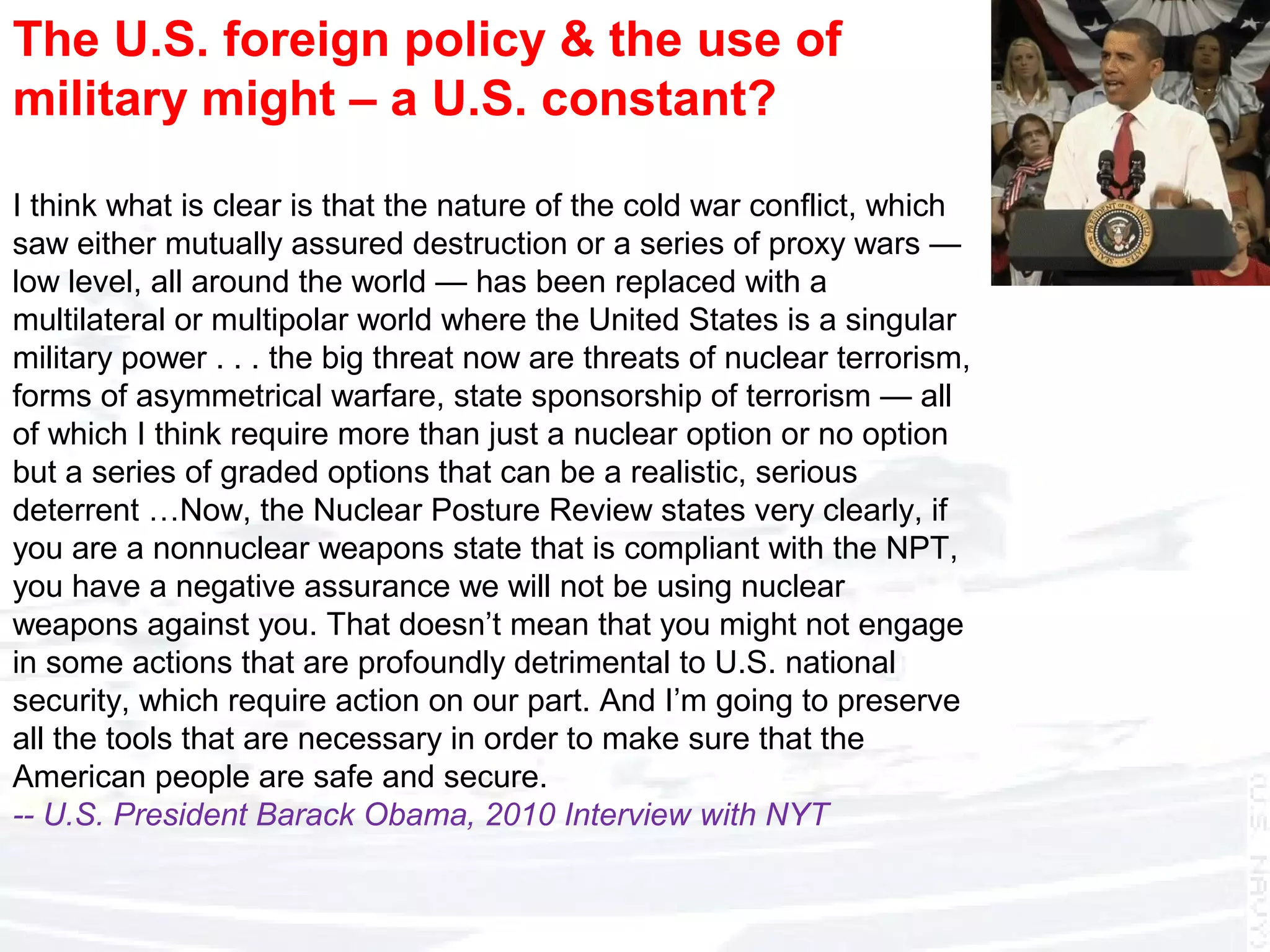
military might – a U.S. constant?
I think what is clear is that the nature of the cold war conflict, which
saw either mutually assured destruction or a series of proxy wars —
low level, all around the world — has been replaced with a
multilateral or multipolar world where the United States is a singular
military power . . . the big threat now are threats of nuclear terrorism,
forms of asymmetrical warfare, state sponsorship of terrorism — all
of which I think require more than just a nuclear option or no option
but a series of graded options that can be a realistic, serious
deterrent …Now, the Nuclear Posture Review states very clearly, if
you are a nonnuclear weapons state that is compliant with the NPT,
you have a negative assurance we will not be using nuclear
weapons against you. That doesn’t mean that you might not engage
in some actions that are profoundly detrimental to U.S. national
security, which require action on our part. And I’m going to preserve
all the tools that are necessary in order to make sure that the
American people are safe and secure.
-- U.S. President Barack Obama, 2010 Interview with NYT
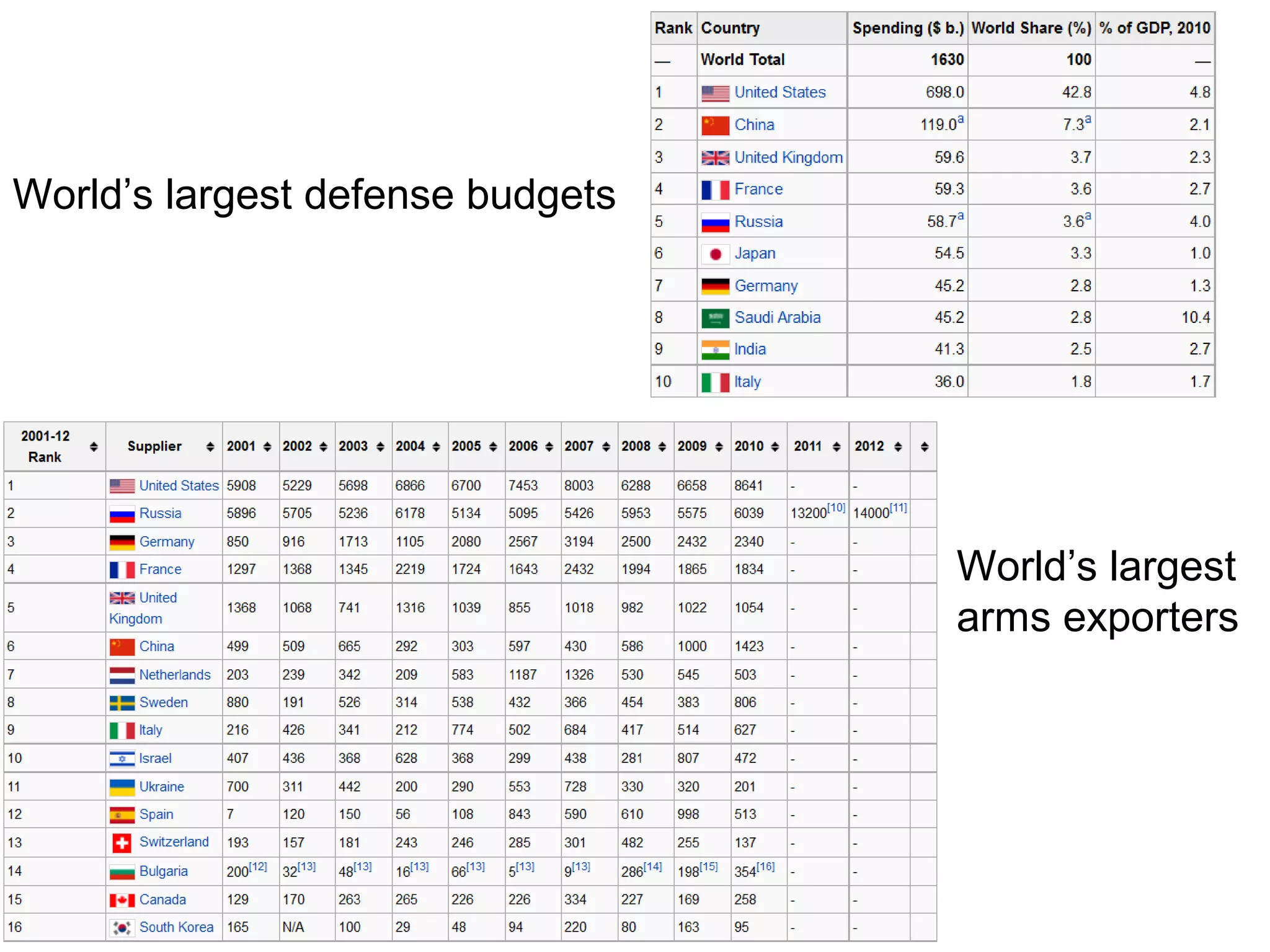
World’s largest defense budgets
World’s largest
arms exporters
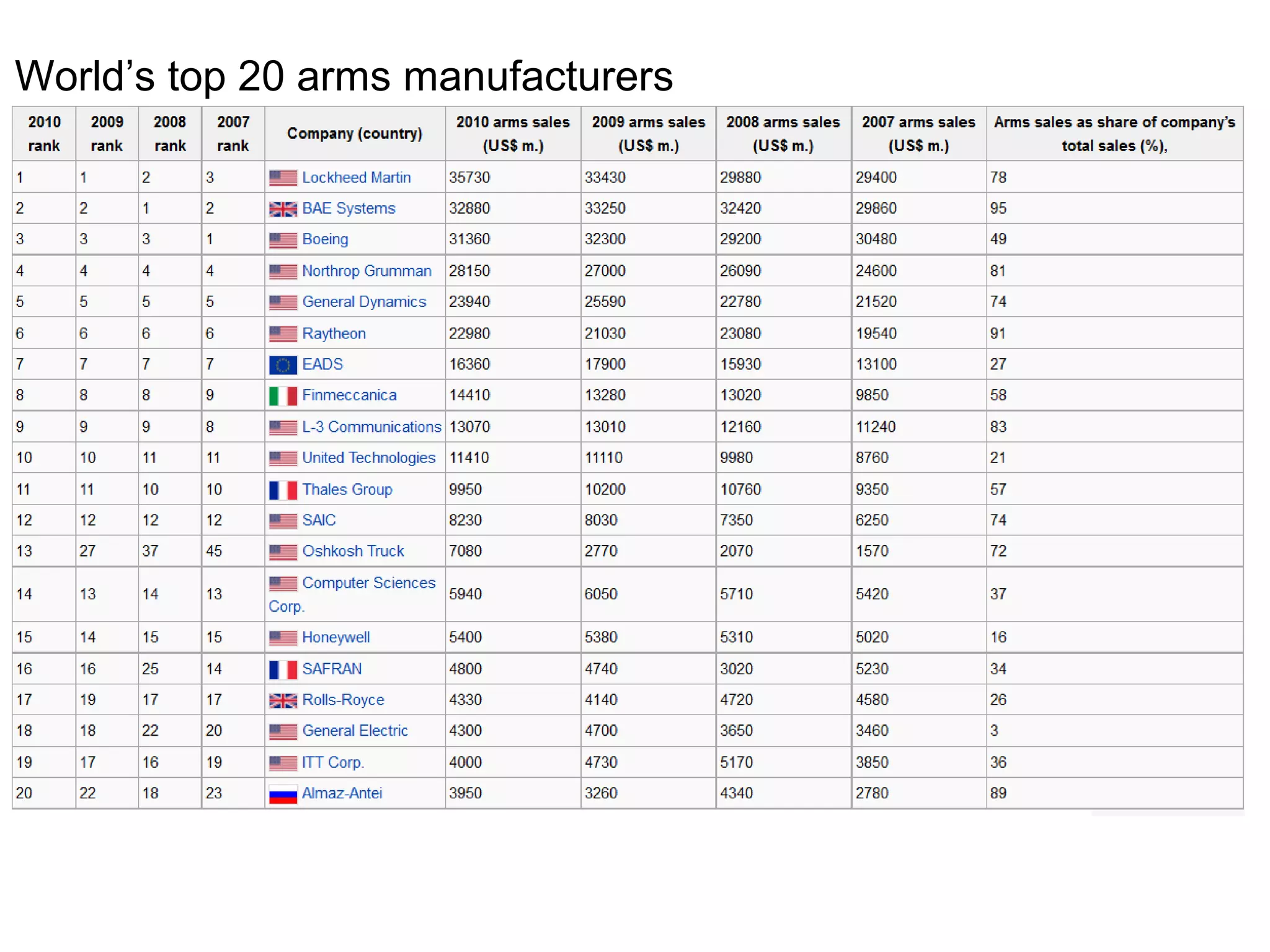
World’s top 20 arms manufacturers
(The Military Industrial Complex)
Homework
READ
- Pew Global Attitudes Poll: June 2008: pp. 1-11, Overview,
AND, Chap. 2, pp. 21-34, Views of the U.S. (Canvas
Readings)
- Pew Global Attitudes Poll (Dec. 2008): Global Public
Opinion in the Bush Years.(Click on the link to read)
- Pew Global Attitudes Poll (July 2009): Confidence in
Obama Lifts U.S. Image Around the World. (Click on the
link to read)
- Pew Global Attitudes Poll (July 2013): America’s global
image is slipping.
- Pew Global Attitudes Analysis (July 2014): World opposed
to U.S. surveillance, drones.
- Stabile, Matt. (2013, Jan.). How Many Americans Have
Passports? The Expeditioner.Com.
http://www.theexpeditioner.com/2010/02/17/how-many-
americans-have-a-passport-2/

Day5 amer-for-policy

  • 1.
    U.S. foreign policy,"The Bush Revolution”, the Obama Administration & the U.S. Military Industrial Complex "As we defend the peace, we will also take advantage of an historic opportunity to preserve the peace." --Former President George W. Bush (2003), National security strategy of the United States of America "Obviously the permanent peace of the world can be secured only through the gradual concentration of the preponderant military strength into the hands of the most pacific communities." - John Fiske (1880), American political ideas viewed from standpoint of universal history While there are instances and individuals who can be met only by force, the United States will be prepared to listen to and talk with our adversaries in order to advance our interests. -- President Barack Obama (2009)
  • 2.
    Daalder & Lindsay:A brief history of U.S. foreign policy - Nascent America Late 1700s, early 1800s - political distance from Europe (“isolationism”) - neutrality "Europe has a set of primary interests which to us have none or a very remote relation. Hence she must be engaged in frequent controversies, the causes of which are essentially foreign to our concerns.” - George Washington "(America) goes not abroad, in search of monsters to destroy. She is the well-wisher to the freedom and independence of all. She is the champion and vindicator only of her own.” - John Quincy Adams (1821) Monroe Doctrine (1823)
  • 3.
    Daalder & Lindsay:A brief history of U.S. foreign policy - Manifest Destiny Middle 1800s - intra-national, westward expansion - global economic & religious expansion - social Darwinism "No man, no party, can fight with any chance of success against a cosmic tendency; no cleverness, no popularity avails against the spirit of the age.” - John Hay, Secretary of State for William McKinley "All nations that are worth anything, always have had, and always will have, some ideal of national destiny, and without it, would soon disappear, and would deserve their fate." - Ephraim Douglass Adams, The power of ideals in American history (1913)
  • 4.
    Daalder & Lindsay:A brief history of U.S. foreign policy - Growing ambition Late 1800s, Early 1900s - internationalists vs. isolationists - Spanish American War & American colonialism - Theodore Roosevelt - costs of America imperialism "I believe that the time will come when such a state of (global federalism) will exist upon the earth, when it will be possible . . . to speak of the UNITED STATES as stretching from pole to pole, -- or, with Tennyson, to celebrate the 'parliament of man and federation of the world.' " - John Fiske (1880), American political ideas viewed from standpoint of universal history
  • 6.
    Daalder & Lindsay:A brief history of U.S. foreign policy - Wilsonianism 1913 - ? - New World Order - American exceptionalism + divine providence = interventionism - international law & institutions - Treaty of Versailles (1919): League of Nations "We do not confine our enthusiasm for individual liberty and free national development to the incidents and movements of affairs which affect only ourselves. We feel it wherever there is a people that tries to walk in these difficult paths of independence and right." -- Woodrow Wilson, 1916 - internationalism vs. unilateralism - 1930s: Depression & return to isolationism
  • 7.
    Daalder & Lindsay:A brief history of U.S. foreign policy - Post WWII: "The Truman Doctrine” 1945 - U.S. emerges as “preeminent” world power - largest economic & military power; nuclear capacity - key question: not what can U.S. do abroad, but what should it do? - Truman Doctrine (1947) "It must be the policy of the United States to support free peoples who are resisting attempted subjugation by armed minorities or by outside pressures." - Marshall Plan (1947) - NATO (1949) -->multilateral alliances & agreements (GATT, IMF, World Bank, etc.)
  • 8.
    Daalder & Lindsay:A brief history of U.S. foreign policy - The Cold War 1950s - Eisenhower --> unilateralist/anti-containment rhetoric; multilateral/containment actions - specter of nuclear annihilation (mutually assured destruction) - hegemonic American multilateralism - rise of U.S. military industrial complex (Eisenhower voices reservations) 1960s-1980s - Cold War logic continues
  • 9.
    Daalder & Lindsay:A brief history of U.S. foreign policy - Post Cold War: The Clinton Era - Wilsonianism revisited? New World Order, Int. Rule of law, Int. organizations, multilateralism critics --> why go international/multilateral now? - key question: not what can U.S. do abroad, but what should it do?
  • 10.
    Daalder & Lindsay:"The Bush Revolution” - revival of American unilateralism - rise of "a la carte" multilateralism - regime change over negotiation - exploitation of European division - doctrine of preemption "The United States can no longer solely rely on a reactive posture as we have in the past. . . We cannot let our enemies strike first." - President George W. Bush (National Security Strategy of the U.S.) NOT a revolution in America's goals (ENDS), but in how to achieve goals (MEANS) then: threat of nuclear war now: no one can push back
  • 11.
    Obama’s foreign policy:Analysis “The lesson of the Bush years is that not talking does not work. Go down the list of countries we’ve ignored and see how successful that strategy has been. … It’s time to turn the page on the diplomacy of tough talk and no action. It’s time to turn the page on Washington’s conventional wisdom that agreement must be reached before you meet, that talking to other countries is some kind of reward, and that Presidents can only meet with people who will tell them what they want to hear.” --President Barack Obama Obama has not achieved the transformative results he promised on the 2008 campaign trail . . . But on balance, he has proved tough, disciplined and, overall, reasonably successful in addressing the nation’s immediate security challenges. One might call him a reluctant realist: Holding onto his idealistic visions and pursuing them where possible but adroitly shifting to tougher measures when necessary … In other words, Obama is a pragmatist. A progressive one, to be sure — since he sought, where possible, to make inroads in the pursuit of his bigger hopes. But a pragmatist just the same — and a hawkish one in many ways …While Obama’s handling of rogue states and other issues makes for a generally positive assessment of his role as commander in chief, it remains an interim assessment — for the Iran and North Korea situations could well deteriorate. --- Martin Indyk, Co-Author, Bending History
  • 12.
    The U.S. militaryaround the world 1.4 million = approximate number of active U.S. military personnel 325,000 = approximate number deployed outside of U.S. 725 = approximate number of U.S. military bases outside U.S. 32 = approximate number of countries with 100 or more U.S. military personnel 6 = number of continents with American military personnel - Sources: U.S. Department of Defense; wikipedia.org; Chalmers Johnson, The Sorrows of Empire, 2003-2005)
  • 13.
    The U.S. foreignpolicy & the use of military might – a U.S. constant? I think what is clear is that the nature of the cold war conflict, which saw either mutually assured destruction or a series of proxy wars — low level, all around the world — has been replaced with a multilateral or multipolar world where the United States is a singular military power . . . the big threat now are threats of nuclear terrorism, forms of asymmetrical warfare, state sponsorship of terrorism — all of which I think require more than just a nuclear option or no option but a series of graded options that can be a realistic, serious deterrent …Now, the Nuclear Posture Review states very clearly, if you are a nonnuclear weapons state that is compliant with the NPT, you have a negative assurance we will not be using nuclear weapons against you. That doesn’t mean that you might not engage in some actions that are profoundly detrimental to U.S. national security, which require action on our part. And I’m going to preserve all the tools that are necessary in order to make sure that the American people are safe and secure. -- U.S. President Barack Obama, 2010 Interview with NYT
  • 14.
    World’s largest defensebudgets World’s largest arms exporters
  • 15.
    World’s top 20arms manufacturers
  • 16.
  • 17.
    Homework READ - Pew GlobalAttitudes Poll: June 2008: pp. 1-11, Overview, AND, Chap. 2, pp. 21-34, Views of the U.S. (Canvas Readings) - Pew Global Attitudes Poll (Dec. 2008): Global Public Opinion in the Bush Years.(Click on the link to read) - Pew Global Attitudes Poll (July 2009): Confidence in Obama Lifts U.S. Image Around the World. (Click on the link to read) - Pew Global Attitudes Poll (July 2013): America’s global image is slipping. - Pew Global Attitudes Analysis (July 2014): World opposed to U.S. surveillance, drones. - Stabile, Matt. (2013, Jan.). How Many Americans Have Passports? The Expeditioner.Com. http://www.theexpeditioner.com/2010/02/17/how-many- americans-have-a-passport-2/