by
SHIPRA CHOUDHARY
14/MAP/007
M.Sc. (Applied Physics)
Under the guidance of
Dr. Manmohan Singh Shishodia
Gautam Buddha University, Greater Noida
Otical propertIes of dimer of plasmonIc nanosphere
 Why Nanomaterials?
 Advantages of Dimer over Single Nanosphere
 Introduction
 Multipole Spectral Expansion method (MSE)
 MSE method for single nanoshere
 MSE method for dimer of nanaosphere
 Dimer Matrix Elements
 Translated Eigenstates
 Future plan
outlines
Why nanomaterials?
• Material that has unique or novel properties, due to the
nanoscale ( nano metre- scale) structuring.
• The properties of the nanomaterials can be different from
bulk material:
 Larger surface area
 Quantum effect begins to dominate
Solar cells
Nanoantenna’s
(Metal Nanoparticles)
Nanoantenna’s
(Silicon Nanoparticles)
Advantages of dimer over single nanoparticles
 Dimer provides a stronger electric field
in than gap region than a single metallic
nanoparticle does in its proximity.
 Dimer plays the role of a nanolens to focus
the incident wave into a small hotspot re-
gion around the gap.
 Dimer plays the role of an antenna.
 Lesser the gap, greater is the electric field enhancement factor.
dm m
b
LR RR
**[ref: Jiunn-Woei Liaw, Jeng-Hong chen, chi-San, and Mao-Kuen kuo, Opt.Express 16,
13532-13540 (2009).]
3.0 3.2 3.4 3.6 3.8 4.0 4.2 4.4
0
1000
2000
3000
4000
5000
6000
7000
Fieldenhancement()
Frequency (eV)
a/r = 0.6
a/r = 0.7
a/r = 0.8
a/r = 0.9
a/r = 1.0
 Introduced by Fuchs and further developed by Bergman,
Milton and stockman.
 Analytical approach for calculating potential at any point.
 Separates the geometrical and dielectric properties and can
be extended to arbitrary combination of nanoparticles.
 Extendible to dimers and multimers.
 Dimer nanostructures may induce a relatively intense local
EMF within the dimer gap region and in the proximity of MNS.
**[ref: D. J. Bergman, Phys. Rep. 43, 377 (1978).]
MULTIPOLE SPECTRAL EXPANSION METHOD
The overall potential expression in this approach
External potential
MSE METHOD FOR Single nanosphere
**[fig ref:Manmohan S. Shihodia, Boris D. Fainberg, and Abraham Nitzen, “Theory of energy
transfer interactions near sphere and nanoshell based plasmonic nanostructures”, SPIE 0277-
786X (2011).]
)()(φ|)()(
s)(s
s
)(φ)φ( extext rrrrrr mlml
ml l
l




 
surface)on theR(rθcosREθcosrEΦ 00ext 
R
P
zO
r
E0 zˆ
ε(ω)
hε
θ









 h
h
ε2ε(ω)
εε(ω)
s)(ωs
s
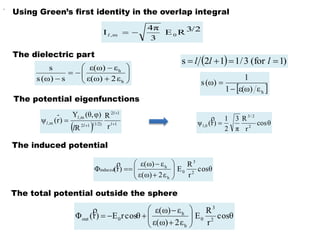
The dielectric part
The total potential outside the sphere
  )1for(3/112s  lll
 hεε(ω)1
1
)(ωs


,
  1
12
(1/2)12
m,
m,
r
R
R
φ),(θY
)r(ψ 


 l
l
l
l
l
l
θcos
r
R
π
3
2
1
)r(ψ 2
2/3
,01 

The potential eigenfunctions
The induced potential
Using Green’s first identity in the overlap integral
3/2RE
3
4π
I 0m, l
θcos
r
R
E
ε2ε(ω)
εε(ω)
)r(Φ 2
3
0
h
h
induced










θcos
r
R
E
ε2ε(ω)
εε(ω)
cosθrE)r(Φ 2
3
0
h
h
0out 









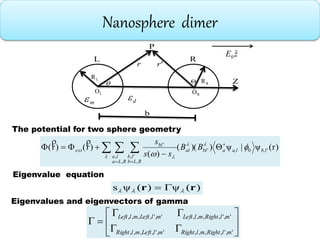
Nanosphere dimer
)r(ψ|ψ))((
)(
)r()r( '0'
,
,
,
',
'
b,la,lablal
RLa
la
RLb
lb
bl
ext BB
ss
s



 

 


   

The potential for two sphere geometry
Eigenvalue equation
)(ψ)(ψs rr  
Eigenvalues and eigenvectors of gamma









'',,,,,'',,,,,
'',,,,,'',,,,,
mlRightmlRightmlLeftmlRight
mlRightmlLeftmlLeftmlLeft
 
m d
'rr
LR
LO
RR
RO
b
L R
P
Z
zE ˆ0
 )b-r(ψψrθd
1'2
'
m'l',L
3
'',;,



 
*
l,m
V
mlml
l
l
Using Green’s identity
dimer matrix elementS
)(
)(
12
''
L
''
,
*
,
Rr
2
'
'
,,,
br
r
r
dR
l
l
ml
ml
Lmlml







 


)]()([
)(
)()]([d
V
*
,
2
,
3
*
,
,
Rr
2
,
*
,
V
3
''''
L
'' rbrrd
r
r
brdRbrr mlmlL
ml
mlLmlmlL


 







),(
1
)( ,12,  ml
l
l
L
ml Yr
lR
r



),(
1
)( *
,12
*
,  ml
l
l
L
ml Yr
lR
r



),(
1)( *
,
1
12
*
,


ml
l
l
L
ml
Yr
lRr
r 





Eigenstates of left sphere
dimer matrix elementS
Eigenstates of right sphere
)(
1
)( '''
'
''
,1'
12
, brmll
l
R
ml
Y
brl
R
br 



 


),(),(
!)!12(!)!12(
!]!1)(2[
000
)12](1)(2)[12(4)1()(
1
),,1'
'
''
''''
''
,)1(
'''
''
''' bbmll
lm
brmll
YY
b
r
l
l
mm
llll
llY
br





 




















 



),(),(
!)!12(!)!12(
!]!1)(2[
000
)12](1)(2)[12(4)1()( '''
''
'
'
,,1'
'
''
''''
''
'
12
, bbmll
lm
l
R
ml
YY
b
r
l
l
mm
llll
ll
l
R
br 




 




















 
 

),(),(
!)!12(!)!12(
!]!1)(2[
000
)12](1)(2)[12(4)1(),(
12
'''
''
'
''
,,1'
'
''
''''
''
'
12
*
,
1
12
2
'
'
,,, bbmll
lm
l
R
Rr
ml
l
l
L
Lmlml
YY
b
r
l
l
mm
llll
ll
l
R
Yr
lR
l
dR
l
l
L





 







 














 


 
),(
!)!12(!)!12(
!]!1)(2[
000
)12](1)(2)[12(4
12
)1( ''
'
''
''
,'
'
''
''''
''
)2/1()2/1(
'
'
,,, bbmmll
l
R
l
Llm
mlml
Y
l
l
mmmm
llllllll
ll
b
R
b
R
l
ll



 

















 














dimer matrix elementS
!!
)!(
]!1)(2[
)!2()!2(
)1(
000
'
'
'
'''
'
ll
ll
ll
llllll ll 






  
)!()!()!()!(]!1)(2[
)!()!()!2()!2(
)1(
)(
''''
'''''
''
''
''
mlmlmlmlll
mmllmmllll
mmmm
llll mmll









 
bmmimm
llbbmmll
eP
mmll
mmllll 


 )(
''
'''
,
''
''' )(cos
)!(
)!(
4
]1)(2[
),(Y 




Using properties of Wigner 3j symbols
Relation b/w Spherical harmonics & Legendre functions
bmmimm
ll
l
R
l
Llm
mlml
eP
ll
ll
l
l
l
l
ll
ll
mlmlmlml
mmll
b
R
b
R
ll
l
llll
)(
'
'
'
'
'
'
''''
'')2/1()2/1(
'
'
''
,,,
''
'
'
'
''
!!
)(
!)!12(
)!2(
!)!12(
)!2(
]!1)(2[
!]!1)(2[
)!()!()!()!(
)!(
)12)(12(
12
]1)(2[
)1(


























bmmimm
ll
l
R
l
Llm
mlml
eP
mlmlmlml
mmll
ll
ll
b
R
b
R )'('
'''''
''
'
')2/1(')2/1(
)!()!()!()!(
)!(
)12)(12(
)1(
'
''




















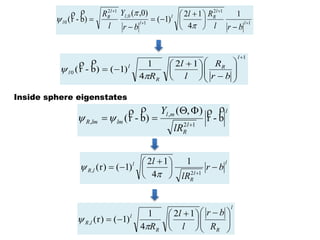
TRANSLATED EIGENStates
Outside sphere eigenstates
1
,
12
b-r
),(
)b-r( 


 l
ml
l
R
lm
Y
l
R



1
,
12
),(
)b-r( 


 l
ml
l
R
lm
R
Y
l
R













b,renwh1
b,rwhen1
cos
br
br









b,rnwhe0
b,rwhen
 
m d
'rr
LR
LO
RR
RO
b
L R
P
Z
zE ˆ0
1
0
12
4
1
)1()b-r(















 

l
R
R
l
l
br
R
l
l
R


1
12
1
0,
12
0
1
4
12
)1(
)0,(
)b-r( 









 


 l
l
Rl
l
l
l
R
l
brl
Rl
br
Y
l
R




Inside sphere eigenstates
l
l
R
ml
lmlmR
lR
Y
b-r
),(
)b-r(
12
,
,




l
l
R
l
lR br
lR
l





 

12,
1
4
12
)1()r(


l
RR
l
lR
R
br
l
l
R 




 





 

12
4
1
)1()r(,


Future plan
 To Calculate the external potential and overlap integral for a pair
of metallic nanoparticles (dimer) to obtain the overall potential in
the gap region.
 To study the effect of Electric Field Enhancement, polarizability
and plexcitonic interactions in the vicinity and the gap region of a
pair of metallic nanoparticles (dimer).
 To explore different plasmonic materials other than metals(Au or
Ag).
 To extend Multipole Spectral Expansion Method to treat
Nanoshells.
references
 Manmohan S. Shishodia, Boris D. Fainberg, and Abraham Nitzen, “Theory of energy
transfer interactions near sphere and nanoshell based plasmonic nanostructures”,
SPIE 0277-786X (2011).
 J.D. Jackson, “Classical Electrodynamics”, John Wiley & Sons, (1998).
 D.J. Bergman, “Dielectric constant of a two-component granular composite: A
practical scheme for calculating the pole spectrum”, phys. Rev. B, 19, 2359 (1979).
 M. Danos, and L.C. Maximon, “Multipole matrix elements of the translation
operator”, J. Mathematical Phys. 6, pp. 766-778 (1965).
 http://functions.wolfram.com/Polynomials/SphericalHarmonicY/20/01/02
 http://mathworld.wolfram.com/Polynomials/Wigner3j-Symbol.html
 Jiunn-Woei Liaw, Jeng-Hong chen, chi-San, and Mao-Kuen kuo, “Purecell effect of
nanoshell dimer on single molecule’s fluoresecnce”, Opt.Express 16, 13532-13540
(2009).
THANKYOU

dimer optical properties

  • 1.
    by SHIPRA CHOUDHARY 14/MAP/007 M.Sc. (AppliedPhysics) Under the guidance of Dr. Manmohan Singh Shishodia Gautam Buddha University, Greater Noida Otical propertIes of dimer of plasmonIc nanosphere
  • 2.
     Why Nanomaterials? Advantages of Dimer over Single Nanosphere  Introduction  Multipole Spectral Expansion method (MSE)  MSE method for single nanoshere  MSE method for dimer of nanaosphere  Dimer Matrix Elements  Translated Eigenstates  Future plan outlines
  • 3.
    Why nanomaterials? • Materialthat has unique or novel properties, due to the nanoscale ( nano metre- scale) structuring. • The properties of the nanomaterials can be different from bulk material:  Larger surface area  Quantum effect begins to dominate Solar cells Nanoantenna’s (Metal Nanoparticles) Nanoantenna’s (Silicon Nanoparticles)
  • 4.
    Advantages of dimerover single nanoparticles  Dimer provides a stronger electric field in than gap region than a single metallic nanoparticle does in its proximity.  Dimer plays the role of a nanolens to focus the incident wave into a small hotspot re- gion around the gap.  Dimer plays the role of an antenna.  Lesser the gap, greater is the electric field enhancement factor. dm m b LR RR **[ref: Jiunn-Woei Liaw, Jeng-Hong chen, chi-San, and Mao-Kuen kuo, Opt.Express 16, 13532-13540 (2009).] 3.0 3.2 3.4 3.6 3.8 4.0 4.2 4.4 0 1000 2000 3000 4000 5000 6000 7000 Fieldenhancement() Frequency (eV) a/r = 0.6 a/r = 0.7 a/r = 0.8 a/r = 0.9 a/r = 1.0
  • 5.
     Introduced byFuchs and further developed by Bergman, Milton and stockman.  Analytical approach for calculating potential at any point.  Separates the geometrical and dielectric properties and can be extended to arbitrary combination of nanoparticles.  Extendible to dimers and multimers.  Dimer nanostructures may induce a relatively intense local EMF within the dimer gap region and in the proximity of MNS. **[ref: D. J. Bergman, Phys. Rep. 43, 377 (1978).] MULTIPOLE SPECTRAL EXPANSION METHOD
  • 6.
    The overall potentialexpression in this approach External potential MSE METHOD FOR Single nanosphere **[fig ref:Manmohan S. Shihodia, Boris D. Fainberg, and Abraham Nitzen, “Theory of energy transfer interactions near sphere and nanoshell based plasmonic nanostructures”, SPIE 0277- 786X (2011).] )()(φ|)()( s)(s s )(φ)φ( extext rrrrrr mlml ml l l       surface)on theR(rθcosREθcosrEΦ 00ext  R P zO r E0 zˆ ε(ω) hε θ
  • 7.
              h h ε2ε(ω) εε(ω) s)(ωs s The dielectricpart The total potential outside the sphere   )1for(3/112s  lll  hεε(ω)1 1 )(ωs   ,   1 12 (1/2)12 m, m, r R R φ),(θY )r(ψ     l l l l l l θcos r R π 3 2 1 )r(ψ 2 2/3 ,01   The potential eigenfunctions The induced potential Using Green’s first identity in the overlap integral 3/2RE 3 4π I 0m, l θcos r R E ε2ε(ω) εε(ω) )r(Φ 2 3 0 h h induced           θcos r R E ε2ε(ω) εε(ω) cosθrE)r(Φ 2 3 0 h h 0out          
  • 8.
    Nanosphere dimer )r(ψ|ψ))(( )( )r()r( '0' , , , ', ' b,la,lablal RLa la RLb lb bl extBB ss s                The potential for two sphere geometry Eigenvalue equation )(ψ)(ψs rr   Eigenvalues and eigenvectors of gamma          '',,,,,'',,,,, '',,,,,'',,,,, mlRightmlRightmlLeftmlRight mlRightmlLeftmlLeftmlLeft   m d 'rr LR LO RR RO b L R P Z zE ˆ0
  • 9.
     )b-r(ψψrθd 1'2 ' m'l',L 3 '',;,      * l,m V mlml l l UsingGreen’s identity dimer matrix elementS )( )( 12 '' L '' , * , Rr 2 ' ' ,,, br r r dR l l ml ml Lmlml            )]()([ )( )()]([d V * , 2 , 3 * , , Rr 2 , * , V 3 '''' L '' rbrrd r r brdRbrr mlmlL ml mlLmlmlL            ),( 1 )( ,12,  ml l l L ml Yr lR r    ),( 1 )( * ,12 * ,  ml l l L ml Yr lR r    ),( 1)( * , 1 12 * ,   ml l l L ml Yr lRr r       Eigenstates of left sphere
  • 10.
    dimer matrix elementS Eigenstatesof right sphere )( 1 )( ''' ' '' ,1' 12 , brmll l R ml Y brl R br         ),(),( !)!12(!)!12( !]!1)(2[ 000 )12](1)(2)[12(4)1()( 1 ),,1' ' '' '''' '' ,)1( ''' '' ''' bbmll lm brmll YY b r l l mm llll llY br                                 ),(),( !)!12(!)!12( !]!1)(2[ 000 )12](1)(2)[12(4)1()( ''' '' ' ' ,,1' ' '' '''' '' ' 12 , bbmll lm l R ml YY b r l l mm llll ll l R br                                 ),(),( !)!12(!)!12( !]!1)(2[ 000 )12](1)(2)[12(4)1(),( 12 ''' '' ' '' ,,1' ' '' '''' '' ' 12 * , 1 12 2 ' ' ,,, bbmll lm l R Rr ml l l L Lmlml YY b r l l mm llll ll l R Yr lR l dR l l L                                     ),( !)!12(!)!12( !]!1)(2[ 000 )12](1)(2)[12(4 12 )1( '' ' '' '' ,' ' '' '''' '' )2/1()2/1( ' ' ,,, bbmmll l R l Llm mlml Y l l mmmm llllllll ll b R b R l ll                                      
  • 11.
    dimer matrix elementS !! )!( ]!1)(2[ )!2()!2( )1( 000 ' ' ' ''' ' ll ll ll llllllll           )!()!()!()!(]!1)(2[ )!()!()!2()!2( )1( )( '''' ''''' '' '' '' mlmlmlmlll mmllmmllll mmmm llll mmll            bmmimm llbbmmll eP mmll mmllll     )( '' ''' , '' ''' )(cos )!( )!( 4 ]1)(2[ ),(Y      Using properties of Wigner 3j symbols Relation b/w Spherical harmonics & Legendre functions bmmimm ll l R l Llm mlml eP ll ll l l l l ll ll mlmlmlml mmll b R b R ll l llll )( ' ' ' ' ' ' '''' '')2/1()2/1( ' ' '' ,,, '' ' ' ' '' !! )( !)!12( )!2( !)!12( )!2( ]!1)(2[ !]!1)(2[ )!()!()!()!( )!( )12)(12( 12 ]1)(2[ )1(                           bmmimm ll l R l Llm mlml eP mlmlmlml mmll ll ll b R b R )'(' ''''' '' ' ')2/1(')2/1( )!()!()!()!( )!( )12)(12( )1( ' ''                    
  • 12.
    TRANSLATED EIGENStates Outside sphereeigenstates 1 , 12 b-r ),( )b-r(     l ml l R lm Y l R    1 , 12 ),( )b-r(     l ml l R lm R Y l R              b,renwh1 b,rwhen1 cos br br          b,rnwhe0 b,rwhen   m d 'rr LR LO RR RO b L R P Z zE ˆ0
  • 13.
    1 0 12 4 1 )1()b-r(                   l R R l l br R l l R   1 12 1 0, 12 0 1 4 12 )1( )0,( )b-r(               l l Rl l l l R l brl Rl br Y l R     Inside sphere eigenstates l l R ml lmlmR lR Y b-r ),( )b-r( 12 , ,     l l R l lR br lR l         12, 1 4 12 )1()r(   l RR l lR R br l l R                12 4 1 )1()r(,  
  • 14.
    Future plan  ToCalculate the external potential and overlap integral for a pair of metallic nanoparticles (dimer) to obtain the overall potential in the gap region.  To study the effect of Electric Field Enhancement, polarizability and plexcitonic interactions in the vicinity and the gap region of a pair of metallic nanoparticles (dimer).  To explore different plasmonic materials other than metals(Au or Ag).  To extend Multipole Spectral Expansion Method to treat Nanoshells.
  • 15.
    references  Manmohan S.Shishodia, Boris D. Fainberg, and Abraham Nitzen, “Theory of energy transfer interactions near sphere and nanoshell based plasmonic nanostructures”, SPIE 0277-786X (2011).  J.D. Jackson, “Classical Electrodynamics”, John Wiley & Sons, (1998).  D.J. Bergman, “Dielectric constant of a two-component granular composite: A practical scheme for calculating the pole spectrum”, phys. Rev. B, 19, 2359 (1979).  M. Danos, and L.C. Maximon, “Multipole matrix elements of the translation operator”, J. Mathematical Phys. 6, pp. 766-778 (1965).  http://functions.wolfram.com/Polynomials/SphericalHarmonicY/20/01/02  http://mathworld.wolfram.com/Polynomials/Wigner3j-Symbol.html  Jiunn-Woei Liaw, Jeng-Hong chen, chi-San, and Mao-Kuen kuo, “Purecell effect of nanoshell dimer on single molecule’s fluoresecnce”, Opt.Express 16, 13532-13540 (2009).
  • 16.