GUIDED BY:
Asst. Prof. Mrs. AMRUTHA.S PRESENTED BY:
CIVIL DEPARTMENT ANU MARY BIJU
S7 CE
ROLL NO.:12
1
CONTENTS
 INTRODUCTION
 SEPTIC SYSTEMS
 TREATMENTS IN SSTS
 REQUIREMENTS OF SSTS
 DESIGN OF THE SYSTEM
 OPERATION AND MAINTENANCE
 CAPACITY , AGE , PERFORMANCE, COST
 ADVANTAGES & DISADVANTAGES
 CONCLUSION
 REFERENCE
2
INTRODUCTION
 Soil based water treatment
- to improve or upgrade the quality of waste water .
 Subsurface Sewage Treatment Systems (SSTS)
SEPTIC SYSTEMS Or INDIVIDUAL
SEWAGE TREATMENT SYSTEMS (ISTS)
 Used mainly in homes and business, not connected to
municipal sewer.
 With these systems, wastewater is re-introduced to the
environment for human needs.
 Common method to solve scarcity.
3
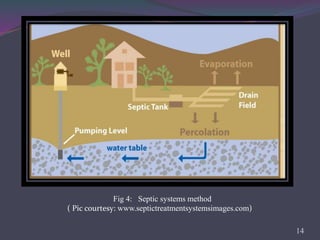
SEPTIC SYSTEMS
 A permanent solution to waste water treatment , produced
in bedroom, kitchen, laundry.
 Used when treatment plants are not accessible.
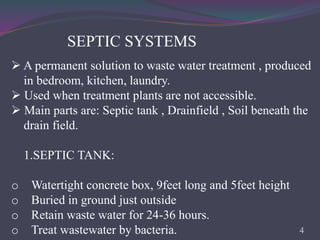
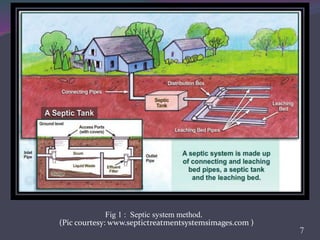
 Main parts are: Septic tank , Drainfield , Soil beneath the
drain field.
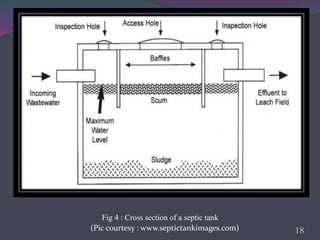
1.SEPTIC TANK:
o Watertight concrete box, 9feet long and 5feet height
o Buried in ground just outside
o Retain waste water for 24-36 hours.
o Treat wastewater by bacteria. 4
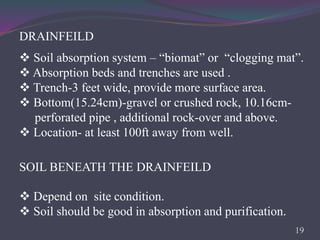
2.DRAINFIELD:
o Connected by a buried pipe.
o Consists of 2 to 5 trenches excavated into the subsoil.
o Also called nitrification field / soil absorption field.
o Sole purpose - deliver wastewater to soil.
CONTD…
5
CONTD….
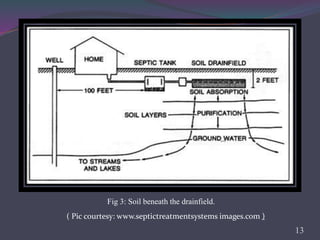
3.SOIL BENEATH DRAINFIELD:
o Wastewater trickle down through gravel to the soil.
o Used only on soils that will absorb and purify the effluents
o Soil will be in uniform brown, yellow/ bright red.
o Neither too sand or too clay, good structure, avoid rock.
6
(Pic courtesy: www.septictreatmentsystemsimages.com )
7
Fig 1 : Septic system method.
TREATMENT
 SSTS treatment is a combination of: physical , chemical
and biological .
 PHYSICAL TREATMENT:
Physical process include
Sedimentation , Screening , Aeration , Filtration ,
Floatation &Skimming , Equalization.
•Sedimentation process is by the use of septic tank.
8
• In septic tank solid waste in waste water settle down due to
gravity(sludge).
• Scum will float on top of water, helps anaerobic bacteria to
degrade organic components.
9
CONTD…..
10
( Pic courtesy: www.septictreatmentsystemsimages.com )
Fig 2: Septic tank for SSTS
CONTD…..
• Pollutants like phosphorous can then be easily removed.
• Chemical industry uses polymer (later stage)
physical separation & excess microbial activity.
CHEMICAL TREATMENT:
• Chemicals used to create changes in pollutants.
• Increase the removal by physical process by adding chemicals
like alum, lime, iron salt.
11
• Pathogens die-change in temperature, food, moisture or
absorbed by soil fungi.
• Negatively charged soil -chemicals, nutrients.
CONTD…...
BIOLOGICAL TREATMENT:
• Bacteria &small organisms treat wastewater by
biochemical decomposition.
• Viruses are removed by negatively charged soil particle.
12
( Pic courtesy: www.septictreatmentsystems images.com )
13
Fig 3: Soil beneath the drainfield.
14
Fig 4: Septic systems method
( Pic courtesy: www.septictreatmentsystemsimages.com)
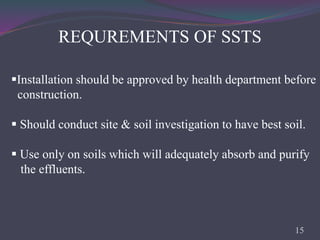
REQUREMENTS OF SSTS
Installation should be approved by health department before
construction.
 Should conduct site & soil investigation to have best soil.
 Use only on soils which will adequately absorb and purify
the effluents.
15
16
 Solid waste that accumulate on septic tank should be pumped
out and disposed off at appropriate locations.
 Do not pour paint, paint thinners, pesticides, poisons, fat,
cooking grease, oils, solvents, disinfectants etc.
 Septic tank & drain field should be properly maintained.
CONTD…..
DESIGN CRITERIA
SEPTIC TANK
Water tight , stable structure for performance, durable,
resistant to corrosion.
 Tank size: bedrooms, no. of inhabitants , water using
appliances.
Should hold at least one week of waste flow.
Key factor: quantity of sewage it can store, rate of waste
discharged, liquid surface area.
Inlet, outlet, inspection holes, risers-lid.
Location: away from wells, surface waters, building
foundations. 17
(Pic courtesy : www.septictankimages.com) 18
Fig 4 : Cross section of a septic tank
DRAINFEILD
 Soil absorption system – “biomat” or “clogging mat”.
 Absorption beds and trenches are used .
 Trench-3 feet wide, provide more surface area.
 Bottom(15.24cm)-gravel or crushed rock, 10.16cm-
perforated pipe , additional rock-over and above.
 Location- at least 100ft away from well.
SOIL BENEATH THE DRAINFEILD
 Depend on site condition.
 Soil should be good in absorption and purification.
19
OPERATION AND MAINTENACE
• Requires limited operator attention.
• Management needs.
• Regular pumping is needed every 3 to 5 years.
1. Size of the tank.
2. Amount of waste water generated by your household.
3. Amount of solids carried in waste water.
4. Age of the system.
 Sludge depth is one-third of liquid depth , regular
pumping is necessary.
20
CONTD….
• MAINTANACE TIPS:
 Annual checking and cleaning.
 Mark the location of the septic tank.
 System should not be installed when soil is wet.
 Septic tank additives is not recommended.
 Minimize the use of harmful substances.
 Restrict the use of garbage materials
 Do not allow the trees to grow, not to dig.
21
CAPACITY
 Size of the house.
 Load requirements.
 Water-using appliances.
AGE
 Depends -Site, Pumping, Maintenance.
 Last for 15 to 40 years .
22
PERFORMANCE
 Depend on –depth of unsaturated soil beneath the
absorption field.
 On-site treatment methods for long-term domestic use.
 Offer the highest level of performance among all.
COST
 Depends on –location, access, subsurface site condition,
type of tank installed
 Offer lowest cost than any other method.
23
ADVANTAGES
o Simplicity, reliability, and low cost.
o Most popular on-site water treatment.
o Nutrients are returned to soil.
o Act as a permanent source of water treatment.
DISADVANTAGES
o Pose an odor problem.
o Pollution of nearby ditches or streams.
o Toilet overflowing.
o Pump failure or blockage in pumping.
24
CONCLUSION
 Very common on-site waste water treatment .
 Septic systems –septic tank, distribution box or
drainfield, and soil beneath the drainfield-percolates
down to ground water.
 Alternative to wastewater treatment plants.
 Widely used in rural areas to save money.
 Efficient, inexpensive, convenient method for treating
household waste.
25
REFERENCE
1. “International Journal of Advanced Research Trends in Engineering
and Technology”(IJARTET), Vol.2, March 2015, Page 118-183,
‘Performance Evaluation of Improved Septic Tank for Domestic Waste
Water Treatment’.
2.“International Journal for Engineering and Technology”,Vol.4, May
2014, Page 1-7, ‘The effect of septic tank location on borehole water
quality in Port Harcourt, Nigeria’ .
3. “Journal of Environmental and Public Health”, March 2015, Page 1-12,
‘A Review of On-site Waste Water Treatment Systems in Western
Australia from 1997-2011’.
26
27
4. “51st ASC Annual International Conference Proceedings”,
2015, page 1-10, ‘Home Owner’s Knowledge and
Responsibilities Of Residential Waste Water Treatment Systems
in Rural Texas’.
5. “EPA, United State Environmental Protection Agency”, July 2015,
Page 1-5, ‘Preventing Septic System Failure”.
6. “Neb Guide-University Of Nebraska-Lincoln Extension, Institute Of
Agriculture & Natural Resources”, May 2015, Page 1-4,
‘Residential On-Site Waste Water Treatment : The Role Of Soil’.
7. “Oklahoma Department of Environmental Quality” , Page 1-7,
‘Subsurface sewage treatment systems ,it’s your on-site system’.
CONTD…
8. www.googlesearch.com
28
THANKYOU

anu

  • 1.
    GUIDED BY: Asst. Prof.Mrs. AMRUTHA.S PRESENTED BY: CIVIL DEPARTMENT ANU MARY BIJU S7 CE ROLL NO.:12 1
  • 2.
    CONTENTS  INTRODUCTION  SEPTICSYSTEMS  TREATMENTS IN SSTS  REQUIREMENTS OF SSTS  DESIGN OF THE SYSTEM  OPERATION AND MAINTENANCE  CAPACITY , AGE , PERFORMANCE, COST  ADVANTAGES & DISADVANTAGES  CONCLUSION  REFERENCE 2
  • 3.
    INTRODUCTION  Soil basedwater treatment - to improve or upgrade the quality of waste water .  Subsurface Sewage Treatment Systems (SSTS) SEPTIC SYSTEMS Or INDIVIDUAL SEWAGE TREATMENT SYSTEMS (ISTS)  Used mainly in homes and business, not connected to municipal sewer.  With these systems, wastewater is re-introduced to the environment for human needs.  Common method to solve scarcity. 3
  • 4.
    SEPTIC SYSTEMS  Apermanent solution to waste water treatment , produced in bedroom, kitchen, laundry.  Used when treatment plants are not accessible.  Main parts are: Septic tank , Drainfield , Soil beneath the drain field. 1.SEPTIC TANK: o Watertight concrete box, 9feet long and 5feet height o Buried in ground just outside o Retain waste water for 24-36 hours. o Treat wastewater by bacteria. 4
  • 5.
    2.DRAINFIELD: o Connected bya buried pipe. o Consists of 2 to 5 trenches excavated into the subsoil. o Also called nitrification field / soil absorption field. o Sole purpose - deliver wastewater to soil. CONTD… 5
  • 6.
    CONTD…. 3.SOIL BENEATH DRAINFIELD: oWastewater trickle down through gravel to the soil. o Used only on soils that will absorb and purify the effluents o Soil will be in uniform brown, yellow/ bright red. o Neither too sand or too clay, good structure, avoid rock. 6
  • 7.
    (Pic courtesy: www.septictreatmentsystemsimages.com) 7 Fig 1 : Septic system method.
  • 8.
    TREATMENT  SSTS treatmentis a combination of: physical , chemical and biological .  PHYSICAL TREATMENT: Physical process include Sedimentation , Screening , Aeration , Filtration , Floatation &Skimming , Equalization. •Sedimentation process is by the use of septic tank. 8
  • 9.
    • In septictank solid waste in waste water settle down due to gravity(sludge). • Scum will float on top of water, helps anaerobic bacteria to degrade organic components. 9 CONTD…..
  • 10.
    10 ( Pic courtesy:www.septictreatmentsystemsimages.com ) Fig 2: Septic tank for SSTS
  • 11.
    CONTD….. • Pollutants likephosphorous can then be easily removed. • Chemical industry uses polymer (later stage) physical separation & excess microbial activity. CHEMICAL TREATMENT: • Chemicals used to create changes in pollutants. • Increase the removal by physical process by adding chemicals like alum, lime, iron salt. 11
  • 12.
    • Pathogens die-changein temperature, food, moisture or absorbed by soil fungi. • Negatively charged soil -chemicals, nutrients. CONTD…... BIOLOGICAL TREATMENT: • Bacteria &small organisms treat wastewater by biochemical decomposition. • Viruses are removed by negatively charged soil particle. 12
  • 13.
    ( Pic courtesy:www.septictreatmentsystems images.com ) 13 Fig 3: Soil beneath the drainfield.
  • 14.
    14 Fig 4: Septicsystems method ( Pic courtesy: www.septictreatmentsystemsimages.com)
  • 15.
    REQUREMENTS OF SSTS Installationshould be approved by health department before construction.  Should conduct site & soil investigation to have best soil.  Use only on soils which will adequately absorb and purify the effluents. 15
  • 16.
    16  Solid wastethat accumulate on septic tank should be pumped out and disposed off at appropriate locations.  Do not pour paint, paint thinners, pesticides, poisons, fat, cooking grease, oils, solvents, disinfectants etc.  Septic tank & drain field should be properly maintained. CONTD…..
  • 17.
    DESIGN CRITERIA SEPTIC TANK Watertight , stable structure for performance, durable, resistant to corrosion.  Tank size: bedrooms, no. of inhabitants , water using appliances. Should hold at least one week of waste flow. Key factor: quantity of sewage it can store, rate of waste discharged, liquid surface area. Inlet, outlet, inspection holes, risers-lid. Location: away from wells, surface waters, building foundations. 17
  • 18.
    (Pic courtesy :www.septictankimages.com) 18 Fig 4 : Cross section of a septic tank
  • 19.
    DRAINFEILD  Soil absorptionsystem – “biomat” or “clogging mat”.  Absorption beds and trenches are used .  Trench-3 feet wide, provide more surface area.  Bottom(15.24cm)-gravel or crushed rock, 10.16cm- perforated pipe , additional rock-over and above.  Location- at least 100ft away from well. SOIL BENEATH THE DRAINFEILD  Depend on site condition.  Soil should be good in absorption and purification. 19
  • 20.
    OPERATION AND MAINTENACE •Requires limited operator attention. • Management needs. • Regular pumping is needed every 3 to 5 years. 1. Size of the tank. 2. Amount of waste water generated by your household. 3. Amount of solids carried in waste water. 4. Age of the system.  Sludge depth is one-third of liquid depth , regular pumping is necessary. 20
  • 21.
    CONTD…. • MAINTANACE TIPS: Annual checking and cleaning.  Mark the location of the septic tank.  System should not be installed when soil is wet.  Septic tank additives is not recommended.  Minimize the use of harmful substances.  Restrict the use of garbage materials  Do not allow the trees to grow, not to dig. 21
  • 22.
    CAPACITY  Size ofthe house.  Load requirements.  Water-using appliances. AGE  Depends -Site, Pumping, Maintenance.  Last for 15 to 40 years . 22
  • 23.
    PERFORMANCE  Depend on–depth of unsaturated soil beneath the absorption field.  On-site treatment methods for long-term domestic use.  Offer the highest level of performance among all. COST  Depends on –location, access, subsurface site condition, type of tank installed  Offer lowest cost than any other method. 23
  • 24.
    ADVANTAGES o Simplicity, reliability,and low cost. o Most popular on-site water treatment. o Nutrients are returned to soil. o Act as a permanent source of water treatment. DISADVANTAGES o Pose an odor problem. o Pollution of nearby ditches or streams. o Toilet overflowing. o Pump failure or blockage in pumping. 24
  • 25.
    CONCLUSION  Very commonon-site waste water treatment .  Septic systems –septic tank, distribution box or drainfield, and soil beneath the drainfield-percolates down to ground water.  Alternative to wastewater treatment plants.  Widely used in rural areas to save money.  Efficient, inexpensive, convenient method for treating household waste. 25
  • 26.
    REFERENCE 1. “International Journalof Advanced Research Trends in Engineering and Technology”(IJARTET), Vol.2, March 2015, Page 118-183, ‘Performance Evaluation of Improved Septic Tank for Domestic Waste Water Treatment’. 2.“International Journal for Engineering and Technology”,Vol.4, May 2014, Page 1-7, ‘The effect of septic tank location on borehole water quality in Port Harcourt, Nigeria’ . 3. “Journal of Environmental and Public Health”, March 2015, Page 1-12, ‘A Review of On-site Waste Water Treatment Systems in Western Australia from 1997-2011’. 26
  • 27.
    27 4. “51st ASCAnnual International Conference Proceedings”, 2015, page 1-10, ‘Home Owner’s Knowledge and Responsibilities Of Residential Waste Water Treatment Systems in Rural Texas’. 5. “EPA, United State Environmental Protection Agency”, July 2015, Page 1-5, ‘Preventing Septic System Failure”. 6. “Neb Guide-University Of Nebraska-Lincoln Extension, Institute Of Agriculture & Natural Resources”, May 2015, Page 1-4, ‘Residential On-Site Waste Water Treatment : The Role Of Soil’. 7. “Oklahoma Department of Environmental Quality” , Page 1-7, ‘Subsurface sewage treatment systems ,it’s your on-site system’. CONTD… 8. www.googlesearch.com
  • 28.