INTRODUCTION TO SUSTAINABLE STORM-WATER MANAGEMENT
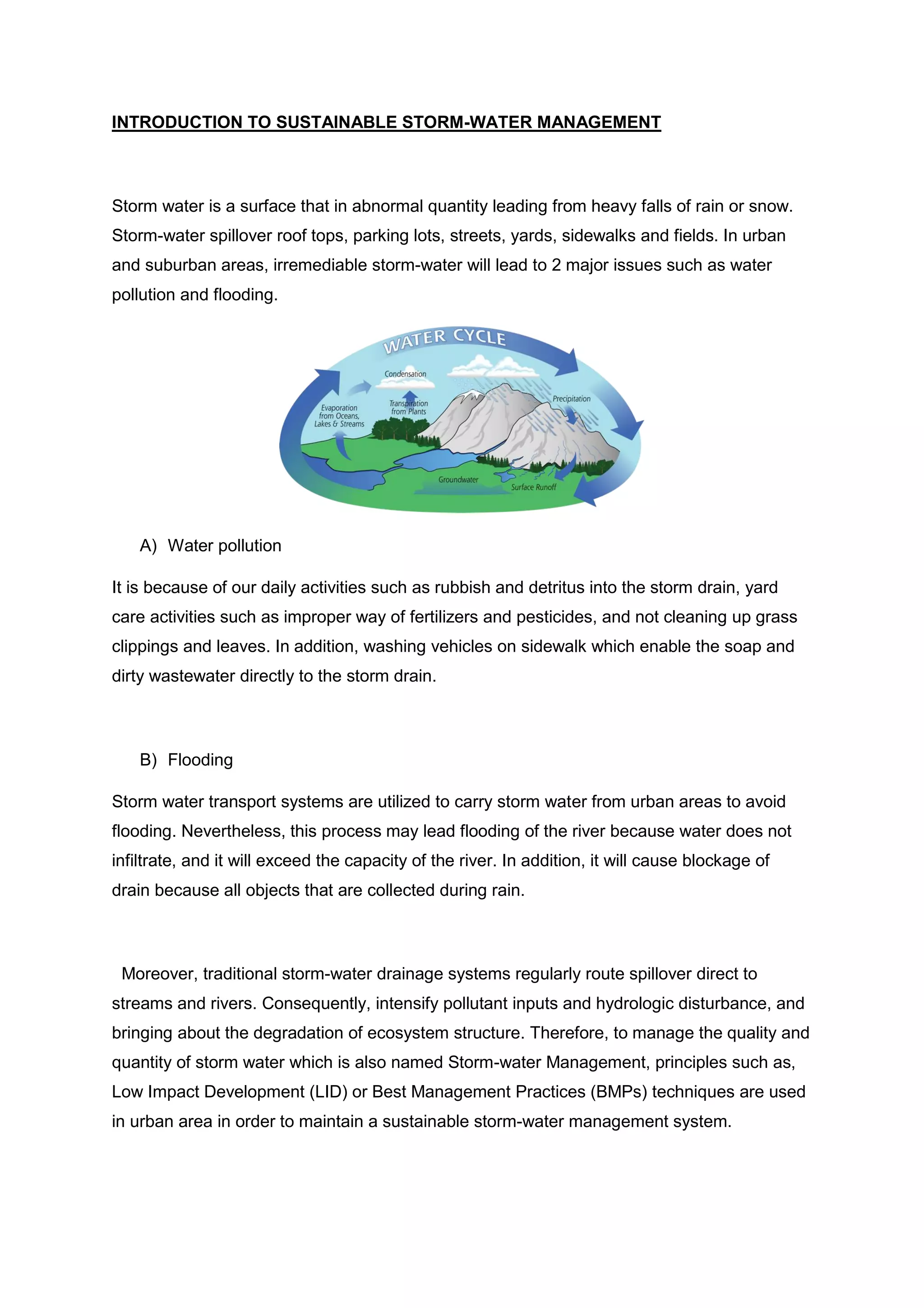
Storm water is a surface that in abnormal quantity leading from heavy falls of rain or snow.
Storm-water spillover roof tops, parking lots, streets, yards, sidewalks and fields. In urban
and suburban areas, irremediable storm-water will lead to 2 major issues such as water
pollution and flooding.
A) Water pollution
It is because of our daily activities such as rubbish and detritus into the storm drain, yard
care activities such as improper way of fertilizers and pesticides, and not cleaning up grass
clippings and leaves. In addition, washing vehicles on sidewalk which enable the soap and
dirty wastewater directly to the storm drain.
B) Flooding
Storm water transport systems are utilized to carry storm water from urban areas to avoid
flooding. Nevertheless, this process may lead flooding of the river because water does not
infiltrate, and it will exceed the capacity of the river. In addition, it will cause blockage of
drain because all objects that are collected during rain.
Moreover, traditional storm-water drainage systems regularly route spillover direct to
streams and rivers. Consequently, intensify pollutant inputs and hydrologic disturbance, and
bringing about the degradation of ecosystem structure. Therefore, to manage the quality and
quantity of storm water which is also named Storm-water Management, principles such as,
Low Impact Development (LID) or Best Management Practices (BMPs) techniques are used
in urban area in order to maintain a sustainable storm-water management system.
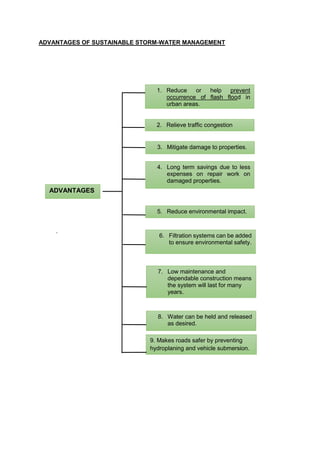
ADVANTAGES OF SUSTAINABLE STORM-WATER MANAGEMENT
.
1. Reduce or help prevent
occurrence of flash flood in
urban areas.
2. Relieve traffic congestion
3. Mitigate damage to properties.
4. Long term savings due to less
expenses on repair work on
damaged properties.
5. Reduce environmental impact.
9. Makes roads safer by preventing
hydroplaning and vehicle submersion.
6. Filtration systems can be added
to ensure environmental safety.
7. Low maintenance and
dependable construction means
the system will last for many
years.
8. Water can be held and released
as desired.
ADVANTAGES
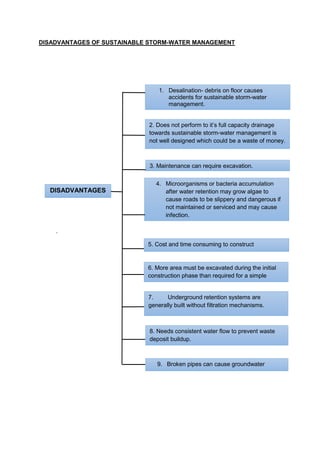
DISADVANTAGES OF SUSTAINABLE STORM-WATER MANAGEMENT
.
1. Desalination- debris on floor causes
accidents for sustainable storm-water
management.
2. Does not perform to it’s full capacity drainage
towards sustainable storm-water management is
not well designed which could be a waste of money.
9. Broken pipes can cause groundwater
contamination.
6. .
3. Maintenance can require excavation.
4. Microorganisms or bacteria accumulation
after water retention may grow algae to
cause roads to be slippery and dangerous if
not maintained or serviced and may cause
infection.
5. .
8. Needs consistent water flow to prevent waste
deposit buildup.
7. Underground retention systems are
generally built without filtration mechanisms.
5. Cost and time consuming to construct
6. More area must be excavated during the initial
construction phase than required for a simple
surface reservoir.
DISADVANTAGES
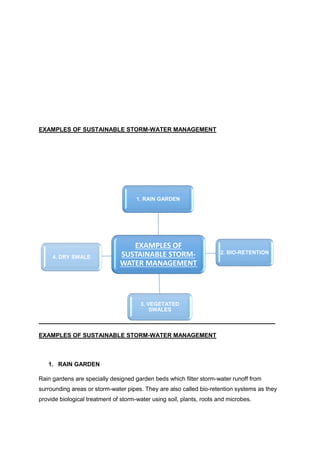
EXAMPLES OF SUSTAINABLE STORM-WATER MANAGEMENT
1. RAIN GARDEN
Rain gardens are specially designed garden beds which filter storm-water runoff from
surrounding areas or storm-water pipes. They are also called bio-retention systems as they
provide biological treatment of storm-water using soil, plants, roots and microbes.
EXAMPLES OF
SUSTAINABLE STORM-
WATER MANAGEMENT
1. RAIN GARDEN
2. BIO-RETENTION
3. VEGETATED
SWALES
4. DRY SWALE
Rain gardens are designed to stop excess storm water, nutrients, rubbish and sediment from
polluting our waterways, bays and oceans. They can even be positioned to capture overflow
from a rainwater tank.
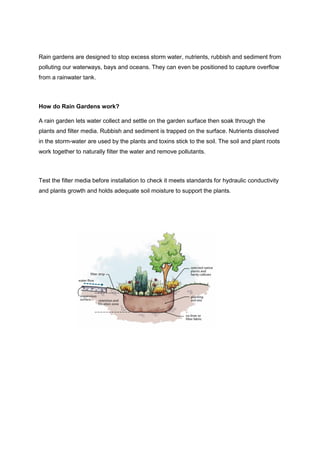
How do Rain Gardens work?
A rain garden lets water collect and settle on the garden surface then soak through the
plants and filter media. Rubbish and sediment is trapped on the surface. Nutrients dissolved
in the storm-water are used by the plants and toxins stick to the soil. The soil and plant roots
work together to naturally filter the water and remove pollutants.
Test the filter media before installation to check it meets standards for hydraulic conductivity
and plants growth and holds adequate soil moisture to support the plants.
INSTALLATION PROCESS OF RAIN GARDEN
Step 1:
Find a location: It is suggested that u place the garden at least 10 feet away from your house
to prevent flooding your house and preferably located in the sun either full or partial. Do not
locate over a septic field and it is better to choose a naturally low spot in your yard where
your downspouts or sump pump outlet can be used to direct the rainwater into your garden.
Step 2:
Measure the drainage area: You have to measure the specific drainage area of the surface
and multiply it by the type of soil if you are capturing water from the roof or any hard
surfaces. For Sandy soil multiply it by 20%, loam use 30-35% and for clay use 45-60%.
These numbers are inflated but they will ensure the garden holds as much water as it
possibly could. You do not have to measure the drainage area if you are using a low spot in
your yard.
Step 3:
Create a design: By planning your garden first, you will be able to create the best
appearance for your garden. Basic principle applies to your garden no matter how small or
big it is.
Step 4:
choose plants: Natives plants are suggested due to the climate in your certain area. The
plants chose can grow well in both wet and dry areas because the garden will temporarily fill
with rainwater from time to time.
Step 5:
Layout of the garden: Lay out the shape and boundaries based on your design.
Step 6:
Dig the garden: Before digging, please locate the underground utilities. Remove turf grass
and dig 4-8 inches deep and use the soil to build berm around the garden edges if
necessary.
Step7:
Prepare the soil: Amend the soil with 2-3 inch of compost and mix well.
Step 8:
Plant the flower and grass: Plants should be placed 1 foot apart from each other.
Step 9:
Mulch the garden: Use coarse, fibrous, shredded wood chips that wont float or be blown
away. The mulch is applied 2-3 inches deep and this is used to keep the moisture in and the
weeds out.
Step 10:
Water & arrange downspout: Water the plants for 2 weeks if it does rain until the garden
looks to be growing on its own without any water from watering.
2. BIO-RETENTION AREAS
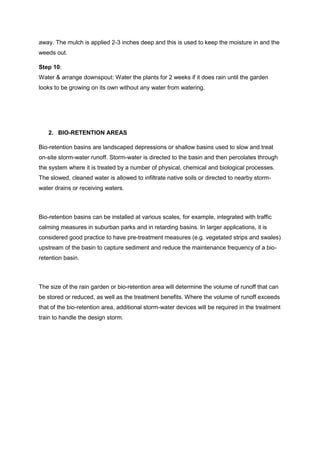
Bio-retention basins are landscaped depressions or shallow basins used to slow and treat
on-site storm-water runoff. Storm-water is directed to the basin and then percolates through
the system where it is treated by a number of physical, chemical and biological processes.
The slowed, cleaned water is allowed to infiltrate native soils or directed to nearby storm-
water drains or receiving waters.
Bio-retention basins can be installed at various scales, for example, integrated with traffic
calming measures in suburban parks and in retarding basins. In larger applications, it is
considered good practice to have pre-treatment measures (e.g. vegetated strips and swales)
upstream of the basin to capture sediment and reduce the maintenance frequency of a bio-
retention basin.
The size of the rain garden or bio-retention area will determine the volume of runoff that can
be stored or reduced, as well as the treatment benefits. Where the volume of runoff exceeds
that of the bio-retention area, additional storm-water devices will be required in the treatment
train to handle the design storm.
INSTALLATION OF BIO-RETENTION
Step 1:
It starts after the entire drainage area has been stabilized with vegetation. While the bio
retention area is being constructed, it would be best to block certain curb or other inlets. The
proposed site should be checked for existing utilities prior to any excavation.
Step 2:
Checking of the boundaries of the contributing drainage area and the actual inlet elevations
to ensure they are confirm the original design should be done by the installer and designers.
Contractors may also be present so it is hard to find subtle differences in site grading,
drainage and paving elevations which can produce hydraulically important differences for the
proposed bio retention area.
Step 3:
Temporary E&S controls are needed to complete the construction of the bio retention area to
divert the storm water away from the bio retention area. Special protection measures such
as erosion control fabrics may be needed to protect vulnerable side slopes during
construction.
Step 4:
Pretreatment cells should be excavated first and then sealed to trap sediments.
Step 5:
Workers should work from the sides to excavate the bio retention area to its appropriated
dimension and depth. Excavating equipment should have scoops with adequate reach to
prevent sitting inside the footprint of the area. The usage of cell construction approach in
larger bio retention basins are necessary where the basin is split into 500-1000 square feet
with a 10-15-foot earth bridge in between so the cells can be excavated from the side.
Step 6:
It may be necessary to rip the bottom soils to a depth of 6-12 inches to promote greater
infiltration.
Step 7:
Geotextile fabric can be placed on the sides of the bio retention area with a 6inch overlap
on the sides. If there is no stone storage layer used, start with 6 inches of #57 stone on the
bottom and then install the perforated underdrain pipe, pack #57 stone to 3 inches above the
underdrain pipe and add around 3 inches of choker stone or pea gravel as a filter between
the underdrain and the soil media layer. If there is a stone storage layer, replace the 6
inches of #57 stone with a suitable depth of #57 stone at the bottom.
Step 8:
Send the soil media from an approved vendor and store it on an impervious area or plastic
sheeting. Apply the soil media in a 12 inch lifts until the desired top elevation of the bio
retention area is reached. To check for the settlement, wait for a few days and add additional
media to achieve the design elevation.
Step 9:
Get ready planting holes for trees and shrubs, then apply the vegetation and water
accordingly. It is possible to install any temporary irrigation.
Step 10:
Place the surface cover in both cells depending on the design. Install the plant materials as
shown in the landscaping plan and water them when there is no rain for the first two months.
Step 11:
Lead the final inspection. Then log the GPD coordinates for each bio retention facility and
submit them for entry into the local maintenance tracking database.
3. VEGETATED SWALES
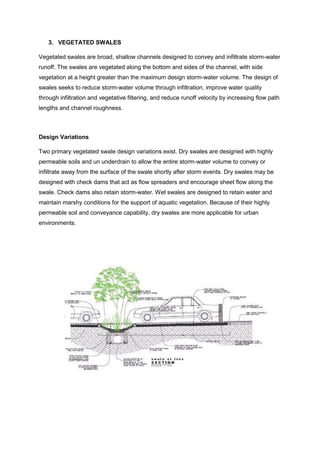
Vegetated swales are broad, shallow channels designed to convey and infiltrate storm-water
runoff. The swales are vegetated along the bottom and sides of the channel, with side
vegetation at a height greater than the maximum design storm-water volume. The design of
swales seeks to reduce storm-water volume through infiltration, improve water quality
through infiltration and vegetative filtering, and reduce runoff velocity by increasing flow path
lengths and channel roughness.
Design Variations
Two primary vegetated swale design variations exist. Dry swales are designed with highly
permeable soils and un underdrain to allow the entire storm-water volume to convey or
infiltrate away from the surface of the swale shortly after storm events. Dry swales may be
designed with check dams that act as flow spreaders and encourage sheet flow along the
swale. Check dams also retain storm-water. Wet swales are designed to retain water and
maintain marshy conditions for the support of aquatic vegetation. Because of their highly
permeable soil and conveyance capability, dry swales are more applicable for urban
environments.
INSTALLATION OF VEGETATED SWALES
Step 1:
Rough grade the vegetated swale. 18 inches of subgrade shall be removed to take place
with a blend of topsoil and sand to promote infiltration and biological development if the
excavation brings to a substantial compaction of the subgrade.
Step 2:
Construct check dams, if required.
Step 3:
Fine grade the vegetated swale where accurate grading is crucial for swales where even the
slightest nonconformities may cause the flow to be exposed and leaked.
Step 4:
Prior to establishment of vegetation, a swale is specifically vulnerable to scour and erosion
and therefore its seed bed must be protected with temporary erosion control.
Step 5:
If all tributary areas are stabilized enough, remove the temporary erosion and sediment
control.
4. DRY SWALE
Dry swales are essentially bio-retention cells that are shallower, configured as linear
channels, and covered with turf or other surface material (other than mulch and ornamental
plants).
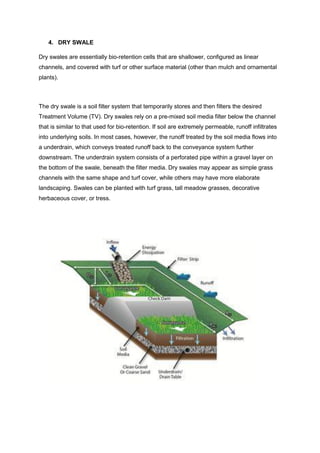
The dry swale is a soil filter system that temporarily stores and then filters the desired
Treatment Volume (TV). Dry swales rely on a pre-mixed soil media filter below the channel
that is similar to that used for bio-retention. If soil are extremely permeable, runoff infiltrates
into underlying soils. In most cases, however, the runoff treated by the soil media flows into
a underdrain, which conveys treated runoff back to the conveyance system further
downstream. The underdrain system consists of a perforated pipe within a gravel layer on
the bottom of the swale, beneath the filter media. Dry swales may appear as simple grass
channels with the same shape and turf cover, while others may have more elaborate
landscaping. Swales can be planted with turf grass, tall meadow grasses, decorative
herbaceous cover, or tress.
INSTALLATION OF DRY SWALE
Step 1:
Protection during site construction where the dry swales should be kept outside the limit of
disturbance during this time where it can prevent soil compaction by heavy equipment.
Step 2:
Stabilize upstream drainage area where the drainage area should be less than 5 acres
Step 3:
There should have permeable soil which can be use with soil amendment which may also
need an underdrain in less permeable soil before excavating the dry swale
Step 4:
Rip or scarify bottom
Step 5:
Install a filter fabric, stone and underdrain to ensure that there are 2 feet of separation to
groundwater.
Step 6:
Add a minimum of 18 inches of soil media in a 12 inch lifts
Step 7:
Install check dams for pre-treatment driveways to avoid certain commercial and industrial
hotspots
Step 8:
Plant trees and shrubs
Step 9:
Install landscape cover.
Step 10:
Inspect construction.
INTRODUCTION OF SMART TUNNEL
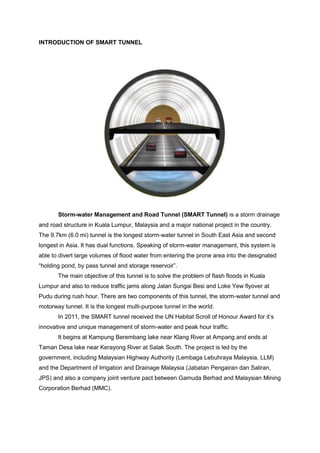
Storm-water Management and Road Tunnel (SMART Tunnel) is a storm drainage
and road structure in Kuala Lumpur, Malaysia and a major national project in the country.
The 9.7km (6.0 mi) tunnel is the longest storm-water tunnel in South East Asia and second
longest in Asia. It has dual functions. Speaking of storm-water management, this system is
able to divert large volumes of flood water from entering the prone area into the designated
“holding pond, by pass tunnel and storage reservoir”.
The main objective of this tunnel is to solve the problem of flash floods in Kuala
Lumpur and also to reduce traffic jams along Jalan Sungai Besi and Loke Yew flyover at
Pudu during rush hour. There are two components of this tunnel, the storm-water tunnel and
motorway tunnel. It is the longest multi-purpose tunnel in the world.
In 2011, the SMART tunnel received the UN Habitat Scroll of Honour Award for it’s
innovative and unique management of storm-water and peak hour traffic.
It begins at Kampung Berembang lake near Klang River at Ampang and ends at
Taman Desa lake near Kerayong River at Salak South. The project is led by the
government, including Malaysian Highway Authority (Lembaga Lebuhraya Malaysia, LLM)
and the Department of Irrigation and Drainage Malaysia (Jabatan Pengairan dan Saliran,
JPS) and also a company joint venture pact between Gamuda Berhad and Malaysian Mining
Corporation Berhad (MMC).
MANAGEMENT SYSTEM
More about SMART Project?
a. the project was commissioned by the Government of Malaysia.
b. the tunnel handles 30,000 cars per day.
c. successfully used 44 times to divert floodwater.
d. project also includes a storage reservoir and twin box culvert to divert any floodwater.
e. In addition, there is a holding basin with a diversion and dedicated tunnel intake
structures.
Smart tunnel is an advanced technology used in Malaysia, to mainly alleviate flood in KL /
reduce traffic congestion. Hence, this technology needs to have a solid management
system to guide things through and perform smoothly.
Management Team
A management is ready to standby for any inconvenience caused to users/customers. It
takes proactive action such as mitigate floods, manage traffic, tackle congestion, provide
information to road users, improve safety and journey time reliability, whilst respecting and
minimizing any adverse impact on the environment.
Maintenance & Service
It is reported that there are significant relationships between SMART Tunnel maintenance
works with flood occurrences and SMART Tunnel maintenance work with traffic flow. When
there is enough maintenance works, flood occurrence will be very low and vice versa. The
research shows that SMART Tunnel plays an important role in decongestion of traffic to and
from the Kuala Lumpur City Centre. It diverts approximately 30,000 cars a day. This
contributes in providing valuable frontier and offers means to improve the maintenance
works of SMART Tunnel to optimize the utilization on flood disaster and traffic flow
management in Kuala Lumpur City Centre. It also updates people about the roles of SMART
Tunnel in Kuala Lumpur City Centre.
The devastating errors are in tunnel‘s maintenance and inspections which is supposed to be
carried-out weekly on the automated flood control gates, the water tight gates on either end
of the motorway tunnel within the stormwater section
Similarly, another component that supposed to be checked frequently, at least twice a week
according to the SMART tunnel operations manual, are the water-tight doors that lead to the
SMART equipment areas, it is also not maintained and checked as prescribed in the
operational manual but, it`s been carried out once in two weeks. Furthermore, the monthly
maintenance works that involves the whole major system of the SMART tunnel including
software checks has limited maintenance.
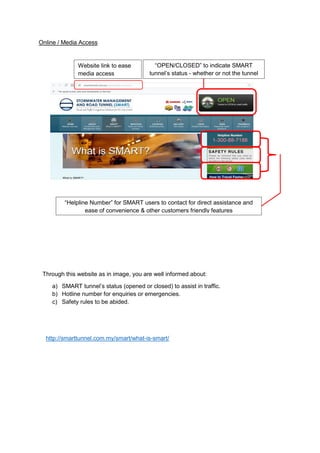
Online / Media Access
Through this website as in image, you are well informed about:
a) SMART tunnel’s status (opened or closed) to assist in traffic.
b) Hotline number for enquiries or emergencies.
c) Safety rules to be abided.
http://smarttunnel.com.my/smart/what-is-smart/
Website link to ease
media access
“OPEN/CLOSED” to indicate SMART
tunnel’s status - whether or not the tunnel
is avaialble at the moment
“Helpline Number” for SMART users to contact for direct assistance and
ease of convenience & other customers friendly features
Smart Criteria
Smart Unique Features Adoption of advanced M&E systems for effective dual purpose
operations such as:
a) Flood detection system (FDS) is being used to predict impeding storms and gives
out flood warnings to the Storm-water Control Center and to alert and enable the
relevant authorities to decide when the Motorway Tunnel has to be used as a flood
tunnel.
b) SCADA system is able to continuously monitor, process and control essential
electrical and mechanical equipment inside the tunnel and are able to respond to any
needs to enable the tunnel to operate under it’s design capability such as functions of
flood gates, road gates, water tight doors, CCTV’s and etc.
c) Tunnel ventilation used is unique in the sense that for it’s axial fans, they are
located on the surface but plays a significant role in ensuring that the pollution level
are within acceptable range. These axial fans are supported by several jet fans
located at the entrances and exits of the dry section of the tunnel.
d) IP68-rated M&E equipment such as lighting luminaries and cables, CCTV’s linear
heat detector, air quality monitoring equipment and lane traffic indicators are all
capable to withstand the dual purpose conditions which include submerging under
water at a pressure of up 2.5 bar for more than 24 hours condition.
Safety
1. There are ventilation or escape shafts at 1km intervals throughout the tunnel. These
will constantly renew the air and maintain the air quality within the motorway section
of the tunnel. (control of vehicle exhaust fumes)
2. To protect the ventilation system during flooding, the systems consist of a series of
shafts each containing an exhaust and fresh air injector.
3. This enable the fans to be located outside the tunnel, creating a longitudinal flow
between shafts that allows the air in the tunnel to be continuously renewed and
enables the extraction of exhaust fumes and smoke in the event of a fire.
SMART Ronda
The Ronda team patrols the SMART highway 24 hours a day to assist motorist in need of
help. The service provided by the Ronda Team is free of charge. Motorist in need of
assistance can use SMART helpline or any of the emergency telephones along the highway.
The line will be connected to the Motorway Control Center.
Motorway Control Center
The Motorway Control Center is manned 24 hours a day by trained traffic controllers. Their
roles are to:
• Monitor traffic situation along SMART alignment via the CCTV’s.
• Received information from road users through the Emergency Telephones or
SMART Helpline.
• Informing the motorist via Variable Message Sign (VMS).
• Spot the cause of traffic congestion, such as vehicle breakdown or accident, and to
immediately dispatch assistance so as to ensure smooth flow of traffic.
Emergency Telephones
The telephones are located at the emergency exits. It is linked to the Motorway Control
Center to provide the motorist with easy access for emergency assistance.
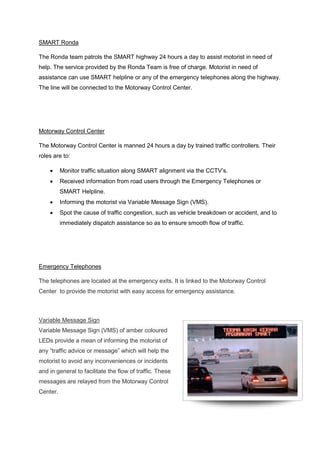
Variable Message Sign
Variable Message Sign (VMS) of amber coloured
LEDs provide a mean of informing the motorist of
any “traffic advice or message” which will help the
motorist to avoid any inconveniences or incidents
and in general to facilitate the flow of traffic. These
messages are relayed from the Motorway Control
Center.
CASE STUDY
Expressway 38
Storm-water Management & Road Tunnel (SMART Tunnel)
Owner: Government of Malaysia Malaysian Highway Authority(LLM)
Maintained by: Syarikat Mengurus Air Banjir dan Terowong Sdn Bhd (SMART).
Location: Kuala Lumpur, Malaysia.
Length: The 13.2m diameter tunnel consists of a 9.7km storm-water bypass tunnel, with a
4km dual-deck motorway within the storm-water tunnel.
Start: Jalan Tun Razak on Kuala Lumpur Middle Ring Road 1.
End: Sungai Besi Airport on Kuala Lumpur-Seremban Expressway.
Primary Destination: Bukit Bintang, Imbi, Cheras, Petaling Jaya, Seremban.
Work Begun: 2003
Opened: 2007
No. of lanes: 4, Double-decked
Operating Speed: 60km/h
Construction Cost: RM1,887 million (US$514.6 million)
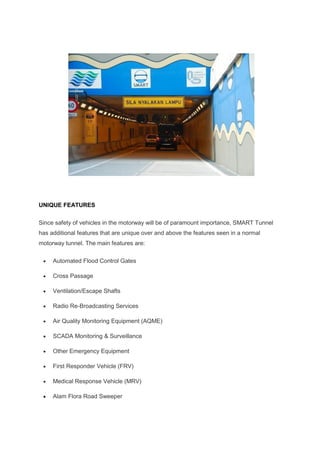
UNIQUE FEATURES
Since safety of vehicles in the motorway will be of paramount importance, SMART Tunnel
has additional features that are unique over and above the features seen in a normal
motorway tunnel. The main features are:
• Automated Flood Control Gates
• Cross Passage
• Ventilation/Escape Shafts
• Radio Re-Broadcasting Services
• Air Quality Monitoring Equipment (AQME)
• SCADA Monitoring & Surveillance
• Other Emergency Equipment
• First Responder Vehicle (FRV)
• Medical Response Vehicle (MRV)
• Alam Flora Road Sweeper
1. Automated Flood Control Gates
The water tight gates are installed on either ends of the motorway tunnel (within the storm-
water section). In addition, similar single flood control steel gates are installed at both
entrances and exits of the motorway tunnel. These gates are operated using a hydraulic
system.
3 automated flood gates at both end of motorway
2 automated road gates at both end junction boxes
2. Cross Passage
Cross Passage between decks at 250m intervals: the passage acts as emergency exits
during an emergency.
3. Ventilation/Escape Shafts
Ventilation/ escape shafts at 1km intervals. These powerful air ventilators will constantly
renew the air and maintain the air quality within the motorway. To protect the ventilation
system during the flooding, the system consists of a series of shafts each containing an
exhaust and fresh air injector. This design enables the fans to be installed outside the
SMART tunnel to create a longitudinal flow in the tunnel between the shafts that permits the
air in the tunnel to be continuously renewed and the extraction of the exhaust fumes. The
feature also allows for smoke control in the event of a fire.
4. Radio Re-Broadcasting Services
Radio re-broadcasting is an audio (sound) broadcasting service, traditionally broadcast
through the air as radio waves (a form of electromagnetic radiation) from a transmitter to an
antenna and finally to a receiving device. Stations can link in radio networks to broadcast
common programming, either in syndication or simulcast or both. Audio broadcasting also
can be done via cable FM, local wire networks, satellite and the Internet. With the radio re-
broadcasting services available in Smart Tunnel, user should be able to receive the radio
channel, hand phone and other maintenance communication reception without any
interference.
5. Air Quality Monitoring Equipment (AQME)
There are 38 sets of AQME monitoring carbon monoxide (CO), nitrogen monoxide (NO) and
particulate. They are cited in the upper and lower decks. The ventilation system will be
operated automatically based on the air quality monitoring system outputs. The ventilation
will provide for the supply and extract of air for both the upper and lower road decks and
consists of 4 nos. of ventilation shafts each containing 8 set of fans.
6. SCADA Monitoring & Surveillance
State-of-the-art SCADA monitoring and surveillance of SMART at its 24-hour SMART
Highway. Smart Tunnel is equipped with more than 212 units of Closed Circuit Television
and BARCO Wall is able to show 70 CCTVs screen at one time. Automatic detection
systems use video images and laser beams processing to detect unusual events.
7. Other Emergency Equipment
Equipped with firefighting equipment, telephone and surveillance at 1 km interval. Hydrant &
Fire Extinguishers located every 90m along slow lane of both tunnel road decks. Hose Reel,
Fire Extinguishers, Break glass and Emergency Telephone located within each cross
passage, ventilation shafts and escape shafts.
8. First Responder Vehicle (FRV)
Custom-Built Fire Engines for SMART Highway
The First Responder Vehicles are specially designed for accessibility into SMART Highway
and equipped to perform necessary fire and rescue emergencies in the dual purpose tunnel.
Manufactured in accordance with international standards of MS ISO 9001 for quality
assurance and under the special requirements of the National Fire Protection Agency, the
vehicles aim to assist the current SMART Highway’s Emergency Response Patrol team’s
rescue operations.
The FRVs were customized to meet the sophisticated designs of the SMART Tunnel such
as height limitations, tunnel manoeuvrability, special equipment housing, and is powered by
an engine that produces minimal carbon emission in order to ensure safety in the tunnel is
maintained throughout an emergency operation.
To further shorten the mobilization time from a Fire and Rescue Department to SMART
Highway during an emergency, each vehicle will be parked at separate and specific
locations to gain direct access into the upper or lower deck of the tunnel (Taman Desa and
Jalan Hang Tuah Fire and Rescue Departments respectively).
The powerful 2.5 liter DOHC 4 x 4 vehicles with customization are the first of its kind,
Malaysian fire engines that will be used solely for SMART Highway operations.
9.Alam Flora Road Sweeper
Alam Flora Road Sweeper is a vehicle which is capable of handling operations for SMART
Tunnel cleanliness. SMART has outsourced the service to Alam Flora which has developed
road sweepers specially for SMART Tunnel. The cleaning operations are done at night with
minimum disruption to traffic flow. The Road Sweeper has a hopper capacity of +/- 5.0cu.m.
It has a water tank and would be able to carry around 1000 liter per session. The sweeper
has a suction capability via the vacuum type “true flow” air system using a fan blower output
of +/- 450m3 per minute. Fitted with a dual sweep brooms on the left and right sides of the
vehicle, the speed is variable and the pressure of the brooms can be controlled. The
dimension of the main broom is 1500mm in length and 400mm in diameter while the gutter
broom measures around 500mm in diameter.
10. Medical Response Vehicle (MRV)
Custom-Built Ambulance for SMART Highway
MRV is a custom made vehicle which is capable in giving the first reponder services or
further emergency treatment. The advantage of the MRV is it can transport the medical team
or the Emergency Medical Specialist to the scene area. The MRV can be used on the wet,
skidded and limited eye vision and also at the off-road situation. For urban situation or
metropolitan condition, MRV is capable to use the road curbs in reaching the incident area.
MRV is a heavy-duty load carrying chassis and it can be used for on and off road situation
for example in the SMART Tunnel, flood condition or off road. It is fully equipped with
medical respondent equipment based on what needed. MRV can carry 6 persons at one
time including the medical equipment. Come with a powerful engine to cater during the
hardcore situation. Provided with the various patience seating configuration based on
treatment needs, MRV are also able to carry the listed medical equipment such as:
• Emergency Medical and Trauma Bag
• Emergency Drugs
• Emergency Airways Management
• Immobilization Set
• Automated External Defibrillator
• Triage Card
• Other equipment carried along to safe guard the incident area include emergency
cone and etc.
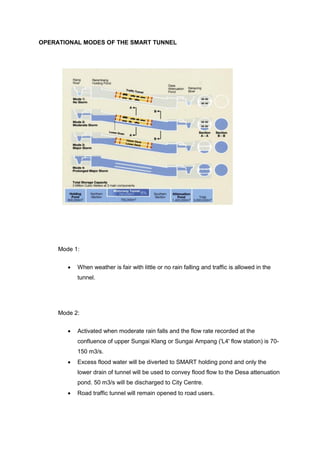
OPERATIONAL MODES OF THE SMART TUNNEL
Mode 1:
• When weather is fair with little or no rain falling and traffic is allowed in the
tunnel.
Mode 2:
• Activated when moderate rain falls and the flow rate recorded at the
confluence of upper Sungai Klang or Sungai Ampang ('L4' flow station) is 70-
150 m3/s.
• Excess flood water will be diverted to SMART holding pond and only the
lower drain of tunnel will be used to convey flood flow to the Desa attenuation
pond. 50 m3/s will be discharged to City Centre.
• Road traffic tunnel will remain opened to road users.
Mode 3:
• Activated when major storm event occurs and flood model forecasts a flow
rate of 150 m3/s or more at L4. Only 10 m3/s will be discharged to city centre.
• Traffic will be evacuated from the road tunnel.
• If heavy rain storm stops early or due to some specific circumstances, then
the traffic tunnel will not be flooded.
• Road tunnel will be re-opened to traffic within 2-8 hours after closure.
Mode 4:
• Activated if heavy rain storm prolongs, usually will be confirmed 1-2 hour after
Mode 3 is declared.
• Road tunnel will be used for passage of flood flow after traffic evacuation
completed.
• Road tunnel will be re-opened to traffic within 4 days of closure.
Once SMART is in place, will the city folks be rid off the flash floods and traffic jams
after heavy downpour?
Studies have shown that where Sungai Klang meets Sungai Ampang and the Sungai
Gombak meets Sungai Klang are the flood prone areas and the Jalan Tun Perak Bridge can
only manage a certain level of flood discharge. The SMART PROJECT when completed will
help divert water from entering the critical location in the Sg. Klang. We would like to correct
the misconception that SMART would be able to resolve the flooding in the city centre by
itself. There are the Sungai Bunos and Sungai Gombak that contribute to floods in the city
centre. There are other flood mitigation projects undertaken by JPS besides SMART which
would then resolve the flooding woes in the city centre. Then again, there is such a thing
called the life span, SMART has its limitation which is dependent on other factors such as
future development. SMART addresses floods caused by overflow of rivers and do not
address flash floods caused by a myriad of other localized problem such as clogged drains
and so on.
Why use TBM instead of conventional tunneling methods?
● prevents/reduces incidences of settlement on the surface by managing and
● controlling unstable ground conditions
● fast/ efficient
● minimizes disruption/disturbances to existing development and traffic
● able to better control water entering the tunnel which will reduce water table draw
down/consolidation settlement
● continuous operations- the TBM can operate round the clock
● less rock damage
● less support requirement
● higher advance rates
● greater worker safety
● potential for remote, automated operation
● minimum land acquisition
INSTALLATION PROCESS OF TBM (TUNNELING METHOD USED IN SMART
PROJECT)
Kuala Lumpur has a high ground water table and it also sits on karstic limestone.
One of the special features of the karstic limestone include cliffs, pinnacles, cavities,
collapsed cavities and sinkholes. Overlying these karstic limestones are loose alluvium
which are from previous tin mining activities.
Due to these soil conditions, geologist made sure that the soil formation cannot be
disturbed as it can cause structural imbalance to the existing structure surrounding the
tunnel. After careful planning and thought, it was decided that Tunnel Boring
Machines(TBMs) would be the most cost-effective and it would have minimal negative
impact on the geological condition of the soil. Tunnel Boring Machines is one of the most
advanced and cost effective method which was mostly used in Europe. TBMs may have
many different types but the Slurry Shield was chosen after much research and study
because this machine was designed to create a pressured shield made up of bentonite and
air pressure which can be used to counter balance the pressure of the loose soil and
groundwater drawdown which is the root cause of incidences of sinkhole appearance. Two
Slurry Shield TBMs were chosen with the same diameter of 13.2m which in terms of
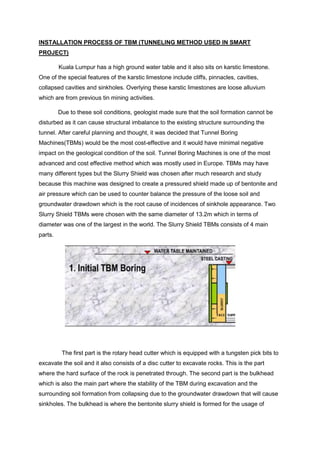
diameter was one of the largest in the world. The Slurry Shield TBMs consists of 4 main
parts.
The first part is the rotary head cutter which is equipped with a tungsten pick bits to
excavate the soil and it also consists of a disc cutter to excavate rocks. This is the part
where the hard surface of the rock is penetrated through. The second part is the bulkhead
which is also the main part where the stability of the TBM during excavation and the
surrounding soil formation from collapsing due to the groundwater drawdown that will cause
sinkholes. The bulkhead is where the bentonite slurry shield is formed for the usage of
stability. The third part is the hydraulic rams which is used to drive the machine forward and
keep the tunnel in its correct position and used to set the alignment of machine straight so
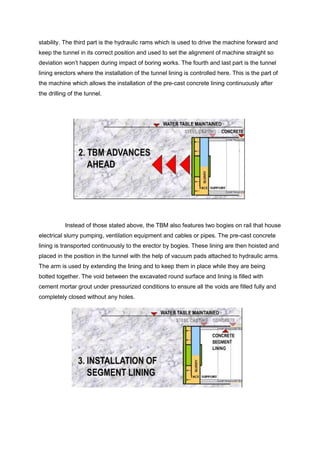
deviation won’t happen during impact of boring works. The fourth and last part is the tunnel
lining erectors where the installation of the tunnel lining is controlled here. This is the part of
the machine which allows the installation of the pre-cast concrete lining continuously after
the drilling of the tunnel.
Instead of those stated above, the TBM also features two bogies on rail that house
electrical slurry pumping, ventilation equipment and cables or pipes. The pre-cast concrete
lining is transported continuously to the erector by bogies. These lining are then hoisted and
placed in the position in the tunnel with the help of vacuum pads attached to hydraulic arms.
The arm is used by extending the lining and to keep them in place while they are being
bolted together. The void between the excavated round surface and lining is filled with
cement mortar grout under pressurized conditions to ensure all the voids are filled fully and
completely closed without any holes.
The lining installation is done together with the drilling works. While the TBM does
the drilling work, the tunnel lining work is using the rails used by the TBM machine where
this makes the transportation through the tunnel easier while both the work progresses.
For SMART, both Slurry Shield machines are used, both starting from the JKR field
area in Jalan Chan Sow Lin. The first machine will be heading North under Jalan Tun Razak
and Jalan Desa Pandan before terminating at the pond at Ampang behind Gleneagles
Hospital. However, for the second machine will head south under the Jalan Chow Sow Lin
and the KL-Seremban Highway next to Sungai BESI airfield before terminating at the
existing pond in Taman Desa.
POSSIBLE PROBLEMS TO THE SMART TUNNEL IN MALAYSIA
1. Limitation
In Malaysia, SMART tunnel can only mitigate flooding in the city center due to overbank
flow of Klang River between Tun Perak Bridge and Dang Wangi Bridge, one option is to
increase the capacity of the stretch of Klang River concerned, and the other option is to reduce
the flood flow passing through it. However, it is not 100% prevent big flood. It just reduced the
percentage of big floods and damages by flood. It used to face only big flood in Kuala Lumpur
before the SMART tunnel was build. (Feekle, 2011)
It is realized that the discharges from the tributaries of Klang River downstream of the
diversion point, condition and capacity of the receiving rivers, Kerayong River and Klang River
downstream of the Kerayong or Klang confluence, have influence to the flooding at city center.
SMART tunnel alone is not able to fully offset these influences. A huge project costs a lot of
money and might not be economical viable. SMART tunnel is not the only solution to the flood
problem, but people would say this is a project worth billions built to relieve the situation in a
big way. The SMART tunnel is designed to handle only 45 per cent of floodwaters coming
from the rivers. When people look at the tunnel and the high cost, they think it would cover all,
but in fact, it only takes care of 45 per cent. (New Sunday Times, 2007)
Another case in Malaysia, which was the day Jalan Tun Razak, Jalan Semarak and
Kampung Baru were flooded just like how it was in 2006, when the worst flood ever hit the city
center. It also seems that the river that burst its bank was Sungai Bunus. It flows through the
Kampung Baru - Jalan Tun Razak - Jalan Semarak area and this waterway was not covered
under the SMART Tunnel scope. So, there is now a need to come up with a flood mitigation
project to resolve this "new problem". (The Star Online, 2011)
2. Ineffectiveness
Another aspect to the problem emerged is SMART tunnel management's slowness in
reacting to downpours leading to flash floods in the suburbs of Kuala Lumpur has angered
residents. Residents in the vicinity of Ampang Jaya and Pandan who have been inundated by
flash floods in recent months have accused the management of the SMART Tunnel of
inefficiency. The continuous downpour had affected housing estates in the whole of Ampang
area and in Kampung Pandan Dalam, Bandar Baru Ampang, Lembah Jaya, Taman Nirwana,
Taman Putra Sulaiman, Taman Dagang and Bukit Belacan. (Pragalath, 2012)
SMART company delay in opening the tunnels is what caused the floods. On that day,
there was six inches of water on the ground and it was raining from evening until 9.30 p.m. at
night. This was not the first time that SMART had neglected its duties. SMART company
should be prepared to guard the city (around the clock) but they are not. (Thomas, 2012)
3. Less Use
People are saying that government refuses to operate the tunnel now because the
government wants to collect toll through SMART traffic operations. If we had this tunnel, how
often would it be used? The tunnel would be used once, or three times yearly. Spending RM1.3
billion for something which would not be used the whole year needed re-evaluation. (New
Sunday Times, 2007)
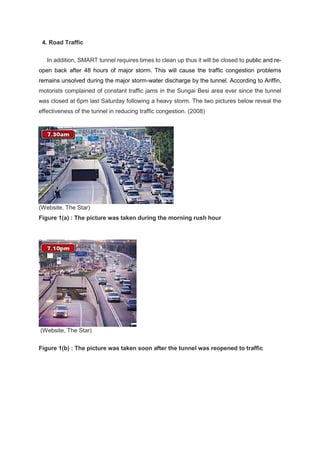
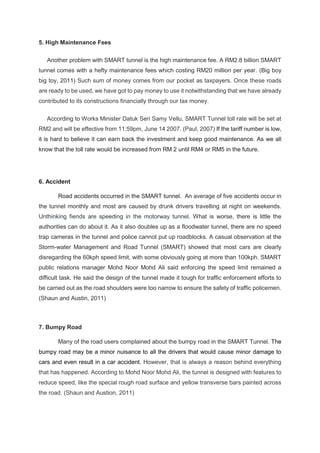
4. Road Traffic
In addition, SMART tunnel requires times to clean up thus it will be closed to public and re-
open back after 48 hours of major storm. This will cause the traffic congestion problems
remains unsolved during the major storm-water discharge by the tunnel. According to Ariffin,
motorists complained of constant traffic jams in the Sungai Besi area ever since the tunnel
was closed at 6pm last Saturday following a heavy storm. The two pictures below reveal the
effectiveness of the tunnel in reducing traffic congestion. (2008)
(Website, The Star)
Figure 1(a) : The picture was taken during the morning rush hour
(Website, The Star)
Figure 1(b) : The picture was taken soon after the tunnel was reopened to traffic
5. High Maintenance Fees
Another problem with SMART tunnel is the high maintenance fee. A RM2.8 billion SMART
tunnel comes with a hefty maintenance fees which costing RM20 million per year. (Big boy
big toy, 2011) Such sum of money comes from our pocket as taxpayers. Once these roads
are ready to be used, we have got to pay money to use it notwithstanding that we have already
contributed to its constructions financially through our tax money.
According to Works Minister Datuk Seri Samy Vellu, SMART Tunnel toll rate will be set at
RM2 and will be effective from 11:59pm, June 14 2007. (Paul, 2007) If the tariff number is low,
it is hard to believe it can earn back the investment and keep good maintenance. As we all
know that the toll rate would be increased from RM 2 until RM4 or RM5 in the future.
6. Accident
Road accidents occurred in the SMART tunnel. An average of five accidents occur in
the tunnel monthly and most are caused by drunk drivers travelling at night on weekends.
Unthinking fiends are speeding in the motorway tunnel. What is worse, there is little the
authorities can do about it. As it also doubles up as a floodwater tunnel, there are no speed
trap cameras in the tunnel and police cannot put up roadblocks. A casual observation at the
Storm-water Management and Road Tunnel (SMART) showed that most cars are clearly
disregarding the 60kph speed limit, with some obviously going at more than 100kph. SMART
public relations manager Mohd Noor Mohd Ali said enforcing the speed limit remained a
difficult task. He said the design of the tunnel made it tough for traffic enforcement efforts to
be carried out as the road shoulders were too narrow to ensure the safety of traffic policemen.
(Shaun and Austin, 2011)
7. Bumpy Road
Many of the road users complained about the bumpy road in the SMART Tunnel. The
bumpy road may be a minor nuisance to all the drivers that would cause minor damage to
cars and even result in a car accident. However, that is always a reason behind everything
that has happened. According to Mohd Noor Mohd Ali, the tunnel is designed with features to
reduce speed, like the special rough road surface and yellow transverse bars painted across
the road. (Shaun and Austion, 2011)
8. Safety Check
A typical tunnel or SMART tunnel has to go through the safety check due to it confined
structural nature when accident happens. For example, Burnley Tunnel Tragedy in Melbourne
which occurred on the 23rd March, 2007 is a good example. Due to the smart safety system
which are TROX fire and smoke dampers installed in the smoke extract system installed in
the tunnel, all passengers were able to evacuate in 15 minutes to avoid the suffocation.
SMART is one of the first type of tunnel that has dual functionalities on storm management
and traffic, thus it should be allocated for this tunnel for trials and simulate the storm situation.
It is because if a car gets trapped inside the tunnel when the gate is closing, the whole system
will be considered as failure and departments and authorities concerned have to be bashed
by the public and the losses are astronomical. (Johnsonooi, 2007)
9. Blind Corner
Ultimately, the exit of tunnel is concealed behind the blind corner hence this problem would
possibly cause the drivers to stop suddenly in the middle of the road because they have no
idea which road to exit. This caused the other cars behind to honk profusely as it is a blind
corner. Hence, more notifications or sign ages are required to inform the drivers before they
reach the exit. (Marmitecarb, 2007)
RECOMMENDATIONS FOR FUTURE IMPROVEMENT
1. Limitation
Since SMART tunnel does not have sufficient capacity to retain that large volume of flood
water during major storm, a more economical method instead of duplicating another project
like SMART tunnel would be constructing pipelines to divert the water OUT of SMART tunnel
when almost at its full capacity. The retained water can be diverted to rivers out of town where
river banks are at stable water (table) level.
In addition, a more advanced method could be adding discharging pumps to discharge water
out of the SMART tunnel. This could be used when water velocity entering the SMART tunnel
is too fast, so to add pumps (or by propellers) to pump out the water as mentioned above.
The concept of discharging water outwards has been used by the Japanese in urban areas,
the project is known as "Metropolitan Area Outer Underground Discharge Channel".
2. Ineffectiveness
SMART company encounters delay in opening its water tunnels for the inlet of water which
allows the flood to happen in the common areas. It was reported a several times of its
ineffectiveness. On a particular day, there was six (6) inches high of water on the ground and
the rain prolongs from evening until 9.30 PM at night. This was not the first time that SMART
had neglected its duties.
SMART company should always be prepared and fulfil its duty to alleviate and prevent flood
at the designated places.
First off, if too many cases of flood have been reported due to SMART tunnel's ineffectiveness,
strict action has to be taken on the personnel because this issue affects lives and also millions
or billions worth of properties in town center. A new management team should be hired to
replace the ineffective ones.
Other than that, SMART equipments and operating devices can either be upgraded or added.
For example, the inside of SMART tunnel during its flood operational mode is supervised by
CCTV. However, due to the tunnel's structure which is not entirely straight and has many
curves, some parts cannot be supervised and monitored even though it already has 212
CCTVs installed. Hence, more CCTVs can be added to unseen areas to monitor the water
level from inside.
At the outside, the flood detection system may be upgraded to increase the sensitivity of the
device/system to detect water and its velocity.
3. Accident
Road accidents occurred in the SMART tunnel. An average of five accidents occur in the
tunnel monthly and most are caused by drunk drivers travelling at night on weekends. Since
there are no speed trap cameras in the tunnel and police cannot put up roadblocks, we should
punish the drunk drivers by giving fine /waterproof speed trap cameras can be placed in the
SMART tunnel.
4. Bumpy Road
Many of the road users complained about the bumpy road in the SMART Tunnel. The bumpy
road may be a minor nuisance to all the drivers that would cause minor damage to cars and
even result in a car accident. Since the tunnel is designed with features to reduce speed, like
the special rough road surface and yellow transverse bars painted across the road, slow down
speed limit sign placed along the road,to avoid minor damage to cars and even result in a
car accident.
5. Blind Corner
Ultimately, the exit of tunnel is concealed behind the blind corner hence this problem would
possibly cause the drivers to stop suddenly in the middle of the road because they have no
idea which road to exit. This caused the other cars behind to honk profusely as it is a blind
corner. Hence, more notifications or sign ages are required to inform the drivers before they
reach the exit. (Marmitecarb, 2007)
Also, when accidents happen or any sudden obstruction occurs at blind spots, there is not
enough time to come to a complete halt. Constructive accidents would happen, where
another vehicle could hit the stationary vehicles. Blind spots can be prevented by adding
convex mirrors (wide-angle mirrors) for a broader vision.
LEARNING OUTCOME
We have thoroughly went through all the discussion on the topics to be studied and we decided
to pick this topic “Stormwater Management”. We are well aware of our country’s climate and
also, it is a Tropical country so it is known for its humid and rainy condition. During the rainy
season, Malaysia is prone to flash floods and it may cause massive damage to buildings,
houses, or even plantation when run-off water or flood water carrying hazardous substances
or particulates flooded the plantation. Another problem would be the exceptionally heavy traffic
congestion caused by the rain where the roads collect puddles of water or even worse, flooded
roads, slowing down vehicles.
Since we are also road users, we wish to learn more about our government’s initiative to ease
the citizens by their effort to relieve traffic congestion and to mainly prevent flood especially
the wealth of town center. Hence, we picked this topic. It is unavoidable to stop natural
phenomenon like heavy rainfall and storms to happen but we could find ways to reduce the
chances of catastrophic events.
SMART tunnel was a wise dual-purpose tunnel built and a worthy investment to alleviate
damage to properties due to flood. However, to have such big project operating, there are
many critical consideration and advanced technology to be implemented and equipped. It may
seem like just constructing a huge-bored tunnel and two main purposes are achieved but
SMART company has incorporated many features so that the SMART tunnel could function
well and smoothly.
We have learnt how the usage of advanced technology in SMART tunnel could divert strong
current of potential flood into the enormous tunnel and how traffic could be diverted out of the
SMART tunnel during its operational mode of water retention and flood prevention. Without
even one (1) or more features, the system goes haywire. Therefore, we could pick some
lessons that “a single twig breaks, but a bundle of twigs is strong and unbreakable”, just like
in any construction project, many other consideration (of components) to work together as a
whole. There are many unforeseen potential problems/obstacles so to think critically.
By studying such cases related to our country’s problems, we could also enhance our
researching skills. Furthermore, these researches could allow us to research further about
foreign countries’ systems (of homogenous topic) to prevent flood (under Stormwater
Management). By means, we tend to be able think broader with the exchange of culture and
additional knowledge. With hopes, in the future we could come out with ideas and projects to
aid to solve problems especially in construction, in affordable, reasonable and helpful solution.
APPENDICES
1. Ali, M. N. (-0001, November 29). Smart tunnel: Two issues, one solution. Retrieved
July 02, 2017, from http://www.geospatialworld.net/article/smart-tunnel-two-issues-
one-solution/
2. SMART (Stormwater Management And Road Tunnel), Kuala Lumpur. (n.d.).
Retrieved July 02, 2017, from http://www.roadtraddic-technology.com/projects/smart
3. SMART Tunnel. (2017, June 28). Retrieved July 02, 2017, from
https://en.wikipedia.org/wiki/SMART_Tunnel
4. Unique Features – SMART Motorway Tunnel. (n.d.). Retrieved July 2, 2017, from
http://smarttunnel.com.my/smart/unique-features/
5. SMART Project - Water. (n.d.). Retrieved July 2, 2017, from
http://www.water.gov.my/programme-aamp-activities-our-services-382/373
6. STORMWATER MANAGEMENT AND ROAD TUNNEL ... - SMART Tunnel. (n.d.).
Retrieved July 2, 2017, from
http://www.smarttunnel.com.my/construction/info_faq.htm
7. Advantages and Disadvantages of Underground Utilities ... (n.d.). Retrieved July 2,
2017, from http://www.merloconstructionmi.com/advantages-disadvantages-
underground-utilities/
8. SMART (Stormwater Management And Road Tunnel), Kuala ... (n.d.). Retrieved July
2, 2017, from
http://www.bing.com/cr?IG=5D92A3BD9152454499756A488425445E&CID=3EA995
D3C68165B51C829F60C7876477&rd=1&h=840CA5S-
BM3_sbzz_sWFr9k5vulJHJaW412QlihisG8&v=1&r=http%3a%2f%2fwww.roadtraffic-
technology.com%2fprojects%2fsmart%2f&p=DevEx,5063.1

Bs finallll (1)

  • 1.
    INTRODUCTION TO SUSTAINABLESTORM-WATER MANAGEMENT Storm water is a surface that in abnormal quantity leading from heavy falls of rain or snow. Storm-water spillover roof tops, parking lots, streets, yards, sidewalks and fields. In urban and suburban areas, irremediable storm-water will lead to 2 major issues such as water pollution and flooding. A) Water pollution It is because of our daily activities such as rubbish and detritus into the storm drain, yard care activities such as improper way of fertilizers and pesticides, and not cleaning up grass clippings and leaves. In addition, washing vehicles on sidewalk which enable the soap and dirty wastewater directly to the storm drain. B) Flooding Storm water transport systems are utilized to carry storm water from urban areas to avoid flooding. Nevertheless, this process may lead flooding of the river because water does not infiltrate, and it will exceed the capacity of the river. In addition, it will cause blockage of drain because all objects that are collected during rain. Moreover, traditional storm-water drainage systems regularly route spillover direct to streams and rivers. Consequently, intensify pollutant inputs and hydrologic disturbance, and bringing about the degradation of ecosystem structure. Therefore, to manage the quality and quantity of storm water which is also named Storm-water Management, principles such as, Low Impact Development (LID) or Best Management Practices (BMPs) techniques are used in urban area in order to maintain a sustainable storm-water management system.
  • 2.
    ADVANTAGES OF SUSTAINABLESTORM-WATER MANAGEMENT . 1. Reduce or help prevent occurrence of flash flood in urban areas. 2. Relieve traffic congestion 3. Mitigate damage to properties. 4. Long term savings due to less expenses on repair work on damaged properties. 5. Reduce environmental impact. 9. Makes roads safer by preventing hydroplaning and vehicle submersion. 6. Filtration systems can be added to ensure environmental safety. 7. Low maintenance and dependable construction means the system will last for many years. 8. Water can be held and released as desired. ADVANTAGES
  • 3.
    DISADVANTAGES OF SUSTAINABLESTORM-WATER MANAGEMENT . 1. Desalination- debris on floor causes accidents for sustainable storm-water management. 2. Does not perform to it’s full capacity drainage towards sustainable storm-water management is not well designed which could be a waste of money. 9. Broken pipes can cause groundwater contamination. 6. . 3. Maintenance can require excavation. 4. Microorganisms or bacteria accumulation after water retention may grow algae to cause roads to be slippery and dangerous if not maintained or serviced and may cause infection. 5. . 8. Needs consistent water flow to prevent waste deposit buildup. 7. Underground retention systems are generally built without filtration mechanisms. 5. Cost and time consuming to construct 6. More area must be excavated during the initial construction phase than required for a simple surface reservoir. DISADVANTAGES
  • 4.
    EXAMPLES OF SUSTAINABLESTORM-WATER MANAGEMENT EXAMPLES OF SUSTAINABLE STORM-WATER MANAGEMENT 1. RAIN GARDEN Rain gardens are specially designed garden beds which filter storm-water runoff from surrounding areas or storm-water pipes. They are also called bio-retention systems as they provide biological treatment of storm-water using soil, plants, roots and microbes. EXAMPLES OF SUSTAINABLE STORM- WATER MANAGEMENT 1. RAIN GARDEN 2. BIO-RETENTION 3. VEGETATED SWALES 4. DRY SWALE
  • 5.
    Rain gardens aredesigned to stop excess storm water, nutrients, rubbish and sediment from polluting our waterways, bays and oceans. They can even be positioned to capture overflow from a rainwater tank. How do Rain Gardens work? A rain garden lets water collect and settle on the garden surface then soak through the plants and filter media. Rubbish and sediment is trapped on the surface. Nutrients dissolved in the storm-water are used by the plants and toxins stick to the soil. The soil and plant roots work together to naturally filter the water and remove pollutants. Test the filter media before installation to check it meets standards for hydraulic conductivity and plants growth and holds adequate soil moisture to support the plants.
  • 6.
    INSTALLATION PROCESS OFRAIN GARDEN Step 1: Find a location: It is suggested that u place the garden at least 10 feet away from your house to prevent flooding your house and preferably located in the sun either full or partial. Do not locate over a septic field and it is better to choose a naturally low spot in your yard where your downspouts or sump pump outlet can be used to direct the rainwater into your garden. Step 2: Measure the drainage area: You have to measure the specific drainage area of the surface and multiply it by the type of soil if you are capturing water from the roof or any hard surfaces. For Sandy soil multiply it by 20%, loam use 30-35% and for clay use 45-60%. These numbers are inflated but they will ensure the garden holds as much water as it possibly could. You do not have to measure the drainage area if you are using a low spot in your yard. Step 3: Create a design: By planning your garden first, you will be able to create the best appearance for your garden. Basic principle applies to your garden no matter how small or big it is. Step 4: choose plants: Natives plants are suggested due to the climate in your certain area. The plants chose can grow well in both wet and dry areas because the garden will temporarily fill with rainwater from time to time. Step 5: Layout of the garden: Lay out the shape and boundaries based on your design. Step 6: Dig the garden: Before digging, please locate the underground utilities. Remove turf grass and dig 4-8 inches deep and use the soil to build berm around the garden edges if necessary. Step7: Prepare the soil: Amend the soil with 2-3 inch of compost and mix well. Step 8: Plant the flower and grass: Plants should be placed 1 foot apart from each other. Step 9: Mulch the garden: Use coarse, fibrous, shredded wood chips that wont float or be blown
  • 7.
    away. The mulchis applied 2-3 inches deep and this is used to keep the moisture in and the weeds out. Step 10: Water & arrange downspout: Water the plants for 2 weeks if it does rain until the garden looks to be growing on its own without any water from watering. 2. BIO-RETENTION AREAS Bio-retention basins are landscaped depressions or shallow basins used to slow and treat on-site storm-water runoff. Storm-water is directed to the basin and then percolates through the system where it is treated by a number of physical, chemical and biological processes. The slowed, cleaned water is allowed to infiltrate native soils or directed to nearby storm- water drains or receiving waters. Bio-retention basins can be installed at various scales, for example, integrated with traffic calming measures in suburban parks and in retarding basins. In larger applications, it is considered good practice to have pre-treatment measures (e.g. vegetated strips and swales) upstream of the basin to capture sediment and reduce the maintenance frequency of a bio- retention basin. The size of the rain garden or bio-retention area will determine the volume of runoff that can be stored or reduced, as well as the treatment benefits. Where the volume of runoff exceeds that of the bio-retention area, additional storm-water devices will be required in the treatment train to handle the design storm.
  • 8.
    INSTALLATION OF BIO-RETENTION Step1: It starts after the entire drainage area has been stabilized with vegetation. While the bio retention area is being constructed, it would be best to block certain curb or other inlets. The proposed site should be checked for existing utilities prior to any excavation. Step 2: Checking of the boundaries of the contributing drainage area and the actual inlet elevations to ensure they are confirm the original design should be done by the installer and designers. Contractors may also be present so it is hard to find subtle differences in site grading, drainage and paving elevations which can produce hydraulically important differences for the proposed bio retention area. Step 3: Temporary E&S controls are needed to complete the construction of the bio retention area to divert the storm water away from the bio retention area. Special protection measures such as erosion control fabrics may be needed to protect vulnerable side slopes during construction. Step 4: Pretreatment cells should be excavated first and then sealed to trap sediments. Step 5: Workers should work from the sides to excavate the bio retention area to its appropriated
  • 9.
    dimension and depth.Excavating equipment should have scoops with adequate reach to prevent sitting inside the footprint of the area. The usage of cell construction approach in larger bio retention basins are necessary where the basin is split into 500-1000 square feet with a 10-15-foot earth bridge in between so the cells can be excavated from the side. Step 6: It may be necessary to rip the bottom soils to a depth of 6-12 inches to promote greater infiltration. Step 7: Geotextile fabric can be placed on the sides of the bio retention area with a 6inch overlap on the sides. If there is no stone storage layer used, start with 6 inches of #57 stone on the bottom and then install the perforated underdrain pipe, pack #57 stone to 3 inches above the underdrain pipe and add around 3 inches of choker stone or pea gravel as a filter between the underdrain and the soil media layer. If there is a stone storage layer, replace the 6 inches of #57 stone with a suitable depth of #57 stone at the bottom. Step 8: Send the soil media from an approved vendor and store it on an impervious area or plastic sheeting. Apply the soil media in a 12 inch lifts until the desired top elevation of the bio retention area is reached. To check for the settlement, wait for a few days and add additional media to achieve the design elevation. Step 9: Get ready planting holes for trees and shrubs, then apply the vegetation and water accordingly. It is possible to install any temporary irrigation. Step 10: Place the surface cover in both cells depending on the design. Install the plant materials as shown in the landscaping plan and water them when there is no rain for the first two months. Step 11: Lead the final inspection. Then log the GPD coordinates for each bio retention facility and submit them for entry into the local maintenance tracking database.
  • 10.
    3. VEGETATED SWALES Vegetatedswales are broad, shallow channels designed to convey and infiltrate storm-water runoff. The swales are vegetated along the bottom and sides of the channel, with side vegetation at a height greater than the maximum design storm-water volume. The design of swales seeks to reduce storm-water volume through infiltration, improve water quality through infiltration and vegetative filtering, and reduce runoff velocity by increasing flow path lengths and channel roughness. Design Variations Two primary vegetated swale design variations exist. Dry swales are designed with highly permeable soils and un underdrain to allow the entire storm-water volume to convey or infiltrate away from the surface of the swale shortly after storm events. Dry swales may be designed with check dams that act as flow spreaders and encourage sheet flow along the swale. Check dams also retain storm-water. Wet swales are designed to retain water and maintain marshy conditions for the support of aquatic vegetation. Because of their highly permeable soil and conveyance capability, dry swales are more applicable for urban environments.
  • 11.
    INSTALLATION OF VEGETATEDSWALES Step 1: Rough grade the vegetated swale. 18 inches of subgrade shall be removed to take place with a blend of topsoil and sand to promote infiltration and biological development if the excavation brings to a substantial compaction of the subgrade. Step 2: Construct check dams, if required. Step 3: Fine grade the vegetated swale where accurate grading is crucial for swales where even the slightest nonconformities may cause the flow to be exposed and leaked. Step 4: Prior to establishment of vegetation, a swale is specifically vulnerable to scour and erosion and therefore its seed bed must be protected with temporary erosion control. Step 5: If all tributary areas are stabilized enough, remove the temporary erosion and sediment control.
  • 12.
    4. DRY SWALE Dryswales are essentially bio-retention cells that are shallower, configured as linear channels, and covered with turf or other surface material (other than mulch and ornamental plants). The dry swale is a soil filter system that temporarily stores and then filters the desired Treatment Volume (TV). Dry swales rely on a pre-mixed soil media filter below the channel that is similar to that used for bio-retention. If soil are extremely permeable, runoff infiltrates into underlying soils. In most cases, however, the runoff treated by the soil media flows into a underdrain, which conveys treated runoff back to the conveyance system further downstream. The underdrain system consists of a perforated pipe within a gravel layer on the bottom of the swale, beneath the filter media. Dry swales may appear as simple grass channels with the same shape and turf cover, while others may have more elaborate landscaping. Swales can be planted with turf grass, tall meadow grasses, decorative herbaceous cover, or tress.
  • 13.
    INSTALLATION OF DRYSWALE Step 1: Protection during site construction where the dry swales should be kept outside the limit of disturbance during this time where it can prevent soil compaction by heavy equipment. Step 2: Stabilize upstream drainage area where the drainage area should be less than 5 acres Step 3: There should have permeable soil which can be use with soil amendment which may also need an underdrain in less permeable soil before excavating the dry swale Step 4: Rip or scarify bottom Step 5: Install a filter fabric, stone and underdrain to ensure that there are 2 feet of separation to groundwater. Step 6: Add a minimum of 18 inches of soil media in a 12 inch lifts Step 7: Install check dams for pre-treatment driveways to avoid certain commercial and industrial hotspots Step 8: Plant trees and shrubs Step 9: Install landscape cover. Step 10: Inspect construction.
  • 14.
    INTRODUCTION OF SMARTTUNNEL Storm-water Management and Road Tunnel (SMART Tunnel) is a storm drainage and road structure in Kuala Lumpur, Malaysia and a major national project in the country. The 9.7km (6.0 mi) tunnel is the longest storm-water tunnel in South East Asia and second longest in Asia. It has dual functions. Speaking of storm-water management, this system is able to divert large volumes of flood water from entering the prone area into the designated “holding pond, by pass tunnel and storage reservoir”. The main objective of this tunnel is to solve the problem of flash floods in Kuala Lumpur and also to reduce traffic jams along Jalan Sungai Besi and Loke Yew flyover at Pudu during rush hour. There are two components of this tunnel, the storm-water tunnel and motorway tunnel. It is the longest multi-purpose tunnel in the world. In 2011, the SMART tunnel received the UN Habitat Scroll of Honour Award for it’s innovative and unique management of storm-water and peak hour traffic. It begins at Kampung Berembang lake near Klang River at Ampang and ends at Taman Desa lake near Kerayong River at Salak South. The project is led by the government, including Malaysian Highway Authority (Lembaga Lebuhraya Malaysia, LLM) and the Department of Irrigation and Drainage Malaysia (Jabatan Pengairan dan Saliran, JPS) and also a company joint venture pact between Gamuda Berhad and Malaysian Mining Corporation Berhad (MMC).
  • 15.
    MANAGEMENT SYSTEM More aboutSMART Project? a. the project was commissioned by the Government of Malaysia. b. the tunnel handles 30,000 cars per day. c. successfully used 44 times to divert floodwater. d. project also includes a storage reservoir and twin box culvert to divert any floodwater. e. In addition, there is a holding basin with a diversion and dedicated tunnel intake structures. Smart tunnel is an advanced technology used in Malaysia, to mainly alleviate flood in KL / reduce traffic congestion. Hence, this technology needs to have a solid management system to guide things through and perform smoothly. Management Team A management is ready to standby for any inconvenience caused to users/customers. It takes proactive action such as mitigate floods, manage traffic, tackle congestion, provide information to road users, improve safety and journey time reliability, whilst respecting and minimizing any adverse impact on the environment.
  • 17.
    Maintenance & Service Itis reported that there are significant relationships between SMART Tunnel maintenance works with flood occurrences and SMART Tunnel maintenance work with traffic flow. When there is enough maintenance works, flood occurrence will be very low and vice versa. The research shows that SMART Tunnel plays an important role in decongestion of traffic to and from the Kuala Lumpur City Centre. It diverts approximately 30,000 cars a day. This contributes in providing valuable frontier and offers means to improve the maintenance works of SMART Tunnel to optimize the utilization on flood disaster and traffic flow management in Kuala Lumpur City Centre. It also updates people about the roles of SMART Tunnel in Kuala Lumpur City Centre. The devastating errors are in tunnel‘s maintenance and inspections which is supposed to be carried-out weekly on the automated flood control gates, the water tight gates on either end of the motorway tunnel within the stormwater section Similarly, another component that supposed to be checked frequently, at least twice a week according to the SMART tunnel operations manual, are the water-tight doors that lead to the SMART equipment areas, it is also not maintained and checked as prescribed in the operational manual but, it`s been carried out once in two weeks. Furthermore, the monthly maintenance works that involves the whole major system of the SMART tunnel including software checks has limited maintenance.
  • 18.
    Online / MediaAccess Through this website as in image, you are well informed about: a) SMART tunnel’s status (opened or closed) to assist in traffic. b) Hotline number for enquiries or emergencies. c) Safety rules to be abided. http://smarttunnel.com.my/smart/what-is-smart/ Website link to ease media access “OPEN/CLOSED” to indicate SMART tunnel’s status - whether or not the tunnel is avaialble at the moment “Helpline Number” for SMART users to contact for direct assistance and ease of convenience & other customers friendly features
  • 19.
    Smart Criteria Smart UniqueFeatures Adoption of advanced M&E systems for effective dual purpose operations such as: a) Flood detection system (FDS) is being used to predict impeding storms and gives out flood warnings to the Storm-water Control Center and to alert and enable the relevant authorities to decide when the Motorway Tunnel has to be used as a flood tunnel. b) SCADA system is able to continuously monitor, process and control essential electrical and mechanical equipment inside the tunnel and are able to respond to any needs to enable the tunnel to operate under it’s design capability such as functions of flood gates, road gates, water tight doors, CCTV’s and etc. c) Tunnel ventilation used is unique in the sense that for it’s axial fans, they are located on the surface but plays a significant role in ensuring that the pollution level are within acceptable range. These axial fans are supported by several jet fans located at the entrances and exits of the dry section of the tunnel. d) IP68-rated M&E equipment such as lighting luminaries and cables, CCTV’s linear heat detector, air quality monitoring equipment and lane traffic indicators are all capable to withstand the dual purpose conditions which include submerging under water at a pressure of up 2.5 bar for more than 24 hours condition. Safety 1. There are ventilation or escape shafts at 1km intervals throughout the tunnel. These will constantly renew the air and maintain the air quality within the motorway section of the tunnel. (control of vehicle exhaust fumes) 2. To protect the ventilation system during flooding, the systems consist of a series of shafts each containing an exhaust and fresh air injector. 3. This enable the fans to be located outside the tunnel, creating a longitudinal flow between shafts that allows the air in the tunnel to be continuously renewed and enables the extraction of exhaust fumes and smoke in the event of a fire.
  • 20.
    SMART Ronda The Rondateam patrols the SMART highway 24 hours a day to assist motorist in need of help. The service provided by the Ronda Team is free of charge. Motorist in need of assistance can use SMART helpline or any of the emergency telephones along the highway. The line will be connected to the Motorway Control Center. Motorway Control Center The Motorway Control Center is manned 24 hours a day by trained traffic controllers. Their roles are to: • Monitor traffic situation along SMART alignment via the CCTV’s. • Received information from road users through the Emergency Telephones or SMART Helpline. • Informing the motorist via Variable Message Sign (VMS). • Spot the cause of traffic congestion, such as vehicle breakdown or accident, and to immediately dispatch assistance so as to ensure smooth flow of traffic. Emergency Telephones The telephones are located at the emergency exits. It is linked to the Motorway Control Center to provide the motorist with easy access for emergency assistance. Variable Message Sign Variable Message Sign (VMS) of amber coloured LEDs provide a mean of informing the motorist of any “traffic advice or message” which will help the motorist to avoid any inconveniences or incidents and in general to facilitate the flow of traffic. These messages are relayed from the Motorway Control Center.
  • 21.
    CASE STUDY Expressway 38 Storm-waterManagement & Road Tunnel (SMART Tunnel) Owner: Government of Malaysia Malaysian Highway Authority(LLM) Maintained by: Syarikat Mengurus Air Banjir dan Terowong Sdn Bhd (SMART). Location: Kuala Lumpur, Malaysia. Length: The 13.2m diameter tunnel consists of a 9.7km storm-water bypass tunnel, with a 4km dual-deck motorway within the storm-water tunnel. Start: Jalan Tun Razak on Kuala Lumpur Middle Ring Road 1. End: Sungai Besi Airport on Kuala Lumpur-Seremban Expressway. Primary Destination: Bukit Bintang, Imbi, Cheras, Petaling Jaya, Seremban. Work Begun: 2003 Opened: 2007 No. of lanes: 4, Double-decked Operating Speed: 60km/h Construction Cost: RM1,887 million (US$514.6 million)
  • 22.
    UNIQUE FEATURES Since safetyof vehicles in the motorway will be of paramount importance, SMART Tunnel has additional features that are unique over and above the features seen in a normal motorway tunnel. The main features are: • Automated Flood Control Gates • Cross Passage • Ventilation/Escape Shafts • Radio Re-Broadcasting Services • Air Quality Monitoring Equipment (AQME) • SCADA Monitoring & Surveillance • Other Emergency Equipment • First Responder Vehicle (FRV) • Medical Response Vehicle (MRV) • Alam Flora Road Sweeper
  • 23.
    1. Automated FloodControl Gates The water tight gates are installed on either ends of the motorway tunnel (within the storm- water section). In addition, similar single flood control steel gates are installed at both entrances and exits of the motorway tunnel. These gates are operated using a hydraulic system. 3 automated flood gates at both end of motorway 2 automated road gates at both end junction boxes 2. Cross Passage Cross Passage between decks at 250m intervals: the passage acts as emergency exits during an emergency. 3. Ventilation/Escape Shafts Ventilation/ escape shafts at 1km intervals. These powerful air ventilators will constantly renew the air and maintain the air quality within the motorway. To protect the ventilation system during the flooding, the system consists of a series of shafts each containing an exhaust and fresh air injector. This design enables the fans to be installed outside the SMART tunnel to create a longitudinal flow in the tunnel between the shafts that permits the air in the tunnel to be continuously renewed and the extraction of the exhaust fumes. The feature also allows for smoke control in the event of a fire.
  • 24.
    4. Radio Re-BroadcastingServices Radio re-broadcasting is an audio (sound) broadcasting service, traditionally broadcast through the air as radio waves (a form of electromagnetic radiation) from a transmitter to an antenna and finally to a receiving device. Stations can link in radio networks to broadcast common programming, either in syndication or simulcast or both. Audio broadcasting also can be done via cable FM, local wire networks, satellite and the Internet. With the radio re- broadcasting services available in Smart Tunnel, user should be able to receive the radio channel, hand phone and other maintenance communication reception without any interference. 5. Air Quality Monitoring Equipment (AQME) There are 38 sets of AQME monitoring carbon monoxide (CO), nitrogen monoxide (NO) and particulate. They are cited in the upper and lower decks. The ventilation system will be operated automatically based on the air quality monitoring system outputs. The ventilation will provide for the supply and extract of air for both the upper and lower road decks and consists of 4 nos. of ventilation shafts each containing 8 set of fans. 6. SCADA Monitoring & Surveillance State-of-the-art SCADA monitoring and surveillance of SMART at its 24-hour SMART Highway. Smart Tunnel is equipped with more than 212 units of Closed Circuit Television and BARCO Wall is able to show 70 CCTVs screen at one time. Automatic detection systems use video images and laser beams processing to detect unusual events. 7. Other Emergency Equipment Equipped with firefighting equipment, telephone and surveillance at 1 km interval. Hydrant & Fire Extinguishers located every 90m along slow lane of both tunnel road decks. Hose Reel, Fire Extinguishers, Break glass and Emergency Telephone located within each cross passage, ventilation shafts and escape shafts.
  • 25.
    8. First ResponderVehicle (FRV) Custom-Built Fire Engines for SMART Highway The First Responder Vehicles are specially designed for accessibility into SMART Highway and equipped to perform necessary fire and rescue emergencies in the dual purpose tunnel. Manufactured in accordance with international standards of MS ISO 9001 for quality assurance and under the special requirements of the National Fire Protection Agency, the vehicles aim to assist the current SMART Highway’s Emergency Response Patrol team’s rescue operations. The FRVs were customized to meet the sophisticated designs of the SMART Tunnel such as height limitations, tunnel manoeuvrability, special equipment housing, and is powered by an engine that produces minimal carbon emission in order to ensure safety in the tunnel is maintained throughout an emergency operation. To further shorten the mobilization time from a Fire and Rescue Department to SMART Highway during an emergency, each vehicle will be parked at separate and specific locations to gain direct access into the upper or lower deck of the tunnel (Taman Desa and Jalan Hang Tuah Fire and Rescue Departments respectively). The powerful 2.5 liter DOHC 4 x 4 vehicles with customization are the first of its kind, Malaysian fire engines that will be used solely for SMART Highway operations. 9.Alam Flora Road Sweeper Alam Flora Road Sweeper is a vehicle which is capable of handling operations for SMART Tunnel cleanliness. SMART has outsourced the service to Alam Flora which has developed road sweepers specially for SMART Tunnel. The cleaning operations are done at night with minimum disruption to traffic flow. The Road Sweeper has a hopper capacity of +/- 5.0cu.m. It has a water tank and would be able to carry around 1000 liter per session. The sweeper has a suction capability via the vacuum type “true flow” air system using a fan blower output of +/- 450m3 per minute. Fitted with a dual sweep brooms on the left and right sides of the vehicle, the speed is variable and the pressure of the brooms can be controlled. The dimension of the main broom is 1500mm in length and 400mm in diameter while the gutter broom measures around 500mm in diameter.
  • 26.
    10. Medical ResponseVehicle (MRV) Custom-Built Ambulance for SMART Highway MRV is a custom made vehicle which is capable in giving the first reponder services or further emergency treatment. The advantage of the MRV is it can transport the medical team or the Emergency Medical Specialist to the scene area. The MRV can be used on the wet, skidded and limited eye vision and also at the off-road situation. For urban situation or metropolitan condition, MRV is capable to use the road curbs in reaching the incident area. MRV is a heavy-duty load carrying chassis and it can be used for on and off road situation for example in the SMART Tunnel, flood condition or off road. It is fully equipped with medical respondent equipment based on what needed. MRV can carry 6 persons at one time including the medical equipment. Come with a powerful engine to cater during the hardcore situation. Provided with the various patience seating configuration based on treatment needs, MRV are also able to carry the listed medical equipment such as: • Emergency Medical and Trauma Bag • Emergency Drugs • Emergency Airways Management • Immobilization Set • Automated External Defibrillator • Triage Card • Other equipment carried along to safe guard the incident area include emergency cone and etc.
  • 27.
    OPERATIONAL MODES OFTHE SMART TUNNEL Mode 1: • When weather is fair with little or no rain falling and traffic is allowed in the tunnel. Mode 2: • Activated when moderate rain falls and the flow rate recorded at the confluence of upper Sungai Klang or Sungai Ampang ('L4' flow station) is 70- 150 m3/s. • Excess flood water will be diverted to SMART holding pond and only the lower drain of tunnel will be used to convey flood flow to the Desa attenuation pond. 50 m3/s will be discharged to City Centre. • Road traffic tunnel will remain opened to road users.
  • 28.
    Mode 3: • Activatedwhen major storm event occurs and flood model forecasts a flow rate of 150 m3/s or more at L4. Only 10 m3/s will be discharged to city centre. • Traffic will be evacuated from the road tunnel. • If heavy rain storm stops early or due to some specific circumstances, then the traffic tunnel will not be flooded. • Road tunnel will be re-opened to traffic within 2-8 hours after closure. Mode 4: • Activated if heavy rain storm prolongs, usually will be confirmed 1-2 hour after Mode 3 is declared. • Road tunnel will be used for passage of flood flow after traffic evacuation completed. • Road tunnel will be re-opened to traffic within 4 days of closure.
  • 29.
    Once SMART isin place, will the city folks be rid off the flash floods and traffic jams after heavy downpour? Studies have shown that where Sungai Klang meets Sungai Ampang and the Sungai Gombak meets Sungai Klang are the flood prone areas and the Jalan Tun Perak Bridge can only manage a certain level of flood discharge. The SMART PROJECT when completed will help divert water from entering the critical location in the Sg. Klang. We would like to correct the misconception that SMART would be able to resolve the flooding in the city centre by itself. There are the Sungai Bunos and Sungai Gombak that contribute to floods in the city centre. There are other flood mitigation projects undertaken by JPS besides SMART which would then resolve the flooding woes in the city centre. Then again, there is such a thing called the life span, SMART has its limitation which is dependent on other factors such as future development. SMART addresses floods caused by overflow of rivers and do not address flash floods caused by a myriad of other localized problem such as clogged drains and so on. Why use TBM instead of conventional tunneling methods? ● prevents/reduces incidences of settlement on the surface by managing and ● controlling unstable ground conditions ● fast/ efficient ● minimizes disruption/disturbances to existing development and traffic ● able to better control water entering the tunnel which will reduce water table draw down/consolidation settlement ● continuous operations- the TBM can operate round the clock ● less rock damage ● less support requirement ● higher advance rates ● greater worker safety ● potential for remote, automated operation ● minimum land acquisition
  • 30.
    INSTALLATION PROCESS OFTBM (TUNNELING METHOD USED IN SMART PROJECT) Kuala Lumpur has a high ground water table and it also sits on karstic limestone. One of the special features of the karstic limestone include cliffs, pinnacles, cavities, collapsed cavities and sinkholes. Overlying these karstic limestones are loose alluvium which are from previous tin mining activities. Due to these soil conditions, geologist made sure that the soil formation cannot be disturbed as it can cause structural imbalance to the existing structure surrounding the tunnel. After careful planning and thought, it was decided that Tunnel Boring Machines(TBMs) would be the most cost-effective and it would have minimal negative impact on the geological condition of the soil. Tunnel Boring Machines is one of the most advanced and cost effective method which was mostly used in Europe. TBMs may have many different types but the Slurry Shield was chosen after much research and study because this machine was designed to create a pressured shield made up of bentonite and air pressure which can be used to counter balance the pressure of the loose soil and groundwater drawdown which is the root cause of incidences of sinkhole appearance. Two Slurry Shield TBMs were chosen with the same diameter of 13.2m which in terms of diameter was one of the largest in the world. The Slurry Shield TBMs consists of 4 main parts. The first part is the rotary head cutter which is equipped with a tungsten pick bits to excavate the soil and it also consists of a disc cutter to excavate rocks. This is the part where the hard surface of the rock is penetrated through. The second part is the bulkhead which is also the main part where the stability of the TBM during excavation and the surrounding soil formation from collapsing due to the groundwater drawdown that will cause sinkholes. The bulkhead is where the bentonite slurry shield is formed for the usage of
  • 31.
    stability. The thirdpart is the hydraulic rams which is used to drive the machine forward and keep the tunnel in its correct position and used to set the alignment of machine straight so deviation won’t happen during impact of boring works. The fourth and last part is the tunnel lining erectors where the installation of the tunnel lining is controlled here. This is the part of the machine which allows the installation of the pre-cast concrete lining continuously after the drilling of the tunnel. Instead of those stated above, the TBM also features two bogies on rail that house electrical slurry pumping, ventilation equipment and cables or pipes. The pre-cast concrete lining is transported continuously to the erector by bogies. These lining are then hoisted and placed in the position in the tunnel with the help of vacuum pads attached to hydraulic arms. The arm is used by extending the lining and to keep them in place while they are being bolted together. The void between the excavated round surface and lining is filled with cement mortar grout under pressurized conditions to ensure all the voids are filled fully and completely closed without any holes.
  • 32.
    The lining installationis done together with the drilling works. While the TBM does the drilling work, the tunnel lining work is using the rails used by the TBM machine where this makes the transportation through the tunnel easier while both the work progresses. For SMART, both Slurry Shield machines are used, both starting from the JKR field area in Jalan Chan Sow Lin. The first machine will be heading North under Jalan Tun Razak and Jalan Desa Pandan before terminating at the pond at Ampang behind Gleneagles Hospital. However, for the second machine will head south under the Jalan Chow Sow Lin and the KL-Seremban Highway next to Sungai BESI airfield before terminating at the existing pond in Taman Desa.
  • 33.
    POSSIBLE PROBLEMS TOTHE SMART TUNNEL IN MALAYSIA 1. Limitation In Malaysia, SMART tunnel can only mitigate flooding in the city center due to overbank flow of Klang River between Tun Perak Bridge and Dang Wangi Bridge, one option is to increase the capacity of the stretch of Klang River concerned, and the other option is to reduce the flood flow passing through it. However, it is not 100% prevent big flood. It just reduced the percentage of big floods and damages by flood. It used to face only big flood in Kuala Lumpur before the SMART tunnel was build. (Feekle, 2011) It is realized that the discharges from the tributaries of Klang River downstream of the diversion point, condition and capacity of the receiving rivers, Kerayong River and Klang River downstream of the Kerayong or Klang confluence, have influence to the flooding at city center. SMART tunnel alone is not able to fully offset these influences. A huge project costs a lot of money and might not be economical viable. SMART tunnel is not the only solution to the flood problem, but people would say this is a project worth billions built to relieve the situation in a big way. The SMART tunnel is designed to handle only 45 per cent of floodwaters coming from the rivers. When people look at the tunnel and the high cost, they think it would cover all, but in fact, it only takes care of 45 per cent. (New Sunday Times, 2007) Another case in Malaysia, which was the day Jalan Tun Razak, Jalan Semarak and Kampung Baru were flooded just like how it was in 2006, when the worst flood ever hit the city center. It also seems that the river that burst its bank was Sungai Bunus. It flows through the Kampung Baru - Jalan Tun Razak - Jalan Semarak area and this waterway was not covered under the SMART Tunnel scope. So, there is now a need to come up with a flood mitigation project to resolve this "new problem". (The Star Online, 2011)
  • 34.
    2. Ineffectiveness Another aspectto the problem emerged is SMART tunnel management's slowness in reacting to downpours leading to flash floods in the suburbs of Kuala Lumpur has angered residents. Residents in the vicinity of Ampang Jaya and Pandan who have been inundated by flash floods in recent months have accused the management of the SMART Tunnel of inefficiency. The continuous downpour had affected housing estates in the whole of Ampang area and in Kampung Pandan Dalam, Bandar Baru Ampang, Lembah Jaya, Taman Nirwana, Taman Putra Sulaiman, Taman Dagang and Bukit Belacan. (Pragalath, 2012) SMART company delay in opening the tunnels is what caused the floods. On that day, there was six inches of water on the ground and it was raining from evening until 9.30 p.m. at night. This was not the first time that SMART had neglected its duties. SMART company should be prepared to guard the city (around the clock) but they are not. (Thomas, 2012) 3. Less Use People are saying that government refuses to operate the tunnel now because the government wants to collect toll through SMART traffic operations. If we had this tunnel, how often would it be used? The tunnel would be used once, or three times yearly. Spending RM1.3 billion for something which would not be used the whole year needed re-evaluation. (New Sunday Times, 2007)
  • 35.
    4. Road Traffic Inaddition, SMART tunnel requires times to clean up thus it will be closed to public and re- open back after 48 hours of major storm. This will cause the traffic congestion problems remains unsolved during the major storm-water discharge by the tunnel. According to Ariffin, motorists complained of constant traffic jams in the Sungai Besi area ever since the tunnel was closed at 6pm last Saturday following a heavy storm. The two pictures below reveal the effectiveness of the tunnel in reducing traffic congestion. (2008) (Website, The Star) Figure 1(a) : The picture was taken during the morning rush hour (Website, The Star) Figure 1(b) : The picture was taken soon after the tunnel was reopened to traffic
  • 36.
    5. High MaintenanceFees Another problem with SMART tunnel is the high maintenance fee. A RM2.8 billion SMART tunnel comes with a hefty maintenance fees which costing RM20 million per year. (Big boy big toy, 2011) Such sum of money comes from our pocket as taxpayers. Once these roads are ready to be used, we have got to pay money to use it notwithstanding that we have already contributed to its constructions financially through our tax money. According to Works Minister Datuk Seri Samy Vellu, SMART Tunnel toll rate will be set at RM2 and will be effective from 11:59pm, June 14 2007. (Paul, 2007) If the tariff number is low, it is hard to believe it can earn back the investment and keep good maintenance. As we all know that the toll rate would be increased from RM 2 until RM4 or RM5 in the future. 6. Accident Road accidents occurred in the SMART tunnel. An average of five accidents occur in the tunnel monthly and most are caused by drunk drivers travelling at night on weekends. Unthinking fiends are speeding in the motorway tunnel. What is worse, there is little the authorities can do about it. As it also doubles up as a floodwater tunnel, there are no speed trap cameras in the tunnel and police cannot put up roadblocks. A casual observation at the Storm-water Management and Road Tunnel (SMART) showed that most cars are clearly disregarding the 60kph speed limit, with some obviously going at more than 100kph. SMART public relations manager Mohd Noor Mohd Ali said enforcing the speed limit remained a difficult task. He said the design of the tunnel made it tough for traffic enforcement efforts to be carried out as the road shoulders were too narrow to ensure the safety of traffic policemen. (Shaun and Austin, 2011) 7. Bumpy Road Many of the road users complained about the bumpy road in the SMART Tunnel. The bumpy road may be a minor nuisance to all the drivers that would cause minor damage to cars and even result in a car accident. However, that is always a reason behind everything that has happened. According to Mohd Noor Mohd Ali, the tunnel is designed with features to reduce speed, like the special rough road surface and yellow transverse bars painted across the road. (Shaun and Austion, 2011)
  • 37.
    8. Safety Check Atypical tunnel or SMART tunnel has to go through the safety check due to it confined structural nature when accident happens. For example, Burnley Tunnel Tragedy in Melbourne which occurred on the 23rd March, 2007 is a good example. Due to the smart safety system which are TROX fire and smoke dampers installed in the smoke extract system installed in the tunnel, all passengers were able to evacuate in 15 minutes to avoid the suffocation. SMART is one of the first type of tunnel that has dual functionalities on storm management and traffic, thus it should be allocated for this tunnel for trials and simulate the storm situation. It is because if a car gets trapped inside the tunnel when the gate is closing, the whole system will be considered as failure and departments and authorities concerned have to be bashed by the public and the losses are astronomical. (Johnsonooi, 2007) 9. Blind Corner Ultimately, the exit of tunnel is concealed behind the blind corner hence this problem would possibly cause the drivers to stop suddenly in the middle of the road because they have no idea which road to exit. This caused the other cars behind to honk profusely as it is a blind corner. Hence, more notifications or sign ages are required to inform the drivers before they reach the exit. (Marmitecarb, 2007)
  • 38.
    RECOMMENDATIONS FOR FUTUREIMPROVEMENT 1. Limitation Since SMART tunnel does not have sufficient capacity to retain that large volume of flood water during major storm, a more economical method instead of duplicating another project like SMART tunnel would be constructing pipelines to divert the water OUT of SMART tunnel when almost at its full capacity. The retained water can be diverted to rivers out of town where river banks are at stable water (table) level. In addition, a more advanced method could be adding discharging pumps to discharge water out of the SMART tunnel. This could be used when water velocity entering the SMART tunnel is too fast, so to add pumps (or by propellers) to pump out the water as mentioned above. The concept of discharging water outwards has been used by the Japanese in urban areas, the project is known as "Metropolitan Area Outer Underground Discharge Channel". 2. Ineffectiveness SMART company encounters delay in opening its water tunnels for the inlet of water which allows the flood to happen in the common areas. It was reported a several times of its ineffectiveness. On a particular day, there was six (6) inches high of water on the ground and the rain prolongs from evening until 9.30 PM at night. This was not the first time that SMART had neglected its duties. SMART company should always be prepared and fulfil its duty to alleviate and prevent flood at the designated places. First off, if too many cases of flood have been reported due to SMART tunnel's ineffectiveness, strict action has to be taken on the personnel because this issue affects lives and also millions or billions worth of properties in town center. A new management team should be hired to replace the ineffective ones. Other than that, SMART equipments and operating devices can either be upgraded or added. For example, the inside of SMART tunnel during its flood operational mode is supervised by CCTV. However, due to the tunnel's structure which is not entirely straight and has many curves, some parts cannot be supervised and monitored even though it already has 212 CCTVs installed. Hence, more CCTVs can be added to unseen areas to monitor the water level from inside.
  • 39.
    At the outside,the flood detection system may be upgraded to increase the sensitivity of the device/system to detect water and its velocity. 3. Accident Road accidents occurred in the SMART tunnel. An average of five accidents occur in the tunnel monthly and most are caused by drunk drivers travelling at night on weekends. Since there are no speed trap cameras in the tunnel and police cannot put up roadblocks, we should punish the drunk drivers by giving fine /waterproof speed trap cameras can be placed in the SMART tunnel. 4. Bumpy Road Many of the road users complained about the bumpy road in the SMART Tunnel. The bumpy road may be a minor nuisance to all the drivers that would cause minor damage to cars and even result in a car accident. Since the tunnel is designed with features to reduce speed, like the special rough road surface and yellow transverse bars painted across the road, slow down speed limit sign placed along the road,to avoid minor damage to cars and even result in a car accident. 5. Blind Corner Ultimately, the exit of tunnel is concealed behind the blind corner hence this problem would possibly cause the drivers to stop suddenly in the middle of the road because they have no idea which road to exit. This caused the other cars behind to honk profusely as it is a blind corner. Hence, more notifications or sign ages are required to inform the drivers before they reach the exit. (Marmitecarb, 2007) Also, when accidents happen or any sudden obstruction occurs at blind spots, there is not enough time to come to a complete halt. Constructive accidents would happen, where another vehicle could hit the stationary vehicles. Blind spots can be prevented by adding convex mirrors (wide-angle mirrors) for a broader vision.
  • 40.
    LEARNING OUTCOME We havethoroughly went through all the discussion on the topics to be studied and we decided to pick this topic “Stormwater Management”. We are well aware of our country’s climate and also, it is a Tropical country so it is known for its humid and rainy condition. During the rainy season, Malaysia is prone to flash floods and it may cause massive damage to buildings, houses, or even plantation when run-off water or flood water carrying hazardous substances or particulates flooded the plantation. Another problem would be the exceptionally heavy traffic congestion caused by the rain where the roads collect puddles of water or even worse, flooded roads, slowing down vehicles. Since we are also road users, we wish to learn more about our government’s initiative to ease the citizens by their effort to relieve traffic congestion and to mainly prevent flood especially the wealth of town center. Hence, we picked this topic. It is unavoidable to stop natural phenomenon like heavy rainfall and storms to happen but we could find ways to reduce the chances of catastrophic events. SMART tunnel was a wise dual-purpose tunnel built and a worthy investment to alleviate damage to properties due to flood. However, to have such big project operating, there are many critical consideration and advanced technology to be implemented and equipped. It may seem like just constructing a huge-bored tunnel and two main purposes are achieved but SMART company has incorporated many features so that the SMART tunnel could function well and smoothly. We have learnt how the usage of advanced technology in SMART tunnel could divert strong current of potential flood into the enormous tunnel and how traffic could be diverted out of the SMART tunnel during its operational mode of water retention and flood prevention. Without even one (1) or more features, the system goes haywire. Therefore, we could pick some lessons that “a single twig breaks, but a bundle of twigs is strong and unbreakable”, just like in any construction project, many other consideration (of components) to work together as a whole. There are many unforeseen potential problems/obstacles so to think critically. By studying such cases related to our country’s problems, we could also enhance our researching skills. Furthermore, these researches could allow us to research further about foreign countries’ systems (of homogenous topic) to prevent flood (under Stormwater Management). By means, we tend to be able think broader with the exchange of culture and additional knowledge. With hopes, in the future we could come out with ideas and projects to aid to solve problems especially in construction, in affordable, reasonable and helpful solution.
  • 41.
    APPENDICES 1. Ali, M.N. (-0001, November 29). Smart tunnel: Two issues, one solution. Retrieved July 02, 2017, from http://www.geospatialworld.net/article/smart-tunnel-two-issues- one-solution/ 2. SMART (Stormwater Management And Road Tunnel), Kuala Lumpur. (n.d.). Retrieved July 02, 2017, from http://www.roadtraddic-technology.com/projects/smart 3. SMART Tunnel. (2017, June 28). Retrieved July 02, 2017, from https://en.wikipedia.org/wiki/SMART_Tunnel 4. Unique Features – SMART Motorway Tunnel. (n.d.). Retrieved July 2, 2017, from http://smarttunnel.com.my/smart/unique-features/ 5. SMART Project - Water. (n.d.). Retrieved July 2, 2017, from http://www.water.gov.my/programme-aamp-activities-our-services-382/373 6. STORMWATER MANAGEMENT AND ROAD TUNNEL ... - SMART Tunnel. (n.d.). Retrieved July 2, 2017, from http://www.smarttunnel.com.my/construction/info_faq.htm 7. Advantages and Disadvantages of Underground Utilities ... (n.d.). Retrieved July 2, 2017, from http://www.merloconstructionmi.com/advantages-disadvantages- underground-utilities/ 8. SMART (Stormwater Management And Road Tunnel), Kuala ... (n.d.). Retrieved July 2, 2017, from http://www.bing.com/cr?IG=5D92A3BD9152454499756A488425445E&CID=3EA995 D3C68165B51C829F60C7876477&rd=1&h=840CA5S- BM3_sbzz_sWFr9k5vulJHJaW412QlihisG8&v=1&r=http%3a%2f%2fwww.roadtraffic- technology.com%2fprojects%2fsmart%2f&p=DevEx,5063.1