International Journal of Civil Engineering and Technology (IJCIET), ISSN 0976 – 6308
INTERNATIONAL JOURNAL OF CIVIL ENGINEERING AND
(Print), ISSN 0976 – 6316(Online) Volume 4, Issue 6, November – December (2013), © IAEME

TECHNOLOGY (IJCIET)

ISSN 0976 – 6308 (Print)
ISSN 0976 – 6316(Online)
Volume 4, Issue 6, November – December, pp. 202-207
© IAEME: www.iaeme.com/ijciet.asp
Journal Impact Factor (2013): 5.3277 (Calculated by GISI)
www.jifactor.com

IJCIET
©IAEME

IMPROVING WASTEWATER QUALITY FROM SEPTIC TANK SYSTEM
BY USING A CHEAP AND SIMPLE SECONDARY TREATMENT METHOD
Dr. GhassanAdhem AL-Dulaimi*
*Institute of TechnologyBaghdad

ABSTRACT
Most of farms and suburban areas in Iraq don't have a sanitary sewer system
network; most of these areas depend upon on-site wastewater treatment which called
(septic tank), in this system wastewater flows from the household sewage lines into an
underground septic tank which drains the effluents into the subsoil layers. In recent years
fresh water become scarce most of agricultural land in the north of Baghdad city that
depend upon rainfall become barren land, so the reuse of wastewater for irrigation
purposes become one of strong options. In general septic tank work as small treatment
plant in which the main treatment process will achieve especially primary treatment and
portion of secondary treatment.
In this research developed a process of secondary treatment in field by using a
simple aeration tank depends on a cheap and low electricity consumption motor to improve
wastewater quality, many of laboratory experiments have been execute results from this
research shows a palpable improves in wastewater quality ranged from 25% to 30% with
respect to biological properties while for the physical properties the improves of waste
water quality range from 20% to 23%, results shows also a palpable improves in
wastewater quality (physical & biological) with low discharge values.
Keyword: Septic tank, cheap secondary treatment
INTRODUCTION
Septic systems are wastewater treatment systems that collect, treat and dispose of wastewater
generated by homes and businesses. A traditional septic system consists of two main parts: a primary
treatment unit (septic tank) and a soil absorption unit [1].
A traditional septic system can be a very effective method of wastewater treatment. The tank
provides for the bacterial breakdown of sewage solids. This process divides the sewage into three
202
International Journal of Civil Engineering and Technology (IJCIET), ISSN 0976 – 6308
(Print), ISSN 0976 – 6316(Online) Volume 4, Issue 6, November – December (2013), © IAEME
layers. The bottom layer (sludge) is comprised of large solids; the middle layer is relatively clear
water with some pollutants; and the top layer consists of floating solids or scum [2].
Septic tanks retain most of the suspended solids from wastewater. The heavier solids (sludge) settle
to the bottom and the grease and fatty solids (scum) float to the top. In the tank, bacteria digest and
compact the sludge. Baffles in the tank provide maximum retention of solids, prevent inlet and outlet
plugging and stop rapid flow of wastewater through the tank. The partially treated water moves on to
the soil absorption field for treatment and disposal. Figure 1 shows atypical septic tank system

Figure (1) Typical Septic Tank Sectional View
In general effluent may possess undesirable constituents such as salts, trace elements, organic
compounds, pathogens and other constituents that may affect soil, crop, public health, and generally
the environment [3].
Four categories namely salinity, infiltration, toxicity and “miscellaneous problems” are used
for evaluating conventional sources of irrigation water. The physical and chemical constituents in
treated effluents need careful consideration in order to evaluate or detect possible short or long-term
effects on soils and crops from salts, nutrients and trace elements.
Constituents of concern in treated sewage are[4]:
a. Suspended Solids (S.S.):This can develop sludge deposits and consequently anaerobic
conditions.
b. BOD5 & COD: refers to the amount of oxygen microorganisms must consume in order to
oxidize all the organic compounds in a liter of wastewater.
d. Nutrients which include, nitrogen, phosphorous and potassium .They are essential in plant
growth, but when discharged in waters, can lead to undesirable growth.
f. Hydrogen ion activity or pH affecting solubility and alkalinity of soils.
h. Dissolve inorganics, like sodium, magnesium calcium and others, which can be damage crop
and pose soil permeability problems.
Household wastewater contains a mix of chemicals, impurities, and other materials. One of
the most important of these materials is organic matter, which is composed of carbon (C), nitrogen
and oxygen. In septic systems, C comes from the digested and undigested food we eat, as well as the
microorganisms that live in the system [5].
Organic matter or humus in wastewater is formed by decomposing action of soil
microorganisms, which break down animal and vegetative matter into elements that can be used by
203
International Journal of Civil Engineering and Technology (IJCIET), ISSN 0976 – 6308
(Print), ISSN 0976 – 6316(Online) Volume 4, Issue 6, November – December (2013), © IAEME
growing plants. Because of its low specific weight and high surface area, humus has a profound
effect upon the physical properties of mineral soils with regard to improved soil structure, water
intake and reservoir capacity, ability to resist erosion, and the ability to hold chemical elemen in a
elements
form readily accessible to plants.
The amount of biodegradable C found in septic systems is important, because by measuring
it, we can determine the waste stream’s biochemical oxygen demand (or, BOD). BOD refers to the
amount of oxygen microorganisms must consume in order to oxidize all the organic compounds in a
sms
liter of wastewater [6]. This is important, because a high BOD number means potential septic system
.
problems for homeowners, while a low BOD means fewer problems for homeowners.
MATERIALS AND METHOD
Study of physical, chemical and biological constituents of wastewaters is important
parameters in the design, collection and reuse of treated effluent. In this research a prototype of
septic tank system has been executed in field many of laboratory experiments has been execute
before and after suggested treatment in order to make sure from validation of the suggested process.
In general four main constraints elements have been measured (PH, BOD5, COD & S.S.), with
S
changing the amount of flow.
Aseptic tank and aeration tank model have been built with dimensions and details that illustrated in
Figure (2).
Three main groups of samples have been taken before/after septic tank model and after
aeration tank respectively. The temperature has been measured and the discharge changes six times
with each group of samples. The quantity of flow has been controlled by using valve at the septic
tank inlet and it’s measured by using a current meter and the excess amount of flow go by pass to
gone
the sanitary public system.
A simple Aeration tank built with cylindrical shape (Diameter=1.5m, Height
Height=3m) with open
cover, artificial dissolved oxygen generate by using a compressor of refrigerator with timer The
timer.
timer works as regulators permit oxygen to flow in time and inhibit it in another time. The chosen of
refrigerator compressor based on its cheap price and availability.

Figure (2) Septic tank & aeration tank model sectional view

204
International Journal of Civil Engineering and Technology (IJCIET), ISSN 0976 – 6308
(Print), ISSN 0976 – 6316(Online) Volume 4, Issue 6, November – December (2013), © IAEME
RESULTS AND CALCULATIONS
Three main groups of samples have been taken; flow rates changes six times with each group
of samples which collected with aid of sampler device. Different denotation time has been used in
order activate the bacterial action (anaerobic and aerobic Bactria), for septic tank used 24 hour and
for aeration tank used 6 hour. Laboratory experiments have been execute in the laboratories of
ministry of environments, results from these experiments illustrated in tables (1,2,&3),
Table(1)shows the crude wastewater specification, Table (2) shows the treated wastewater
specification after septic tank while Table (3) shows the treated wastewater specification after
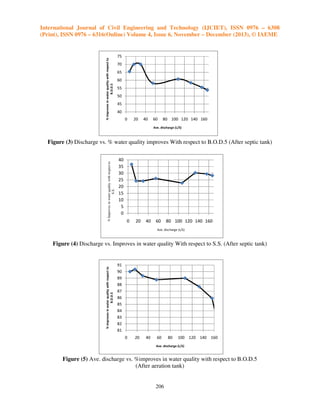
aeration tank. The improves in wastewater quality with respect to B.O.D. & S.S. represented
graphically with aid of SPSS program as shown in figures(1,2,3&4).
Table(1) Crude wastewater specification (Before septic tank)
Flow
C.O.D
PH
S.S.
Temperature Cº
‫ܦ .ܱ .ܤ‬ହ
(L/hrs.)
(mg/l)
(mg/l)
7
220
233
7.15
150
22
16
252
271
7.03
161
23
30
295
312
6.65
174
23.6
55
320
343
6.28
230
22.5
107
355
417
7.3
291
22
133
410
494
7.2
350
23.4
156
410
450
7.8
380
21
167
480
590
6.8
450
22.6
Table(2) Treated wastewater specification (After septic tank model)
Flow (L/S) ‫ܦ .ܱ .ܤ‬ହ (mg/l) C.O.D
PH
S.S.
Temperature Cº
(mg/l)
9
76
88
7.1
95
22.3
18
84
95
7.58
122
23.5
28
93
120
7.27
132
23
52
134
154
7.74
170
22
105
157
175
6.48
225
21
130
179
196
7.3
244
24
152
196
211
7.1
268
22.6
177
222
245
7.4
323
23
Table(3) Treated wastewater specification (After aeration tank model)
Flow (L/S) ‫ܦ .ܱ .ܤ‬ହ (mg/l) C.O.D
PH
S.S.
Temperature Cº
(mg/l)
6
22
40
7.2
54
22.7
14
27
48
7.38
67
23
35
33
57
6.8
77
23.3
57
36
66
7.2
85
23
108
44
78
7.5
105
24
140
53
85
7.4
123
22.4
163
62
115
6.77
157
21.7
179
87
122
7.15
188
22

205
% improves in water quality with respect to
B.O.D.5

International Journal of Civil Engineering and Technology (IJCIET), ISSN 0976 – 6308
(Print), ISSN 0976 – 6316(Online) Volume 4, Issue 6, November – December (2013), © IAEME

75
70
65
60
55
50
45
40
0

20

40

60

80 100 120 140 160

Ave. discharge (L/S)

% Improves in water quality with respect to
S.S.

Figure (3) Discharge vs. % water quality improves With respect to B.O.D.5 (After septic tank)
40
35
30
25
20
15
10
5
0
0

20

40

60

80 100 120 140 160

Ave. discharge (L/S)

% improves in water quality with respect to
B.O.D.5

Figure (4) Discharge vs. Improves in water quality With respect to S.S. (After septic tank)

91
90
89
88
87
86
85
84
83
82
81
0

20

40

60

80

100 120 140 160

Ave. discharge (L/S)

Figure (5) Ave. discharge vs. %improves in water quality with respect to B.O.D.5
(After aeration tank)

206
% Improves in water quality with respect to
S.S.

International Journal of Civil Engineering and Technology (IJCIET), ISSN 0976 – 6308
(Print), ISSN 0976 – 6316(Online) Volume 4, Issue 6, November – December (2013), © IAEME
80
70
60
50
40
30
20
10
0
0

20

40

60 80 100 120 140 160 180
Ave. discharge (L/S)

Figure (6) Discharge vs. Improves in water quality With respect to S.S. (After aeration tank)

CONCLUSIONS
Results from this research shows that the best way to manage the septic system is to minimize
the volume of household wastewater produce. Reducing wastewater volume improves treatment by
increasing the time the waste spends in the system, which gives the waste more time for settling,
separation and soil contact. Lower volumes of wastewater also mean longer system life and less
chance of overflow.
Research shows also that using aeration tank in addition to septic tank is an active method to
improve the biological and physical wastewater properties as shown in Figures(3, 4, 5 & 6).In
general improves in water quality with respect to biological properties ranged from 25% to 30%
while improves in water quality with respect to physical properties about 20%.
REFERENCES
1. DaviesM. L., Water and Wastewater Engineering, McGraw-Hill, US, 2007.
2. Metcalf & Eddy, Wastewater Engineering, McGraw-Hill, US, 1982.
3. Wood D.K., Trace elements in biological waste treatment, J. water pollution control federation,
Vol.43. No.1, PP.102, 1971.
4. Wilson D., The Treatment And Management Of Urban Solid Waste, Technomic publishing Co.,
US,1989.
5. Mueller, James A. , Oxygen theory in biological treatment plant design, J. Environmental
engineering division, ASCE J., Vol.99, No.3, PP.381, 1988.
6. Mara,D. D., Bacteriology For Sanitary Engineers, Churchill Livingston, Edinburgh,1974.
7. R Radhakrishanan and A Praveen, “Sustainability Perceptions on Wastewater Treatment
Operations in Urban Areas of Developing World”, International Journal of Civil Engineering &
Technology (IJCIET), Volume 3, Issue 1, 2012, pp. 45 - 61, ISSN Print: 0976 – 6308,
ISSN Online: 0976 – 6316.
8. Dr. P. Mariappan, “Wastewater Management in a Dwelling House- A Case Study”,
International Journal of Civil Engineering & Technology (IJCIET), Volume 3, Issue 2, 2012,
pp. 16 - 24, ISSN Print: 0976 – 6308, ISSN Online: 0976 – 6316.

207

20320130406020 2

  • 1.
    International Journal ofCivil Engineering and Technology (IJCIET), ISSN 0976 – 6308 INTERNATIONAL JOURNAL OF CIVIL ENGINEERING AND (Print), ISSN 0976 – 6316(Online) Volume 4, Issue 6, November – December (2013), © IAEME TECHNOLOGY (IJCIET) ISSN 0976 – 6308 (Print) ISSN 0976 – 6316(Online) Volume 4, Issue 6, November – December, pp. 202-207 © IAEME: www.iaeme.com/ijciet.asp Journal Impact Factor (2013): 5.3277 (Calculated by GISI) www.jifactor.com IJCIET ©IAEME IMPROVING WASTEWATER QUALITY FROM SEPTIC TANK SYSTEM BY USING A CHEAP AND SIMPLE SECONDARY TREATMENT METHOD Dr. GhassanAdhem AL-Dulaimi* *Institute of TechnologyBaghdad ABSTRACT Most of farms and suburban areas in Iraq don't have a sanitary sewer system network; most of these areas depend upon on-site wastewater treatment which called (septic tank), in this system wastewater flows from the household sewage lines into an underground septic tank which drains the effluents into the subsoil layers. In recent years fresh water become scarce most of agricultural land in the north of Baghdad city that depend upon rainfall become barren land, so the reuse of wastewater for irrigation purposes become one of strong options. In general septic tank work as small treatment plant in which the main treatment process will achieve especially primary treatment and portion of secondary treatment. In this research developed a process of secondary treatment in field by using a simple aeration tank depends on a cheap and low electricity consumption motor to improve wastewater quality, many of laboratory experiments have been execute results from this research shows a palpable improves in wastewater quality ranged from 25% to 30% with respect to biological properties while for the physical properties the improves of waste water quality range from 20% to 23%, results shows also a palpable improves in wastewater quality (physical & biological) with low discharge values. Keyword: Septic tank, cheap secondary treatment INTRODUCTION Septic systems are wastewater treatment systems that collect, treat and dispose of wastewater generated by homes and businesses. A traditional septic system consists of two main parts: a primary treatment unit (septic tank) and a soil absorption unit [1]. A traditional septic system can be a very effective method of wastewater treatment. The tank provides for the bacterial breakdown of sewage solids. This process divides the sewage into three 202
  • 2.
    International Journal ofCivil Engineering and Technology (IJCIET), ISSN 0976 – 6308 (Print), ISSN 0976 – 6316(Online) Volume 4, Issue 6, November – December (2013), © IAEME layers. The bottom layer (sludge) is comprised of large solids; the middle layer is relatively clear water with some pollutants; and the top layer consists of floating solids or scum [2]. Septic tanks retain most of the suspended solids from wastewater. The heavier solids (sludge) settle to the bottom and the grease and fatty solids (scum) float to the top. In the tank, bacteria digest and compact the sludge. Baffles in the tank provide maximum retention of solids, prevent inlet and outlet plugging and stop rapid flow of wastewater through the tank. The partially treated water moves on to the soil absorption field for treatment and disposal. Figure 1 shows atypical septic tank system Figure (1) Typical Septic Tank Sectional View In general effluent may possess undesirable constituents such as salts, trace elements, organic compounds, pathogens and other constituents that may affect soil, crop, public health, and generally the environment [3]. Four categories namely salinity, infiltration, toxicity and “miscellaneous problems” are used for evaluating conventional sources of irrigation water. The physical and chemical constituents in treated effluents need careful consideration in order to evaluate or detect possible short or long-term effects on soils and crops from salts, nutrients and trace elements. Constituents of concern in treated sewage are[4]: a. Suspended Solids (S.S.):This can develop sludge deposits and consequently anaerobic conditions. b. BOD5 & COD: refers to the amount of oxygen microorganisms must consume in order to oxidize all the organic compounds in a liter of wastewater. d. Nutrients which include, nitrogen, phosphorous and potassium .They are essential in plant growth, but when discharged in waters, can lead to undesirable growth. f. Hydrogen ion activity or pH affecting solubility and alkalinity of soils. h. Dissolve inorganics, like sodium, magnesium calcium and others, which can be damage crop and pose soil permeability problems. Household wastewater contains a mix of chemicals, impurities, and other materials. One of the most important of these materials is organic matter, which is composed of carbon (C), nitrogen and oxygen. In septic systems, C comes from the digested and undigested food we eat, as well as the microorganisms that live in the system [5]. Organic matter or humus in wastewater is formed by decomposing action of soil microorganisms, which break down animal and vegetative matter into elements that can be used by 203
  • 3.
    International Journal ofCivil Engineering and Technology (IJCIET), ISSN 0976 – 6308 (Print), ISSN 0976 – 6316(Online) Volume 4, Issue 6, November – December (2013), © IAEME growing plants. Because of its low specific weight and high surface area, humus has a profound effect upon the physical properties of mineral soils with regard to improved soil structure, water intake and reservoir capacity, ability to resist erosion, and the ability to hold chemical elemen in a elements form readily accessible to plants. The amount of biodegradable C found in septic systems is important, because by measuring it, we can determine the waste stream’s biochemical oxygen demand (or, BOD). BOD refers to the amount of oxygen microorganisms must consume in order to oxidize all the organic compounds in a sms liter of wastewater [6]. This is important, because a high BOD number means potential septic system . problems for homeowners, while a low BOD means fewer problems for homeowners. MATERIALS AND METHOD Study of physical, chemical and biological constituents of wastewaters is important parameters in the design, collection and reuse of treated effluent. In this research a prototype of septic tank system has been executed in field many of laboratory experiments has been execute before and after suggested treatment in order to make sure from validation of the suggested process. In general four main constraints elements have been measured (PH, BOD5, COD & S.S.), with S changing the amount of flow. Aseptic tank and aeration tank model have been built with dimensions and details that illustrated in Figure (2). Three main groups of samples have been taken before/after septic tank model and after aeration tank respectively. The temperature has been measured and the discharge changes six times with each group of samples. The quantity of flow has been controlled by using valve at the septic tank inlet and it’s measured by using a current meter and the excess amount of flow go by pass to gone the sanitary public system. A simple Aeration tank built with cylindrical shape (Diameter=1.5m, Height Height=3m) with open cover, artificial dissolved oxygen generate by using a compressor of refrigerator with timer The timer. timer works as regulators permit oxygen to flow in time and inhibit it in another time. The chosen of refrigerator compressor based on its cheap price and availability. Figure (2) Septic tank & aeration tank model sectional view 204
  • 4.
    International Journal ofCivil Engineering and Technology (IJCIET), ISSN 0976 – 6308 (Print), ISSN 0976 – 6316(Online) Volume 4, Issue 6, November – December (2013), © IAEME RESULTS AND CALCULATIONS Three main groups of samples have been taken; flow rates changes six times with each group of samples which collected with aid of sampler device. Different denotation time has been used in order activate the bacterial action (anaerobic and aerobic Bactria), for septic tank used 24 hour and for aeration tank used 6 hour. Laboratory experiments have been execute in the laboratories of ministry of environments, results from these experiments illustrated in tables (1,2,&3), Table(1)shows the crude wastewater specification, Table (2) shows the treated wastewater specification after septic tank while Table (3) shows the treated wastewater specification after aeration tank. The improves in wastewater quality with respect to B.O.D. & S.S. represented graphically with aid of SPSS program as shown in figures(1,2,3&4). Table(1) Crude wastewater specification (Before septic tank) Flow C.O.D PH S.S. Temperature Cº ‫ܦ .ܱ .ܤ‬ହ (L/hrs.) (mg/l) (mg/l) 7 220 233 7.15 150 22 16 252 271 7.03 161 23 30 295 312 6.65 174 23.6 55 320 343 6.28 230 22.5 107 355 417 7.3 291 22 133 410 494 7.2 350 23.4 156 410 450 7.8 380 21 167 480 590 6.8 450 22.6 Table(2) Treated wastewater specification (After septic tank model) Flow (L/S) ‫ܦ .ܱ .ܤ‬ହ (mg/l) C.O.D PH S.S. Temperature Cº (mg/l) 9 76 88 7.1 95 22.3 18 84 95 7.58 122 23.5 28 93 120 7.27 132 23 52 134 154 7.74 170 22 105 157 175 6.48 225 21 130 179 196 7.3 244 24 152 196 211 7.1 268 22.6 177 222 245 7.4 323 23 Table(3) Treated wastewater specification (After aeration tank model) Flow (L/S) ‫ܦ .ܱ .ܤ‬ହ (mg/l) C.O.D PH S.S. Temperature Cº (mg/l) 6 22 40 7.2 54 22.7 14 27 48 7.38 67 23 35 33 57 6.8 77 23.3 57 36 66 7.2 85 23 108 44 78 7.5 105 24 140 53 85 7.4 123 22.4 163 62 115 6.77 157 21.7 179 87 122 7.15 188 22 205
  • 5.
    % improves inwater quality with respect to B.O.D.5 International Journal of Civil Engineering and Technology (IJCIET), ISSN 0976 – 6308 (Print), ISSN 0976 – 6316(Online) Volume 4, Issue 6, November – December (2013), © IAEME 75 70 65 60 55 50 45 40 0 20 40 60 80 100 120 140 160 Ave. discharge (L/S) % Improves in water quality with respect to S.S. Figure (3) Discharge vs. % water quality improves With respect to B.O.D.5 (After septic tank) 40 35 30 25 20 15 10 5 0 0 20 40 60 80 100 120 140 160 Ave. discharge (L/S) % improves in water quality with respect to B.O.D.5 Figure (4) Discharge vs. Improves in water quality With respect to S.S. (After septic tank) 91 90 89 88 87 86 85 84 83 82 81 0 20 40 60 80 100 120 140 160 Ave. discharge (L/S) Figure (5) Ave. discharge vs. %improves in water quality with respect to B.O.D.5 (After aeration tank) 206
  • 6.
    % Improves inwater quality with respect to S.S. International Journal of Civil Engineering and Technology (IJCIET), ISSN 0976 – 6308 (Print), ISSN 0976 – 6316(Online) Volume 4, Issue 6, November – December (2013), © IAEME 80 70 60 50 40 30 20 10 0 0 20 40 60 80 100 120 140 160 180 Ave. discharge (L/S) Figure (6) Discharge vs. Improves in water quality With respect to S.S. (After aeration tank) CONCLUSIONS Results from this research shows that the best way to manage the septic system is to minimize the volume of household wastewater produce. Reducing wastewater volume improves treatment by increasing the time the waste spends in the system, which gives the waste more time for settling, separation and soil contact. Lower volumes of wastewater also mean longer system life and less chance of overflow. Research shows also that using aeration tank in addition to septic tank is an active method to improve the biological and physical wastewater properties as shown in Figures(3, 4, 5 & 6).In general improves in water quality with respect to biological properties ranged from 25% to 30% while improves in water quality with respect to physical properties about 20%. REFERENCES 1. DaviesM. L., Water and Wastewater Engineering, McGraw-Hill, US, 2007. 2. Metcalf & Eddy, Wastewater Engineering, McGraw-Hill, US, 1982. 3. Wood D.K., Trace elements in biological waste treatment, J. water pollution control federation, Vol.43. No.1, PP.102, 1971. 4. Wilson D., The Treatment And Management Of Urban Solid Waste, Technomic publishing Co., US,1989. 5. Mueller, James A. , Oxygen theory in biological treatment plant design, J. Environmental engineering division, ASCE J., Vol.99, No.3, PP.381, 1988. 6. Mara,D. D., Bacteriology For Sanitary Engineers, Churchill Livingston, Edinburgh,1974. 7. R Radhakrishanan and A Praveen, “Sustainability Perceptions on Wastewater Treatment Operations in Urban Areas of Developing World”, International Journal of Civil Engineering & Technology (IJCIET), Volume 3, Issue 1, 2012, pp. 45 - 61, ISSN Print: 0976 – 6308, ISSN Online: 0976 – 6316. 8. Dr. P. Mariappan, “Wastewater Management in a Dwelling House- A Case Study”, International Journal of Civil Engineering & Technology (IJCIET), Volume 3, Issue 2, 2012, pp. 16 - 24, ISSN Print: 0976 – 6308, ISSN Online: 0976 – 6316. 207