Anti-oppressive Education

   …Leading to Social Justice
Class Outline
• Introduction to anti-oppressive education
  and social justice
• Self awareness activity
• Discussion of “Posts” article in small
  group format
• Discussion of Indecently Exposed in
  small group format
• Large group debriefing of article and
  video
• Closure
Oppression is:

A social dynamic in which
certain ways of being in this
world,including certain ways
of identifying or being
identified, are normalized or
privileged while other ways
are disadvantaged or
marginalized.
Forms of oppression
include:
Forms of oppression
include:
• Racism
Forms of oppression
include:
• Racism
• Classism
Forms of oppression
include:
• Racism
• Classism
• Sexism
Forms of oppression
include:
•   Racism
•   Classism
•   Sexism
•   Heterosexism
Forms of oppression
include:
•   Racism
•   Classism
•   Sexism
•   Heterosexism
•   Anti-Semitism
Forms of oppression
include:
•   Racism
•   Classism
•   Sexism
•   Heterosexism
•   Anti-Semitism
•   Ablism
Forms of oppression
include:
•   Racism
•   Classism
•   Sexism
•   Heterosexism
•   Anti-Semitism
•   Ablism
•   Colonialism
Forms of oppression
include:
•   Racism
•   Classism
•   Sexism
•   Heterosexism
•   Anti-Semitism
•   Ablism
•   Colonialism
•   And other isms….
Circle of Oppression:
Oppression is socially constructed, not
individual.


From:http://www.oswego.edu/~prusso1/circle_of_oppression.htm
Social Justice
Social Justice
• The Government’s Agenda for creating a
  fair and equal society where ‘everyone
  matters’
Social Justice
• The Government’s Agenda for creating a
  fair and equal society where ‘everyone
  matters’


• Equitable access to resources and the
  benefits derived from them; a system
  that recognizes inalienable rights and
  adheres to what is fair, honest, and
  moral. (Canadian Charter of Rights and
  Freedoms)
How privileged are you?


   And the survey says…..
Approaches to Anti-
oppressive Education…
Approaches to Anti-
oppressive Education…

• Subtle ways like changing the
  wording of issues
Approaches to Anti-
oppressive Education…

• Subtle ways like changing the
  wording of issues

• Obvious ways like creating learning
  situations that help students to be
  critical observers of their
  environment
What can teachers do?

• Teach students to value difference,
  recognize injustice, and take action
  to question injustice
What can teachers do?

• Teach students to value difference,
  recognize injustice, and take action
  to question injustice
• Critically evaluate and modify
  curriculum, materials, and teaching
  strategies
What can teachers do?
• Teach students to value difference,
  recognize injustice, and take action
  to question injustice
• Critically evaluate and modify
  curriculum, materials, and teaching
  strategies
• Expand personal and professional
  knowledge about issues of
  oppression and marginalized
  groups
What can teachers do?

• Learn from and collaborate with
  other teachers who teach for social
  justice
What can teachers do? (cont.)

• Learn from and collaborate with
  other teachers who teach for social
  justice
• Take a stance in their personal,
  social, and professional lives to
  work for social justice
Discussion Time!!!
1. Form two small groups.
2. Use the discussion guide to
   discuss Kumashiro’s article.
3. Exchange two members with the
   other group.
4. Discuss the video (second page
   of the discussion guide).
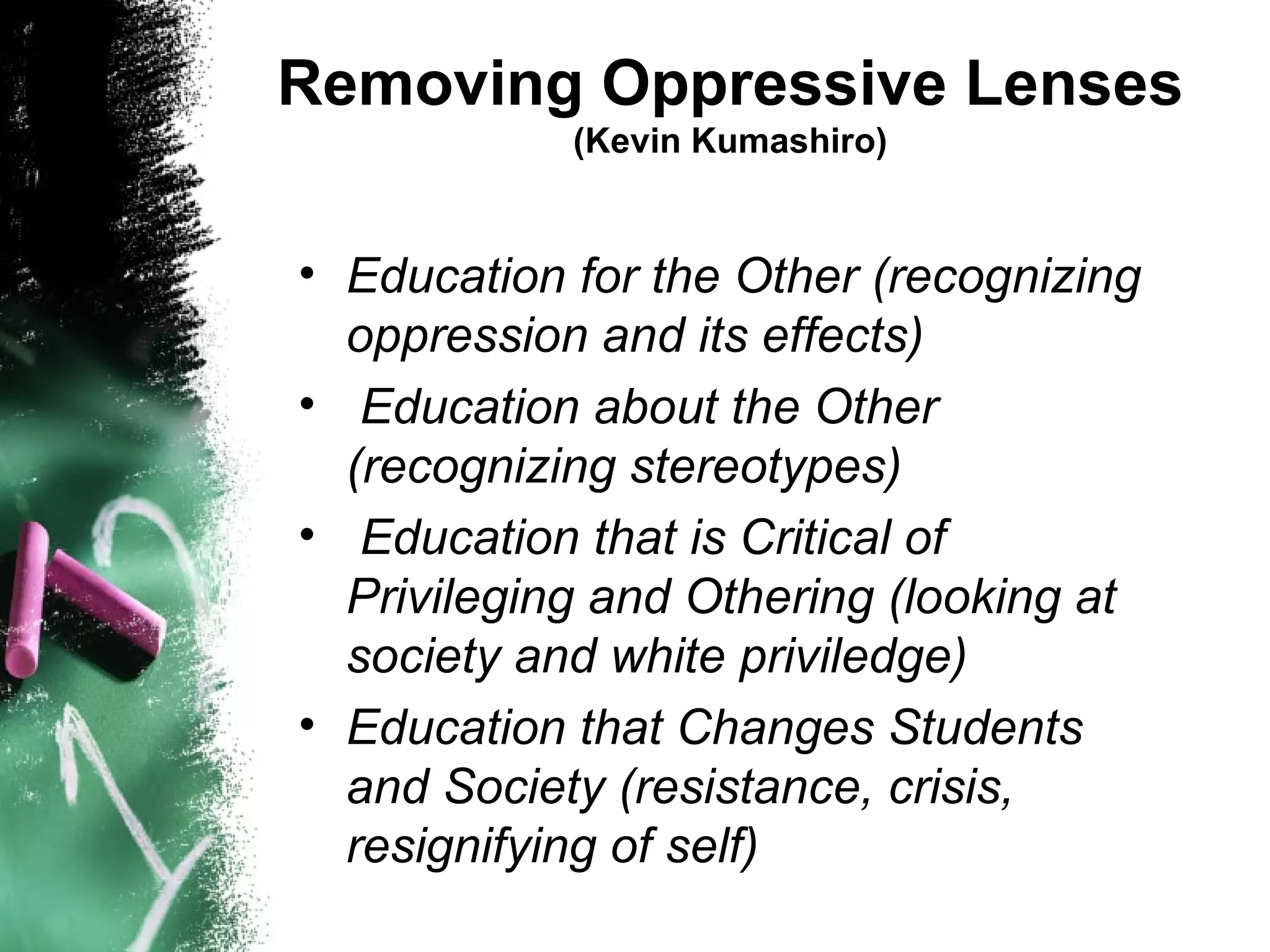
Removing Oppressive Lenses
            (Kevin Kumashiro)


• Education for the Other (recognizing
  oppression and its effects)
• Education about the Other
  (recognizing stereotypes)
• Education that is Critical of
  Privileging and Othering (looking at
  society and white priviledge)
• Education that Changes Students
  and Society (resistance, crisis,
  resignifying of self)
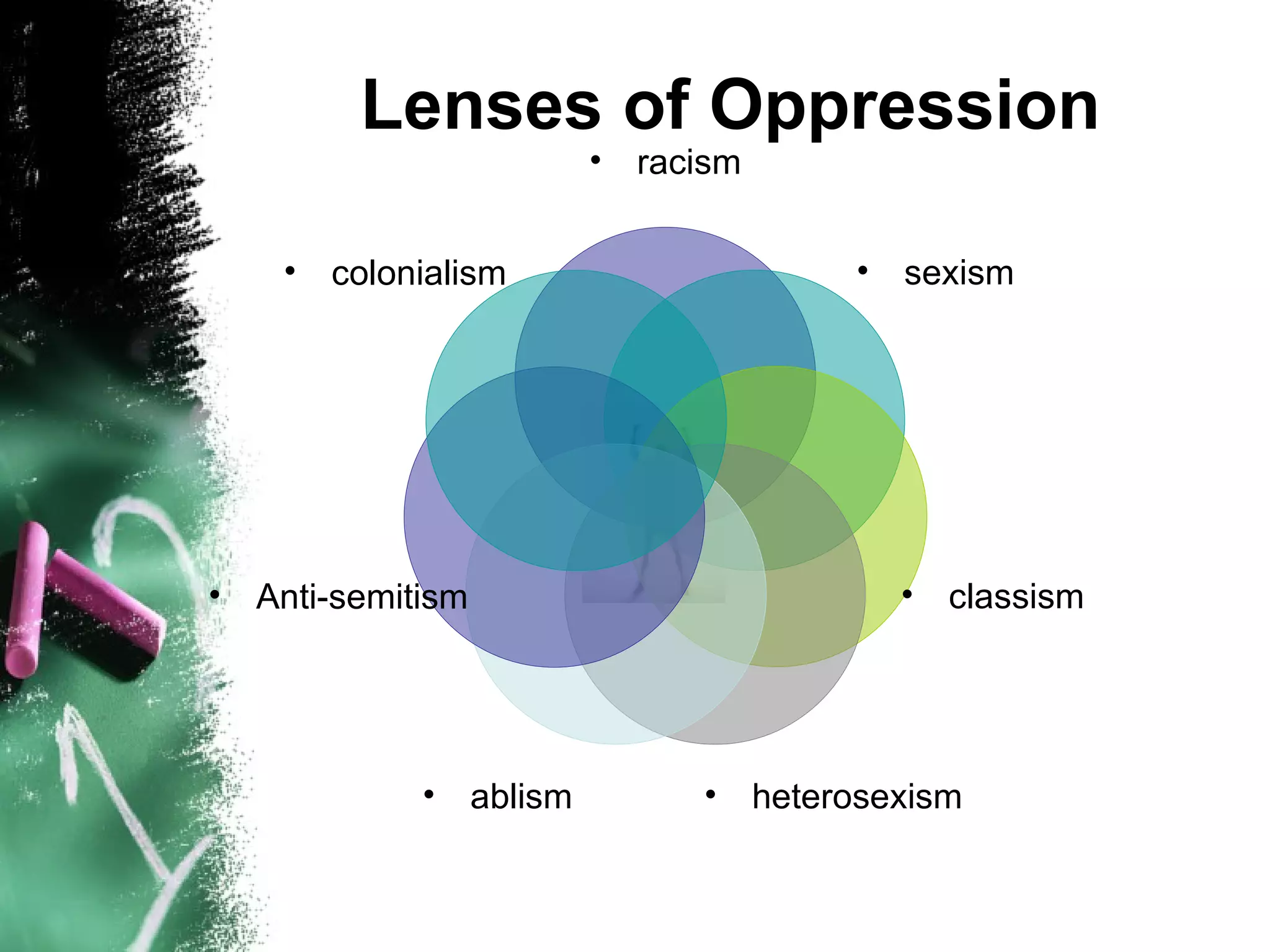
Lenses of Oppression
                           •   racism


    •   colonialism                          •   sexism


• Anti-semitism                                  • classism


             •    ablism          •     heterosexism
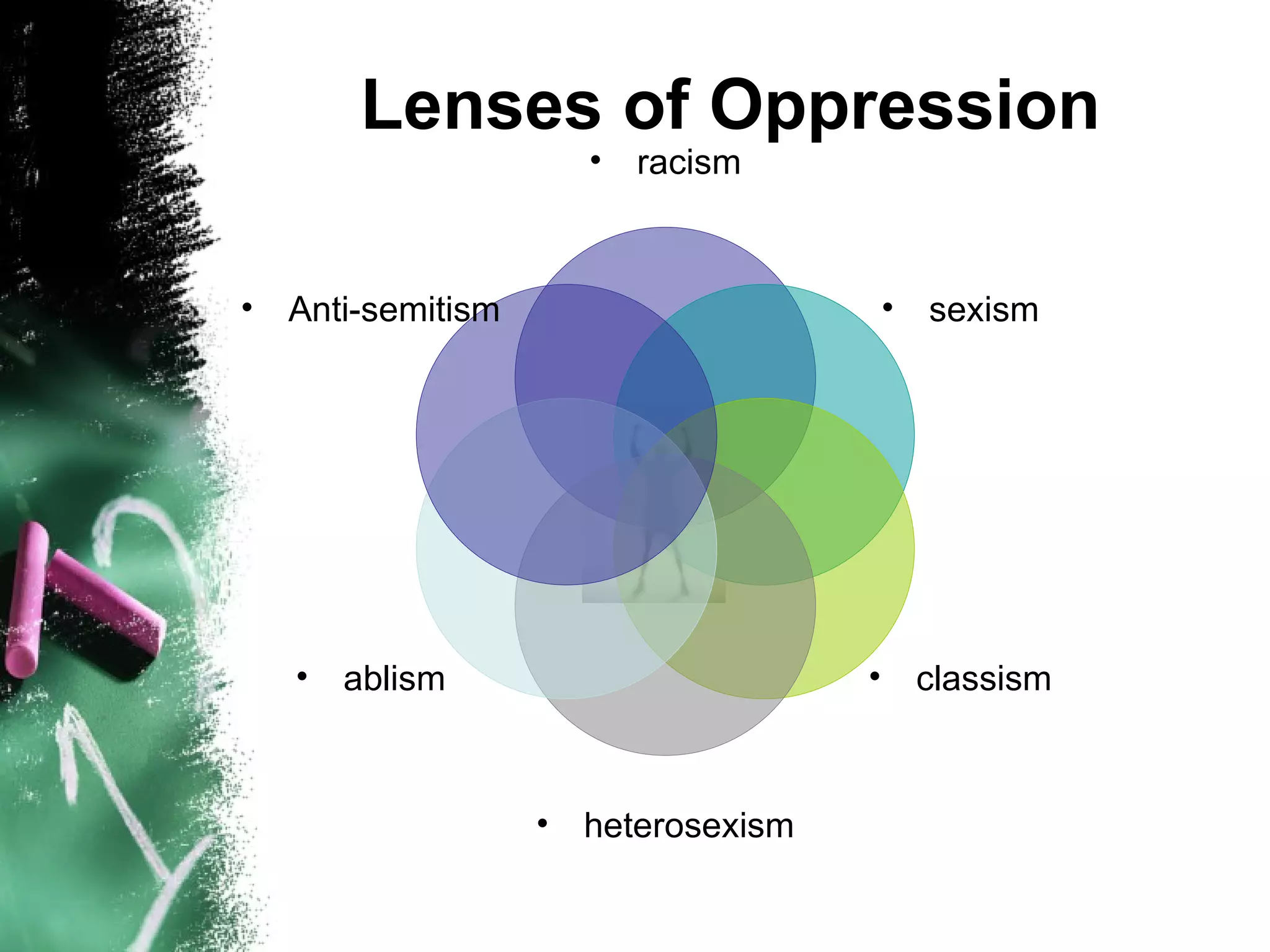
Lenses of Oppression
                        •   racism


•   Anti-semitism                          •   sexism


    •   ablism                         •       classism


                    •   heterosexism
Lenses of Oppression
                       •   racism


•   ablism                                  •   sexism


    •   heterosexism                •   classism
Lenses of Oppression
                     •   racism


• heterosexism                      •   sexism


                 •       classism
Lenses of Oppression
               •   racism


•   classism                •   sexism
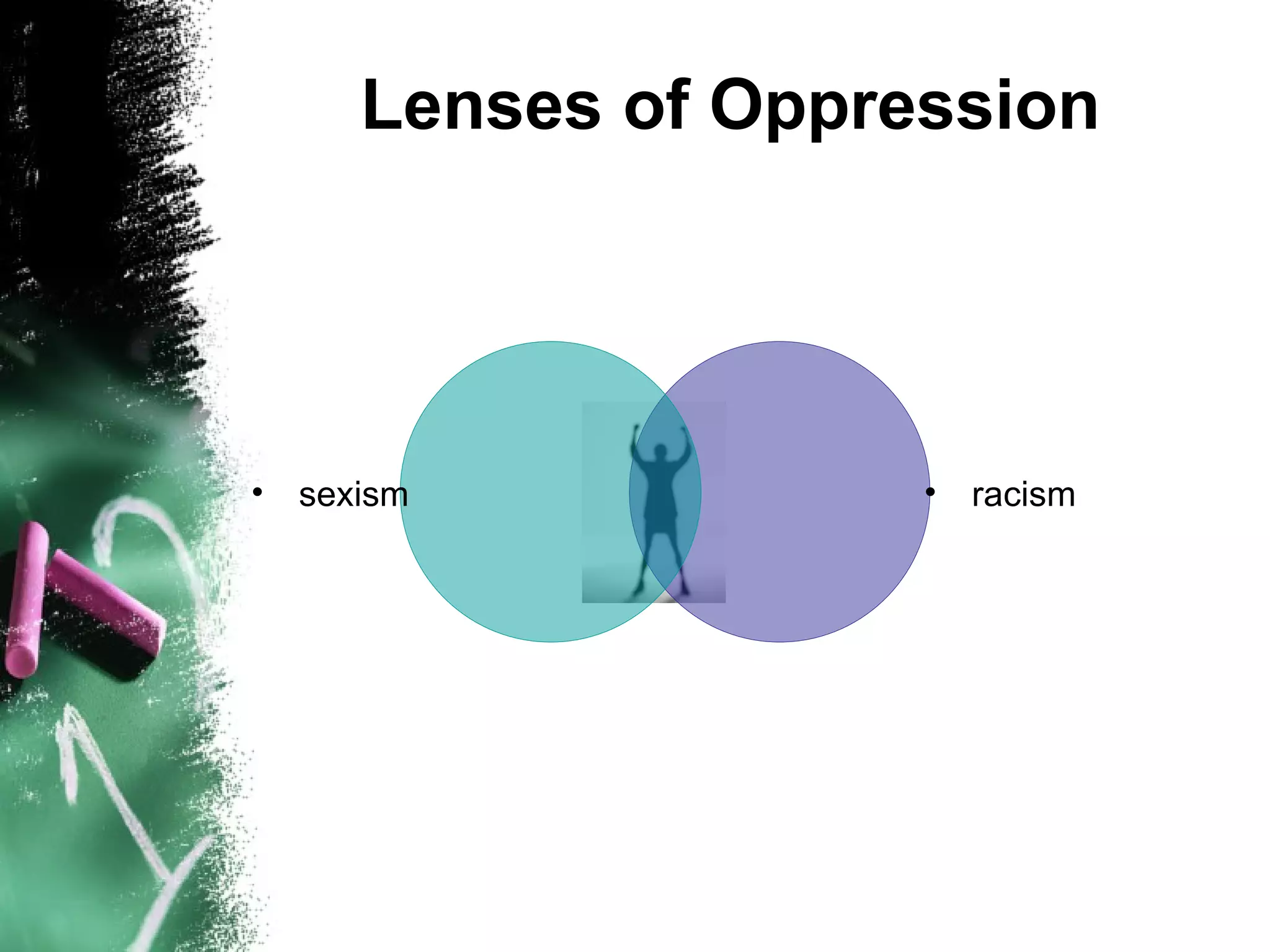
Lenses of Oppression


•   sexism            •   racism
Lenses of Oppression

      •   racism
Perceptions free from oppression,
let teachers focus on individuals.

         Anti-oppressive Lens
Never judge me till you’ve
walked a mile in my shoes...

Anti-Oppressive Education

  • 1.
    Anti-oppressive Education …Leading to Social Justice
  • 2.
    Class Outline • Introductionto anti-oppressive education and social justice • Self awareness activity • Discussion of “Posts” article in small group format • Discussion of Indecently Exposed in small group format • Large group debriefing of article and video • Closure
  • 3.
    Oppression is: A socialdynamic in which certain ways of being in this world,including certain ways of identifying or being identified, are normalized or privileged while other ways are disadvantaged or marginalized.
  • 4.
  • 5.
  • 6.
  • 7.
    Forms of oppression include: •Racism • Classism • Sexism
  • 8.
    Forms of oppression include: • Racism • Classism • Sexism • Heterosexism
  • 9.
    Forms of oppression include: • Racism • Classism • Sexism • Heterosexism • Anti-Semitism
  • 10.
    Forms of oppression include: • Racism • Classism • Sexism • Heterosexism • Anti-Semitism • Ablism
  • 11.
    Forms of oppression include: • Racism • Classism • Sexism • Heterosexism • Anti-Semitism • Ablism • Colonialism
  • 12.
    Forms of oppression include: • Racism • Classism • Sexism • Heterosexism • Anti-Semitism • Ablism • Colonialism • And other isms….
  • 13.
    Circle of Oppression: Oppressionis socially constructed, not individual. From:http://www.oswego.edu/~prusso1/circle_of_oppression.htm
  • 14.
  • 15.
    Social Justice • TheGovernment’s Agenda for creating a fair and equal society where ‘everyone matters’
  • 16.
    Social Justice • TheGovernment’s Agenda for creating a fair and equal society where ‘everyone matters’ • Equitable access to resources and the benefits derived from them; a system that recognizes inalienable rights and adheres to what is fair, honest, and moral. (Canadian Charter of Rights and Freedoms)
  • 17.
    How privileged areyou? And the survey says…..
  • 18.
  • 19.
    Approaches to Anti- oppressiveEducation… • Subtle ways like changing the wording of issues
  • 20.
    Approaches to Anti- oppressiveEducation… • Subtle ways like changing the wording of issues • Obvious ways like creating learning situations that help students to be critical observers of their environment
  • 21.
  • 22.
    What can teachersdo? • Teach students to value difference, recognize injustice, and take action to question injustice
  • 23.
    What can teachersdo? • Teach students to value difference, recognize injustice, and take action to question injustice • Critically evaluate and modify curriculum, materials, and teaching strategies
  • 24.
    What can teachersdo? • Teach students to value difference, recognize injustice, and take action to question injustice • Critically evaluate and modify curriculum, materials, and teaching strategies • Expand personal and professional knowledge about issues of oppression and marginalized groups
  • 25.
    What can teachersdo? • Learn from and collaborate with other teachers who teach for social justice
  • 26.
    What can teachersdo? (cont.) • Learn from and collaborate with other teachers who teach for social justice • Take a stance in their personal, social, and professional lives to work for social justice
  • 27.
    Discussion Time!!! 1. Formtwo small groups. 2. Use the discussion guide to discuss Kumashiro’s article. 3. Exchange two members with the other group. 4. Discuss the video (second page of the discussion guide).
  • 28.
    Removing Oppressive Lenses (Kevin Kumashiro) • Education for the Other (recognizing oppression and its effects) • Education about the Other (recognizing stereotypes) • Education that is Critical of Privileging and Othering (looking at society and white priviledge) • Education that Changes Students and Society (resistance, crisis, resignifying of self)
  • 29.
    Lenses of Oppression • racism • colonialism • sexism • Anti-semitism • classism • ablism • heterosexism
  • 30.
    Lenses of Oppression • racism • Anti-semitism • sexism • ablism • classism • heterosexism
  • 31.
    Lenses of Oppression • racism • ablism • sexism • heterosexism • classism
  • 32.
    Lenses of Oppression • racism • heterosexism • sexism • classism
  • 33.
    Lenses of Oppression • racism • classism • sexism
  • 34.
    Lenses of Oppression • sexism • racism
  • 35.
  • 36.
    Perceptions free fromoppression, let teachers focus on individuals. Anti-oppressive Lens
  • 37.
    Never judge metill you’ve walked a mile in my shoes...