Social Justice on
College Campuses:
Building Critical
Communities
Dr. Silvia C. Bettez
Department of Educational Leadership &Cultural
Foundations
UNC Greensboro
scbettez@uncg.edu
Diversity Education Week
UNC Wilmington
4-21-14
Goals
1. To define inclusion and diversity as it relates to the UNC
Wilmington context and pose questions that inspire critical
thinking related to issues of equity.
2. To define social justice and related concepts in efforts to
raise critical consciousness.
3. To provide strategies for building critical communities as a
tool for social justice.
4. To inspire you to continue discussions about community
building during Diversity Education Week and ideally take
actions toward building critical communities in your lives.
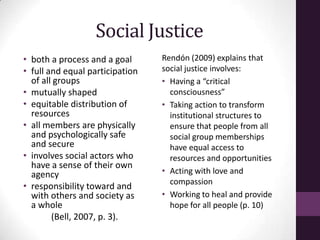
Social Justice
• both a process and a goal
• full and equal participation
of all groups
• mutually shaped
• equitable distribution of
resources
• all members are physically
and psychologically safe
and secure
• involves social actors who
have a sense of their own
agency
• responsibility toward and
with others and society as
a whole
(Bell, 2007, p. 3).
Rendón (2009) explains that
social justice involves:
• Having a “critical
consciousness”
• Taking action to transform
institutional structures to
ensure that people from all
social group memberships
have equal access to
resources and opportunities
• Acting with love and
compassion
• Working to heal and provide
hope for all people (p. 10)
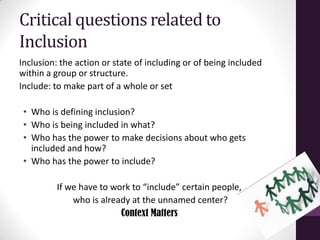
Critical questions related to
Inclusion
Inclusion: the action or state of including or of being included
within a group or structure.
Include: to make part of a whole or set
• Who is defining inclusion?
• Who is being included in what?
• Who has the power to make decisions about who gets
included and how?
• Who has the power to include?
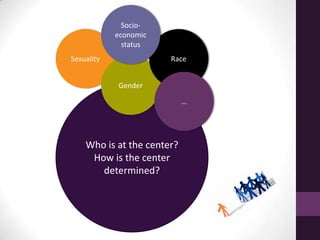
If we have to work to “include” certain people,
who is already at the unnamed center?
Context Matters
Who is at the center?
How is the center
determined?
Sexuality
Gender
Race
Socio-
economic
status
…
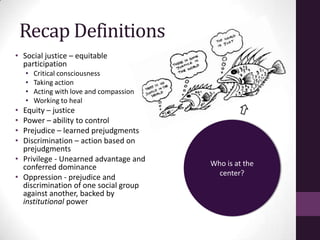
Recap Definitions
• Social justice – equitable
participation
• Critical consciousness
• Taking action
• Acting with love and compassion
• Working to heal
• Equity – justice
• Power – ability to control
• Prejudice – learned prejudgments
• Discrimination – action based on
prejudgments
• Privilege - Unearned advantage and
conferred dominance
• Oppression - prejudice and
discrimination of one social group
against another, backed by
institutional power
Who is at the
center?
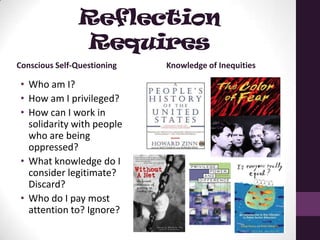
Reflection
Requires
Conscious Self-Questioning
• Who am I?
• How am I privileged?
• How can I work in
solidarity with people
who are being
oppressed?
• What knowledge do I
consider legitimate?
Discard?
• Who do I pay most
attention to? Ignore?
Knowledge of Inequities
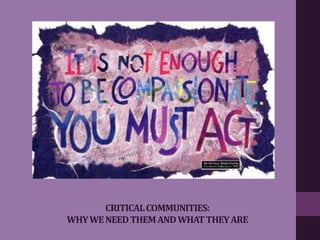
CRITICALCOMMUNITIES:
WHYWENEEDTHEMANDWHATTHEYARE
Critical Community Building
definition revealed
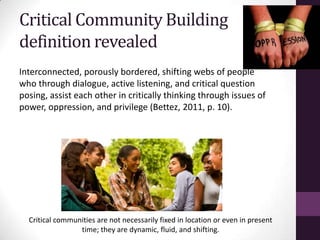
Interconnected, porously bordered, shifting webs of people
who through dialogue, active listening, and critical question
posing, assist each other in critically thinking through issues of
power, oppression, and privilege (Bettez, 2011, p. 10).
Critical communities are not necessarily fixed in location or even in present
time; they are dynamic, fluid, and shifting.
To practice critical community
building
• Think of the web: be open, inviting, allow shifts, and
accept change.
• Engage in dialogue through active listening and critical
question posing that interrogates issues of power,
privilege, and oppression.
• Commit and be accountable to the well-being of the
whole.
Closing Questions
1. How will you make a conscientious effort to operate with an
attitude of openness and inclusivity within your social justice
work?
2. What is the promise that you are willing make regarding
active listening?
3. What is the promise that you are willing to make that
constitutes a risk or major shift for you?
4. What is the promise that you are postponing?
5. Where and how might you continue conversations about
critical community building?
6. What does what you have learned today mean for the work
that you do as a student, educator, activist, or simply a
citizen of the UNCW community and of the world?
Social justice Teaching Resources
• EdChange
• http://www.edchange.org/who.html
• Critical Multicultural Pavilion
• http://www.edchange.org/multicultural/
• Culturally Responsive Teaching Website (based on Geneva
Gay’s work)
• http://www.intime.uni.edu/multiculture/curriculum/culture/Tea
ching.htm
• James Banks Video
• http://www.uwtv.org/video/player.aspx?mediaid=16209170
• WISE Website – Working to Improve Schools and Education
• http://www.ithaca.edu/wise/
• Five Ways to Analyze Classrooms for an Anti-bias Approach
• http://www.nncc.org/Diversity/sac26_anti-bias.analyz.html
Social justice Teaching Resources
continued
• Electronic Magazine of Multicultural Education
• http://www.eastern.edu/publications/emme/
• Teaching for Change
• http://www.teachingforchange.org/
• Understanding Prejudice
• http://www.understandingprejudice.org/
• Teaching Tolerance
• http://www.splcenter.org/what-we-do/teaching-tolerance
• New Horizons for Learning
• http://education.jhu.edu/PD/newhorizons/
• Project Implicit (Harvard)
• https://implicit.harvard.edu/implicit/demo/takeatest.html
• Edutopia
• http://www.edutopia.org/
• Changing Education Paradigms TED Video
• http://www.ted.com/talks/lang/en/ken_robinson_changing_edu
cation_paradigms.html
Lgbtq community resources
• GLSEN
• http://www.glsen.org/cgi-bin/iowa/all/home/index.html
• Think Before You Speak Website
• http://www.thinkb4youspeak.com/
• The Trevor Project
• http://www.thetrevorproject.org
Disability issues resources
• People First
• http://www.health.ny.gov/publications/0951/
• Disability is Natural
• http://www.disabilityisnatural.com/
• Disabled Students’ Program
• http://dsp.berkeley.edu/TeachStudentsWithDisab.html
• Disabled World Toward Tomorrow
• http://www.disabled-world.com/
References
• Adams, M., Bell, L.A., & Griffin, P. (Eds.). (1997). Teaching for diversity and social justice: A
sourcebook. New York: Routledge.
• Bell, L. A. (1997). Theoretical foundations for social justice education. In M. Adams, L. A. Bell,
& P. Griffin (Eds.), Teaching for diversity and social justice (pp. 1-15). New York & London:
Routledge.
• Block, P. (2008). Community: The structure of belonging. San Francisco, CA: Berrett-
Koehler Publishers, Inc.
• Darder, A. (2002). Reinventing Paulo Freire: A pedagogy of love. Boulder, CO: Westview Press.
• Freire, P. (2000). Pedagogy of the oppressed, 30th anniversary edition. New York:
Continuum.
• Hinchey, P. (1998). Finding freedom in the classroom: A practical introduction to critical
theory. New York: Peter Lang.
• Johnson, A. (2006). Privilege, power, and difference (2nd ed.). New York: McGraw-Hill.
• Kincheloe, J. (2007). Critical pedagogy: Where are we now? (2nd ed.). New York: Peter Lang.
• Kumashiro, K. (2004). Against common sense: Teaching and learning toward social justice.
New York: RoutledgeFalmer.
• Rendón, L. (2009). Sentipensante (sensing/thinking) pedagogy: Educating for wholeness,
social justice, and liberation. Sterling, VA: Stylus.
• Sensoy, O., & DiAngelo, R. (2012). Is everyone really equal? An introduction to key concepts in
social justice education. New York, NY: Teachers College Press.
• Wahl, S. T. (2014). Instructors corner #1: Are diversity and inclusion efforts in higher
education working? An intercultural communication perspective. Communication Currents,
9(1). http://www.natcom.org/CommCurrentsArticle.aspx?id=4683
• Weber, L. (2001). Understanding race, class, gender, and sexuality: A conceptual
framework. New York: McGraw-Hill.
• Zinn, Howard. 2004. “The Optimism of Uncertainty.” Pp. 63-72 in The Impossible Will Take a
Little While: A Citizen’s Guide to Hope in a Time of Fear. Edited by Paul R. Loeb. New York:
Basic Books.
Bettez References
• Bettez, S. C. (2012). But don’t call me white: Mixed race women
exposing nuances of privilege and oppression politics. Rotterdam,
Netherlands: Sense.
• Bettez, S. C., & Hytten, K. (2013). Community building in social
justice work: A critical approach. Educational Studies, 29(1), 45-66.
• Bettez, S. C. (2012). Navigating the guilt vs. innocence dichotomy in
teaching social justice. South Atlantic Philosophy of Education
Society 2011 Yearbook, 169-181.
• Bettez, S. C. (2011). Building critical communities amid the
uncertainty of social justice pedagogy in the graduate classroom.
The Review of Education, Pedagogy, and Cultural Studies, 33, 76–
106.
• Hytten, K., & Bettez, S. C. (2011). Understanding education for social
justice. Educational Foundations, 25(1–2), 7–24.
• Bettez, S. C. (2011). Critical community building: Beyond belonging.
Educational Foundations, 25(3–4), 3–19.

Uncw bettez keynote_handout

  • 1.
    Social Justice on CollegeCampuses: Building Critical Communities Dr. Silvia C. Bettez Department of Educational Leadership &Cultural Foundations UNC Greensboro scbettez@uncg.edu Diversity Education Week UNC Wilmington 4-21-14
  • 2.
    Goals 1. To defineinclusion and diversity as it relates to the UNC Wilmington context and pose questions that inspire critical thinking related to issues of equity. 2. To define social justice and related concepts in efforts to raise critical consciousness. 3. To provide strategies for building critical communities as a tool for social justice. 4. To inspire you to continue discussions about community building during Diversity Education Week and ideally take actions toward building critical communities in your lives.
  • 3.
    Social Justice • botha process and a goal • full and equal participation of all groups • mutually shaped • equitable distribution of resources • all members are physically and psychologically safe and secure • involves social actors who have a sense of their own agency • responsibility toward and with others and society as a whole (Bell, 2007, p. 3). Rendón (2009) explains that social justice involves: • Having a “critical consciousness” • Taking action to transform institutional structures to ensure that people from all social group memberships have equal access to resources and opportunities • Acting with love and compassion • Working to heal and provide hope for all people (p. 10)
  • 4.
    Critical questions relatedto Inclusion Inclusion: the action or state of including or of being included within a group or structure. Include: to make part of a whole or set • Who is defining inclusion? • Who is being included in what? • Who has the power to make decisions about who gets included and how? • Who has the power to include? If we have to work to “include” certain people, who is already at the unnamed center? Context Matters
  • 5.
    Who is atthe center? How is the center determined? Sexuality Gender Race Socio- economic status …
  • 6.
    Recap Definitions • Socialjustice – equitable participation • Critical consciousness • Taking action • Acting with love and compassion • Working to heal • Equity – justice • Power – ability to control • Prejudice – learned prejudgments • Discrimination – action based on prejudgments • Privilege - Unearned advantage and conferred dominance • Oppression - prejudice and discrimination of one social group against another, backed by institutional power Who is at the center?
  • 7.
    Reflection Requires Conscious Self-Questioning • Whoam I? • How am I privileged? • How can I work in solidarity with people who are being oppressed? • What knowledge do I consider legitimate? Discard? • Who do I pay most attention to? Ignore? Knowledge of Inequities
  • 8.
  • 9.
    Critical Community Building definitionrevealed Interconnected, porously bordered, shifting webs of people who through dialogue, active listening, and critical question posing, assist each other in critically thinking through issues of power, oppression, and privilege (Bettez, 2011, p. 10). Critical communities are not necessarily fixed in location or even in present time; they are dynamic, fluid, and shifting.
  • 10.
    To practice criticalcommunity building • Think of the web: be open, inviting, allow shifts, and accept change. • Engage in dialogue through active listening and critical question posing that interrogates issues of power, privilege, and oppression. • Commit and be accountable to the well-being of the whole.
  • 11.
    Closing Questions 1. Howwill you make a conscientious effort to operate with an attitude of openness and inclusivity within your social justice work? 2. What is the promise that you are willing make regarding active listening? 3. What is the promise that you are willing to make that constitutes a risk or major shift for you? 4. What is the promise that you are postponing? 5. Where and how might you continue conversations about critical community building? 6. What does what you have learned today mean for the work that you do as a student, educator, activist, or simply a citizen of the UNCW community and of the world?
  • 12.
    Social justice TeachingResources • EdChange • http://www.edchange.org/who.html • Critical Multicultural Pavilion • http://www.edchange.org/multicultural/ • Culturally Responsive Teaching Website (based on Geneva Gay’s work) • http://www.intime.uni.edu/multiculture/curriculum/culture/Tea ching.htm • James Banks Video • http://www.uwtv.org/video/player.aspx?mediaid=16209170 • WISE Website – Working to Improve Schools and Education • http://www.ithaca.edu/wise/ • Five Ways to Analyze Classrooms for an Anti-bias Approach • http://www.nncc.org/Diversity/sac26_anti-bias.analyz.html
  • 13.
    Social justice TeachingResources continued • Electronic Magazine of Multicultural Education • http://www.eastern.edu/publications/emme/ • Teaching for Change • http://www.teachingforchange.org/ • Understanding Prejudice • http://www.understandingprejudice.org/ • Teaching Tolerance • http://www.splcenter.org/what-we-do/teaching-tolerance • New Horizons for Learning • http://education.jhu.edu/PD/newhorizons/ • Project Implicit (Harvard) • https://implicit.harvard.edu/implicit/demo/takeatest.html • Edutopia • http://www.edutopia.org/ • Changing Education Paradigms TED Video • http://www.ted.com/talks/lang/en/ken_robinson_changing_edu cation_paradigms.html
  • 14.
    Lgbtq community resources •GLSEN • http://www.glsen.org/cgi-bin/iowa/all/home/index.html • Think Before You Speak Website • http://www.thinkb4youspeak.com/ • The Trevor Project • http://www.thetrevorproject.org
  • 15.
    Disability issues resources •People First • http://www.health.ny.gov/publications/0951/ • Disability is Natural • http://www.disabilityisnatural.com/ • Disabled Students’ Program • http://dsp.berkeley.edu/TeachStudentsWithDisab.html • Disabled World Toward Tomorrow • http://www.disabled-world.com/
  • 16.
    References • Adams, M.,Bell, L.A., & Griffin, P. (Eds.). (1997). Teaching for diversity and social justice: A sourcebook. New York: Routledge. • Bell, L. A. (1997). Theoretical foundations for social justice education. In M. Adams, L. A. Bell, & P. Griffin (Eds.), Teaching for diversity and social justice (pp. 1-15). New York & London: Routledge. • Block, P. (2008). Community: The structure of belonging. San Francisco, CA: Berrett- Koehler Publishers, Inc. • Darder, A. (2002). Reinventing Paulo Freire: A pedagogy of love. Boulder, CO: Westview Press. • Freire, P. (2000). Pedagogy of the oppressed, 30th anniversary edition. New York: Continuum. • Hinchey, P. (1998). Finding freedom in the classroom: A practical introduction to critical theory. New York: Peter Lang. • Johnson, A. (2006). Privilege, power, and difference (2nd ed.). New York: McGraw-Hill. • Kincheloe, J. (2007). Critical pedagogy: Where are we now? (2nd ed.). New York: Peter Lang. • Kumashiro, K. (2004). Against common sense: Teaching and learning toward social justice. New York: RoutledgeFalmer. • Rendón, L. (2009). Sentipensante (sensing/thinking) pedagogy: Educating for wholeness, social justice, and liberation. Sterling, VA: Stylus. • Sensoy, O., & DiAngelo, R. (2012). Is everyone really equal? An introduction to key concepts in social justice education. New York, NY: Teachers College Press. • Wahl, S. T. (2014). Instructors corner #1: Are diversity and inclusion efforts in higher education working? An intercultural communication perspective. Communication Currents, 9(1). http://www.natcom.org/CommCurrentsArticle.aspx?id=4683 • Weber, L. (2001). Understanding race, class, gender, and sexuality: A conceptual framework. New York: McGraw-Hill. • Zinn, Howard. 2004. “The Optimism of Uncertainty.” Pp. 63-72 in The Impossible Will Take a Little While: A Citizen’s Guide to Hope in a Time of Fear. Edited by Paul R. Loeb. New York: Basic Books.
  • 17.
    Bettez References • Bettez,S. C. (2012). But don’t call me white: Mixed race women exposing nuances of privilege and oppression politics. Rotterdam, Netherlands: Sense. • Bettez, S. C., & Hytten, K. (2013). Community building in social justice work: A critical approach. Educational Studies, 29(1), 45-66. • Bettez, S. C. (2012). Navigating the guilt vs. innocence dichotomy in teaching social justice. South Atlantic Philosophy of Education Society 2011 Yearbook, 169-181. • Bettez, S. C. (2011). Building critical communities amid the uncertainty of social justice pedagogy in the graduate classroom. The Review of Education, Pedagogy, and Cultural Studies, 33, 76– 106. • Hytten, K., & Bettez, S. C. (2011). Understanding education for social justice. Educational Foundations, 25(1–2), 7–24. • Bettez, S. C. (2011). Critical community building: Beyond belonging. Educational Foundations, 25(3–4), 3–19.