PRECLINICAL SCREENING OF ANTIHYPERLIPIDEMIC DRUGS
Noida Institute of Engineering and Technology
(Pharmacy Institute)
Greater Noida
Presented by :-
ANMOL KANDA
M . Pharm (Pharmacology)
Submitted to :-
Dr. Saumya Das
Associate Professor
NIET (Pharmacy Institute)
Greater Noida
HYPERLIPIDEMIA
 It is a condition of abnormally elevated levels of any or all lipids or lipoproteins in the blood .
 Lipids are carried in plasma as lipoproteins .
 Plasma lipid concentration are dependent on the concentration of lipoproteins .
LIPOPROTIENS
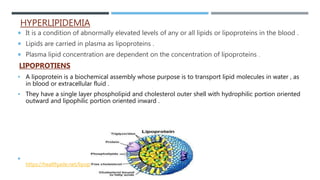
 A lipoprotein is a biochemical assembly whose purpose is to transport lipid molecules in water , as
in blood or extracellular fluid .
 They have a single layer phospholipid and cholesterol outer shell with hydrophilic portion oriented
outward and lipophilic portion oriented inward .

https://healthjade.net/lipoprotein/
CLASSIFICATION OF LIPOPROTIENS
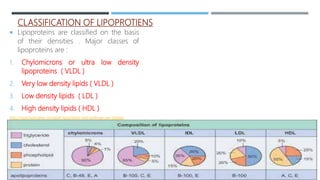
 Lipoproteins are classified on the basis
of their densities . Major classes of
lipoproteins are :
1. Chylomicrons or ultra low density
lipoproteins ( VLDL )
2. Very low density lipids ( VLDL )
3. Low density lipids ( LDL )
4. High density lipids ( HDL )
https://basicmedicalkey.com/lipids-lipoproteins-and-cardiovascular-disease/
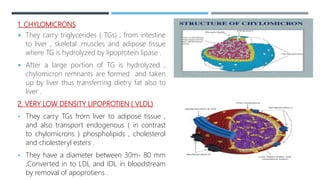
1. CHYLOMICRONS
 They carry triglycerides ( TGs) , from intestine
to liver , skeletal ,muscles and adipose tissue
where TG is hydrolyzed by lipoprotein lipase .
 After a large portion of TG is hydrolyzed ,
chylomicron remnants are formed and taken
up by liver thus transferring dietry fat also to
liver .
2. VERY LOW DENSITY LIPOPROTIEN ( VLDL)
 They carry TGs from liver to adipose tissue ,
and also transport endogenous ( in contrast
to chylomicrons ) phospholipids , cholesterol
and cholesteryl esters .
 They have a diameter between 30m- 80 mm
,Converted in to LDL and IDL in bloodstream
by removal of apoprotiens .
3. LOW DENSITY LIPOPROTIEN ( LDL)
 Sometimes referred to as “ Bad lipoprotein “ as they are responsible for atherosclerosis progression
by oxidizing in the walls of arteries .
 Contains chiefly cholesterol .
 Carry fats and cholesterol from liver to tissue .
4. HIGH DENSITY LIPOPROTIEN (HDL)
 Referred as ‘” good lipoprotein “ as the high levels lead to low rates of atherosclerosis progression.
 Collect fat molecules from cells/tissues to the liver .
 Generally raised levels of VLDL , IDL and LDL are associated with atherogenic while HDL may be
protective as it facilitates removal of CH from tissue .
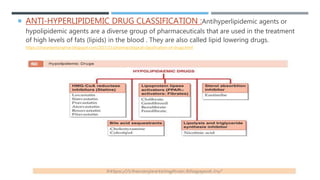
 ANTI-HYPERLIPIDEMIC DRUG CLASSIFICATION :Antihyperlipidemic agents or
hypolipidemic agents are a diverse group of pharmaceuticals that are used in the treatment
of high levels of fats (lipids) in the blood . They are also called lipid lowering drugs.
https://charanjeetsinghrar.blogspot.com/2017/11/pharmacological-classification-of-drugs.html
SCREENING MODELS
1. IN – VIVO MODELS
A. Tritan wistar rat induced hyperlipidemia
B. Cholesterol diet induced antherosclerosis in rabbit
C. Hereditary hyperlipidemia in rabbit
D. Hereditary hyper-cholesteromia in rats
E. Transgenic animal model
F. Hypolipidemic activity in Syrian hamster
2. IN – VITRO MODELS
A. Inhibition of isolated HMG-COA reductase inhibitions
B. ACAT inhibition model .
 IN-VIVO MODELS
TRITON WISTAR RAT INDUCED HYPERLIPIDEMIA
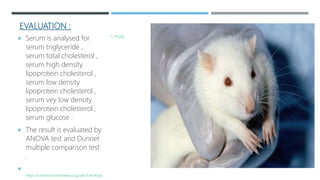
 PURPOSE : The systemic administration of the surfactant triton to rats , result in a biphasic
elevation of plasma cholesterol and triglycerides .
 REQUIREMENTS : chemicals = surfactant , triton .
animals = wistar strain male albino rats .
 PROCEDURE :
 Rat are divided into7 groups such that each group contains 6rats and kept in cages 5 days
prior to dosing .
 The animals are starved for 18 hrs with 10% aqueous solution of triton at 400mg/kg body
weight giving I.P . The test drugs and the solvent for control is administered simultaneously
with triton injection .
 After administration of triton , blood is collected by retro orbital puncture under either
anesthesia and sujected to centrifugation to obtain serum after 24 hrs or 48 hrs .
EVALUATION :
 Serum is analysed for
serum triglyceride ,
serum total cholesterol ,
serum high density
lipoprotein cholesterol ,
serum low density
lipoprotein cholesterol ,
serum vey low density
lipoprotein cholesterol ,
serum glucose .
 The result is evaluated by
ANOVA test and Dunnet
multiple comparison test
.

https://commons.wikimedia.org/wiki/File:Wista
r_rat.jpg
CHOLESTEROL-DIET INDUCED ATHEROSCLEROSIS IN RABBITS
 PURPOSE : rabbits are known to be susceptible to hypercholesterolemia and arteriosclerosis
after excessive cholesterol feeding . Therefore , this approach been chosen by to study the
effect of potential anti-arteriosclerotic drugs .
 REQUIREMENTS : Animals : White new Zealand male rabbit
 PROCEDURE :
 Group of male rabbits ( standard and control ) at an age of 8 to 10 weeks are used and
blood is withdrawn from the marginal ear vein for determination of total cholesterol , total
glycerides , and blood sugar
 The rabbits are switched from commercial food to a diet supplemented with 0.3-2%
cholesterol and kept on this regimen for a period of 10-12 weeks
 One group is kept on normal diet . During and at the end of the experiment blood is taken
for analysis .
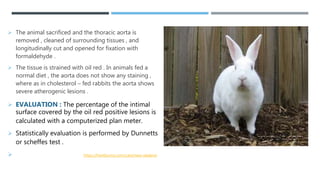
 The animal sacrificed and the thoracic aorta is
removed , cleaned of surrounding tissues , and
longitudinally cut and opened for fixation with
formaldehyde .
 The tissue is strained with oil red . In animals fed a
normal diet , the aorta does not show any staining ,
where as in cholesterol – fed rabbits the aorta shows
severe atherogenic lesions .
 EVALUATION : The percentage of the intimal
surface covered by the oil red positive lesions is
calculated with a computerized plan meter.
 Statistically evaluation is performed by Dunnetts
or scheffes test .
 https://herebunny.com/care/new-zealand
HEREDITARY HYPERLIPEMIA IN RABBITS
 PURPOSE : To produce hereditary hyperlipidemia in rabbit. To study the effect of potential anti-
arteriosclerotic drugs .
 REQUIREMENTS :
 chemical = probucol
 animals = female DDY mice , homozygous wistar hereditary hyperlipidemic rabbits .
 PROCEDURE :
 Homozygous wistar hereditary hyperlipidemic rabbits are raised by mating heterozygous female
wistar hereditary hyperlipidemic rabbits with homozygous male wistar hereditary hyperlipidemic
rabbits.
 At 2 months of age , eight rabbits are divide into two groups ( group A and group B ). Rabbits in
group A ( two males , two females ) , are fed standard rabbit chow for 6 months .
 Rabbits in group B ( two males , two females ) were raised with rabbit chow enriched with 1 %
(wt/wt) probucol for 6 months .
 The amount of daily diet for each animal is restricted to 100 gm during the study period
 Sex months later ( at the age of 8 months ) , the rabbits are sacrificed and their blood and aortas
are taken for analysis.
 EVALUATION :
 Plasma levels of cholesterol is measured by the enzymatic method.
 Statistical significance is determined by the student t-test .
 The t-test compares two averages and tells if they are different from each other . The t-test also
tells how significant the difference are .
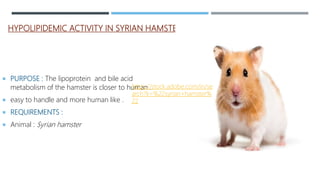
HYPOLIPIDEMIC ACTIVITY IN SYRIAN HAMSTERS
 PURPOSE : The lipoprotein and bile acid
metabolism of the hamster is closer to human .
 easy to handle and more human like .
 REQUIREMENTS :
 Animal : Syrian hamster
https://stock.adobe.com/in/se
arch?k=%22syrian+hamster%
22
PROCEDURE
 Male Syrian hamster weighting 95-125 gm at the start of experiment are randomly assigned to
form groups of 6 animals each .
 After 1 month of cholesterol rich diet they develop sub endothelial foam cells which are
precursors of fatty streaks that develops into complex plaques .
 The animals are anesthetized with diethyl ether , a blood sample is taken from the superior
venacava .
EVALUATION :
 The plasma is analyzed for total cholesterol using a colorimetric enzymatic assay .
 The cholesterol content of high density lipoprotein is determined using a precipitation kit .
INVITRO - MODELS
INHIBITION OF THE ISOLATED ENZYME HMG-COA-REDUCTASE
 PURPOSE : For screening purpose , studies on the inhibition of HMG-CoA reductase
obtained from rat liver microsomal fraction can be used .
 REQUIREMENTS : chemical : Dithiothreitol ( reducing agent ) , Animal : rats .
 The inhibitory activity of the test compound on HMGCo-A reductase is estimated with
soluble enzyme preparations obtained from the microsomal fraction of rat liver .
 HMG-CoA reductase is a rate controlling enzyme of mevalonate pathway that produces
cholesterol
 Inhibitors of HMG-CoA reduce the cholesterol production in body by inhibiting HMG-CoA .
 PROCEDURE :
 The inhibitory activity of the test compound on HMG-CoA reductase is estimated with
soluble enzyme preparations obtained from the microsomal fraction of rat liver (philipp and
Shapiro 1979).
 The enzyme reaction is carried out with 50uL partially purified HMG CoA reductase in buffer
containing Trid , EDTA , and dithiothreitol at Ph 7.5 , NADPH regenerating system .
 The final incubation volume is 200 ul .
 The main reaction is preceded by 20 min ,preincubation with the NADPH regeneration system at 37 Celsius , followed
by 20 min incubation at 37 Celsius of the complete samples with the test compound or the standard and stopped by
addition of 7 HCLo4 .
 After 60 min. , at room temperature , the samples are cooled in an ice –bath and neutralized by addition of 75uL 3N
POT . Acetate
 Supplementing the volume with water to 500uL , the precipitate is centrifuged and 250uL of the clear supernatant are
applied to a column ( o.6x8.0cm) OF BIORAD AG1-8 ( 100-200mesh).
 Mevalonolactone is eluted with water discarding the first 750uL and collecting the next 3, 500uL . Five hundred uL of
the eluate are used for measurement in duplicated , mixed in vials with 10 ml quickscint (Zinsser) and measured in a
liquid scintillation counter ( backman)
 The assay is generally performed in triplicate . Lovastatin sodium is used as standard .
 EVALUATION :
 The mean values with and without inhibitors are compared for the calculation of inhibition .
 IC50 values are calculated .
IN – VITRO ACAT INHIBITORY ACTIVITY .
 PURPOSE AND RATIONALE : IN-vitro ACAT inhibitory activity can be determined in
microsomal preparations from liver or intestine of rabbits .
 PROCEDURE :
 Hepatic or intestinal microsomes are prepared from rabbits . Prior to sacrifice , the animals
receive chow supplemented with 2% cholesterol and 10% safflower oil for 6 weeks.
 Each assay contain 0.2 mg of microsomal protein and fatty acid-poor bovine serum albumin
in KH2PO4 buffer , PH 7.4 , containing KCL , EDTA and sucrose .
 Drug dilutions are made in DMSO ( 5 ul DMSO/200ul total incubation volume ) . The
reaction is started by the addition of oleyl CoA .
 After 3 min the reaction is stopped by the addition of chloroform – methanol 2:1 [3H] ,
cholesteryl oleate is used as internal standard .
 Lipid extract are dissolved in chloroform , spotted on TCL plates (silica gel G) and developed
in hexane – petroleum ether –acetic acid 80:20:1
 Unlabeled , carrier cholesterol oleate is added to the internal standard to aid band visualization with iodine
vapor.
 The bands corresponding to cholesteryl esters is then scraped into scintillation vials and radioactivity is
determined by liquid scintillation spectroscopy .
 EVALUATION :
 For each compound four concentrations are evaluated in duplicate . IC50 values are
determined by performing a nonlinear least –squares fit of the data to a log dose – response
curve .
REFERENCE :
 https://www.hindawi.com/journals/ecam/2015/328545/
 https://www.ahajournals.org/doi/10.1161/atvbaha.107.147280
 Vogel H.G hard “Drug Discovery and Evaluation – Pharmacological Assay “ 2nd edition , spinger–verlag berlin
Heidelberg
 Tripathi K.D essentials of medical pharmacology (8th edition ) jaypee brothers medical .
 Goodman and gilman : the pharmacological basis of therapeutics (12th edition) .

THANK YOU

ANTIHYPERLIPIDEMIC screening models

  • 1.
    PRECLINICAL SCREENING OFANTIHYPERLIPIDEMIC DRUGS Noida Institute of Engineering and Technology (Pharmacy Institute) Greater Noida Presented by :- ANMOL KANDA M . Pharm (Pharmacology) Submitted to :- Dr. Saumya Das Associate Professor NIET (Pharmacy Institute) Greater Noida
  • 2.
    HYPERLIPIDEMIA  It isa condition of abnormally elevated levels of any or all lipids or lipoproteins in the blood .  Lipids are carried in plasma as lipoproteins .  Plasma lipid concentration are dependent on the concentration of lipoproteins . LIPOPROTIENS  A lipoprotein is a biochemical assembly whose purpose is to transport lipid molecules in water , as in blood or extracellular fluid .  They have a single layer phospholipid and cholesterol outer shell with hydrophilic portion oriented outward and lipophilic portion oriented inward .  https://healthjade.net/lipoprotein/
  • 3.
    CLASSIFICATION OF LIPOPROTIENS Lipoproteins are classified on the basis of their densities . Major classes of lipoproteins are : 1. Chylomicrons or ultra low density lipoproteins ( VLDL ) 2. Very low density lipids ( VLDL ) 3. Low density lipids ( LDL ) 4. High density lipids ( HDL ) https://basicmedicalkey.com/lipids-lipoproteins-and-cardiovascular-disease/
  • 4.
    1. CHYLOMICRONS  Theycarry triglycerides ( TGs) , from intestine to liver , skeletal ,muscles and adipose tissue where TG is hydrolyzed by lipoprotein lipase .  After a large portion of TG is hydrolyzed , chylomicron remnants are formed and taken up by liver thus transferring dietry fat also to liver . 2. VERY LOW DENSITY LIPOPROTIEN ( VLDL)  They carry TGs from liver to adipose tissue , and also transport endogenous ( in contrast to chylomicrons ) phospholipids , cholesterol and cholesteryl esters .  They have a diameter between 30m- 80 mm ,Converted in to LDL and IDL in bloodstream by removal of apoprotiens .
  • 5.
    3. LOW DENSITYLIPOPROTIEN ( LDL)  Sometimes referred to as “ Bad lipoprotein “ as they are responsible for atherosclerosis progression by oxidizing in the walls of arteries .  Contains chiefly cholesterol .  Carry fats and cholesterol from liver to tissue . 4. HIGH DENSITY LIPOPROTIEN (HDL)  Referred as ‘” good lipoprotein “ as the high levels lead to low rates of atherosclerosis progression.  Collect fat molecules from cells/tissues to the liver .  Generally raised levels of VLDL , IDL and LDL are associated with atherogenic while HDL may be protective as it facilitates removal of CH from tissue .
  • 6.
     ANTI-HYPERLIPIDEMIC DRUGCLASSIFICATION :Antihyperlipidemic agents or hypolipidemic agents are a diverse group of pharmaceuticals that are used in the treatment of high levels of fats (lipids) in the blood . They are also called lipid lowering drugs. https://charanjeetsinghrar.blogspot.com/2017/11/pharmacological-classification-of-drugs.html
  • 7.
    SCREENING MODELS 1. IN– VIVO MODELS A. Tritan wistar rat induced hyperlipidemia B. Cholesterol diet induced antherosclerosis in rabbit C. Hereditary hyperlipidemia in rabbit D. Hereditary hyper-cholesteromia in rats E. Transgenic animal model F. Hypolipidemic activity in Syrian hamster 2. IN – VITRO MODELS A. Inhibition of isolated HMG-COA reductase inhibitions B. ACAT inhibition model .
  • 8.
  • 9.
    TRITON WISTAR RATINDUCED HYPERLIPIDEMIA  PURPOSE : The systemic administration of the surfactant triton to rats , result in a biphasic elevation of plasma cholesterol and triglycerides .  REQUIREMENTS : chemicals = surfactant , triton . animals = wistar strain male albino rats .  PROCEDURE :  Rat are divided into7 groups such that each group contains 6rats and kept in cages 5 days prior to dosing .  The animals are starved for 18 hrs with 10% aqueous solution of triton at 400mg/kg body weight giving I.P . The test drugs and the solvent for control is administered simultaneously with triton injection .  After administration of triton , blood is collected by retro orbital puncture under either anesthesia and sujected to centrifugation to obtain serum after 24 hrs or 48 hrs .
  • 10.
    EVALUATION :  Serumis analysed for serum triglyceride , serum total cholesterol , serum high density lipoprotein cholesterol , serum low density lipoprotein cholesterol , serum vey low density lipoprotein cholesterol , serum glucose .  The result is evaluated by ANOVA test and Dunnet multiple comparison test .  https://commons.wikimedia.org/wiki/File:Wista r_rat.jpg
  • 11.
    CHOLESTEROL-DIET INDUCED ATHEROSCLEROSISIN RABBITS  PURPOSE : rabbits are known to be susceptible to hypercholesterolemia and arteriosclerosis after excessive cholesterol feeding . Therefore , this approach been chosen by to study the effect of potential anti-arteriosclerotic drugs .  REQUIREMENTS : Animals : White new Zealand male rabbit  PROCEDURE :  Group of male rabbits ( standard and control ) at an age of 8 to 10 weeks are used and blood is withdrawn from the marginal ear vein for determination of total cholesterol , total glycerides , and blood sugar  The rabbits are switched from commercial food to a diet supplemented with 0.3-2% cholesterol and kept on this regimen for a period of 10-12 weeks  One group is kept on normal diet . During and at the end of the experiment blood is taken for analysis .
  • 12.
     The animalsacrificed and the thoracic aorta is removed , cleaned of surrounding tissues , and longitudinally cut and opened for fixation with formaldehyde .  The tissue is strained with oil red . In animals fed a normal diet , the aorta does not show any staining , where as in cholesterol – fed rabbits the aorta shows severe atherogenic lesions .  EVALUATION : The percentage of the intimal surface covered by the oil red positive lesions is calculated with a computerized plan meter.  Statistically evaluation is performed by Dunnetts or scheffes test .  https://herebunny.com/care/new-zealand
  • 13.
    HEREDITARY HYPERLIPEMIA INRABBITS  PURPOSE : To produce hereditary hyperlipidemia in rabbit. To study the effect of potential anti- arteriosclerotic drugs .  REQUIREMENTS :  chemical = probucol  animals = female DDY mice , homozygous wistar hereditary hyperlipidemic rabbits .  PROCEDURE :  Homozygous wistar hereditary hyperlipidemic rabbits are raised by mating heterozygous female wistar hereditary hyperlipidemic rabbits with homozygous male wistar hereditary hyperlipidemic rabbits.  At 2 months of age , eight rabbits are divide into two groups ( group A and group B ). Rabbits in group A ( two males , two females ) , are fed standard rabbit chow for 6 months .  Rabbits in group B ( two males , two females ) were raised with rabbit chow enriched with 1 % (wt/wt) probucol for 6 months .
  • 14.
     The amountof daily diet for each animal is restricted to 100 gm during the study period  Sex months later ( at the age of 8 months ) , the rabbits are sacrificed and their blood and aortas are taken for analysis.  EVALUATION :  Plasma levels of cholesterol is measured by the enzymatic method.  Statistical significance is determined by the student t-test .  The t-test compares two averages and tells if they are different from each other . The t-test also tells how significant the difference are .
  • 15.
    HYPOLIPIDEMIC ACTIVITY INSYRIAN HAMSTERS  PURPOSE : The lipoprotein and bile acid metabolism of the hamster is closer to human .  easy to handle and more human like .  REQUIREMENTS :  Animal : Syrian hamster https://stock.adobe.com/in/se arch?k=%22syrian+hamster% 22
  • 16.
    PROCEDURE  Male Syrianhamster weighting 95-125 gm at the start of experiment are randomly assigned to form groups of 6 animals each .  After 1 month of cholesterol rich diet they develop sub endothelial foam cells which are precursors of fatty streaks that develops into complex plaques .  The animals are anesthetized with diethyl ether , a blood sample is taken from the superior venacava . EVALUATION :  The plasma is analyzed for total cholesterol using a colorimetric enzymatic assay .  The cholesterol content of high density lipoprotein is determined using a precipitation kit .
  • 17.
  • 18.
    INHIBITION OF THEISOLATED ENZYME HMG-COA-REDUCTASE  PURPOSE : For screening purpose , studies on the inhibition of HMG-CoA reductase obtained from rat liver microsomal fraction can be used .  REQUIREMENTS : chemical : Dithiothreitol ( reducing agent ) , Animal : rats .  The inhibitory activity of the test compound on HMGCo-A reductase is estimated with soluble enzyme preparations obtained from the microsomal fraction of rat liver .  HMG-CoA reductase is a rate controlling enzyme of mevalonate pathway that produces cholesterol  Inhibitors of HMG-CoA reduce the cholesterol production in body by inhibiting HMG-CoA .  PROCEDURE :  The inhibitory activity of the test compound on HMG-CoA reductase is estimated with soluble enzyme preparations obtained from the microsomal fraction of rat liver (philipp and Shapiro 1979).  The enzyme reaction is carried out with 50uL partially purified HMG CoA reductase in buffer containing Trid , EDTA , and dithiothreitol at Ph 7.5 , NADPH regenerating system .  The final incubation volume is 200 ul .
  • 19.
     The mainreaction is preceded by 20 min ,preincubation with the NADPH regeneration system at 37 Celsius , followed by 20 min incubation at 37 Celsius of the complete samples with the test compound or the standard and stopped by addition of 7 HCLo4 .  After 60 min. , at room temperature , the samples are cooled in an ice –bath and neutralized by addition of 75uL 3N POT . Acetate  Supplementing the volume with water to 500uL , the precipitate is centrifuged and 250uL of the clear supernatant are applied to a column ( o.6x8.0cm) OF BIORAD AG1-8 ( 100-200mesh).  Mevalonolactone is eluted with water discarding the first 750uL and collecting the next 3, 500uL . Five hundred uL of the eluate are used for measurement in duplicated , mixed in vials with 10 ml quickscint (Zinsser) and measured in a liquid scintillation counter ( backman)  The assay is generally performed in triplicate . Lovastatin sodium is used as standard .  EVALUATION :  The mean values with and without inhibitors are compared for the calculation of inhibition .  IC50 values are calculated .
  • 20.
    IN – VITROACAT INHIBITORY ACTIVITY .  PURPOSE AND RATIONALE : IN-vitro ACAT inhibitory activity can be determined in microsomal preparations from liver or intestine of rabbits .  PROCEDURE :  Hepatic or intestinal microsomes are prepared from rabbits . Prior to sacrifice , the animals receive chow supplemented with 2% cholesterol and 10% safflower oil for 6 weeks.  Each assay contain 0.2 mg of microsomal protein and fatty acid-poor bovine serum albumin in KH2PO4 buffer , PH 7.4 , containing KCL , EDTA and sucrose .  Drug dilutions are made in DMSO ( 5 ul DMSO/200ul total incubation volume ) . The reaction is started by the addition of oleyl CoA .  After 3 min the reaction is stopped by the addition of chloroform – methanol 2:1 [3H] , cholesteryl oleate is used as internal standard .  Lipid extract are dissolved in chloroform , spotted on TCL plates (silica gel G) and developed in hexane – petroleum ether –acetic acid 80:20:1
  • 21.
     Unlabeled ,carrier cholesterol oleate is added to the internal standard to aid band visualization with iodine vapor.  The bands corresponding to cholesteryl esters is then scraped into scintillation vials and radioactivity is determined by liquid scintillation spectroscopy .  EVALUATION :  For each compound four concentrations are evaluated in duplicate . IC50 values are determined by performing a nonlinear least –squares fit of the data to a log dose – response curve .
  • 22.
    REFERENCE :  https://www.hindawi.com/journals/ecam/2015/328545/ https://www.ahajournals.org/doi/10.1161/atvbaha.107.147280  Vogel H.G hard “Drug Discovery and Evaluation – Pharmacological Assay “ 2nd edition , spinger–verlag berlin Heidelberg  Tripathi K.D essentials of medical pharmacology (8th edition ) jaypee brothers medical .  Goodman and gilman : the pharmacological basis of therapeutics (12th edition) .
  • 23.