Mrs. Pradnya N. Jagtap
Ms. Sayali S. Chavan
Department of Pharmacology
PDEA’s SGRS College of Pharmacy
Screening of Drugs for
Behavioural and Muscle
Coordination
Screening Methods for behavioural and muscle Coordination
a) Motor activity and behaviour
1. Method of intermittent observation
2. Open field test
3. Hole board test
4. Combined open field test
b) Test for muscle coordination
1. Inclined plane method
2. Chimny test
3. Grip strength
4. Rotarod method
Motor Activity& Behaviour
1. Method of intermittent observations
Purpose
Tostudy stimulant and sedative drugs by changing animal behavior after adm.
Procedure-
• Mice weight-25 g ,12 animals are divided into group of 3 mice.
• For testing sedative activity, the mice are injected after 10 min s.c with 0.5 mg/kg
methamphetamine.
• For testing stimulant activity, the mice are treated with 800 mg/kg paraldehyde.
• each group is placed into a glass jar of 12 cm diameter and 20 cm height which in
turn are placed in a wooden box of 130 50 30 cm & start observation.
• amphetamine treated mice count between 120 to 150 and sedative drugs shows
decrease in counts.
2. Open field test
Purpose-
• To assess the activity of sedative or stimulant drugs.
Procedure-
• The rats are observed in a square open field area (68 68 45 cm)
equipped with 2 rows of 8 photocells, sensitive to infrared light, placed
40 and 125 mm above the floor.
• Measurements are made in the dark in a ventilated, sound-attenuating
box.
• Interruptions of photocell beams can be collected by a microcomputer
and Interruption of light beams as a measure of movements of ratsor
mice in a cage.
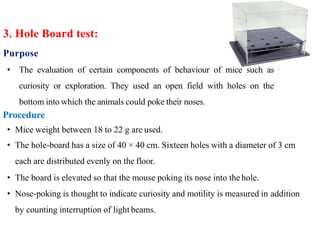
Purpose
• The evaluation of certain components of behaviour of mice such as
curiosity or exploration. They used an open field with holes on the
bottom into which the animals could poke their noses.
Procedure
• Mice weight between 18 to 22 g are used.
• The hole-board has a size of 40 × 40 cm. Sixteen holes with a diameter of 3 cm
each are distributed evenly on the floor.
• The board is elevated so that the mouse poking its nose into the hole.
• Nose-poking is thought to indicate curiosity and motility is measured in addition
by counting interruption of light beams.
3. Hole Board test:
Purpose
• The simultaneous determination of locomotion and curiosity by
using a modification of the hole-board test and a photo-beam
system.
Procedure
• The animal is tested individually in an automated open-field box which
consists of a black Plexiglas cage (35 35 20 cm) with a post (8 8 20 cm) in
the centre of the cage.
• Two evenly spaced photo cell beams perpendicular to the wall and 2 cm
above the floor divide the box into 4 compartments.
• Every photo cell beam interruption is registered automatically as an activity
count.
• 30 min. after i.p and 60 min. after oral administration of the test compound
the animal is placed into the cage and the behaviour recorded for a period of
5 min.
4. Combined open field test:
1. Inclined plane method
procedure-
• Male mice with a body weight between 20 to 30 kg are used.
• The plane consists of two rectangular plywood boards connected at one end by a
hinge. One board is the base, the other is the movable inclined plane. A rubber
mat with ridges 0.2 cm in height is fixed to the inclined plane which is set at 65
degrees.
• The test compound or the standard are administered to groups of 10 mice either
i.p. or s.c. or orally. 30, 60 and 90 min thereafter, the mice are placed at the upper
part of the inclined plane and are given 30 s to hang on or to fall off.
• Purpose - The inclined plane method is used to assess
skeletal muscle relaxation.
Test For Muscle Co-ordination
2. Chimney Test:
Purpose-
• A simple test for assessing the tranquilizing and muscle relaxant
activity.
Procedure-
• Male mice weighing between 16 to 22 are used.
• Pyrex-glass cylinders 30 cm long are required.
• The internal diameter varies with the animal’s weight: for mice
weighing 16 to 18 g, the diameter is 22 mm, for mice weighing 18
to 20 g, 25 mm; for mice weighing 20 to 22 g, 28 mm.
• Each tube has a mark 20 cm from its base. Initially, the tube is held
in a horizontal
• position. At the end of the tube, near the mark, a mouse is introduced
with the head forward.
• When the mouse reaches the other end of the tube, toward which it
is pushed if necessary with a rod, the tube is moved to a vertical
position.
• Immediately, the mouse tries to climb backwards and performs
coordinated movements similar to an alpinist to pass a chimney in
the mountains.
• The time required by the mouse to climb backwards out at the top
of the
cylinder is noted.
3. Grip Strength test:
Purpose
• The test is being used to assess muscular strength or neuromuscular
function.
Procedure-
• Male or female mice with an average weight of 22 g are used.
• The animals are exposed to a horizontal thin threat or metallic wire suspended
about 30 cm into the air which they immediately grasp with the forepaws.
• The mouse is released to hang on with its forelimbs. Normal animals are
able to
catch the threat with the hind limbs and to climb up within 5 s.
• After oral or subcutaneous administration the animals are tested every 15 min.
Animals which are not able to touch the threat with the hind limbs within 5 s or
fall off from the threat are considered to be impaired.
4. Rotarod method
Purpose-
Procedure –
• Male mice with an weight between 20 and 30 g are used.
• The apparatus consists of a horizontal wooden rod or metal rod coated with
rubber with 3 cm diameter attached to a motor with the speed adjusted to 2
rotations per minute.
• The rod is 75 cm in length and is divided into 6 sections by plastic discs,
thereby allowing the simultaneous testing of 6 mice. The rod is in a height of
about 50 cm above the table top in order to discourage the animals from
jumping off the roller.
• The test is used to evaluate the activity
of drugs interfering with motor
coordination and muscle activity.
• Cages below the sections serve to restrict the movements
of the animals when they fall from the roller.
• Only those animals which have demonstrated their ability
to remain on the
revolving rod for at least 1 minute are used for the test.
• The test compounds are administered intraperitoneally or
orally.
• 30 min. after intraperitoneal or 60 min after oral
administration the mice are placed for 1 min on the
rotating rod.
• The number of animals falling from the roller during this
time is counted.
 Screening Methods for behavioural and muscle Coordination