The Use of Recombinant
 Adeno-Associated Viral
Vectors in Gene Therapy
   to Treat Epilepsy

               Omega Cantrell
Outline
   Introduction
    ◦   What is normal?
    ◦   What is epilepsy?
    ◦   Current treatments
    ◦   rAAV
    ◦   Neurotransmitters
   Studies
    ◦ Galanin-focused studies
    ◦ NPY-focused studies
   Implications
   Conclusions

                                2
Objectives


 Why is epilepsy a good target?
 How does gene therapy work?
 What is the best transgene for this?


                                         3
Outline
   Introduction
    ◦ What is normal?
    ◦   What is epilepsy?
    ◦   Current treatments
    ◦   rAAV
    ◦   Neurotransmitters
   Studies
    ◦ Galanin-focused studies
    ◦ NPY-focused studies
   Implications
   Conclusions
                                4
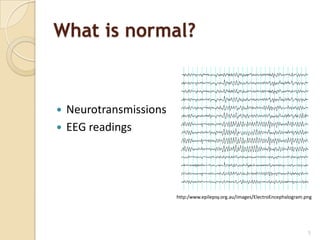
What is normal?


 Neurotransmissions
 EEG readings


                       http:/www.epilepsy.org.au/images/ElectroEncephalogram.png


                                                                              5
Outline
   Introduction
    ◦ What is normal?
    ◦ What is epilepsy?
    ◦ Current treatments
    ◦ rAAV
    ◦ Neurotransmitters
   Studies
    ◦ Galanin-focused studies
    ◦ NPY-focused studies
   Implications
   Conclusions
                                6
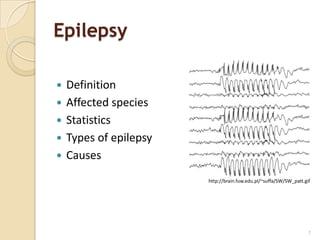
Epilepsy

   Definition
   Affected species
   Statistics
   Types of epilepsy
   Causes
                        http://brain.fuw.edu.pl/~suffa/SW/SW_patt.gif


                                                                    7
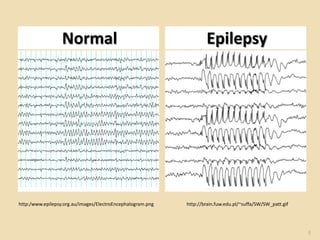
Normal                                            Epilepsy


http:/www.epilepsy.org.au/images/ElectroEncephalogram.png   http://brain.fuw.edu.pl/~suffa/SW/SW_patt.gif


                                                                                                            8
Outline
   Introduction
    ◦ What is normal?
    ◦ What is epilepsy?
    ◦ Current treatments
    ◦ rAAV
    ◦ Neurotransmitters
   Studies
    ◦ Galanin-focused studies
    ◦ NPY-focused studies
   Implications
   Conclusions
                                9
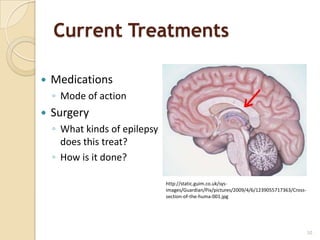
Current Treatments

   Medications
    ◦ Mode of action
   Surgery
    ◦ What kinds of epilepsy
      does this treat?
    ◦ How is it done?

                               http://static.guim.co.uk/sys-
                               images/Guardian/Pix/pictures/2009/4/6/1239055717363/Cross-
                               section-of-the-huma-001.jpg


                                                                                            10
Outline
   Introduction
    ◦ What is normal?
    ◦ What is epilepsy?
    ◦ Current treatments
    ◦ rAAV
    ◦ Neurotransmitters
   Studies
    ◦ Galanin-focused studies
    ◦ NPY-focused studies
   Implications
   Conclusions
                                11
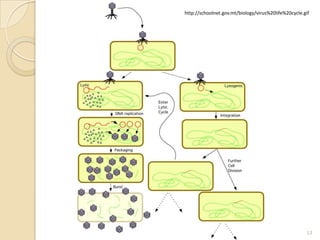
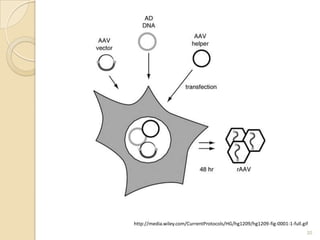
How is a viral vector constructed?
 Life cycle manipulation
 Removal of rep and cap genes
    ◦ Why?  Rep’s effect
   Addition of beneficial components
    ◦ Triple plasmid transfection method; what is
      added?
      Helper
      Transgene
      Promoter


                                                    12
http://schoolnet.gov.mt/biology/virus%20life%20cycle.gif


                                                      13
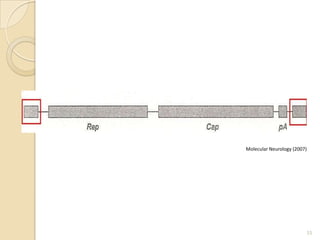
How is an rAAV vector constructed?

  Life cycle manipulation
  Removal of rep and cap genes
  Addition of beneficial components
     ◦ Triple plasmid transfection method; what is
       added?
       Helper
       Transgene
       Promoter


                                                     14
Molecular Neurology (2007)


                         15
How is an rAAV vector constructed?

  Life cycle manipulation
  Removal of rep and cap genes
  Addition of beneficial components
     ◦ Triple plasmid transfection method; what is
       added?
       Helper
       Transgene
       Promoter


                                                     16
Recombinant Adeno-Associated
Virus (rAAV)

 What is it?
 Characteristics
 Advantages
 What should be kept in mind when using
  this vector?


                                           17
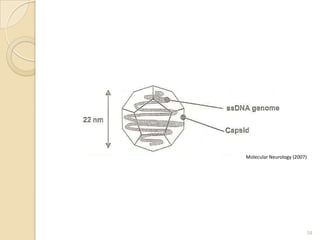
Molecular Neurology (2007)


                         18
Recombinant Adeno-Associated
Virus (rAAV)

 What is it?
 Characteristics
 Advantages
 What should be kept in mind when using
  this vector?


                                       19
http://media.wiley.com/CurrentProtocols/HG/hg1209/hg1209-fig-0001-1-full.gif
                                                                           20
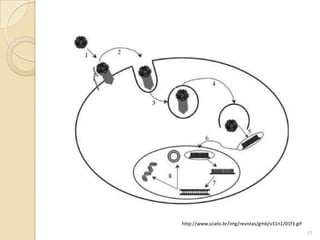
How is it delivered?


 Intraparenchymally
 Small volumes, at low flow rates
 Diffusion to targets
 Are there any limitations?


                                     21
http://www.scielo.br/img/revistas/gmb/v31n1/01f3.gif
                                                       22
Outline
   Introduction
    ◦   What is normal?
    ◦   What is epilepsy?
    ◦   Current treatments
    ◦   rAAV
    ◦ Neurotransmitters
   Studies
    ◦ Galanin-focused studies
    ◦ NPY-focused studies
   Implications
   Conclusions
                                23
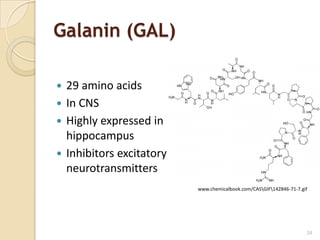
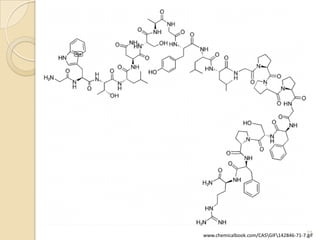
Galanin (GAL)

 29 amino acids
 In CNS
 Highly expressed in
  hippocampus
 Inhibitors excitatory
  neurotransmitters
                          www.chemicalbook.com/CASGIF142846-71-7.gif


                                                                     24
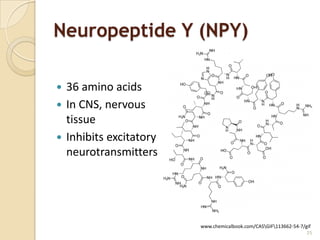
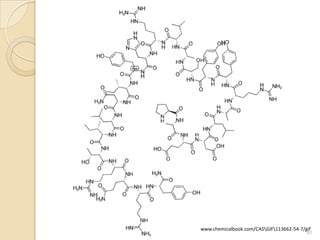
Neuropeptide Y (NPY)

 36 amino acids
 In CNS, nervous
  tissue
 Inhibits excitatory
  neurotransmitters


                        www.chemicalbook.com/CASGIF113662-54-7/gif
                                                                  25
Outline
   Introduction
    ◦   What is normal?
    ◦   What is epilepsy?
    ◦   Current treatments
    ◦   rAAV
    ◦   Neurotransmitters
   Studies
    ◦ Galanin-focused studies
    ◦ NPY-focused studies
   Implications
   Conclusions
                                26
27
www.chemicalbook.com/CASGIF142846-71-7.gif
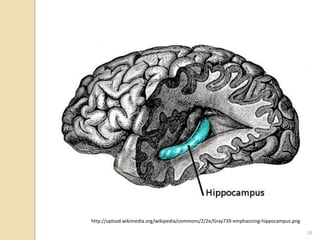
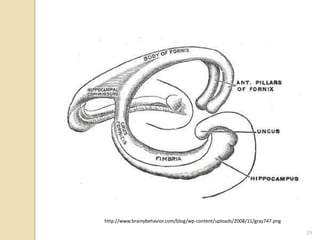
http://upload.wikimedia.org/wikipedia/commons/2/2e/Gray739-emphasizing-hippocampus.png

                                                                                         28
http://www.brainybehavior.com/blog/wp-content/uploads/2008/11/gray747.png

                                                                            29
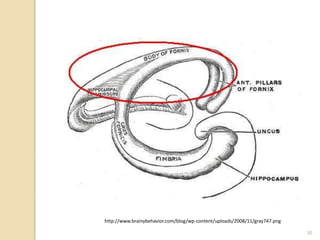
http://www.brainybehavior.com/blog/wp-content/uploads/2008/11/gray747.png

                                                                            30
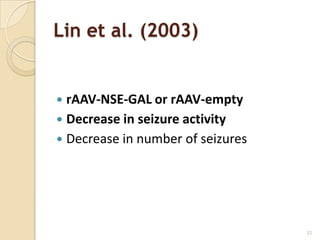
Lin et al. (2003)


 rAAV-NSE-GAL or rAAV-empty
 Decrease in seizure activity
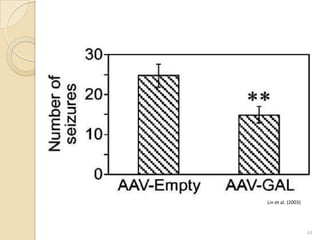
 Decrease in number of seizures


                                   31
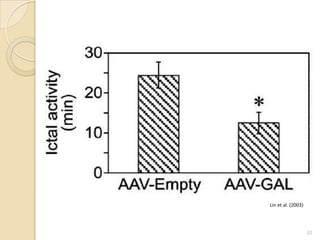
Lin et al. (2003)


                    32
Lin et al. (2003)


 rAAV-NSE-GAL or rAAV-empty
 Decrease in seizure activity
 Decrease in number of seizures


                                   33
Lin et al. (2003)


                    34
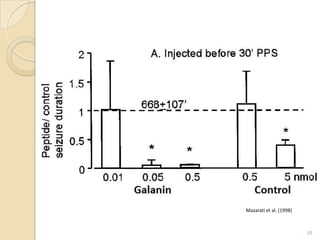
Mazarati et al. (1998)


 Perforant path stimulation
 30 minutes before or after PPS
 Decreased time in seizure activity when
  given before PPS


                                            35
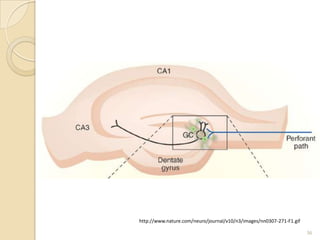
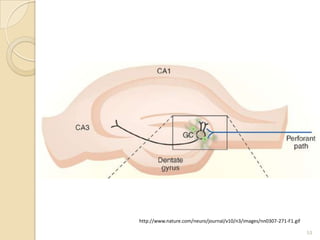
http://www.nature.com/neuro/journal/v10/n3/images/nn0307-271-F1.gif

                                                                      36
Mazarati et al. (1998)

 Perforant path stimulation
 30 minutes before or after PPS
 Decreased time in seizure activity when
  given before PPS
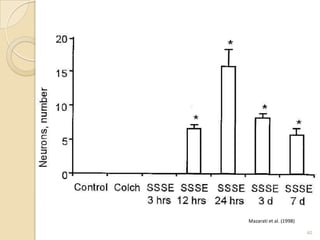
 More GAL-positive neurons in treated rats


                                          37
Mazarati et al. (1998)


                         38
Mazarati et al. (1998)

 Perforant path stimulation
 30 minutes before or after PPS
 Decreased time in seizure activity when
  given before PPS
 More GAL-positive neurons in treated rats


                                              39
Mazarati et al. (1998)

                         40
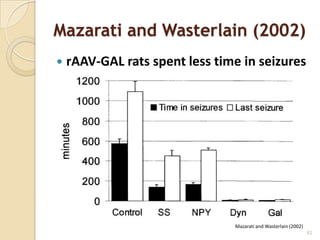
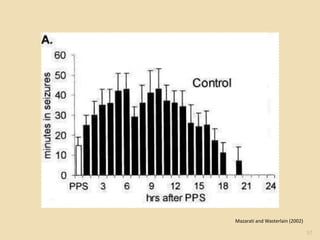
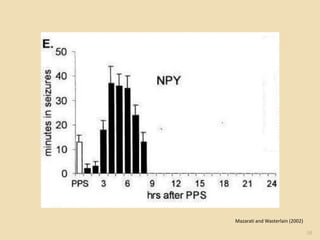
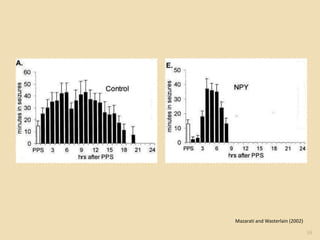
Mazarati and Wasterlain (2002)
   rAAV-GAL rats spent less time in seizures


                                Mazarati and Wasterlain (2002)
                                                                 41
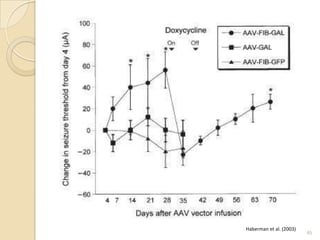
Haberman et al. (2003)
 Seizure threshold reduced by rAAV-FIB-
  GAL
 Given doxycycline, threshold returned to
  baseline
 After removal, threshold increased again
 GAL in cells after seizures: higher GAL in
  vitro in rAAV-FIB-GAL cells


                                               42
43
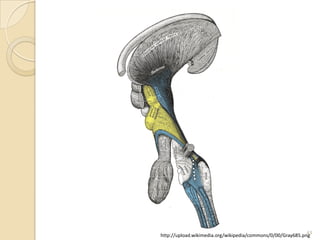
http://upload.wikimedia.org/wikipedia/commons/0/00/Gray685.png
Haberman et al. (2003)
 Seizure threshold reduced by rAAV-FIB-
  GAL
 Given doxycycline, threshold returned to
  baseline
 After removal, threshold increased again
 GAL in cells after seizures: higher GAL in
  vitro in rAAV-FIB-GAL cells


                                               44
Haberman et al. (2003)
                         45
Outline
   Introduction
    ◦   What is normal?
    ◦   What is epilepsy?
    ◦   Current treatments
    ◦   rAAV
    ◦   Neurotransmitters
   Studies
    ◦ Galanin-focused studies
    ◦ NPY-focused studies
   Implications
   Conclusions
                                46
www.chemicalbook.com/CASGIF113662-54-7/gif
                                          47
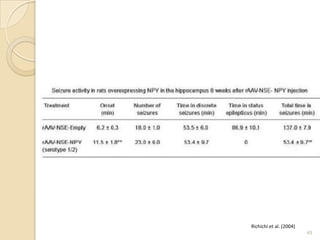
Richichi et al. (2004)

 Used two serotypes of rAAV-NSE-NPY;
  kainic acid to induce seizures
 Onset delayed almost twofold
 No SE in treated animals, at least 60
  minute episodes in control group
 NPY found only in neurons


                                          48
Richichi et al. (2004)
                         49
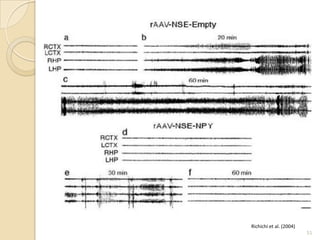
Richichi et al. (2004)

 Used two serotypes of rAAV-NSE-NPY;
  kainic acid to induce seizures
 Onset delayed almost twofold
 No SE in treated animals, average of 87
  minute episodes in control group


                                            50
Richichi et al. (2004)
                         51
Mazarati & Wasterlain (2002)

   30 minutes PPS to induce seizure activity
    ◦ Ten minutes after, injected with vector
 No significant difference in time spent in
  total seizure activity
 Treated animals: ~4 hours in seizure activity
 SSSE decreased to <20 minutes total


                                                  52
http://www.nature.com/neuro/journal/v10/n3/images/nn0307-271-F1.gif

                                                                      53
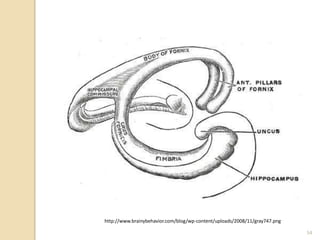
http://www.brainybehavior.com/blog/wp-content/uploads/2008/11/gray747.png

                                                                            54
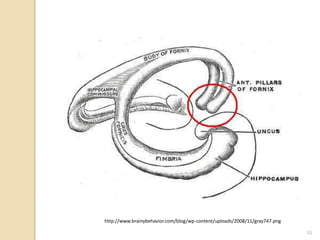
http://www.brainybehavior.com/blog/wp-content/uploads/2008/11/gray747.png

                                                                            55
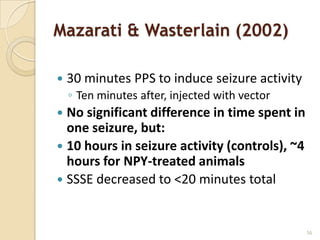
Mazarati & Wasterlain (2002)

   30 minutes PPS to induce seizure activity
    ◦ Ten minutes after, injected with vector
 No significant difference in time spent in
  one seizure, but:
 10 hours in seizure activity (controls), ~4
  hours for NPY-treated animals
 SSSE decreased to <20 minutes total


                                                56
Mazarati and Wasterlain (2002)

                                 57
Mazarati and Wasterlain (2002)

                                 58
Mazarati and Wasterlain (2002)

                                 59
Outline
   Introduction
    ◦   What is normal?
    ◦   What is epilepsy?
    ◦   Current treatments
    ◦   rAAV
         What is it?
         How is it contructed?
    ◦ Neurotransmitters
   Studies
Implications
   Conclusions
                                  60
Galanin transgene

 Strong neurotropism
 Prevents initiation of SE
 Drastic reduction in seizure activity and
  number of seizures observed


                                              61
Neuropeptide Y transgene

 Reduced number of seizures
 Delay in seizure onset
 No significant decrease in time spent in
  seizure activity


                                             62
CONCLUSIONS


          63
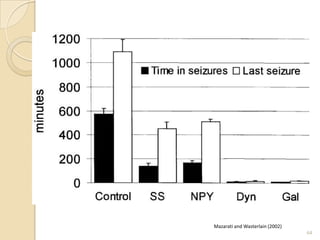
Mazarati and Wasterlain (2002)
                                 64
What’s next?

 Much more research needs to be done
 What needs to be determined?
 Injection should be minimally invasive
 Obtain FDA approval for use in humans


                                           65
References
   Haberman, R.P., R.J. Samulski, and T. J. McCown. 2003. Attenuation of
    seizures and neuronal death by adeno-associated virus vector galanin
    expression and secretion. Nature Medicine. 9(8): 1076-1080.
   Lin, E.D., C. Richichi, D. Young, K. Baer, A. Vezzani, and M.J. During. 2003.
    Recombinant AAV-mediated expression of galanin in rat hippocampus
    suppresses seizure development. European Journal of Neuroscience. 18:
    2087-2092
   Mazarati, A.M and C.G. Wasterlain. 2002. Anticonvulsant effects of four
    neuropeptides in the rat hippocampus during self-sustaining status
    epilepticus. Neuroscience Letters. 331: 123-127.
   Mazarati, A.M., H. Liu, U. Soomets, R. Sankar, D. Shin, H. Katsumori, Ü.
    Langel, and C.G. Wasterlain. 1998. Galanin modulation of seizures and
    seizure modulation of hippocampal galanin in animal models of status
    epilepticus. Journal of Neuroscience. 18(23): 10070-10077.
   Richichi, C, E.D. Lin, D. Stefanin, D. Colella, T. Ravizza, G. Grignaschi, P.
    Veglianese, G. Sperk, M.J. During, and A. Vezzani. 2004. Anticonvulsant
    and antiepileptogenic effects mediated by adeno-associated virus vector
    neuropeptide Y expression in the rat hippocampus. Journal of
    Neuroscience. 24(12): 3051-3059.


                                                                                    66
Questions?


         67
Questions?


         68

AVS 406 Presentation

  • 1.
    The Use ofRecombinant Adeno-Associated Viral Vectors in Gene Therapy to Treat Epilepsy Omega Cantrell
  • 2.
    Outline  Introduction ◦ What is normal? ◦ What is epilepsy? ◦ Current treatments ◦ rAAV ◦ Neurotransmitters  Studies ◦ Galanin-focused studies ◦ NPY-focused studies  Implications  Conclusions 2
  • 3.
    Objectives  Why isepilepsy a good target?  How does gene therapy work?  What is the best transgene for this? 3
  • 4.
    Outline  Introduction ◦ What is normal? ◦ What is epilepsy? ◦ Current treatments ◦ rAAV ◦ Neurotransmitters  Studies ◦ Galanin-focused studies ◦ NPY-focused studies  Implications  Conclusions 4
  • 5.
    What is normal? Neurotransmissions  EEG readings http:/www.epilepsy.org.au/images/ElectroEncephalogram.png 5
  • 6.
    Outline  Introduction ◦ What is normal? ◦ What is epilepsy? ◦ Current treatments ◦ rAAV ◦ Neurotransmitters  Studies ◦ Galanin-focused studies ◦ NPY-focused studies  Implications  Conclusions 6
  • 7.
    Epilepsy  Definition  Affected species  Statistics  Types of epilepsy  Causes http://brain.fuw.edu.pl/~suffa/SW/SW_patt.gif 7
  • 8.
    Normal Epilepsy http:/www.epilepsy.org.au/images/ElectroEncephalogram.png http://brain.fuw.edu.pl/~suffa/SW/SW_patt.gif 8
  • 9.
    Outline  Introduction ◦ What is normal? ◦ What is epilepsy? ◦ Current treatments ◦ rAAV ◦ Neurotransmitters  Studies ◦ Galanin-focused studies ◦ NPY-focused studies  Implications  Conclusions 9
  • 10.
    Current Treatments  Medications ◦ Mode of action  Surgery ◦ What kinds of epilepsy does this treat? ◦ How is it done? http://static.guim.co.uk/sys- images/Guardian/Pix/pictures/2009/4/6/1239055717363/Cross- section-of-the-huma-001.jpg 10
  • 11.
    Outline  Introduction ◦ What is normal? ◦ What is epilepsy? ◦ Current treatments ◦ rAAV ◦ Neurotransmitters  Studies ◦ Galanin-focused studies ◦ NPY-focused studies  Implications  Conclusions 11
  • 12.
    How is aviral vector constructed?  Life cycle manipulation  Removal of rep and cap genes ◦ Why?  Rep’s effect  Addition of beneficial components ◦ Triple plasmid transfection method; what is added?  Helper  Transgene  Promoter 12
  • 13.
  • 14.
    How is anrAAV vector constructed?  Life cycle manipulation  Removal of rep and cap genes  Addition of beneficial components ◦ Triple plasmid transfection method; what is added?  Helper  Transgene  Promoter 14
  • 15.
  • 16.
    How is anrAAV vector constructed?  Life cycle manipulation  Removal of rep and cap genes  Addition of beneficial components ◦ Triple plasmid transfection method; what is added?  Helper  Transgene  Promoter 16
  • 17.
    Recombinant Adeno-Associated Virus (rAAV) What is it?  Characteristics  Advantages  What should be kept in mind when using this vector? 17
  • 18.
  • 19.
    Recombinant Adeno-Associated Virus (rAAV) What is it?  Characteristics  Advantages  What should be kept in mind when using this vector? 19
  • 20.
  • 21.
    How is itdelivered?  Intraparenchymally  Small volumes, at low flow rates  Diffusion to targets  Are there any limitations? 21
  • 22.
  • 23.
    Outline  Introduction ◦ What is normal? ◦ What is epilepsy? ◦ Current treatments ◦ rAAV ◦ Neurotransmitters  Studies ◦ Galanin-focused studies ◦ NPY-focused studies  Implications  Conclusions 23
  • 24.
    Galanin (GAL)  29amino acids  In CNS  Highly expressed in hippocampus  Inhibitors excitatory neurotransmitters www.chemicalbook.com/CASGIF142846-71-7.gif 24
  • 25.
    Neuropeptide Y (NPY) 36 amino acids  In CNS, nervous tissue  Inhibits excitatory neurotransmitters www.chemicalbook.com/CASGIF113662-54-7/gif 25
  • 26.
    Outline  Introduction ◦ What is normal? ◦ What is epilepsy? ◦ Current treatments ◦ rAAV ◦ Neurotransmitters  Studies ◦ Galanin-focused studies ◦ NPY-focused studies  Implications  Conclusions 26
  • 27.
  • 28.
  • 29.
  • 30.
  • 31.
    Lin et al.(2003)  rAAV-NSE-GAL or rAAV-empty  Decrease in seizure activity  Decrease in number of seizures 31
  • 32.
    Lin et al.(2003) 32
  • 33.
    Lin et al.(2003)  rAAV-NSE-GAL or rAAV-empty  Decrease in seizure activity  Decrease in number of seizures 33
  • 34.
    Lin et al.(2003) 34
  • 35.
    Mazarati et al.(1998)  Perforant path stimulation  30 minutes before or after PPS  Decreased time in seizure activity when given before PPS 35
  • 36.
  • 37.
    Mazarati et al.(1998)  Perforant path stimulation  30 minutes before or after PPS  Decreased time in seizure activity when given before PPS  More GAL-positive neurons in treated rats 37
  • 38.
    Mazarati et al.(1998) 38
  • 39.
    Mazarati et al.(1998)  Perforant path stimulation  30 minutes before or after PPS  Decreased time in seizure activity when given before PPS  More GAL-positive neurons in treated rats 39
  • 40.
    Mazarati et al.(1998) 40
  • 41.
    Mazarati and Wasterlain(2002)  rAAV-GAL rats spent less time in seizures Mazarati and Wasterlain (2002) 41
  • 42.
    Haberman et al.(2003)  Seizure threshold reduced by rAAV-FIB- GAL  Given doxycycline, threshold returned to baseline  After removal, threshold increased again  GAL in cells after seizures: higher GAL in vitro in rAAV-FIB-GAL cells 42
  • 43.
  • 44.
    Haberman et al.(2003)  Seizure threshold reduced by rAAV-FIB- GAL  Given doxycycline, threshold returned to baseline  After removal, threshold increased again  GAL in cells after seizures: higher GAL in vitro in rAAV-FIB-GAL cells 44
  • 45.
    Haberman et al.(2003) 45
  • 46.
    Outline  Introduction ◦ What is normal? ◦ What is epilepsy? ◦ Current treatments ◦ rAAV ◦ Neurotransmitters  Studies ◦ Galanin-focused studies ◦ NPY-focused studies  Implications  Conclusions 46
  • 47.
  • 48.
    Richichi et al.(2004)  Used two serotypes of rAAV-NSE-NPY; kainic acid to induce seizures  Onset delayed almost twofold  No SE in treated animals, at least 60 minute episodes in control group  NPY found only in neurons 48
  • 49.
    Richichi et al.(2004) 49
  • 50.
    Richichi et al.(2004)  Used two serotypes of rAAV-NSE-NPY; kainic acid to induce seizures  Onset delayed almost twofold  No SE in treated animals, average of 87 minute episodes in control group 50
  • 51.
    Richichi et al.(2004) 51
  • 52.
    Mazarati & Wasterlain(2002)  30 minutes PPS to induce seizure activity ◦ Ten minutes after, injected with vector  No significant difference in time spent in total seizure activity  Treated animals: ~4 hours in seizure activity  SSSE decreased to <20 minutes total 52
  • 53.
  • 54.
  • 55.
  • 56.
    Mazarati & Wasterlain(2002)  30 minutes PPS to induce seizure activity ◦ Ten minutes after, injected with vector  No significant difference in time spent in one seizure, but:  10 hours in seizure activity (controls), ~4 hours for NPY-treated animals  SSSE decreased to <20 minutes total 56
  • 57.
  • 58.
  • 59.
  • 60.
    Outline  Introduction ◦ What is normal? ◦ What is epilepsy? ◦ Current treatments ◦ rAAV  What is it?  How is it contructed? ◦ Neurotransmitters  Studies Implications  Conclusions 60
  • 61.
    Galanin transgene  Strongneurotropism  Prevents initiation of SE  Drastic reduction in seizure activity and number of seizures observed 61
  • 62.
    Neuropeptide Y transgene Reduced number of seizures  Delay in seizure onset  No significant decrease in time spent in seizure activity 62
  • 63.
  • 64.
  • 65.
    What’s next?  Muchmore research needs to be done  What needs to be determined?  Injection should be minimally invasive  Obtain FDA approval for use in humans 65
  • 66.
    References  Haberman, R.P., R.J. Samulski, and T. J. McCown. 2003. Attenuation of seizures and neuronal death by adeno-associated virus vector galanin expression and secretion. Nature Medicine. 9(8): 1076-1080.  Lin, E.D., C. Richichi, D. Young, K. Baer, A. Vezzani, and M.J. During. 2003. Recombinant AAV-mediated expression of galanin in rat hippocampus suppresses seizure development. European Journal of Neuroscience. 18: 2087-2092  Mazarati, A.M and C.G. Wasterlain. 2002. Anticonvulsant effects of four neuropeptides in the rat hippocampus during self-sustaining status epilepticus. Neuroscience Letters. 331: 123-127.  Mazarati, A.M., H. Liu, U. Soomets, R. Sankar, D. Shin, H. Katsumori, Ü. Langel, and C.G. Wasterlain. 1998. Galanin modulation of seizures and seizure modulation of hippocampal galanin in animal models of status epilepticus. Journal of Neuroscience. 18(23): 10070-10077.  Richichi, C, E.D. Lin, D. Stefanin, D. Colella, T. Ravizza, G. Grignaschi, P. Veglianese, G. Sperk, M.J. During, and A. Vezzani. 2004. Anticonvulsant and antiepileptogenic effects mediated by adeno-associated virus vector neuropeptide Y expression in the rat hippocampus. Journal of Neuroscience. 24(12): 3051-3059. 66
  • 67.
  • 68.

Editor's Notes

  • #6 Negative feedback (Na/K); neurons fire 30 times/second brain waves are small
  • #8 “recurrent, unprovoked seizures”; affects dogs, cats, rats; most common neurological disorder in humans; affects 0.5-1% (higher in undeveloped parts of the world); neurons fire up to 500 times/sec (30 in normal)  hyperactivity results in seizures; types: focal (one area), includes temporal lobe epilepsy (most common for in adults, often resistant to treatment with medication), generalized (spreads across brain); can be caused by genetics, metabolic disorders, etc; brain waves are high, rapid spikes (more = more intense)
  • #11 Block sodium channels (prevent hyperactivity); 1/3 resistant to medication, may be eligible for surgery: done after multiple failed attempts with Rxs; focal and generalized, but only certain subtypes; focal area removed (TLE), corpus callosum cut (generalized)
  • #19 Single strand DNA, capsid; very small, able to infect wide variety of cell types/host organisms
  • #20 Long latency period, little or no response from host’s immune system, can stably transduce (intro foreign genetic material into host cell), especially neurons; needs a helper virus to replicate! (sheds once in host cell)
  • #22 Limited diffusion area
  • #27 Done in hippocampus of brain, specifically, dorsal hippocampus
  • #33 Average25 minutes in controls, 13.5 in treated  ~55% decrease
  • #35 Average 25 seizures observed in controls, 15 in treated (60% decrease)
  • #36 Perforant path = input pathway to hippocampus
  • #37 Input pathway, very neuron dense; stimulation = seizures (highlight hippocampus!)
  • #38 Varying concentrations of galanin given
  • #39 For same concentration (0.5 nmol), saw 95% decrease in seizure duration
  • #40 In 2-mm slice of hippocampus, saw 16 positive neurons 24 h after PPS; none in control at any point
  • #42 Average 590 minutes in seizure activity for control, less than 10 in gal-treated
  • #43 FIB = fibronectinsecretory sequence (promoter), vector given in inferior collicular cortex of brainstem
  • #45 Doxycycline = antibiotic; initial difference: 60% higher in treated than control, after removal of doxy: 30% higher in treated than controls, appeared to continue rising
  • #46 In vitro, no detectable amount of GAL, but 32 ng/mL in treated cells
  • #49 Serotypes = subtypes, based on glycoprotein markers; used 2 and 1/2
  • #51 SE = status epilepticus (prolonged seizure activity – lasting more than a few minutes)
  • #53 Injected with vector in dentate gyrus of hippocampus
  • #57 15 minutes in control, 13 in treated (no significant difference)
  • #62 Expressed only in neurons (also due to neuronal promoter); can both prevent SE from starting, and stop it if it’s already going (drugs can’t even do this); 77% decrease in seizure activity, 40% decrease in number observed
  • #63 Delay from 11.5 m (control) to ~6 m (treated); average length of one seizure 15 m in control, 13 m in treated
  • #64 Both are strong anticonvulsants, but GAL appears to be the best choice: 40% decrease in number of seizures observed, compared to 13% in NPY (based on studies reviewed); 77% decrease in time in activity (no data for NPY);
  • #65 590 in control, ~180 in NPY, &lt;10 in GAL; hard to be able to dispute that GAL has a strong effect on seizure activity than NPY