Anticoagulants
Warfarin
Dr. Archana Dhavalshankh
Pro & Head, Dept of Pharmacology
D Y Patil Medical College, Kolhapur
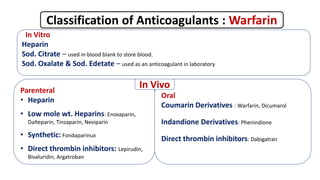
Classification of Anticoagulants : Warfarin
In Vitro
Heparin
Sod. Citrate – used in blood blank to store blood.
Sod. Oxalate & Sod. Edetate – used as an anticoagulant in laboratory
Parenteral
• Heparin
• Low mole wt. Heparins: Enoxaparin,
Dalteparin, Tinzaparin, Neviparin
• Synthetic: Fondaparinux
• Direct thrombin inhibitors: Lepirudin,
Bivaluridin, Argatroban
Oral
Coumarin Derivatives : Warfarin, Dicumarol
Indandione Derivatives: Phenindione
Direct thrombin inhibitors: Dabigatran
In Vivo
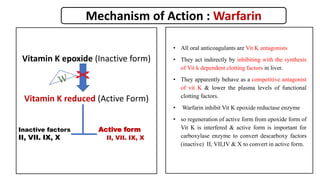
Vitamin K epoxide (Inactive form)
Vitamin K reduced (Active Form)
Inactive factors Active form
II, VII. IX, X II, VII. IX, X
Mechanism of Action : Warfarin
• All oral anticoagulants are Vit K antagonists
• They act indirectly by inhibiting with the synthesis
of Vit k dependent clotting factors in liver.
• They apparently behave as a competitive antagonist
of vit K & lower the plasma levels of functional
clotting factors.
• Warfarin inhibit Vit K epoxide reductase enzyme
• so regeneration of active form from epoxide form of
Vit K is interfered & active form is important for
carboxylase enzyme to convert descarboxy factors
(inactive) II, VII,IV & X to convert in active form.
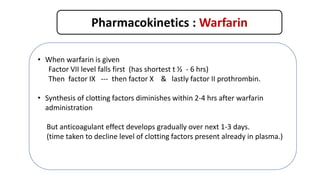
Pharmacokinetics : Warfarin
• When warfarin is given
Factor VII level falls first (has shortest t ½ - 6 hrs)
Then factor IX --- then factor X & lastly factor II prothrombin.
• Synthesis of clotting factors diminishes within 2-4 hrs after warfarin
administration
But anticoagulant effect develops gradually over next 1-3 days.
(time taken to decline level of clotting factors present already in plasma.)
Th. Effect occurs only when synthesis of clotting factors is reduced by 40-50 %
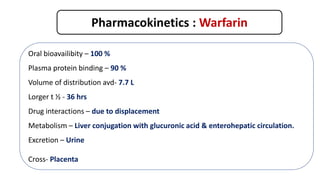
Pharmacokinetics : Warfarin
Oral bioavailibity – 100 %
Plasma protein binding – 90 %
Volume of distribution avd- 7.7 L
Lorger t ½ - 36 hrs
Drug interactions – due to displacement
Metabolism – Liver conjugation with glucuronic acid & enterohepatic circulation.
Excretion – Urine
Cross- Placenta
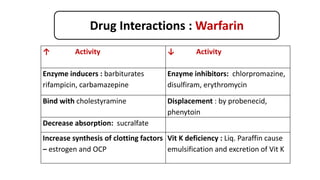
Drug Interactions : Warfarin
↑ Activity ↓ Activity
Enzyme inducers : barbiturates
rifampicin, carbamazepine
Enzyme inhibitors: chlorpromazine,
disulfiram, erythromycin
Bind with cholestyramine Displacement : by probenecid,
phenytoin
Decrease absorption: sucralfate
Increase synthesis of clotting factors
– estrogen and OCP
Vit K deficiency : Liq. Paraffin cause
emulsification and excretion of Vit K
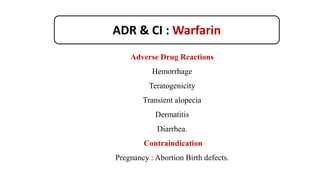
ADR & CI : Warfarin
Adverse Drug Reactions
Hemorrhage
Teratogenicity
Transient alopecia
Dermatitis
Diarrhea.
Contraindication
Pregnancy : Abortion Birth defects.
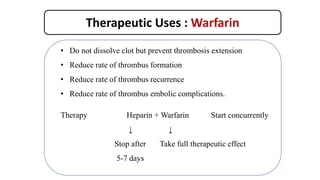
Therapeutic Uses : Warfarin
• Do not dissolve clot but prevent thrombosis extension
• Reduce rate of thrombus formation
• Reduce rate of thrombus recurrence
• Reduce rate of thrombus embolic complications.
Therapy Heparin + Warfarin Start concurrently
↓ ↓
Stop after Take full therapeutic effect
5-7 days
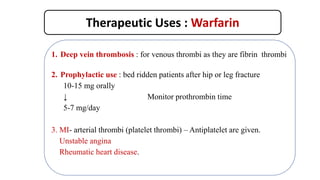
Therapeutic Uses : Warfarin
1. Deep vein thrombosis : for venous thrombi as they are fibrin thrombi
2. Prophylactic use : bed ridden patients after hip or leg fracture
10-15 mg orally
↓ Monitor prothrombin time
5-7 mg/day
3. MI- arterial thrombi (platelet thrombi) – Antiplatelet are given.
Unstable angina
Rheumatic heart disease.

Anticoagulants warfarin

  • 1.
    Anticoagulants Warfarin Dr. Archana Dhavalshankh Pro& Head, Dept of Pharmacology D Y Patil Medical College, Kolhapur
  • 2.
    Classification of Anticoagulants: Warfarin In Vitro Heparin Sod. Citrate – used in blood blank to store blood. Sod. Oxalate & Sod. Edetate – used as an anticoagulant in laboratory Parenteral • Heparin • Low mole wt. Heparins: Enoxaparin, Dalteparin, Tinzaparin, Neviparin • Synthetic: Fondaparinux • Direct thrombin inhibitors: Lepirudin, Bivaluridin, Argatroban Oral Coumarin Derivatives : Warfarin, Dicumarol Indandione Derivatives: Phenindione Direct thrombin inhibitors: Dabigatran In Vivo
  • 3.
    Vitamin K epoxide(Inactive form) Vitamin K reduced (Active Form) Inactive factors Active form II, VII. IX, X II, VII. IX, X Mechanism of Action : Warfarin • All oral anticoagulants are Vit K antagonists • They act indirectly by inhibiting with the synthesis of Vit k dependent clotting factors in liver. • They apparently behave as a competitive antagonist of vit K & lower the plasma levels of functional clotting factors. • Warfarin inhibit Vit K epoxide reductase enzyme • so regeneration of active form from epoxide form of Vit K is interfered & active form is important for carboxylase enzyme to convert descarboxy factors (inactive) II, VII,IV & X to convert in active form.
  • 4.
    Pharmacokinetics : Warfarin •When warfarin is given Factor VII level falls first (has shortest t ½ - 6 hrs) Then factor IX --- then factor X & lastly factor II prothrombin. • Synthesis of clotting factors diminishes within 2-4 hrs after warfarin administration But anticoagulant effect develops gradually over next 1-3 days. (time taken to decline level of clotting factors present already in plasma.) Th. Effect occurs only when synthesis of clotting factors is reduced by 40-50 %
  • 5.
    Pharmacokinetics : Warfarin Oralbioavailibity – 100 % Plasma protein binding – 90 % Volume of distribution avd- 7.7 L Lorger t ½ - 36 hrs Drug interactions – due to displacement Metabolism – Liver conjugation with glucuronic acid & enterohepatic circulation. Excretion – Urine Cross- Placenta
  • 6.
    Drug Interactions :Warfarin ↑ Activity ↓ Activity Enzyme inducers : barbiturates rifampicin, carbamazepine Enzyme inhibitors: chlorpromazine, disulfiram, erythromycin Bind with cholestyramine Displacement : by probenecid, phenytoin Decrease absorption: sucralfate Increase synthesis of clotting factors – estrogen and OCP Vit K deficiency : Liq. Paraffin cause emulsification and excretion of Vit K
  • 7.
    ADR & CI: Warfarin Adverse Drug Reactions Hemorrhage Teratogenicity Transient alopecia Dermatitis Diarrhea. Contraindication Pregnancy : Abortion Birth defects.
  • 8.
    Therapeutic Uses :Warfarin • Do not dissolve clot but prevent thrombosis extension • Reduce rate of thrombus formation • Reduce rate of thrombus recurrence • Reduce rate of thrombus embolic complications. Therapy Heparin + Warfarin Start concurrently ↓ ↓ Stop after Take full therapeutic effect 5-7 days
  • 9.
    Therapeutic Uses :Warfarin 1. Deep vein thrombosis : for venous thrombi as they are fibrin thrombi 2. Prophylactic use : bed ridden patients after hip or leg fracture 10-15 mg orally ↓ Monitor prothrombin time 5-7 mg/day 3. MI- arterial thrombi (platelet thrombi) – Antiplatelet are given. Unstable angina Rheumatic heart disease.