• Antibodies are substances which are
formed in the serum and tissue
fluids in response to an antigen.
• Antibodies react with antigen
specifically.
• Properties of Antibodies:-
1.Chemical nature of antibodies
is globulin so they are named
as Immunoglobulins.
2.Serum globulins are separated
into pseudoglobulins (water
soluble) and euglobulins (water
insoluble).
• Structure of Immunoglobulin:-
- An Antibody molecule consists of
two identical heavy and light chains.
- The heavy (H) chains are longer and
light (L) chains are shorter.
- Both types of chains are polypeptide
in nature. The two heavy chains are
held together by disulphide (S-S)
bonds.
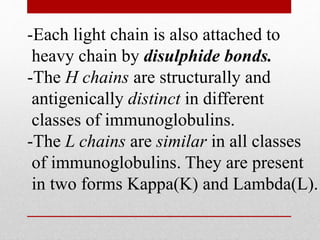
-Each light chain is also attached to
heavy chain by disulphide bonds.
-The H chains are structurally and
antigenically distinct in different
classes of immunoglobulins.
-The L chains are similar in all classes
of immunoglobulins. They are present
in two forms Kappa(K) and Lambda(L).
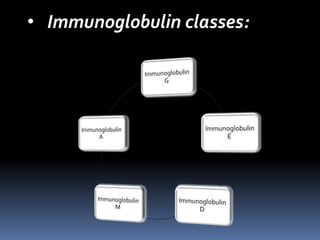
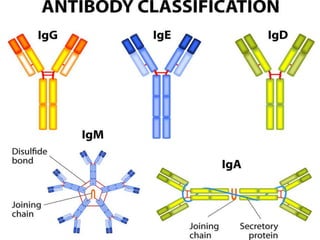
• Immunoglobulin classes:
Immunoglobulin G (Ig G):
 Ig G is the major serum immunoglobulin.
 The normal serum concentration is about
8-16mg/ml.
 Molecular weight is 150,000.
 Half life is about 23 days.
 It is the only immunoglobulin that is
transported through placenta and provides
natural passive immunity to the new born.
 It appears late but persists for a longer period.
 It is distributed equally between the
extravascular and intravascular compartments.
 It participates in precipitation, complement
fixation and neutralisation of toxin and viruses
 Ig G binds to microorganisms and enhances
the process of phagocytosis.
 There are four sub classes of Ig G:
- Ig G1 - Ig G3
- Ig G2 - Ig G4
Immunoglobulin A(Ig A):
 Ig A is the second major serum
immunoglobulin. The normal major serum
concentration is 0.6-4.2mg/ml.
 Half life is about 6-8 days.
 It occurs in two forms: serum IgA and
secretory IgA.
 Molecular weight of serum IgA is 160,000
and secretory IgA is 400,000.
 It is the principle immunoglobulin present
in secretions such as milk,tears,saliva,sweat.
It is also present in colostrum and in secretions
like respiratory, intestinal and genital systems.
 It protects the mucous membranes against
microorganisms.
 IgA does not fix complement but can activate
alternative complement pathway.
 IgA mainly synthesized locally by plasma cell
 There are two subclasses of Ig A:
-Ig A1
-Ig A2
Immunoglobulin M(Ig M):
 Ig M is a pentamer consisting of 5
immunoglobulin
 It constitutes about 5-8 percent of total serum
immunoglobulins.
 The normal level in serum is 0.5-2mg/ml.
 Half life is about 5 days.
 The molecular weight is 900,000 to 1,000,000
hence called ‘millionarie molecule’.
 IgM is mainly distributed intravascularly.
 It is the earliest synthesised immunoglobulin
by foetus in about 20 weeks of age.
 It appears early in respose to infection
before IgG.
 It is very effective antibody in agglutination,
complement fixation and opsonisation.
 IgM provides protection against blood
invasion by microorganisms
 There are two subclasses of IgM:
-IgM1
-IgM2
Immunoglobulin D (IgD):
 IgD is present in a concentration of 3mg per
100 ml in serum.
 Molecular weight is 1,80,000
 Half life is about three days.
 It is mostly intravascular in distribution.
 It is present on surface of unstimulated B
lymphocytes in blood and acts as
recognition receptors for antigens.
 There are two subclasses:
-IgD1 & IgD2.
Immunoglobulin E:
 It resembles IgG in structure.
 Molecular weight is about 190,000.
 Half life is 2-3 days.
 IgE is mainly produced in the linings of
respiratory and intestinal tracts.
 Serum contains only in traces.
 It is mostly distributed extravascularly.
 IgE mediates type 1 hypersensitivity
reaction. This is responsible for asthma,
hay fever.
 It has affinity for surface of tissue cells,
particularly mast cells of the same species.
 High level of IgE in serum is also seen in
children with a high load of intestinal
parasitism.
 It cannot cross the placental barrier or fix the
complement.
 IgE is responsible for anaphylactic type of
reaction.
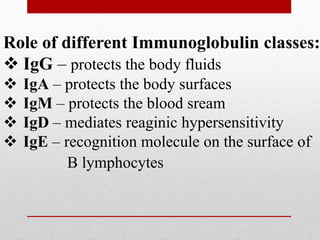
Role of different Immunoglobulin classes:
 IgG – protects the body fluids
 IgA – protects the body surfaces
 IgM – protects the blood sream
 IgD – mediates reaginic hypersensitivity
 IgE – recognition molecule on the surface of
B lymphocytes
ANTIBODIES-IMMUNOGLOBULINS

ANTIBODIES-IMMUNOGLOBULINS

  • 2.
    • Antibodies aresubstances which are formed in the serum and tissue fluids in response to an antigen. • Antibodies react with antigen specifically.
  • 3.
    • Properties ofAntibodies:- 1.Chemical nature of antibodies is globulin so they are named as Immunoglobulins. 2.Serum globulins are separated into pseudoglobulins (water soluble) and euglobulins (water insoluble).
  • 4.
    • Structure ofImmunoglobulin:- - An Antibody molecule consists of two identical heavy and light chains. - The heavy (H) chains are longer and light (L) chains are shorter. - Both types of chains are polypeptide in nature. The two heavy chains are held together by disulphide (S-S) bonds.
  • 5.
    -Each light chainis also attached to heavy chain by disulphide bonds. -The H chains are structurally and antigenically distinct in different classes of immunoglobulins. -The L chains are similar in all classes of immunoglobulins. They are present in two forms Kappa(K) and Lambda(L).
  • 6.
  • 8.
    Immunoglobulin G (IgG):  Ig G is the major serum immunoglobulin.  The normal serum concentration is about 8-16mg/ml.  Molecular weight is 150,000.  Half life is about 23 days.  It is the only immunoglobulin that is transported through placenta and provides natural passive immunity to the new born.  It appears late but persists for a longer period.
  • 9.
     It isdistributed equally between the extravascular and intravascular compartments.  It participates in precipitation, complement fixation and neutralisation of toxin and viruses  Ig G binds to microorganisms and enhances the process of phagocytosis.  There are four sub classes of Ig G: - Ig G1 - Ig G3 - Ig G2 - Ig G4
  • 10.
    Immunoglobulin A(Ig A): Ig A is the second major serum immunoglobulin. The normal major serum concentration is 0.6-4.2mg/ml.  Half life is about 6-8 days.  It occurs in two forms: serum IgA and secretory IgA.  Molecular weight of serum IgA is 160,000 and secretory IgA is 400,000.  It is the principle immunoglobulin present in secretions such as milk,tears,saliva,sweat.
  • 11.
    It is alsopresent in colostrum and in secretions like respiratory, intestinal and genital systems.  It protects the mucous membranes against microorganisms.  IgA does not fix complement but can activate alternative complement pathway.  IgA mainly synthesized locally by plasma cell  There are two subclasses of Ig A: -Ig A1 -Ig A2
  • 12.
    Immunoglobulin M(Ig M): Ig M is a pentamer consisting of 5 immunoglobulin  It constitutes about 5-8 percent of total serum immunoglobulins.  The normal level in serum is 0.5-2mg/ml.  Half life is about 5 days.  The molecular weight is 900,000 to 1,000,000 hence called ‘millionarie molecule’.  IgM is mainly distributed intravascularly.  It is the earliest synthesised immunoglobulin
  • 13.
    by foetus inabout 20 weeks of age.  It appears early in respose to infection before IgG.  It is very effective antibody in agglutination, complement fixation and opsonisation.  IgM provides protection against blood invasion by microorganisms  There are two subclasses of IgM: -IgM1 -IgM2
  • 14.
    Immunoglobulin D (IgD): IgD is present in a concentration of 3mg per 100 ml in serum.  Molecular weight is 1,80,000  Half life is about three days.  It is mostly intravascular in distribution.  It is present on surface of unstimulated B lymphocytes in blood and acts as recognition receptors for antigens.  There are two subclasses: -IgD1 & IgD2.
  • 15.
    Immunoglobulin E:  Itresembles IgG in structure.  Molecular weight is about 190,000.  Half life is 2-3 days.  IgE is mainly produced in the linings of respiratory and intestinal tracts.  Serum contains only in traces.  It is mostly distributed extravascularly.  IgE mediates type 1 hypersensitivity reaction. This is responsible for asthma, hay fever.
  • 16.
     It hasaffinity for surface of tissue cells, particularly mast cells of the same species.  High level of IgE in serum is also seen in children with a high load of intestinal parasitism.  It cannot cross the placental barrier or fix the complement.  IgE is responsible for anaphylactic type of reaction.
  • 17.
    Role of differentImmunoglobulin classes:  IgG – protects the body fluids  IgA – protects the body surfaces  IgM – protects the blood sream  IgD – mediates reaginic hypersensitivity  IgE – recognition molecule on the surface of B lymphocytes