
 Introduction
 Definitions
 Ideal properties
 Classification
Based on Ingredients & Application(craig)
Based on Bonding mechanism(william
O’Brien)
Based on setting reaction (Anusavice)
 Silicate cement
 Zinc phosphate cement
 IN last 20 years there has been explosion of different
types of dental cements that have become available to
practicing dentist, many of them tailored for specialized
types of restoration. In fact, there are so many products to
choose from the task, can become confusing.
 Dental cements, in the recent years has become
restricted to those materials which are employed to bond
inlays, crowns, bridges, posts and facings in or on the tooth
and to retain orthodontic bonds and retainers, however
secondary applications of these cements include cavity
linings, bases and temporary filings, endodontic sealer
 These different applications make varying demands on
manipulative properties, working and setting times, and
resistance to mechanical breakdown and dissolution. Thus
some materials are better suited to some application than
others
 Many of these materials are supplied in powder /liquid form
and set by an acid-base reaction, but this is not universally
true
 As yet, there is no ideal dental cement. Each material must
be used on its merits with knowledge of its limitation
 Cement :- A non metallic material, used for luting, filling
permanent or temporary restorative purposes, made by
mixing components into a plastic mass that sets or as an
adherent sealer in attaching various dental restorations in
or on the tooth. .
{CRAIG}
 A cement is commonly considered as a substance that
holds 2 surfaces together, it also serves as an agents as
esthetics restorative material, thermal insulator,
temporary restorative material and medicament for
pulpal protection under larger restorations .
{Karl. F .and Jack Moons}
 A substance that hardens to act as a Base, Liner,
Filling material or adhesive to bind devices and
prosthesis to tooth structure to each other.
{Anusavice}
 Should be strong and hard.
 Able to protect pulp
 Should be insoluble in saliva & liquids taken in mouth
 Should be dimensionally stable.
 Should be adhesive.
 Should be non porous.
 Should be biocompatible and non irritant.
 Co-efficient of thermal expansion should be equal to the tooth
structure.
 Should not be affected by thermal changes and moisture .
 Should be easy to manipulate.
 Based on ingredients & Application (Criag 12th edition)
 Water based cements
Glass & Resin modified glass ionomer
Zinc Polyacrylate
Zinc phosphate
 Resin based cements
Composite & adhesive resin
Compomers
 Oil based cements
Zinc Oxide Eugenol
Non Eugenol-Zinc Oxide
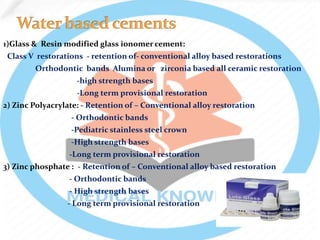
1)Glass & Resin modified glass ionomer cement:
Class V restorations - retention of- conventional alloy based restorations
Orthodontic bands Alumina or zirconia based all ceramic restoration
-high strength bases
-Long term provisional restoration
2) Zinc Polyacrylate: - Retention of – Conventional alloy restoration
- Orthodontic bands
-Pediatric stainless steel crown
-High strength bases
-Long term provisional restoration
3) Zinc phosphate : - Retention of – Conventional alloy based restoration
- Orthodontic bands
- High strength bases
- Long term provisional restoration
1) Composite & adhesive resin :
- Bonding – Conventional alloy based Restoration
- Ceramic crowns, bridges, veneers, inlays, onlays.
- Post and cores
- Restoration of - Provisional restorations
- Orthodontic bands
2) Compomers :
- Bonded conventional alloy based restoration
- Retention of - Alumina or zircon based all ceramic restoration
-Orthodontic bands
- High strength bases
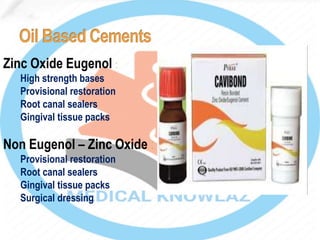
Zinc Oxide Eugenol :
High strength bases
Provisional restoration
Root canal sealers
Gingival tissue packs
Non Eugenol – Zinc Oxide :
Provisional restoration
Root canal sealers
Gingival tissue packs
Surgical dressing
 Phosphate based :
Zinc phosphate cement
Modified zinc phosphate cement
Fluoridated cement
Copper cement
Silicophosphate
 Phenolate based :
Zinc oxide eugenol cement
Reinforcedzinc oxide eugenol
EBA and other chelate cements
Calcium hydroxide chelate cement
 Polycarboxylate based :
Zinc polycarboxylate cement
Glass ionomer cement
 Methacrylate based :
Acrylic cements
BIS-GMA type cements
 Acid Base Reaction Cements
 Polymerizing cements
 Dual cure cements
 Tricure cements
 Introduced in 1903 as anterior filling materials.
 Silicates are attacked by oral fluids and in time
degrade.
 They may not be considered permanent
restoration.
 The uses of silicate cements diminished with the
advent of composite resins and development of
GIC
Powder
 Silica
 Alumina
 Fluoride compounds
 Calcium salts
 Fluoride Flux –
To permit proper sintering of
the other ingredients.
 Phosphoric acid
 Water
 Buffer salts
Liquid
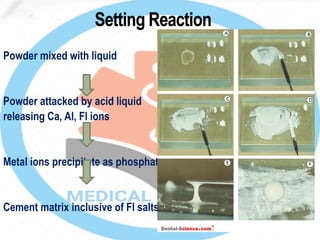
Powder mixed with liquid
Powder attacked by acid liquid
releasing Ca, Al, Fl ions
Metal ions precipitate as phosphate
Cement matrix inclusive of Fl salts
 It exhibit good esthetic qualities.
 Anticariogenic property
 Analogues to topical applied fluoride solution.
Disadvantages
 It lacks stability in oral fluids with loss of esthetic qualities
 Rubber dam is essential for successful silicate restoration.
 Irritant to pulp
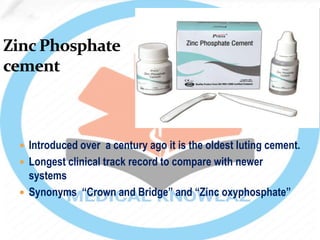
 Introduced over a century ago it is the oldest luting cement.
 Longest clinical track record to compare with newer
systems
 Synonyms “Crown and Bridge” and “Zinc oxyphosphate”
Powder
 Zinc Oxide – principle ingredient
 Magnesium Oxide – reduces the temperature of calcification
. .. process 2.10% aids in sintering
 Oxides of Bismuth,
 Calcium or Barium – Impact a smoothness to freshly mixed
Cement mass
 Silicon Dioxide -In active filler
Phosphoric acid – 45-64% Reacts with ZnO
Water - 30-55% Increases Rate of reaction
Aluminium - 2.3% Essential to the cement forming
reaction
Zinc - 0.9% Moderates reaction between powder and
Liquid . allows
adequate working time .
Type 1 - Fine grained for luting
–Film thickness should be less than 25um
Type 2 - Medium grained for luting and filling
- Film thickness should be more than 40um
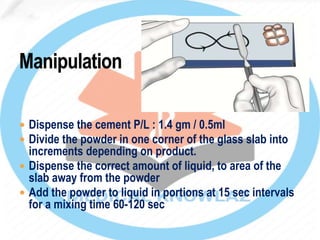
 Dispense the cement P/L : 1.4 gm / 0.5ml
 Divide the powder in one corner of the glass slab into
increments depending on product.
 Dispense the correct amount of liquid, to area of the
slab away from the powder
 Add the powder to liquid in portions at 15 sec intervals
for a mixing time 60-120 sec
 Mix it over a large area of the slab with a flexible metal
spatula
 Test the consistency of the cement before adding the
last portion of powder.
 Only part of that portion of powder may be necessary to
reach the desired consistency.
 The cementing strings about one inch above the slab
Note : Powder liquid reactions, an accelerated
by the presence of heat (exothermic)
 Liquid consists of partially centralized dilute
phosphoric acid.
 When this liquid is exposed to a humid
atmosphere, it will absorb water. Whereas
exposure to dry air tends to result in a loss of
water which will after the property of cement.
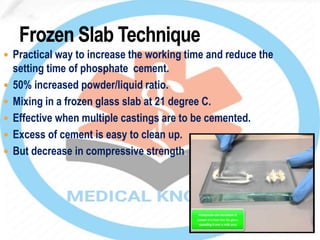
 Practical way to increase the working time and reduce the
setting time of phosphate cement.
 50% increased powder/liquid ratio.
 Mixing in a frozen glass slab at 21 degree C.
 Effective when multiple castings are to be cemented.
 Excess of cement is easy to clean up.
 But decrease in compressive strength.
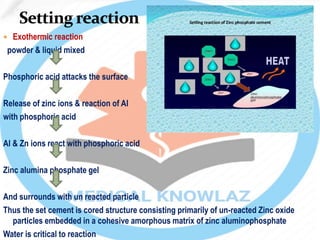
 Exothermic reaction
powder & liquid mixed
Phosphoric acid attacks the surface
Release of zinc ions & reaction of Al
with phosphoric acid
Al & Zn ions react with phosphoric acid
Zinc alumina phosphate gel
And surrounds with un reacted particle
Thus the set cement is cored structure consisting primarily of un-reacted Zinc oxide
particles embedded in a cohesive amorphous matrix of zinc aluminophosphate
Water is critical to reaction
 Compressive strength – 104 Mpa
 Tensile strength – 55 Mpa
 Modulus of elasticity – 13.7Gpa (stiff & resistance to
deformity)
 Retention is mechanical
 At insertion PH at 2 min -2
 at 24 hrs – 5.5
 Damage to pulp occurs during first few hrs of insertion
 Most popular for cast restorations
 Adequate strength
 Reasonable working time
 Excess material can be easily removed
 Acceptable effect over the dental pulp
 Manipulation less critical than other cements.
Disadvantages
 Pulp irritation
 Lack of antibacterial action
 Brittleness
 Lack of adhesion
 Solubility in acid fluids
 Luting of restorations (inlays, crowns, fixed
dental)
 High strength bases
 Temporary restorations
 Luting of orthodontic bands and brackets
 Though cements are used in small quantities in oral cavity,
it should be used with at most care, as it is very important.
There are innumerable cements present with different
properties, one should know all the properties to use it in
order to give a successful restoration to the patient
Dental cements part 1

Dental cements part 1

  • 2.
     Introduction  Definitions Ideal properties  Classification Based on Ingredients & Application(craig) Based on Bonding mechanism(william O’Brien) Based on setting reaction (Anusavice)  Silicate cement  Zinc phosphate cement
  • 3.
     IN last20 years there has been explosion of different types of dental cements that have become available to practicing dentist, many of them tailored for specialized types of restoration. In fact, there are so many products to choose from the task, can become confusing.  Dental cements, in the recent years has become restricted to those materials which are employed to bond inlays, crowns, bridges, posts and facings in or on the tooth and to retain orthodontic bonds and retainers, however secondary applications of these cements include cavity linings, bases and temporary filings, endodontic sealer
  • 4.
     These differentapplications make varying demands on manipulative properties, working and setting times, and resistance to mechanical breakdown and dissolution. Thus some materials are better suited to some application than others  Many of these materials are supplied in powder /liquid form and set by an acid-base reaction, but this is not universally true  As yet, there is no ideal dental cement. Each material must be used on its merits with knowledge of its limitation
  • 5.
     Cement :-A non metallic material, used for luting, filling permanent or temporary restorative purposes, made by mixing components into a plastic mass that sets or as an adherent sealer in attaching various dental restorations in or on the tooth. . {CRAIG}  A cement is commonly considered as a substance that holds 2 surfaces together, it also serves as an agents as esthetics restorative material, thermal insulator, temporary restorative material and medicament for pulpal protection under larger restorations . {Karl. F .and Jack Moons}
  • 6.
     A substancethat hardens to act as a Base, Liner, Filling material or adhesive to bind devices and prosthesis to tooth structure to each other. {Anusavice}
  • 7.
     Should bestrong and hard.  Able to protect pulp  Should be insoluble in saliva & liquids taken in mouth  Should be dimensionally stable.  Should be adhesive.  Should be non porous.  Should be biocompatible and non irritant.  Co-efficient of thermal expansion should be equal to the tooth structure.  Should not be affected by thermal changes and moisture .  Should be easy to manipulate.
  • 8.
     Based oningredients & Application (Criag 12th edition)  Water based cements Glass & Resin modified glass ionomer Zinc Polyacrylate Zinc phosphate  Resin based cements Composite & adhesive resin Compomers  Oil based cements Zinc Oxide Eugenol Non Eugenol-Zinc Oxide
  • 9.
    1)Glass & Resinmodified glass ionomer cement: Class V restorations - retention of- conventional alloy based restorations Orthodontic bands Alumina or zirconia based all ceramic restoration -high strength bases -Long term provisional restoration 2) Zinc Polyacrylate: - Retention of – Conventional alloy restoration - Orthodontic bands -Pediatric stainless steel crown -High strength bases -Long term provisional restoration 3) Zinc phosphate : - Retention of – Conventional alloy based restoration - Orthodontic bands - High strength bases - Long term provisional restoration
  • 10.
    1) Composite &adhesive resin : - Bonding – Conventional alloy based Restoration - Ceramic crowns, bridges, veneers, inlays, onlays. - Post and cores - Restoration of - Provisional restorations - Orthodontic bands 2) Compomers : - Bonded conventional alloy based restoration - Retention of - Alumina or zircon based all ceramic restoration -Orthodontic bands - High strength bases
  • 11.
    Zinc Oxide Eugenol: High strength bases Provisional restoration Root canal sealers Gingival tissue packs Non Eugenol – Zinc Oxide : Provisional restoration Root canal sealers Gingival tissue packs Surgical dressing
  • 12.
     Phosphate based: Zinc phosphate cement Modified zinc phosphate cement Fluoridated cement Copper cement Silicophosphate  Phenolate based : Zinc oxide eugenol cement Reinforcedzinc oxide eugenol EBA and other chelate cements Calcium hydroxide chelate cement
  • 13.
     Polycarboxylate based: Zinc polycarboxylate cement Glass ionomer cement  Methacrylate based : Acrylic cements BIS-GMA type cements
  • 14.
     Acid BaseReaction Cements  Polymerizing cements  Dual cure cements  Tricure cements
  • 15.
     Introduced in1903 as anterior filling materials.  Silicates are attacked by oral fluids and in time degrade.  They may not be considered permanent restoration.  The uses of silicate cements diminished with the advent of composite resins and development of GIC
  • 16.
    Powder  Silica  Alumina Fluoride compounds  Calcium salts  Fluoride Flux – To permit proper sintering of the other ingredients.  Phosphoric acid  Water  Buffer salts Liquid
  • 17.
    Powder mixed withliquid Powder attacked by acid liquid releasing Ca, Al, Fl ions Metal ions precipitate as phosphate Cement matrix inclusive of Fl salts
  • 18.
     It exhibitgood esthetic qualities.  Anticariogenic property  Analogues to topical applied fluoride solution. Disadvantages  It lacks stability in oral fluids with loss of esthetic qualities  Rubber dam is essential for successful silicate restoration.  Irritant to pulp
  • 19.
     Introduced overa century ago it is the oldest luting cement.  Longest clinical track record to compare with newer systems  Synonyms “Crown and Bridge” and “Zinc oxyphosphate”
  • 20.
    Powder  Zinc Oxide– principle ingredient  Magnesium Oxide – reduces the temperature of calcification . .. process 2.10% aids in sintering  Oxides of Bismuth,  Calcium or Barium – Impact a smoothness to freshly mixed Cement mass  Silicon Dioxide -In active filler
  • 21.
    Phosphoric acid –45-64% Reacts with ZnO Water - 30-55% Increases Rate of reaction Aluminium - 2.3% Essential to the cement forming reaction Zinc - 0.9% Moderates reaction between powder and Liquid . allows adequate working time .
  • 22.
    Type 1 -Fine grained for luting –Film thickness should be less than 25um Type 2 - Medium grained for luting and filling - Film thickness should be more than 40um
  • 23.
     Dispense thecement P/L : 1.4 gm / 0.5ml  Divide the powder in one corner of the glass slab into increments depending on product.  Dispense the correct amount of liquid, to area of the slab away from the powder  Add the powder to liquid in portions at 15 sec intervals for a mixing time 60-120 sec
  • 24.
     Mix itover a large area of the slab with a flexible metal spatula  Test the consistency of the cement before adding the last portion of powder.  Only part of that portion of powder may be necessary to reach the desired consistency.  The cementing strings about one inch above the slab
  • 25.
    Note : Powderliquid reactions, an accelerated by the presence of heat (exothermic)  Liquid consists of partially centralized dilute phosphoric acid.  When this liquid is exposed to a humid atmosphere, it will absorb water. Whereas exposure to dry air tends to result in a loss of water which will after the property of cement.
  • 26.
     Practical wayto increase the working time and reduce the setting time of phosphate cement.  50% increased powder/liquid ratio.  Mixing in a frozen glass slab at 21 degree C.  Effective when multiple castings are to be cemented.  Excess of cement is easy to clean up.  But decrease in compressive strength.
  • 27.
     Exothermic reaction powder& liquid mixed Phosphoric acid attacks the surface Release of zinc ions & reaction of Al with phosphoric acid Al & Zn ions react with phosphoric acid Zinc alumina phosphate gel And surrounds with un reacted particle Thus the set cement is cored structure consisting primarily of un-reacted Zinc oxide particles embedded in a cohesive amorphous matrix of zinc aluminophosphate Water is critical to reaction
  • 28.
     Compressive strength– 104 Mpa  Tensile strength – 55 Mpa  Modulus of elasticity – 13.7Gpa (stiff & resistance to deformity)  Retention is mechanical  At insertion PH at 2 min -2  at 24 hrs – 5.5  Damage to pulp occurs during first few hrs of insertion
  • 29.
     Most popularfor cast restorations  Adequate strength  Reasonable working time  Excess material can be easily removed  Acceptable effect over the dental pulp  Manipulation less critical than other cements. Disadvantages  Pulp irritation  Lack of antibacterial action  Brittleness  Lack of adhesion  Solubility in acid fluids
  • 30.
     Luting ofrestorations (inlays, crowns, fixed dental)  High strength bases  Temporary restorations  Luting of orthodontic bands and brackets
  • 31.
     Though cementsare used in small quantities in oral cavity, it should be used with at most care, as it is very important. There are innumerable cements present with different properties, one should know all the properties to use it in order to give a successful restoration to the patient

Editor's Notes