1
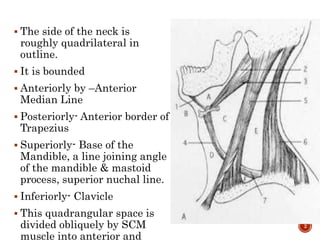
 The side of the neck is
roughly quadrilateral in
outline.
 It is bounded
 Anteriorly by –Anterior
Median Line
 Posteriorly- Anterior border of
Trapezius
 Superiorly- Base of the
Mandible, a line joining angle
of the mandible & mastoid
process, superior nuchal line.
 Inferiorly- Clavicle
 This quadrangular space is
divided obliquely by SCM
muscle into anterior and
2
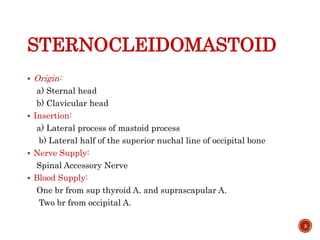
STERNOCLEIDOMASTOID
 Origin:
a) Sternal head
b) Clavicular head
 Insertion:
a) Lateral process of mastoid process
b) Lateral half of the superior nuchal line of occipital bone
 Nerve Supply:
Spinal Accessory Nerve
 Blood Supply:
One br from sup thyroid A. and suprascapular A.
Two br from occipital A.
3
STERNOCLEIDOMASTOID
 One of the most important
landmark in neck.
 Actions-
 When one muscles
contracts-
 When both muscles
contracts
 To make scm taut on one
side, the pt is asked to turn
the head to opp. side
against resistance.
4
PLATYSMA
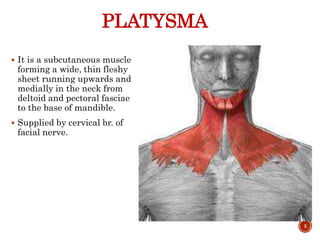
 It is a subcutaneous muscle
forming a wide, thin fleshy
sheet running upwards and
medially in the neck from
deltoid and pectoral fasciae
to the base of mandible.
 Supplied by cervical br. of
facial nerve.
5
ANTERIOR TRIANGLE OF
NECK
 Boundaries:
Medially: Ant median plane of neck
Laterally: SCM
Superiorly: Base of the mandible and a line joining the angle
of the mandible n mastoid process
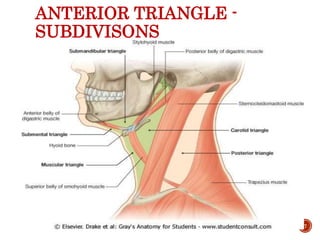
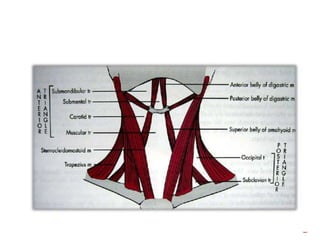
 Subdivisions:
The ant triangle is subdivided by the digastric belly and sup
belly of omohyoid into:
a) Submental
b) Digastric
c) Carotid and
d) Muscular Triangles
6
ANTERIOR TRIANGLE -
SUBDIVISONS
7
8
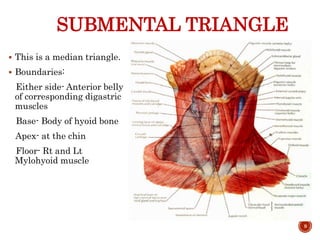
SUBMENTAL TRIANGLE
 This is a median triangle.
 Boundaries:
Either side- Anterior belly
of corresponding digastric
muscles
Base- Body of hyoid bone
Apex- at the chin
Floor- Rt and Lt
Mylohyoid muscle
9
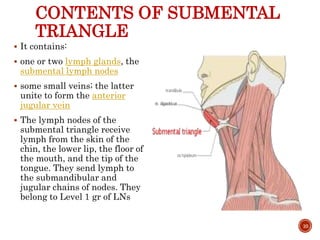
CONTENTS OF SUBMENTAL
TRIANGLE
 It contains:
 one or two lymph glands, the
submental lymph nodes
 some small veins; the latter
unite to form the anterior
jugular vein
 The lymph nodes of the
submental triangle receive
lymph from the skin of the
chin, the lower lip, the floor of
the mouth, and the tip of the
tongue. They send lymph to
the submandibular and
jugular chains of nodes. They
belong to Level 1 gr of LNs
10
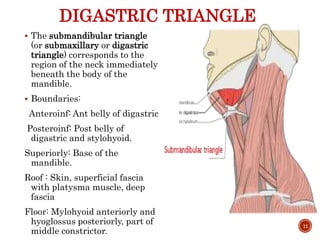
DIGASTRIC TRIANGLE
 The submandibular triangle
(or submaxillary or digastric
triangle) corresponds to the
region of the neck immediately
beneath the body of the
mandible.
 Boundaries:
Anteroinf: Ant belly of digastric
Posteroinf: Post belly of
digastric and stylohyoid.
Superiorly: Base of the
mandible.
Roof : Skin, superficial fascia
with platysma muscle, deep
fascia
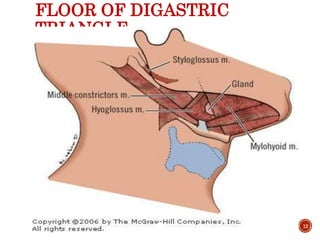
Floor: Mylohyoid anteriorly and
hyoglossus posteriorly, part of
middle constrictor.
11
FLOOR OF DIGASTRIC
TRIANGLE
12
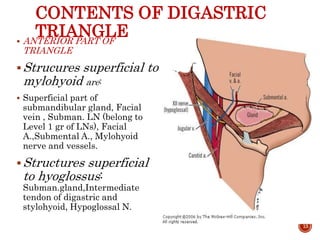
CONTENTS OF DIGASTRIC
TRIANGLE ANTERIOR PART OF
TRIANGLE
Strucures superficial to
mylohyoid are:
 Superficial part of
submandibular gland, Facial
vein , Subman. LN (belong to
Level 1 gr of LNs), Facial
A.,Submental A., Mylohyoid
nerve and vessels.
Structures superficial
to hyoglossus:
Subman.gland,Intermediate
tendon of digastric and
stylohyoid, Hypoglossal N.
13
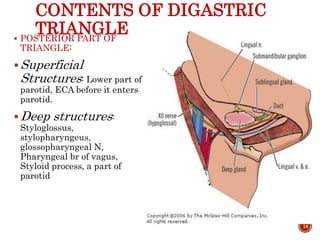
CONTENTS OF DIGASTRIC
TRIANGLE POSTERIOR PART OF
TRIANGLE:
Superficial
Structures: Lower part of
parotid, ECA before it enters
parotid.
Deep structures:
Styloglossus,
stylopharyngeus,
glossopharyngeal N,
Pharyngeal br of vagus,
Styloid process, a part of
parotid
14
CONTENTS OF POSTERIOR PART
OF DIGASTRIC TRIANGLE
Deepest structures:
a) Internal carotid A.
b) Internal jugular vein
c) Vagus N.
• Submandibular LNs: Belong to Level 1 gr of LNs
• Clinically important because of their wide area of drainage. They are
very commonly enlarged.
• They drain: a) center of forehead
b) Nose with Max. Frontal & Ethmoid sinuses
c) Inner canthus of the eye
d) Upper lip and the ant part of cheek with adjoinin gums
e)Outer part of lower lip with gums and teeth excluding incisors
f)Ant 2/3rd of tongue and floor of mouth
15
CAROTID TRIANGLE
 Boundaries:
 Anterosup: Post belly of
digastric
 Anteroinf: Sup belly of
omohyoid
 Posteriorly: Ant border of SCM
 Roof: skin, superficial fascia,
investing layer of deep fascia
 Floor: Thyrohyoid M,
hyoglossus, Middle and Inf.
constrictors of pharynx
16
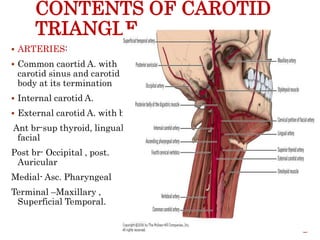
CONTENTS OF CAROTID
TRIANGLE
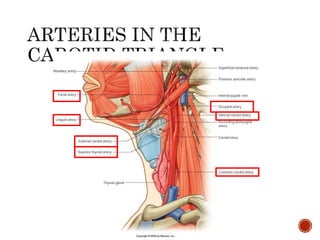
 ARTERIES:
 Common caortid A. with
carotid sinus and carotid
body at its termination
 Internal carotid A.
 External carotid A. with br.-
Ant br-sup thyroid, lingual
facial
Post br- Occipital , post.
Auricular
Medial- Asc. Pharyngeal
Terminal –Maxillary ,
Superficial Temporal.
17
CONTENTS OF CAROTID
TRIANGLE
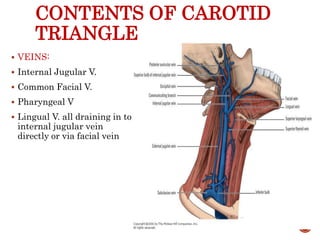
 VEINS:
 Internal Jugular V.
 Common Facial V.
 Pharyngeal V
 Lingual V. all draining in to
internal jugular vein
directly or via facial vein
19
CONTENTS OF CAROTID
TRIANGLE
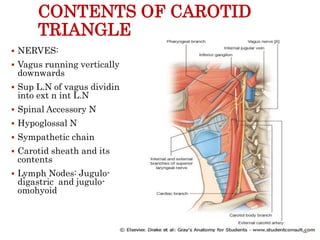
 NERVES:
 Vagus running vertically
downwards
 Sup L.N of vagus dividing
into ext n int L.N
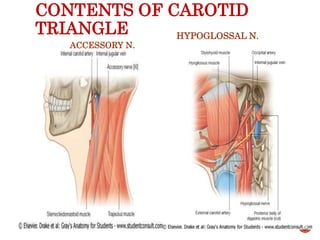
 Spinal Accessory N
 Hypoglossal N
 Sympathetic chain
 Carotid sheath and its
contents
 Lymph Nodes: Jugulo-
digastric and jugulo-
omohyoid
20
CONTENTS OF CAROTID
TRIANGLE
ACCESSORY N.
HYPOGLOSSAL N.
21
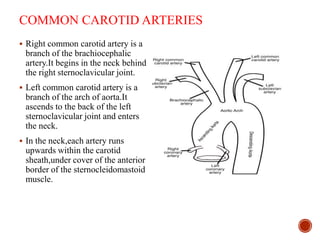
COMMON CAROTID ARTERIES
 Right common carotid artery is a
branch of the brachiocephalic
artery.It begins in the neck behind
the right sternoclavicular joint.
 Left common carotid artery is a
branch of the arch of aorta.It
ascends to the back of the left
sternoclavicular joint and enters
the neck.
 In the neck,each artery runs
upwards within the carotid
sheath,under cover of the anterior
border of the sternocleidomastoid
muscle.
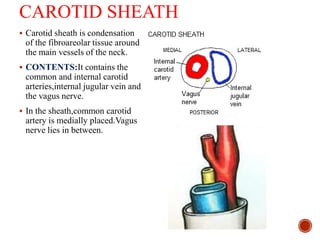
CAROTID SHEATH
 Carotid sheath is condensation
of the fibroareolar tissue around
the main vessels of the neck.
 CONTENTS:It contains the
common and internal carotid
arteries,internal jugular vein and
the vagus nerve.
 In the sheath,common carotid
artery is medially placed.Vagus
nerve lies in between.
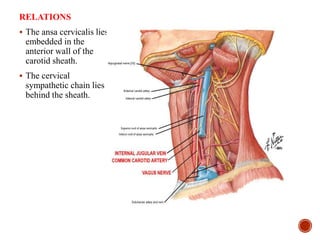
RELATIONS
 The ansa cervicalis lies
embedded in the
anterior wall of the
carotid sheath.
 The cervical
sympathetic chain lies
behind the sheath.
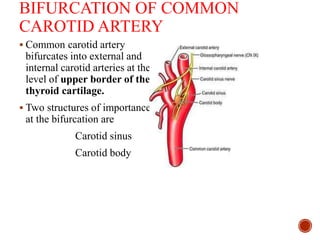
BIFURCATION OF COMMON
CAROTID ARTERY
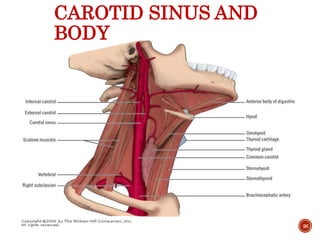
 Common carotid artery
bifurcates into external and
internal carotid arteries at the
level of upper border of the
thyroid cartilage.
 Two structures of importance
at the bifurcation are
Carotid sinus
Carotid body
CAROTID SINUS AND
BODY
26
CAROTID SINUS
 Carotid sinus is slight dilatation at the termination of the common
carotid artery or the beginning of the internal carotid artery.
 It receives a rich innervation from the glossopharyngeal and
sympathetic nerves.
FUNCTION:
Carotid sinus acts as a baroreceptor or pressure receptor and
regulates pressure.
APPLIED ANATOMY
CAROTID SINUS SYNDROME
 Loss of consciousness due to simple head movements.
 Hypersensitivity of the carotid sinus due to an unknown etiology.
 Sudden slight pressure changes, such as that occasioned by
movement of the head, may result in stimulation of the carotid
sinus.
 Impulses transmitted by the sinus reduce blood pressure and slow
the pumping action of the heart.
Thus decreasing blood supply to the brain and resulting in sudden
loss of consciousness.
While supporting the mandible care should be taken not to apply
pressure on the carotid sinus.
CAROTID BODY
 Carotid body is a small,oval reddish-brown structure situated
behind the bifurcation.
 It receives nerve supply mainly from the glossopharyngeal nerve,
but also from the vagus and sympathetic nerves.
FUNCTION:
Carotid body acts as a chemoreceptor and responds to changes in
the oxygen and carbon dioxide and Ph content of the blood.
EXTERNAL CAROTID
ARTERY
 Generally,it lies anterior to the internal carotid artery.
 It is the chief artery of supply to structures in the front of the neck
and in the face.
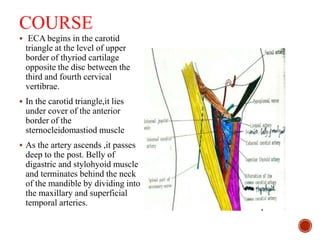
COURSE
 ECA begins in the carotid
triangle at the level of upper
border of thyriod cartilage
opposite the disc between the
third and fourth cervical
vertibrae.
 In the carotid triangle,it lies
under cover of the anterior
border of the
sternocleidomastiod muscle
 As the artery ascends ,it passes
deep to the post. Belly of
digastric and stylohyoid muscle
and terminates behind the neck
of the mandible by dividing into
the maxillary and superficial
temporal arteries.
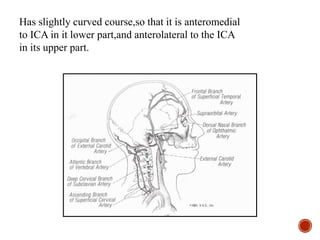
Has slightly curved course,so that it is anteromedial
to ICA in it lower part,and anterolateral to the ICA
in its upper part.
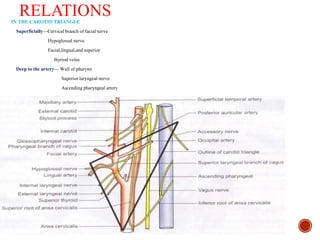
RELATIONSIN THE CAROTID TRIANGLE
Superficially—Cervical branch of facial nerve
Hypoglossal nerve
Facial,lingual,and superior
thyriod veins
Deep to the artery— Wall of pharynx
Superior laryngeal nerve
Ascending pharyngeal artery
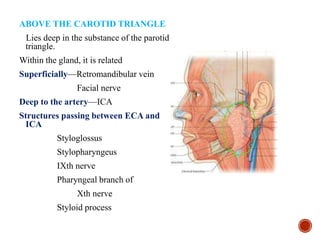
ABOVE THE CAROTID TRIANGLE
Lies deep in the substance of the parotid
triangle.
Within the gland, it is related
Superficially—Retromandibular vein
Facial nerve
Deep to the artery—ICA
Structures passing between ECA and
ICA
Styloglossus
Stylopharyngeus
IXth nerve
Pharyngeal branch of
Xth nerve
Styloid process
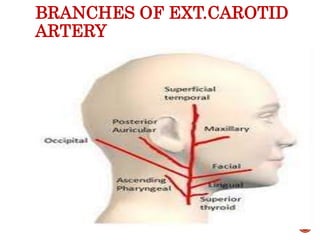
BRANCHES OF EXT.CAROTID
ARTERY
35
ANTERIOR BRANCHES
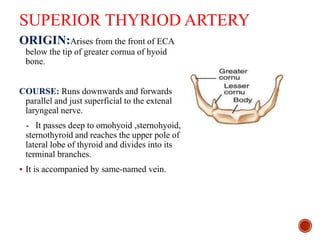
SUPERIOR THYRIOD ARTERY
ORIGIN:Arises from the front of ECA
below the tip of greater cornua of hyoid
bone.
COURSE: Runs downwards and forwards
parallel and just superficial to the extenal
laryngeal nerve.
- It passes deep to omohyoid ,sternohyoid,
sternothyroid and reaches the upper pole of
lateral lobe of thyroid and divides into its
terminal branches.
 It is accompanied by same-named vein.
BRANCHES:
INFRAHYOID ARTERY
STERNOCLEIDOMASTOID ARTERY
SUPERIOR LARYNGEALARTERY
CRICOTHYROID ARTERY
GLANDULAR BRANCHES
APPLIED ANATOMY
 The arch of superior thyroid artery is characteristic – diagnostic landmark
 The artery and external laryngeal nerve are close to each other higher up,
but diverge slightly near the gland.
- So, ligature of superior thyroid artery in thyroid surgery should be made
close to the gland in order to avoid injury of the external laryngeal nerve.
-Damage to the external laryngeal nerve causes some weakness of
phonation due to loss of tightening effect of the cricothyriod on the vocal
cord.
 Intra-arterial infusion chemotherapy for laryngeal and hypopharyngeal
cancers.
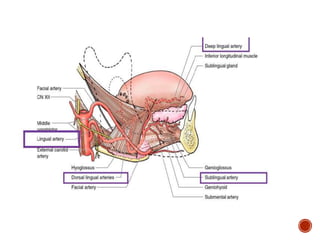
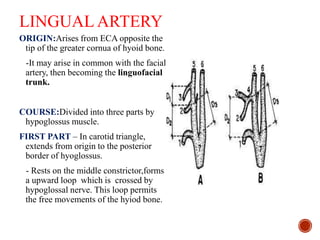
LINGUAL ARTERY
ORIGIN:Arises from ECA opposite the
tip of the greater cornua of hyoid bone.
-It may arise in common with the facial
artery, then becoming the linguofacial
trunk.
COURSE:Divided into three parts by
hypoglossus muscle.
FIRST PART – In carotid triangle,
extends from origin to the posterior
border of hyoglossus.
- Rests on the middle constrictor,forms
a upward loop which is crossed by
hypoglossal nerve. This loop permits
the free movements of the hyiod bone.
SECOND PART – Deep to
hyoglossus, runs horizontally
forward along the upper border of
hyoid bone between hyoglossus
laterally and middle constrictor,
stylohyoid ligament medially.
THIRD PART [ ‘arteria profunda
linguae’ ]—Also called as deep
lingual artery.
-It runs upwards along the anterior
Border of hyoglossus, then
horizontally forwards on the
undersurface of tongue on each side
of frenum linguae.
-In vertical course,it lies b/t the
genioglossus medially & inferior
longitudinal muscle of tongue
laterally. Horizontal part is
accompanied by lingual nerve.
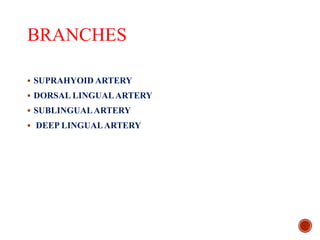
BRANCHES
 SUPRAHYOID ARTERY
 DORSAL LINGUALARTERY
 SUBLINGUALARTERY
 DEEP LINGUALARTERY
FACIAL ARTERY
ORIGIN: Arises from the ECA just above the tip of greater cornua
of hyoid bone.
COURSE: Runs upwards in -- neck as cervical part ; face -- facial
part.
Tortuous course—In neck allows free movements of pharynx
during deglutition,
on face -- free movements of mandible , lips, & cheek during
mastication & facial expressions, escapes traction & pressure
during movements.
.
Cervical part : Cervical part Runs
upwards on superior constrictor
of pharynx deep to the posterior
belly of digastric.
-It grooves the posterior border
of submandibular gland, makes
S-bend [2 loops] 1st winding
down over submandibular gland
& then up over the base of
mandible.
Facial part:The vessel enters the face by winding around the base of
the mandible, and by piercing the deep cervical fascia,at the
anteroinferior angle of the masseter muscle.
 It runs upwards and forwards deep to the risorus, to a point 1.25cm
lateral to the angle of the mouth.
 Then it ascends by the side of the nose upto the medial angle of the
eye where it terminates by anastomosing with the dorsal nasal
branch of the ophthalmic artery.
BRANCHES
CERVICAL PART:
ASCENDING PALATINE ARTERY
TONSILLAR A RTERY
GLANDULAR ARTERIES
SUBMENTALARTERY
FACIAL PART:
INFERIOR LABIALARTERY
SUPERIOR LABIALARTERY
LATERAL NASALARTERY
ANGULAR ARTERY
POSTERIOR BRANCHES
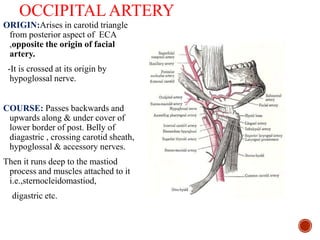
OCCIPITAL ARTERY
ORIGIN:Arises in carotid triangle
from posterior aspect of ECA
,opposite the origin of facial
artery.
-It is crossed at its origin by
hypoglossal nerve.
COURSE: Passes backwards and
upwards along & under cover of
lower border of post. Belly of
diagastric , crossing carotid sheath,
hypoglossal & accessory nerves.
Then it runs deep to the mastiod
process and muscles attached to it
i.e.,sternocleidomastiod,
digastric etc.
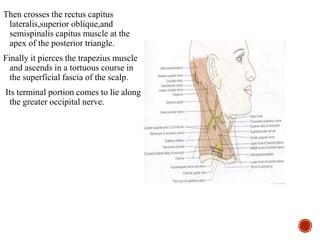
Then crosses the rectus capitus
lateralis,superior oblique,and
semispinalis capitus muscle at the
apex of the posterior triangle.
Finally it pierces the trapezius muscle
and ascends in a tortuous course in
the superficial fascia of the scalp.
Its terminal portion comes to lie along
the greater occipital nerve.
BRANCHES
 STERNOMASTOID BRANCHES
 AURICULAR BRANCH
 MASTOID BRANCH
 MENINGEAL BRANCH
 MUSCULAR BRANCH
POSTERIOR AURICULAR
ARTERYORIGIN: Arises from the posterior
aspect of the external carotid artery
just above the posterior belly of the
digastric.
COURSE:It runs upwards and
backwards deep to parotid gland,
but superficial to the styloid
process.It crosses the base of the
mastiod process and ascends behind
the auricle.
BRANCHES
Stylomastoid.
Auricular
Occipital.
MEDIAL BRANCH
ASCENDING PHARYNGEAL
ARTERY
ORIGIN:The smallest branch arising
from the medial side of the external
carotid artery, near its
commencement.
COURSE: Ascends vertically between
the internal carotid and the side of the
pharynx, to the under surface of the
base of the skull, lying on the Longus
capitis.
BRANCHES
 PHARYNGEAL BRANCHES
 PALATINE BRANCH
 PREVERTEBRAL BRANCHES
 INFERIOR TYMPANIC ARTERY
 MENINGEAL BRANCHES
TERMINAL BRANCHES
MAXILLARY ARTERY
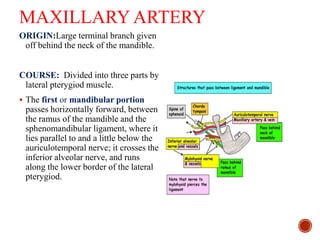
ORIGIN:Large terminal branch given
off behind the neck of the mandible.
COURSE: Divided into three parts by
lateral pterygiod muscle.
 The first or mandibular portion
passes horizontally forward, between
the ramus of the mandible and the
sphenomandibular ligament, where it
lies parallel to and a little below the
auriculotemporal nerve; it crosses the
inferior alveolar nerve, and runs
along the lower border of the lateral
pterygiod.
 The second or pterygoid portion runs obliquely forward and
upward superficial to the lower head of the lateral pterygiod.
 The third or pterygopalatine portion passes between the two
heads of the lateral pterygiod and pterygomaxillary fissure,to enter
into the pterygopalatine fossa where it lies in front of the
sphenopalatine ganglion.
BRANCHES
First or Mandibular Portion
 Deep Auricular.
 Anterior Tympanic.
 Middle Meningeal
 Accessory Meningeal
 Inferior Alveolar.
Second or Pterygoid Portion
 Deep Temporal.
 Masseteric.
 Pterygoid.
 Buccinator.
Third or Pterygopalatine
Portion
•Posterior Superior
Alveolar.
•Infraorbital.
•Greater palatine artery
•Pharyngeal.
•Aretry of pterygiod canal
•Sphenopalatine.
SUPERFICIAL TEMPORAL
ARTERY
ORIGIN: The smaller of the two terminal branches of the external
carotid, appears, to be the continuation of ECA. It begins in the
substance of the parotid gland, behind the neck of the mandible.
COURSE: It runs vertically upwards crossing over the root of the
zygomatic process
-about 5 cm. above this process it divides into two branches, a
frontal and a parietal.
 Relations.—As it crosses
the zygomatic process, it
is covered by the
Auricularis anterior
muscle, and by a dense
fascia; it is crossed by the
temporal and zygomatic
branches of the facial
nerve and one or two
veins, and is accompanied
by the auriculotemporal
nerve, which lies
immediately behind it.
BRANCHES
Besides some twigs to the parotid gland, to the
temporomandibular joint, and to the Masseter muscle,
its branches are:
 Transverse Facial.
 Anterior Auricular.
 Middle Temporal.
 Frontal.
 Parietal
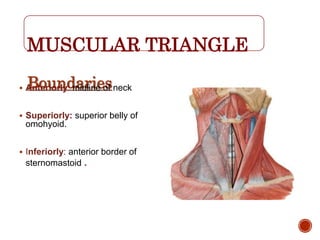
MUSCULAR TRIANGLE
Boundaries Anteriorly: midline of neck
 Superiorly: superior belly of
omohyoid.
 Inferiorly: anterior border of
sternomastoid .
Contents
Sternohyoid muscle
Sternothyroid
muscle
Thyrohyoid muscle
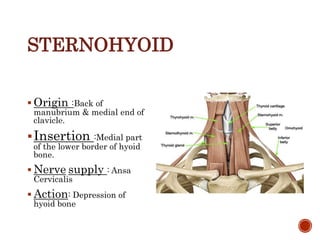
STERNOHYOID
 Origin :Back of
manubrium & medial end of
clavicle.
Insertion :Medial part
of the lower border of hyoid
bone.
 Nerve supply : Ansa
Cervicalis
 Action: Depression of
hyoid bone
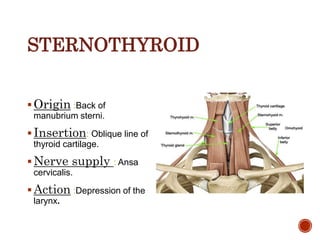
STERNOTHYROID
Origin :Back of
manubrium sterni.
Insertion: Oblique line of
thyroid cartilage.
Nerve supply : Ansa
cervicalis.
Action :Depression of the
larynx.
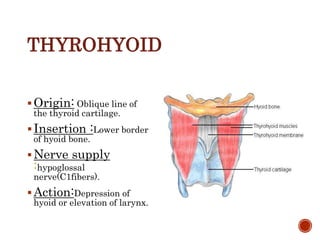
THYROHYOID
Origin: Oblique line of
the thyroid cartilage.
Insertion :Lower border
of hyoid bone.
Nerve supply
:hypoglossal
nerve(C1fibers).
Action:Depression of
hyoid or elevation of larynx.
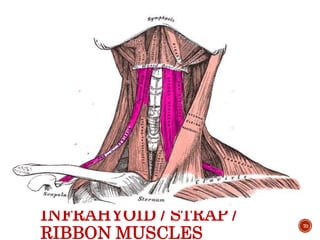
INFRAHYOID / STRAP /
RIBBON MUSCLES
70
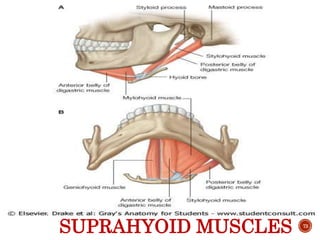
SUPRAHYOID
MUSCLESMUSCLE ORIGIN INSERTIO
N
NERVE
SUPPLY
DIGASTRIC Anterior belly from
digastric fossa
Post belly from
mastoid notch
Intermediate
tendon held by a
pulley to hyoid
bone
Ant belly by nerve
of mylohyoid
Post belly by facial
nerve
STYLOHYO
ID
Posterior surface
of styloid process
Junction of body
and greater
cornua of hyoid
bone
Facial nerve
MYLOHYOI
D
Mylohyoid line of
mandible
Body of hyoid
bone
Two m. muscle
of both side form
median raphe
Nerve to
mylohyoid
GENIOHYO
ID
Inferior mental
spine(Genial
tubercle)
Ant surface of
body of hyoid
bone
C1 thru
hypoglossal nerve71
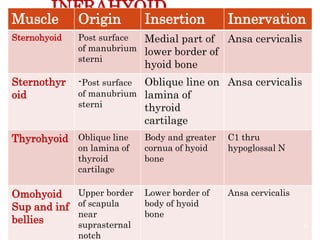
INFRAHYOID
MUSCLESMuscle Origin Insertion Innervation
Sternohyoid Post surface
of manubrium
sterni
Medial part of
lower border of
hyoid bone
Ansa cervicalis
Sternothyr
oid
-Post surface
of manubrium
sterni
Oblique line on
lamina of
thyroid
cartilage
Ansa cervicalis
Thyrohyoid Oblique line
on lamina of
thyroid
cartilage
Body and greater
cornua of hyoid
bone
C1 thru
hypoglossal N
Omohyoid
Sup and inf
bellies
Upper border
of scapula
near
suprasternal
notch
Lower border of
body of hyoid
bone
Ansa cervicalis
72
SUPRAHYOID MUSCLES 73
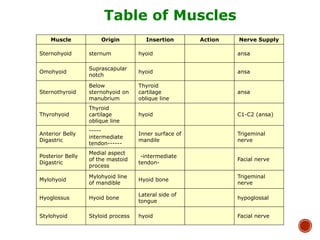
Table of Muscles
Muscle Origin Insertion Action Nerve Supply
Sternohyoid sternum hyoid ansa
Omohyoid
Suprascapular
notch
hyoid ansa
Sternothyroid
Below
sternohyoid on
manubrium
Thyroid
cartilage
oblique line
ansa
Thyrohyoid
Thyroid
cartilage
oblique line
hyoid C1-C2 (ansa)
Anterior Belly
Digastric
-----
intermediate
tendon------
Inner surface of
mandile
Trigeminal
nerve
Posterior Belly
Digastric
Medial aspect
of the mastoid
process
-intermediate
tendon-
Facial nerve
Mylohyoid
Mylohyoid line
of mandible
Hyoid bone
Trigeminal
nerve
Hyoglossus Hyoid bone
Lateral side of
tongue
hypoglossal
Stylohyoid Styloid process hyoid Facial nerve
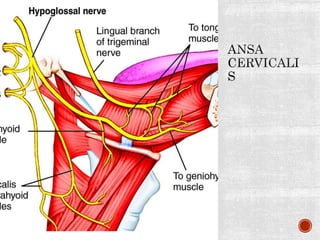
ANSA CERVICALIS
 Also known as Ansa
Hypoglossi.
 This is a thin nerve loop
that lies embedded in the
ant wall of carotid sheath.
 FORMATION:
Superior Root:continuation
of descending br of
hypoglossal N.
Inferior Root: 2nd and 3rd
cervical spinal N.
• Supplies Infrahyoid
muscles.
75
ANSA CERVICALIS
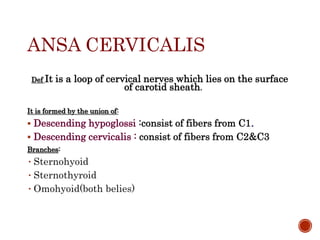
Def It is a loop of cervical nerves which lies on the surface
of carotid sheath.
It is formed by the union of:
 Descending hypoglossi :consist of fibers from C1.
 Descending cervicalis : consist of fibers from C2&C3
Branches:
• Sternohyoid
• Sternothyroid
• Omohyoid(both belies)
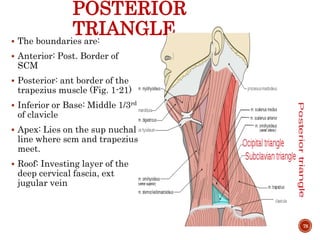
POSTERIOR
TRIANGLE The boundaries are:
 Anterior: Post. Border of
SCM
 Posterior: ant border of the
trapezius muscle (Fig. 1-21)
 Inferior or Base: Middle 1/3rd
of clavicle
 Apex: Lies on the sup nuchal
line where scm and trapezius
meet.
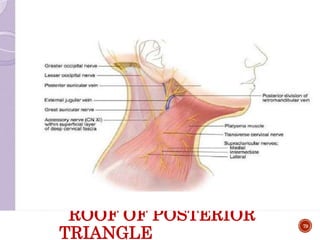
 Roof: Investing layer of the
deep cervical fascia, ext
jugular vein
78
ROOF OF POSTERIOR
TRIANGLE
79
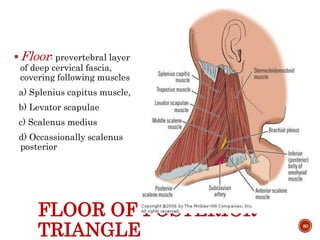
FLOOR OF POSTERIOR
TRIANGLE
Floor: prevertebral layer
of deep cervical fascia,
covering following muscles
a) Splenius capitus muscle,
b) Levator scapulae
c) Scalenus medius
d) Occassionally scalenus
posterior
80
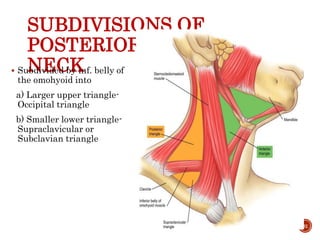
SUBDIVISIONS OF
POSTERIOR TRIANGLE OF
NECK Subdivided by inf. belly of
the omohyoid into
a) Larger upper triangle-
Occipital triangle
b) Smaller lower triangle-
Supraclavicular or
Subclavian triangle
81
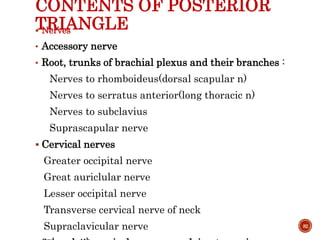
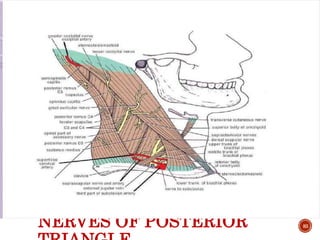
CONTENTS OF POSTERIOR
TRIANGLE Nerves
• Accessory nerve
• Root, trunks of brachial plexus and their branches :
Nerves to rhomboideus(dorsal scapular n)
Nerves to serratus anterior(long thoracic n)
Nerves to subclavius
Suprascapular nerve
 Cervical nerves
Greater occipital nerve
Great auriclular nerve
Lesser occipital nerve
Transverse cervical nerve of neck
Supraclavicular nerve 82
NERVES OF POSTERIOR 83
ARTERIES OF POSTERIOR
TRIANGLE
 Arteries
 Occipital artery
 Third part of
subclavianartery &
branches of
subclavianartery
 Suprascapular
 Transverse cervical
84
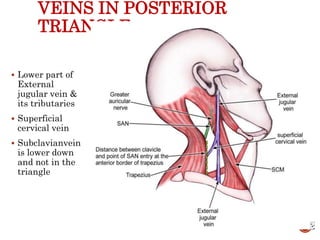
VEINS IN POSTERIOR
TRIANGLE
 Lower part of
External
jugular vein &
its tributaries
 Superficial
cervical vein
 Subclavianvein
is lower down
and not in the
triangle
85
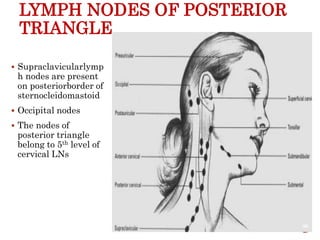
LYMPH NODES OF POSTERIOR
TRIANGLE
 Supraclavicularlymp
h nodes are present
on posteriorborder of
sternocleidomastoid
 Occipital nodes
 The nodes of
posterior triangle
belong to 5th level of
cervical LNs
86

Triangle of Neck by Mohit

  • 1.
  • 2.
     The sideof the neck is roughly quadrilateral in outline.  It is bounded  Anteriorly by –Anterior Median Line  Posteriorly- Anterior border of Trapezius  Superiorly- Base of the Mandible, a line joining angle of the mandible & mastoid process, superior nuchal line.  Inferiorly- Clavicle  This quadrangular space is divided obliquely by SCM muscle into anterior and 2
  • 3.
    STERNOCLEIDOMASTOID  Origin: a) Sternalhead b) Clavicular head  Insertion: a) Lateral process of mastoid process b) Lateral half of the superior nuchal line of occipital bone  Nerve Supply: Spinal Accessory Nerve  Blood Supply: One br from sup thyroid A. and suprascapular A. Two br from occipital A. 3
  • 4.
    STERNOCLEIDOMASTOID  One ofthe most important landmark in neck.  Actions-  When one muscles contracts-  When both muscles contracts  To make scm taut on one side, the pt is asked to turn the head to opp. side against resistance. 4
  • 5.
    PLATYSMA  It isa subcutaneous muscle forming a wide, thin fleshy sheet running upwards and medially in the neck from deltoid and pectoral fasciae to the base of mandible.  Supplied by cervical br. of facial nerve. 5
  • 6.
    ANTERIOR TRIANGLE OF NECK Boundaries: Medially: Ant median plane of neck Laterally: SCM Superiorly: Base of the mandible and a line joining the angle of the mandible n mastoid process  Subdivisions: The ant triangle is subdivided by the digastric belly and sup belly of omohyoid into: a) Submental b) Digastric c) Carotid and d) Muscular Triangles 6
  • 7.
  • 8.
  • 9.
    SUBMENTAL TRIANGLE  Thisis a median triangle.  Boundaries: Either side- Anterior belly of corresponding digastric muscles Base- Body of hyoid bone Apex- at the chin Floor- Rt and Lt Mylohyoid muscle 9
  • 10.
    CONTENTS OF SUBMENTAL TRIANGLE It contains:  one or two lymph glands, the submental lymph nodes  some small veins; the latter unite to form the anterior jugular vein  The lymph nodes of the submental triangle receive lymph from the skin of the chin, the lower lip, the floor of the mouth, and the tip of the tongue. They send lymph to the submandibular and jugular chains of nodes. They belong to Level 1 gr of LNs 10
  • 11.
    DIGASTRIC TRIANGLE  Thesubmandibular triangle (or submaxillary or digastric triangle) corresponds to the region of the neck immediately beneath the body of the mandible.  Boundaries: Anteroinf: Ant belly of digastric Posteroinf: Post belly of digastric and stylohyoid. Superiorly: Base of the mandible. Roof : Skin, superficial fascia with platysma muscle, deep fascia Floor: Mylohyoid anteriorly and hyoglossus posteriorly, part of middle constrictor. 11
  • 12.
  • 13.
    CONTENTS OF DIGASTRIC TRIANGLEANTERIOR PART OF TRIANGLE Strucures superficial to mylohyoid are:  Superficial part of submandibular gland, Facial vein , Subman. LN (belong to Level 1 gr of LNs), Facial A.,Submental A., Mylohyoid nerve and vessels. Structures superficial to hyoglossus: Subman.gland,Intermediate tendon of digastric and stylohyoid, Hypoglossal N. 13
  • 14.
    CONTENTS OF DIGASTRIC TRIANGLEPOSTERIOR PART OF TRIANGLE: Superficial Structures: Lower part of parotid, ECA before it enters parotid. Deep structures: Styloglossus, stylopharyngeus, glossopharyngeal N, Pharyngeal br of vagus, Styloid process, a part of parotid 14
  • 15.
    CONTENTS OF POSTERIORPART OF DIGASTRIC TRIANGLE Deepest structures: a) Internal carotid A. b) Internal jugular vein c) Vagus N. • Submandibular LNs: Belong to Level 1 gr of LNs • Clinically important because of their wide area of drainage. They are very commonly enlarged. • They drain: a) center of forehead b) Nose with Max. Frontal & Ethmoid sinuses c) Inner canthus of the eye d) Upper lip and the ant part of cheek with adjoinin gums e)Outer part of lower lip with gums and teeth excluding incisors f)Ant 2/3rd of tongue and floor of mouth 15
  • 16.
    CAROTID TRIANGLE  Boundaries: Anterosup: Post belly of digastric  Anteroinf: Sup belly of omohyoid  Posteriorly: Ant border of SCM  Roof: skin, superficial fascia, investing layer of deep fascia  Floor: Thyrohyoid M, hyoglossus, Middle and Inf. constrictors of pharynx 16
  • 17.
    CONTENTS OF CAROTID TRIANGLE ARTERIES:  Common caortid A. with carotid sinus and carotid body at its termination  Internal carotid A.  External carotid A. with br.- Ant br-sup thyroid, lingual facial Post br- Occipital , post. Auricular Medial- Asc. Pharyngeal Terminal –Maxillary , Superficial Temporal. 17
  • 19.
    CONTENTS OF CAROTID TRIANGLE VEINS:  Internal Jugular V.  Common Facial V.  Pharyngeal V  Lingual V. all draining in to internal jugular vein directly or via facial vein 19
  • 20.
    CONTENTS OF CAROTID TRIANGLE NERVES:  Vagus running vertically downwards  Sup L.N of vagus dividing into ext n int L.N  Spinal Accessory N  Hypoglossal N  Sympathetic chain  Carotid sheath and its contents  Lymph Nodes: Jugulo- digastric and jugulo- omohyoid 20
  • 21.
  • 22.
    COMMON CAROTID ARTERIES Right common carotid artery is a branch of the brachiocephalic artery.It begins in the neck behind the right sternoclavicular joint.  Left common carotid artery is a branch of the arch of aorta.It ascends to the back of the left sternoclavicular joint and enters the neck.  In the neck,each artery runs upwards within the carotid sheath,under cover of the anterior border of the sternocleidomastoid muscle.
  • 23.
    CAROTID SHEATH  Carotidsheath is condensation of the fibroareolar tissue around the main vessels of the neck.  CONTENTS:It contains the common and internal carotid arteries,internal jugular vein and the vagus nerve.  In the sheath,common carotid artery is medially placed.Vagus nerve lies in between.
  • 24.
    RELATIONS  The ansacervicalis lies embedded in the anterior wall of the carotid sheath.  The cervical sympathetic chain lies behind the sheath.
  • 25.
    BIFURCATION OF COMMON CAROTIDARTERY  Common carotid artery bifurcates into external and internal carotid arteries at the level of upper border of the thyroid cartilage.  Two structures of importance at the bifurcation are Carotid sinus Carotid body
  • 26.
  • 27.
    CAROTID SINUS  Carotidsinus is slight dilatation at the termination of the common carotid artery or the beginning of the internal carotid artery.  It receives a rich innervation from the glossopharyngeal and sympathetic nerves. FUNCTION: Carotid sinus acts as a baroreceptor or pressure receptor and regulates pressure.
  • 28.
    APPLIED ANATOMY CAROTID SINUSSYNDROME  Loss of consciousness due to simple head movements.  Hypersensitivity of the carotid sinus due to an unknown etiology.  Sudden slight pressure changes, such as that occasioned by movement of the head, may result in stimulation of the carotid sinus.  Impulses transmitted by the sinus reduce blood pressure and slow the pumping action of the heart. Thus decreasing blood supply to the brain and resulting in sudden loss of consciousness. While supporting the mandible care should be taken not to apply pressure on the carotid sinus.
  • 29.
    CAROTID BODY  Carotidbody is a small,oval reddish-brown structure situated behind the bifurcation.  It receives nerve supply mainly from the glossopharyngeal nerve, but also from the vagus and sympathetic nerves. FUNCTION: Carotid body acts as a chemoreceptor and responds to changes in the oxygen and carbon dioxide and Ph content of the blood.
  • 30.
    EXTERNAL CAROTID ARTERY  Generally,itlies anterior to the internal carotid artery.  It is the chief artery of supply to structures in the front of the neck and in the face.
  • 31.
    COURSE  ECA beginsin the carotid triangle at the level of upper border of thyriod cartilage opposite the disc between the third and fourth cervical vertibrae.  In the carotid triangle,it lies under cover of the anterior border of the sternocleidomastiod muscle  As the artery ascends ,it passes deep to the post. Belly of digastric and stylohyoid muscle and terminates behind the neck of the mandible by dividing into the maxillary and superficial temporal arteries.
  • 32.
    Has slightly curvedcourse,so that it is anteromedial to ICA in it lower part,and anterolateral to the ICA in its upper part.
  • 33.
    RELATIONSIN THE CAROTIDTRIANGLE Superficially—Cervical branch of facial nerve Hypoglossal nerve Facial,lingual,and superior thyriod veins Deep to the artery— Wall of pharynx Superior laryngeal nerve Ascending pharyngeal artery
  • 34.
    ABOVE THE CAROTIDTRIANGLE Lies deep in the substance of the parotid triangle. Within the gland, it is related Superficially—Retromandibular vein Facial nerve Deep to the artery—ICA Structures passing between ECA and ICA Styloglossus Stylopharyngeus IXth nerve Pharyngeal branch of Xth nerve Styloid process
  • 35.
  • 36.
  • 37.
    SUPERIOR THYRIOD ARTERY ORIGIN:Arisesfrom the front of ECA below the tip of greater cornua of hyoid bone. COURSE: Runs downwards and forwards parallel and just superficial to the extenal laryngeal nerve. - It passes deep to omohyoid ,sternohyoid, sternothyroid and reaches the upper pole of lateral lobe of thyroid and divides into its terminal branches.  It is accompanied by same-named vein.
  • 38.
    BRANCHES: INFRAHYOID ARTERY STERNOCLEIDOMASTOID ARTERY SUPERIORLARYNGEALARTERY CRICOTHYROID ARTERY GLANDULAR BRANCHES
  • 39.
    APPLIED ANATOMY  Thearch of superior thyroid artery is characteristic – diagnostic landmark  The artery and external laryngeal nerve are close to each other higher up, but diverge slightly near the gland. - So, ligature of superior thyroid artery in thyroid surgery should be made close to the gland in order to avoid injury of the external laryngeal nerve. -Damage to the external laryngeal nerve causes some weakness of phonation due to loss of tightening effect of the cricothyriod on the vocal cord.  Intra-arterial infusion chemotherapy for laryngeal and hypopharyngeal cancers.
  • 40.
    LINGUAL ARTERY ORIGIN:Arises fromECA opposite the tip of the greater cornua of hyoid bone. -It may arise in common with the facial artery, then becoming the linguofacial trunk. COURSE:Divided into three parts by hypoglossus muscle. FIRST PART – In carotid triangle, extends from origin to the posterior border of hyoglossus. - Rests on the middle constrictor,forms a upward loop which is crossed by hypoglossal nerve. This loop permits the free movements of the hyiod bone.
  • 41.
    SECOND PART –Deep to hyoglossus, runs horizontally forward along the upper border of hyoid bone between hyoglossus laterally and middle constrictor, stylohyoid ligament medially. THIRD PART [ ‘arteria profunda linguae’ ]—Also called as deep lingual artery. -It runs upwards along the anterior Border of hyoglossus, then horizontally forwards on the undersurface of tongue on each side of frenum linguae. -In vertical course,it lies b/t the genioglossus medially & inferior longitudinal muscle of tongue laterally. Horizontal part is accompanied by lingual nerve.
  • 43.
    BRANCHES  SUPRAHYOID ARTERY DORSAL LINGUALARTERY  SUBLINGUALARTERY  DEEP LINGUALARTERY
  • 44.
    FACIAL ARTERY ORIGIN: Arisesfrom the ECA just above the tip of greater cornua of hyoid bone. COURSE: Runs upwards in -- neck as cervical part ; face -- facial part. Tortuous course—In neck allows free movements of pharynx during deglutition, on face -- free movements of mandible , lips, & cheek during mastication & facial expressions, escapes traction & pressure during movements. .
  • 45.
    Cervical part :Cervical part Runs upwards on superior constrictor of pharynx deep to the posterior belly of digastric. -It grooves the posterior border of submandibular gland, makes S-bend [2 loops] 1st winding down over submandibular gland & then up over the base of mandible.
  • 46.
    Facial part:The vesselenters the face by winding around the base of the mandible, and by piercing the deep cervical fascia,at the anteroinferior angle of the masseter muscle.  It runs upwards and forwards deep to the risorus, to a point 1.25cm lateral to the angle of the mouth.  Then it ascends by the side of the nose upto the medial angle of the eye where it terminates by anastomosing with the dorsal nasal branch of the ophthalmic artery.
  • 47.
    BRANCHES CERVICAL PART: ASCENDING PALATINEARTERY TONSILLAR A RTERY GLANDULAR ARTERIES SUBMENTALARTERY
  • 48.
    FACIAL PART: INFERIOR LABIALARTERY SUPERIORLABIALARTERY LATERAL NASALARTERY ANGULAR ARTERY
  • 49.
  • 50.
    OCCIPITAL ARTERY ORIGIN:Arises incarotid triangle from posterior aspect of ECA ,opposite the origin of facial artery. -It is crossed at its origin by hypoglossal nerve. COURSE: Passes backwards and upwards along & under cover of lower border of post. Belly of diagastric , crossing carotid sheath, hypoglossal & accessory nerves. Then it runs deep to the mastiod process and muscles attached to it i.e.,sternocleidomastiod, digastric etc.
  • 51.
    Then crosses therectus capitus lateralis,superior oblique,and semispinalis capitus muscle at the apex of the posterior triangle. Finally it pierces the trapezius muscle and ascends in a tortuous course in the superficial fascia of the scalp. Its terminal portion comes to lie along the greater occipital nerve.
  • 52.
    BRANCHES  STERNOMASTOID BRANCHES AURICULAR BRANCH  MASTOID BRANCH  MENINGEAL BRANCH  MUSCULAR BRANCH
  • 53.
    POSTERIOR AURICULAR ARTERYORIGIN: Arisesfrom the posterior aspect of the external carotid artery just above the posterior belly of the digastric. COURSE:It runs upwards and backwards deep to parotid gland, but superficial to the styloid process.It crosses the base of the mastiod process and ascends behind the auricle.
  • 54.
  • 55.
  • 56.
    ASCENDING PHARYNGEAL ARTERY ORIGIN:The smallestbranch arising from the medial side of the external carotid artery, near its commencement. COURSE: Ascends vertically between the internal carotid and the side of the pharynx, to the under surface of the base of the skull, lying on the Longus capitis.
  • 57.
    BRANCHES  PHARYNGEAL BRANCHES PALATINE BRANCH  PREVERTEBRAL BRANCHES  INFERIOR TYMPANIC ARTERY  MENINGEAL BRANCHES
  • 58.
  • 59.
    MAXILLARY ARTERY ORIGIN:Large terminalbranch given off behind the neck of the mandible. COURSE: Divided into three parts by lateral pterygiod muscle.  The first or mandibular portion passes horizontally forward, between the ramus of the mandible and the sphenomandibular ligament, where it lies parallel to and a little below the auriculotemporal nerve; it crosses the inferior alveolar nerve, and runs along the lower border of the lateral pterygiod.
  • 60.
     The secondor pterygoid portion runs obliquely forward and upward superficial to the lower head of the lateral pterygiod.  The third or pterygopalatine portion passes between the two heads of the lateral pterygiod and pterygomaxillary fissure,to enter into the pterygopalatine fossa where it lies in front of the sphenopalatine ganglion.
  • 61.
    BRANCHES First or MandibularPortion  Deep Auricular.  Anterior Tympanic.  Middle Meningeal  Accessory Meningeal  Inferior Alveolar. Second or Pterygoid Portion  Deep Temporal.  Masseteric.  Pterygoid.  Buccinator. Third or Pterygopalatine Portion •Posterior Superior Alveolar. •Infraorbital. •Greater palatine artery •Pharyngeal. •Aretry of pterygiod canal •Sphenopalatine.
  • 62.
    SUPERFICIAL TEMPORAL ARTERY ORIGIN: Thesmaller of the two terminal branches of the external carotid, appears, to be the continuation of ECA. It begins in the substance of the parotid gland, behind the neck of the mandible. COURSE: It runs vertically upwards crossing over the root of the zygomatic process -about 5 cm. above this process it divides into two branches, a frontal and a parietal.
  • 63.
     Relations.—As itcrosses the zygomatic process, it is covered by the Auricularis anterior muscle, and by a dense fascia; it is crossed by the temporal and zygomatic branches of the facial nerve and one or two veins, and is accompanied by the auriculotemporal nerve, which lies immediately behind it.
  • 64.
    BRANCHES Besides some twigsto the parotid gland, to the temporomandibular joint, and to the Masseter muscle, its branches are:  Transverse Facial.  Anterior Auricular.  Middle Temporal.  Frontal.  Parietal
  • 65.
    MUSCULAR TRIANGLE Boundaries Anteriorly:midline of neck  Superiorly: superior belly of omohyoid.  Inferiorly: anterior border of sternomastoid .
  • 66.
  • 67.
    STERNOHYOID  Origin :Backof manubrium & medial end of clavicle. Insertion :Medial part of the lower border of hyoid bone.  Nerve supply : Ansa Cervicalis  Action: Depression of hyoid bone
  • 68.
    STERNOTHYROID Origin :Back of manubriumsterni. Insertion: Oblique line of thyroid cartilage. Nerve supply : Ansa cervicalis. Action :Depression of the larynx.
  • 69.
    THYROHYOID Origin: Oblique lineof the thyroid cartilage. Insertion :Lower border of hyoid bone. Nerve supply :hypoglossal nerve(C1fibers). Action:Depression of hyoid or elevation of larynx.
  • 70.
    INFRAHYOID / STRAP/ RIBBON MUSCLES 70
  • 71.
    SUPRAHYOID MUSCLESMUSCLE ORIGIN INSERTIO N NERVE SUPPLY DIGASTRICAnterior belly from digastric fossa Post belly from mastoid notch Intermediate tendon held by a pulley to hyoid bone Ant belly by nerve of mylohyoid Post belly by facial nerve STYLOHYO ID Posterior surface of styloid process Junction of body and greater cornua of hyoid bone Facial nerve MYLOHYOI D Mylohyoid line of mandible Body of hyoid bone Two m. muscle of both side form median raphe Nerve to mylohyoid GENIOHYO ID Inferior mental spine(Genial tubercle) Ant surface of body of hyoid bone C1 thru hypoglossal nerve71
  • 72.
    INFRAHYOID MUSCLESMuscle Origin InsertionInnervation Sternohyoid Post surface of manubrium sterni Medial part of lower border of hyoid bone Ansa cervicalis Sternothyr oid -Post surface of manubrium sterni Oblique line on lamina of thyroid cartilage Ansa cervicalis Thyrohyoid Oblique line on lamina of thyroid cartilage Body and greater cornua of hyoid bone C1 thru hypoglossal N Omohyoid Sup and inf bellies Upper border of scapula near suprasternal notch Lower border of body of hyoid bone Ansa cervicalis 72
  • 73.
  • 74.
    Table of Muscles MuscleOrigin Insertion Action Nerve Supply Sternohyoid sternum hyoid ansa Omohyoid Suprascapular notch hyoid ansa Sternothyroid Below sternohyoid on manubrium Thyroid cartilage oblique line ansa Thyrohyoid Thyroid cartilage oblique line hyoid C1-C2 (ansa) Anterior Belly Digastric ----- intermediate tendon------ Inner surface of mandile Trigeminal nerve Posterior Belly Digastric Medial aspect of the mastoid process -intermediate tendon- Facial nerve Mylohyoid Mylohyoid line of mandible Hyoid bone Trigeminal nerve Hyoglossus Hyoid bone Lateral side of tongue hypoglossal Stylohyoid Styloid process hyoid Facial nerve
  • 75.
    ANSA CERVICALIS  Alsoknown as Ansa Hypoglossi.  This is a thin nerve loop that lies embedded in the ant wall of carotid sheath.  FORMATION: Superior Root:continuation of descending br of hypoglossal N. Inferior Root: 2nd and 3rd cervical spinal N. • Supplies Infrahyoid muscles. 75
  • 76.
    ANSA CERVICALIS Def Itis a loop of cervical nerves which lies on the surface of carotid sheath. It is formed by the union of:  Descending hypoglossi :consist of fibers from C1.  Descending cervicalis : consist of fibers from C2&C3 Branches: • Sternohyoid • Sternothyroid • Omohyoid(both belies)
  • 78.
    POSTERIOR TRIANGLE The boundariesare:  Anterior: Post. Border of SCM  Posterior: ant border of the trapezius muscle (Fig. 1-21)  Inferior or Base: Middle 1/3rd of clavicle  Apex: Lies on the sup nuchal line where scm and trapezius meet.  Roof: Investing layer of the deep cervical fascia, ext jugular vein 78
  • 79.
  • 80.
    FLOOR OF POSTERIOR TRIANGLE Floor:prevertebral layer of deep cervical fascia, covering following muscles a) Splenius capitus muscle, b) Levator scapulae c) Scalenus medius d) Occassionally scalenus posterior 80
  • 81.
    SUBDIVISIONS OF POSTERIOR TRIANGLEOF NECK Subdivided by inf. belly of the omohyoid into a) Larger upper triangle- Occipital triangle b) Smaller lower triangle- Supraclavicular or Subclavian triangle 81
  • 82.
    CONTENTS OF POSTERIOR TRIANGLENerves • Accessory nerve • Root, trunks of brachial plexus and their branches : Nerves to rhomboideus(dorsal scapular n) Nerves to serratus anterior(long thoracic n) Nerves to subclavius Suprascapular nerve  Cervical nerves Greater occipital nerve Great auriclular nerve Lesser occipital nerve Transverse cervical nerve of neck Supraclavicular nerve 82
  • 83.
  • 84.
    ARTERIES OF POSTERIOR TRIANGLE Arteries  Occipital artery  Third part of subclavianartery & branches of subclavianartery  Suprascapular  Transverse cervical 84
  • 85.
    VEINS IN POSTERIOR TRIANGLE Lower part of External jugular vein & its tributaries  Superficial cervical vein  Subclavianvein is lower down and not in the triangle 85
  • 86.
    LYMPH NODES OFPOSTERIOR TRIANGLE  Supraclavicularlymp h nodes are present on posteriorborder of sternocleidomastoid  Occipital nodes  The nodes of posterior triangle belong to 5th level of cervical LNs 86