PRESENTATION BY
apoorva k. Shetti
2bu09ec006
UNDER THE GUIDANCE OF
Lect. AMARJEETSINGH THAKUR
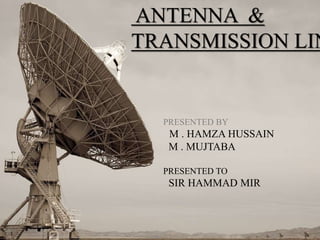
ANTENNA &
TRANSMISSION LIN
PRESENTED BY
M . HAMZA HUSSAIN
M . MUJTABA
PRESENTED TO
SIR HAMMAD MIR
CONTENTS
 INTRODUCTION
 TYPES OF TRANSSMISSION LINE
 USES OF TRANSMISSION LINE
 MODE OF SIGNAL PROPAGATION OF TRANSMISSION LINE
 SMART ANTENNA
 USES OF ANTENNA
 WAVE PROPAGATION
 ADVANTAGE
 ANTENNA DRAWBACK
INTRODUCTION
TRANSMISSION LINE
 It is two wire cable that is used to delivered energy transmitter
to antenna.
ANTENNA
 Antenna is electrical device which converts electric power
into electromagnetic waves or vice versa.
TYPES OF TRANSMISSION LINE
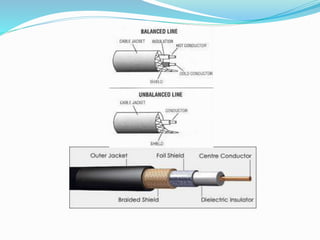
BALANCED LINE
Made up of two parallel conductors .
Insulating spacers may be use the wire separated .
CO-AXIAL CABLE
Outer plastic insulation .
Inner dielectric insulator .
Solid copper center conductor .
USES OF TRANSMISSION LINE
 To transmit energy .
 It acts as communication media .
 As resonant circuit at very high frequency .
 As measuring devices at high frequency .
 As aid to obtain impedance matching .
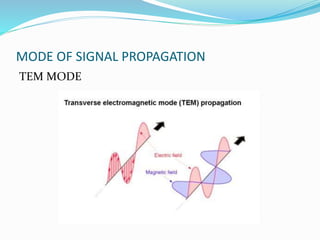
MODE OF SIGNAL PROPAGATION
TEM MODE
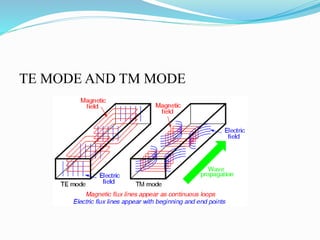
TE MODE AND TM MODE
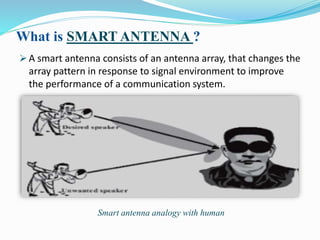
What is SMART ANTENNA ?
 A smart antenna consists of an antenna array, that changes the
array pattern in response to signal environment to improve
the performance of a communication system.
Smart antenna analogy with human
THE AIM OF SMART ANTENNA SYSTEM
 To maximize the antenna gain in the desired
direction.
 To minimize the gain in directions of interferers.
USES OF ANTEENA
Used to transmit and receive the signal .
Used to transmit and receive radio wave .
They are easy to fix and carry .
Antenna is wide range usage .
WAVE OF PROPAGATION
Ground wave propagation . (surface)
Sky wave propagation .
Space wave propagation .
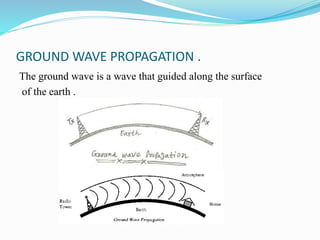
GROUND WAVE PROPAGATION .
The ground wave is a wave that guided along the surface
of the earth .
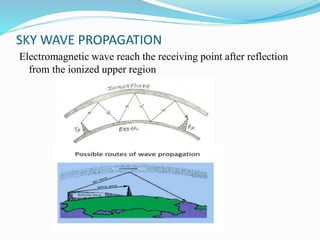
SKY WAVE PROPAGATION
Electromagnetic wave reach the receiving point after reflection
from the ionized upper region
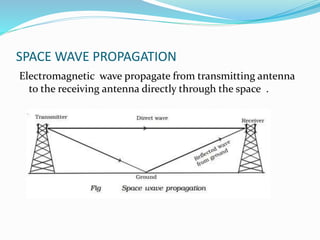
SPACE WAVE PROPAGATION
Electromagnetic wave propagate from transmitting antenna
to the receiving antenna directly through the space .
ADVANTAGES OF ANTENNA
 Enhance coverage through Range extension.
 Fully controllable by software so less manual operations.
 Reduction in transmitted power.
 Provides high security.
 Improve system capacity.
 Increased bandwidth
 Increased the number of user .
Antenna’s Drawback
 Their transceivers are much more complex than traditional
base station transceivers.
 Expensive.
 Location.
Anteena & transmission line

Anteena & transmission line

  • 2.
    PRESENTATION BY apoorva k.Shetti 2bu09ec006 UNDER THE GUIDANCE OF Lect. AMARJEETSINGH THAKUR ANTENNA & TRANSMISSION LIN PRESENTED BY M . HAMZA HUSSAIN M . MUJTABA PRESENTED TO SIR HAMMAD MIR
  • 3.
    CONTENTS  INTRODUCTION  TYPESOF TRANSSMISSION LINE  USES OF TRANSMISSION LINE  MODE OF SIGNAL PROPAGATION OF TRANSMISSION LINE  SMART ANTENNA  USES OF ANTENNA  WAVE PROPAGATION  ADVANTAGE  ANTENNA DRAWBACK
  • 4.
    INTRODUCTION TRANSMISSION LINE  Itis two wire cable that is used to delivered energy transmitter to antenna. ANTENNA  Antenna is electrical device which converts electric power into electromagnetic waves or vice versa.
  • 5.
    TYPES OF TRANSMISSIONLINE BALANCED LINE Made up of two parallel conductors . Insulating spacers may be use the wire separated . CO-AXIAL CABLE Outer plastic insulation . Inner dielectric insulator . Solid copper center conductor .
  • 7.
    USES OF TRANSMISSIONLINE  To transmit energy .  It acts as communication media .  As resonant circuit at very high frequency .  As measuring devices at high frequency .  As aid to obtain impedance matching .
  • 8.
    MODE OF SIGNALPROPAGATION TEM MODE
  • 9.
    TE MODE ANDTM MODE
  • 10.
    What is SMARTANTENNA ?  A smart antenna consists of an antenna array, that changes the array pattern in response to signal environment to improve the performance of a communication system. Smart antenna analogy with human
  • 11.
    THE AIM OFSMART ANTENNA SYSTEM  To maximize the antenna gain in the desired direction.  To minimize the gain in directions of interferers.
  • 12.
    USES OF ANTEENA Usedto transmit and receive the signal . Used to transmit and receive radio wave . They are easy to fix and carry . Antenna is wide range usage .
  • 13.
    WAVE OF PROPAGATION Groundwave propagation . (surface) Sky wave propagation . Space wave propagation .
  • 14.
    GROUND WAVE PROPAGATION. The ground wave is a wave that guided along the surface of the earth .
  • 15.
    SKY WAVE PROPAGATION Electromagneticwave reach the receiving point after reflection from the ionized upper region
  • 16.
    SPACE WAVE PROPAGATION Electromagneticwave propagate from transmitting antenna to the receiving antenna directly through the space .
  • 17.
    ADVANTAGES OF ANTENNA Enhance coverage through Range extension.  Fully controllable by software so less manual operations.  Reduction in transmitted power.  Provides high security.  Improve system capacity.  Increased bandwidth  Increased the number of user .
  • 18.
    Antenna’s Drawback  Theirtransceivers are much more complex than traditional base station transceivers.  Expensive.  Location.