Facts:
It is most economical to produce an IC in large
volumes
Many designs required only small volumes of ICs
Need an IC that can be:
Produced in large volumes
Handle many designs required in small volumes
A programmable logic part can be:
Made in large volumes
Programmed to implement large numbers of different
low-volume designs


The technologies (continued)
◦ Build lookup tables

 Storage elements (as in a memory)

◦ Transistor Switching Control
 Stored charge on a floating transistor gate
 Erasable
 Electrically erasable
 Flash (as in Flash Memory)

 Storage elements (as in a memory)


Permanent - Cannot be erased and reprogrammed
 Mask programming
 Fuse
 Antifuse



Reprogrammable

◦ Volatile - Programming lost if chip power lost
 Single-bit storage element

◦ Non-Volatile

 Erasable
 Electrically erasable
 Flash (as in Flash Memory)







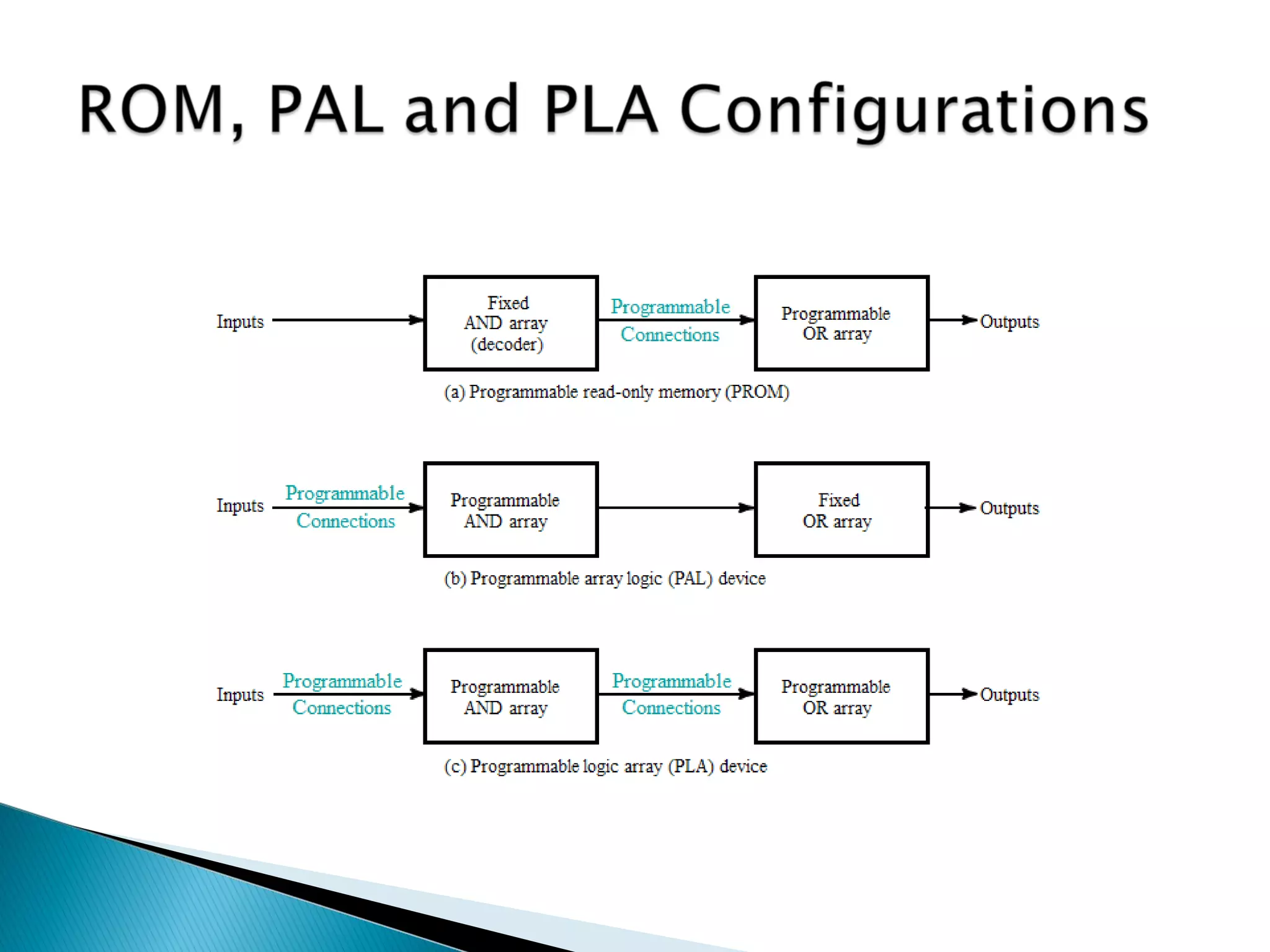
Read Only Memory (ROM) - a fixed array of AND
gates and a programmable array of OR gates
Programmable Array Logic (PAL)® - a
programmable array of AND gates feeding a fixed
array of OR gates.
Programmable Logic Array (PLA) - a
programmable array of AND gates feeding a
programmable array of OR gates.
Complex Programmable Logic Device (CPLD)
/Field- Programmable Gate Array (FPGA) complex enough to be called “architectures”


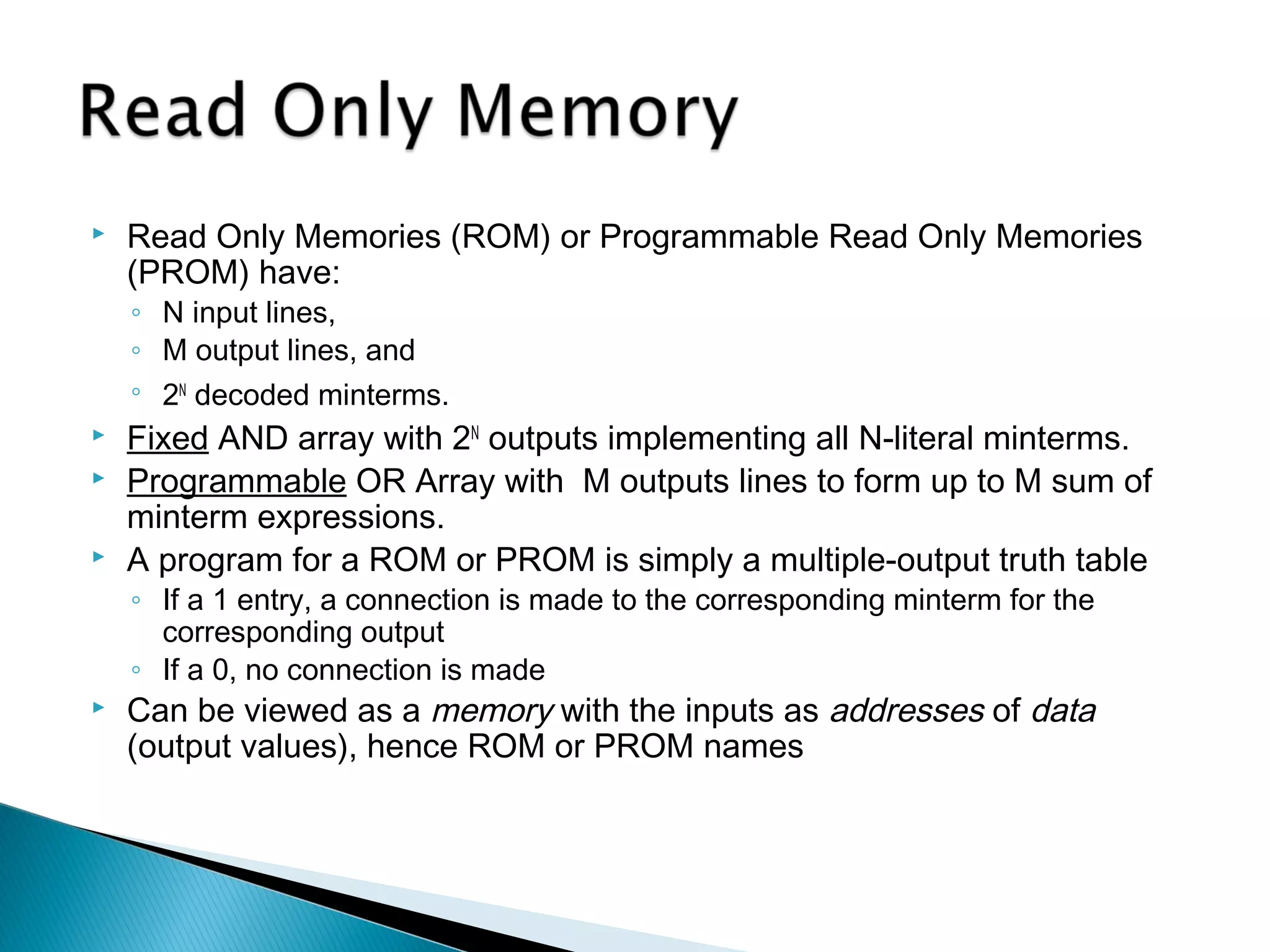
Read Only Memories (ROM) or Programmable Read Only Memories
(PROM) have:
◦ N input lines,
◦ M output lines, and
◦ 2N decoded minterms.





Fixed AND array with 2N outputs implementing all N-literal minterms.
Programmable OR Array with M outputs lines to form up to M sum of
minterm expressions.
A program for a ROM or PROM is simply a multiple-output truth table
◦ If a 1 entry, a connection is made to the corresponding minterm for the
corresponding output
◦ If a 0, no connection is made



Can be viewed as a memory with the inputs as addresses of data
(output values), hence ROM or PROM names








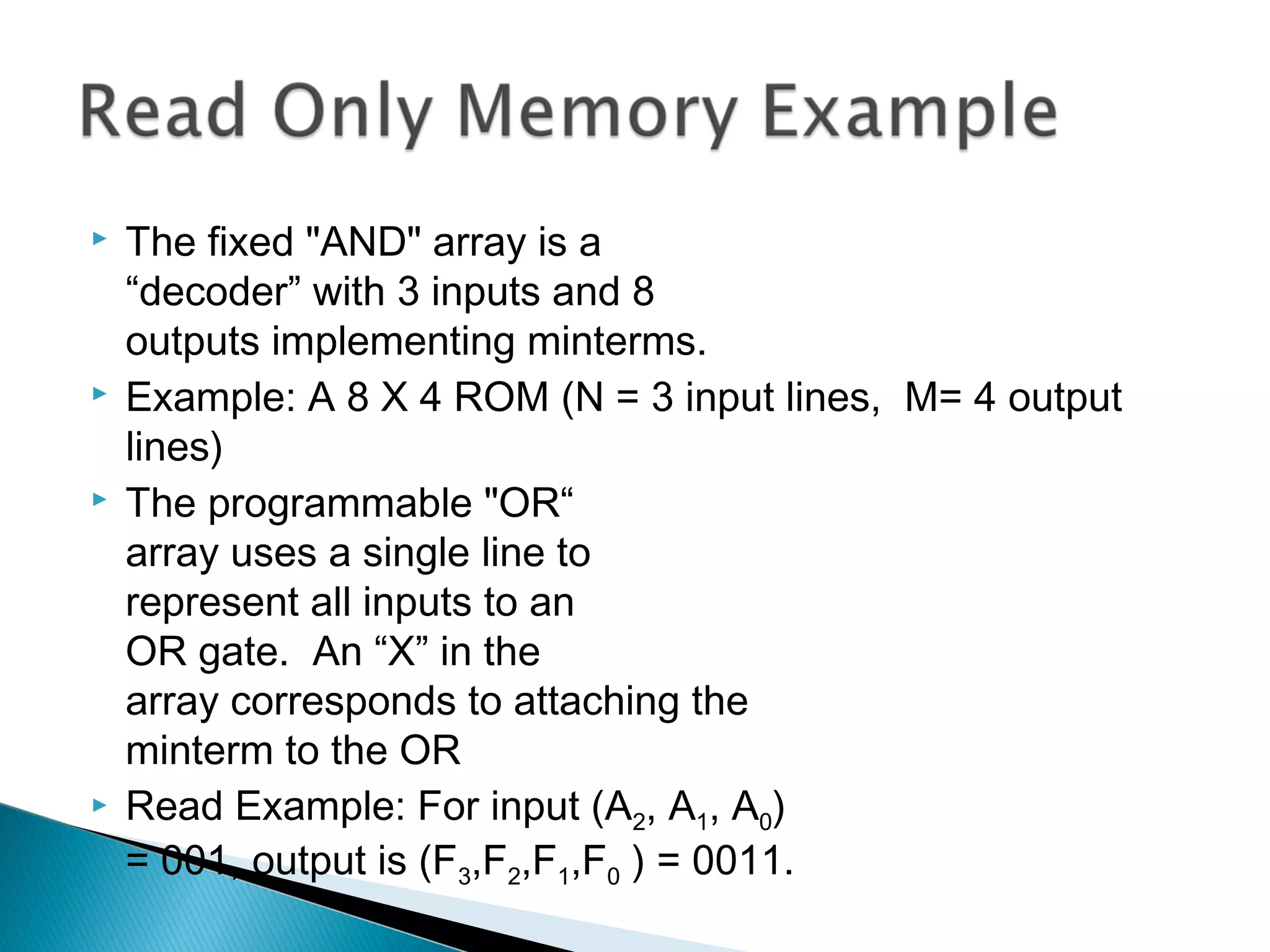
The fixed "AND" array is a
“decoder” with 3 inputs and 8
outputs implementing minterms.
Example: A 8 X 4 ROM (N = 3 input lines, M= 4 output
lines)
The programmable "OR“
array uses a single line to
represent all inputs to an
OR gate. An “X” in the
array corresponds to attaching the
minterm to the OR
Read Example: For input (A2, A1, A0)
= 001, output is (F3,F2,F1,F0 ) = 0011.


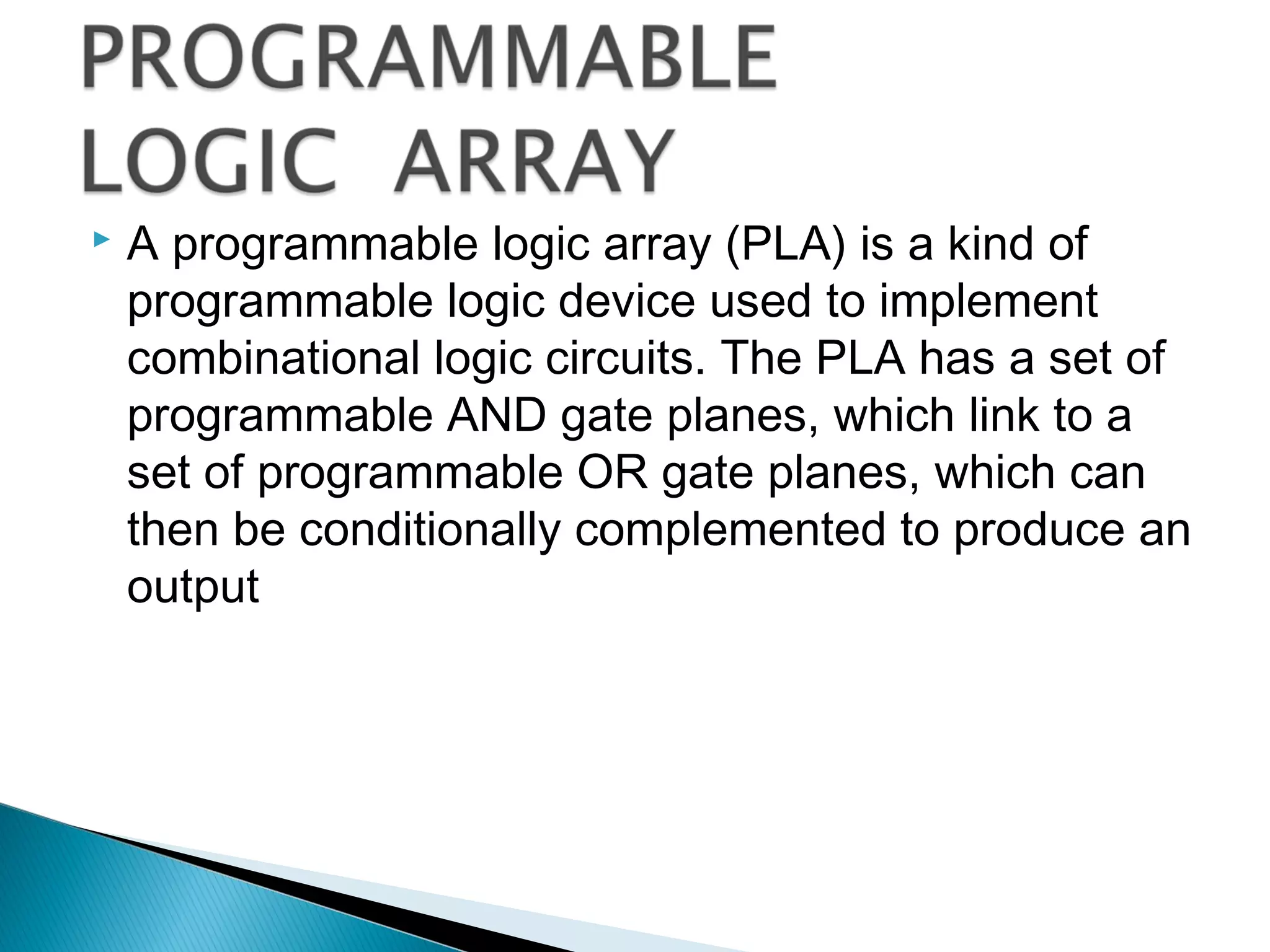
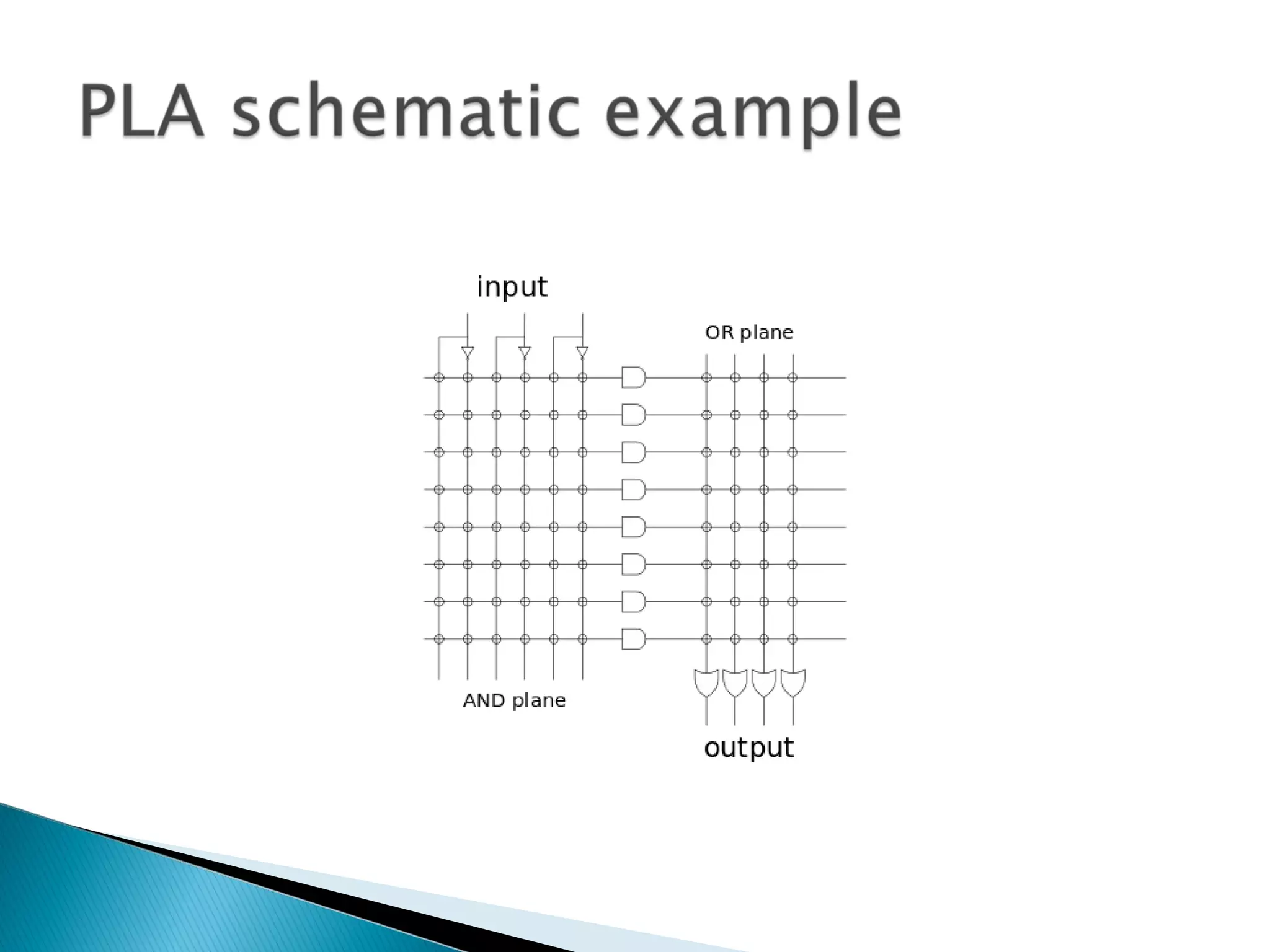
A programmable logic array (PLA) is a kind of
programmable logic device used to implement
combinational logic circuits. The PLA has a set of
programmable AND gate planes, which link to a
set of programmable OR gate planes, which can
then be conditionally complemented to produce an
output


This layout allows for a large number of logic
functions to be synthesized in the sum of products
(and sometimes product of sums) canonical forms




Compared to a ROM and a PAL, a PLA is the most flexible
having a programmable set of ANDs combined with a
programmable set of ORs.
Advantages

◦ A PLA can have large N and M permitting implementation of
equations that are impractical for a ROM (because of the number of
inputs, N, required) 
◦ A PLA has all of its product terms connectable to all outputs,
overcoming the problem of the limited inputs to the PAL ORs
◦ Some PLAs have outputs that can be complemented, adding POS
functions



Disadvantage

◦ Often, the product term count limits the application of a PLA. Twolevel multiple-output optimization reduces the number of product
terms in an implementation, helping to fit it into a PLA.
by

kundan gupta

programmable logic devices part 1

  • 2.
    Facts: It is mosteconomical to produce an IC in large volumes Many designs required only small volumes of ICs Need an IC that can be: Produced in large volumes Handle many designs required in small volumes A programmable logic part can be: Made in large volumes Programmed to implement large numbers of different low-volume designs
  • 3.
     The technologies (continued) ◦Build lookup tables  Storage elements (as in a memory) ◦ Transistor Switching Control  Stored charge on a floating transistor gate  Erasable  Electrically erasable  Flash (as in Flash Memory)  Storage elements (as in a memory)
  • 4.
     Permanent - Cannotbe erased and reprogrammed  Mask programming  Fuse  Antifuse  Reprogrammable ◦ Volatile - Programming lost if chip power lost  Single-bit storage element ◦ Non-Volatile  Erasable  Electrically erasable  Flash (as in Flash Memory)
  • 5.
        Read Only Memory(ROM) - a fixed array of AND gates and a programmable array of OR gates Programmable Array Logic (PAL)® - a programmable array of AND gates feeding a fixed array of OR gates. Programmable Logic Array (PLA) - a programmable array of AND gates feeding a programmable array of OR gates. Complex Programmable Logic Device (CPLD) /Field- Programmable Gate Array (FPGA) complex enough to be called “architectures”
  • 7.
     Read Only Memories(ROM) or Programmable Read Only Memories (PROM) have: ◦ N input lines, ◦ M output lines, and ◦ 2N decoded minterms.    Fixed AND array with 2N outputs implementing all N-literal minterms. Programmable OR Array with M outputs lines to form up to M sum of minterm expressions. A program for a ROM or PROM is simply a multiple-output truth table ◦ If a 1 entry, a connection is made to the corresponding minterm for the corresponding output ◦ If a 0, no connection is made  Can be viewed as a memory with the inputs as addresses of data (output values), hence ROM or PROM names
  • 8.
        The fixed "AND"array is a “decoder” with 3 inputs and 8 outputs implementing minterms. Example: A 8 X 4 ROM (N = 3 input lines, M= 4 output lines) The programmable "OR“ array uses a single line to represent all inputs to an OR gate. An “X” in the array corresponds to attaching the minterm to the OR Read Example: For input (A2, A1, A0) = 001, output is (F3,F2,F1,F0 ) = 0011.
  • 9.
     A programmable logicarray (PLA) is a kind of programmable logic device used to implement combinational logic circuits. The PLA has a set of programmable AND gate planes, which link to a set of programmable OR gate planes, which can then be conditionally complemented to produce an output
  • 10.
     This layout allowsfor a large number of logic functions to be synthesized in the sum of products (and sometimes product of sums) canonical forms
  • 12.
      Compared to aROM and a PAL, a PLA is the most flexible having a programmable set of ANDs combined with a programmable set of ORs. Advantages ◦ A PLA can have large N and M permitting implementation of equations that are impractical for a ROM (because of the number of inputs, N, required)  ◦ A PLA has all of its product terms connectable to all outputs, overcoming the problem of the limited inputs to the PAL ORs ◦ Some PLAs have outputs that can be complemented, adding POS functions  Disadvantage ◦ Often, the product term count limits the application of a PLA. Twolevel multiple-output optimization reduces the number of product terms in an implementation, helping to fit it into a PLA.
  • 13.