
History 
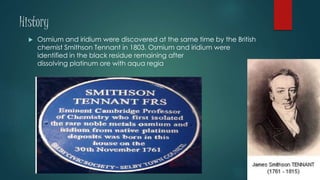
 Osmium and iridium were discovered at the same time by the British 
chemist Smithson Tennant in 1803. Osmium and iridium were 
identified in the black residue remaining after 
dissolving platinum ore with aqua regia
Source 
 Obtained from the same ore with platinum. 
 Turkey, with 127,000 tonnes, has the world's largest reserves of 
osmium known. 
 Bulgaria also has large reserves of about 2500 tons. 
 These transition metals are also found in iridiosmium, a natural alloy 
of iridium and osmium, and platinum-bearing river sands in the Ural 
Mountains, North and South America.
Properties 
 Group Name: Platinum group 
 metal Block: Block D Period: 6 
 solid at 298 K 
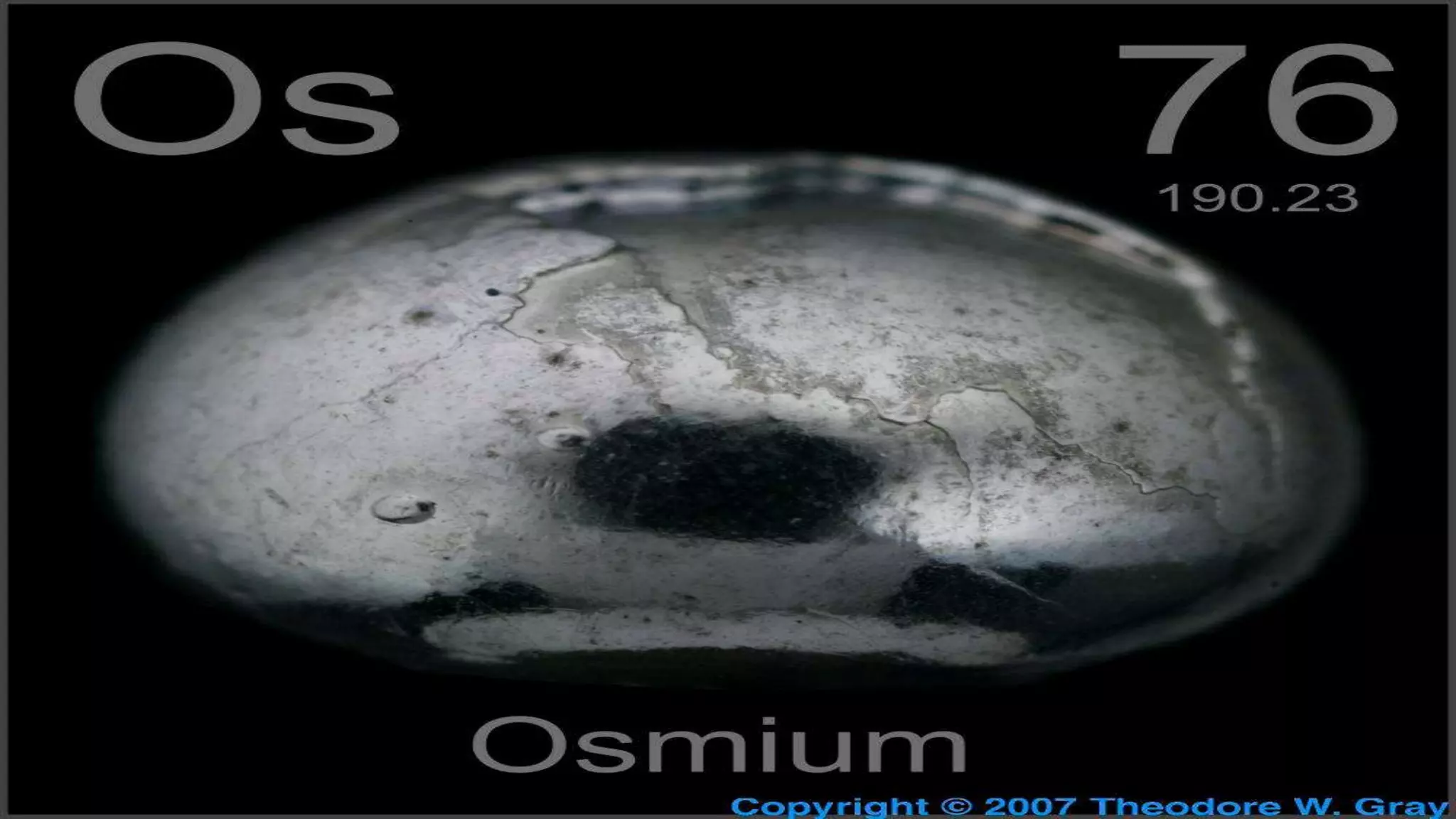
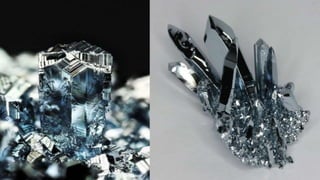
 Colour: blue-gray 
 Boiling Point: 5285K (5012 ° C) 
 Melting Point: 3306K (3033 ° C) 
 Density : 22.61g / cm3
How to get 
 Metallic osmium is hard, brittle and very difficult to make. 
 Powdered osmium is easier to make but emits osmium tetroxide 
(OsO4) when it is exposed to the air. Unfortunately, osmium tetroxide 
smells bad and is very poisonous. Because of these problems, 
osmium is primarily used to make very hard alloys. Osmium alloys 
can be found in ball point pen tips, fountain pen tips, record player 
needles, electrical contacts and other devices where frictional wear 
must be minimized.
Compound 
 Fluorides 
 Osmium hexafluoride: OsF6 
 Osmium octafluoride: OsF8 
 Osmium tetrafluoride: OsF4 
 Osmium heptafluoride: OsF7 
 Osmium pentafluoride: [OsF5]4
Continue… 
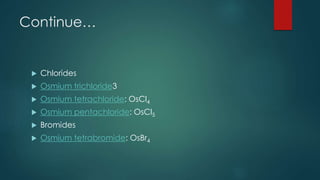
 Chlorides 
 Osmium trichloride3 
 Osmium tetrachloride: OsCl4 
 Osmium pentachloride: OsCl5 
 Bromides 
 Osmium tetrabromide: OsBr4
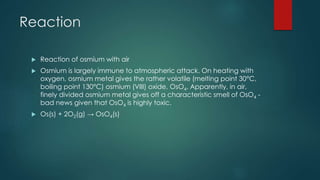
Reaction 
 Reaction of osmium with air 
 Osmium is largely immune to atmospheric attack. On heating with 
oxygen, osmium metal gives the rather volatile (melting point 30°C, 
boiling point 130°C) osmium (VIII) oxide, OsO4. Apparently, in air, 
finely divided osmium metal gives off a characteristic smell of OsO4 - 
bad news given that OsO4 is highly toxic. 
 Os(s) + 2O2(g) → OsO4(s)
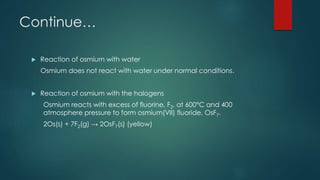
Continue… 
 Reaction of osmium with water 
Osmium does not react with water under normal conditions. 
 Reaction of osmium with the halogens 
Osmium reacts with excess of fluorine, F2, at 600°C and 400 
atmosphere pressure to form osmium(VII) fluoride, OsF7. 
2Os(s) + 7F2(g) → 2OsF7(s) (yellow)
Application 
 Osmium has only a few uses. It is used to produce very hard alloys 
for fountain pen tips, instrument pivots, needles and electrical 
contacts. It is also used in the chemical industry as a catalyst.

Osmium

  • 2.
    History  Osmiumand iridium were discovered at the same time by the British chemist Smithson Tennant in 1803. Osmium and iridium were identified in the black residue remaining after dissolving platinum ore with aqua regia
  • 3.
    Source  Obtainedfrom the same ore with platinum.  Turkey, with 127,000 tonnes, has the world's largest reserves of osmium known.  Bulgaria also has large reserves of about 2500 tons.  These transition metals are also found in iridiosmium, a natural alloy of iridium and osmium, and platinum-bearing river sands in the Ural Mountains, North and South America.
  • 5.
    Properties  GroupName: Platinum group  metal Block: Block D Period: 6  solid at 298 K  Colour: blue-gray  Boiling Point: 5285K (5012 ° C)  Melting Point: 3306K (3033 ° C)  Density : 22.61g / cm3
  • 6.
    How to get  Metallic osmium is hard, brittle and very difficult to make.  Powdered osmium is easier to make but emits osmium tetroxide (OsO4) when it is exposed to the air. Unfortunately, osmium tetroxide smells bad and is very poisonous. Because of these problems, osmium is primarily used to make very hard alloys. Osmium alloys can be found in ball point pen tips, fountain pen tips, record player needles, electrical contacts and other devices where frictional wear must be minimized.
  • 7.
    Compound  Fluorides  Osmium hexafluoride: OsF6  Osmium octafluoride: OsF8  Osmium tetrafluoride: OsF4  Osmium heptafluoride: OsF7  Osmium pentafluoride: [OsF5]4
  • 8.
    Continue…  Chlorides  Osmium trichloride3  Osmium tetrachloride: OsCl4  Osmium pentachloride: OsCl5  Bromides  Osmium tetrabromide: OsBr4
  • 9.
    Reaction  Reactionof osmium with air  Osmium is largely immune to atmospheric attack. On heating with oxygen, osmium metal gives the rather volatile (melting point 30°C, boiling point 130°C) osmium (VIII) oxide, OsO4. Apparently, in air, finely divided osmium metal gives off a characteristic smell of OsO4 - bad news given that OsO4 is highly toxic.  Os(s) + 2O2(g) → OsO4(s)
  • 10.
    Continue…  Reactionof osmium with water Osmium does not react with water under normal conditions.  Reaction of osmium with the halogens Osmium reacts with excess of fluorine, F2, at 600°C and 400 atmosphere pressure to form osmium(VII) fluoride, OsF7. 2Os(s) + 7F2(g) → 2OsF7(s) (yellow)
  • 11.
    Application  Osmiumhas only a few uses. It is used to produce very hard alloys for fountain pen tips, instrument pivots, needles and electrical contacts. It is also used in the chemical industry as a catalyst.