Annotating and Cataloging CNVs in VarSeq
Dr. Nathan Fortier – Director of Research
20 most promising
Biotech Technology
Providers
Top 10 Analytics
Solution Providers
Hype Cycle for
Life sciences
Q & A
Please enter your questions into your GoToWebinar panel
NIH Grant Funding Acknowledgments
▪ Research reported in this publication was supported by the National Institute Of General
Medical Sciences of the National Institutes of Health under:
- Award Number R43GM128485
- Award Number 2R44 GM125432-01
- Award Number 2R44 GM125432-02
▪ PI is Dr. Andreas Scherer, CEO Golden Helix.
▪ The content is solely the responsibility of the authors and does not necessarily represent the
official views of the National Institutes of Health.
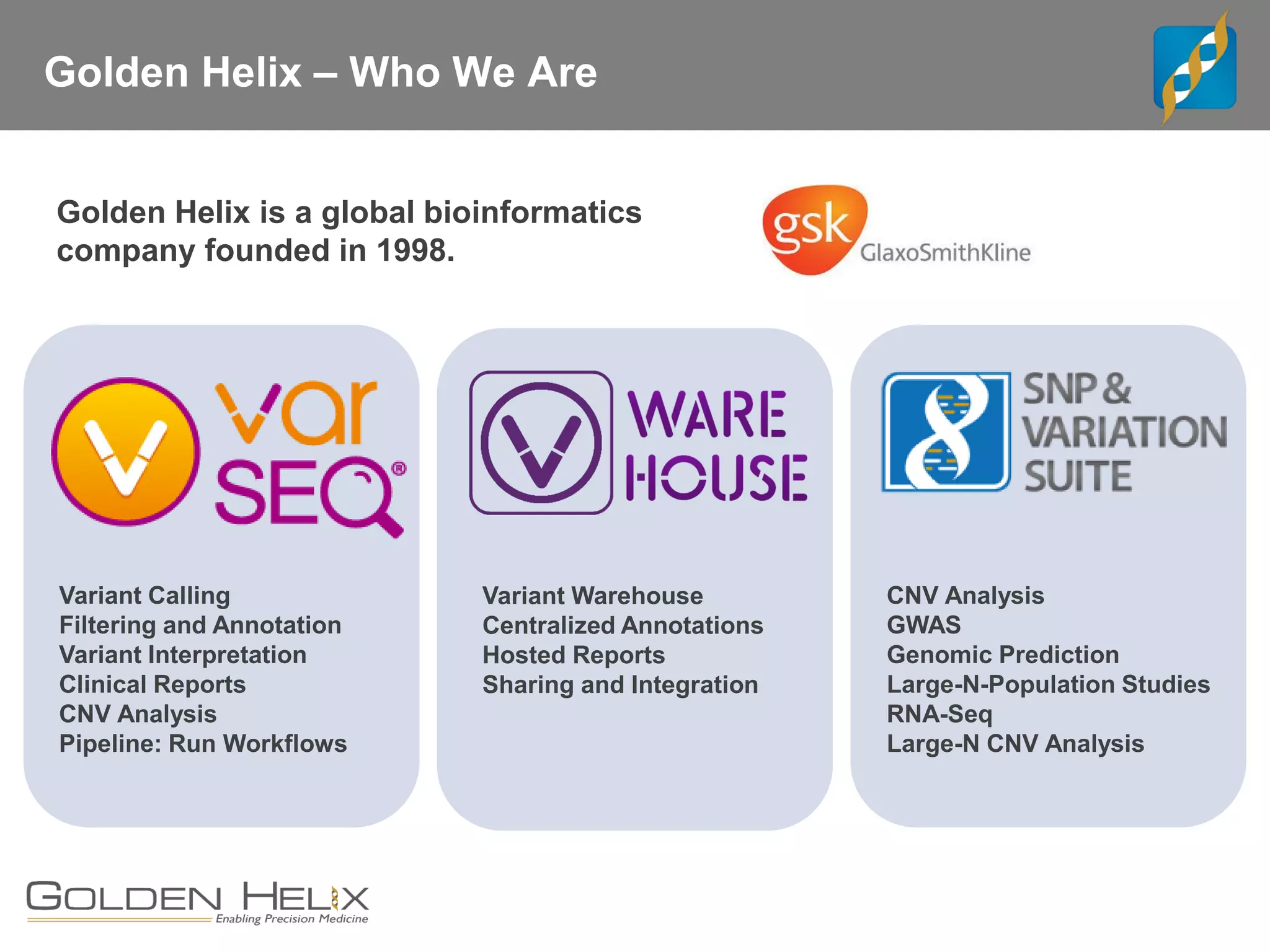
Golden Helix – Who We Are
Golden Helix is a global bioinformatics
company founded in 1998.
CNV Analysis
GWAS
Genomic Prediction
Large-N-Population Studies
RNA-Seq
Large-N CNV Analysis
Variant Warehouse
Centralized Annotations
Hosted Reports
Sharing and Integration
Variant Calling
Filtering and Annotation
Variant Interpretation
Clinical Reports
CNV Analysis
Pipeline: Run Workflows
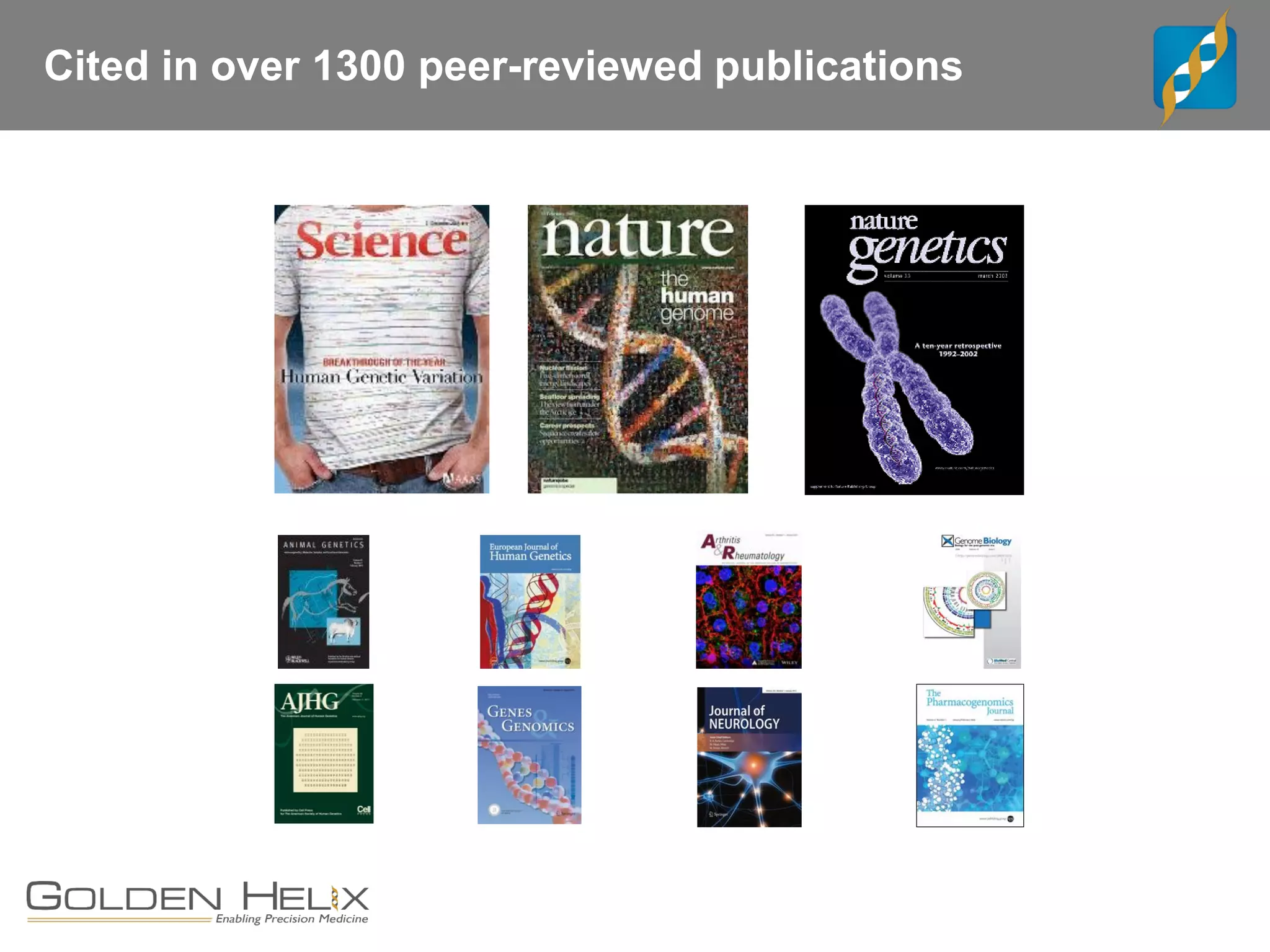
Cited in over 1300 peer-reviewed publications
Over 400 customers globally
Golden Helix – Who We Are
When you choose a Golden Helix solution, you get more than just software
▪ REPUTATION
▪ TRUST
▪ EXPERIENCE
▪ INDUSTRY FOCUS
▪ THOUGHT
LEADERSHIP
▪ COMMUNITY
▪ TRAINING
▪ SUPPORT
▪ RESPONSIVENESS
▪ INNOVATION and
SPEED
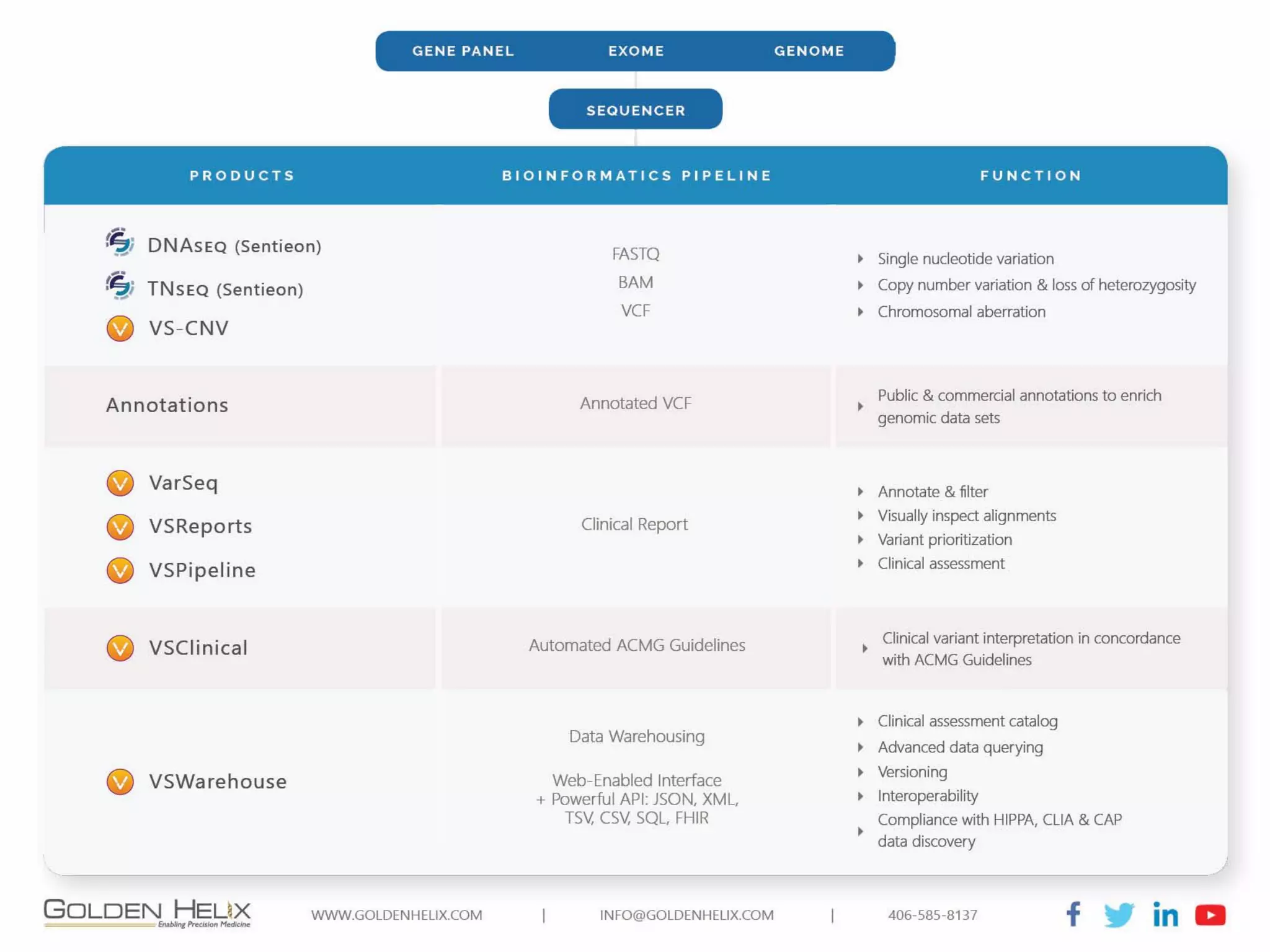
VarSeq Clinical Workflows Stack
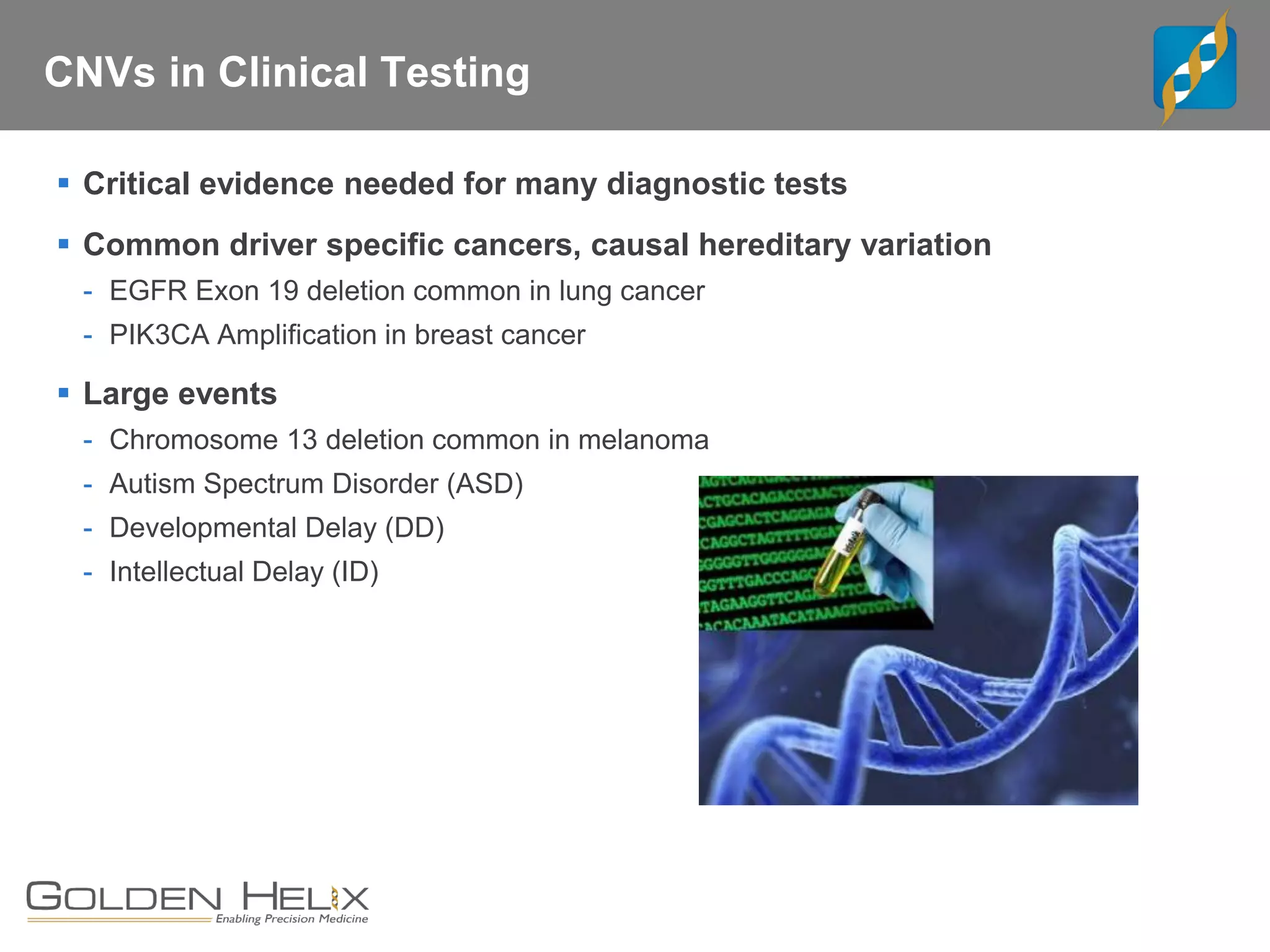
CNVs in Clinical Testing
▪ Critical evidence needed for many diagnostic tests
▪ Common driver specific cancers, causal hereditary variation
- EGFR Exon 19 deletion common in lung cancer
- PIK3CA Amplification in breast cancer
▪ Large events
- Chromosome 13 deletion common in melanoma
- Autism Spectrum Disorder (ASD)
- Developmental Delay (DD)
- Intellectual Delay (ID)
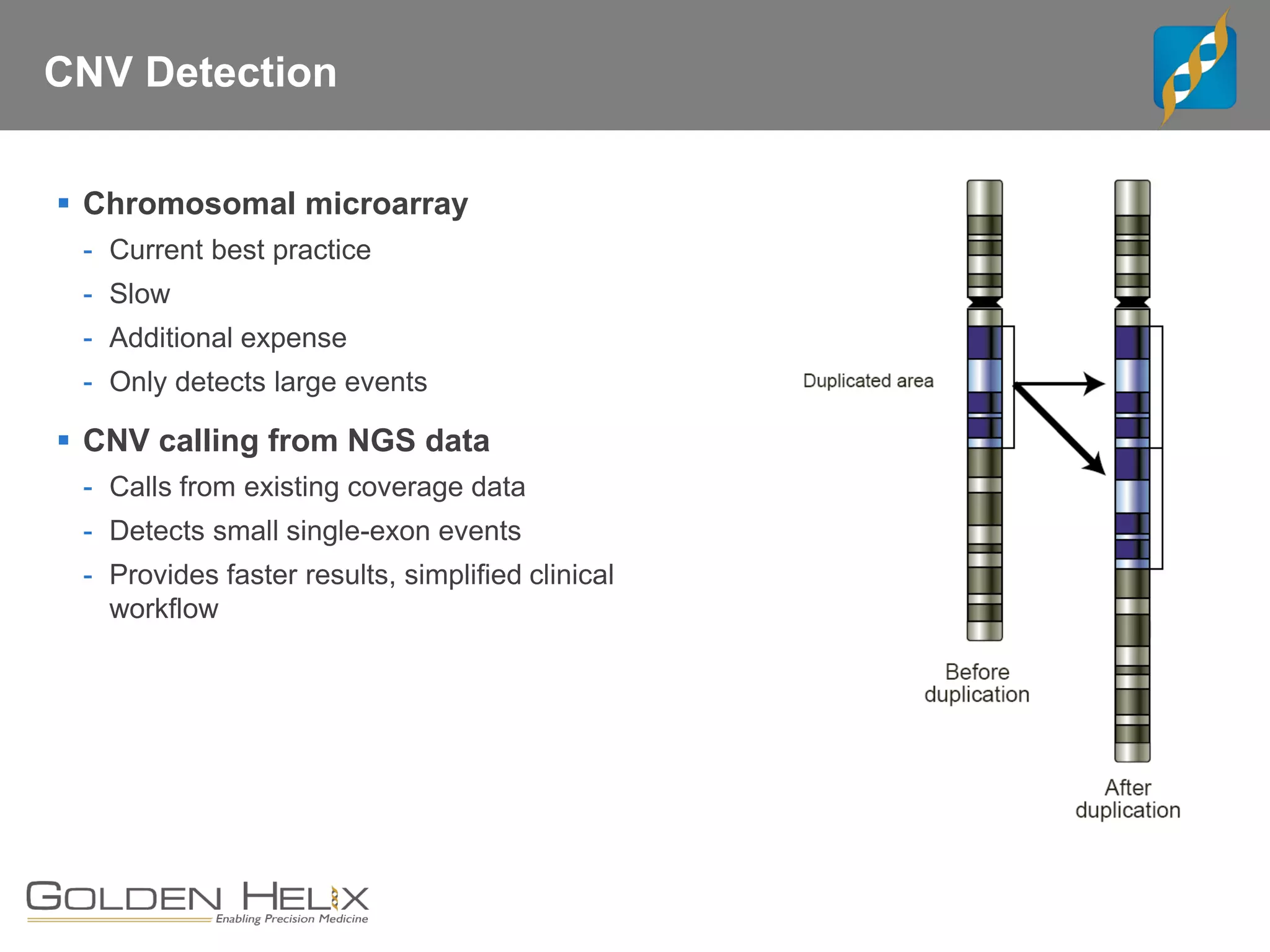
CNV Detection
▪ Chromosomal microarray
- Current best practice
- Slow
- Additional expense
- Only detects large events
▪ CNV calling from NGS data
- Calls from existing coverage data
- Detects small single-exon events
- Provides faster results, simplified clinical
workflow
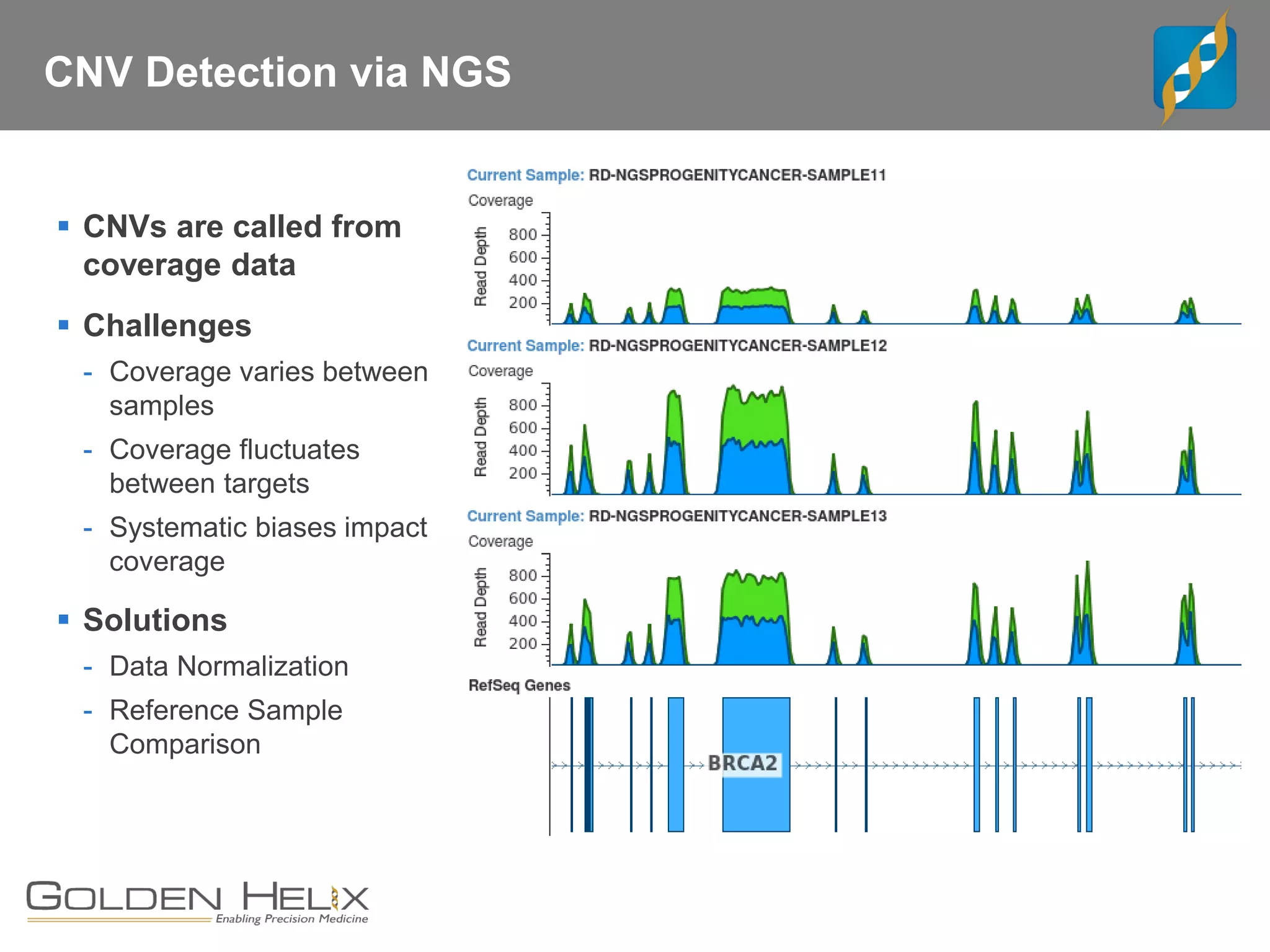
CNV Detection via NGS
▪ CNVs are called from
coverage data
▪ Challenges
- Coverage varies between
samples
- Coverage fluctuates
between targets
- Systematic biases impact
coverage
▪ Solutions
- Data Normalization
- Reference Sample
Comparison
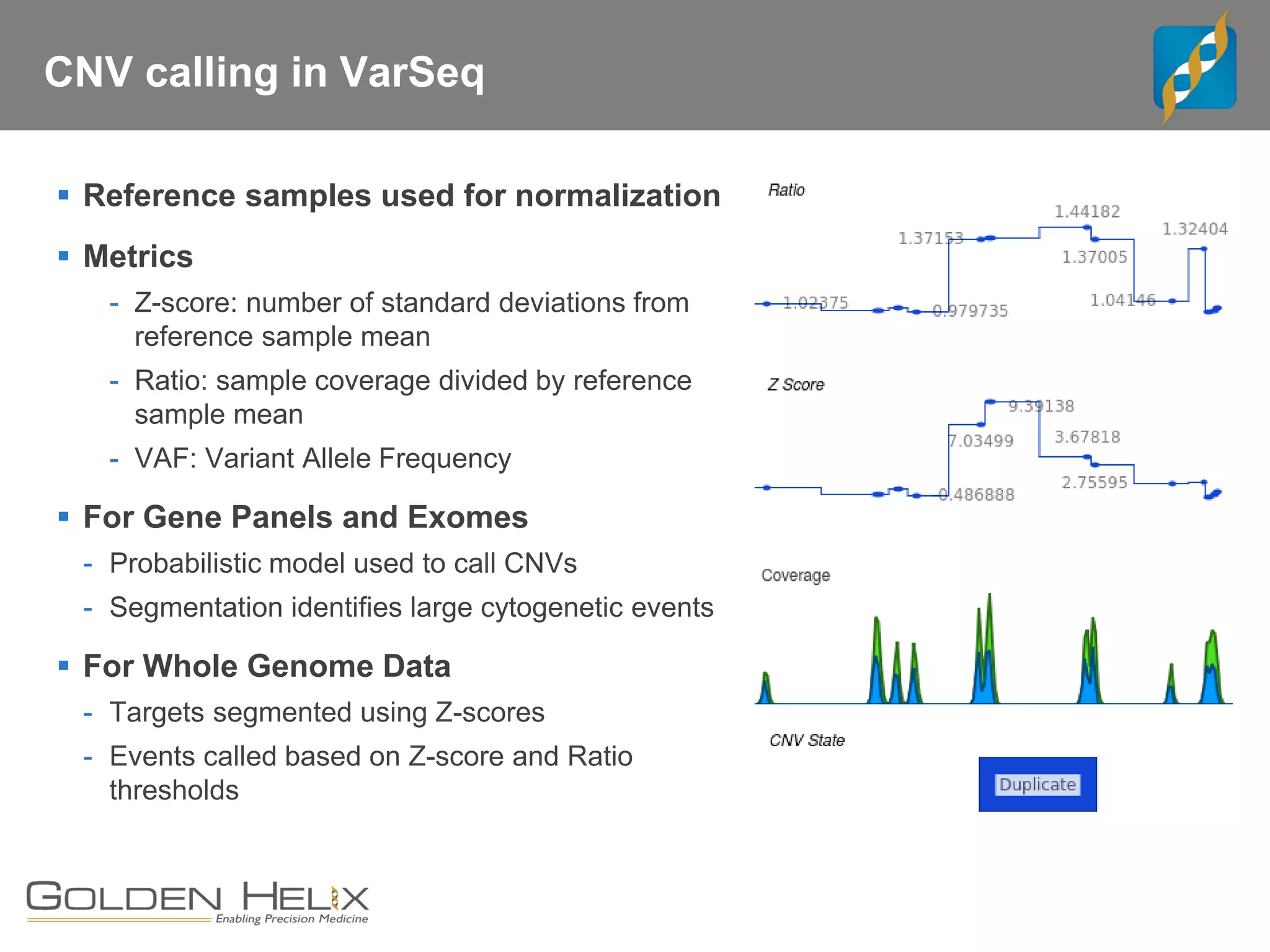
CNV calling in VarSeq
▪ Reference samples used for normalization
▪ Metrics
- Z-score: number of standard deviations from
reference sample mean
- Ratio: sample coverage divided by reference
sample mean
- VAF: Variant Allele Frequency
▪ For Gene Panels and Exomes
- Probabilistic model used to call CNVs
- Segmentation identifies large cytogenetic events
▪ For Whole Genome Data
- Targets segmented using Z-scores
- Events called based on Z-score and Ratio
thresholds
QC Events
▪ Low quality events can be flagged if
- Event targets have low coverage
- There is high variation between samples at event targets
- Event cannot be differentiated from noise at a region
▪ Samples can be flagged if
- The sample does not match the references
- The sample has extremely low coverage
- There is high variance across the target regions
▪ Filtering flagged events improves precision
Reference Samples
▪ Match references are chosen for each
sample
▪ Samples with lowest percent difference
chosen
▪ Performance affected if controls don’t have
matching coverage profile
▪ Samples are flagged if the average percent
difference is above 20%
Requirements
▪ 100x Coverage
▪ Reference samples
- Recommend at least 30 references
- From same platform and library
preparation
- Automatic gender matched references
for non-autosomal calls
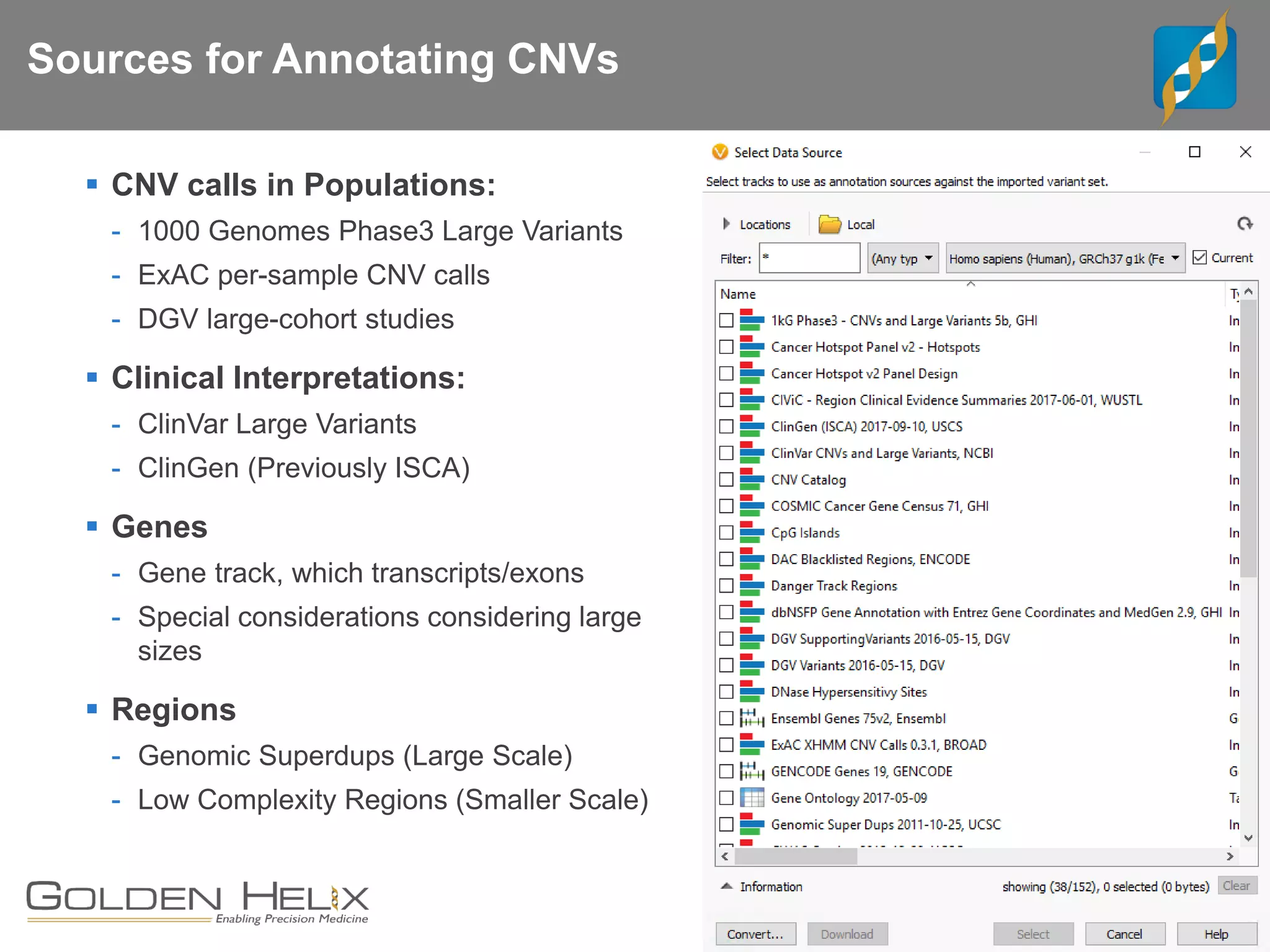
▪ CNV calls in Populations:
- 1000 Genomes Phase3 Large Variants
- ExAC per-sample CNV calls
- DGV large-cohort studies
▪ Clinical Interpretations:
- ClinVar Large Variants
- ClinGen (Previously ISCA)
▪ Genes
- Gene track, which transcripts/exons
- Special considerations considering large
sizes
▪ Regions
- Genomic Superdups (Large Scale)
- Low Complexity Regions (Smaller Scale)
Sources for Annotating CNVs
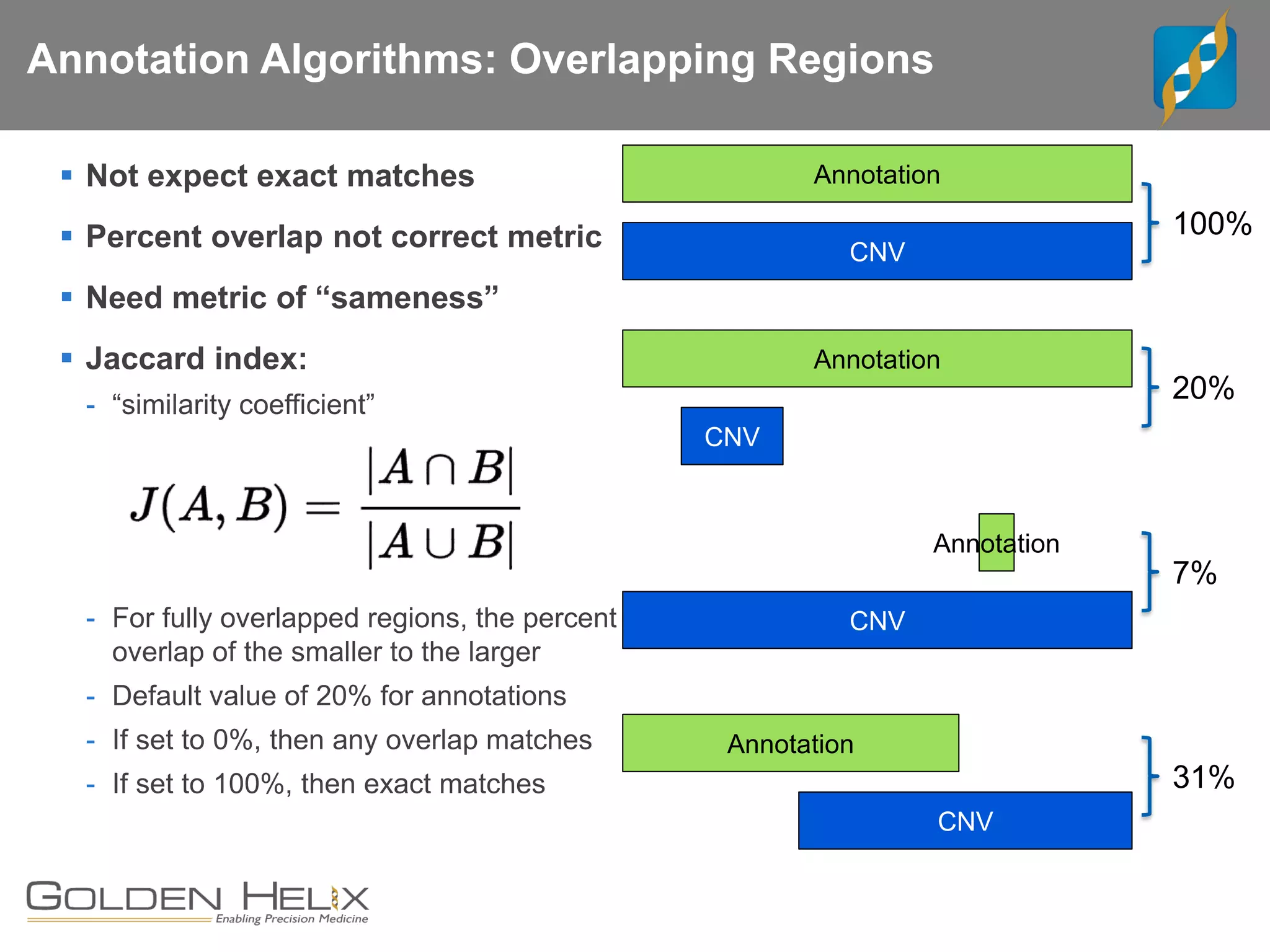
Annotation Algorithms: Overlapping Regions
CNV
Annotation
CNV
Annotation
CNV
Annotation
CNV
Annotation
▪ Not expect exact matches
▪ Percent overlap not correct metric
▪ Need metric of “sameness”
▪ Jaccard index:
- “similarity coefficient”
- For fully overlapped regions, the percent
overlap of the smaller to the larger
- Default value of 20% for annotations
- If set to 0%, then any overlap matches
- If set to 100%, then exact matches
100%
20%
7%
31%
VarSeq Demonstration
NIH Grant Funding Acknowledgments
▪ Research reported in this publication was supported by the National Institute Of General
Medical Sciences of the National Institutes of Health under:
- Award Number R43GM128485
- Award Number 2R44 GM125432-01
- Award Number 2R44 GM125432-02
▪ PI is Dr. Andreas Scherer, CEO Golden Helix.
▪ The content is solely the responsibility of the authors and does not necessarily represent the
official views of the National Institutes of Health.
Q & A
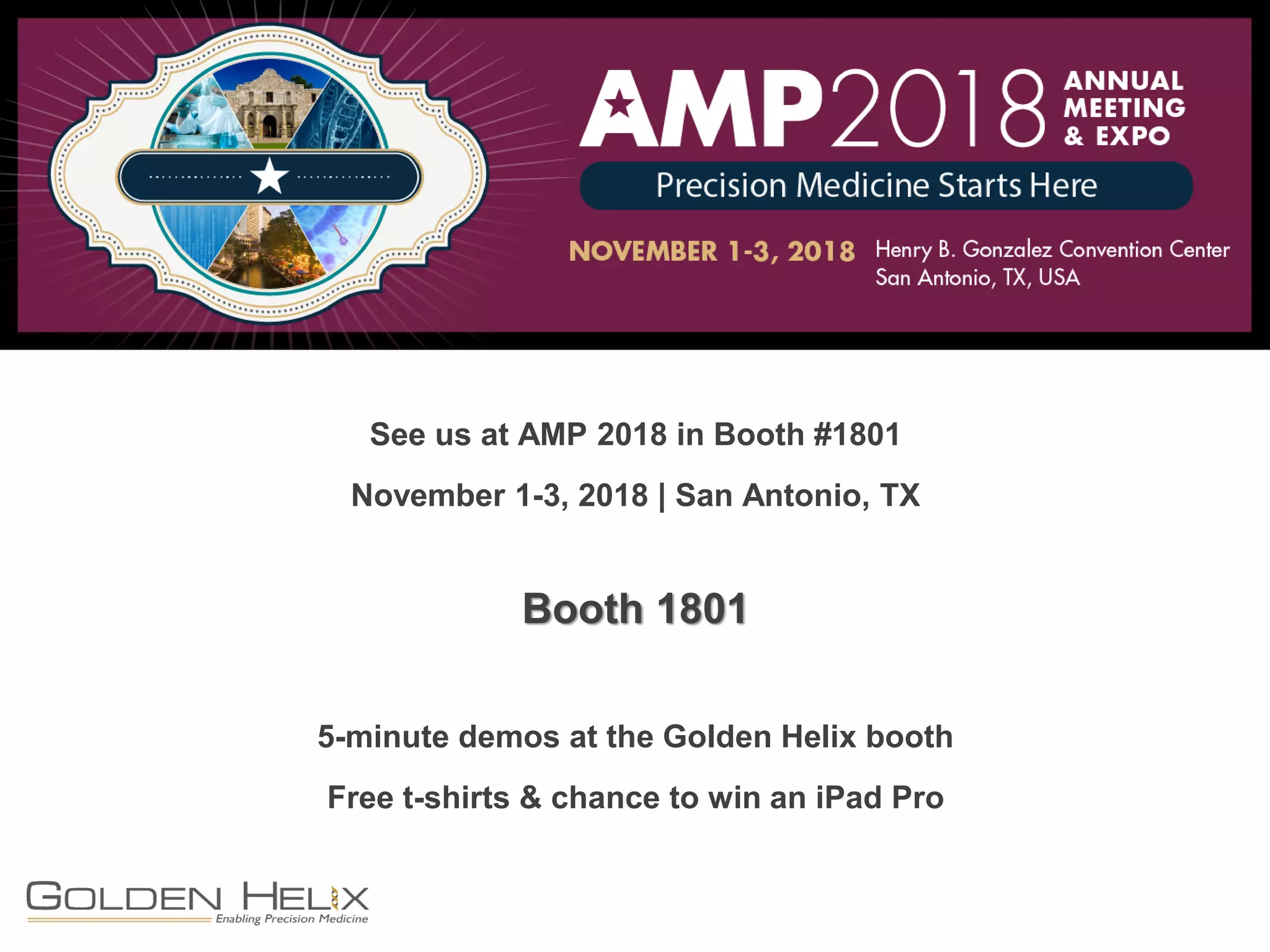
AMP 2018 – Annual Meeting & Expo
See us at AMP 2018 in Booth #1801
November 1-3, 2018 | San Antonio, TX
Booth 1801
5-minute demos at the Golden Helix booth
Free t-shirts & chance to win an iPad Pro
Q & A

Annotating and Cataloging CNVs in VarSeq

  • 1.
    Annotating and CatalogingCNVs in VarSeq Dr. Nathan Fortier – Director of Research 20 most promising Biotech Technology Providers Top 10 Analytics Solution Providers Hype Cycle for Life sciences
  • 2.
    Q & A Pleaseenter your questions into your GoToWebinar panel
  • 3.
    NIH Grant FundingAcknowledgments ▪ Research reported in this publication was supported by the National Institute Of General Medical Sciences of the National Institutes of Health under: - Award Number R43GM128485 - Award Number 2R44 GM125432-01 - Award Number 2R44 GM125432-02 ▪ PI is Dr. Andreas Scherer, CEO Golden Helix. ▪ The content is solely the responsibility of the authors and does not necessarily represent the official views of the National Institutes of Health.
  • 4.
    Golden Helix –Who We Are Golden Helix is a global bioinformatics company founded in 1998. CNV Analysis GWAS Genomic Prediction Large-N-Population Studies RNA-Seq Large-N CNV Analysis Variant Warehouse Centralized Annotations Hosted Reports Sharing and Integration Variant Calling Filtering and Annotation Variant Interpretation Clinical Reports CNV Analysis Pipeline: Run Workflows
  • 5.
    Cited in over1300 peer-reviewed publications
  • 6.
  • 7.
    Golden Helix –Who We Are When you choose a Golden Helix solution, you get more than just software ▪ REPUTATION ▪ TRUST ▪ EXPERIENCE ▪ INDUSTRY FOCUS ▪ THOUGHT LEADERSHIP ▪ COMMUNITY ▪ TRAINING ▪ SUPPORT ▪ RESPONSIVENESS ▪ INNOVATION and SPEED
  • 8.
  • 9.
    CNVs in ClinicalTesting ▪ Critical evidence needed for many diagnostic tests ▪ Common driver specific cancers, causal hereditary variation - EGFR Exon 19 deletion common in lung cancer - PIK3CA Amplification in breast cancer ▪ Large events - Chromosome 13 deletion common in melanoma - Autism Spectrum Disorder (ASD) - Developmental Delay (DD) - Intellectual Delay (ID)
  • 10.
    CNV Detection ▪ Chromosomalmicroarray - Current best practice - Slow - Additional expense - Only detects large events ▪ CNV calling from NGS data - Calls from existing coverage data - Detects small single-exon events - Provides faster results, simplified clinical workflow
  • 11.
    CNV Detection viaNGS ▪ CNVs are called from coverage data ▪ Challenges - Coverage varies between samples - Coverage fluctuates between targets - Systematic biases impact coverage ▪ Solutions - Data Normalization - Reference Sample Comparison
  • 12.
    CNV calling inVarSeq ▪ Reference samples used for normalization ▪ Metrics - Z-score: number of standard deviations from reference sample mean - Ratio: sample coverage divided by reference sample mean - VAF: Variant Allele Frequency ▪ For Gene Panels and Exomes - Probabilistic model used to call CNVs - Segmentation identifies large cytogenetic events ▪ For Whole Genome Data - Targets segmented using Z-scores - Events called based on Z-score and Ratio thresholds
  • 13.
    QC Events ▪ Lowquality events can be flagged if - Event targets have low coverage - There is high variation between samples at event targets - Event cannot be differentiated from noise at a region ▪ Samples can be flagged if - The sample does not match the references - The sample has extremely low coverage - There is high variance across the target regions ▪ Filtering flagged events improves precision
  • 14.
    Reference Samples ▪ Matchreferences are chosen for each sample ▪ Samples with lowest percent difference chosen ▪ Performance affected if controls don’t have matching coverage profile ▪ Samples are flagged if the average percent difference is above 20%
  • 15.
    Requirements ▪ 100x Coverage ▪Reference samples - Recommend at least 30 references - From same platform and library preparation - Automatic gender matched references for non-autosomal calls
  • 16.
    ▪ CNV callsin Populations: - 1000 Genomes Phase3 Large Variants - ExAC per-sample CNV calls - DGV large-cohort studies ▪ Clinical Interpretations: - ClinVar Large Variants - ClinGen (Previously ISCA) ▪ Genes - Gene track, which transcripts/exons - Special considerations considering large sizes ▪ Regions - Genomic Superdups (Large Scale) - Low Complexity Regions (Smaller Scale) Sources for Annotating CNVs
  • 17.
    Annotation Algorithms: OverlappingRegions CNV Annotation CNV Annotation CNV Annotation CNV Annotation ▪ Not expect exact matches ▪ Percent overlap not correct metric ▪ Need metric of “sameness” ▪ Jaccard index: - “similarity coefficient” - For fully overlapped regions, the percent overlap of the smaller to the larger - Default value of 20% for annotations - If set to 0%, then any overlap matches - If set to 100%, then exact matches 100% 20% 7% 31%
  • 18.
  • 19.
    NIH Grant FundingAcknowledgments ▪ Research reported in this publication was supported by the National Institute Of General Medical Sciences of the National Institutes of Health under: - Award Number R43GM128485 - Award Number 2R44 GM125432-01 - Award Number 2R44 GM125432-02 ▪ PI is Dr. Andreas Scherer, CEO Golden Helix. ▪ The content is solely the responsibility of the authors and does not necessarily represent the official views of the National Institutes of Health.
  • 20.
  • 21.
    AMP 2018 –Annual Meeting & Expo See us at AMP 2018 in Booth #1801 November 1-3, 2018 | San Antonio, TX Booth 1801 5-minute demos at the Golden Helix booth Free t-shirts & chance to win an iPad Pro
  • 22.