



Exome Analysis with VS-CNV and
VSClinical: Updated Strategies and
Expanded Capabilities
April 7, 2021
Presented by Gabe Rudy, VP of Product & Engineering
2
Any Questions?
Exome Analysis with VS-CNV and
VSClinical: Updated Strategies and
Expanded Capabilities
April 7, 2021
Presented by Gabe Rudy, VP of Product & Engineering
NIH Grant Funding Acknowledgments
4
• Research reported in this publication was supported by the National Institute Of General Medical Sciences of the
National Institutes of Health under:
o Award Number R43GM128485-01
o Award Number R43GM128485-02
o Award Number 2R44 GM125432-01
o Award Number 2R44 GM125432-02
o Montana SMIR/STTR Matching Funds Program Grant Agreement Number 19-51-RCSBIR-005
• PI is Dr. Andreas Scherer, CEO of Golden Helix.
• The content is solely the responsibility of the authors and does not necessarily represent the official views of the National
Institutes of Health.
Who Are We?
5
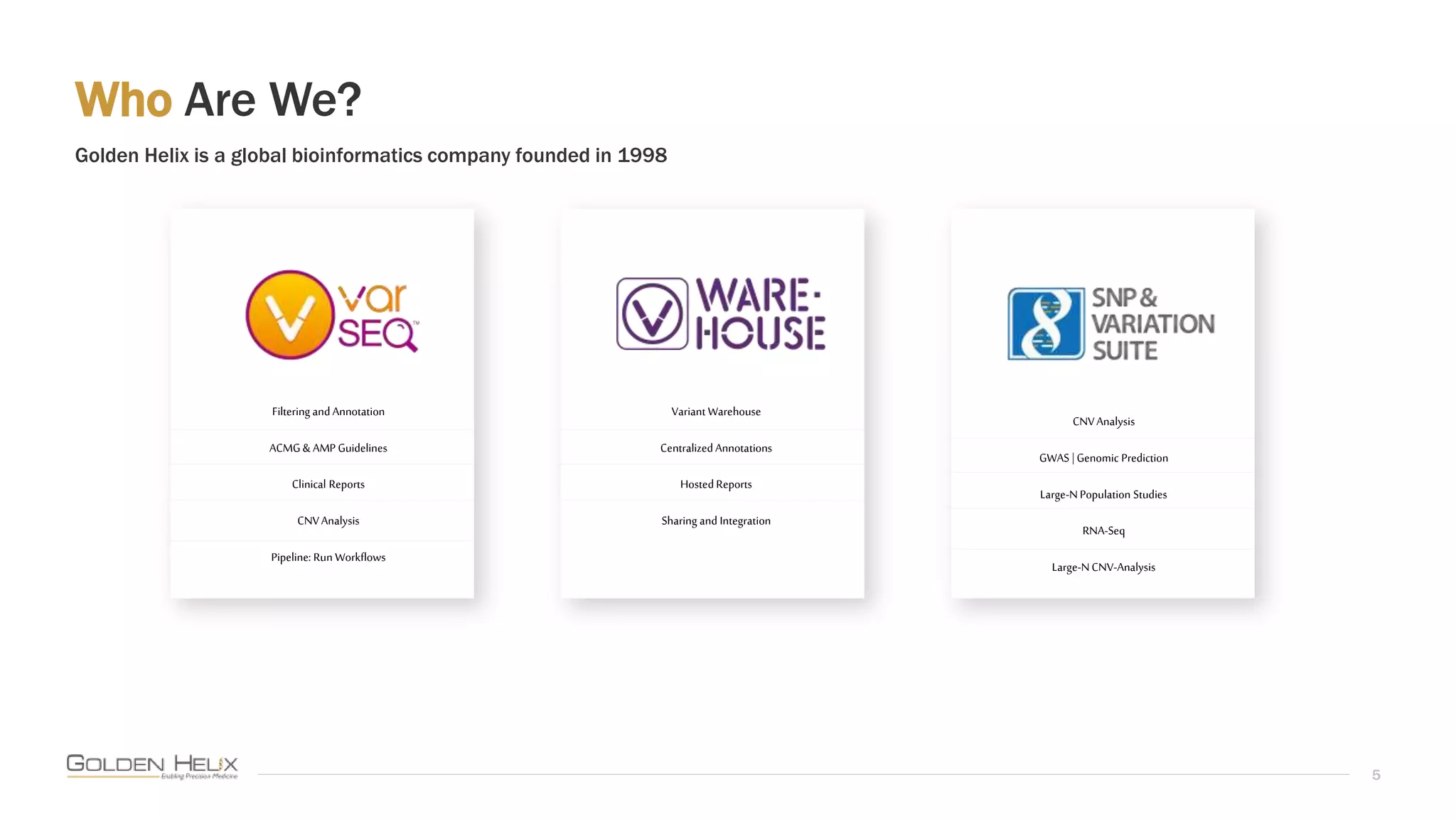
Golden Helix is a global bioinformatics company founded in 1998
Filtering and Annotation
ACMG & AMP Guidelines
Clinical Reports
CNVAnalysis
Pipeline: Run Workflows
CNVAnalysis
GWAS |Genomic Prediction
Large-NPopulation Studies
RNA-Seq
Large-NCNV-Analysis
Variant Warehouse
CentralizedAnnotations
Hosted Reports
Sharing and Integration
Cited in 1,000s of Peer-Reviewed Publications
6
Over 400 Customers Globally
7
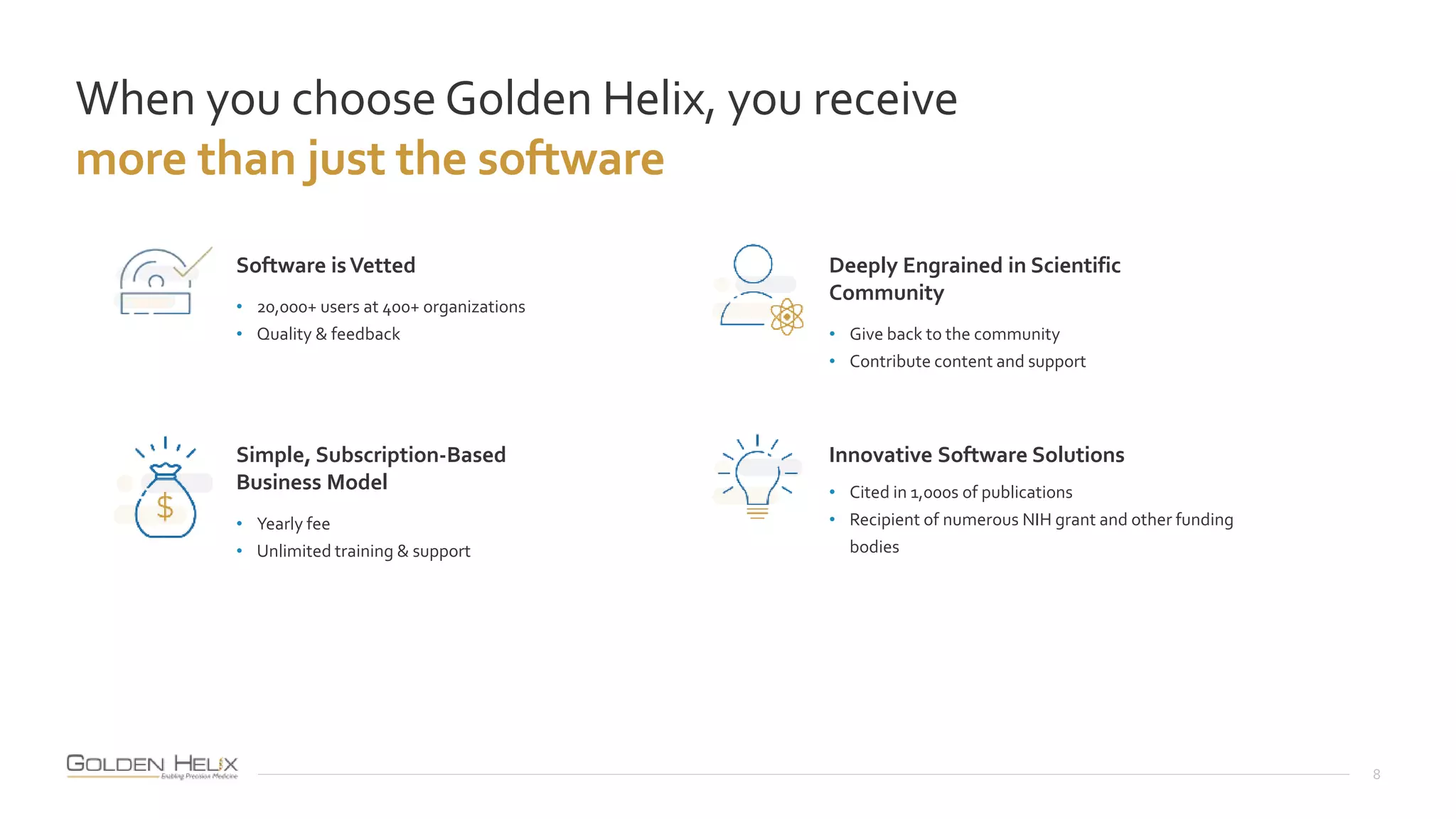
When you choose Golden Helix, you receive
more than just the software
8
Software isVetted
• 20,000+ users at 400+ organizations
• Quality & feedback
Simple, Subscription-Based
Business Model
• Yearly fee
• Unlimited training & support
Deeply Engrained in Scientific
Community
• Give back to the community
• Contribute content and support
Innovative Software Solutions
• Cited in 1,000s of publications
• Recipient of numerous NIH grant and other funding
bodies
9
Content Overview
10
Demonstration
Deep dive into new features and compile all variant
interpretation into a synchronized report
Enhanced variant analysis
Analyzing splice site, non-coding RNA, and
mitochondrial variants
Whole Exome CNV analysis
Relevance and improvements to exome CNV calling in
VarSeq
• Gene panels versus exomes
o Importance of exome analysis for evaluating complex
disorders and diagnostic testing
• Variant discovery with exome data
o Detect non-traditional clinically relevant variants
• Assembling a report
o Generate a report to include clinical variants, incidental
findings and gene coverage
11
Whole Exome Analysis
12
Quick Poll
Do you have or plan to have any exome-based tests for
research or clinical purposes?
1. Currently use exomes for clinical purposes
2. Currently use exomes for research purposes
3. Plan to implement exomes in the future
4. Not currently using exomes, no plans
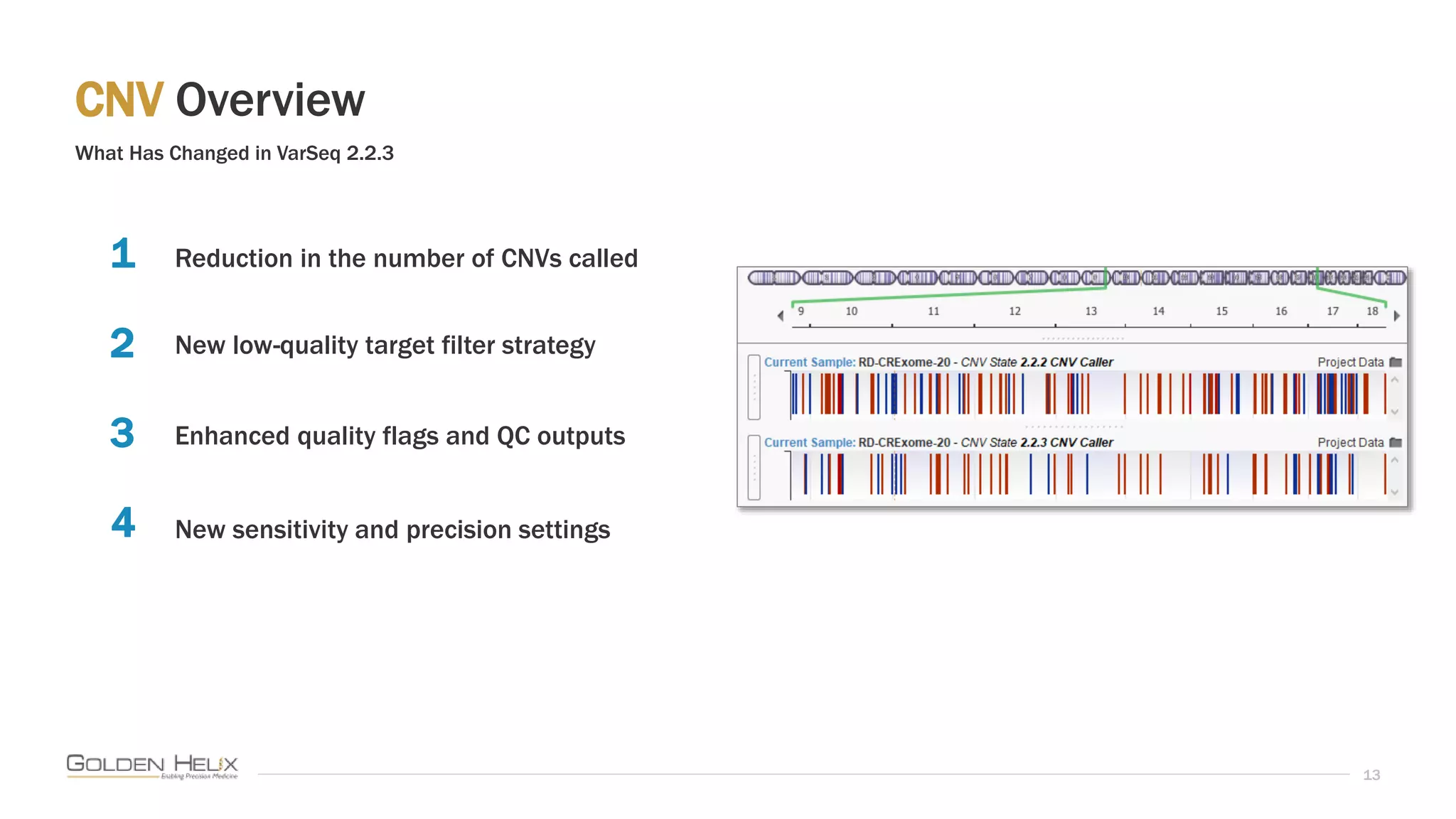
CNV Overview
13
Reduction in the number of CNVs called
1
2
3
4
New low-quality target filter strategy
Enhanced quality flags and QC outputs
New sensitivity and precision settings
What Has Changed in VarSeq 2.2.3
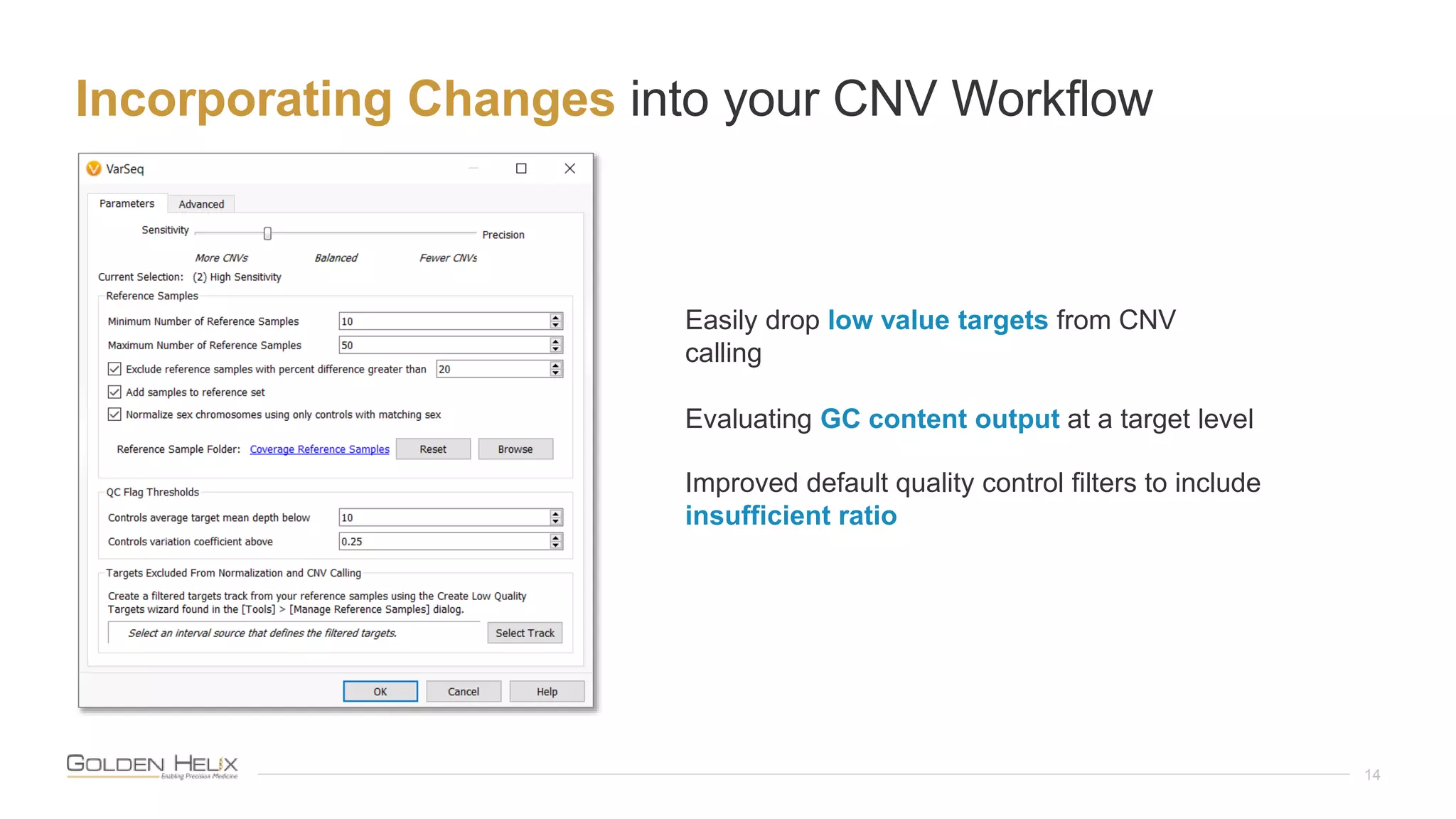
Incorporating Changes into your CNV Workflow
14
Easily drop low value targets from CNV
calling
Evaluating GC content output at a target level
Improved default quality control filters to include
insufficient ratio
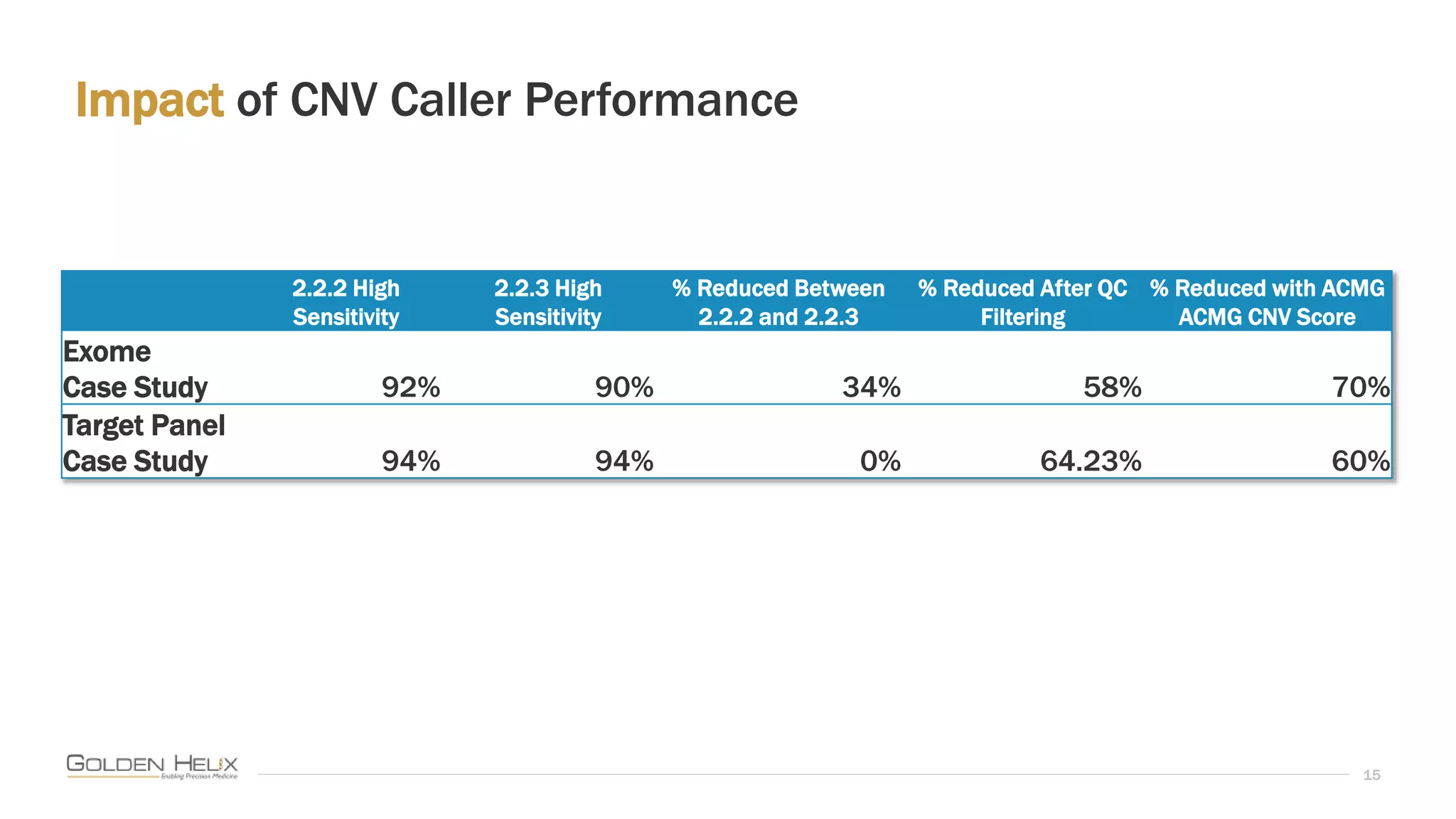
Impact of CNV Caller Performance
15
2.2.2 High
Sensitivity
2.2.3 High
Sensitivity
% Reduced Between
2.2.2 and 2.2.3
% Reduced After QC
Filtering
% Reduced with ACMG
ACMG CNV Score
Exome
Case Study 92% 90% 34% 58% 70%
Target Panel
Case Study 94% 94% 0% 64.23% 60%
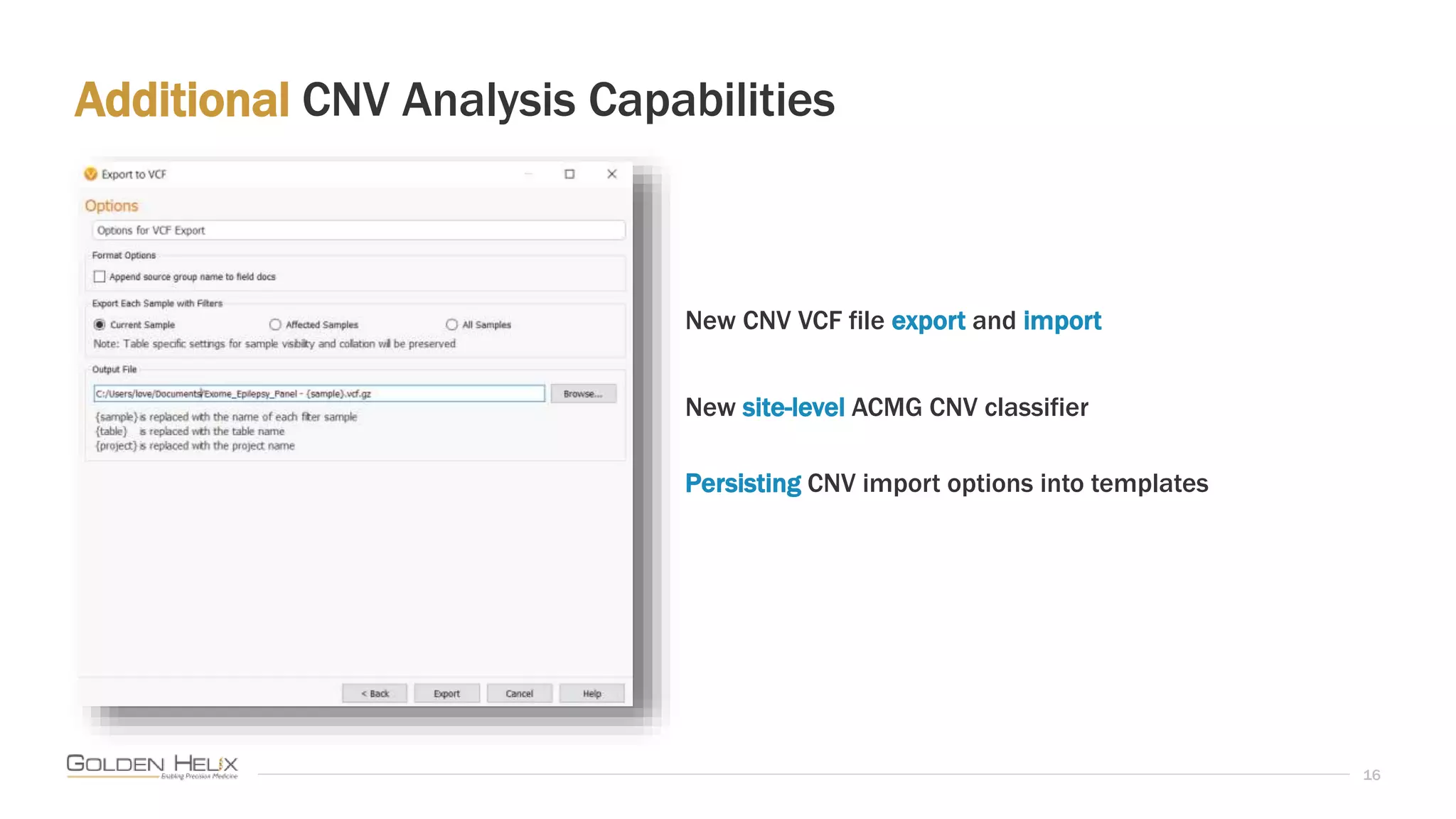
Additional CNV Analysis Capabilities
16
New CNV VCF file export and import
New site-level ACMG CNV classifier
Persisting CNV import options into templates
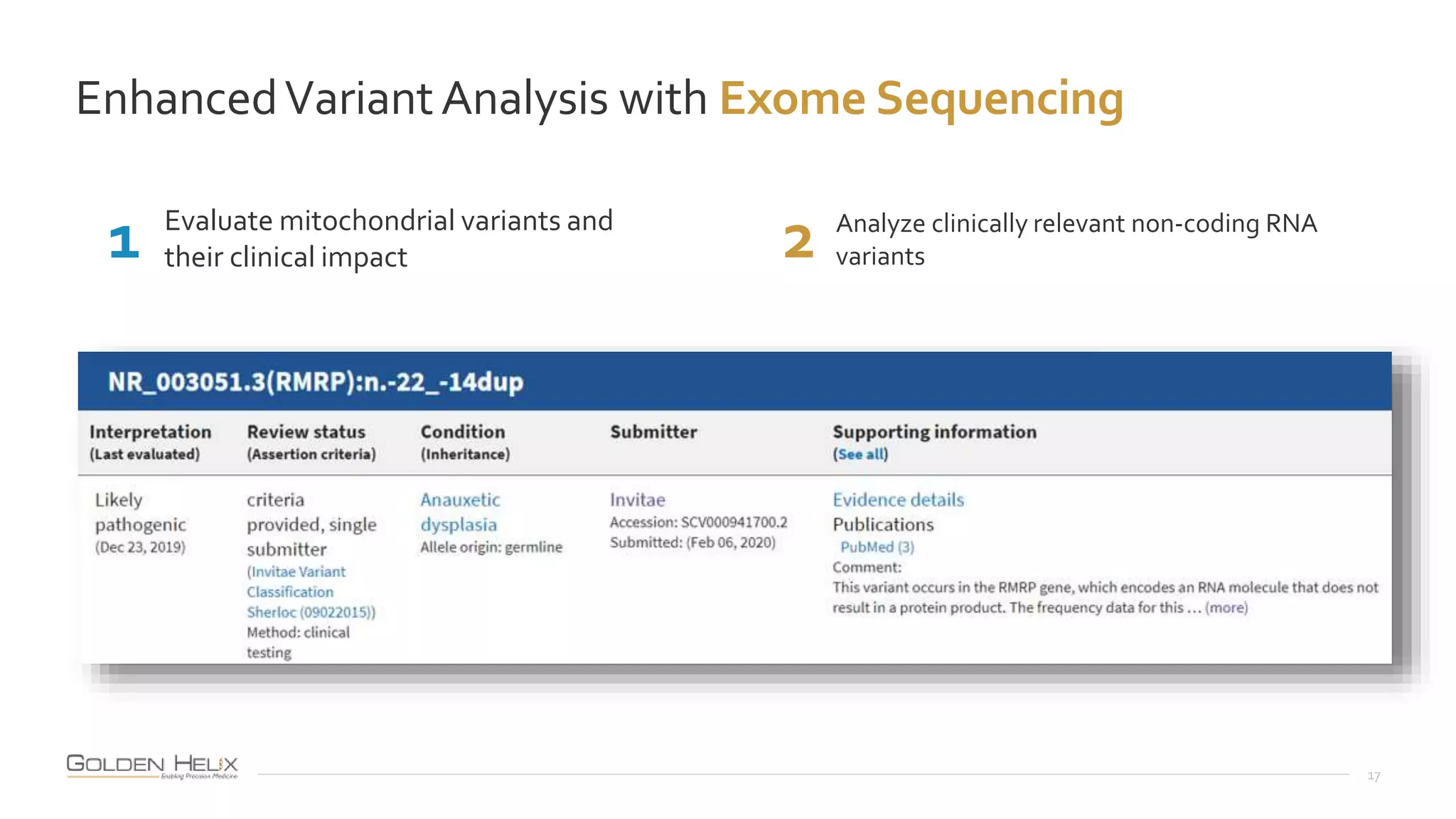
17
Evaluate mitochondrial variants and
their clinical impact
1 2 Analyze clinically relevant non-coding RNA
variants
EnhancedVariantAnalysis with Exome Sequencing
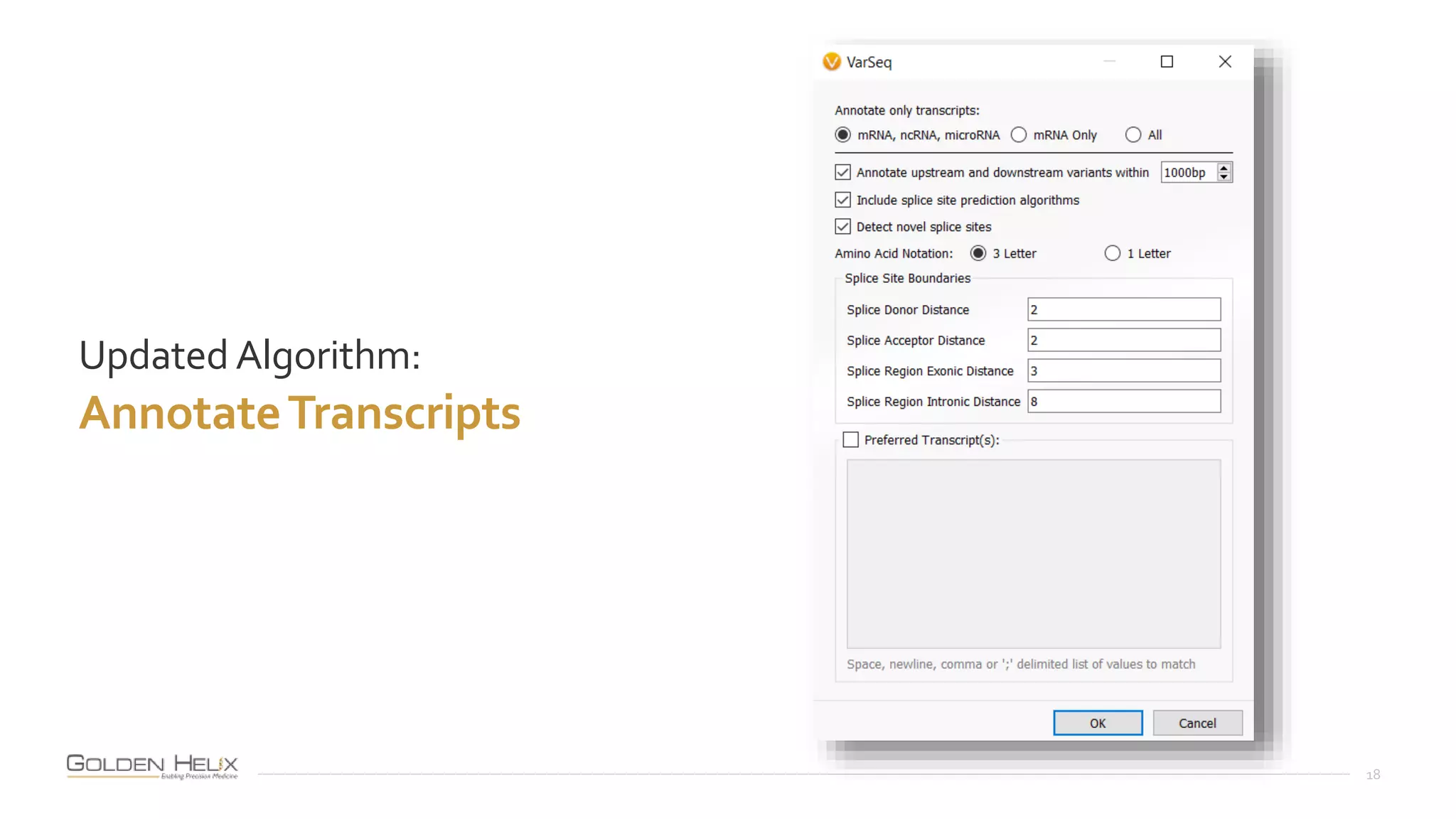
Updated Algorithm:
AnnotateTranscripts
18
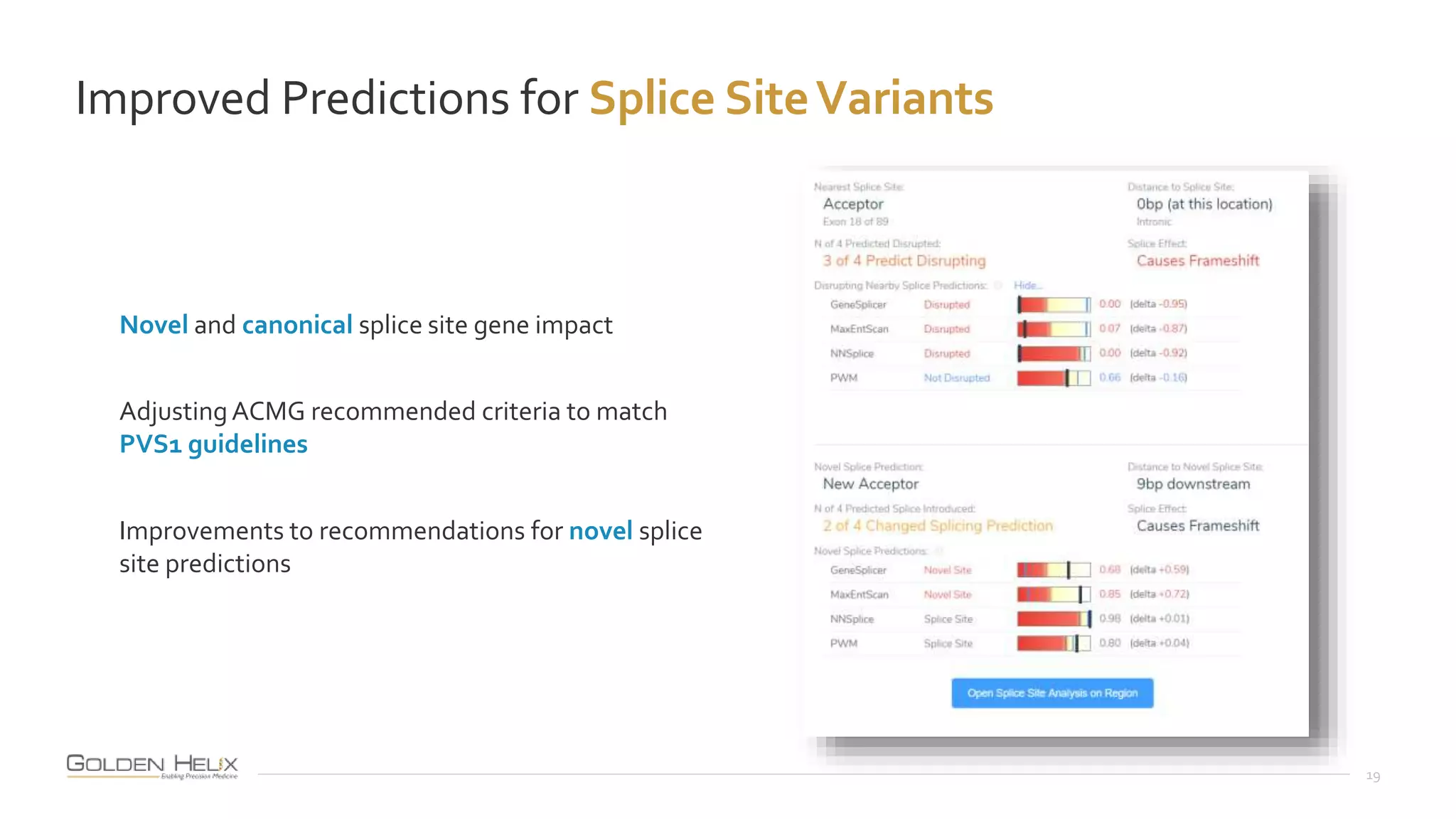
Improved Predictions for Splice SiteVariants
19
Novel and canonical splice site gene impact
AdjustingACMG recommended criteria to match
PVS1 guidelines
Improvements to recommendations for novel splice
site predictions
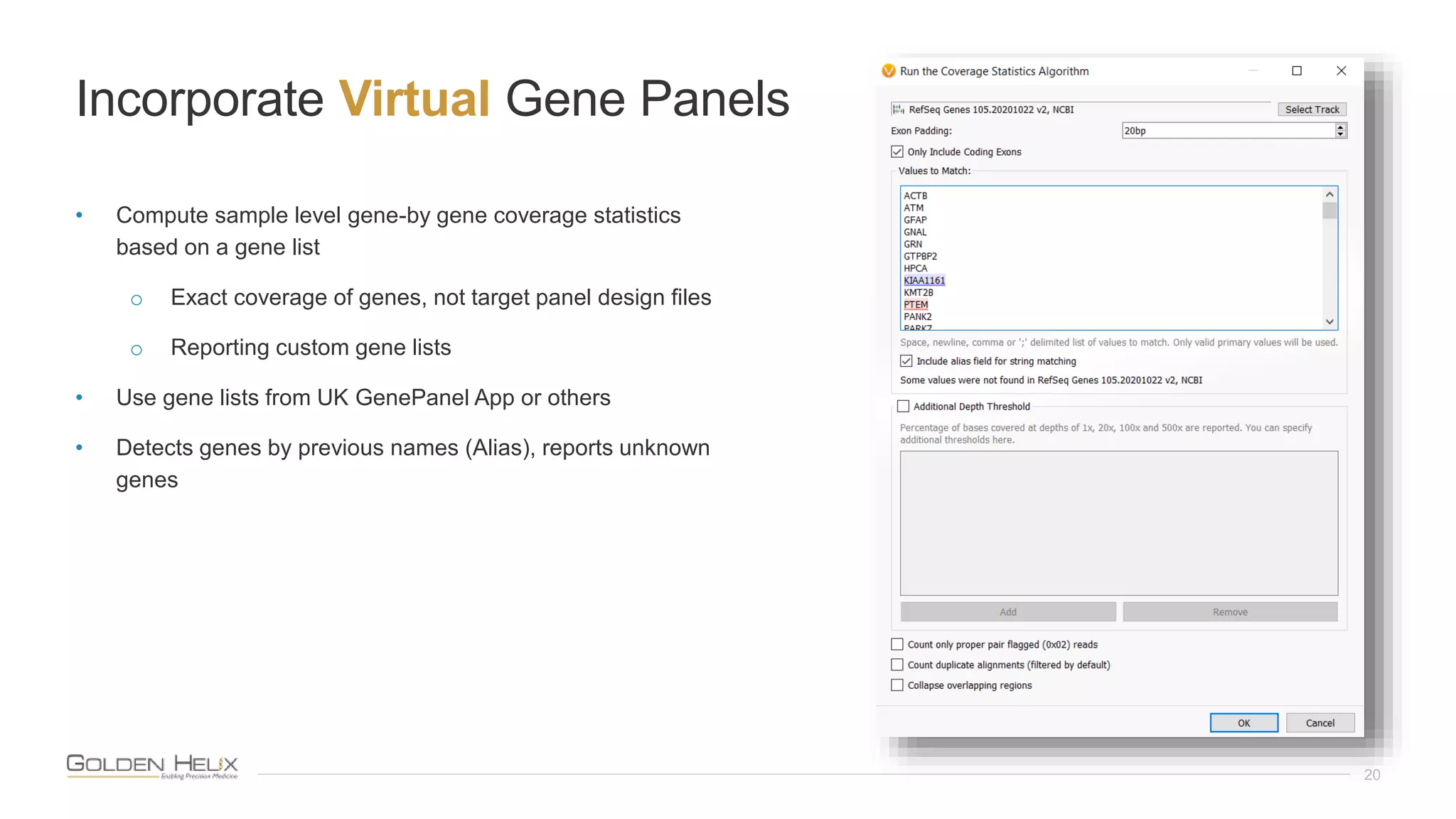
• Compute sample level gene-by gene coverage statistics
based on a gene list
o Exact coverage of genes, not target panel design files
o Reporting custom gene lists
• Use gene lists from UK GenePanel App or others
• Detects genes by previous names (Alias), reports unknown
genes
Incorporate Virtual Gene Panels
20
21
Product Demo
NIH Grant Funding Acknowledgments
22
• Research reported in this publication was supported by the National Institute Of General Medical Sciences of the
National Institutes of Health under:
o Award Number R43GM128485-01
o Award Number R43GM128485-02
o Award Number 2R44 GM125432-01
o Award Number 2R44 GM125432-02
o Montana SMIR/STTR Matching Funds Program Grant Agreement Number 19-51-RCSBIR-005
• PI is Dr. Andreas Scherer, CEO of Golden Helix.
• The content is solely the responsibility of the authors and does not necessarily represent the official views of the National
Institutes of Health.
Become aGolden Helix Genomic Curator
23
• We are now accepting applications to become a Genomic Curator!
• Looking for experienced variant interpretation scientists with a background in oncology and targeted molecular therapy
reporting
• How to apply:
• Resume
• Sample of writing (variant or biomarker interpretations)
• Send to personnel@goldenhelix.com
24
Any Questions?
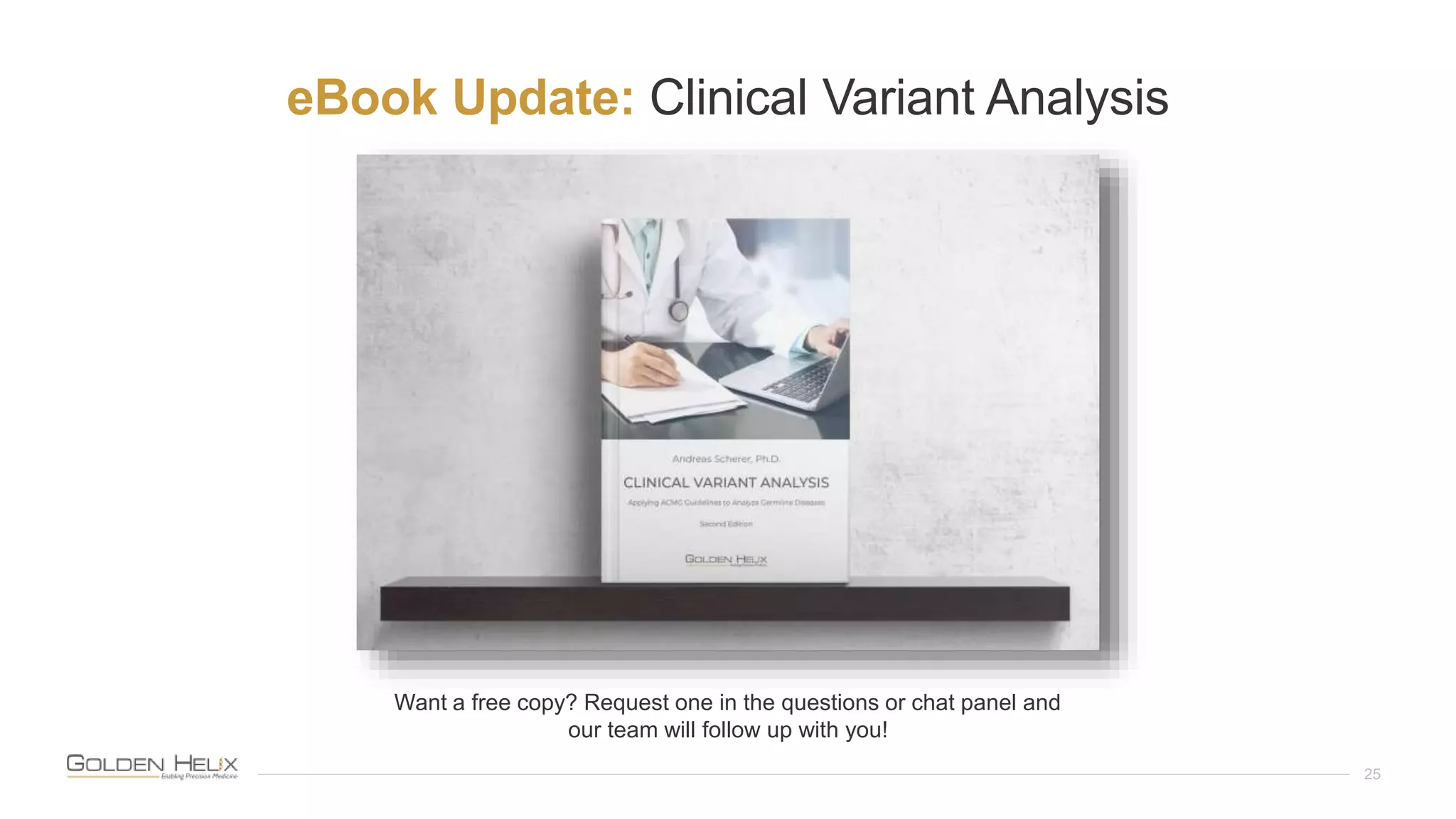
eBook Update: Clinical Variant Analysis
25
Want a free copy? Request one in the questions or chat panel and
our team will follow up with you!
COVID-19 Publications &Articles
26
Investigating the Global Spread of SARS-CoV-2 Leveraging Next-
Gen Sequencing and Principal ComponentAnalysis
European Journal of Clinical and Biomedical Sciences
Christiane Scherer, James Grover, Darby Kammeraad, Gabe Rudy, Andreas Scherer
Diagnosing andTracking COVID-19 Infections Leveraging Next-
Gen Sequencing
The Journal of Precision Medicine Feature | Andreas Scherer, Christiane Scherer
Golden Helix: Enabling Precision Medicine with Cutting-Edge NGS
Technologies
Clinical OMICs Feature
Leveraging Next-Generation SequencingTechnology in the Fight
Against COVID-19
Clinical Lab Manager Feature | Andreas Scherer
SARS-CoV-2Global Spreading Investigation using Principal
ComponentAnalysis of SequenceVariants
Journal of Genetics and Genome Research
Christiane Scherer, James Grover, Darby Kammeraad, Gabe Rudy, Andreas Scherer
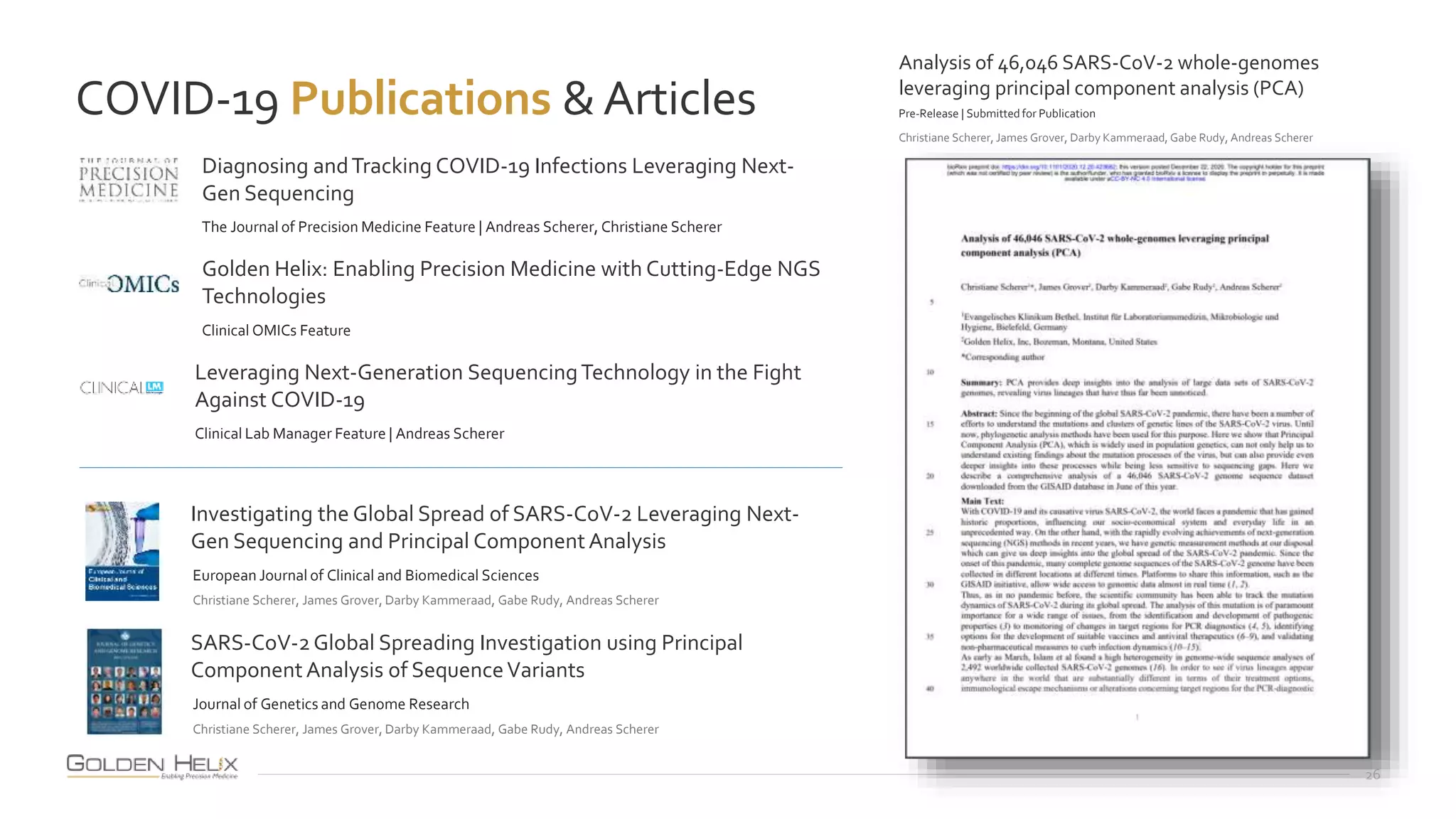
Analysis of 46,046 SARS-CoV-2 whole-genomes
leveraging principal component analysis (PCA)
Pre-Release | Submittedfor Publication
Christiane Scherer, James Grover, Darby Kammeraad, Gabe Rudy, Andreas Scherer
27
Any Questions?

Exome Analysis with VS-CNV and VSClinical: Updated Strategies and Expanded Capabilities

  • 1.
    Exome Analysis withVS-CNV and VSClinical: Updated Strategies and Expanded Capabilities April 7, 2021 Presented by Gabe Rudy, VP of Product & Engineering
  • 2.
  • 3.
    Exome Analysis withVS-CNV and VSClinical: Updated Strategies and Expanded Capabilities April 7, 2021 Presented by Gabe Rudy, VP of Product & Engineering
  • 4.
    NIH Grant FundingAcknowledgments 4 • Research reported in this publication was supported by the National Institute Of General Medical Sciences of the National Institutes of Health under: o Award Number R43GM128485-01 o Award Number R43GM128485-02 o Award Number 2R44 GM125432-01 o Award Number 2R44 GM125432-02 o Montana SMIR/STTR Matching Funds Program Grant Agreement Number 19-51-RCSBIR-005 • PI is Dr. Andreas Scherer, CEO of Golden Helix. • The content is solely the responsibility of the authors and does not necessarily represent the official views of the National Institutes of Health.
  • 5.
    Who Are We? 5 GoldenHelix is a global bioinformatics company founded in 1998 Filtering and Annotation ACMG & AMP Guidelines Clinical Reports CNVAnalysis Pipeline: Run Workflows CNVAnalysis GWAS |Genomic Prediction Large-NPopulation Studies RNA-Seq Large-NCNV-Analysis Variant Warehouse CentralizedAnnotations Hosted Reports Sharing and Integration
  • 6.
    Cited in 1,000sof Peer-Reviewed Publications 6
  • 7.
  • 8.
    When you chooseGolden Helix, you receive more than just the software 8 Software isVetted • 20,000+ users at 400+ organizations • Quality & feedback Simple, Subscription-Based Business Model • Yearly fee • Unlimited training & support Deeply Engrained in Scientific Community • Give back to the community • Contribute content and support Innovative Software Solutions • Cited in 1,000s of publications • Recipient of numerous NIH grant and other funding bodies
  • 9.
  • 10.
    Content Overview 10 Demonstration Deep diveinto new features and compile all variant interpretation into a synchronized report Enhanced variant analysis Analyzing splice site, non-coding RNA, and mitochondrial variants Whole Exome CNV analysis Relevance and improvements to exome CNV calling in VarSeq
  • 11.
    • Gene panelsversus exomes o Importance of exome analysis for evaluating complex disorders and diagnostic testing • Variant discovery with exome data o Detect non-traditional clinically relevant variants • Assembling a report o Generate a report to include clinical variants, incidental findings and gene coverage 11 Whole Exome Analysis
  • 12.
    12 Quick Poll Do youhave or plan to have any exome-based tests for research or clinical purposes? 1. Currently use exomes for clinical purposes 2. Currently use exomes for research purposes 3. Plan to implement exomes in the future 4. Not currently using exomes, no plans
  • 13.
    CNV Overview 13 Reduction inthe number of CNVs called 1 2 3 4 New low-quality target filter strategy Enhanced quality flags and QC outputs New sensitivity and precision settings What Has Changed in VarSeq 2.2.3
  • 14.
    Incorporating Changes intoyour CNV Workflow 14 Easily drop low value targets from CNV calling Evaluating GC content output at a target level Improved default quality control filters to include insufficient ratio
  • 15.
    Impact of CNVCaller Performance 15 2.2.2 High Sensitivity 2.2.3 High Sensitivity % Reduced Between 2.2.2 and 2.2.3 % Reduced After QC Filtering % Reduced with ACMG ACMG CNV Score Exome Case Study 92% 90% 34% 58% 70% Target Panel Case Study 94% 94% 0% 64.23% 60%
  • 16.
    Additional CNV AnalysisCapabilities 16 New CNV VCF file export and import New site-level ACMG CNV classifier Persisting CNV import options into templates
  • 17.
    17 Evaluate mitochondrial variantsand their clinical impact 1 2 Analyze clinically relevant non-coding RNA variants EnhancedVariantAnalysis with Exome Sequencing
  • 18.
  • 19.
    Improved Predictions forSplice SiteVariants 19 Novel and canonical splice site gene impact AdjustingACMG recommended criteria to match PVS1 guidelines Improvements to recommendations for novel splice site predictions
  • 20.
    • Compute samplelevel gene-by gene coverage statistics based on a gene list o Exact coverage of genes, not target panel design files o Reporting custom gene lists • Use gene lists from UK GenePanel App or others • Detects genes by previous names (Alias), reports unknown genes Incorporate Virtual Gene Panels 20
  • 21.
  • 22.
    NIH Grant FundingAcknowledgments 22 • Research reported in this publication was supported by the National Institute Of General Medical Sciences of the National Institutes of Health under: o Award Number R43GM128485-01 o Award Number R43GM128485-02 o Award Number 2R44 GM125432-01 o Award Number 2R44 GM125432-02 o Montana SMIR/STTR Matching Funds Program Grant Agreement Number 19-51-RCSBIR-005 • PI is Dr. Andreas Scherer, CEO of Golden Helix. • The content is solely the responsibility of the authors and does not necessarily represent the official views of the National Institutes of Health.
  • 23.
    Become aGolden HelixGenomic Curator 23 • We are now accepting applications to become a Genomic Curator! • Looking for experienced variant interpretation scientists with a background in oncology and targeted molecular therapy reporting • How to apply: • Resume • Sample of writing (variant or biomarker interpretations) • Send to personnel@goldenhelix.com
  • 24.
  • 25.
    eBook Update: ClinicalVariant Analysis 25 Want a free copy? Request one in the questions or chat panel and our team will follow up with you!
  • 26.
    COVID-19 Publications &Articles 26 Investigatingthe Global Spread of SARS-CoV-2 Leveraging Next- Gen Sequencing and Principal ComponentAnalysis European Journal of Clinical and Biomedical Sciences Christiane Scherer, James Grover, Darby Kammeraad, Gabe Rudy, Andreas Scherer Diagnosing andTracking COVID-19 Infections Leveraging Next- Gen Sequencing The Journal of Precision Medicine Feature | Andreas Scherer, Christiane Scherer Golden Helix: Enabling Precision Medicine with Cutting-Edge NGS Technologies Clinical OMICs Feature Leveraging Next-Generation SequencingTechnology in the Fight Against COVID-19 Clinical Lab Manager Feature | Andreas Scherer SARS-CoV-2Global Spreading Investigation using Principal ComponentAnalysis of SequenceVariants Journal of Genetics and Genome Research Christiane Scherer, James Grover, Darby Kammeraad, Gabe Rudy, Andreas Scherer Analysis of 46,046 SARS-CoV-2 whole-genomes leveraging principal component analysis (PCA) Pre-Release | Submittedfor Publication Christiane Scherer, James Grover, Darby Kammeraad, Gabe Rudy, Andreas Scherer
  • 27.

Editor's Notes

  • #5 Before we start diving into the subject, I wanted mention our appreciation for our grant funding from NIH. The research reported in this publication was supported by the National institute of general medical sciences of the national institutes of health under the listed awards. Additionally we are also grateful for receiving local grant funding from the state of Montana. Our PI is Dr. Andreas Scherer who is also the CEO at Golden Helix and the content described today is the responsibility of the authors and does not officially represent the views of the NIH. So with that covered, lets take just a few minutes to talk a little bit about our company Golden Helix.
  • #6 Golden Helix was founded back in 1998, and we are one of the few bioinformatic companies that can say we have 20 years of experience building NGS solutions in the research and clinical space. These solutions have a very broad range of capabilities, including VarSeq and the clinical products that are part of the VarSeq clinical suite, such as VS-CNV and VSClinical.   Given the focused topic of this webcast, we won’t have time to even the full scope of our ACMG and AMP workflows that are part of the VSClinical clinical suite, but you are interested in any of these, please check the archive of previous webcasts and tutorials on our website.
  • #7 We have been cited in thousands of peer reviewed publications, and we are always happy to celebrate the success of our customers in performing their research with our tools. We even have a regular posting to our blog highlighting these publications!
  • #8 We serve over 400 customers globally, and these customers span many different industries, from academic institutions, to research hospitals, to commercial testing labs and government institutions. 
  • #9 And that large customer base is really an asset that is hard to match. We can deliver a very high quality product, that meets the very diverse needs of this market because we work so closely with our customer base. As a business, we want to be aligned with the success of our customers. To that end, we use a simple per-user subscription model that comes with unlimited training and support, and is not based on the number of samples you run. So lets move on now, and start today’s discussion with an overview of the VarSeq product suite, and how our topic today builds off of its capabilities.
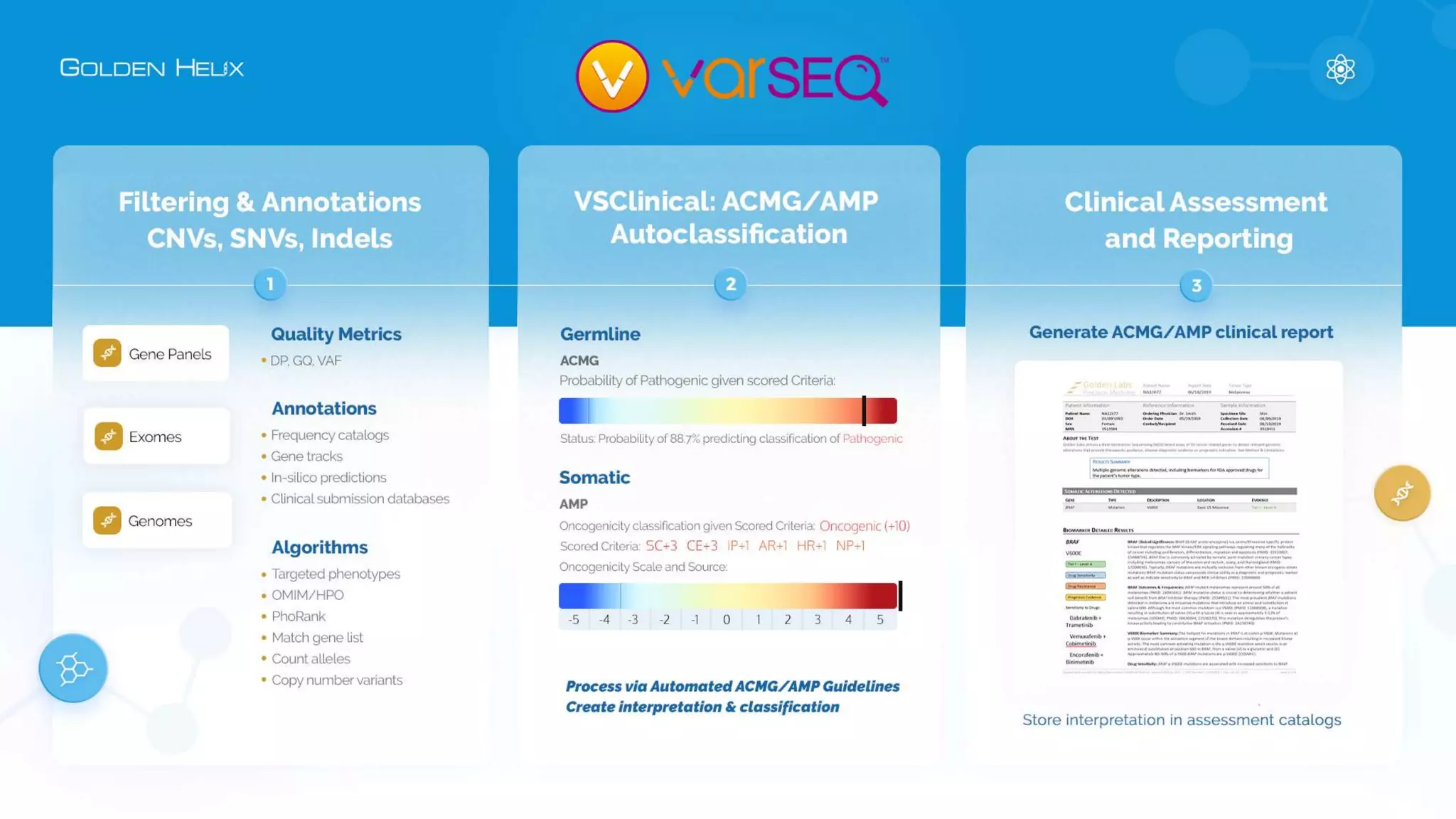
  • #10 The general clinical testing workflow requires taking an enormous amount of raw genomic variants, whether they are small variants or copy number variants, and determining which ones are high quality, and through a standardized interpretation process, which ones should be put on a individualized clinical report. VarSeq is the base platform that supports variant annotation and QC analysis. Our VSClinical package implements industry standard guidelines such as ACMG for germline variants and AMP for somatic variants found in cancers to evaluate, score and interpret variants in a systematic and repeatable manner. And finally, a clinical report can contain the supporting information and resulting work of this entire process.
  • #11 Today, our topic is going to start with a discussion of NGS exomes, and some of the challenges to adopting it in your clinical workflow. This will help motivate the work we put into the upcoming VarSeq 2.2.3 release. Then, we will go into some of the specific improvements that were made to CNV calling and how these changes can be worked into a VS_CNV best practice workflow. We will spend most of our time discussing the whole exome CNV calling, but it is important to mention updates were made to other algorithms that enhance variant analysis across the board, improvements in how we handle splice site variants, non-coding RNA and mitochondrial variants that you may see in your NGS exomes. Then in the product demonstration I will walk you through these capabilities in VarSeq and VSClincal and demonstrate how this all comes together in a clinical report.
  • #12 State of exomes analysis Point 1: Gene panels are a great start for clinical testing and continue to be a focus, but exomes are starting to becomes a great option when condition is complex like multigenic disorder- autism or developmental delay. Additionally, analyzing whole exomes are a great option for diagnostic testing of asymptomatic people for lifetime risk etc. because these cases often do not have a focused gene panel because condition is complex. Point 2: Motivation expanded to assist in the discovery of clinically relevant variants (including CNVs). Captures variants of all types- splice site, non-coding functional RNAs, etc Point 3: Report contains all of these reportable and incidental findings. Transition: In this release, a number of new features to improve exome analysis, but of course many of the features that I will talk about are not limited to exome analysis and are helpful for other use cases as well.
  • #13 Wait for results – will be silent for about 30 secs
  • #14 A new VS-CNV best-practice workflow with specialized features for calling CNVs on exomes and large panels with more precision, enhanced quality flags and additional outputs. Reduce number of CNVs called by over half on average. Many CNVs before would have been flagged for issues Enhanced quality flags Additional Q/C outputs at target/sample/CNV level
  • #15 Three Major things: GC Content output- evaluating GC at target level and incorporate into model Easily drop low value targets from consideration Improved default Q/C filters to include insufficient ratio flag- Transition using the discussion on ratio metric that precision is maintained without reducing sensitivity, let me show you what this looks like…
  • #16 More details of benchmarks and new CNV caller capabilities on next webcast Transition: Before we leave the topic of CNVs there are a few other new features I want to mention
  • #17 Additional CNV analysis capabilities such as CNV export and import as VCFs Site level ACMG classifier CNV export dialog picture Persisting CNV import options into templates (drop columns, filed types and advanced options)
  • #18 222 wouldn’t find this variant but 223 does. Without changing defaults, missing these because not standard mrna transcripts- have own annotation and hgvs…. Transition into new annotate transcripts Algorithm
  • #19 New defaults Opt in- forshadow demo- update templates
  • #20 Novel/canonical splice site gene impact predictions handles edge cases where novel splice is replacing canonical splice- not predicting both at the same time. Adjusted ACMG criteria to match the PVS1 guidelines more strictly based on discussion with guidelines authors. PP3 Strong/moderate vs PVS1 strong or moderate. Avoid double counting criteria.
  • #21 Strategies for incorporating disease-specific virtual gene panel lists into the filtering, quality and reporting capabilities of VSClinical For each gene the coverage is computed using the exons of the clinically relevant transcript as the target regions. The total coverage as well as strand based coverage is computed from the quality filtered pileup depth for each region. Aggregate statistics are computed for each sample across all of the regions to provide a high level overview of the sample’s coverage. Get a full picture of percentage of coverage on a gene level, if targets fail to be covered in that gene will still see coverage output. An additional way to provide useful summary stats. Where get gene lists? UK gene panel app- grabs lists here but also have curated track that can be used for annotating and filtering GREAT FOR REPORTING!
  • #22 Let’s go ahead and transition over to my VarSeq project. This project will have 3 whole exome samples already imported and I will also be using a bone disease gene panel to find clinically relevant variants and CNVs.
  • #23 Again, we want to mention how grateful we are for grants such as these which provides huge momentum in developing our software. At this point Ill turn things back over to Delaina and she will talk about some Golden Helix updates and then we will go into the Q and Answer period.
  • #24 Again, we want to mention how grateful we are for grants such as these which provides huge momentum in developing our software. At this point Ill turn things back over to Delaina and she will talk about some Golden Helix updates and then we will go into the Q and Answer period.
  • #26 Again, I want to mention how grateful we are we are thankful of grants such as this which support the advancement and development of our software to create the high quality software you'll see today. So with that covered, lets take a few minutes to talk a little bit about our company Golden Helix.
  • #27 Over the course of the 2020 period, we worked with a clinical lab in Germany to do the analysis of 46k samples to break down population structure for the genomic variability among those samples. Excited for this upcoming publication coming up for everyone to read.