Annotated
Bibliographies
Liz Johns emjohns@jhu.edu
POLL
What is your proposed question for
this assignment/course?
TONIGHT’S GOAL
Take a strategic approach to tackling
the annotated bibliography and better
understand the qualities of a strong
annotation.
Steps to the Annotated Bibliography
Annotation Break Down
Examples
Practice
Resources
ANNOTATED BIBLIOGRAPHIES
In 3 pages or less include:
1. Your proposed question from Session 3 (revised
as necessary)
2. A list of at least four articles that directly relate
to your area of interest.
1. For each article, list it’s full APA or MLA citation
format
2. After each citation write a 3-4 sentence
summary and then a 3-4 sentence statement
explaining the relevance of the article to your
area of interest and proposed question.
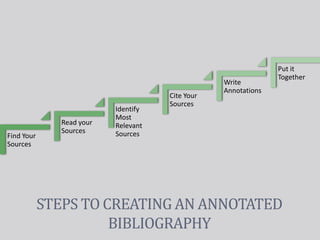
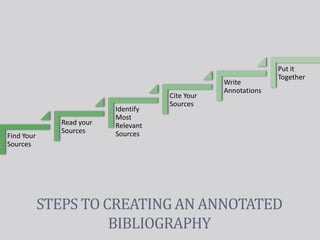
STEPS TO CREATING AN ANNOTATED
BIBLIOGRAPHY
Find Your
Sources
Read your
Sources
Identify
Most
Relevant
Sources
Cite Your
Sources
Write
Annotations
Put it
Together
STEP 1: FIND YOUR SOURCES
POLL
Where do you typically go first when
searching for peer-reviewed literature?
POLL
Where do you think is the best place to
start your literature searches for this
assignment?
WHERE?
• Research Guide for Education:
guides.library.jhu.edu/education
• Research Guide for MEHP
guides.library.jhu.edu/ed-health
cc: Valerie Everett - https://www.flickr.com/photos/66742614@N00
QUESTIONS?
PEER REVIEWED
PEER REVIEWED
Check Ulrich’s Database
(refer to the Library Research Module for a refresher)
STEP 2: READ YOUR SOURCES
Take notes as you are reading.
STEP 3: IDENTIFY THE MOST
IMPORTANT SOURCES
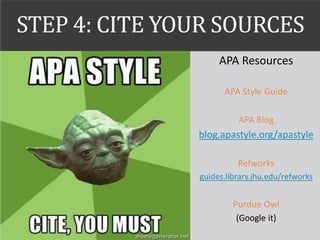
STEP 4: CITE YOUR SOURCES
APA Resources
APA Style Guide
APA Blog
blog.apastyle.org/apastyle
Refworks
guides.library.jhu.edu/refworks
Purdue Owl
(Google it)
STEP 4: CITE YOUR SOURCES
MLA Resources
MLA Handbook
JHU Citing Help
guides.library.jhu.edu/citin
g/mla
Refworks
guides.library.jhu.edu/refworks
Purdue Owl
(Google it)
STEP 5: WRITE YOUR
ANNOTATIONS
In 3 pages or less include:
1. Your proposed question from Session 3 (revised
as necessary)
2. A list of at least four articles that directly relate
to your area of interest.
1. For each article, list it’s full APA or MLA citation
format
2. After each citation write a 3-4 sentence
summary and then a 3-4 sentence statement
explaining the relevance of the article to your
area of interest and proposed question.
PARTS OF AN ANNOTATION
1. Summary/Evaluation
(3-4 sentences)
2. Relevance/Evaluation
(3-4 sentences)
SUMMARY
Highlight the main points or
findings.
Describe the accuracy and
quality of the resource.
Review the sample/population.
SUMMARY: PARAPHRASE
Use your own words, do not
copy the abstract.
Paraphrasing advice: owl.english.purdue.edu/owl/resource/563/02/
RELEVANCE
• Consider:
• Conclusions drawn from the data that
relate to your work
• Methods/design that may inform your work
on the topic
• Limitations of the source
• How does this add to or inform your topic?
cc: Valerie Everett - https://www.flickr.com/photos/66742614@N00
QUESTIONS?
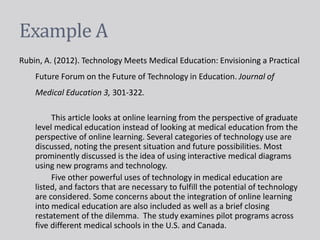
Example A
Rubin, A. (2012). Technology Meets Medical Education: Envisioning a Practical
Future Forum on the Future of Technology in Education. Journal of
Medical Education 3, 301-322.
This article looks at online learning from the perspective of graduate

level medical education instead of looking at medical education from the
perspective of online learning. Several categories of technology use are

discussed, noting the present situation and future possibilities. Most
prominently discussed is the idea of using interactive medical diagrams
using new programs and technology.
Five other powerful uses of technology in medical education are
listed, and factors that are necessary to fulfill the potential of technology
are considered. Some concerns about the integration of online learning
into medical education are also included as well as a brief closing
restatement of the dilemma. The study examines pilot programs across
five different medical schools in the U.S. and Canada.
Example A
Rubin, A. (2012). Technology Meets Medical Education: Envisioning a Practical
Future Forum on the Future of Technology in Education. Journal of
Medical Education 3, 301-322.
This article looks at online learning from the perspective of graduate
level medical education instead of looking at medical education from the
perspective of online learning. Several categories of technology use are
discussed, noting the present situation and future possibilities. Most
prominently discussed is the idea of using interactive medical diagrams
using new programs and technology.
Five other powerful uses of technology in medical education are
listed, and factors that are necessary to fulfill the potential of technology
are considered. Some concerns about the integration of online learning
into medical education are also included as well as a brief closing
restatement of the dilemma. The study examines pilot programs across
five different medical schools in the U.S. and Canada.
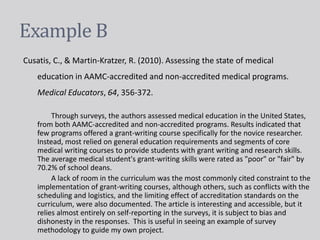
Example B
Cusatis, C., & Martin-Kratzer, R. (2010). Assessing the state of medical
education in AAMC-accredited and non-accredited medical programs.
Medical Educators, 64, 356-372.
Through surveys, the authors assessed medical education in the United States,
from both AAMC-accredited and non-accredited programs. Results indicated that
few programs offered a grant-writing course specifically for the novice researcher.
Instead, most relied on general education requirements and segments of core
medical writing courses to provide students with grant writing and research skills.
The average medical student's grant-writing skills were rated as "poor" or "fair" by
70.2% of school deans.
A lack of room in the curriculum was the most commonly cited constraint to the
implementation of grant-writing courses, although others, such as conflicts with the
scheduling and logistics, and the limiting effect of accreditation standards on the
curriculum, were also documented. The article is interesting and accessible, but it
relies almost entirely on self-reporting in the surveys, it is subject to bias and
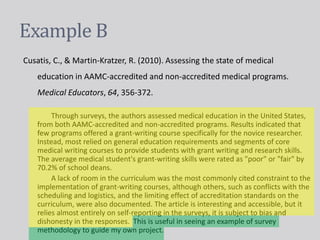
dishonesty in the responses. This is useful in seeing an example of survey
methodology to guide my own project.
Example B
Cusatis, C., & Martin-Kratzer, R. (2010). Assessing the state of medical
education in AAMC-accredited and non-accredited medical programs.
Medical Educators, 64, 356-372.
Through surveys, the authors assessed medical education in the United States,
from both AAMC-accredited and non-accredited programs. Results indicated that
few programs offered a grant-writing course specifically for the novice researcher.
Instead, most relied on general education requirements and segments of core
medical writing courses to provide students with grant writing and research skills.
The average medical student's grant-writing skills were rated as "poor" or "fair" by
70.2% of school deans.
A lack of room in the curriculum was the most commonly cited constraint to the
implementation of grant-writing courses, although others, such as conflicts with the
scheduling and logistics, and the limiting effect of accreditation standards on the
curriculum, were also documented. The article is interesting and accessible, but it
relies almost entirely on self-reporting in the surveys, it is subject to bias and
dishonesty in the responses. This is useful in seeing an example of survey
methodology to guide my own project.
Example C
Starks, B. C., Harrison, L., & Denhardt, K. (2011). Outside the comfort zone of the classroom.
Journal of Nursing Education, 2, 203-225. doi:10.1080/10511253.2010.517773
This paper explains how service learning can be a valuable part of a student’s academic
career. Service can be tied into a course and takes students outside of the classroom for a
non-traditional, active learning experience that can impact not only their education, but their
personal and professional lives. Examples of service learning in a nursing context are
provided for other educators to encourage them to explore service learning projects in their
own courses.
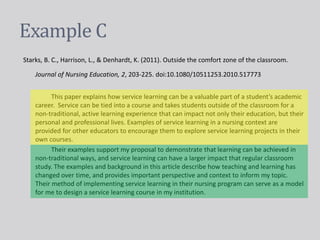
Their examples support my proposal to demonstrate that learning can be achieved in
non-traditional ways, and service learning can have a larger impact that regular classroom
study. The examples and background in this article describe how teaching and learning has
changed over time, and provides important perspective and context to inform my topic.
Their method of implementing service learning in their nursing program can serve as a model
for me to design a service learning course in my institution.
Example C
Starks, B. C., Harrison, L., & Denhardt, K. (2011). Outside the comfort zone of the classroom.
Journal of Nursing Education, 2, 203-225. doi:10.1080/10511253.2010.517773
This paper explains how service learning can be a valuable part of a student’s academic
career. Service can be tied into a course and takes students outside of the classroom for a
non-traditional, active learning experience that can impact not only their education, but their
personal and professional lives. Examples of service learning in a nursing context are
provided for other educators to encourage them to explore service learning projects in their
own courses.
Their examples support my proposal to demonstrate that learning can be achieved in
non-traditional ways, and service learning can have a larger impact that regular classroom
study. The examples and background in this article describe how teaching and learning has
changed over time, and provides important perspective and context to inform my topic.
Their method of implementing service learning in their nursing program can serve as a model
for me to design a service learning course in my institution.
cc: Valerie Everett - https://www.flickr.com/photos/66742614@N00
QUESTIONS?
tinyurl.com/zaytcr6
PRACTICE
POLL
Do you feel more confident in creating
your annotated bibliography after
participating in this workshop?
cc: Valerie Everett - https://www.flickr.com/photos/66742614@N00
QUESTIONS?
STEP 6: PUT IT TOGETHER
Start with your proposed
question.
List citations.
Put annotations directly
underneath each citation.
STEPS TO CREATING AN ANNOTATED
BIBLIOGRAPHY
Find Your
Sources
Read your
Sources
Identify
Most
Relevant
Sources
Cite Your
Sources
Write
Annotations
Put it
Together
LIBRARY RESOURCES
Guide for Education
guides.library.jhu.edu/education
Research Guide for MEHP
guides.library.jhu.edu/ed-health
Library Research Modules in Blackboard
REFWORKS & CITING
RefWorks Guide
guides.library.jhu.edu/refworks
JHU Citing Help
guides.library.jhu.edu/citing/mla
FINAL THOUGHTS
http://bit.ly/dsplvq
What will you do differently?
cc: Valerie Everett - https://www.flickr.com/photos/66742614@N00
QUESTIONS?
Liz: emjohns@jhu.edu

Ed Scholarship Annotated Bibliography Session

  • 1.
  • 2.
    POLL What is yourproposed question for this assignment/course?
  • 4.
    TONIGHT’S GOAL Take astrategic approach to tackling the annotated bibliography and better understand the qualities of a strong annotation.
  • 5.
    Steps to theAnnotated Bibliography Annotation Break Down Examples Practice Resources
  • 6.
  • 7.
    ANNOTATED BIBLIOGRAPHIES In 3pages or less include: 1. Your proposed question from Session 3 (revised as necessary) 2. A list of at least four articles that directly relate to your area of interest. 1. For each article, list it’s full APA or MLA citation format 2. After each citation write a 3-4 sentence summary and then a 3-4 sentence statement explaining the relevance of the article to your area of interest and proposed question.
  • 8.
    STEPS TO CREATINGAN ANNOTATED BIBLIOGRAPHY Find Your Sources Read your Sources Identify Most Relevant Sources Cite Your Sources Write Annotations Put it Together
  • 9.
    STEP 1: FINDYOUR SOURCES
  • 10.
    POLL Where do youtypically go first when searching for peer-reviewed literature?
  • 11.
    POLL Where do youthink is the best place to start your literature searches for this assignment?
  • 12.
    WHERE? • Research Guidefor Education: guides.library.jhu.edu/education • Research Guide for MEHP guides.library.jhu.edu/ed-health
  • 13.
    cc: Valerie Everett- https://www.flickr.com/photos/66742614@N00 QUESTIONS?
  • 14.
  • 15.
    PEER REVIEWED Check Ulrich’sDatabase (refer to the Library Research Module for a refresher)
  • 16.
    STEP 2: READYOUR SOURCES
  • 17.
    STEP 2: READYOUR SOURCES Take notes as you are reading.
  • 18.
    STEP 3: IDENTIFYTHE MOST IMPORTANT SOURCES
  • 19.
    STEP 4: CITEYOUR SOURCES APA Resources APA Style Guide APA Blog blog.apastyle.org/apastyle Refworks guides.library.jhu.edu/refworks Purdue Owl (Google it)
  • 20.
    STEP 4: CITEYOUR SOURCES MLA Resources MLA Handbook JHU Citing Help guides.library.jhu.edu/citin g/mla Refworks guides.library.jhu.edu/refworks Purdue Owl (Google it)
  • 21.
    STEP 5: WRITEYOUR ANNOTATIONS In 3 pages or less include: 1. Your proposed question from Session 3 (revised as necessary) 2. A list of at least four articles that directly relate to your area of interest. 1. For each article, list it’s full APA or MLA citation format 2. After each citation write a 3-4 sentence summary and then a 3-4 sentence statement explaining the relevance of the article to your area of interest and proposed question.
  • 22.
    PARTS OF ANANNOTATION 1. Summary/Evaluation (3-4 sentences) 2. Relevance/Evaluation (3-4 sentences)
  • 23.
    SUMMARY Highlight the mainpoints or findings. Describe the accuracy and quality of the resource. Review the sample/population.
  • 24.
    SUMMARY: PARAPHRASE Use yourown words, do not copy the abstract. Paraphrasing advice: owl.english.purdue.edu/owl/resource/563/02/
  • 25.
    RELEVANCE • Consider: • Conclusionsdrawn from the data that relate to your work • Methods/design that may inform your work on the topic • Limitations of the source • How does this add to or inform your topic?
  • 26.
    cc: Valerie Everett- https://www.flickr.com/photos/66742614@N00 QUESTIONS?
  • 27.
    Example A Rubin, A.(2012). Technology Meets Medical Education: Envisioning a Practical Future Forum on the Future of Technology in Education. Journal of Medical Education 3, 301-322. This article looks at online learning from the perspective of graduate level medical education instead of looking at medical education from the perspective of online learning. Several categories of technology use are discussed, noting the present situation and future possibilities. Most prominently discussed is the idea of using interactive medical diagrams using new programs and technology. Five other powerful uses of technology in medical education are listed, and factors that are necessary to fulfill the potential of technology are considered. Some concerns about the integration of online learning into medical education are also included as well as a brief closing restatement of the dilemma. The study examines pilot programs across five different medical schools in the U.S. and Canada.
  • 28.
    Example A Rubin, A.(2012). Technology Meets Medical Education: Envisioning a Practical Future Forum on the Future of Technology in Education. Journal of Medical Education 3, 301-322. This article looks at online learning from the perspective of graduate level medical education instead of looking at medical education from the perspective of online learning. Several categories of technology use are discussed, noting the present situation and future possibilities. Most prominently discussed is the idea of using interactive medical diagrams using new programs and technology. Five other powerful uses of technology in medical education are listed, and factors that are necessary to fulfill the potential of technology are considered. Some concerns about the integration of online learning into medical education are also included as well as a brief closing restatement of the dilemma. The study examines pilot programs across five different medical schools in the U.S. and Canada.
  • 29.
    Example B Cusatis, C.,& Martin-Kratzer, R. (2010). Assessing the state of medical education in AAMC-accredited and non-accredited medical programs. Medical Educators, 64, 356-372. Through surveys, the authors assessed medical education in the United States, from both AAMC-accredited and non-accredited programs. Results indicated that few programs offered a grant-writing course specifically for the novice researcher. Instead, most relied on general education requirements and segments of core medical writing courses to provide students with grant writing and research skills. The average medical student's grant-writing skills were rated as "poor" or "fair" by 70.2% of school deans. A lack of room in the curriculum was the most commonly cited constraint to the implementation of grant-writing courses, although others, such as conflicts with the scheduling and logistics, and the limiting effect of accreditation standards on the curriculum, were also documented. The article is interesting and accessible, but it relies almost entirely on self-reporting in the surveys, it is subject to bias and dishonesty in the responses. This is useful in seeing an example of survey methodology to guide my own project.
  • 30.
    Example B Cusatis, C.,& Martin-Kratzer, R. (2010). Assessing the state of medical education in AAMC-accredited and non-accredited medical programs. Medical Educators, 64, 356-372. Through surveys, the authors assessed medical education in the United States, from both AAMC-accredited and non-accredited programs. Results indicated that few programs offered a grant-writing course specifically for the novice researcher. Instead, most relied on general education requirements and segments of core medical writing courses to provide students with grant writing and research skills. The average medical student's grant-writing skills were rated as "poor" or "fair" by 70.2% of school deans. A lack of room in the curriculum was the most commonly cited constraint to the implementation of grant-writing courses, although others, such as conflicts with the scheduling and logistics, and the limiting effect of accreditation standards on the curriculum, were also documented. The article is interesting and accessible, but it relies almost entirely on self-reporting in the surveys, it is subject to bias and dishonesty in the responses. This is useful in seeing an example of survey methodology to guide my own project.
  • 31.
    Example C Starks, B.C., Harrison, L., & Denhardt, K. (2011). Outside the comfort zone of the classroom. Journal of Nursing Education, 2, 203-225. doi:10.1080/10511253.2010.517773 This paper explains how service learning can be a valuable part of a student’s academic career. Service can be tied into a course and takes students outside of the classroom for a non-traditional, active learning experience that can impact not only their education, but their personal and professional lives. Examples of service learning in a nursing context are provided for other educators to encourage them to explore service learning projects in their own courses. Their examples support my proposal to demonstrate that learning can be achieved in non-traditional ways, and service learning can have a larger impact that regular classroom study. The examples and background in this article describe how teaching and learning has changed over time, and provides important perspective and context to inform my topic. Their method of implementing service learning in their nursing program can serve as a model for me to design a service learning course in my institution.
  • 32.
    Example C Starks, B.C., Harrison, L., & Denhardt, K. (2011). Outside the comfort zone of the classroom. Journal of Nursing Education, 2, 203-225. doi:10.1080/10511253.2010.517773 This paper explains how service learning can be a valuable part of a student’s academic career. Service can be tied into a course and takes students outside of the classroom for a non-traditional, active learning experience that can impact not only their education, but their personal and professional lives. Examples of service learning in a nursing context are provided for other educators to encourage them to explore service learning projects in their own courses. Their examples support my proposal to demonstrate that learning can be achieved in non-traditional ways, and service learning can have a larger impact that regular classroom study. The examples and background in this article describe how teaching and learning has changed over time, and provides important perspective and context to inform my topic. Their method of implementing service learning in their nursing program can serve as a model for me to design a service learning course in my institution.
  • 33.
    cc: Valerie Everett- https://www.flickr.com/photos/66742614@N00 QUESTIONS?
  • 34.
  • 35.
    POLL Do you feelmore confident in creating your annotated bibliography after participating in this workshop?
  • 36.
    cc: Valerie Everett- https://www.flickr.com/photos/66742614@N00 QUESTIONS?
  • 37.
    STEP 6: PUTIT TOGETHER Start with your proposed question. List citations. Put annotations directly underneath each citation.
  • 38.
    STEPS TO CREATINGAN ANNOTATED BIBLIOGRAPHY Find Your Sources Read your Sources Identify Most Relevant Sources Cite Your Sources Write Annotations Put it Together
  • 39.
    LIBRARY RESOURCES Guide forEducation guides.library.jhu.edu/education Research Guide for MEHP guides.library.jhu.edu/ed-health Library Research Modules in Blackboard
  • 40.
    REFWORKS & CITING RefWorksGuide guides.library.jhu.edu/refworks JHU Citing Help guides.library.jhu.edu/citing/mla
  • 42.
  • 43.
    cc: Valerie Everett- https://www.flickr.com/photos/66742614@N00 QUESTIONS? Liz: emjohns@jhu.edu

Editor's Notes

  • #8 From the assignment: Write an annotation for each source. These annotations should be single-spaced and should include an overview of the study and succinctly evaluate the source’s argument, sources of evidence, methodology, and conclusions specifically focused on the underlying causes and factors associated with your POP and their relation to the POP. The annotation should also indicate the primary audience of the work and the constructs used.
  • #9 Focusing on Step 5 today, writing annotations.
  • #22 From the assignment: Write an annotation for each source. These annotations should be single-spaced and should include an overview of the study and succinctly evaluate the source’s argument, sources of evidence, methodology, and conclusions specifically focused on the underlying causes and factors associated with your POP and their relation to the POP. The annotation should also indicate the primary audience of the work and the constructs used.
  • #39 Focusing on Step 5 today, writing annotations.