IN THE NAME OF ALLAH, THE BENIFICIENT THE MERCIFUL
Presented to
Dr. Sammiya Shahid
Presented by
KOMAL AROOSH
Roll no :- S2019140032
Session:- 2019-2021
Analgesic Activity
Contents
• What are analgesics?
• Classification of analgesics
• What are analgesics used for?
• How does analgesics work in the body?
• What are differences between analgesics?
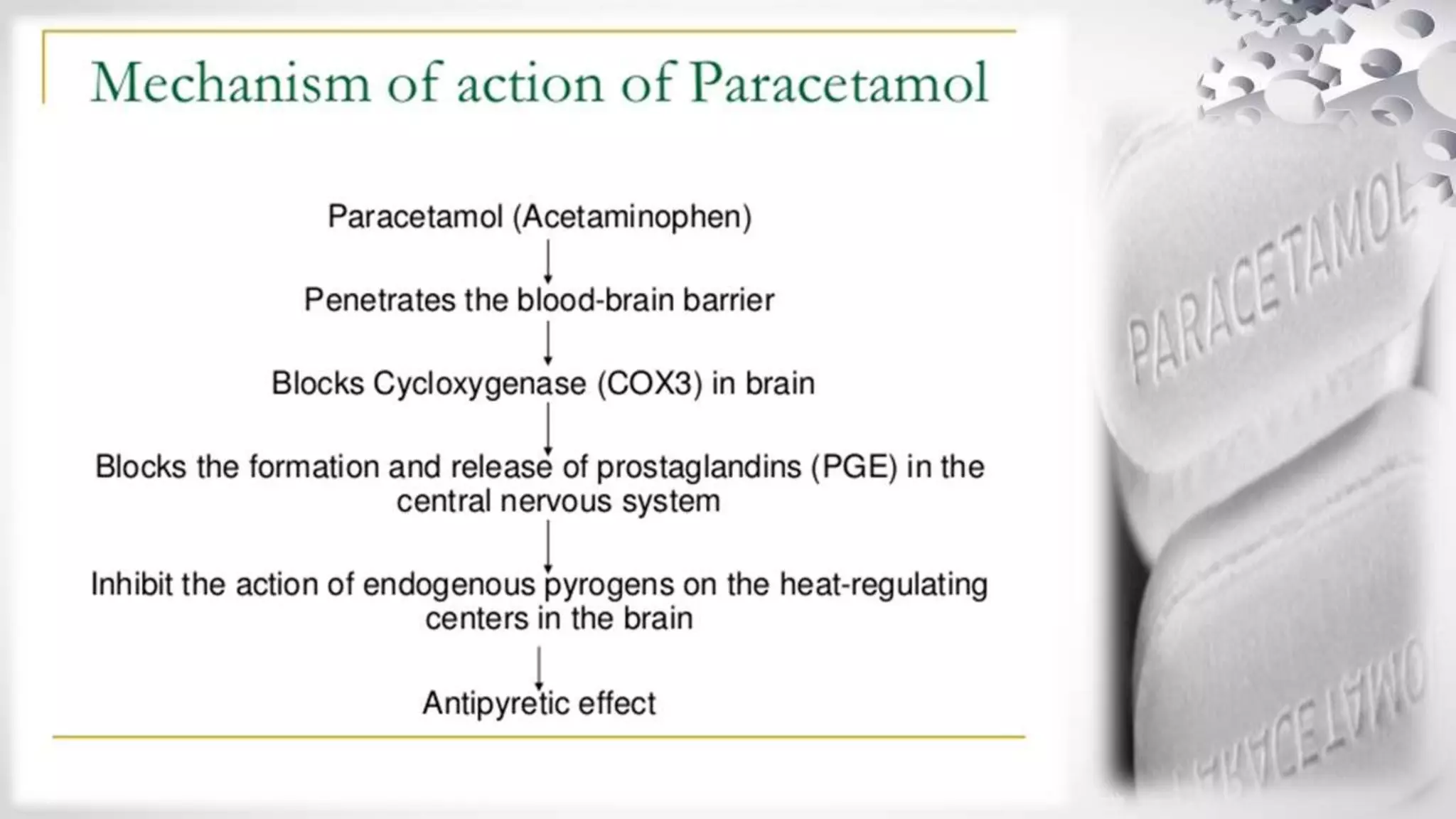
• Mechanism of action of Paracetamol
• How to check analgesic activity of plants and herbs?
• What are the difference between the working of analgesics?
• Are analgesic safe?
What are Analgesics?
The term “Analgesic” is derived from two
Greek words –
(1) an ("without") and
(2) algos ("pain").
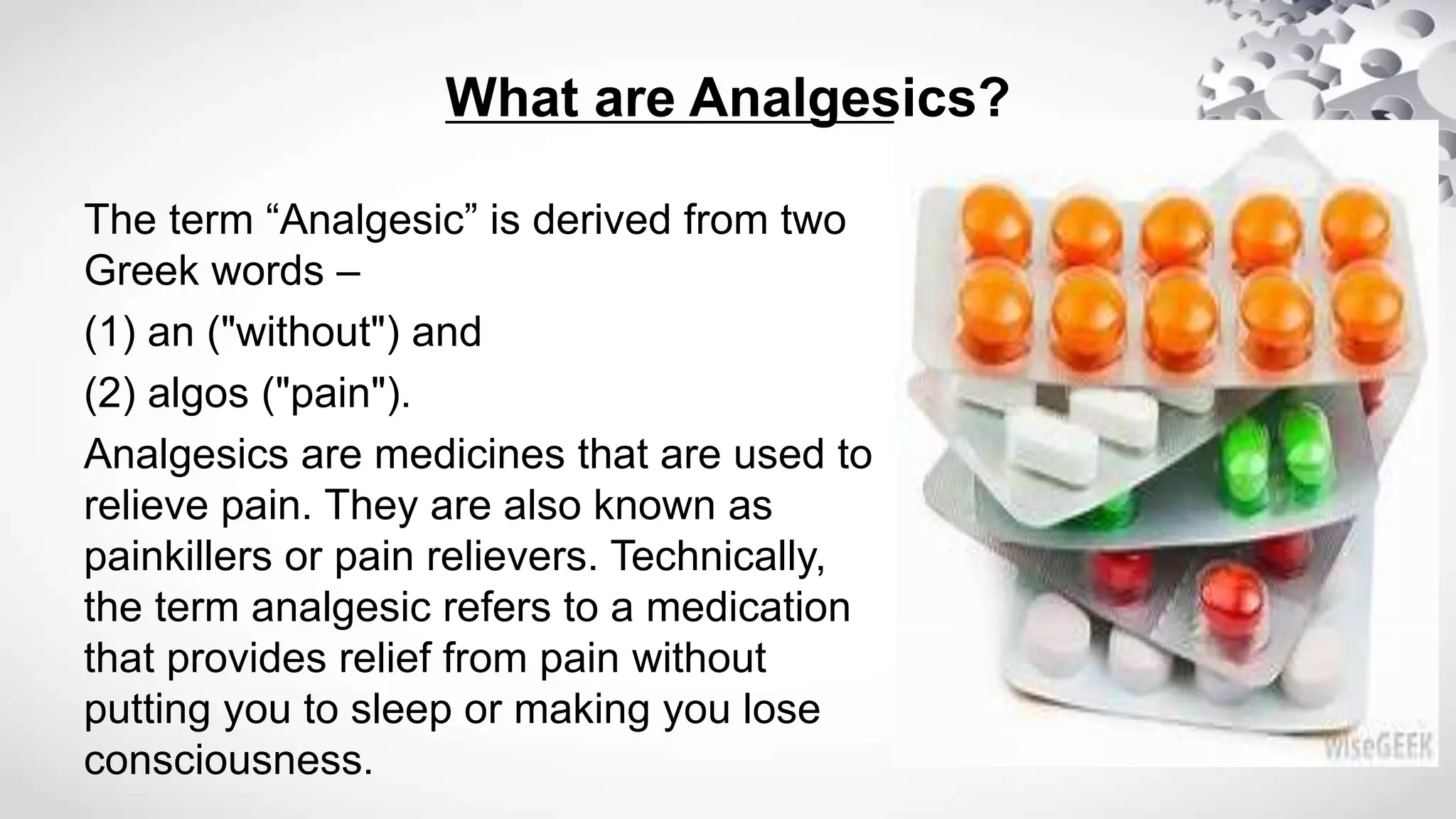
Analgesics are medicines that are used to
relieve pain. They are also known as
painkillers or pain relievers. Technically,
the term analgesic refers to a medication
that provides relief from pain without
putting you to sleep or making you lose
consciousness.
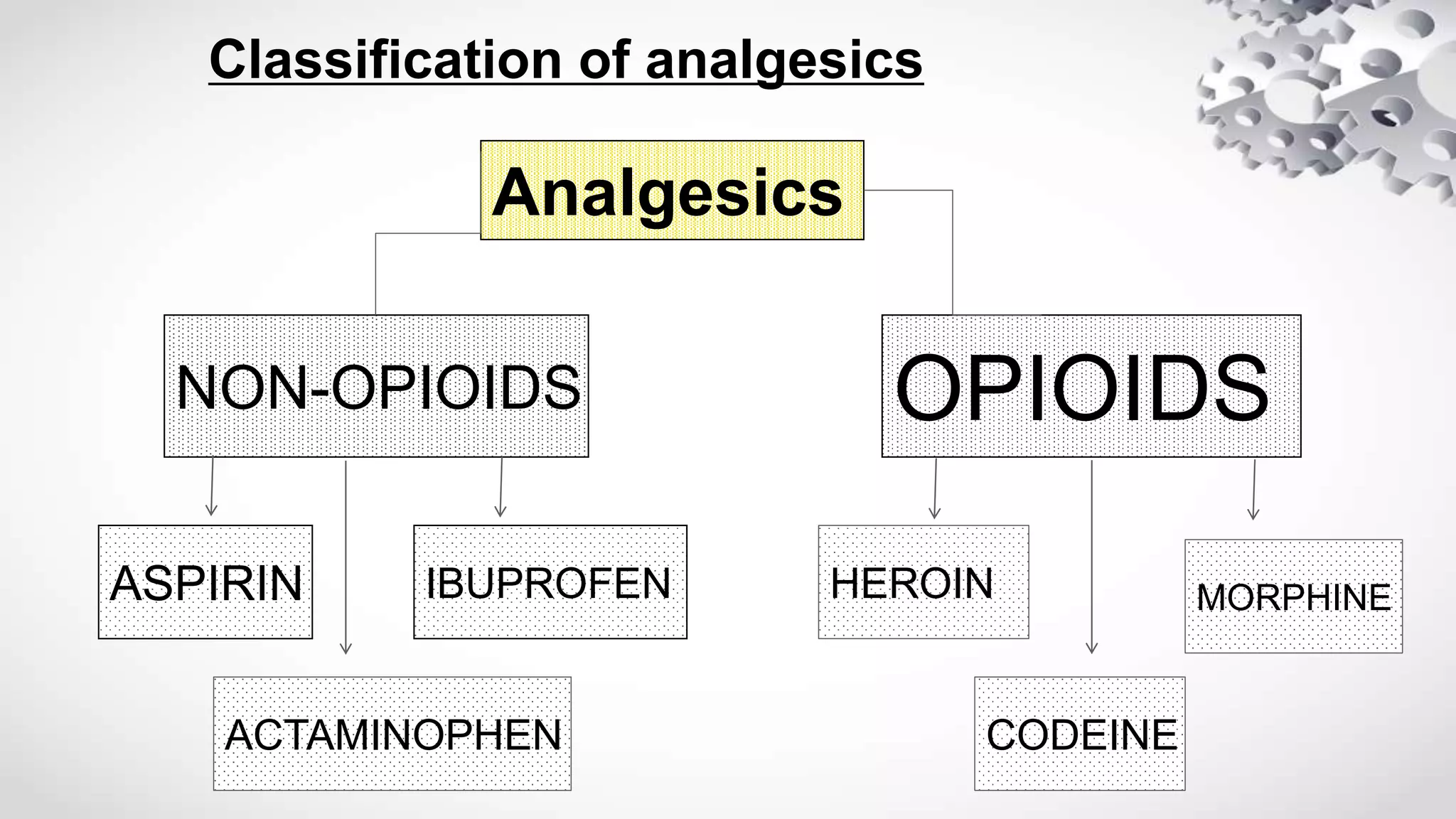
Classification of analgesics
Analgesics
NON-OPIOIDS
HEROIN
CODEINE
MORPHINE
ACTAMINOPHEN
ASPIRIN IBUPROFEN
OPIOIDS
What are analgesics used for?
Analgesics may be taken to relieve pain that arises from a
wide range of conditions, such as:
Appendicitis ,cancer, congenital conditions such as
curvature of the spine,surgery
,trauma,toothache,nurve damges infections,wound
cleansing and debridement.
How Does an Analgesic Work in the body?
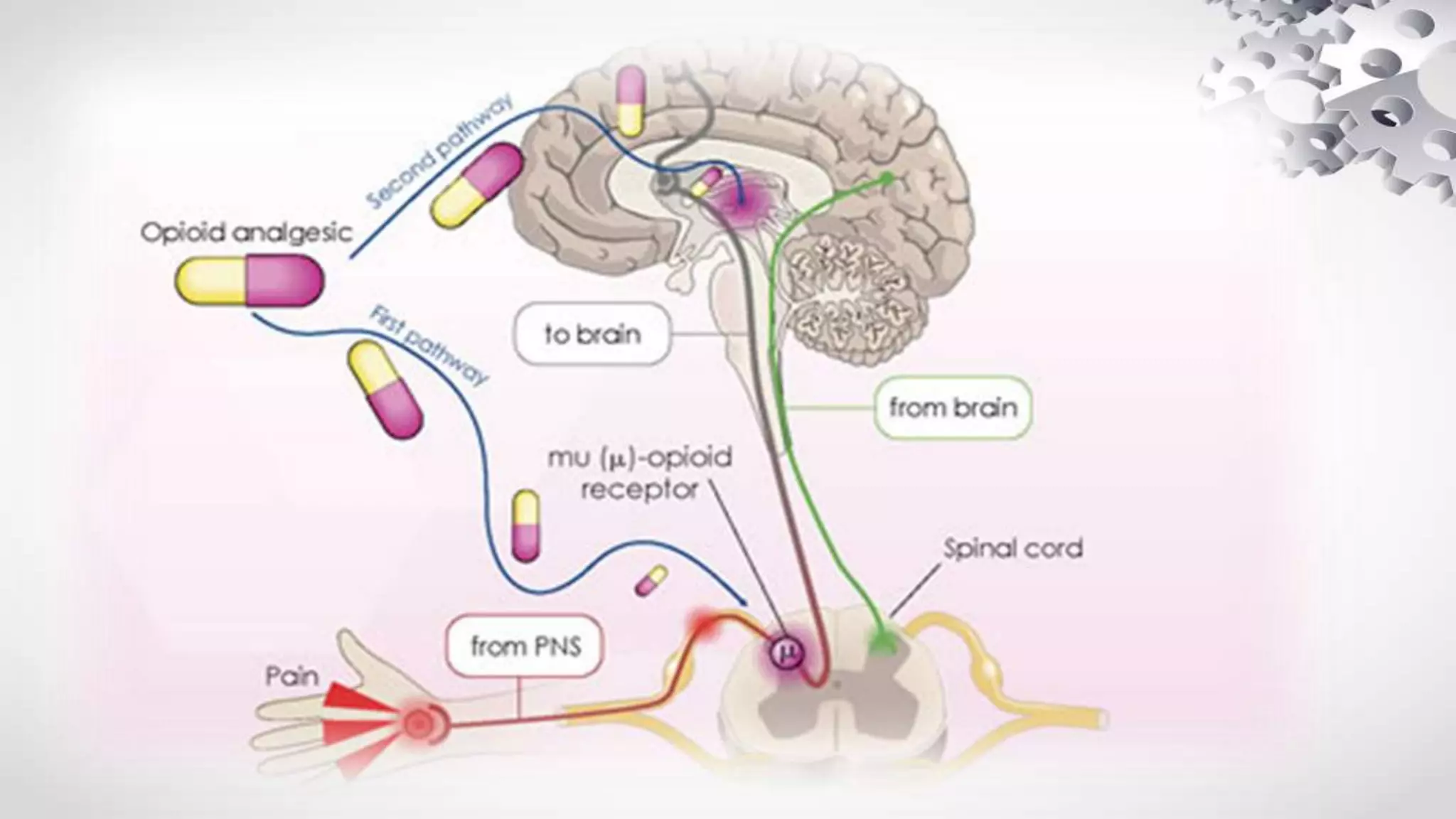
1. Opioids reduce the pain signals sent by the nervous
system and the brain's reaction to those pain signals.
2. Tylenol works by changing the way the body senses
pain.
3. NSAIDs block the effects of prostaglandins (chemicals
in the body with hormone-like qualities), reducing both pain
and swelling.
How to check analgesic activity in plants
and herbs?
Analgesic activity in plants and herbs can be checked by
the following methods/models-
• Hot plate method
• Tail flick method
• Tail immersion method
• Electric stimulus models
• Chemical Stimulus models
• Mechanical stimulus models
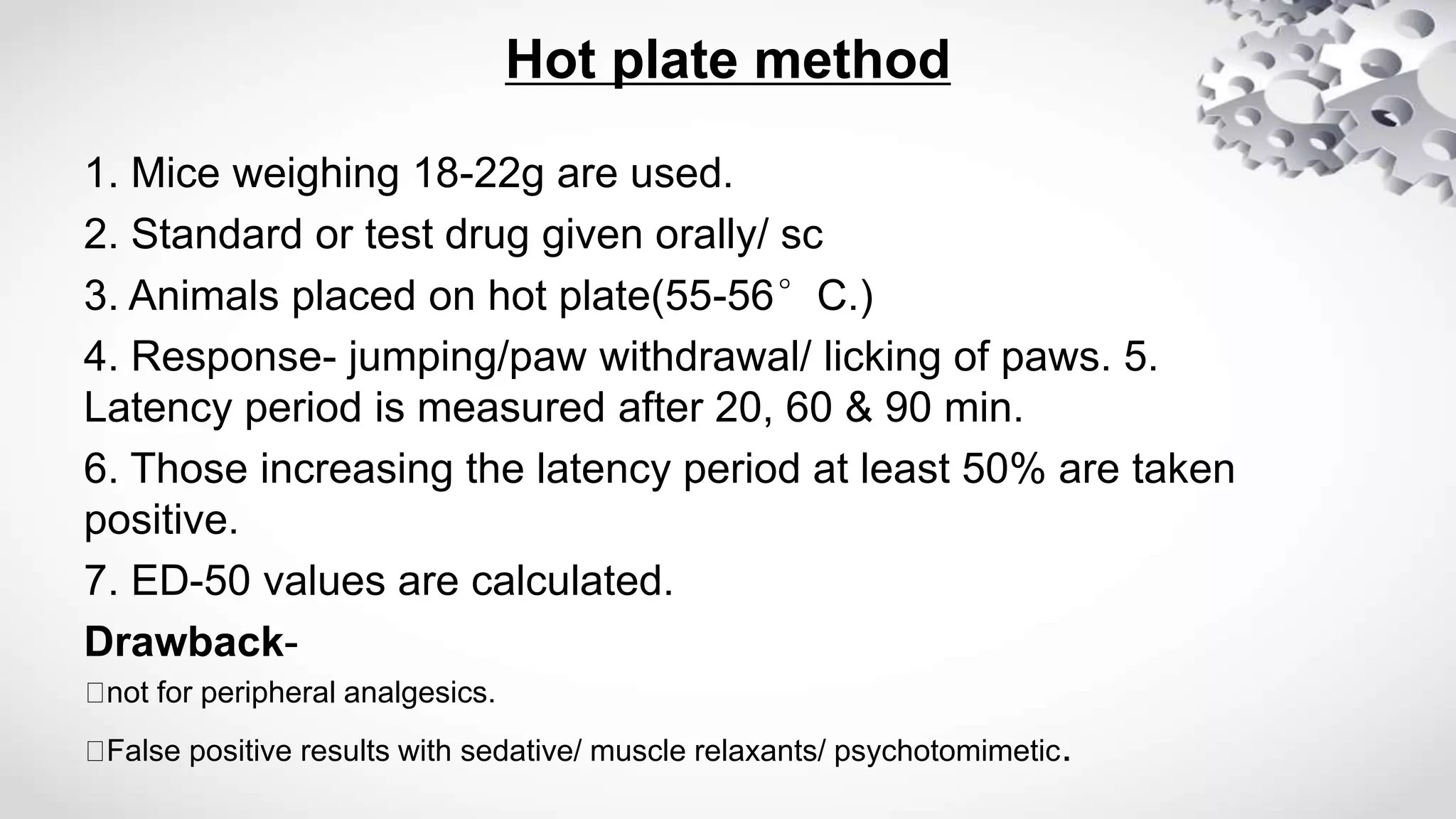
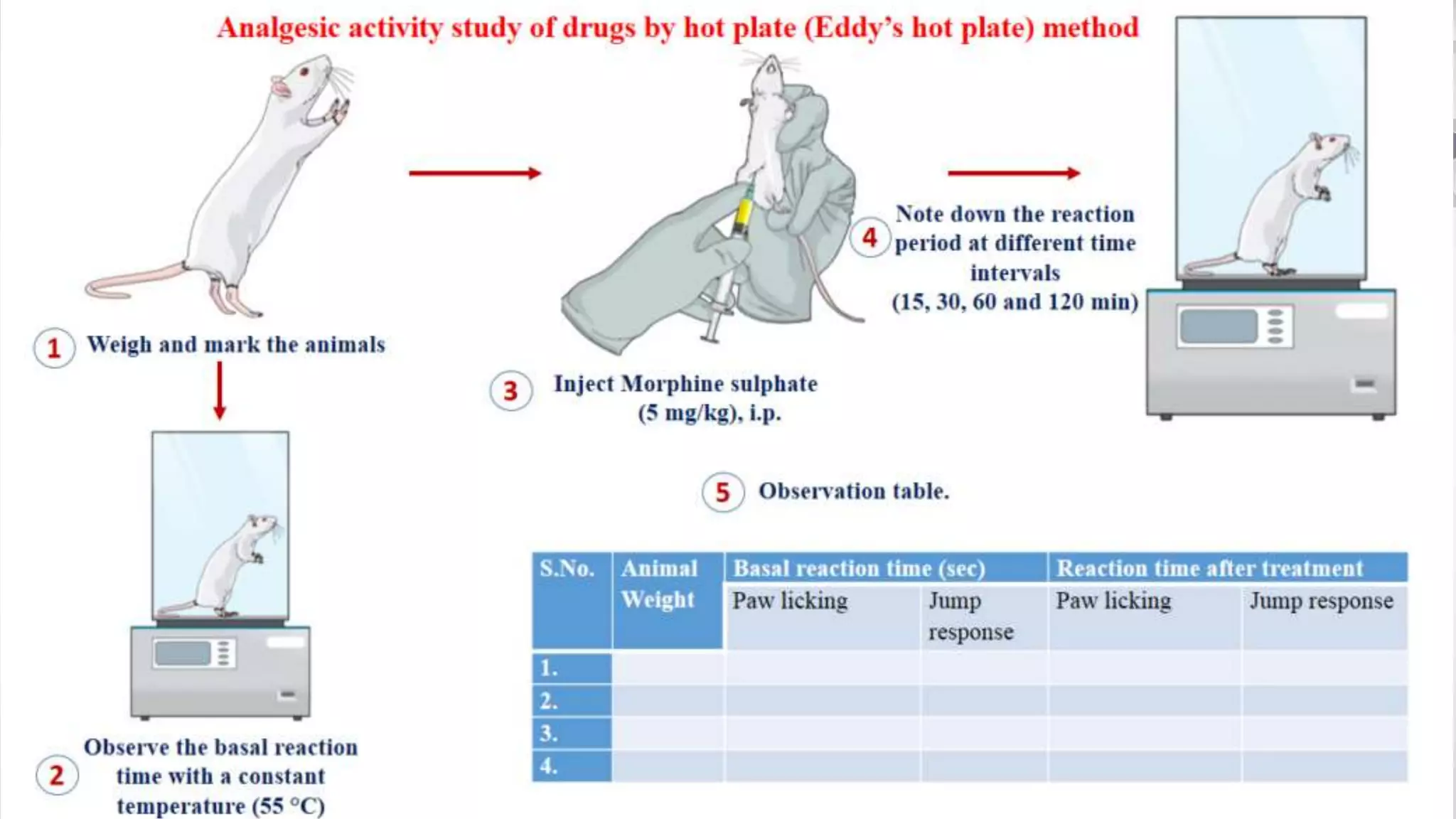
Hot plate method
1. Mice weighing 18-22g are used.
2. Standard or test drug given orally/ sc
3. Animals placed on hot plate(55-56°C.)
4. Response- jumping/paw withdrawal/ licking of paws. 5.
Latency period is measured after 20, 60 & 90 min.
6. Those increasing the latency period at least 50% are taken
positive.
7. ED-50 values are calculated.
Drawback-
not for peripheral analgesics.
False positive results with sedative/ muscle relaxants/ psychotomimetic.
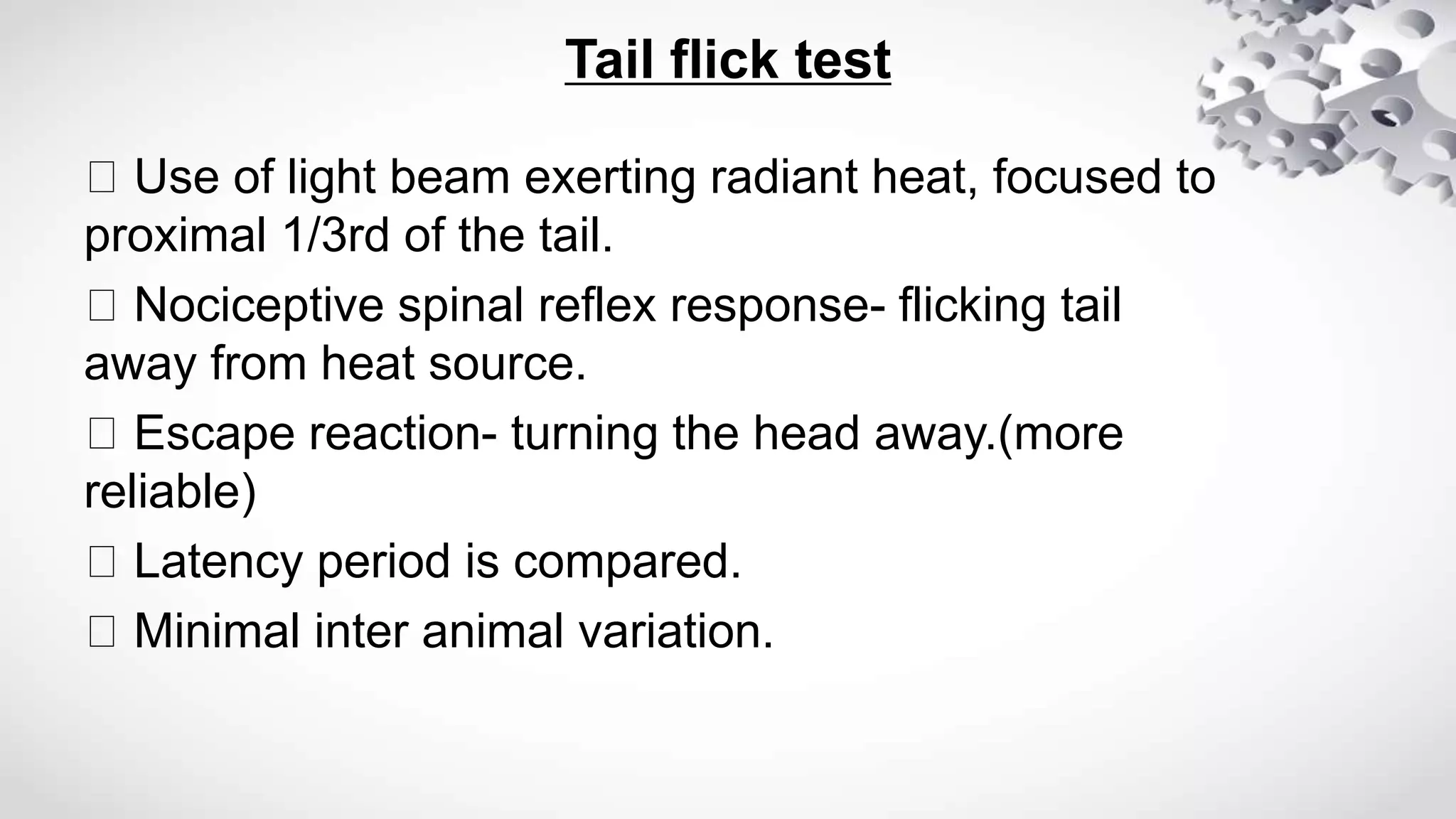
Tail flick test
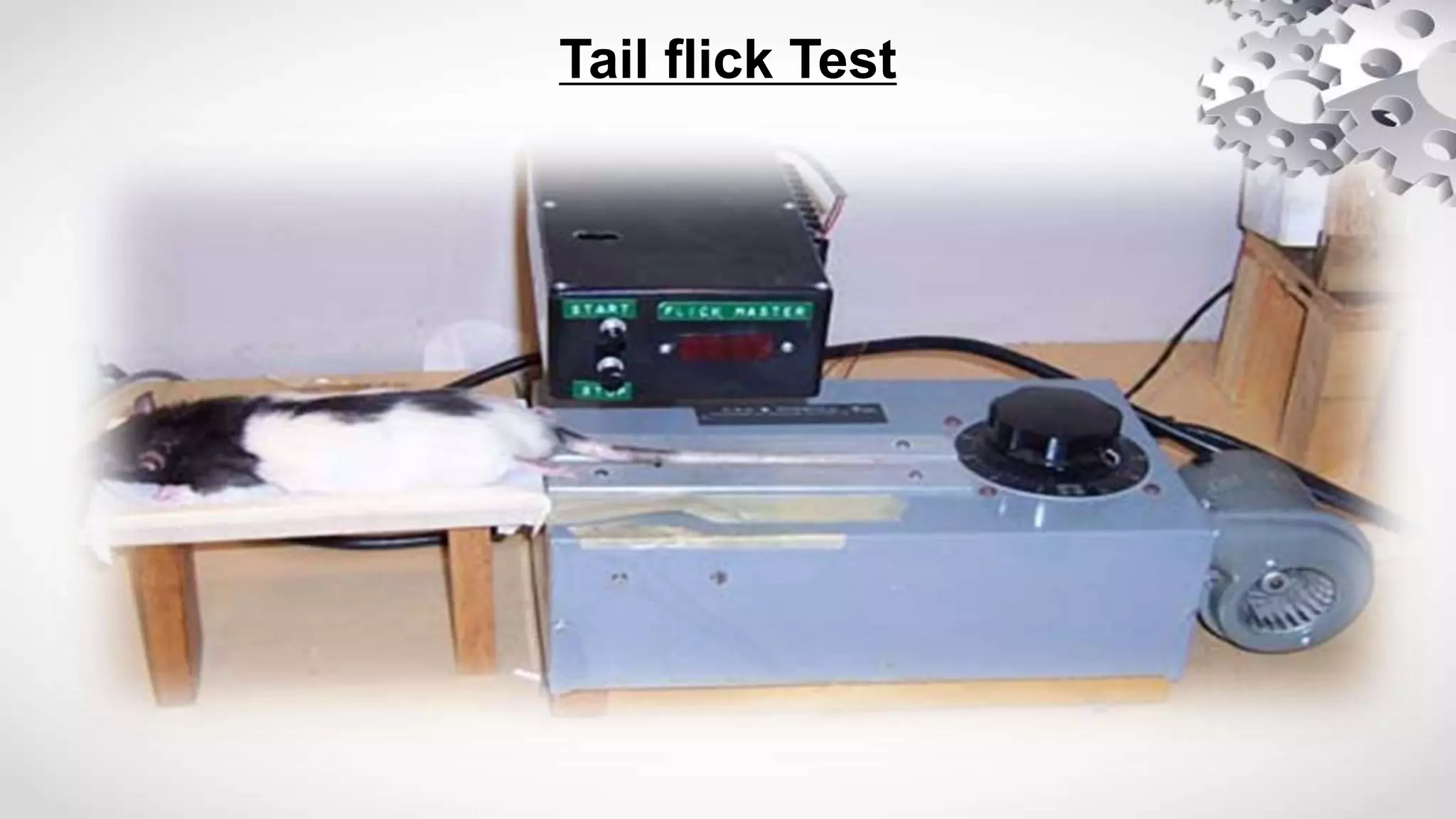
Use of light beam exerting radiant heat, focused to
proximal 1/3rd of the tail.
Nociceptive spinal reflex response- flicking tail
away from heat source.
Escape reaction- turning the head away.(more
reliable)
Latency period is compared.
Minimal inter animal variation.
Tail flick Test
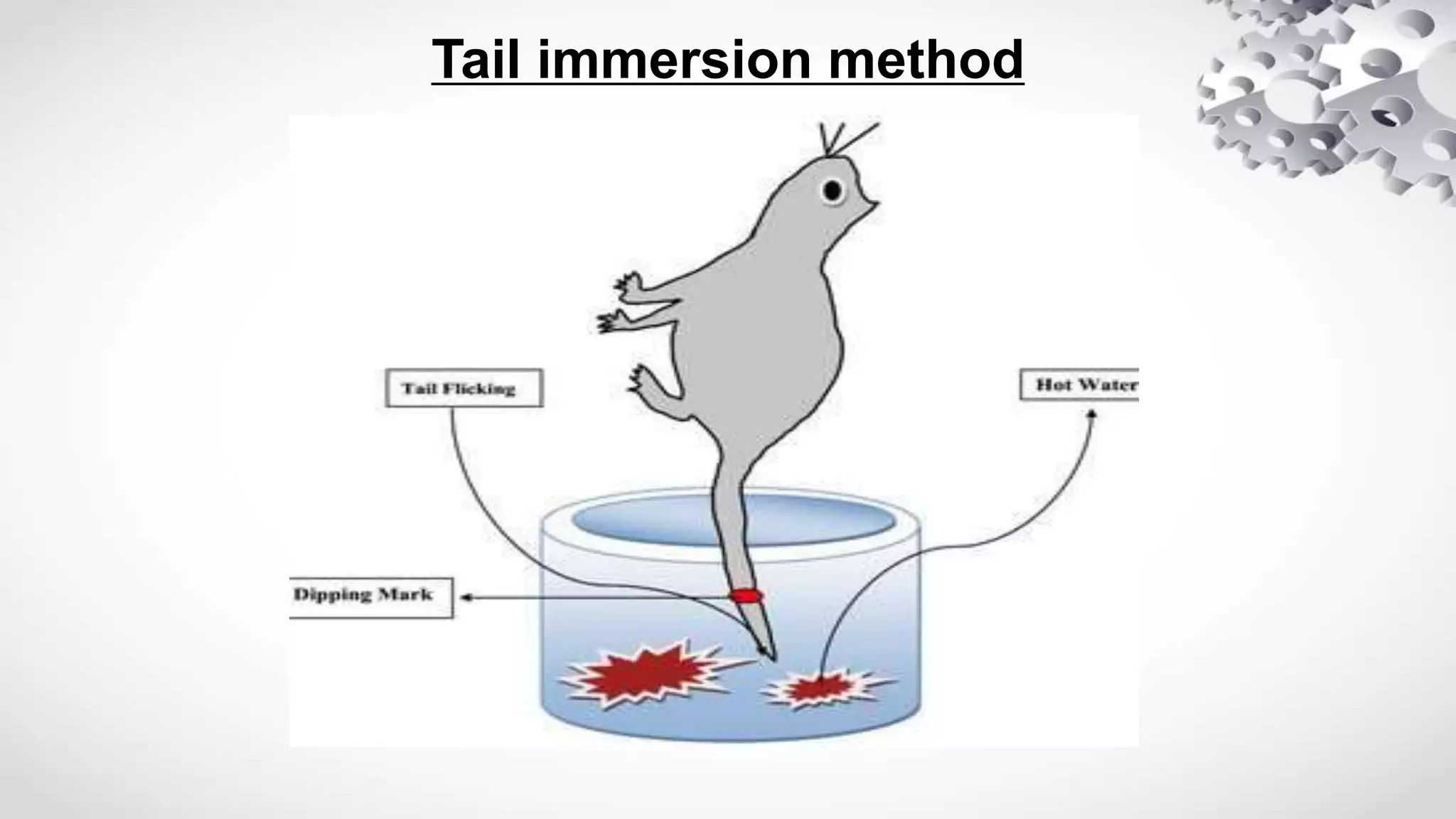
Tail immersion method
Young female Wister rats(170-210 g).
Placed in cages with tail hanging out freely.
Distal 5 cm tail is immersed (max 15 sec) in a cup of
warm water(55°C)
Tail withdrawal reflex is seen
Recording done after ½ , 1,2,3,4 and 6 hours.
latency period ˃6s is taken as positive.
Modifications- cold mixture of water & ethylene glycol
at -10°C./ cold ethanol at -20°C.
Tail immersion method
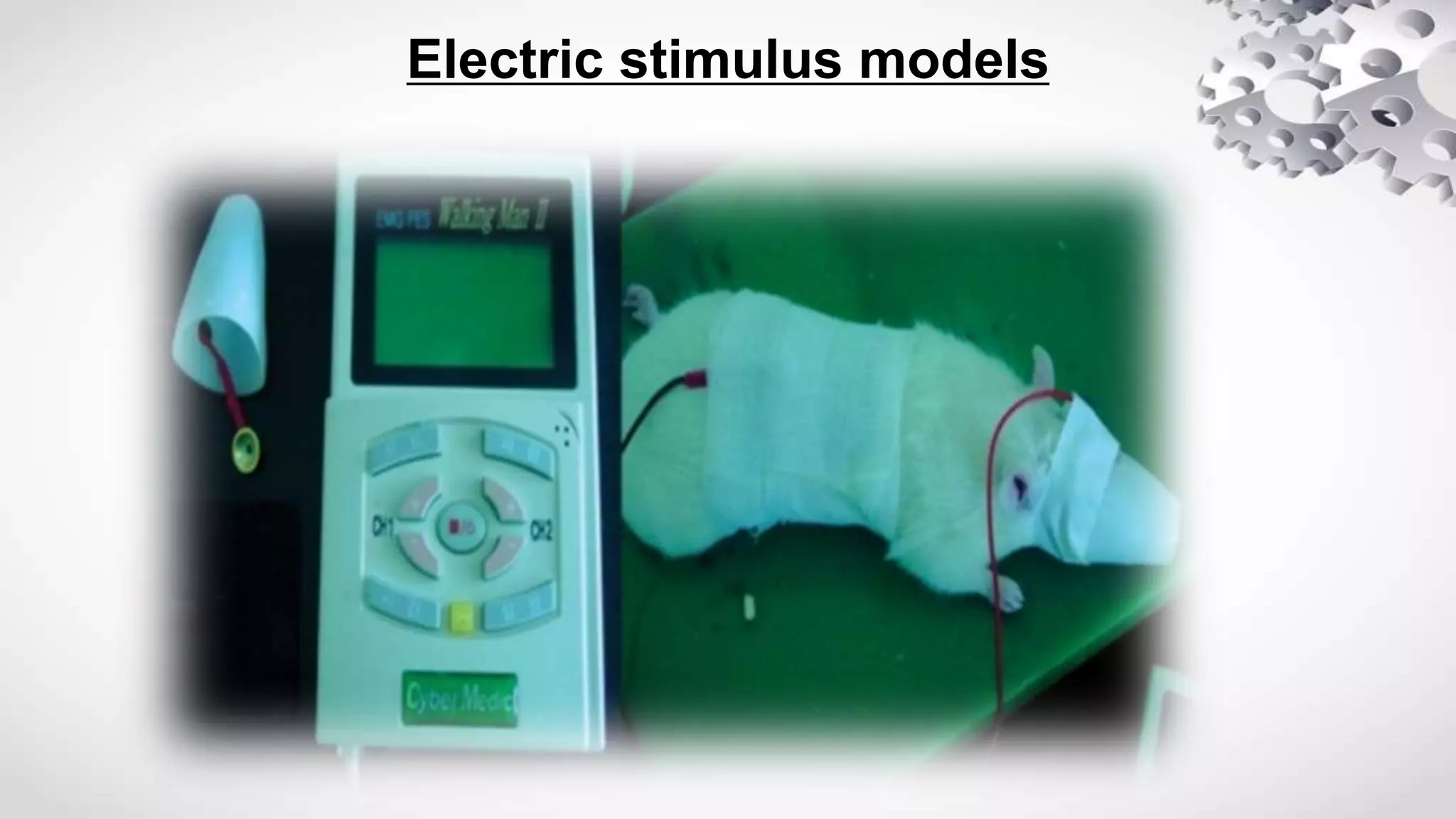
Electric stimulus models
Tooth pulp test-
1. Rabbits(2-3kg) are anaesthetized with thiopental at 15 mg/kg i.v.
2. Clamping electrodes are placed into tooth pulp chamber through
drilled holes.
3. After 30 min, stimulus given by rectangular current(50 Hz) upto 1
sec
4. Animals starts licking- current threshold is measured.
Modification: stimulus given via subcutaneous electrodes at the tail
Monkey shock titration test: shock given via Coulbourn Instrument
Programmable shocker at tail
Electric stimulus models
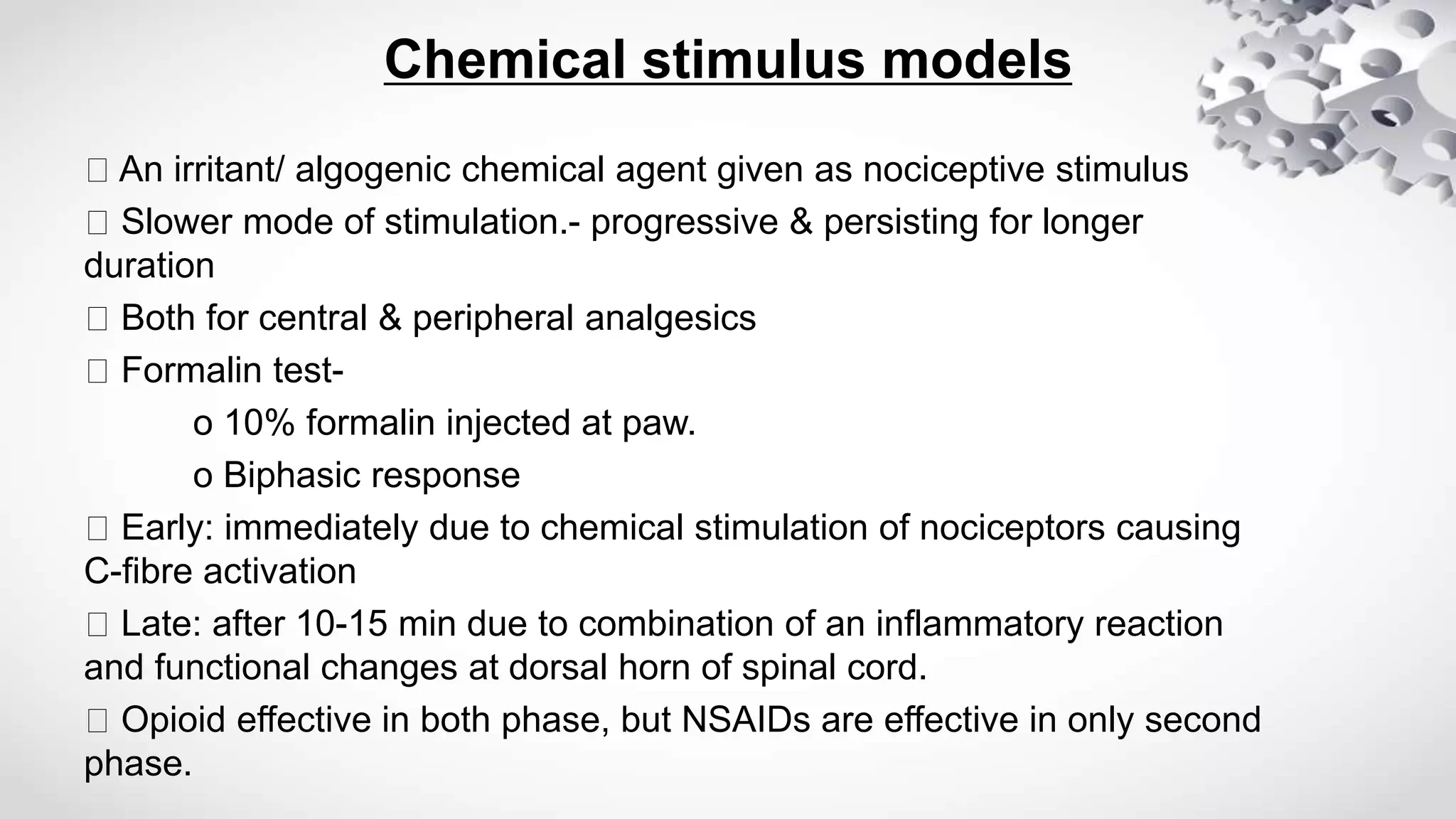
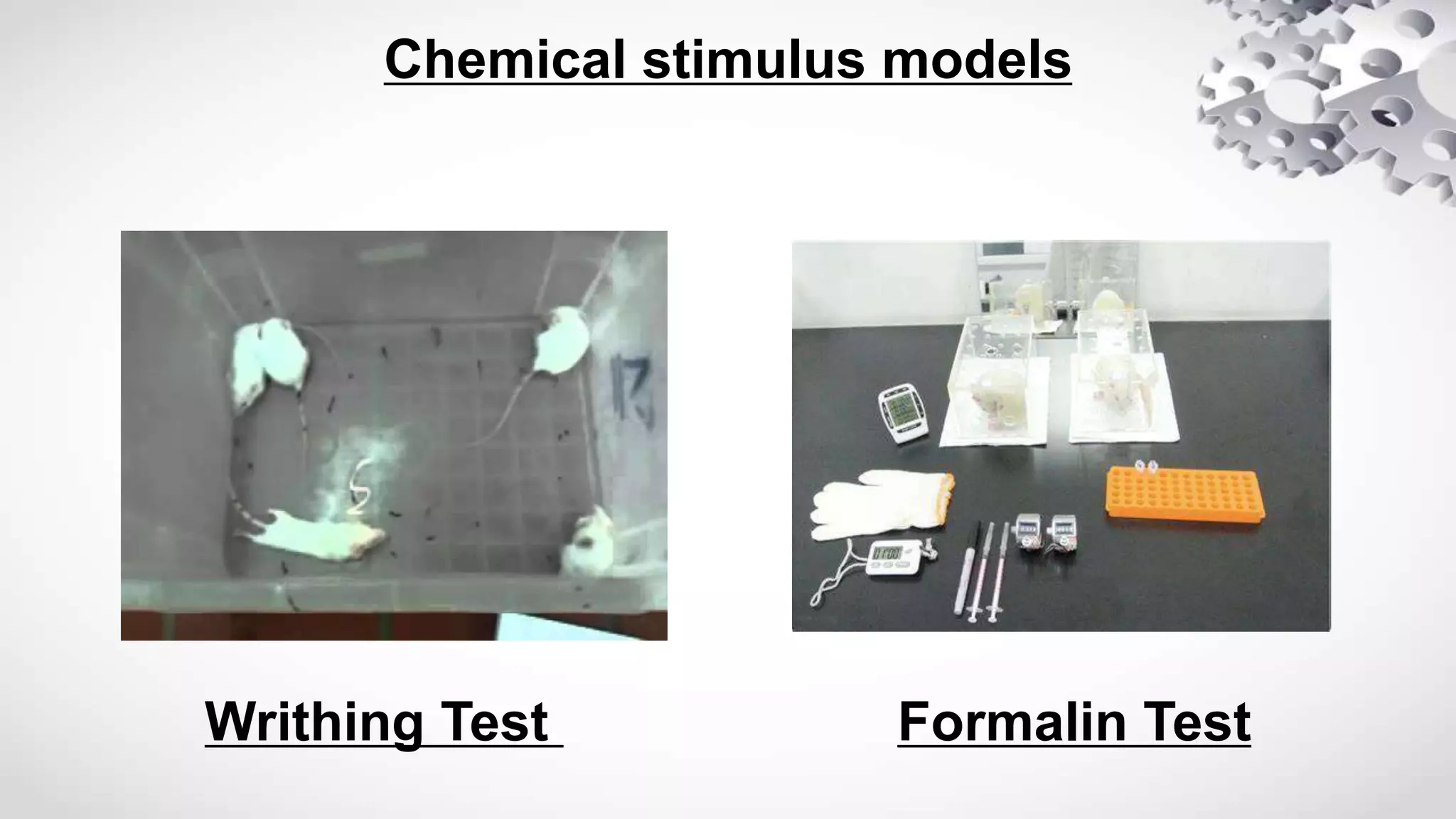
Chemical stimulus models
An irritant/ algogenic chemical agent given as nociceptive stimulus
Slower mode of stimulation.- progressive & persisting for longer
duration
Both for central & peripheral analgesics
Formalin test-
o 10% formalin injected at paw.
o Biphasic response
Early: immediately due to chemical stimulation of nociceptors causing
C-fibre activation
Late: after 10-15 min due to combination of an inflammatory reaction
and functional changes at dorsal horn of spinal cord.
Opioid effective in both phase, but NSAIDs are effective in only second
phase.
Chemical stimulus models
Writhing Test Formalin Test
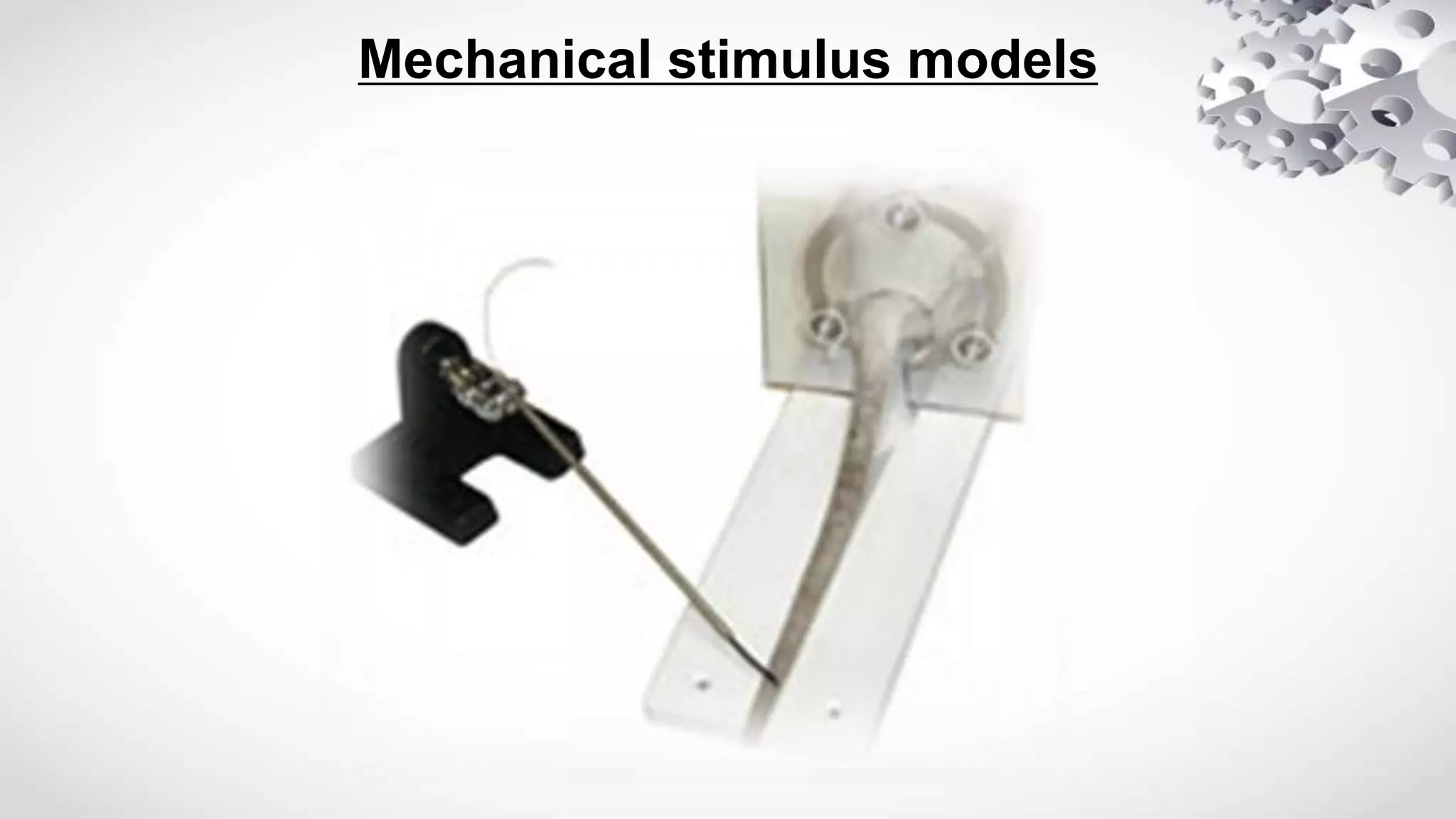
Mechanical stimulus models
Tail-clip method:
1. Noxious stimulus by using artery clip placed at the
root of tail.
2. Response- biting the clip/tail.
3. Reaction time is noted.
4. Cut off time- average reaction time plus 3 times
the sd of the combined latencies of the control mice
at all time period.
Mechanical stimulus models
Conclusion
No model is ideal, except chemical stimulus model,
most closely mimicking acute clinical pain.
Neuropathic pain, very difficult to design the ideal
model both for the technical and ethical reasons.
But still, animal models are very important to assess
the analgesic activity of drugs.
Continued search should be maintained to find out
novel drug targets & to develop ideal animal model for
their assessment.
What are the differences between working
of analgesics?
• Analgesics differ in the way they work and, in their
potency, (how strong they are). There are also differences
in the way they are absorbed, distributed, metabolized
and excreted within the body.
• Within the same class of analgesic (for example NSAIDs)
there are differences in their likelihood for side effects,
potency, and the way they need to be taken (for
example, by mouth, applied topically, by injection).
Are analgesics safe?
No drug is completely safe, taking over-the-counter painkillers daily for
aches and pains is not recommended use. ... Research has shown that about
a third of Americans admit to taking more than the recommended dose of
over-the-counter pain meds, thinking that doing so will increase their
effectivenessTypically, adverse side effects are tied to the long-
term use of the drug but not always—short-term use of many drugs can also
be problematic for some patients such as
• Short-term use of naproxen or other NSAIDs can cause stomach ulcers and bleedings.
• Long-term use of ibuprofen can increase the risk for heart attack, stroke and ulcers. It can
also increase the risk of bleeding in the stomach.
• Paracetamol overdoses represent 20 per cent of liver transplants across Europe, but rise
to 52 per cent in Ireland and 28 per cent in the UK, dropping to 1 per cent in Italy.
• C. Fookes,drug-class Analgesics,BPharm. 2018
• C Eustice,Treating Arthritis With Naproxen, Medical
Review Board.2019
• Anonymous,researchers shed new light on how
paracetamol causes liver damage,british liver trust.2017
• S Chakrabarty, Evaluation of analgesic agents
,Department of Pharmacology B.S. Medical College.2016

Anlalgesic activity and its classification

  • 1.
    IN THE NAMEOF ALLAH, THE BENIFICIENT THE MERCIFUL Presented to Dr. Sammiya Shahid Presented by KOMAL AROOSH Roll no :- S2019140032 Session:- 2019-2021 Analgesic Activity
  • 2.
    Contents • What areanalgesics? • Classification of analgesics • What are analgesics used for? • How does analgesics work in the body? • What are differences between analgesics? • Mechanism of action of Paracetamol • How to check analgesic activity of plants and herbs? • What are the difference between the working of analgesics? • Are analgesic safe?
  • 3.
    What are Analgesics? Theterm “Analgesic” is derived from two Greek words – (1) an ("without") and (2) algos ("pain"). Analgesics are medicines that are used to relieve pain. They are also known as painkillers or pain relievers. Technically, the term analgesic refers to a medication that provides relief from pain without putting you to sleep or making you lose consciousness.
  • 4.
  • 5.
    What are analgesicsused for? Analgesics may be taken to relieve pain that arises from a wide range of conditions, such as: Appendicitis ,cancer, congenital conditions such as curvature of the spine,surgery ,trauma,toothache,nurve damges infections,wound cleansing and debridement.
  • 6.
    How Does anAnalgesic Work in the body? 1. Opioids reduce the pain signals sent by the nervous system and the brain's reaction to those pain signals. 2. Tylenol works by changing the way the body senses pain. 3. NSAIDs block the effects of prostaglandins (chemicals in the body with hormone-like qualities), reducing both pain and swelling.
  • 9.
    How to checkanalgesic activity in plants and herbs? Analgesic activity in plants and herbs can be checked by the following methods/models- • Hot plate method • Tail flick method • Tail immersion method • Electric stimulus models • Chemical Stimulus models • Mechanical stimulus models
  • 10.
    Hot plate method 1.Mice weighing 18-22g are used. 2. Standard or test drug given orally/ sc 3. Animals placed on hot plate(55-56°C.) 4. Response- jumping/paw withdrawal/ licking of paws. 5. Latency period is measured after 20, 60 & 90 min. 6. Those increasing the latency period at least 50% are taken positive. 7. ED-50 values are calculated. Drawback- not for peripheral analgesics. False positive results with sedative/ muscle relaxants/ psychotomimetic.
  • 12.
    Tail flick test Useof light beam exerting radiant heat, focused to proximal 1/3rd of the tail. Nociceptive spinal reflex response- flicking tail away from heat source. Escape reaction- turning the head away.(more reliable) Latency period is compared. Minimal inter animal variation.
  • 13.
  • 14.
    Tail immersion method Youngfemale Wister rats(170-210 g). Placed in cages with tail hanging out freely. Distal 5 cm tail is immersed (max 15 sec) in a cup of warm water(55°C) Tail withdrawal reflex is seen Recording done after ½ , 1,2,3,4 and 6 hours. latency period ˃6s is taken as positive. Modifications- cold mixture of water & ethylene glycol at -10°C./ cold ethanol at -20°C.
  • 15.
  • 16.
    Electric stimulus models Toothpulp test- 1. Rabbits(2-3kg) are anaesthetized with thiopental at 15 mg/kg i.v. 2. Clamping electrodes are placed into tooth pulp chamber through drilled holes. 3. After 30 min, stimulus given by rectangular current(50 Hz) upto 1 sec 4. Animals starts licking- current threshold is measured. Modification: stimulus given via subcutaneous electrodes at the tail Monkey shock titration test: shock given via Coulbourn Instrument Programmable shocker at tail
  • 17.
  • 18.
    Chemical stimulus models Anirritant/ algogenic chemical agent given as nociceptive stimulus Slower mode of stimulation.- progressive & persisting for longer duration Both for central & peripheral analgesics Formalin test- o 10% formalin injected at paw. o Biphasic response Early: immediately due to chemical stimulation of nociceptors causing C-fibre activation Late: after 10-15 min due to combination of an inflammatory reaction and functional changes at dorsal horn of spinal cord. Opioid effective in both phase, but NSAIDs are effective in only second phase.
  • 19.
  • 20.
    Mechanical stimulus models Tail-clipmethod: 1. Noxious stimulus by using artery clip placed at the root of tail. 2. Response- biting the clip/tail. 3. Reaction time is noted. 4. Cut off time- average reaction time plus 3 times the sd of the combined latencies of the control mice at all time period.
  • 21.
  • 22.
    Conclusion No model isideal, except chemical stimulus model, most closely mimicking acute clinical pain. Neuropathic pain, very difficult to design the ideal model both for the technical and ethical reasons. But still, animal models are very important to assess the analgesic activity of drugs. Continued search should be maintained to find out novel drug targets & to develop ideal animal model for their assessment.
  • 23.
    What are thedifferences between working of analgesics? • Analgesics differ in the way they work and, in their potency, (how strong they are). There are also differences in the way they are absorbed, distributed, metabolized and excreted within the body. • Within the same class of analgesic (for example NSAIDs) there are differences in their likelihood for side effects, potency, and the way they need to be taken (for example, by mouth, applied topically, by injection).
  • 24.
    Are analgesics safe? Nodrug is completely safe, taking over-the-counter painkillers daily for aches and pains is not recommended use. ... Research has shown that about a third of Americans admit to taking more than the recommended dose of over-the-counter pain meds, thinking that doing so will increase their effectivenessTypically, adverse side effects are tied to the long- term use of the drug but not always—short-term use of many drugs can also be problematic for some patients such as • Short-term use of naproxen or other NSAIDs can cause stomach ulcers and bleedings. • Long-term use of ibuprofen can increase the risk for heart attack, stroke and ulcers. It can also increase the risk of bleeding in the stomach. • Paracetamol overdoses represent 20 per cent of liver transplants across Europe, but rise to 52 per cent in Ireland and 28 per cent in the UK, dropping to 1 per cent in Italy.
  • 25.
    • C. Fookes,drug-classAnalgesics,BPharm. 2018 • C Eustice,Treating Arthritis With Naproxen, Medical Review Board.2019 • Anonymous,researchers shed new light on how paracetamol causes liver damage,british liver trust.2017 • S Chakrabarty, Evaluation of analgesic agents ,Department of Pharmacology B.S. Medical College.2016