ANTIPYRETIC DRUGS
                CLINICAL PHARMACOLOGY I
                        MFK 1213
              DIPLOMA IN MEDICAL ASSISTANT
             UNIVERSITY COLLEGE SHAHPUTRA


PRESENTED BY:
SITI FAATIN FAZIRAH BINTI ROSLAN             | SP50512008
MUHAMAD HAFIZ BIN ROSLI                      | SP50512004
MUHAMMAD AIMAN SYAZWAN BIN RUSLANI           | SP50512012
OBJECTIVE OUTILNE
 Definition NSAIDs
 Groups of NSAIDs
 Definition of Antipyretic Drugs
 Pharmacokinetic of Drugs
 Mechanism of Action
 Drugs for Antipyretic
 Adverse Effect
 Management of Drugs Toxicity
 Patient Eduction
DEFINITION OF NSAIDS


 ‘NSAIDs is any one of a large group of drugs
   used for pain relief, particularly in rheumatic
    disease associated with inflammation but
   also in dysmenorrhoea and metastatic bone
                      disease’.
 8th Edition 2010, Oxford University Press, Oxford Concise Colour Medical Dictionary, Page
                                                                                       506
GROUP OF NSAIDS


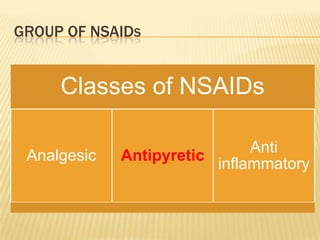
     Classes of NSAIDs

                              Anti
 Analgesic   Antipyretic
                         inflammatory
DEFINITION OF ANTIPYRETIC


     ‘A drug that reduces fever by
    lowering the body temperature’.
8th Edition 2010, Oxford University Press, Oxford Concise Colour Medical Dictionary, Page 43


Some analgesic drugs have antipyretic activity.
PHARMACOKINETICS OF DRUGS

 Absorption : stomach, intestinal mucosa
 Distribution: blood plasma

 Metabolism: liver

 Excretion: in urine, bile
MECHANISM OF ACTION
Activities of antipyretic:
 Used to treat fever.
 Inhibits the enzyme COX.
 Fever  release of endogenous pyrogens
  (e.g., interleukin-1) released from leucocytes  acts
  directly on the thermoregulatory centers in
  hypothalamus  increase body T°.
 This is assoc with increase in brain PGs (pyrogenic).
 Aspirin prevents the T°-rising effects of interleukin-1
  by preventing the increase in brain PGs.
DRUGS FOR ANTIPYRETIC

 Aspirin
 Paracetamol / Acetaminophen
ASPIRIN
 Indication: mild to moderate pain
 Contraindication: gastric and duodenal
  ulcer, hemorrhagic diathesis, hypersensitivity to
  aspirin or other NSAIDs, children under 12 y/o.
  hypersensitivity (attacks to
  asthma, angioedema, urticaria or rhinitis;
  pregnancy (third trimester); PT with hemophilia
  or hemorrhagic disorder; gout; severe renal or
  hepatic impairment; lactation
 Action: antiplatelet, antirheumatic, antipyretic.
 Dosage: 300 – 900 mg 4-6 hours. Max. 4 g
  daily. Children not recommended.
ASPIRIN CONT..
   Adverse effect: gastric
    hemorrhage, hypersensitivity, trombocytopenia, GI
    disturbance, prolong bleeding
    time, rhinitis, urticaria, epigastric
    discomfort, angioedema, salicylism, tinnitus, broncho
    spasm
   Interaction: Acetazolamide, Dipyridamol; salicylate
    toxicity (vomiting, tachycardia, hyperpnea, mental
    confusion) or acetazolamide toxicity
    (fatigue, lethargy, somnolence, confusion, hyperchlor
    emic metabolic acidosis) Alentronate: GI
    stress, antacids, calcium, alcohol, cortocosteroids, ph
    enylbutazone, and oxyphenbutazone may increase
    risk of GI ulceration. Aspirin increases phenytoin
    levels. May antagonize actions of uricosurics and
PARACETAMOL / ACETAMINOPHEN

 PARACETAMOL 120 mg/5 ml Syrup
 Indications : Mild to moderate pain and
  pyrexia.
 Dosage : Child :
  up to 1 year : 60 – 120 mg.
  1 – 5 years : 120 – 240 mg.
  6 – 12 years. 240 – 480 mg per dose.
  Repeat every 4 – 6 hours when necessary.
  Maximum of 4 doses in 24 hours.
PARACETAMOL / ACETAMINOPHEN CONT…

 Contraindications : Nephropathy.
 Precautions : Renal and hepatic failure.
  Avoid chronic use.
 Interactions : Anticoagulants, alcohol, liver
  enzyme inducers, aspirin, chloramphenicol
  and phenobarbitone.
 Adverse Reactions : Allergic reactions, skin
  rash.
PARACETAMOL / ACETAMINOPHEN CONT…
   Indications : Symptomatic relief of fever and
    post operative pain for pediatric cases.

 PARACETAMOL 125 – 250 mg Suppository
 Dosage : Child 1 – 5 years : 125 – 250 mg. 6 –
  12 years : 250 – 500 mg. 3 – 11 month : 80 mg
  inserted every 4 – 6 hours if necessary.
  Maximum 4 doses in 24 hours. Infants : under 3
  month should not be given paracetamol unless
  advised by doctor; a dose of 10 mg/kg (5 mg/kg
  if jaundice) is suitable.
PARACETAMOL / ACETAMINOPHEN CONT…

 Paracetamol 500 mg tablet
 Dosage: adult; 500-1000mg every 4-6
  hours, max. of 4 g daily.
GENERAL ADVERSE EFFECT
   CNS: headache, tinnitus, dizziness
   CVS: fluid retention hypertension, edema, CHF (rarely)
   GI: abdominal pain, dysplasia, nausea, vomiting, ulcer or
    bleeding (rarely)
   Hematologic: rare thrombocytopenia, neutropenia, or
    even aplastic anemia
   Hepatic: abnormal liver function test and rare liver failure
   Pulmonary: asthma
   Rashes: all types pruritus
   Renal: renal insufficiency, renal failure, hyperkalemia, and
    proteinuria
MANAGEMENT OF DRUGS TOXICITY

 Gastric lavage
 Peritoneal dialysis

 Activated charcoal

 Hemodialysis

 Intramuscular vit. K

 Antidote

 IV fluid and electrolyte supplements
PATIENT EDUCATION

 Follow the instruction by doctor
 Inform the dentist if the patient take aspirin

 Patient with renal failure should notify the
  doctor
 Explain to the patient about the effect of
  drugs
 Avoid drugs overdose

Antipyretic drugs

  • 1.
    ANTIPYRETIC DRUGS CLINICAL PHARMACOLOGY I MFK 1213 DIPLOMA IN MEDICAL ASSISTANT UNIVERSITY COLLEGE SHAHPUTRA PRESENTED BY: SITI FAATIN FAZIRAH BINTI ROSLAN | SP50512008 MUHAMAD HAFIZ BIN ROSLI | SP50512004 MUHAMMAD AIMAN SYAZWAN BIN RUSLANI | SP50512012
  • 2.
    OBJECTIVE OUTILNE  DefinitionNSAIDs  Groups of NSAIDs  Definition of Antipyretic Drugs  Pharmacokinetic of Drugs  Mechanism of Action  Drugs for Antipyretic  Adverse Effect  Management of Drugs Toxicity  Patient Eduction
  • 3.
    DEFINITION OF NSAIDS ‘NSAIDs is any one of a large group of drugs used for pain relief, particularly in rheumatic disease associated with inflammation but also in dysmenorrhoea and metastatic bone disease’. 8th Edition 2010, Oxford University Press, Oxford Concise Colour Medical Dictionary, Page 506
  • 4.
    GROUP OF NSAIDS Classes of NSAIDs Anti Analgesic Antipyretic inflammatory
  • 5.
    DEFINITION OF ANTIPYRETIC ‘A drug that reduces fever by lowering the body temperature’. 8th Edition 2010, Oxford University Press, Oxford Concise Colour Medical Dictionary, Page 43 Some analgesic drugs have antipyretic activity.
  • 6.
    PHARMACOKINETICS OF DRUGS Absorption : stomach, intestinal mucosa  Distribution: blood plasma  Metabolism: liver  Excretion: in urine, bile
  • 7.
    MECHANISM OF ACTION Activitiesof antipyretic:  Used to treat fever.  Inhibits the enzyme COX.  Fever  release of endogenous pyrogens (e.g., interleukin-1) released from leucocytes  acts directly on the thermoregulatory centers in hypothalamus  increase body T°.  This is assoc with increase in brain PGs (pyrogenic).  Aspirin prevents the T°-rising effects of interleukin-1 by preventing the increase in brain PGs.
  • 8.
    DRUGS FOR ANTIPYRETIC Aspirin  Paracetamol / Acetaminophen
  • 9.
    ASPIRIN  Indication: mildto moderate pain  Contraindication: gastric and duodenal ulcer, hemorrhagic diathesis, hypersensitivity to aspirin or other NSAIDs, children under 12 y/o. hypersensitivity (attacks to asthma, angioedema, urticaria or rhinitis; pregnancy (third trimester); PT with hemophilia or hemorrhagic disorder; gout; severe renal or hepatic impairment; lactation  Action: antiplatelet, antirheumatic, antipyretic.  Dosage: 300 – 900 mg 4-6 hours. Max. 4 g daily. Children not recommended.
  • 10.
    ASPIRIN CONT..  Adverse effect: gastric hemorrhage, hypersensitivity, trombocytopenia, GI disturbance, prolong bleeding time, rhinitis, urticaria, epigastric discomfort, angioedema, salicylism, tinnitus, broncho spasm  Interaction: Acetazolamide, Dipyridamol; salicylate toxicity (vomiting, tachycardia, hyperpnea, mental confusion) or acetazolamide toxicity (fatigue, lethargy, somnolence, confusion, hyperchlor emic metabolic acidosis) Alentronate: GI stress, antacids, calcium, alcohol, cortocosteroids, ph enylbutazone, and oxyphenbutazone may increase risk of GI ulceration. Aspirin increases phenytoin levels. May antagonize actions of uricosurics and
  • 11.
    PARACETAMOL / ACETAMINOPHEN PARACETAMOL 120 mg/5 ml Syrup  Indications : Mild to moderate pain and pyrexia.  Dosage : Child : up to 1 year : 60 – 120 mg. 1 – 5 years : 120 – 240 mg. 6 – 12 years. 240 – 480 mg per dose. Repeat every 4 – 6 hours when necessary. Maximum of 4 doses in 24 hours.
  • 12.
    PARACETAMOL / ACETAMINOPHENCONT…  Contraindications : Nephropathy.  Precautions : Renal and hepatic failure. Avoid chronic use.  Interactions : Anticoagulants, alcohol, liver enzyme inducers, aspirin, chloramphenicol and phenobarbitone.  Adverse Reactions : Allergic reactions, skin rash.
  • 13.
    PARACETAMOL / ACETAMINOPHENCONT…  Indications : Symptomatic relief of fever and post operative pain for pediatric cases.  PARACETAMOL 125 – 250 mg Suppository  Dosage : Child 1 – 5 years : 125 – 250 mg. 6 – 12 years : 250 – 500 mg. 3 – 11 month : 80 mg inserted every 4 – 6 hours if necessary. Maximum 4 doses in 24 hours. Infants : under 3 month should not be given paracetamol unless advised by doctor; a dose of 10 mg/kg (5 mg/kg if jaundice) is suitable.
  • 14.
    PARACETAMOL / ACETAMINOPHENCONT…  Paracetamol 500 mg tablet  Dosage: adult; 500-1000mg every 4-6 hours, max. of 4 g daily.
  • 15.
    GENERAL ADVERSE EFFECT  CNS: headache, tinnitus, dizziness  CVS: fluid retention hypertension, edema, CHF (rarely)  GI: abdominal pain, dysplasia, nausea, vomiting, ulcer or bleeding (rarely)  Hematologic: rare thrombocytopenia, neutropenia, or even aplastic anemia  Hepatic: abnormal liver function test and rare liver failure  Pulmonary: asthma  Rashes: all types pruritus  Renal: renal insufficiency, renal failure, hyperkalemia, and proteinuria
  • 16.
    MANAGEMENT OF DRUGSTOXICITY  Gastric lavage  Peritoneal dialysis  Activated charcoal  Hemodialysis  Intramuscular vit. K  Antidote  IV fluid and electrolyte supplements
  • 17.
    PATIENT EDUCATION  Followthe instruction by doctor  Inform the dentist if the patient take aspirin  Patient with renal failure should notify the doctor  Explain to the patient about the effect of drugs  Avoid drugs overdose

Editor's Notes

  • #4 Dysmenorrhoea – menstrual pain
  • #6 Some analgesic drugs have antipyretic activity which are aspirin and paracetemol.
  • #8 COX – cyclooxygenase is responsible for formation of important biological mediators called prostanoids, including prostaglandins, prostacyclin and thromboxane.Pharmacological inhibition of COX can provide relief from the symptoms of inflammation and pain.